


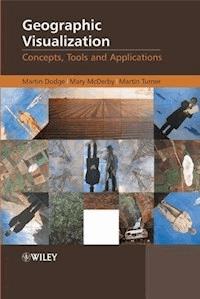
Geographic Visualization E-Book
96,99 €
Mehr erfahren.
- Herausgeber: John Wiley & Sons
- Kategorie: Wissenschaft und neue Technologien
- Sprache: Englisch
Geographic Visualization: Concepts, Tools and Applications is a 'state-of-the-art' review of the latest developments in the subject. It examines how new concepts, methods and tools can be creatively applied to solve problems relevant to a wide range of topics. The text covers the impact of three-dimensional displays on user interaction along with the potentialities in animation and clearly explains how to create temporally sensitive visualizations. It also explores the potential for handling mobile data and representing uncertainty; as well as the role of participatory visualization systems and exploratory methods. Hallmark Features: * An introduction to the diverse forms of geographic visualization which draws upon a number of theoretical perspectives and disciplines to provide an insightful commentary on new methods, techniques and tools. * Richly illustrated in full colour throughout, including numerous relevant case studies and accessible discussions of important visualization concepts to enable clearer understanding for non-technical audiences. * Chapters are written by leading scholars and researchers in a range of cognate fields, including, cartography, GIScience, architecture, art, urban planning and computer graphics with case studies drawn from Europe, North America and Australia This book is an invaluable resource for all graduate students, researchers and professionals working in the geographic information sector, computer graphics and cartography.
Sie lesen das E-Book in den Legimi-Apps auf:
Seitenzahl: 636
Veröffentlichungsjahr: 2011
Ähnliche




















Contents
Foreword
Acknowledgements
Authors’ Biographies
1 The Power of Geographical VisualizationsMartin Dodge, Mary McDerby and Martin Turner
1.1 Aims
1.2 The nature of geographic visualization
1.3 The visualization process
1.4 Digital transition and geographic visualization
1.5 The politics of visualization
1.6 The utility of geographic visualization
1.7 Conclusions
References
2 What does Google Earth Mean for the Social Sciences?Michael F. Goodchild
2.1 Introduction
2.2 Major features of Google Earth
2.3 Fundamental spatial concepts
2.4 The social perspective
2.5 Research challenges
2.6 Conclusions
References
3 Coordinated Multiple Views for Exploratory GeoVisualizationJonathan C. Roberts
3.1 Introduction
3.2 Data preparation
3.3 Informative visualizations
3.4 Interaction and manipulation
3.5 Tools and toolkits
3.6 Conclusions
References
4 The Role of Map Animation for Geographic VisualizationMark Harrower and Sara Fabrikant
4.1 Introduction
4.2 Types of time
4.3 The nature of animated maps
4.4 Potential pitfalls of map animation
4.5 Conclusions
References
5 Telling an Old Story with New MapsAnna Barford and Danny Dorling
5.1 Introduction: re-visualizing our world
5.2 Method and content
5.3 The champagne glass of income distribution
References
6 Re-visiting the Use of Surrogate Walks for Exploring Local Geographies Using Non-immersive MultimediaWilliam Cartwright
6.1 Introduction
6.2 Queenscliff Video Atlas
6.3 GeoExploratorium
6.4 Townsville GeoKnowledge Project
6.5 Jewell Area prototype
6.6 Melbourne Historical Buildings Demonstration Product
6.7 Testing the user’s perception of space and place
6.8 Further development work
6.9 Conclusion
Acknowledgements
References
7 Visualization with High-resolution Aerial Photography in Planning-related Property ResearchScott Orford
7.1 Introduction
7.2 Applications of aerial photography in planning-related property research
7.3 Aerial photography, property and surveillance
7.4 Conclusion
References
8 Towards High-resolution Self-organizing Maps of Geographic FeaturesAndré Skupin and Aude Esperbé
8.1 Introduction
8.2 Self-organizing maps
8.3 High-resolution SOM
8.4 High-resolution SOM for Climate Attributes
8.5 Summary and outlook
Acknowledgements
References
9 The Visual CityAndy Hudson-Smith
9.1 The development of digital space
9.2 Creating place and space
9.3 Visual cities and the visual Earth
9.4 The development of virtual social space
9.5 The future: the personal city
References
10 Travails in the Third Dimension: A Critical Evaluation of Three-dimensional Geographical VisualizationIfan D. H. Shepherd
10.1 Introduction
10.2 What is gained by going from 2D to 3D?
10.3 Some problems with 3D views
10.4 Conclusions
Acknowledgements
References
11 Experiences of Using State of the Art Immersive Technologies for Geographic VisualizationMartin Turner and Mary McDerby
11.1 Introduction
11.2 The human visual system
11.3 Constructing large-scale visualization systems
11.4 Rules and recommendations
11.5 The future – a better and cheaper place
References
12 Landscape Visualization: Science and ArtGary Priestnall and Derek Hampson
12.1 Landscape visualization: contexts of use
12.2 The need for ground truth
12.3 Outcomes from fieldwork exercises
12.4 Broadening the context
12.5 The Chat Moss case study
12.6 Discussion
12.7 Conclusion
Acknowledgements
References
13 Visualization, Data Sharing and MetadataHumphrey Southall
13.1 Introduction
13.2 The data documentation initiative and the aggregate data extension
13.3 Implementing the DDI within the GB Historical GIS
13.4 Driving visualization in Vision of Britain
13.5 Conclusion
Acknowledgements
References
14 Making Uncertainty Usable: Approaches for Visualizing Uncertainty InformationStephanie Deitrick and Robert Edsall
14.1 Introduction: the need for representations of uncertainty
14.2 The complexity of uncertainty
14.3 Uncertainty visualization: a user-centred research agenda
14.4 Conclusion
References
15 Geovisualization and Time – New Opportunities for the Space–Time CubeMenno-Jan Kraak
15.1 Introduction
15.2 Hägerstrand’s time geography and the space–time cube
15.3 Basics of the space–time cube
15.4 The space–time cube at work
15.5 Discussion
References
16 Visualizing Data Gathered by Mobile PhonesMichael A. E. Wright, Leif Oppermann and Mauricio Capra
16.1 Introduction
16.2 What are we visualizing?
16.3 How can we visualize this data?
16.4 Case studies
16.5 Discussion
16.6 Conclusion
References
Index
Copyright © 2008 John Wiley & Sons Ltd, The Atrium, Southern Gate, Chichester,
West Sussex PO19 8SQ, England
Telephone (+44) 1243 779777
Email (for orders and customer service enquiries): [email protected]
Visit our Home Page on www.wileyeurope.com or www.wiley.com
All Rights Reserved. No part of this publication may be reproduced, stored in a retrieval system or transmitted in any form or by any means, electronic, mechanical, photocopying, recording, scanning or otherwise, except under the terms of the Copyright, Designs and Patents Act 1988 or under the terms of a licence issued by the Copyright Licensing Agency Ltd, 90 Tottenham Court Road, London W1T 4LP, UK, without the permission in writing of the Publisher. Requests to the Publisher should be addressed to the Permissions Department, John Wiley & Sons Ltd, The Atrium, Southern Gate, Chichester, West Sussex PO19 8SQ, England, or emailed to [email protected], or faxed to (+44) 1243 770620.
Designations used by companies to distinguish their products are often claimed as trademarks. All brand names and product names used in this book are trade names, service marks, trademarks or registered trademarks of their respective owners. The Publisher is not associated with any product or vendor mentioned in this book.
This publication is designed to provide accurate and authoritative information in regard to the subject matter covered. It is sold on the understanding that the Publisher is not engaged in rendering professional services. If professional advice or other expert assistance is required, the services of a competent professional should be sought.
Other Wiley Editorial Offices
John Wiley & Sons Inc., 111 River Street, Hoboken, NJ 07030, USA
Jossey-Bass, 989 Market Street, San Francisco, CA 94103–1741, USA
Wiley-VCH Verlag GmbH, Boschstr. 12, D-69469 Weinheim, Germany
John Wiley & Sons Australia Ltd, 33 Park Road, Milton, Queensland 4064, Australia
John Wiley & Sons (Asia) Pte Ltd, 2 Clementi Loop #02-01, Jin Xing Distripark, Singapore 129809
John Wiley & Sons Canada Ltd, 6045 Freemont Blvd, Mississauga, Ontario, L5R 4J3
Wiley also publishes its books in a variety of electronic formats. Some content that appears in print may not be available in electronic books.
Library of Congress Cataloging-in-Publication Data
Geographic visualization: concepts, tools and applications / edited by Martin Dodge,
Mary McDerby and Martin Turner.
p. cm.
Includes bibliographical references and index.
ISBN 978-0-470-51511-2 (cloth)
1. Geography–Computer network resources. 2. Visualization.
3. Geographic information systems. I. Dodge, Martin, 1971– II. McDerby, Mary.
III. Turner, Martin (Martin John Turner), 1968–
G70.212.G463 2008
910.285–dc22
2008004951
British Library Cataloguing in Publication Data
A catalogue record for this book is available from the British Library
ISBN 978-0-470-51511-2
Martin Dodge dedicates this book to Maggie
Mary McDerby dedicates this book to her mother
Margaret Murray (1944–2006)
Foreword
Encounters with (Geo) Visualization
David J. Unwin
Emeritus Chair in Geography, Birkbeck College, University of London and Visiting Chair in Geomatic Engineering, University College, University of London
This volume presents essays that collectively give an overview of the current state of the art in what has become to be known as ‘geovisualization’, the exploratory analysis by graphics of data in which their spatial location is used as an important and necessary part of the analysis. In this forword I examine the scientific, geographical and administrative contexts in which geovisualization has developed in UK, concluding with a series of concerns related to where it is now heading.
Contexts: scientific
The scientific background to visualization is both well known and well documented. Traditionally in science, graphical modelling is subservient to mathematical and even statistical analysis: although colloquially we might ‘see’ a result, invariably the preferred form of analysis is by mathematics or statistics. This started to change in the 1960s with the increasing use of computers to draw pictures for which a variety of stand-alone computer programs with names like GHOST, GINO and PICASSO were developed. However, it took a series of other necessary changes before arguments based on graphics became accepted, if not on equal terms with mathematical and statistical modelling, at least as part of the basic toolkit of scientific investigation.
First, throughout the sciences developments in sensor technology and automated data capture now provide data at rates faster than can easilybe converted into knowledge. Second, some of the most exciting discoveries have been associated with non-linear dynamics where apparently simple equations like the finite difference form of the logistic conceal enormously complex, but real-world-like, behaviour that can only be appreciated when displayed graphically. Third, as science has progressed to produce ever more complex simulation models, so it became necessary to use graphics as the only practicable way to assimilate all the model outputs. Particularly relevant examples include the complex, large-scale environmental simulations provided by atmospheric general circulation models used in the verification of the carbon dioxide-induced greenhouse warming hypothesis and complex social simulations of the spatial behaviour of whole populations based on models of individual behaviour. Finally, there have been enormous changes in our computing environment, all of which promote graphics as the major communication medium. It is easy to forget how far we have come. Even as late as the 1980s, colour displays were expensive luxuries needing substantial computer power to drive them, most hard copy was by way of monochrome pen plotters, and software was still in the form of subroutine libraries such as GINO, GHOST and GKS or in visualization systems such as IBM Explorer, AVS and PV-WAVE. If you wanted to use a computer to draw maps, chances were that you were in for a difficult and expensive time. For example, in 1980 the Census Research Unit at Durham University published an atlas of maps of the 1971 UK Census of Population (Census Research Unit, 1980), which used the then-new laser printing technology to produce, at great difficulty and expense, maps with individual colour symbolism for each and every kilometre grid square over Britain. At the time, these were the most detailed population maps at this scale and resolution ever produced.
As our computing norm we now have ‘point and click’ graphic interfaces to very large and fast machines equipped with high screen and spectral resolution displays and, thanks to the World Wide Web, graphical communication has become easier and easier. Nowadays, if you want to draw a map, a few mouse clicks using some cheap and easy to use software is all that are required. If you want to explore the map content using visual methods, then the same software will provide all the necessary resolution, colour, linkage back to the data, and so on, that are required. Provided you have the data, high spatial resolution population maps of UK are relatively easy to create on the desktop with standard hardware. In this new environment, the software can take the role of a toolkit to enable the scientist to create data displays that enable the exploratory development and testing of ideas that may later form the basis of more formal hypotheses and mathematical models.
Contexts: geographical
The geographical context is perhaps a little less well-known, but given the general changes outlined above, it was inevitable that some cartographers would ‘morph’ into ‘geovisualizers’ and that the two traditions of cartography and scientific visualization using computer graphics would intersect to give what has become known as geovisualization. This union has taken place alongside the increasing use of ‘location’ in almost all walks of life and the increasingly widespread availability and use of geographical information systems software. A brief visit to almost any GIS trade exhibition, or, more to the point, a look at the ‘map gallery’ at the annual ESRI San Diego User Conference (www.esri.com/events/uc/results/map_gallery_results.xhtml), will show that maps continue to be not only the main selling point for GIS and associated data products, but also are one of the principal outputs from such systems. One result of the democratization of mapping, in which every map user can also now become the cartographers, has been a huge increase in the use of maps. Sometimes, as at the ESRI conferences, these are fine examples of the art and science of cartography, but all too often the products show ignorance of quite basic cartographic design, and miss the potentials available had these same data been analysed using modern geovisualization techniques.
It is certainly true that spatial coordinates can be treated simply as just two additional variables added to an existing set to be visualized. From this perspective there is nothing particularly special about adding geographical space. Yet experience suggests that, although the techniques used might look much the same as those used in more general scientific visualization, there is actually something that is special about ‘geo’. In part this is to do with the ubiquitous presence in the real world of spatial autocorrelation, but I suspect it is also to do with what for want of a better word I call ‘context’. Consider the very simple set of 24 numbers located geographically by the eastings and northings of some geographical grid shown below. These data can be analysed as a simple problem in general scientific visualization by interpolation of a continuous surface passing through them. However, if I provide you with the context that these numbers are mean January temperatures across the Rocky Mountain foothills in Alberta, I strongly suspect that you will realize that your initial analysis is faulty. Adding the real world context provided by spatial location adds much more than just two or more additional columns of data, and I am not sure the same would be said, for example, if these numbers had been the rate of a chemical reaction visualized in a space provided by temperature and pressure coordinates.
Figure F.1 Some numbers to be visualized?
Generations of cartographers have accumulated a great deal of knowledge of how these real world contexts can be addressed in their mappings, of what ‘works’ and what does not ‘work’. Just because this knowledge has resisted formalization is no reason to ignore it. There is a continuing educational agenda here, in coupling those who have only recently discovered how useful maps can be to the community of cartographer/geovisualizers whose work is reported here and to the accumulated cartographic knowledge they bring into their work.
Contexts: organizational
This volume has a direct ancestral link back to a similar workshop sponsored by the (UK) Association for Geographic Information’s Education and Research Committee and organized by the ESRC Midlands Regional Research Laboratory in Loughborough in 1992. The result then was an edited book which took the workshop title Visualization in Geographical Information Systems (Hearnshaw and Unwin, 1994; see also Unwin, 1994). In turn this spawned two further workshops on Visualization in the Social Sciences (1997, reported at www.agocg.ac.uk) and Virtual Reality in Geography (Fisher and Unwin, 2002). The second and third workshops were sponsored by a group set up by the UK academic research councils as their Advisory Group on Computer Graphics (AGOCG), a body I had been invited to join some time in the early 1980s as a representative of some hypothetical ‘typical user’ of graphic output from computers. As a geographer with a strong interest in cartography, sitting at meetings of this group was very instructive. First, as perhaps might have been expected, working with people very much at the cutting-edge of scientific research in computer graphics in UK, I became aware of the possibilities for cartography inherent in the newly developed and developing technology (see Brodlie et al., 1992). Second, what perhaps was not so expected was the realization of the potential that cartography had to offer scientific visualization in areas such as what, for want of a better word, I will call the theory of graphics and graphical understanding, the use and perception of colour in graphics, symbology and so on. In the computer graphics community, the various works of Tufte were some sort of gospel and the work was conducted in almost complete ignorance of over a century of accumulated experience in the mapping and display of thematic spatial data. Much as I admire the spirit in which they were produced, the various books by Tufte are neither the only nor the last, word in graphical excellence. Dogmatic and essentially pre-computer he may be, but at the time even Bertin (1967, 1981) had much to offer this community (see Muller, 1981).
But … what questions remain?
Reading the contributions to this volume makes it clear that much of what in the 1990s seemed to be at the cutting edge, such as the use of visually realistic displays, density estimation to visualize point patterns, area cartograms, linking and brushing, and map animation, have become commonplace. First and foremost, this volume reports immense progress in the further harnessing of the available technology to facilitate the visualization of geographic data. However, what I think stands out plainly from a comparison with the outputs from the history I have outlined is just how enduring some of the underlying themes have become. Examples in no special order include the balance between photo-realism and cartographic generalization in virtual reality, animation, projection (cartograms), conveying error/uncertainty graphically and temporal change. I suspect that there is more to this than at first meets the eye and that it is symptomatic of maybe three underlying problems in geovisualization.
The first concerns the interplay between the data that are being visualized, their geographical context and the technology used. Given that we have a research need to use visualization to generate, test and present ideas about some geographic data, three basic strategies might be recognized. The first is the geovisualization route, to provide affordances that enable interactive exploration of these data using object linking, brushing, and so on, but, by and large, leaving the data intact. The second is the spatial analytical route, to modify the numbers to be mapped by some form of arithmetic manipulation, for example by conversion into density estimates, probabilities against some hypothesized process or the derivation of ‘local’ statistics to isolate areas of specific research interest. The third, and least commonly adopted, is what I chose to call Tobler’s way, which is to re-project these same data into a space, such as an area cartogram, in which some notion of geographic reality is better evident. For a ludicrously early and perceptive example of this see Tobler (1963).
Currently, work seems to be channelled down one or other of these three routes, yet it should be clear that most progress is likely to be made by combining them. The recent paper by Mennis (2006) provides an example of careful visualization of the results of the local statistical operation known as geographically weighted regression. Similarly, a classical spatial analytical tool, the Moran ‘scatterplot’ (Anselin, 1996), seldom makes much sense unless it is object-linked back to a choropleth map of the individual values. Doubtless the reader can provide other examples.
My second issue is that, despite the best efforts of some cartographers and members of the geographic information science community, as yet we seem to have little by way of ‘well found’ theory to enable us to answer basic visualization questions such as ‘what works?’, ‘why does it work?’ and even ‘what’s likely to be the best way of displaying these data?’ What we have are some moderately well-articulated design rules, some interesting speculation based in, for example, communication theory or semiotics, some results from usability and perception experiments, and appeals to our instincts. The result is that in geovisualization we can be accused of finding tricky ways of turning one complex, hard-to-understand graphic and its associated data into another that is equally complex and hard to understand. It may well be that the basis for such theory exists and that what is lacking is the required synthesis, but it may also be that it cannot be formalized.
My third and final issue relates to the use of geovisualization and its relationship to the derivation, testing and presentation of social scientific theory. It was not the intention of any of the authors of the chapters in this volume to address this issue, but I doubt that in social science any hypothesis generation ab initio using graphics is either possible or even desirable. If this proposition seems unduly heretical in a forword to a book such as this, by way of evidence in its favour, I would point out that we do not to my knowledge have any published examples of pure hypothesis generation from graphics. Perhaps nobody is willing to come clean on the issue? The interplay between graphics, theory and prior domain knowledge seems to me to be always more complex than we usually recognize.
What I think we have in social science are examples of its use as a means of testing existing hypotheses. Nowhere is the relation of graphic to underlying theory better documented than in recent deconstructions of John Snow’s ‘iconic’ 1854 map of cholera deaths in Soho, London, and its visual demonstration that a single polluted water supply pump was its cause and not the then popular notion of a ‘miasma’ in the air. Armed with the digitized data, numerous people have used statistical analyses to verify Snow’s visual association (see Koch and Denke, 2004), but it is the role of the map that has attracted most attention. Many people – myself included – have cited Snow’s mapping as a classic example of a geovisualization that in some sense led to the hypothesis that cholera is water-borne. What emerges from the more recent debates (see Brody et al., 2000; Koch, 2004, 2005; Johnson, 2006) is that Snow already had his hypothesis and that the map was a very specific test against the ‘air-borne’ alternative.
Of course the entire episode remains a superb example of what this volume’s editors refer to as the ‘power in visualizing geography’. This power may have developed and have been best articulated in the physical and natural sciences, but it is of particular relevance to the social sciences where, like John Snow over 150 years ago, we have complex, multi-dimensional data with a variety of measurement scales from which it is necessary to test often contested and mutable theories. This volume not only shows how much progress has been made, it also points to many ways by which geovisualization will develop in the future.
References
Anselin, L. (1996) The Moran scatterplot as an ESDA tool to assess local instability in spatial association. In Spatial Analytical Perspectives on GIS, Fischer, M., Scholten, H. J. and Unwin, D. (eds). London, Taylor & Francis, pp. 111–125.
Bertin, J. (1967) Semiologie Graphique. Les diagrammes– LesReseaux– Les Cartes. Paris, Mouton-Gauthier-Villars. (Translated and reprinted in 1984 as Semiology of Graphics, Madison, WI, University of Wisconsin Press.)
Bertin, J. (1981) Graphics and Graphic Information Processing. Berlin, Walter de Gruyter.
Brodlie, K. W., Carpenter, L. A., Earnshaw, R. A., Gallop, J. R., Hubbold, R. J., Mumford, A. M., Osland, C. D. and Quarendon, P. (1992) Scientific Visualization Techniques and Applications. Berlin, Springer.
Brody, H., Rip, M. R., Vinten-Johansen, P., Paneth, N. and Rachman, S. (2000) Map-making and myth-making in Broad Street: the London cholera epidemic, 1854. The Lancet 356(9223): 64–66.
Census Research Unit (1980) People in Britain – a Census Atlas. London, HMSO.
Fisher, P. F. and Unwin, D. J. (2002) Virtual Reality in Geography. London, Taylor and Francis.
Hearnshaw, H. M. and Unwin, D. J. (1994) Visualization in Geographical Information Systems. Chichester, Wiley.
Johnson, S. (2006) The Ghost Map. New York, Riverhead Hardcover.
Koch, T. (2004) The map as intent: variations on the theme of John Snow. Cartographica 39(4): 1–13.
Koch, T. (2005) Cartographies of Disease: Maps, Mapping and Medicine. Redlands, CA, ESRI Press.
Koch, T. and Denke, K. (2004) Medical mapping: the revolution in teaching – and using – maps for the analysis of medical issues. Journal of Geography 103: 76–85.
Mennis, J. (2006) Mapping the results of geographically weighted regression. Cartographic Journal 43(2): 171–179.
Muller, J. C. (1981) Bertin’s theory of graphics: a challenge to North American thematic cartography. Cartographica 18: 1–8.
Tobler,W.R. (1963) Geographic area and map projections. Geographical Review 53:59–78.
Unwin, D. J. (1994) ViSc, GIS and cartography. Progress in Human Geography 18: 516–522.
Acknowledgements
This book grew out of a selection of papers read and discussed at a workshop on Geographic Visualization Across the Social Sciences held at the University of Manchester in June 2006. The workshop was financially supported through an ESRC grant as an Agenda Setting Workshop administered by the National Centre for e-Social Sciences (NCeSS) and by the JISC-funded UK Visualization Support Network (vizNET). We also wish to acknowledge the support and encouragement from various groups within the University of Manchester, the University of Nottingham and University College London as well as the Cathy Marsh Centre for Census and Survey Research.
We are grateful for the encouragement of Mike Batty and Paul Longley in turning this into a book. Thanks also to the enthusiastic support of our editor Rachel Ballard, along with the help of Robert Hambrook, Liz Renwick and Fiona Woods, at John Wiley and Sons.
Martin, Mary and Martin
The University of Manchester, September 2007
Authors’ Biographies
Anna Barford
Department of Geography, University of Sheffield, UK
Anna Barford is a researcher working in the Social and Spatial Inequalities Group. She has a BA from the University of Cambridge and an MA from the University of Nottingham. Anna has worked at the University of Leeds; interned in the Department of HIV/AIDS at the World Health Organization; and has undertaken independent research into participatory ‘development’ projects in Nepal.
Maurico Capra
Research Associate
Mixed Reality Laboratory, University of Nottingham
Mauricio Capra is an research associate in the Mixed Reality Laboratory at the University of Nottingham. His research interests include pervasive games, authoring, orchestration, evaluation, ethnographical studies, mobile technologies and augmented reality. He received his BSc in computers science from Universidade Luterana do Brasil, his MSc in cartographic engineering from Instituto Militar de Engenharia, Brazil, and is now waiting for his Viva at University of Nottingham. However, what he really likes to do is to ride his bicycle and fly over the moors in his paraglider.
William Cartwright
Professor of Cartography and Geographical Visualization
School of Mathematical and Geospatial Sciences, RMIT University, Australia
William Cartwright is Professor of Cartography and Geographical Visualization in the School of Mathematical and Geospatial Sciences at RMIT University, Australia. His major research interests are the application of New Media to cartography, the exploration of different metaphorical approaches to the depiction of geographical information and how the Art elements of cartography can be used to compose complementary views of the world to the views constructed by science and technology.
Stephanie Deitrick
School of Geographical Sciences, Arizona State University, USA
Stephanie Deitrick is a doctoral student in the School of Geographical Sciences at Arizona State University in Tempe, Arizona. She holds degrees in Geography and Mathematics. Her primary interests are the representation of uncertainty, the use of GIS in public policy decision-making, and the usability of geovisualization applications.
Martin Dodge
Lecturer in Human Geography
School of Environment and Development, University of Manchester, UK
Martin Dodge works at the University of Manchester as a Lecturer in Human Geography. His research focuses primarily on the geography of cyberspace, particularly ways to map and visualize the Internet and the Web. He is the curator of a web-based Atlas of Cyberspace (www.cybergeography.org/atlas) and has co-authored two books, Mapping Cyberspace (Routledge, 2000) and Atlas of Cyberspace (Addison-Wesley 2001), both with Rob Kitchin.
Danny Dorling
Professor of Human Geography
Department of Geography, University of Sheffield, UK
Danny Dorling worked on children’s play schemes in the late 1980s, but has been trapped in universities since then. He has worked with several colleagues on a number of books, papers and reports. He is currently Professor of Human Geography at Sheffield University, Visiting Professor in Social Medicine at Bristol University and Adjunct Professor in the Department of Geography, University of Canterbury, New Zealand.
Robert Edsall
Assistant Professor
School of Geographical Sciences, Arizona State University, USA
Robert Edsall is an assistant professor in the School of Geographical Sciences at Arizona State University in Tempe. He holds degrees in Geography, Meteorology and Music and received his PhD in 2001 from Penn State University. His primary interests are in geovisualization tool and interface design, and the cognition and usability of cartographic applications.
Aude Esperbé
Geography Graduate Student
Department of Geography, San Diego State University, USA
Aude Esperbe is a graduate student pursuing an MS degree in Geography at San Diego State University. She holds an MS degree in Geology from the Institut Lasalle Beauvais, France. She worked for four years as a geological engineer in the oil and gas industry and previously in environmental consulting companies. Her interests are in the areas of visual representation of geologic and geographic phenomena, GIS and cartographic design.
Sara Fabrikant
Associate Professor of Geography
Department of Geography, University of Zurich, Switzerland
Sara Irina Fabrikant, a Swiss mapematician, is currently an associate professor of geography and head of the Geographic Information Visualization and Analysis (GIVA) group at the GIScience Center in the Geography Department of the University of Zurich, Switzerland. Her research and teaching interests lie in geographic information visualization, GIScience and cognition, designing cognitively adequate graphical user interfaces, and dynamic cartography. She holds an MS from the University of Zurich, Switzerland, and a PhD from the University of Colorado at Boulder, USA.
Michael F. Goodchild
Professor of Geography
Department of Geography, University of California, Santa Barbara, USA
Michael F. Goodchild is Professor of Geography at the University of California, Santa Barbara. His interests centre on geographic information systems and science, and he is the author of over 15 books and 400 papers. He is a member of the US National Academy of Sciences, and has played leading roles in the National Center for Geographic Information and Analysis, the Center for Spatially Integrated Social Science, and the Alexandria Digital Library.
Derek Hampson
Artist
School of Fine Art, University College for the Creative Arts, Canterbury, UK
Derek Hampson is a painter with an interest in problems of representation. His research interest centres on the processes of making the unseen seen through painting or drawing – that is, how we can visually represent that which we cannot see. These include abstract things such as thoughts, ideas, concepts but also existent things beyond the realm of standard vision, such as the very small or the very distant. He is the creator of painting cycles such as Ulster in Albion, The Loves of the Plants and True. His theoretical interests centre on philosophy, particularly twentieth century phenomenology as developed by Husserl and Heidegger and also to a lesser extent the transcendental philosophy of Kant. He is Course Leader of the University College for the Creative Arts undergraduate Fine Art course based at Canterbury, UK. He holds a BA and an MA in Fine Art from Nottingham Trent University.
Mark Harrower
Assistant Professor of Geography
Department of Geography, University of Wisconsin – Madison, USA
Mark Harrower is an assistant professor of geography and associate director of the Cartography Laboratory at the University of Wisconsin – Madison. His research interests include interactive and animated mapping systems, perceptual and cognitive issues in map reading, interface design and developing new tools for map production. Harrower has an MS and a PhD from the Pennsylvania State University, both in geography.
Andrew Hudson-Smith
Senior Research Fellow
Centre for Advanced Spatial Analysis, University College London, UK
Andrew Hudson-Smith is a Senior Research Fellow at the Centre for Advanced Spatial Analysis, University College London and author of the Digital Urban blog. His research is concentrated around the visualization of cities using digital means for both capture and representation. His latest work can be found at www.digitalurban.blogspot.com.
Menno-Jan Kraak
Professor and Chairman of the Department of Geo-Information Processing
International Institute for Geo-Information Science and Earth Observation
Menno-Jan Kraak is, together with F. J. Ormeling, the author of Cartography: Visualization of Geospatial Data. He works at the ITC – International Institute of Geo-Information Science and Earth Observation as Professor in Geovisualization. He is vice-president of the International Cartographic Association.
Mary McDerby
Visualization Support Officer
Research Computing Services, University of Manchester, UK
Mary McDerby is visualization support officer in Research Computing Services providing visualization, computer graphics, multimedia and image processing services to the University of Manchester. Her research is in the visualization of complex datasets within a virtual reality environment, as well as medical visualization. She is active in both national and international computer graphics/visualization communities such as Eurographics, and has been a co-editor of the proceedings of the UK chapter for the past three years.
Leif Oppermann
Researcher
Mixed Reality Laboratory, University of Nottingham, UK
Leif Oppermann is a researcher at the Mixed Reality Laboratory at the University of Nottingham. His main research interest is in pervasive games and the infrastructure, software tools and processes needed to get them running. He has been involved in the making of mixed reality games and is working towards a PhD about extending authoring tools for location-aware applications with completion anticipated for 2008. Prior to joining the MRL he studied Media Computer Science at the Hochschule Harz in Wernigerode, Germany. His degree in Interaction Surfaces in Augmented Reality was awarded the Best of Faculty prize in 2003.
Scott Orford
Lecturer in GIS and Spatial Analysis
School of City and Regional Planning, Cardiff University, UK
Scott Orford is a Lecturer in GIS and Spatial Analysis in the School of City and Regional Planning, Cardiff University. His research interests includes visualization, GIS and the statistical modelling of socio-economic spatial processes with a particular emphasis upon the built environment. He has a BSc in Geography from Lancaster University and a PhD from the School of Geographical Sciences, Bristol University.
Gary Priestnall
Associate Professor
School of Geography, University of Nottingham, UK
Gary Priestnall is an associate professor within the geographical information science research theme in the School of Geography, The University of Nottingham. His research draws upon interests in geography, art and computer science and focuses on the way digital geographic representations are constructed and how they are used in various contexts. His interests fuse research with teaching and learning, looking increasingly at the use of three-dimensional visualization and mobile mapping in the context of the field-based activities. He is director of the MSc in GIS at Nottingham and is the site manager for the Nottingham arm of the SPLINT (Spatial Literacy in Teaching) Centre for Excellence in Teaching and Learning.
Jonathan C. Roberts
Senior Lecturer
School of Computer Science, Bangor University, UK
Jonathan C. Roberts is a senior lecturer in the School of Computer Science, Bangor University, UK. He received his BSc and PhD from the University of Kent, both in Computer Science, and is a Fellow of the Higher Education Academy. His research interests focus around visualization, especially exploratory visualization, multiple views, visualization reference models, visualization in virtual environments, haptic interfaces and Web-based visualization. He is chair of the UK chapter of the Eurographics Association and sits on the editorial board of Information Visualization.
Ifan D. H. Shepherd
Professor of GeoBusiness
Middlesex University Business School, Middlesex University, UK
Ifan D. H. Shepherd is Professor of GeoBusiness at Middlesex University, where he teaches geodemographics, geographical information systems and e-business. His research interests include data visualization, the history of geodemographics, personal and religious marketing, and the transfer of learning. In his spare time, he is building a three-dimension virtual reality system for Victorian London with his son, who is a computer games programmer.
André Skupin
Associate Professor of Geography
Department of Geography, San Diego State University, USA
André Skupin is an associate professor of Geography at San Diego State University. He received a Dipl.-Ing. degree in Cartography at the Technical University Dresden, Germany, and a PhD in Geography at the State University of New York at Buffalo. Areas of interest and expertise include text document visualization, geographic visualization, cartographic generalization and visual data mining. Much of his research revolves around new perspectives on geographic metaphors, methods and principles, outside of traditional geographic domains.
Humphrey Southall
Reader in Geography
Department of Geography, University of Portsmouth, UK
Humphrey Southall is Director of the Great Britain Historical GIS Project and principal author of the web site A Vision of Britain through Time. His earliest research was on the historical development of labour markets in Britain and the origins of the north-south divide. He holds an MA and a PhD from Cambridge University.
Martin Turner
Visualization Team Leader
Research Computing Services, University of Manchester, UK
Martin Turner is the Visualization Team Leader within Research Computing Services at the University of Manchester. He gained his PhD in the Computer Laboratory, at Cambridge University. His research in visualization and image processing has resulted in a Fellowship with British Telecom, a published book, Fractal Geometry in Digital Imaging (Academic Press, 1998) as well as over 50 other publications, and he has supervised to completion seven successful MPhil/PhD students. Key activities and grants cover both local and nationally funded high-end visualization services as well as commercial contracts.
Michael Wright
Researcher
Mixed Reality Laboratory, University of Nottingham, UK
Michael Wright is a researcher at the Mixed Reality Laboratory at the University of Nottingham. His main research interest is in exploratory visualizations and pervasive games. He has previously worked on a visualization system for Hitchers and an authoring interface for Day of the Figurines. His current research interests are in the visualization of human activity in pervasive and ubiquitous environments.
1
The Power of Geographical Visualizations
Martin Dodge, Mary McDerby and Martin Turner
School of Environment and Development and Research Computing Services, University of Manchester
Now when I was a little chap I had a passion for maps. I would look for hours at South America, or Africa, or Australia, and lose myself in all the glories of exploration. At that time there were many blank spaces on the earth and when I found one that looked particularly inviting on a map (but they all look that) I would put my finger on it and say, ‘When I grow up I will go there’.
(Joseph Conrad, Heart of Darkness, 1902)
I believe we need a ‘Digital Earth’. A multi-resolution, three-dimensional representation of the planet, into which we can embed vast quantities of geo-referenced data. . . . Imagine, for example, a young child going to a Digital Earth exhibit at a local museum. After donning a head-mounted display, she sees Earth as it appears from space. Using a data glove, she zooms in, using higher and higher levels of resolution, to see continents, then regions, countries, cities, and finally individual houses, trees, and other natural and man-made objects. Having found an area of the planet she is interested in exploring, she takes the equivalent of a ‘magic carpet ride’ through a 3-D visualization of the terrain. Of course, terrain is only one of the many kinds of data with which she can interact. . . . she is able to request information on land cover, distribution of plant and animal species, real-time weather, roads, political boundaries, and population.
Lesen Sie weiter in der vollständigen Ausgabe!
Lesen Sie weiter in der vollständigen Ausgabe!
Lesen Sie weiter in der vollständigen Ausgabe!
Lesen Sie weiter in der vollständigen Ausgabe!
Lesen Sie weiter in der vollständigen Ausgabe!
Lesen Sie weiter in der vollständigen Ausgabe!
Lesen Sie weiter in der vollständigen Ausgabe!
Lesen Sie weiter in der vollständigen Ausgabe!
Lesen Sie weiter in der vollständigen Ausgabe!
Lesen Sie weiter in der vollständigen Ausgabe!
Lesen Sie weiter in der vollständigen Ausgabe!
Lesen Sie weiter in der vollständigen Ausgabe!
Lesen Sie weiter in der vollständigen Ausgabe!
Lesen Sie weiter in der vollständigen Ausgabe!
Lesen Sie weiter in der vollständigen Ausgabe!
Lesen Sie weiter in der vollständigen Ausgabe!




