


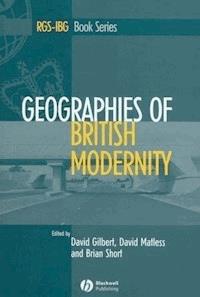
Geographies of British Modernity E-Book
25,99 €
Mehr erfahren.
- Herausgeber: John Wiley & Sons
- Kategorie: Wissenschaft und neue Technologien
- Serie: RGS-IBG Book Series
- Sprache: Englisch
This volume brings together leading scholars in the geography and history of twentieth-century Britain to illustrate the contribution that geographical thinking can make to understanding modern Britain. * * The first collection to explore the contribution that geographical thinking can make to our understanding of modern Britain. * Contains thirteen essays by leading scholars in the geography and history of twentieth-century Britain. * Focuses on how and why geographies of Britain have formed and changed over the past century. * Combines economic, political, social and cultural geographies. * Demonstrates the vitality of work in this field and its relevance to everyday life.
Sie lesen das E-Book in den Legimi-Apps auf:
Seitenzahl: 518
Veröffentlichungsjahr: 2011
Ähnliche




















Contents
Series Editors’ Preface
Acknowledgements
List of Contributors
Chapter One Historical Geographies of British Modernity
Geographies of Modernity
British Modern: Something Done?
British Historical Geography and the Twentieth Century
Approaching the Geographies of British Modernity
REFERENCES
Part I
Chapter Two A Century of Progress? Inequalities in British Society, 1901—2000
Great Progress Coupled with Little Fundamental Change
Three Choices
On Progress
A Little More Geography
Conclusion
ACKNOWLEDGEMENTS
REFERENCES
Chapter Three The Conservative Century? Geography and Conservative Electoral Success during the Twentieth Century
Exaggeration and Bias in the Electoral System
The Changing Electoral Context
Creating the Interacting Geographies: Constituency Delimitation
Redistribution in the United Kingdom
Identifying Electoral Bias
Conclusions
NOTES
REFERENCES
Chapter Four Mobility in the Twentieth Century: Substituting Commuting for Migration?
Introduction
Data
Changing Home and Workplace
Changing Attitudes to Mobility
Conclusions
ACKNOWLEDGEMENTS
REFERENCES
Chapter Five Qualifying the Evidence: Perceptions of Rural Change in Britain in the Second Half of the Twentieth Century
NOTES
REFERENCES
Part II
Chapter Six ‘A Power for Good or Evil’: Geographies of the M1 in Late Fifties Britain
Designing
Constructing
Driving
Placing the Modern Motorway
NOTES
REFERENCES
Chapter Seven A New England: Landscape, Exhibition and Remaking Industrial Space in the 1930s
Dead King and the Underground
Envisioning a New England
The Industrial City of Tomorrow
After
NOTES
REFERENCES
Chapter Eight A Man’s World? Masculinity and Metropolitan Modernity at Simpson Piccadilly
Simpsons: A West End Store
’An expression in every way of the modern spirit’: Modernism and Masculinity at 202 Piccadilly
The Simpsons Man
Masculinity and Metropolitan Modernity at Simpson Piccadilly
NOTE
REFERENCES
Chapter Nine Mosques, Temples and Gurdwaras: New Sites of Religion in Twentieth-Century Britain
Muslim, Sikh and Hindu Places of Worship in Britain
The Spatial Evolution of Mosques, Gurdwaras and Mandirs in Britain
Sites and Scales of Minority Religious Worship
Contested Landscapes
Transnational Flows
Conclusion
ACKNOWLEDGEMENTS
REFERENCES
Part III
Chapter Ten ’Stop being so English’: Suburban Modernity and National Identity in the Twentieth Century
Suburbia and Englishness
In Search of Middle England: Thatcher, Major and Blair as Suburban Leaders
Coda: Suburbia and Narratives of English Decline
REFERENCES
Chapter Eleven Nation, Empire and Cosmopolis: Ireland and the Break with Britain
Introduction
Cosmopolitans
The Instability of Content in Nationalisms
The Instability of Scale in Nationalisms
ACKNOWLEDGEMENTS
REFERENCES
Chapter Twelve British Geographical Representations of Imperialism and Colonial Development in the Early and Mid-Twentieth Century
Introduction
1900–1918
British Geographies of Development c.1935–1965
Conclusion
ACKNOWLEDGEMENTS
REFERENCES
Afterword: Emblematic Landscapes of the British Modern
Index
RGS-IBG Book Series
The Royal Geographical Society (with the Institute of British Geographers) Book Series provides a forum for scholarly monographs and edited collections of academic papers at the leading edge of research in human and physical geography. The volumes are intended to make significant contributions to the field in which they lie, and to be written in a manner accessible to the wider community of academic geographers. Some volumes will disseminate current geographical research reported at conferences or sessions convened by Research Groups of the Society. Some will be edited or authored by scholars from beyond the UK. All are designed to have an international readership and to both reflect and stimulate the best current research within geography.
The books will stand out in terms of:
the quality of researchtheir contribution to their research fieldtheir likelihood to stimulate other research.being scholarly but accessible.For series guides go to http://www.blackwellpublishing.com/pdf/rgsibg.pdf
Published
Geomorphological Processes and Landscape Change: Britain in the Last 1000 Years
Edited by David L. Higgitt and E. Mark Lee
Globalizing South China
Carolyn L. Cartier
Lost Geographies of Power
John Allen
Geographies of British Modernity
Edited by David Gilbert, David Matless and Brian Short
A New Deal for Transport?
Edited by Iain Docherty and Jon Shaw
Forthcoming
Domicile and Diaspora
Alison Blunt
Fieldwork
Simon Naylor
Putting Workfare in Place
Peter Sunley, Ron Martin and Corinne Nativel
Natural Resources in Eastern Europe
Chad Staddon
Military Geographies
Rachel Woodward
The Geomorphology of Upland Peat
Martin Evans and Jeff Warburton
Geographies and Moralities
David Smith and Roger Lee
© 2003 by Blackwell Publishing Ltd
350 Main Street, Malden. MA 02148–5020, USA
108 Cowley Road, Oxford OX4 1JF, UK
550 Swanston Street, Carlton, Victoria 3053, Australia
The right of David Gilbert, David Matless and Brian Short to be identified as the Authors of the Editorial Material in this Work has been asserted in accordance with the UK Copyright, Designs, and Patents Act 1988.
All rights reserved. No part of this publication may be reproduced, stored in a retrieval system, or transmitted, in any form or by any means, electronic, mechanical, photocopying, recording or otherwise, except as permitted by the UK Copyright. Designs and Patents Act 1988, without the prior permission of the publisher
First published 2003 by Blackwell Publishing Ltd
Library of Congress Cataloging-in-Publication Data
Geographies of British modernity: space and society in the twentieth century/edited by David Gilbert, David Matless, and and Brian Short.
p. cm. – (RGS-IBG book series)
Includes bibliographical references and index.
ISBN 0–631–23500–0 (alk. paper)—ISBN 0–631–23501–9 (pbk.: alk. paper)
1. Great Britain—Historical geography. 2. Great Britain—Social conditions—twentieth century. 3. Great Britain—History—twentieth century. 4. Human geography–Great Britain.
I. Gilbert, David. II. Matless, David. III. Short, Brian, 1944-IV. Series.
DA600.G45 2003
911’.41–dc21 2003000665
A catalogue record for this title is available from the British Library.
Set in 10/12 pt Plantin
by Kolam Information Services Pvt. Ltd, Pondicherry, India
Printed and bound in the United Kingdom
by MPG Books, Bodmin, Cornwall
For further information on
Blackwell Publishing, visit our website:
http://www.blackwellpublishing.com
Series Editors’ Preface
The RGS–IBG Book series publishes the highest quality of research and scholarship across the broad disciplinary spectrum of geography. Addressing the vibrant agenda of theoretical debates and issues that characterize the contemporary discipline, contributions will provide a synthesis of research, teaching, theory and practice that both reflects and stimulates cutting-edge research. The series seeks to engage an international readership through the provision of scholarly, vivid and accessible texts.
Nick Henry and Jon Sadler
RGS–IGB Book Series Editors
Acknowledgements
The editors would like to thank the contributors to this volume for their cooperation, patience and prompt attention to our queries. A collaboration of this kind might have included many other authors and themes, and so we also thank those colleagues whose original proposals we finally had to omit because of shortage of space. Many colleagues have commented on whole or part of the proposal, and our thanks go to Alan Baker and Richard Dennis for their initial thoughts; to Nick Henry, Human Geography editor of the Blackwell IBG/RGS series, and to the anonymous referees whose reports were so thorough and helpful. We are also indebted to Jane Hotchkiss, Angela Cohen and Sarah Falkus from the Blackwell editorial team. The volume originated from the opportunity to meet the contributors at a Historical Geography Research Group symposium at the IBG/RGS 2000 conference at the University of Sussex, and we are grateful to the HGRG for its willingness to support our idea, and also to provide support for study group guests. Editorial meetings have taken our time away from departmental matters: we therefore thank our own colleagues at Nottingham, Royal Holloway and Sussex for their understanding; and the ideally located Pizza Paradiso in Store Street, London, for its ambience and stimulus to editorial thought.
We thank copyright holders for their kind permission to reproduce the images used. Every effort has been made to obtain permission to reproduce copyright material but if proper acknowledgement has not been made we would invite copyright holders to inform us of the oversight.
David Gilbert
David Matless
Brian Short
Contributors
Robin Butlin is Professor of Historicasl Geography at the University of Leeds. His research interests include historical geographies of: European imperialism, c.1880-1960, Palestine c.1600-1914, and English rural landscapes, together with the history of Historical Geography. His publications include Historical Geography: Through the Gates of Space and Time(1993); Geography and Imperialism 1820–1940, edited with Morag Bell and Michael Heffernan (1995); Ecological Relations in Historical Times, edited with N. Roberts (1995); An Historical Geography of Europe, edited with R. A. Dodgshon (1998); and Place, Culture and Identity: Essays inHonour of Alan R. H. Baker, edited with I. S. Black (2001).
Danny Dorling is Professor of Geography at the University of Leeds; he was previously Reader in Geography at the University of Bristol. His recent publications include Health, Place and Society, with M. Shaw and R. Mitchell (2000).
Bronwen Edwards is completing a Ph.D. at the London College of Fashion, London Institute. Her research concerns the architecture and culture of shopping in London’s West End from 1930 to 1959. She has worked for the Twentieth Century Society and for English Heritage.
David Gilbert is a Senior Lecturer in the Department of Geography at Royal Holloway, University of London. His recent research has concerned the modern history of London, with particular emphasis on the development of suburban culture, and the influence of imperialism on London’s physical and social landscapes. He was co-editor, with Felix Driver, of Imperial Cities: Landscape, Display and Identity (1999).
Gerry Kearns is a Lecturer in Geography at the University of Cambridge. His main research interests are the history of urban public health, the relations between geographic thought and imperialism, and the geographical dimensions of Irish identities. Recent publications relevant to the concerns of the chapter in this book include ‘Time and Some Citizenship: Nationalism and Thomas Davis Bulla´n’, Irish Studies Journal, 5 (2001), 23–54; and ‘‘‘Educate that holy hatred’’: Place, Trauma and Identity in the Irish Nationalism of John Mitchel’, Political Geography, 20 (2001), 885–911.
Alun Howkins is Professor of Social History at the University of Sussex. He has published widely on the social and cultural history of rural England, and is the author of Poor Labouring Men: Rural Radicalism in Norfolk,1872–1923 (1985), and Reshaping Rural England: A Social History,1850–1925 (1992). He has recently published a substantial section of the Cambridge Agrarian History of England and Wales, volume 7, and as a regular broadcaster wrote and presented the major BBC series, FruitfulEarth in 1999. He is an editor of History Workshop Journal and Oral History.
Ron Johnston is a Professor in the School of Geographical Sciences at the University of Bristol; Charles Pattie is a Professor in the Department of Geography at the University of Sheffield; Danny Dorling is a Professor and David Rossiter is a Research Fellow in the School of Geography at the University of Leeds. They have collaborated widely in studies of the UK’s electoral geography over the last decade, and have co-authored two recent books for Manchester University Press: The Boundary Commissions:Redrawing the UK’s Map of Parliamentary Constituencies (1999), and From Votes to Seats: The Operation of the UK Electoral System since 1945 (2001).
Dennis Linehan is a Lecturer in Cultural and Historical Geography at University College, Cork. He is currently working on a book on the question of industrial modernity and regionalism in Britain.
David Matless is Reader in Cultural Geography at the University of Nottingham. He is the author of Landscape and Englishness (1998) and editor of The Place of Music (1998). He is currently researching cultures of nature in twentieth-century England, and the life and work of ecologist and artist Marietta Pallis.
Peter Merriman is a Lecturer in the Department of Geography at the University of Reading. His research focuses on mobility, space and social theory, historical geographies of transport, and cultures of landscape in twentieth-century Britain. He is currently writing a book on the cultural geographies of the M1 motorway.
Simon Naylor is Lecturer in Human Geography in the School of Geographical Sciences, University of Bristol. He is a historical and cultural geographer with research interests in the geographies of science, technology and religion. He is co-editor, with Ian Cook, David Crouch and James Ryan, of Cultural Turns/Geographical Turns: Perspectives on CulturalGeography (2000).
Colin Pooley is Professor of Social and Historical Geography at Lancaster University. His research focuses on societal change in Britain and Europe over the last 200 years, and especially aspects of migration, mobility, health, housing and ethnicity. Publications include a wide range of journal articles, and his recent research with J. Turnbull on migration is reported in Migration and Mobility in Britain since the Eighteenth Century (1998).
Rebecca Preston is a researcher and writer on the history of gardening, and is currently Research Assistant at the AHRB Centre for the Study of the Domestic Interior at the Royal College of Art. Her Ph.D. at Royal Holloway, University of London on the culture and politics of gardening in nineteenth-century Britain was completed in 1999. Her published work explores the relationship between the practices of gardening and social identity.
James R. Ryan is Lecturer in Human Geography at Queen’s University Belfast. He is author of Picturing Empire (1997) and co-editor, with Ian Cook, David Crouch and Simon Naylor, of Cultural Turns/Geographical Turns: Perspectives on Cultural Geography (2000), and, with Joan M. Schwartz, of Picturing Place (2003).
Brian Short is Professor of Historical Geography, and currently Head of the Department of Geography, at the University of Sussex. His research and publications have primarily focused on rural communities, economy and landscape, with a recent emphasis on the earlier twentieth century, as seen in his Land and Society in Edwardian Britain (1997) and The NationalFarm Survey 1941–1943: State Surveillance and the Countryside in Englandand Wales in the Second World War, co-authored with Charles Watkins, William Foot and Phil Kinsman (2000).
Chapter One
Historical Geographies of British Modernity
Brian Short, David Gilbert and David Matless
Geographies of Modernity
In 1902 Heinemann of London published Halford Mackinder’s Britain and the British Seas, a work of geographical synthesis in which ‘the phenomena of topographical distribution relating to many classes of fact have been treated, but from a single standpoint and on a uniform method’ (1902: vii). Reread a century later, Mackinder’s account of Britain contains some elements that seem archaic and others that still appear perceptive or even visionary. One diagram in the book shows ‘the relative nigresence of the British population’ (1902: 182). This used an index based on samples of hair colour to map the patterning of what were described as long-skulled and dark Celts, long-skulled and blond Teutons, and remnant groups of ‘round-headed men’. Mackinder’s diagram is now used only as a pedagogic device to illustrate the contemporary obsession with racial difference (and the shaky evidence on which it was based). Students familiar with the cultural complexities of early twenty-first-century Britain find the language, aims and methods of Mackinder’s treatment of ‘racial geography’ perplexing, amusing, risible or offensive. In contrast, Mackinder’s comments on the potential of tidal power as a replacement for fossil fuels, seem like a prophecy still waiting to be fulfilled:
A vaster supply of energy than can be had from the coal of the whole world is to be found in the rise and fall of the tide upon the submerged plateau which is the foundation of Britain. No one has yet devised a satisfactory method of harnessing the tides, but the electrical conveyance of power has removed one at least of the impediments, and sooner or later, when the necessity is upon us, a way may be found of converting their rhythmical pulsation into electrical energy. (1902: 339)
It is appropriate to open this book on the Geographies of British Modernity, the first volume dedicated specifically to the historical geography of twentieth-century Britain, with reference to Mackinder, not just because Britain andthe British Seas provides a convenient starting point from the early years of the century. As we argue later in this introductory essay, it is important to think about how the discipline of geography has changed and developed over the twentieth century as a way of writing about Britain and Britishness, and Mackinder is often credited with the establishment of British academic geography. But it is also appropriate to start with Mackinder because, as Gearóid Ó Tuathail (1992) has argued, his work as both academic geographer and as politician must be interpreted as a comment on the nature of the modern world and Britain’s place within it. Mackinder is now best remembered as a geopolitician, through his theory of the ‘world heartland’ that influenced and legitimized American Cold War strategy. This work on the ‘closed heart-land of Euro-Asia’ as the ‘geographical pivot of history’ needs to be set within what was a much broader response to dramatic transformations that were taking place at the beginning of the twentieth century (Mackinder 1904: 434). Mackinder’s work can be seen as an attempt ‘to modernize traditional conservative myths about an organic community in an age where a multiplicity of international and domestic material transformations were eroding the economic foundations of the British Empire and the social world of the aristocratic establishment who ran it’ (Ó Tuathail 1992: 102). Seen from this perspective, Mackinder’s broader undertaking becomes a particular interpretation and projection of the geography of British modernity at the beginning of the twentieth century.
Lesen Sie weiter in der vollständigen Ausgabe!
Lesen Sie weiter in der vollständigen Ausgabe!
Lesen Sie weiter in der vollständigen Ausgabe!
Lesen Sie weiter in der vollständigen Ausgabe!
Lesen Sie weiter in der vollständigen Ausgabe!
Lesen Sie weiter in der vollständigen Ausgabe!
Lesen Sie weiter in der vollständigen Ausgabe!
Lesen Sie weiter in der vollständigen Ausgabe!
Lesen Sie weiter in der vollständigen Ausgabe!
Lesen Sie weiter in der vollständigen Ausgabe!
Lesen Sie weiter in der vollständigen Ausgabe!
Lesen Sie weiter in der vollständigen Ausgabe!
Lesen Sie weiter in der vollständigen Ausgabe!
Lesen Sie weiter in der vollständigen Ausgabe!
Lesen Sie weiter in der vollständigen Ausgabe!
Lesen Sie weiter in der vollständigen Ausgabe!




