


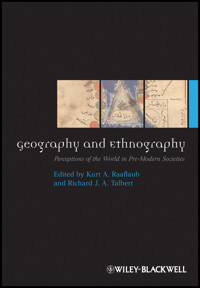
Geography and Ethnography E-Book
36,99 €
Mehr erfahren.
- Herausgeber: John Wiley & Sons
- Kategorie: Geisteswissenschaft
- Serie: Ancient World: Comparative Histories
- Sprache: Englisch
This fascinating volume brings together leading specialists, who have analyzed the thoughts and records documenting the worldviews of a wide range of pre-modern societies.
- Presents evidence from across the ages; from antiquity through to the Age of Discovery
- Provides cross-cultural comparison of ancient societies around the globe, from the Chinese to the Incas and Aztecs, from the Greeks and Romans to the peoples of ancient India
- Explores newly discovered medieval Islamic materials
Sie lesen das E-Book in den Legimi-Apps auf:
Seitenzahl: 791
Veröffentlichungsjahr: 2012
Ähnliche




















Contents
Cover
Half Title page
Title page
Copyright page
List of Figures
Notes on Contributors
Series Editor’s Preface
The Ancient World: Comparative Histories
Chapter 1: Introduction
Chapter 2: Where the Black Antelope Roam: Dharma and Human Geography in India
Preamble: Speke, Memory, and the Proper Use of Native Lore
Part 1. The Dharmic Imaginary of the World and Its Peoples
Part 2. Alternatives
Conclusion
Acknowlegments
Notes
References
Chapter 3: Humans, Demons, Gods, and Their Worlds: The Sacred and Scientific Cosmologies of India
Introduction: Two Indian Views of the Cosmos
The Evolution of Indian Cosmological Concepts
Negotiating the Astronomical Cosmos: Interactions between Sacred and Scientific Models
Concluding Questions: The Role and Nature of Siddhntic Cosmology
Notes
References
Chapter 4: Structured Perceptions of Real and Imagined Landscapes in Early China
Introduction
The Fangmatan Maps of Qin
The Mawangdui Maps of Western Han
The Anping Map of Eastern Han
Notes
References
Chapter 5: Nonary Cosmography in Ancient China
Notes
References
Chapter 6: Knowledge of Other Cultures in China’s Early Empires
The Standard Histories and Other Documents
Contacts with the north and with Central Asia
The South
Outlying Regions, West and East
Silk and its Destination
Geographical Ideas
The Calls of Mystery and Faith
Reports of Later Times
Notes
References
Chapter 7: The Mississippian Peoples’ Worldview
Differentiated Identities
Connections
Borders
Knowledge
Change
Conclusion
Notes
References
Chapter 8: Aztec Geography and Spatial Imagination
Historical Background
New World Geography?
Nican: The Here and Now
Huehca: Beyond the Horizon
Nahuac: The Heart of Empire
Notes
References
Chapter 9: Inca Worldview
Evidence and Problems
Tawantinsuyu
Spatial Order
Reimagining Tawantinsuyu
Worlds in Collision
Notes
References
Chapter 10: Masters of the Four Corners of the Heavens: Views of the Universe in Early Mesopotamian Writings
Notes
References
Chapter 11: The World and the Geography of Otherness in Pharaonic Egypt
Introduction: The Ancient Egyptian Perspective on the World
Geography
Ethnography
Notes
References
Chapter 12: On Earth as in Heaven: The Apocalyptic Vision of World Geography from Urzeit to Endzeit according to the Book of Jubilees
Introduction
Sources of the Book of Jubilees
Temporal and Spatial Axes of the Book of Jubilees
Geography and Ethnography in the Book of Jubilees
Conclusion
Notes
References
Chapter 13: “I Know the Number of the Sand and the Measure of the Sea”: Geography and Difference in the Early Greek World
Our Disabilities
The Shield of Achilles
The Cosmic Hierarchy
Imagining the World
The Polis
Catalogues
Geography Without Maps
Early Maps
Reading a Map
Mapping Difference
Notes
References
Chapter 14: Continents, Climates, and Cultures: Greek Theories of Global Structure
Early Greek Geography: The Ionians (Sixth and Early Fifth Centuries BCE)
Herodotus (Late Fifth Century BCE)
The Airs Waters Places (Late Fifth Century BCE)
Plato, Aristotle and Isocrates (Fourth Century BCE)
Hellenistic and Roman Geography (Third Century BCE through Second Century CE)
The Book of Jubilees (A Jewish Text Incorporating Greek Elements, Second Century BCE)
Notes
References
Chapter 15: The Geographical Narrative of Strabo of Amasia
Notes
References
Chapter 16: The Roman Worldview: Beyond Recovery?
Notes
References
Chapter 17: The Medieval Islamic Worldview: Arabic Geography in Its Historical Context
Was it “Medieval?”
Was it “Islamic?”
Was it a “Worldview?”
Notes
References
Chapter 18: The Book of Curiosities: An Eleventh-Century Egyptian View of the Lands of the Infidels
Notes
References
Chapter 19: Geography and Ethnography in Medieval Europe: Classical Traditions and Contemporary Concerns
Reconciling Classical Geo/Ethnographical Knowledge and Christianity
Geo/Ethnography at School
Geography and Contemplation
Classical Knowledge Made Relevant
Geographical Legacy and Imperial Ideology
Conclusion
Notes
References
Chapter 20: Europeans Plot the Wider World, 1500–1750
Ptolemy’s Known World and Knowledge of the Globe
The Combination of the Ptolemaic and the Portolan Chart Traditions
The Cartographic Skills of the Columbus Brothers
Iberian Cartographic Knowledge and German Printers
Portuguese Chartmakers and the Dieppe School
The Spanish Use of Cartography in Imperial Administration
The Emergence of the Thames School
Some Final Examples of the Artist/Cartographers
The Advent of the Printed Marine Atlas
The Cartography of the Jesuits
Estate Plans and Their Use
The Plans of the Military Engineers
Conclusion
Notes
References
Index
Geography and Ethnography
The Ancient World: Comparative Histories
Series Editor: Kurt Raaflaub
Published
War and Peace in the Ancient World
Edited by Kurt Raaflaub
Household and Family Religion in Antiquity
Edited by John Bodel and Saul Olyan
Epic and History
Edited by David Konstan and Kurt A. Raaflaub
Geography and Ethnography: Perceptions of the World in Pre-Modern Societies
Edited by Kurt A. Raaflaub and Richard J. A. Talbert
The Roman Empire in Context: Historical and Comparative Perspectives
Edited by Johann P. Arnason and Kurt A. Raaflaub
Highways, Byways, and Road Systems in the Pre-Modern World
Edited by Susan E. Alcock, John Bodel, and Richard J. A. Talbert
The Gift in Antiquity
Edited by Michael L. Satlow
The Greek Polis and the Invention of Democracy
Edited by Johann P. Arnason, Kurt A. Raaflaub, and Peter Wagner
This paperback edition first published 2013© 2013 Blackwell Publishing Ltd
Edition history: Blackwell Publishing Ltd (hardback, 2010)
Blackwell Publishing was acquired by John Wiley & Sons in February 2007. Blackwell’s publishing program has been merged with Wiley’s global Scientific, Technical, and Medical business to form Wiley-Blackwell.
Registered OfficeJohn Wiley & Sons Ltd, The Atrium, Southern Gate, Chichester, West Sussex, PO19 8SQ, UK
Editorial Offices350 Main Street, Malden, MA 02148-5020, USA9600 Garsington Road, Oxford, OX4 2DQ, UKThe Atrium, Southern Gate, Chichester, West Sussex, PO19 8SQ, UK
For details of our global editorial offices, for customer services, and for information about how to apply for permission to reuse the copyright material in this book please see our website at www.wiley.com/wiley-blackwell.
The right of Kurt A. Raaflaub and Richard J. A. Talbert to be identified as the authors of the editorial material in this work has been asserted in accordance with the UK Copyright, Designs and Patents Act 1988.
All rights reserved. No part of this publication may be reproduced, stored in a retrieval system, or transmitted, in any form or by any means, electronic, mechanical, photocopying, recording or otherwise, except as permitted by the UK Copyright, Designs and Patents Act 1988, without the prior permission of the publisher.
Wiley also publishes its books in a variety of electronic formats. Some content that appears in print may not be available in electronic books.
Designations used by companies to distinguish their products are often claimed as trademarks. All brand names and product names used in this book are trade names, service marks, trademarks or registered trademarks of their respective owners. The publisher is not associated with any product or vendor mentioned in this book. This publication is designed to provide accurate and authoritative information in regard to the subject matter covered. It is sold on the understanding that the publisher is not engaged in rendering professional services. If professional advice or other expert assistance is required, the services of a competent professional should be sought.
Library of Congress Cataloging-in-Publication DataGeography and ethnography : perceptions of the world in pre-modern societies / edited by Kurt A. Raaflaub and Richard J. A. Talbert.p. cm. – (The ancient world comparative histories)Includes bibliographical references and index.ISBN 978-1-4051-9146-3 (hardcover : alk. paper) ISBN 978-1-118-58985-4 (pbk. : alk. paper) 1. Geographical perception—Cross-cultural studies. 2. Human geography—Cross-cultural studies. 3. Civilization, Ancient. I. Raaflaub, Kurt A. II. Talbert, Richard J. A., 1947-71.5.G46 2010304.2’3—dc222009020183
A catalogue record for this book is available from the British Library.
Cover image: MSS 972, folio 29a: map of the Mediterranean from a treatise by al-Istakhi. The Nasser D. Khalili Collection of Islamic Art, courtesy of the Khalili Family Trust.Copyright: The Nour Foundation
List of Figures
4.1 Military garrison map, excavated from Mawangdui Tomb Number Three, Changshan, Hunan province
4.2 Phase I Pre-conflict tactical features
4.3 Phase II Actual invasion route
4.4 Phase III Future defensive planning
4.5 Line drawing of compound found in the tomb at Anping, Lüjiazhuang, Hebei province
6.1 Map of Central Asia
7.1 Mississippian winged serpent
7.2 Copper plate from Etowah, showing a figure holding a war club and severed head
7.3 Engraved shell from Spiro
7.4 Chickasaw map, 1737
7.5 Mississippian head pot from Bradley, the Mississippian site that was probably Pacaha
8.1 Map of the Valley of Mexico
8.2 Drawing after Códice Santa Maria Asunción, fol. 57v, ca. 1544
8.3 Drawing after Plano parcial de la ciudad de México, detail, ca. 1565
8.4 Codex Mendoza, ca. 1545, showing the tribute due from the region headed by Coayxtlahuacan
8.5 Map of the Aztec empire: outer provinces
8.6 Stone of Tizoc, detail showing Tizoc (left) conquering the deity of Xochimilco (right), ca. 1485
8.7 Map of Tenochtitlan and the Gulf Coast, from Praeclara Fernandi Cortesii de Noua Maris Oceani Hyspania Narratio
8.8 Codex Mendoza, fol. 2r, ca. 1545, showing an abstracted map of Tenochtitlan at its founding
9.1 Extent of Tawantinsuyu and the Inca road network
9.2 The Tawantinsuyu Division
9.3 Collasuyu and the Urcusuyu/Umasuyu Division
9.4 Mapa mundi of Felipe Guaman Poma de Ayala, 1615
9.5 Tawantinsuyu map in the Galvin ms. of Guaman Poma
9.6 Pontifical world map of Felipe Guaman Poma de Ayala, 1615
9.7 Inca tunic with t’oqapu design
10.1 The Babylonian “Map of the world”
10.2 Early Dynastic Mesopotamia
10.3 The Old Akkadian world
10.4 The victory stele of Naram-Sin
10.5 The Ur III world
11.1 “Smiting the enemy” scene from the temple of Ramses III
11.2 Hieroglyphic classifiers of an Egyptian word for enemies shaped as foreign bodies
12.1 Map of 1 Enoch 17–19
12.2 Jubilees’ mappa mundi
13.1 Herodotus’s Scythian “map”
14.1 The three continents as envisaged by Herodotus according to J. L. Myres in Geographical Journal 8 (1896), page 627
14.2 T-O Map. In Saint Isidorus [Bishop of Seville], Etymologiarum sive originum libri XX. Augsburg, Gunther Zainer, 1472
15.1 World map according to Strabo
15.2 Traditional division of the globe into latitudinal climatic zones
16.1 Aerial view of modern Verona (Italy) in a loop of the Adige river, showing the continued importance of the Roman street-grid
16.2 Checkerboard pattern of Roman land division (“centuriation”) as seen from the air near modern Pula (Croatia) in the Istria peninsula
16.3 Stone marking the boundary between the territories of Aquileia and Emona, retrieved from the bed of the Ljubljanica river (Slovenia)
16.4 Milestone originally from the Roman province of Noricum, today preserved in Salzburg (Austria)
16.5 Two-dimensional reproduction of the milestone’s Latin text
16.6 Reconstructed section of the Marble Plan of Rome, reflecting its large scale (1:240) and extraordinary level of detail
16.7 Reassembled fragments from a survey map on stone erected at Arausio (today Orange, France) during the late first century CE
16.8 Section of the Italian peninsula south from Ravenna on the Peutinger Map, flanked by narrow channels of open water representing (above) the Adriatic Sea and (below) the Mediterranean
16.9 Miniature silver beaker, probably produced in the first century CE and found in a sacred spring at Vicarello north-west of Rome
16.10 Bronze parts (two discs, the larger recessed to accommodate the smaller; a combined gnomon and hour-scale held together by a bolt) of a Roman sundial said to have been found near Bratislava (Slovakia), now in the (Ashmolean) Museum of the History of Science, Oxford
16.11 Names on the Tischendorf sundial (found at Memphis, Egypt) plotted on a modern base map
18.1 The map of the Mediterranean from the Book of Curiosities
18.2 The map of the Mediterranean from the treatise by al-Istakhri; (d. ca. 961)
18.3 The Mediterranean Sea from the Book of Curiosities, partially labeled
18.4 Diagram of the first five bays, opening a navigational guide to bays in the Aegean Sea
19.1 Beatus, world map from the monastery of Santo Domingo de Silos.
19.2 Liber Precum, the Third Temptation of Christ: Devil offers Christ a world map as a symbol of the world
19.3 The world map, Hereford Cathedral ca. 1300
19.4 Martianus Capella, De nuptiis Philologiae et Mercurii: Geometry
20.1 The known world as envisaged by Ptolemy on the globe, from Abraham Ortelius, Theatrum Orbis Terrarum (1606 edition)
20.2 Map of the Mediterranean from Visconte Maggiolo [Portolan Atlas, ms.], Naples 1511
20.3 Lopez de Velasco, map from Antonio de Herrera, Décadas (1601)
20.4 Samuel de Champlain, image of an Amerindian and a palm tree, from his manuscript concerning his travels in the West Indies
20.5 Lucas Waghenaer, chart from his Spieghel der Zeervaert (1585)
20.6 Jesuit map of the Great Lakes, 1672
Notes on Contributors
David Buisseret received his PhD from the University of Cambridge. He was formerly Garrett Professor of History at the University of Texas at Arlington, and now in retirement works out of the Newberry Library, Chicago. His special interests cover early modern France, the colonial Caribbean, and the history of cartography. He has most recently edited The Oxford Companion to World Exploration (2007), and Jamaica in 1687: The Taylor Manuscript at the National Library of Jamaica (2008).
Susan Guettel Cole received her PhD in Classics at the University of Minnesota. She is Professor of Classics at the State University of New York in Buffalo. In 1990 she was Directeur d’Etudes Associé at the Ecole Pratique des Hautes Etudes in Paris. She has published Theoi Megaloi: The Cult of the Great Gods at Samothrace (1984), and Landscapes, Gender, and Ritual Space (2004). She is working on Dionysiac Inscriptions of Asia Minor and on Pigs for Demeter, an examination of the rituals and gestures associated with the worship of Demeter.
Daniela Dueck received her PhD in History from the Hebrew University in Jerusalem, and is Senior Lecturer in History and Classics at Bar Ilan University in Israel. She has published, in addition to articles and chapters, Strabo of Amasia: A Greek Man of Letters in Augustan Rome (2000), and has co-edited Strabo’s Cultural Geography: The Making of a Kolossourgia (2005). In addition, she maintains a strong interest in the Greek “Minor Geographers.”
Kathleen DuVal received her PhD in History at the University of California, Davis, and held an Andrew W. Mellon Postdoctoral Fellowship at the University of Pennsylvania before joining the history faculty at the University of North Carolina, Chapel Hill. Her research focuses on early America, particularly cross-cultural relations on North American borderlands. She is the author of The Native Ground: Indians and Colonists in the Heart of the Continent (2006), and co-author of Interpreting a Continent: Voices from Colonial America (forthcoming 2009). She is currently writing a history of the American Revolution on the Gulf Coast.
John B. Henderson is Bell Professor of History at Louisiana State University in Baton Rouge. He received his PhD from the University of California at Berkeley. His publications, translated into various languages (including Korean and Chinese), include The Development and Decline of Chinese Cosmology (1984); Scripture, Canon, and Commentary: A Comparison of Confucian and Western Exegesis (1991); The Construction of Orthodoxy and Heresy: Neo-Confucian, Islamic, Jewish, and Early Christian Patterns (1998). He is co-editor of Notions of Time in Chinese Historical Thinking (2006).
Hsin-Mei Agnes Hsu received her PhD in East Asian Languages and Civilizations from the University of Pennsylvania. She held a three-year Joukowsky Postdoctoral Fellowship at Brown University, and a Mellon Research Scholarship at Stanford University. She is currently Director of Education and Dean of the Confucius Institute at the China Institute in New York. She is also an international expert for UNESCO’s World Heritage Centre on the transnational nomination of the Silk Roads, for which she wrote a policy paper on the universal value of road systems in ancient empires. An article by her on ancient Chinese cartography was published in the Journal of the Royal Asiatic Society 3, 17. 4 (2007).
Catherine Julien received her PhD in Anthropology from the University of California at Berkeley. She is Professor of History at Western Michigan University. Her most recent book is an edition of the History of How the Spaniards Arrived in Peru by the Inca Titu Cusi Yupanqui (2007). Her book Reading Inca History (2000) was awarded the Modern Language Association’s Katherine Singer Kovacs Award and the Society for Ethnohistory’s Erminie Wheeler-Voegelin Award. She is currently involved in a documentary editing project on the exploration of the interior of South America in the time of governor Alvar Nuñez Cabeza de Vaca (1540–5).
Michael Loewe received his PhD from the University of London. He was University Lecturer in Chinese Studies and Fellow of Clare Hall at the University of Cambridge until his retirement in 1990. He has held various Visiting Professorships and is, among other distinctions, Foreign Honorary Member of the American Academy of Arts and Sciences. His publications include Divination, Mythology, and Monarchy in Han China (1994); A Biographical Dictionary of the Qin, Han and Xin Dynasties (2000), with a Companion: The Men Who Governed Han China (2004); and The Government of the Qin and Han Empires 221 BCE-220 CE (2006). Among his several edited volumes is volume 1 of The Cambridge History of China (1986).
Natalia Lozovsky is a medievalist who received her PhD from the University of Colorado at Boulder. Having taught at Boulder and at Indiana University-Purdue University, Indianapolis, she now works as an independent scholar. Her research interests cover geo/ethnography and history in the Middle Ages, medieval education, imperial ideology, and intellectual traditions in medieval Europe. She has published numerous articles and book chapters as well as “The Earth Is Our Book”: Geographical Knowledge in the Latin West, 400–1000 (2000). She is currently working on a book Empire and Ethno/Geography in Medieval Europe, as well as participating in the preparation of a collaborative critical edition of a medieval commentary on Martianus Capella’s On the Marriage of Philosophy and Mercury.
Piotr Michalowski received his PhD in Near Eastern Languages and Literatures from Yale University. He is George G. Cameron Professor of Ancient Near Eastern Languages and Civilizations at the University of Michigan, and a member of the American Philosophical Society. He has published The Lamentation over the Destruction of Sumer and Ur (1989), and Letters from Early Mesopotamia (1993). Work in progress includes The Correspondence of the Kings of Ur, and The Birth of Literature and the Death of Kings.
Christopher Minkowski is Boden Professor of Sanskrit at Oxford University. His PhD is in Sanskrit and Indian Studies from Harvard University. Among other distinctions, he has been a Visiting Scholar at the Institute for Advanced Studies at the Hebrew University in Jerusalem, and a Fulbright Research Scholar in India. His publications include Priesthood in Ancient India: A Study of the Maitrvarua Priest (1991), and numerous recent articles on the history of commentary in Sanskrit and on Indian history of science.
Gerald Moers received his PhD at the University of Göttingen and is Junior Professor in Egyptology there. He has taught at Los Angeles, Basel, and Munich, and has received major research grants from the German Science Foundation. His publications include Fingierte Welten in der ägyptischen Literatur des 2. Jahrtausends v. Chr.: Grenzüberschreitung, Reisemotiv und Fiktionalität (2001), and two edited volumes, Definitely: Egyptian Literature. Proceedings of the Symposium “Ancient Egyptian Literature: History and Forms” (1999), and jn.t Dr.w – Festschrift für Friedrich Junge (2006).
Barbara Mundy is an art historian who received her PhD in History of Art from Yale University. She is currently associate professor at Fordham University. Her research has focused on the contributions of indigenous peoples to Latin American art of the colonial period. Her book The Mapping of New Spain (1996) was awarded the Nebenzahl prize in the history of cartography; she has also been a contributor to the History of Cartography series. She is co-author of a website/CD-ROM, Vistas: Visual Culture in Spanish America, 1520–1820 (www.smith.edu/vistas). Her principal current project focuses on Mexico City, tracing its transformation from Aztec sacred center to Spanish viceregal capital, examining particularly the role of the city’s indigenous population.
Kim Plofker received her PhD in History of Mathematics from Brown University. She held a Postdoctoral Fellowship at the University of Utrecht, and was Affiliated Fellow at the International Institute for Asian Studies at the University of Leiden, before accepting a visiting faculty position at Union College in Schenectady NY. She has published numerous articles on Indian mathematics and astronomy, among other topics, and is co-editor of Studies in the History of the Exact Sciences in Honour of David Pingree (2004). Her monograph, Mathematics in India, was published in 2009.
Kurt A. Raaflaub received his PhD from the University of Basel. He is David Herlihy University Professor and Professor of Classics and History as well as Director of the Program in Ancient Studies at Brown University. His research interests focus on the social, political, and intellectual history of archaic Greece and the Roman republic, war and peace in the ancient world, and the comparative history of the ancient world. Recent publications include The Discovery of Freedom in Ancient Greece (2004, winner of the American Historical Association’s James Henry Breasted Prize), War and Peace in the Ancient World (ed., 2007), Origins of Democracy in Ancient Greece (co-author, 2007), and a co-edited Companion to Archaic Greece (2009).
James S. Romm is James H. Ottaway Jr. Professor of Classics at Bard College. His PhD is in Classics from Princeton University. He has held a Junior Fellowship at the Center for Hellenic Studies and a Guggenheim Fellowship. His books include The Edges of the Earth in Ancient Thought: Geography, Exploration, and Fiction (1992), and Herodotus (1998). He is working on an illustrated and annotated edition of Arrian’s Anabasis for the Landmark Series, and on a book about events sparked by Alexander’s death.
Emilie Savage-Smith received her PhD in History of Science and Medicine from the University of Wisconsin, Madison. She is Professor of the History of Islamic Science at the University of Oxford and Senior Research Fellow at St. Cross College. She has been awarded several major research grants, not least for The Book of Curiosities: An Early 11th-Century Arabic Cosmography (now available in a full edition and translation at www.bodley.ox.ac.uk/bookofcuriosities). Her many printed books include Medieval Islamic Medicine (2007, awarded the 2008 British-Kuwait Friendship Society Book Prize for Middle Eastern Studies); Medieval Views of the Cosmos (2004); Magic and Divination in Early Islam (2004); and Science, Tools and Magic (2 vols. 1997).
James Scott received his PhD at the University of Tübingen. He has been an Alexander von Humboldt Fellow and a Jerusalem Trust Fellow at the Oxford Centre for Hebrew and Jewish Studies, and is currently Professor of Religious Studies at Trinity Western University, British Columbia, Canada. His primary research interests focus on the New Testament (especially Pauline letters and Mark) and early Judaism (especially the Book of Jubilees and the interpenetration of Hellenism and Judaism, including ancient geographical conceptions). Recent publications include On Earth as in Heaven: The Restoration of Sacred Space and Sacred Time in the Book of Jubilees (2004); Geography in Early Judaism and Christianity: The Book of Jubilees (2002), and Paul and the Nations (1995).
Adam J. Silverstein received his PhD from the University of Cambridge. He held a British Academy post-doctoral fellowship in Near Eastern Studies at Cambridge, and is currently University Research Lecturer in Oriental Studies (Judaism and Islam) at the University of Oxford. He works on culture and civilization in the Near East from ancient to Islamic times, focusing on the interaction between Judaism and Islam, and between these two religious traditions and the indigenous traditions of the Near East. Recent publications include Postal Systems in the pre-Modern Islamic World (2007); “From Markets to Marvels: Jews on the Maritime Route to China ca. 850 – ca. 950 CE,” Journal of Jewish Studies 58 (2007) 91–104; and “The Book of Esther and the Enûma Elish,” BSOAS 69 (2006) 209–23.
Richard J. A. Talbert received his PhD from the University of Cambridge and is W. R. Kenan Professor of History and Classics at the University of North Carolina, Chapel Hill. Ancient mapping, worldview and travel dominate his current research. He edited the Barrington Atlas of the Greek and Roman World (2000), and co-edited Space in the Roman World: Its Perception and Presentation (2004), and Cartography in Antiquity and the Middle Ages: Fresh Perspectives, New Methods (2008). Forthcoming are the 2007 Nebenzahl Lectures Ancient Perspectives: Maps and Their Place in Mesopotamia, Egypt, Greece and Rome under his editorship, and a major study (electronic/print hybrid, Cambridge UP) Rome’s World: The Peutinger Map Reconsidered.
Series Editor’s Preface
The Ancient World: Comparative Histories
The application of a comparative approach to the ancient world at large has been rare. This series, of which the current volume is the third, intends to fill this gap. It pursues important social, political, religious, economic, and intellectual issues through a wide range of ancient or early societies, occasionally covering an even broader diachronic scope. “Ancient” will here be understood broadly, encompassing not only societies that are “ancient” within the traditional chronological framework of c. 3000 BCE to c. 600 CE in East, South, and West Asia, the Mediterranean, and Europe, but also later ones that are structurally “ancient” or “early,” such as those in pre-modern Japan or in Meso- and South America before the Spanish Conquest. By engaging in comparative studies of the ancient world on a truly global scale, this series hopes to throw light not only on common patterns and marked differences, but also to illustrate the remarkable variety of responses humankind developed to meet common challenges. Focusing as it does on periods that are far removed from our own time, and in which modern identities are less immediately engaged, the series contributes to enhancing our understanding and appreciation of differences among cultures of various traditions and backgrounds. Not least, it thus illuminates the continuing relevance of the study of the ancient world in helping us to cope with problems of our own multicultural world.
Earlier volumes in the series are War and Peace in the Ancient World (ed. Kurt A. Raaflaub, 2007) and Household and Family Religion in Antiquity (eds. John Bodel and Saul Olyan, 2008). Forthcoming volumes include Epic and History (eds. David Konstan and Kurt Raaflaub, 2009), Highways and Byways in the Ancient World (eds. Susan Alcock, John Bodel, and Richard Talbert), The Roman Empire in Context (eds. Johann Arnason and Kurt A. Raaflaub), and Thinking, Recording, and Writing History in the Ancient World (ed. Kurt A. Raaflaub).
Kurt A. Raaflaub
Chapter 1
Introduction
RICHARD J. A. TALBERT AND KURT A. RAAFLAUB
It is a sad opening, but an unavoidable one, to acknowledge that this volume remains lame. Its Introduction cannot be balanced by the corresponding Conclusion that Denis Cosgrove provided with his unrivalled range, flair and insight to a workshop on this volume’s topic at Brown University in March 2006. In planning this volume and the program of the workshop at which contributors had a chance to present and discuss first versions of their chapters, Kurt Raaflaub and I had been eager to include a capstone session at which some synthesis and reflection on themes in the individual contributions could be ventured, and broad lines of continuing enquiry identified for further discussion. Denis Cosgrove at the University of California, Los Angeles, seemed to us a scholar ideally suited to open such a session. We were delighted and honored when he accepted our invitation to do so, and he duly spoke with characteristic authority and enthusiasm. Tragically, however, he died two years later on March 21, 2008 from complications following cancer surgery, and in consequence he was never able to distill his words into writing for this volume.
Denis Cosgrove’s death is a major loss to us all. To quote David Lowenthal in his obituary for The Independent (April 8, 2008): “Cosgrove’s central mission was to illuminate the dynamic interplay between the world’s diverse material landscapes and equally diverse modes of imagining and exploring them.” At Brown, Denis formulated for us eight questions as potentially rewarding lines of comprehensive enquiry into worldview among premodern societies, and I reproduce them here as recorded in my imperfect notes scribbled on the occasion. The introductory overview which follows would hardly be the place for any attempt to do full justice to the eight, but a shared concern for many of the themes and issues raised should readily be apparent.
To determine the order in which the 19 contributions should appear in a volume as wide-ranging as this one presents a delicate fundamental challenge that its editors may postpone, but ultimately cannot evade. In the obvious absence of any natural order, we have followed our inclination not to privilege Europe, and indeed to place the most familiar theme last – that is, David Buisseret’s account of how from the fifteenth century onwards a combination of the Ptolemaic and Portolan chart traditions enabled European cartographers to record the expanding exploration of the world launched from their continent, and eventually to produce maps of all kinds according to the widely recognized norms still taken for granted today. Even in the 1570s, however (as Buisseret recounts), reliance upon any such standards was strikingly premature. Philip II of Spain had hoped that his cosmographer could be supplied with maps, or pinturas, by the various administrative divisions of his farflung empire, which would then form the basis for a detailed, comprehensive map of the whole. That ambition proved impossible to achieve, however, because the 200 or so pinturas sent adopted too wide a variety of styles, many of them reflecting not European cartographic norms, but rather those of such subject peoples as the Aztecs and the Maya.
Almost to its very end, therefore, this volume compels readers to engage with the unfamiliar. It is, as Christopher Minkowski aptly summarizes it in the opening contribution, “a project of recovering and understanding the uses of geographical and ethnographical knowledge and conceptions by the peoples who produced them, in their own times and places.” For twenty-first century Westerners, the difficulties are many and formidable. Particularly taxing for us are non-literate societies. Hence it takes special dedication and sensitivity on the part of Kathleen DuVal, Barbara Mundy and Catherine Julien to tease out the worldview of Mississippian peoples (whose own names we do not even know!), the Aztecs, and the Inca respectively. Archaeology and material objects can yield vital testimony, if only the relevant pictographs and other signs can be interpreted. Potentially valuable, too, but liable to mislead and frustrate at the same time, is the written record of Westerners whose own ingrained conceptions inevitably influenced their understanding. In the Inca case, as Julien explains, the territory of Tawantinsuyu (Peru) survived, but it was entirely reimagined by its Spanish conquerors; the original conceptualization of the name – which seems to have combined geography, political theory, and a statement of power – resists our full comprehension in the absence of accounts by native authors in local languages.
More generally, throughout the volume it is essential to distrust any presumption – so easily made on our part – that the societies under investigation approached the world at all as we do. Mundy warns: “the insistence in modern geographic practice on vision and verisimilitude as the basis for geographic representations does not always hold in the New World, where ‘ways of knowing’ are not always based on sight.” Julien offers reason to think that the Inca system of orientation may not have relied upon the cardinal points. John Henderson, in explicating nonary cosmography in ancient China – a long-lasting and highly influential ordering of space – articulates the risk inherent in tapping Chinese texts of this type for insight into matters of prime concern to us (the Chinese concept of the world, for example). Such matters may in fact have been of marginal interest at best to these ancient authors, giving rise to the danger that our preoccupations will not only prove largely fruitless, but will also lead us to overlook the authors’ own priorities. By the same token Michael Loewe, reviewing the various types of reports to survive in Chinese documents, concludes that it is not the norm to find there a sense of space, or recognition of long distances, or appreciation for the effect of natural conditions on the growth of a community, let alone on the characteristics of its culture. Our deep-rooted intellectual categories and periodizations, moreover, may act as a positive hindrance to appreciation of premodern cultures. As Henderson cautions, the Chinese division of space according to the pattern of the square divided equally 3 × 3 is an ordering that falls between modern geography, cartography, even cosmography. Adam Silverstein concludes from his discussion of “the medieval Islamic worldview” that the very notion is an oxymoron. The relevant body of writing in Arabic and Persian is uniquely large. However, it is hardly accurate to describe those geographers who did form a worldview – one very dependent upon Hellenistic, Iranian and Mesopotamian ideas in fact – as genuinely medieval or Islamic. On the other hand, the geographers who were Islamic and, in chronological terms “medieval,” hardly had a worldview; they felt obliged to draw upon only personal observation or the testimony of eye-witnesses, and so ignored non-Muslim lands as a result.
A further assumption to be avoided is that maps or map-like images occupied an important place, indeed any place, in the premodern societies discussed. In early Mesopotamia the symbolic literary imagery examined by Piotr Michalowski is paramount. In early Greek culture, too, discussed by Susan Cole and James Romm, maps were created as aids to philosophical and geographical speculation about the world. Literary records, including geographic catalogs in Greek epic poetry, as well as itineraries, predated maps and were never superseded by them. Division of the globe by continents, climates and cultures became a topic that engaged a long succession of Greek writers, who in turn later influenced Jewish, Roman and medieval thinking in East and West. Meantime the “colossal,” comprehensive work of narrative geography by the Greek author Strabo – the subject of Daniela Dueck’s contribution – confined itself to words and ideas, without maps. Even so, Strabo insisted that any geographer should be an experienced traveler who could claim autopsia, as he proudly did himself. As my own contribution recognizes, Roman culture likewise, despite its unwavering pride in territorial expansion, never enlarged the limited range of contexts and purposes for which it employed maps of various types; in part for this reason, cartographic norms failed to develop. Romans clearly came to share an extensive “mental map,” but this remains elusive, as does insight into the learning and cognitive processes underlying it. As Emilie Savage-Smith reveals, our perception of Islamic cartography in general, and of its mapping of the Mediterranean in particular, has been hugely enriched by the recovery of the Book of Curiosities of the Sciences and Marvels for the Eyes that only came to light in 2000. Its novel rendering of the Mediterranean forms a stark contrast to the vision conveyed by the earlier “Balkh School” of cartography. But the contrast in turn raises questions of whether the eastern Mediterranean’s dominance (to the surprising exclusion of Muslim Spain and western Europe) merely reflects eccentricity on the part of the anonymous Egyptian mapmaker, or whether his perception was in fact one widely shared in early eleventh-century Egypt.
For early China, Agnes Hsu’s contribution makes the persuasive claim that the maps found at Mawangdui in 1973 – hitherto admired principally for their rendering of hydrology and topography – also convey a ritual and symbolic quality that should not be overlooked. The demarcation of Han-controlled territory in Changsha on one of these maps acts as a visual symbol signifying the separation between the civilized world and the landscapes of untamed peoples. In addition, once the set was placed in the tomb from which it has been recovered, the maps became a metaphor for a space that is preserved in perpetuity. In the same way, Hsu maintains, the Anping map-like mural of Eastern Han – with its axonometric, or characteristically Chinese “bird’s-eye view,” perspective – had a spiritual function in the tomb where it was painted; it, too, arrested time and space for ever.
Regardless of whether or not the societies under discussion developed maps, there emerges from the volume a persistent (and perhaps hardly surprising) tendency for them to situate themselves at the center of their world, to exaggerate the extent of their control, and at the same time to envisage one or more zones beyond. There their own exemplary level of civilization is missing, and indeed even their knowledge of the land and its peoples gradually fades – the “distance decay function,” as Cosgrove termed it. Akkad in Mesopotamia represents itself not so much as a center to be contrasted with a periphery, but more as a focal point for the whole world, with the kings of Akkad claiming to rule the four corners of the universe. Babylonian literature draws a basic distinction between “homeland” (kalam, further divided into cultivated and uncultivated areas) and “the Eastern mountains” (kur). In the Aztec empire, with its concentric spaces extending out from the island capital Tenochtitlan at the center, the equivalent contrast is between the nearby and intelligible (nahuac) and the distant unknown (huehca). Mississippian peoples had a keen sense of self-identity and of borders, yet were inclusivist in outlook, eager to learn from outsiders. Egyptians mirrored these attitudes in the first two respects, but (as Gerald Moers illustrates from an exceptional variety of texts and images) their rejection of most foreigners was extreme – peoples viewed as disgusting, unsettled, desperate to rob Egypt of vital resources. As the living incorporation of the god Horus, Pharaoh’s role in principle was to impose orderly rule upon the cosmos from its center Egypt; yet the foreigners’ zone was acknowledged to be uncontrollable in practice, and a constant threat to Egypt’s wellbeing unless confronted with unflinching violence. Greeks imagined three zones: themselves, with barbaroi beyond and, further still, horrific agrioi – cannibals, or lice-eaters, or people who turned into wolves once a year. The Chinese, like Egyptians and Greeks, were especially fearful of marauding nomads, above all the Xiongnu to the north; hence their “Great walls” were built as protection.
At the same time, flexibility in attitudes towards foreigners is unmistakable. Egyptians idealized the exotic, distant and near-mythical land of Punt. Once the Chinese realized the prospects for trade and settlement in such remote regions as Da Xia and Anxi (Bactria and Persia), they willingly developed friendly relations with the aliens there. Strabo, in his highly ethnographic Geography, remains inconsistent in his ranking of Romans. There are times when he groups them together with his fellow Greeks as “us” against “them,” the rest of the world. Elsewhere, however, he insists upon the overall superiority of Greeks on cultural grounds, but in recognition of the Romans’ achievement as empire-builders he is prepared to term them “refined barbarians.” What remains unique in Greek geographic and ethnographic writing is the remarkable attempt of the incomplete medical treatise Airs Waters Places – an anonymous late fifth century BCE work, discussed by Romm – to link the earth’s climates, continents and political structures into a single comprehensive system. Later Greek thinkers preferred to credit that both climate and culture were primarily determined by heat, cold and a mix of the two; none adopted the anonymous author’s more intricate climatic model, with its consideration for the effects of East and West winds together with the established opposition between North and South.
It is vital to appreciate that many premodern societies attached the greatest importance to situating themselves not merely within the immediately perceived world, but also within a vaster universe, as already noted of Akkad and Egypt. To them, moreover, the teaching of sacred scripture may be held superior to scientific knowledge. India’s Sanskrit texts, the Puras, present an outstanding instance, not merely defining geography but also thereby justifying a hierarchical ordering of Aryan society by castes. This vast assemblage of mythology, legend and history is discussed by both Christopher Minkowski and Kim Plofker. In the latter’s words:
It represents the earth as a flat circular disk resting in the middle of the brahmnda or “cosmic egg” surrounded by the primal elements. Above the disk of the earth are stacked the layers of the various heavens; below the earth are corresponding layers of the various patlas or underworlds, and beneath those in turn successive narakas or hells. All the dimensions involved are immense: for example, the diameter of the earth’s disk is said to extend for five hundred million of the units called yojanas, which would be approximately on the order of five billion kilometers. The great mountain Meru in the middle of the earth’s disk reaches to the pole-star in the heavens, and the other stars and planets wheel around it, appearing to rise or set as they are revealed or hidden by its massive form. All the locations in this vast expanse are teeming with beings of elaborately diverse sorts. [pp. 35–6]
Despite the revered status of this Purnic vision, both Minkowski and Plofker are particularly concerned to show how attention was also still paid to real-world geography and astronomy in India, and how intersection of the two types of vision occurred. A comparable amalgam treated by James Scott is to be found in the Hebrew Book of Jubilees. This neglected apocalyptic text (surviving complete only in an Ethiopic translation) skillfully exploits both biblical and Hellenistic Greek conceptions of geography in order to establish the prominent place of Israel and the Jews in the world, both now and in the expected eschatological future. Jubilees affirms a spatial symmetry between heaven and earth and promises that, in accordance with God’s original plan for his creation, blessings will radiate out from Zion to the rest of the world.
A superficially more familiar case of amalgam may be found perhaps in European ethnography, geography and cartography during the Middle Ages, the focus of Natalia Lozovsky’s attention. In fact only quite recently has a serious effort been made to understand the different ways in which medieval scholars reconciled classical scholarship and Christian doctrine in order to develop their own distinctive presentation of the world and its peoples. New knowledge was incorporated where possible. Thus it is no surprise to find ninth-century scribes at St. Gall in Switzerland glossing a geographical chapter of Orosius’ early fifth-century History Against the Pagans with up-to-date information about the encroaching Bulgars and Hungarians (the latter would eventually sack the abbey). Medieval mappaemundi purposefully combined both spiritual truths and information about the material world. The image of the earth seen from above became an aid to prayer and meditation, a chance to ponder its smallness, transience and sinfulness, as in St Benedict’s vision. At the same time, geographic and ethnographic texts had real-world value in education, as well as in reinforcing rulers’ self-identity and sense of authority; the Roman tradition of creating maps to serve as statements of power was extended too.
Ideally this volume might have sought to include discussion of still more premodern societies than it does, but by its very nature it is open-ended, a work in progress. A single pathbreaking volume can only accomplish so much; if other colleagues are subsequently inspired to follow this lead, that further progress will be very welcome. The present contributions amply confirm the rewarding scope, diversity and extraordinary richness of the themes that they unlock. At the same time they underline the risks to be incurred by the all-too-common temptation to draw conclusions about a society’s worldview based on inadequate knowledge or inappropriate modern assumptions. As it happens, a memorable instance of such flawed knowledge and its misuse is recalled on the first page of the first contribution below: an unwary British scholar in Calcutta developing outlandish theories about the origins of civilizations gains over-zealous assistance from a Brahmin Sanskrit expert, and the published fraudulent testimony is later used by a British explorer in Africa to aid his (successful!) search for the headwaters of the Nile. Read on.
Richard Talbert
****
After initial collaboration between editors and authors, early versions of most of the chapters in this volume were offered for discussion in a workshop that took place under the auspices of the Program in Ancient Studies at Brown University in March 2006. This workshop – preceded by three lectures on important aspects of our topic relating respectively to the Middle Ages, the early modern period, and native peoples of North America – had the purpose of enhancing a common focus in all contributions, fostering intense interaction and collaboration among contributors, and facilitating the creation of a coherent book rather than merely a volume of collected essays. To amplify the coverage, a few chapters were solicited following the workshop.
For several years a grant from the Kirk Foundation in Florida, offered through the good services of Faith Sandstrom, a Brown PhD in Archaeology and Classics, and her husband Frederick, one of the foundation’s financial advisors, enabled the Program in Ancient Studies to organize a lecture series, sometimes ending with a small colloquium, that discussed an important topic from the perspectives of several ancient civilizations. For this volume’s topic, we organized for the first time a workshop with stellar international participation. This event, too, was the first that the Sandstroms themselves supported with a major gift. In appreciation of their continuous enthusiastic support, this workshop bore their name: we are truly thankful to them. But thanks are owed to many others as well for their generous contributions: the Program in Medieval Studies, the Program in Renaissance and Early Modern Studies, the John Carter Brown Library, the Artemis and Martha Sharp Joukowsky Institute for Archaeology and the Ancient World, the Departments of Classics, Egyptology and Ancient Western Asian Studies, and History, the Marshall Woods Lectureships Foundation of Fine Arts, the Charles P. Sisson II Memorial Lectureship, the Bruce M. Bigelow Class of 1955 Lecture Series, and the Royce Family Fund for Teaching Excellence, all at Brown University. The publication of this volume has been facilitated by contributions from the Program in Ancient Studies and the Royce Family Fund for Teaching Excellence.
Finally, we should not forget that it is individuals who make things happen. I thank the contributors for their participation in our project, whether they were part of the initial cast or joined us afterwards, and for their valuable contributions; the willingness of all to engage in an extended collaborative effort has enriched the final product. Most of all, I thank Richard Talbert for his enthusiastic endorsement of this project, much good advice, and excellent collaboration in preparing the volume for publication; Mark Thatcher, graduate student in Classics at Brown University, for preparing the index; and the administrator of the Program in Ancient Studies, Maria Sokolova, for taking care of innumerable administrative details before, during, and after the conference.
Kurt Raaflaub
Chapter 2
Where the Black Antelope Roam: Dharma and Human Geography in India
CHRISTOPHER MINKOWSKI
Preamble: Speke, Memory, and the Proper Use of Native Lore
In order to consider the history of geography-writing in India let us begin with the story of an intrepid British explorer of the nineteenth century, and a notorious Sanskrit forgery. The explorer was John Hanning Speke (1827–64), the discoverer of the source of the Nile, who was, at least in part, correctly guided by false information. That information came, as he thought, from archaic Indian sources.
The story of the discovery of the source of the Nile by Speke in 1862, on an expedition that was supported by the Royal Geographical Society, is well known, but this minor part of the story is not. It begins somewhat earlier, in Calcutta at the end of the eighteenth century. There, a British Sanskrit scholar called Francis Wilford (1761?–1822) hired a pandit, that is, a traditionally trained “native” Sanskrit expert, a Brahmin, to collect for him all the references that the pandit could find to two locations outside of India.
Lesen Sie weiter in der vollständigen Ausgabe!
Lesen Sie weiter in der vollständigen Ausgabe!
Lesen Sie weiter in der vollständigen Ausgabe!
Lesen Sie weiter in der vollständigen Ausgabe!
Lesen Sie weiter in der vollständigen Ausgabe!
Lesen Sie weiter in der vollständigen Ausgabe!
Lesen Sie weiter in der vollständigen Ausgabe!
Lesen Sie weiter in der vollständigen Ausgabe!
Lesen Sie weiter in der vollständigen Ausgabe!
Lesen Sie weiter in der vollständigen Ausgabe!
Lesen Sie weiter in der vollständigen Ausgabe!
Lesen Sie weiter in der vollständigen Ausgabe!
Lesen Sie weiter in der vollständigen Ausgabe!
Lesen Sie weiter in der vollständigen Ausgabe!
Lesen Sie weiter in der vollständigen Ausgabe!
Lesen Sie weiter in der vollständigen Ausgabe!
Lesen Sie weiter in der vollständigen Ausgabe!
Lesen Sie weiter in der vollständigen Ausgabe!
Lesen Sie weiter in der vollständigen Ausgabe!




