


Geological Field Techniques E-Book
38,99 €
Mehr erfahren.
- Herausgeber: John Wiley & Sons
- Kategorie: Wissenschaft und neue Technologien
- Sprache: Englisch
GEOLOGICAL FIELD TECHNIQUES The understanding of Earth processes and environments over geological time is highly dependent upon both the experience that can only be gained through doing fieldwork, and the collection of reliable data and appropriate samples in the field. This textbook explains the main data gathering techniques used by geologists in the field and the reasons for these, with emphasis throughout on how to make effective field observations and record these in suitable formats. Equal weight is given to assembling field observations from igneous, metamorphic and sedimentary rock types. There are also substantial chapters on producing a field notebook, collecting structural information, recording fossil data and constructing geological maps. Geological Field Techniques is designed for students, amateur enthusiasts and professionals who have a background in geology and wish to collect field data on rocks and geological features. Teaching aspects of this textbook include: * step-by-step guides to essential practical skills such as using a compass-clinometer, making a geological map and drawing a field sketch; * tricks of the trade, checklists, flow charts and short worked examples; * over 200 illustrations of a wide range of field notes, maps and geological features; * appendices with the commonly used rock description and classification diagrams; * a supporting website hosted by Wiley-Blackwell is available at www.wiley.com/go/coe/geology
Sie lesen das E-Book in den Legimi-Apps auf:
Seitenzahl: 426
Veröffentlichungsjahr: 2011
Ähnliche




















Contents
Preface
Acknowledgements
1 Introduction
1.1 A selection of general books and reference material on geology
1.2 Books on geological field techniques
2 Field Equipment and Safety
2.1 Introduction
2.2 The hand lens and binoculars
2.3 The compass-clinometer
2.4 Global positioning systems and altimeters
2.5 Measuring distance and thickness
2.6 Classification and colour charts
2.7 Hammer, chisels and other hardware
2.8 The hardcopy field notebook
2.9 The laptop, netbook or PDA as a notebook
2.10 Writing equipment, maps and relevant literature
2.11 Comfort, field safety and field safety equipment
2.12 Conservation, respect and obtaining permission
2.13 Further reading
3 Introduction to Field Observations at Different Scales
3.1 Introduction: What, where and how?
3.2 Scale of observation, where to start and basic measurements
3.3 Overview of possible data formats
4 The Field Notebook
4.1 Introduction: The purpose of field notes
4.2 Field notebook layout
4.3 Field sketches: A picture is worth a thousand words
4.4 Written notes: Recording data, ideas and interpretation
4.5 Correlation with other data sets and interpretations
5 Recording Palaeontological Information
5.1 Introduction: Fossils are smart particles
5.2 Fossil types and preservation
5.3 Fossil distribution and where to find them
5.4 Sampling strategies
5.5 Estimating abundance
5.6 Summary
5.7 Further reading
6 Recording Features of Sedimentary Rocks and Constructing Graphic Logs
6.1 Introduction
6.2 Description, recognition and recording of sedimentary deposits and sedimentary structures
6.3 Graphic logs
6.4 Rocks in space: Reconstructing sedimentary environments and their diagnostic features
6.5 Using sedimentary rocks to interpret climate change and sea-level change
6.6 Further reading
7 Recording Features of Igneous Rocks
7.1 Equipment, basic tips and safety
7.2 Field relationships of igneous rocks
7.3 Mineralogy and small-scale textures of igneous rocks
7.4 Recent and active volcanoes
7.5 Further reading
8 Recording Structural Information
8.1 Equipment and measurement
8.2 Brittle structures: Faults, joints and veins
8.3 Ductile structures: Shear zones, foliations and folds
8.4 Further reading
9 Recording Features of Metamorphic Rocks
9.1 Basic skills and equipment for metamorphic fieldwork
9.2 Textures
9.3 Mineralogy
9.4 Unravelling metamorphism and deformation
9.5 Further reading
10 Making a Geological Map
10.1 Principles and aims
10.2 Preparation and materials
10.3 Location, location, location
10.4 Making a field map
10.5 Mapping techniques
10.6 The geological map
10.7 Further reading
11 Recording Numerical Data and Use of Instruments in the Field
11.1 Data collection
11.2 Transport and protection of the instruments
11.3 Correlation with other data sets
11.4 Further reading
12 Photography
13 Sampling
13.1 Selecting and labelling samples
13.2 Practical advice
14 Concluding Remarks
14.1 Further reading on scientific report writing
References
Appendix A1: General
Appendix A5: Fossils
Appendix A6: Sedimentary
Appendix A7: Igneous
Appendix A8: Structural
Appendix A9: Metamorphic
Appendix A10: Mapping
Index
Cartoons by Ian Wightman
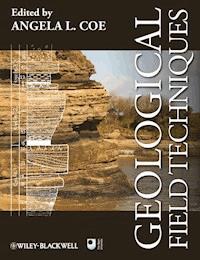
Front cover image: Carboniferous age (Namurian) rocks exposed at Sugar Sands Bay, near Alnwick, Northumberland, UK. These are part of a succession of rocks interpreted as infill of an interdistributary bay or lagoon along the shore of a delta. Superimposed on the photograph is part of a graphic log of the succession summarizing the thickness of the units, lithology, sedimentary structures and cycles. (Angela L. Coe, The Open University, UK.)
Back cover images (in descending order):
1. Walcott Quarry, Canadian Rockies during 1998 showing the exposure of the Burgess Shale (Cambrian) that is famous for the exceptional soft body preservation of some of the oldest fossils on Earth. (Angela L. Coe, The Open University, UK.)
2. Geologists working on the organic-rich mudrocks of the Monterey Formation (Miocene), Naples Beach, California, USA. (Anthony S. Cohen, The Open University, UK.)
3. Asymmetric folds in Proterozoic strata, Harvey’s Return, Kangaroo Island, Australia. Lens cap is 5.5 cm across. (Tom W. Argles, The Open University, UK.)
4. A Silva compass-clinometer being used to measure the dip of a fault plane, Whitesands Bay, St David’s, Wales, UK. (Tom W. Argles, The Open University, UK.)
5. The ammonite Psiloceras planorbis (J. de C. Sowerby) from the Lias Group, UK. This species defines the lowermost ammonite zone of the Jurassic. Ammonite is c. 4 cm across. (Peter R. Sheldon, The Open University, UK.)
Companion Website: A companion resources site for this book is available at www.wiley.com/go/coe/geology
With:
All figures and tables from the bookAdditional excercises and answersUseful websites, selected by the authorsPublished by Blackwell Publishing Ltd in association with
The Open University Walton Hall, Milton Keynes MK7 6AA United Kingdom
First published 2010 Copyright © 2010, The Open University
All rights reserved. No part of this publication may be reproduced, stored in a retrieval system, transmitted or utilised in any form or by any means, electronic, mechanical, photocopying, recording or otherwise, without written permission from the publisher or a licence from the Copyright Licensing Agency Ltd. Details of such licences (for reprographic reproduction) may be obtained from the Copyright Licensing Agency Ltd, Saffron House, 6–10 Kirby Street, London EC1N 8TS (website www.cla.co.uk).
Open University course materials may also be made available in electronic formats for use by students of the University. All rights, including copyright and related rights and database rights, in electronic course materials and their contents are owned by or licensed to The Open University, or otherwise used by The Open University as permitted by applicable law.
In using electronic course materials and their contents you agree that your use will be solely for the purposes of following an Open University course of study or otherwise as licensed by The Open University or its assigns.
Except as permitted above you undertake not to copy, store in any medium (including electronic storage or use in a website), distribute, transmit or retransmit, broadcast, modify or show in public such electronic materials in whole or in part without the prior written consent of The Open University or in accordance with the Copyright, Designs and Patents Act 1988.
The paper used in this publication is procured from forests independently certified to the level of Forest Stewardship Council (FSC) principles and criteria. Chain of custody certification allows the tracing of this paper back to specific forest-management units (see www.fsc.org).
Details of Open University courses can be obtained from the Student Registration and Enquiry Service, The Open University, PO Box 197, Milton Keynes MK7 6BJ, United Kingdom (tel. +44 (0)845 300 60 90, email [email protected]).
www.open.ac.uk
Library of Congress Cataloging-in-Publication Data
Geological field techniques / edited by Angela L. Coe. p. cm. Includes bibliographical references and index. ISBN 978-1-4443-3061-8 (hardback) ISBN 978-1-4443-3062-5 (paperback) 1. Geology–Fieldwork. I. Coe, Angela L. QE45.G46 2010 550.072'3–dc22
2010016419
Preface
Working in the field contributes a crucial element to our knowledge and understanding of Earth processes, whether it is the prediction of volcanic eruptions, understanding periods of past climate change recorded in sedimentary deposits, deciphering an episode of mountain building, or working out where to find mineral resources. Without primary field data and geological samples of the highest quality, further scientific study such as sophisticated isotope measurements or the reconstruction of past life assemblages and habitats is at best without context, and at worst, completely meaningless.
Geological fieldwork can be both fun and challenging. It provides the chance to work outdoors under a range of conditions and to explore our natural world. It also provides an often unparalleled opportunity to travel and visit localities as more than a tourist. Indeed it often takes you to unspoilt parts of the world that tourists rarely penetrate. Almost all fieldwork enables us to work as part of a team, often with international partners, and this can be one of the most rewarding experiences of being a geologist because we can learn from each other. Many long-term friendships have been forged through geological fieldwork.
This book is aimed primarily at undergraduates studying geology and Earth sciences. It will also potentially be of use to engineers, archaeologists and environmental scientists who need to collect information on the bedrock. The increasingly multidisciplinary nature of science will make the text useful to masters, doctoral and professional scientists who do not have a background in practical geology or Earth science. The book is non-site specific and includes examples from around the world. There are chapters covering data collection from igneous, metamorphic and sedimentary rocks as well as specific chapters on palaeontological and structural data collection. It also deals with the basics of geological mapping.
The book assumes a basic understanding of the main concepts and theory in geology. It assumes that the reader is familiar with: the major rock-forming minerals, how to identify minerals in hand specimen, rock classification, geological processes and common geological terms. The further reading lists at the ends of the chapters provide a selection of introductory geological texts as well as more specialist ones. In addition there are appendices summarizing key geological features and classification schemes. There is also an accompanying website (www.wiley.com/go/coe/geology) with all of the figures, tables, links to other websites and other material. Reviews of the original book proposal suggested expansion of certain chapters and even the deletion of others, however, none of the reviewers agreed on which chapters these should be so clearly it is a matter of personal preference. We have therefore kept to the broad overview, and refer the reader to more specialist fieldwork texts that are available, and hope that this book inspires others to write textbooks on more specific fieldwork topics that are not available.
Writing a book on field techniques has long been an ambition of mine; the style and organization has had a lengthy gestation period during many months of fieldwork, both as a researcher and a university lecturer. I am delighted that when I was eventually able to spend some time completing this task I was joined by a number of colleagues who had expertise that complemented my own; it has been a pleasure to work with them. I would like to thank all the colleagues, PhD students and undergraduate students that I have worked with. My experience of being with them in the field has helped me to shape this book.
Wishing you both enjoyable and highly productive fieldwork.
Angela L.CoeThe Open University, November 2009
Acknowledgements
Ian Francis and Kelvin Matthews of Wiley-Blackwell are thanked for their support and advice and for managing the production of this book. We are grateful to Harry Langford for copy editing. We would also like to thank Jim Iley of The Open University and Susan Francis and Matt Lloyd of Cambridge University Press for their enthusiastic support in the initial stages of this project. The help of The Open University co-publication team–Giles Clark, David Vince and Christianne Bailey–is gratefully acknowledged. Ruth Drage is thanked for her help in managing the artwork part of the project and for her input to the book design.
We are very grateful to Tiffany Barry, Kate Bradshaw, Richard Brown, Brian McDonald, Susan Ramsay, Janet Sumner, Paul Temple and Clare Warren, all of whom were brave enough to lend us their field notebooks for reproduction in this book. We are also grateful to Kate Andrew and Susie Clarke who kindly allowed us to copy part of their geological field and fair copy maps. The unpublished field notes of these individuals are accredited in the figure captions.
Many thanks go to Ian Wightman whose inspiring and amusing cartoons have livened up this book. Andrew Tindle (The Open University) is thanked for his excellent photography of most of the hand specimens (particularly Chapters 8 and 9) and for providing a set-up for photographing specimens and field notebooks. Various colleagues have allowed us to reproduce their photographs in this book, for which we are grateful. These individuals are acknowledged in the figure captions. Andrew Whitehead and David DuPlessis with the help of Chris Hough and Jon Owen (The Open University) prepared the final version of the figures. Richard Howes is thanked for general assistance with the electronic files. We are grateful to Andrew Lloyd for help with scanning, image processing and also for contributing to the design and preparation of the cover image for this book.
We are grateful to all of the anonymous academic reviewers contacted by Wiley-Blackwell and Cambridge University Press who provided feedback and ideas on the book proposal. Susan Ramsay (University of Glasgow), Ian Parkinson (The Open University), Clare Warren (The Open University) and two anonymous reviewers contacted by Wiley-Blackwell are thanked for their comments on earlier versions of this manuscript.
Last, but not least, we would like to thank our field colleagues, and students, for interesting and stimulating discussion in the field.
Figure acknowledgements
Grateful acknowledgement is made to the following sources for previously published figures (for full references see pp. 261–262):
Map extracts in Figures 2.11, 2.12, 10.1a, 10.1b and 10.5. Reproduced with permission of the Ordnance Survey on behalf of Her Majesty’s Stationary Office. © Crown Copyright 2010. All rights reserved; Figure 5.13: Spicer, R. A., and Hill, C. R. 1979. ‘Principal components. …’,Review of Palaeobotany and Palynology. Elsevier Inc; Figure 6.10: Coe, A. L. 1996. ‘Unconformities within. …’,in Special Publication No. 103, 1996. The Geological Society, London; Figures 6.13b and 6.14: Alexander, J. 1992. ‘Nature and origin of. …’, Journal of the Geological Society, Vol 149. Copyright © 1992 The Geological Society; Figure 7.16: Lippard, S. J. et al. 1986. The Ophiolite of Northern Oman. Copyright © 1986 The Geological Society; Figure 10.2b: Watts, D. R. et al. (2005) ‘Mapping granite and. …’, Geological Society of America Bulletin, Vol. 117. Copyright © 2005 Geological Society of America; Figure A5.4: After Goldring, R. 1991. Fossils in the Field. Copyright © 1991 Longman Group UK Limited; Figure A5.6: After North American Commission on Stratigraphic Nomenclature 1983. AAPG © 1983. American Association of Petroleum Geologists; Figures A6.9a, A6.9b and A6.13: After Stow, D. A. V. 2005. Sedimentary Rocks in the Field. Copyright © 2005 Manson Publishing Ltd; Figure A10.2: After McClay, K. R. 1991. The Mapping of Geological Structures. Geological Society of London Handbook. Copyright © K. R. McClay. John Wiley and Sons.
Every effort has been made to contact copyright holders. If any have been inadvertently overlooked we will be pleased to make the necessary amendments at the first opportunity.
1 Introduction
Angela L. Coe
The main aim of field geology is to observe and collect data from rocks and/or unconsolidated deposits, which will further our understanding of the physical, chemical and biological processes that have occurred over geological time. Many of the basic observational principles used in field geology have not changed for hundreds of years, although the interpretation of the data, the scale of resolution and some of the equipment has advanced greatly. Fieldwork involves making careful observations and measurements in the field (Figure 1.1 a) and the collection and precise recording of the position of samples for laboratory analysis (Figure 1.1 b). The very act of collecting field data often raises questions about processes on Earth, which had perhaps not previously been envisaged. Furthermore, during fieldwork it is usual to initiate, or to build on, constructing and testing different hypotheses and interpretations based on the observations; this iterative process will help to determine the essential data and samples to collect.
This book is divided into 14 chapters. Chapter 2 covers the most commonly used field equipment and outlines field safety procedures. Chapter 3 explores the general objectives of fieldwork and how to make a start. Chapter 4 is devoted to the production of a field notebook (hard copy or electronic), as this is the key record of geological field data. The bulk of the book comprises five chapters covering the necessary skills for the collection of palaeontological (Chapter 5 ), sedimentological (Chapter 6 ), igneous (Chapter 7 ), structural (Chapter 8 ) and metamorphic data (Chapter 9 ). Chapter 10 uses the field techniques covered in the previous five chapters to introduce geological mapping, where it is usually necessary to deal with a range of rock types and different kinds of exposure*. The book concludes with short chapters on recording numerical and geophysical data (Chapter 11 ), photography (Chapter 12 ) and sampling (Chapter 13 ).
Figure 1.1 (a) Geologists collecting data for a graphic log (Section 6.3 ) to record how a sedimentary succession has changed through time and to decipher the overall depositional environment. By working together they can share tasks and discuss their observations. (b) The recessed bed marks the Cretaceous – Paleogene boundary at Woodside Creek, near Kekerengu, New Zealand. Note the holes where samples have been extracted for palaeomagnetism studies. In this case the number of holes is rather excessive and breaks the code of good practice (Section 2.12 and Chapter 13 ). (a and b: Angela L. Coe, The Open University, UK.)
Field geology presents four main intellectual challenges. These are:
1. Deciding what data to collect in order to address the scientific question(s).
2. Finding the most suitable exposures from which to collect the data.
3. Making a good record of the data collected; preferably a record that can be understood by others and can be used years after the data were collected.
4. Understanding and interpreting the basic observations that you make.
This book deals with challenges 1, 2 and 3. Challenge 4, interpreting the observations, is to a large extent a matter of experience and having a good theoretical understanding of geology and geological processes. There are many general geological and Earth science textbooks on the market, a selection of which are included in the further reading lists at the end of each chapter. Deciding what data to collect relates directly to the objective of the fieldwork (Chapter 3 ). Some typical overall objectives are: constructing the geological history of a region (Chapter 10 ), collecting data on a period of climate change (Chapter 6 ), gathering evidence for a mass extinction event (Chapter 5 ), understanding a phase of igneous activity (Chapter 7 ) or mountain building (Chapters 8 and 9 ), together with finding and evaluating mineral or water resources and understanding natural hazards (e.g. landslides, earthquakes and fl oods; Chapters 6 and 8 ). Within each of these major objectives the fieldwork should be broken down into achievable daily tasks. Locating the most suitable exposures is crucial if the objective of the fieldwork is anything other than detailed mapping where ideally all exposures need to be examined. The different types of exposure are dealt with in Chapters 3 and 10, and more specific examples are given in Chapters 5 – 9. Throughout the book, but particularly in Chapter 4, we have provided ideas and examples for constructing effective field notebooks. We have also added practical tips in the margin, and fl owcharts for deductive thinking processes and tasks. In Chapters 5 – 10 we have used worked examples to demonstrate both the method of reasoning and the way in which particular problems have been tackled.
1.1 A selection of general books and reference material on geology
Allerby, M. 2008. A Dictionary of Earth Sciences, Oxford University Press, 672 pp.
Bishop, A., Woolley, A. and Hamilton, W. 1999. Minerals, Rocks and Fossils, Cambridge University Press, 336 pp. [Small book with colour photos and brief, reliable descriptions of minerals, rocks and fossils.]
Cockell, C., Corfield, R., Edwards, N. E. and Harris, N. B. W. 2008. An Introduction to the Earth - Life System, Cambridge University Press and The Open University, 328 pp. [Full colour book covering Earth system science at the Earth ’ s surface with particular reference to life systems.]
Grotzinger, J., Jordan, T. H., Press, F. and Siever, R. 2006 .Understanding Earth ( 5th edition ) W. H. Freeman & Co., 670 pp. [An outstanding, clearly written, widely used introduction to Earth sciences with many colour illustrations providing a global perspective.]
Keary, P. 2005. Penguin Dictionary of Geology, Penguin, 336 pp.
Murck, B. W. 2001. Geology: A Self - teaching Guide, John Wiley & Sons, 336 pp.
Rogers, N. W., Blake, S., Burton, K., Widdowson, M., Parkinson, I. and Harris N. B. W. 2008. An Introduction to Our Dynamic Planet, Cambridge University Press and The Open University, 398 pp. [Full colour book covering the solid Earth aspects of Earth system science, including planetary formation, the Earth ’ s structure, plate tectonics and volcanology.]
Rothery, D. A. 2010. Teach Yourself Geology ( 4th edition ), Hodder and Stoughton, 288 pp. [Covers all of the basics and is useful as either a primer or a refresher.]
Stanley, S. 2005. Earth System History, W. H. Freeman & Co., 567 pp. [Accessible look at the Earth as a system. Extensively illustrated in full colour.]
1.2 Books on geological field techniques
Compton, R. A. 1985. Geology in the Field, John Wiley & Sons, 398 pp. [Comprehensive but dense black and white book on basic geology and field techniques. Replacement of Compton ’ s Manual of Field Geology (1962).]
Freeman, T. 1999. Procedures in Field Geology, Blackwell Science, 93 pp. [Pocket sized, black and white book covering mainly mapping techniques, with particular emphasis on compassclinometer and trigonometric solutions for recording the geometry of geological features.]
Maley, T. S. 2005. Field Geology Illustrated, Mineral Land
Publications, 704 pp. [Book illustrating geological features and terms through hundreds of clear black and white photographs and line drawings.]
See also: Barnes and Lisle 2003 (Section 10.7 ); Fry 1991 (Section 9.5 ); McClay 1991 (Section 8.4 ); Stow 2005, Tucker 2003 (Section 6.6 ); and Thorpe and Brown 1991 (Section 7.5 ).
* The term exposure is used to indicate areas where rocks are visible at the Earth ’ s surface. This is in contrast to the term outcrop which also encompasses those areas where the rock is at the Earth ’ s surface but is covered by superficial deposits and soil.
2
Field equipment and safety
Angela L. Coe
This chapter covers general geological field equipment and its use. It also provides an overview of the health and safety requirements in the field. More specialist field equipment and safety considerations are covered within Chapters 5 – 10 where appropriate. Sampling is covered as a separate topic in Chapter 13 and photographic equipment is briefly reviewed in Chapter 12. All the health and safety notes provided in this book are generic. Other sources and regulations will need to be consulted and followed depending on the field area, the country, the nature of the fieldwork and the regulations of your employer or educational institution.
2.1 Introduction
Before going out into the field it is necessary to: (1) assemble all of the field equipment that you might need; (2) assess any safety issues; and (3) if necessary obtain permission to visit the area. Both the safety and permission aspects may require documentation to be completed. Exactly what equipment you will need depends on the type of fieldwork you will be undertaking. The items required for most fieldwork tasks are listed in Table , and the equipment usually needed for sampling in Table on p. 6. Optional equipment and that needed for more specialist tasks is listed in Table on p. 6.
Lesen Sie weiter in der vollständigen Ausgabe!
Lesen Sie weiter in der vollständigen Ausgabe!
Lesen Sie weiter in der vollständigen Ausgabe!
Lesen Sie weiter in der vollständigen Ausgabe!
Lesen Sie weiter in der vollständigen Ausgabe!
Lesen Sie weiter in der vollständigen Ausgabe!
Lesen Sie weiter in der vollständigen Ausgabe!
Lesen Sie weiter in der vollständigen Ausgabe!
Lesen Sie weiter in der vollständigen Ausgabe!
Lesen Sie weiter in der vollständigen Ausgabe!
Lesen Sie weiter in der vollständigen Ausgabe!
Lesen Sie weiter in der vollständigen Ausgabe!
Lesen Sie weiter in der vollständigen Ausgabe!
Lesen Sie weiter in der vollständigen Ausgabe!
Lesen Sie weiter in der vollständigen Ausgabe!
Lesen Sie weiter in der vollständigen Ausgabe!
Lesen Sie weiter in der vollständigen Ausgabe!
Lesen Sie weiter in der vollständigen Ausgabe!
Lesen Sie weiter in der vollständigen Ausgabe!
Lesen Sie weiter in der vollständigen Ausgabe!
Lesen Sie weiter in der vollständigen Ausgabe!




