


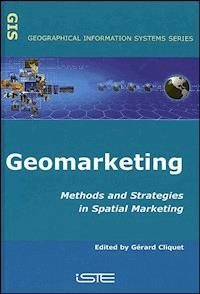
Geomarketing E-Book
146,99 €
Mehr erfahren.
- Herausgeber: John Wiley & Sons
- Kategorie: Fachliteratur
- Sprache: Englisch
This title describes the state of the art in all areas of spatial marketing, discussing the various constituents which make up the geography of markets. Demand varies according to location and can be measured according to revenue, the number of households, spending patterns and lifestyles. Supply is also dependent on position, because prices, services, products and available shops rely on location, while the difference between supply and demand is the rationale for the role of the trader. The book also covers the way geographic techniques help to solve marketing problems and contains chapters written by contributors with extensive experience in this field; given that it is crucial for companies to direct their marketing correctly at their target audience, this will be indispensable reading for those involved in this area.
Sie lesen das E-Book in den Legimi-Apps auf:
Seitenzahl: 576
Veröffentlichungsjahr: 2013
Ähnliche




















Table of Contents
Chapter 1: Spatial Marketing
Introduction
1.1. Marketing and geography
1.2. Spatial marketing applications
1.3. Conclusion
1.4. References
PART I: Consumer Behavior and Geographic Information
Chapter 2: Consumer Spatial Behavior
Introduction
2.1. Observation of spatial behavior
2.2. Gravitational modeling or the management of “stocks” of clients
2.3. The subjective approach and choice models
2.4. The management of the flow of customers: new research perspectives
2.5. Conclusion
2.6. References
Chapter 3: Consumer Values, Lifestyles and Geographic Information
Introduction
3.1. Values and related concepts
3.2. Values in marketing
3.3. Geographic analysis of values
3.4. Values and lifestyles examined by research companies
3.5. Conclusion
3.6. References
Chapter 4: Geomarketing and Consumer Behavior
Introduction
4.1. The foundations of geomarketing
4.2. An application: the development of behavioral databases for a territory
4.3. Conclusion
4.4. References
PART II: Retail Location and Geographic Information
Chapter 5: Geographical Information in Retail Store Location: A Managerial Perspective
Introduction
5.1. The location research tradition
5.2. Location and decision-making
5.3. Location, retailers and consumers
5.4. Conclusion
5.5. References
Chapter 6: Retail Location Models
Introduction
6.1. Gravitation models
6.2. Spatial interaction models
6.3. Combined attraction models for multiple locations
6.4. Location models and geographic information
6.5. Conclusion
6.6. References
Chapter 7: GIS and Retail Location Models
Introduction
7.1. Stages in the development of store location methods
7.2. Changes in retail distribution: an example from the motor industry
7.3. Modeling ideal partners
7.4. Conclusions
7.5. References
Chapter 8: Spatial Strategies in Retail and Service Activities
Introduction
8.1. Typology of spatial strategies
8.2. Networking in retail and service activities
8.3. Territory coverage and spatial strategies
8.4. Conclusion
8.5. References
PART III: Marketing Management and Geographic Information
Chapter 9: Price and Geographic Information
Introduction
9.1. The impact of the geographic dimension on the components of price
9.2. Geographic pricing policies
9.3. Conclusion
9.4. References
Chapter 10: Advertising Policy and Geographic Information
Introduction
10.1. The use of geographic information in advertising strategy
10.2. The principal users of geomarketing in the advertising domain
10.3. The potential users of geomarketing in the advertising domain
10.4. Conclusion
10.5. References
10.6. Bibliography
Chapter 11: Direct Marketing and Geographic Information
Introduction
11.1. Taking space into account in direct marketing
11.2. The definition of the territory and the level of geographic indirect marketing
11.3. Conclusion
11.4. References
Chapter 12: Products and Geographic Information: Geo-Merchandizing
Introduction
12.1. The factors explaining the development of geo-merchandizing
12.2. A typology of geo-merchandizing approaches
12.3. The implementation of geo-merchandizing
12.4. Conclusion
12.5. References
List of Contributors
Index
First published in France in 2002 by Hermes Science/Lavoisier entitled “Le géomarketing: méthodes et stratégies du marketing spatial”
First published in Great Britain and the United States in 2006 by ISTE Ltd
Translated by Eugene Hughes
Apart from any fair dealing for the purposes of research or private study, or criticism or review, as permitted under the Copyright, Designs and Patents Act 1988, this publication may only be reproduced, stored or transmitted, in any form or by any means, with the prior permission in writing of the publishers, or in the case of reprographic reproduction in accordance with the terms and licenses issued by the CLA. Enquiries concerning reproduction outside these terms should be sent to the publishers at the undermentioned address:
ISTE Ltd6 Fitzroy SquareLondon W1T 5DXUKISTE USA4308 Patrice RoadNewport Beach, CA 92663USAwww.iste.co.uk © LAVOISIER, 2002© ISTE Ltd, 2006The rights of Gérard Cliquet to be identified as the author of this work has been asserted in accordance with the Copyright, Designs and Patents Act 1988.
Library of Congress Cataloging-in-Publication Data
Cliquet, Gérard.
[Géomarketing. English]
Geomarketing: methods and strategies in special marketing / Gerard Cliquet.-- 1st ed.
p. cm.
ISBN-13: 978-1-905209-07-1
1. Target marketing. 2. Consumer behavior. I. Title.
HF5415.127.C5513 2006
658.8'04--dc22
005035291
British Library Cataloguing-in-Publication Data
A CIP record for this book is available from the British Library
ISBN 10: 1-905209-07-X
ISBN 13: 978-1-905209-07-1
Chapter 1
Spatial Marketing1
Introduction
According to many philosophers [BEN 01] following Foucault [FOU 94], space characterizes our era. This would seem quite paradoxical when compared to Moscovici’s [MOS 83, p. 262] remark which asserts, throughout the 20th century, nothing less than “the disappearance of geography”, a logical continuation from the author of the “temporalization of space.” Yet, if this temporalization of space can lead to inevitable selections, not to say exclusions, the “spatialization of time”, on the other hand, opens up more generous perspectives [BEN 01] and leads to a different philosophical understanding of history.
What is good for history is also good for other social science disciplines. Marketing, in its allacticological1 understanding [CLI 99] or its dimension of exchange, commercial or not, is not an exception. The importance of the dimension of space increases inversely with market expansion. It should be noted in passing that considering the arrival of the internet as a new form of the disappearance of the geography of markets would no doubt be committing a serious error. Consumers remain very precisely localized in geographic space, which explains that the difficulties met by certain internet distribution companies in delivering to their clients [CLI 01], and the companies themselves, although present on the web, still originate from very precise geographic zones from which they cannot easily escape [VOL 00].
We have denounced the lack of interest amongst researchers in spatial analysis in marketing [GRE 83]. Marketing researchers have instead turned more towards behavioral science. However, spatial aspects have returned to the forefront with the enlargement of the horizon of firms, particularly in the retailing industry, on the one hand and with the development of geomarketing techniques on the other. The geography of markets constitutes an ensemble of important elements in the realm of marketing for at least four reasons [JON 99]:
– demand varies according to available space and can be measured just as easily in terms of revenue, number of households, budgetary structures of spending, and lifestyles;
– supply also varies according to available space in that prices, services, the products and available stores vary with location;
– supply and demand are generally separate, which justifies the role of the retailer, whose job is to overcome this separation by studying the spatial behavior of both consumers and shopping centers, as well as the logistic chain of supplies at regional, national and international levels;
– the majority of economic activities use space and space has a cost. In order to control it better, this space must be decomposed into units of analysis: this division can rest just as easily on politico-administrative considerations as on census units or even zip/postal codes.
The title of this book makes reference, as indicated by the overall theme of the area of study to which it belongs (Information Géographique et Aménagement du Territoire2), to geographic information. Defining geographic information is not so simple when it deals with “a very widespread type of information” or in other words, “objects or physical phenomena, or living beings or societies, from the moment that they are linked to a territory” [DEN 96]. Yet if geographic information is at the heart of the approach followed in this book, it will not be possible to ignore the other real and potential benefits of geography to marketing, from both the conceptual and methodological points of view.
The introduction of geography into marketing cannot be limited to a simple division of space and to the utilization of geographic software destined to process large quantities of localized data. There have been publications since the 1970s that have shown the importance of mapping in marketing decisions [BEL 78]. It is true that these studies have considerably improved our knowledge of market spheres, but they do not constitute in any way a foundation for marketing strategy. That is why this book, after describing what is happening in marketing thanks to the introduction of geographic information, will set out to open up the research perspectives, not as far as geomarketing is concerned, which represents above all a collection of techniques, but with the admittedly ambitious objective of developing true spatial marketing.
We will therefore begin by examining the links between marketing and geography by showing, on the one hand, the importance of space in decisions made by companies today and, on the other hand, that beyond geomarketing, it is actually a true spatial marketing that organizations need. We will then tackle the applications of geography, starting with the most classic, retail location, followed by the current and future utilization possibilities at the very heart of the other elements of the marketing mix.
Lesen Sie weiter in der vollständigen Ausgabe!
Lesen Sie weiter in der vollständigen Ausgabe!
Lesen Sie weiter in der vollständigen Ausgabe!
Lesen Sie weiter in der vollständigen Ausgabe!
Lesen Sie weiter in der vollständigen Ausgabe!
Lesen Sie weiter in der vollständigen Ausgabe!
Lesen Sie weiter in der vollständigen Ausgabe!
Lesen Sie weiter in der vollständigen Ausgabe!
Lesen Sie weiter in der vollständigen Ausgabe!
Lesen Sie weiter in der vollständigen Ausgabe!
Lesen Sie weiter in der vollständigen Ausgabe!
Lesen Sie weiter in der vollständigen Ausgabe!
Lesen Sie weiter in der vollständigen Ausgabe!
Lesen Sie weiter in der vollständigen Ausgabe!
Lesen Sie weiter in der vollständigen Ausgabe!
Lesen Sie weiter in der vollständigen Ausgabe!




