


2,49 €
Mehr erfahren.
- Herausgeber: Blagoy Kiroff
- Kategorie: Geisteswissenschaft
- Sprache: Englisch
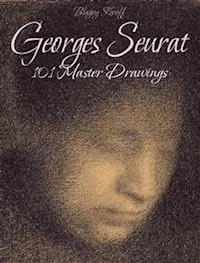
An important Post-Impressionist French painter, Georges Seurat moved away from the apparent spontaneity and rapidity of Impressionism and developed a structured, more monumental art to depict modern urban life. Seurat studied avant-garde painting techniques, especially Impressionism and the latest scientific theories pertaining to light and color. From 1885 to 1886 he developed the divisionist depicting. This new style, which consisted of systematically applied small touches of unmodulated color, was based on contemporary optical theories of color relationships. For several of his large compositions, Seurat painted many small studies. For his study drawings he used black Conté crayon to create gradations of tone on the textured paper, achieving effects akin to those in his pointillist paintings, in which he juxtaposed dots of pure colors that blended optically to produce another color.
Das E-Book können Sie in Legimi-Apps oder einer beliebigen App lesen, die das folgende Format unterstützen:
Veröffentlichungsjahr: 2015
Ähnliche

Georges Seurat:
101 Master Drawings
By Blagoy Kiroff
––––––––
First Edition
*****
Georges Seurat:: 101 Master Drawings
*****
Copyright © 2015 Blagoy Kiroff
Table of Contents
Title Page
Copyright Page
Foreword
Drawings
Foreword
An important Post-Impressionist French painter, Georges Seurat moved away from the apparent spontaneity and rapidity of Impressionism and developed a structured, more monumental art to depict modern urban life. For several of his large compositions, Seurat painted many small studies. He is chiefly remembered as the pioneer of the Neo-Impressionist technique commonly known as Divisionism, or Pointillism, an approach associated with a softly flickering surface of small dots or strokes of color. His innovations derived from new quasi-scientific theories about color and expression, yet the graceful beauty of his work is explained by the influence of very different sources. Initially, he believed that great modern art would show contemporary life in ways similar to classical art, except that it would use technologically informed techniques. Later he grew more interested in Gothic art and popular posters, and the influences of these on his work make it some of the first modern art to make use of such unconventional sources for expression. His success quickly propelled him to the forefront of the Parisian avant-garde. His triumph was short-lived, as after barely a decade of mature work he died at the age of only 31. But his innovations would be highly influential, shaping the work of artists as diverse as Vincent van Gogh and the Italian Futurists, while pictures like A Sunday Afternoon on the Island of La Grand Jatte have since become widely popular icons.
Georges Seurat first studied art with Justin Lequien, a sculptor then attended the Ecole des Beaux-Arts in 1878 and 1879. After a year of service at Brest Military Academy, he returned to Paris in 1880. He shared a small studio on the Left Bank with two student friends before moving to a studio of his own. For the next two years he worked at mastering the art of black-and-white drawing. He spent 1883 on his first major painting, a huge canvas titled Bathers at Asnieres.
After his painting was rejected by the Paris Salon, Seurat turned away from such establishments, instead allying with the independent artists of Paris. In 1884 he and other artists (including Maximilien Luce) formed the Societe des Artistes Independants. There he met and befriended fellow artist Paul Signac. Seurat shared his new ideas about Pointillism with Signac, who subsequently painted in the same idiom. In the summer of 1884, Seurat began work on his masterpiece, A Sunday Afternoon on the Island of La Grande Jatte, which took him two years to complete.
Seurat studied avant-garde painting techniques, especially Impressionism and the latest scientific theories pertaining to light and color. From 1885 to 1886 he developed the divisionist depicting. This new style, which consisted of systematically applied small touches of un-modulated color, was based on contemporary optical theories of colour relationships.
Two years after his first Neo-Impressionist work was shown at the Salon des Independants, Seurat exhibited A Sunday on La Grande Jatte at the eighth and final Impressionist group show in 1886. His disciplined technique exerted a considerable influence over Neo-Impressionist artists such as Camille Pissarro, Henri Edmond Cross, and Paul Signac.
Seurat died in Paris on 29 March 1891 at the age of 31. The cause of his death is uncertain. His last ambitious work, The Circus, was left unfinished at the time of his death.
Drawings
Study for 'Une Baignade'
1883, Conte crayon on cream paper
Detail
Detail
Seurat was an inspired draughtsman. He frequently used conte crayon and made full use of the subtle tones which the medium allowed, as well as exploiting the rough texture of his chosen 'Ingres' brand of paper. This study of the seated nude youth was made from a life model in Seurat's studio. He used it for the central figure in his monumental painting of 'The Bathers, Asnières' (The National Gallery, London). The stillness of the pose was carried over into the painting, where the youth sits languidly on the river bank, cooling his feet in the water.




