


39,59 €
Mehr erfahren.
- Herausgeber: Packt Publishing
- Kategorie: Wissenschaft und neue Technologien
- Sprache: Englisch
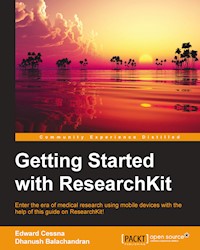
Enter the era of medical research using mobile devices with the help of this guide on ResearchKit!
About This Book
- Create a simple clinical research app using most aspects of ResearchKit
- Build a simple survey with various data types with the results printed on the screen.
- A step-by-step guide introducing Apple's ResearchKit and techniques to incorporate it into various apps.
Who This Book Is For
This book is aimed at medical researchers with basic iOS coding knowledge and iOS developers looking to create clinical research apps.
What You Will Learn
- Learn to create customized consent form
- Get introduced to two backend services: a simple backend server using Sinatra and Sage Bridge
- Build a custom task (a conditional survey example) and a navigable task
- Get an Overview of ResearchKit's open source repository and App Core
- Interaction with the hardware of the device including the gyro and the motion sensors
- Learn the basics of this revolutionary technology
- Get introduced to the barebones app and learn to write your first code
In Detail
ResearchKit is an open source software development framework from Apple that lets you easily create mobile applications for clinical research studies. ResearchKit provides you the ability to orchestrate the administration of tasks and recording of the results. ResearchKit provides tasks in order to perform informed consent, active tasks, and surveys.
Starting with the basics of the ResearchKit framework, this books walks you through the steps of creating iOS applications that could serve as the basis of a clinical research mobile app.
This book will introduce readers to ResearchKit and how to turn your iPhone into into a clinical research tool. The book will start off by installing and building the research framework in line with the researcher's needs; during this, the reader will learn to embed ResearchKit in the application and create a small task.
After this, the book will go a little deeper into creating modules for surveys, consents, and so on. The book will also cover the various aspects of privacy and security with regard to participant data, and how to build dashboards for visualizing medical data and results in line with the researcher's requirements: data backends, JSON serialization and deserialization, and so on.
Readers will be able to fully utilize ResearchKit for medical research, will be able to get more and more patients to participate in their surveys, and will gain insights from the surveys using the dashboards created.
Style and approach
A hands-on guide with ample screenshots for you to follow and learn about ResearchKit. Each topic is explained sequentially and placed in context so that you can get a better understanding of every step in the process of creating clinical research apps.
Sie lesen das E-Book in den Legimi-Apps auf:
Seitenzahl: 125
Veröffentlichungsjahr: 2016
Ähnliche



















Table of Contents
Getting Started with ResearchKit
Getting Started with ResearchKit
Copyright © 2016 Packt Publishing
All rights reserved. No part of this book may be reproduced, stored in a retrieval system, or transmitted in any form or by any means, without the prior written permission of the publisher, except in the case of brief quotations embedded in critical articles or reviews.
Every effort has been made in the preparation of this book to ensure the accuracy of the information presented. However, the information contained in this book is sold without warranty, either express or implied. Neither the author, nor Packt Publishing, and its dealers and distributors will be held liable for any damages caused or alleged to be caused directly or indirectly by this book.
Packt Publishing has endeavored to provide trademark information about all of the companies and products mentioned in this book by the appropriate use of capitals. However, Packt Publishing cannot guarantee the accuracy of this information.
First published: February 2016
Production reference: 1020216
Published by Packt Publishing Ltd.
Livery Place
35 Livery Street
Birmingham B3 2PB, UK.
ISBN 978-1-78588-917-2
www.packtpub.com
Credits
Authors
Dhanush Balachandran
Edward Cessna
Reviewers
Oliver Gepp
Andreas Griesser
Commissioning Editor
Veena Pagare
Acquisition Editor
Kevin Colaco
Content Development Editor
Sumeet Sawant
Technical Editor
Danish Shaikh
Copy Editor
Vibha Shukla
Project Coordinator
Shweta H Birwatkar
Proofreader
Safis Editing
Indexer
Mariammal Chettiyar
Graphics
Disha Haria
Production Coordinator
Nilesh Mohite
Cover Work
Nilesh Mohite
About the Authors
Dhanush Balachandran has a vast experience in creating mobile apps for healthcare industry that include several ResearchKit apps. He was the lead iOS engineer at Jiff, a healthcare start-up and later worked on ResearchKit-based apps for leading institutions. Currently, he is an iOS engineer at DJI. He is also the founder & CEO of mobile app startup, Sortly.
Edward Cessna is the software engineering director for Y Media Labs, a digital agency in Northern California that creates mobile applications. He has three decades of software engineering experience—ranging from embedded software providing cryptographic services to a multitude of iOS applications. He has been working with iOS since its first public release in July 2008. He has managed the development effort for a number of ResearchKit-based applications for leading research institutions.
About the Reviewers
Oliver Gepp is a senior software engineer at Zühlke Group, Switzerland with a strong focus on mobile apps. He has a diploma in media computer science from the Technical University of Dresden, Germany. Most of his projects are in the insurance and banking business, where he covers the whole application life cycle such as business analysis, development, and testing. His passion is developing mobile apps for the iOS platform not only in Swift and Objective-C, but also with cross platform technologies such as Xamarin.
Andreas Griesser is leading the business development at Zühlke Group, Switzerland in the area of LabScience, Pharmaceutical & Biotechnology. He holds a master's degree in telecommunication, mathematics, and informatics from the Technical University of Graz, Austria and a PhD in computer science from the Swiss Federal Institute of Technology, Switzerland (ETH). During his career, he was involved in research projects of real-time three-dimensional scanning, general-purpose computing on graphics processing units (GPGPU), and medical image analysis.
Under his current activities at Zühlke in the healthcare sector, he focuses on topics such as digital transformation and connected devices—not only on a technical level, but also with a business-related perspective.
www.PacktPub.com
Support files, eBooks, discount offers, and more
For support files and downloads related to your book, please visit www.PacktPub.com.
Did you know that Packt offers eBook versions of every book published, with PDF and ePub files available? You can upgrade to the eBook version at www.PacktPub.com and as a print book customer, you are entitled to a discount on the eBook copy. Get in touch with us at <[email protected]> for more details.
At www.PacktPub.com, you can also read a collection of free technical articles, sign up for a range of free newsletters and receive exclusive discounts and offers on Packt books and eBooks.
https://www2.packtpub.com/books/subscription/packtlib
Do you need instant solutions to your IT questions? PacktLib is Packt's online digital book library. Here, you can search, access, and read Packt's entire library of books.
Why subscribe?
Free access for Packt account holders
If you have an account with Packt at www.PacktPub.com, you can use this to access PacktLib today and view 9 entirely free books. Simply use your login credentials for immediate access.
Preface
This book helps you get started on creating ResearchKit-based applications. ResearchKit™ is an open source framework introduced by Apple that allows researchers and developers to create powerful apps for medical research.
What this book covers
Chapter 1, Getting Started, introduces ResearchKit and explains the anatomy of a ResearchKit-based application.
Chapter 2, ResearchKit Hello World, helps you create your first ResearchKit application and teaches how to integrate ResearchKit in your projects.
Chapter 3, Building Surveys, covers how to create and present clinical surveys. In this process, you'll also learn about the ResearchKit object model.
Chapter 4, ResearchKit Informed Consent, explains how to create, present, and obtain informed consent to participate in clinical studies from the end users.
Chapter 5, Active Tasks, covers how to use active tasks—one of the most important features of ResearchKit.
Chapter 6, Navigable and Custom Tasks, helps you create smart surveys that can skip questions based on the answers provided by users.
Chapter 7, Back End Service, explains how to serialize task results to send to a backend service.
Chapter 8, Where to go from here, helps you learn various tools and tips to create real-world ResearchKit applications.
What you need for this book
Access to the Internet to download the source code associated with this book
Who this book is for
This book is aimed at medical researchers with basic iOS coding knowledge and iOS developers looking to create clinical research apps.
Reader feedback
Feedback from our readers is always welcome. Let us know what you think about this book—what you liked or may have disliked. Reader feedback is important for us to develop titles that you really get the most out of.
To send us general feedback, simply send an e-mail to <[email protected]>, and mention the book title via the subject of your message.
If there is a topic that you have expertise in and you are interested in either writing or contributing to a book, see our author guide on www.packtpub.com/authors.
Customer support
Now that you are the proud owner of a Packt book, we have a number of things to help you to get the most from your purchase.
Downloading the example code
You can download the example code files for all Packt books you have purchased from your account at http://www.packtpub.com. If you purchased this book elsewhere, you can visit http://www.packtpub.com/support and register to have the files e-mailed directly to you.
Errata
Although we have taken every care to ensure the accuracy of our content, mistakes do happen. If you find a mistake in one of our books—maybe a mistake in the text or the code—we would be grateful if you would report this to us. By doing so, you can save other readers from frustration and help us improve subsequent versions of this book. If you find any errata, please report them by visiting http://www.packtpub.com/submit-errata, selecting your book, clicking on the erratasubmissionform link, and entering the details of your errata. Once your errata are verified, your submission will be accepted and the errata will be uploaded on our website, or added to any list of existing errata, under the Errata section of that title. Any existing errata can be viewed by selecting your title from http://www.packtpub.com/support.
Piracy
Piracy of copyright material on the Internet is an ongoing problem across all media. At Packt, we take the protection of our copyright and licenses very seriously. If you come across any illegal copies of our works, in any form, on the Internet, please provide us with the location address or website name immediately so that we can pursue a remedy.
Please contact us at <[email protected]> with a link to the suspected pirated material.
We appreciate your help in protecting our authors, and our ability to bring you valuable content.
Questions
You can contact us at <[email protected]> if you are having a problem with any aspect of the book, and we will do our best to address it.
Chapter 1. Getting Started
On March 9, 2015, Apple introduced ResearchKit, a software framework that facilitates the development of health and clinical-based research applications for iOS. Doctors and researchers will be able to collect larger quantities of data frequently and with greater accuracy through the applications built with ResearchKit. The ultimate goal is to increase the research community's knowledge on diseases that could potentially lead to medical breakthroughs in the treatment of the studied diseases.
In conjunction with ResearchKit's announcement, Apple announced and released five ResearchKit-based applications. These applications are as follows:
The five initial ResearchKit-based applications shared similar user experience. Using a common application core that's independent of ResearchKit, these applications had a common on-boarding process to enroll new participants in the study, an activity list to present tasks that the researchers wish the participants to carry out, and a dashboard to present the results of the previously carried out tasks. Additionally, these applications used the same backend service to establish accounts, download task schedules and surveys, and upload the collected data in a secure manner.
Apple has open sourced all of the initial ResearchKit applications, and the application core that provides additional services and capabilities beyond these features of ResearchKit.
Note
Links to the source code, documentation, and other information can be found on www.apple.com/researchkit and www.researchkit.org; the source code is hosted directly on GitHub at https://github.com/researchkit.
The open source applications serve as an example for researchers to undertake the development of their own ResearchKit-based applications. As examples, there are differences between these applications and the ones available from the App Store. In general, copyright material has been removed along with the cryptographic credentials that enable the applications to upload data to the researcher's servers.
What is ResearchKit?
At its core, ResearchKit orchestrates the administering of tasks and recording of the results from each




