


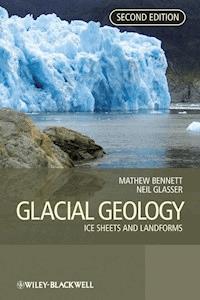
Glacial Geology E-Book
50,99 €
Mehr erfahren.
- Herausgeber: John Wiley & Sons
- Kategorie: Wissenschaft und neue Technologien
- Sprache: Englisch
The new Second Edition of Glacial Geology provides a modern, comprehensive summary of glacial geology and geomorphology. It is has been thoroughly revised and updated from the original First Edition. This book will appeal to all students interested in the landforms and sediments that make up glacial landscapes.
The aim of the book is to outline glacial landforms and sediments and to provide the reader with the tools required to interpret glacial landscapes. It describes how glaciers work and how the processes of glacial erosion and deposition which operate within them are recorded in the glacial landscape.
The Second Edition is presented in the same clear and concise format as the First Edition, providing detailed explanations that are not cluttered with unnecessary detail. Additions include a new chapter on Glaciations around the Globe, demonstrating the range of glacial environments present on Earth today and a new chapter on Palaeoglaciology, explaining how glacial landforms and sediments are used in ice-sheet reconstructions. Like the original book, text boxes are used throughout to explain key concepts and to introduce students to case study material from the glacial literature. Newly updated sections on Further Reading are also included at the end of each chapter to point the reader towards key references. The book is illustrated throughout with colour photographs and illustrations.
Sie lesen das E-Book in den Legimi-Apps auf:
Seitenzahl: 621
Veröffentlichungsjahr: 2011
Ähnliche




















Contents
Preface
Acknowledgements
Illustrations
Chapter 1: Introduction
1.1 What is Glacial Geology and Why is it Important?
1.2 The Aim and Structure of this Book
Chapter 2: Glaciations Around The Globe
2.1 The Antarctic Ice Sheet
2.2 Greenland in the Greenhouse
2.3 Southern Hemisphere Temperate Glaciers: Patagonia and New Zealand
2.4 Northern Hemisphere Temperate Glaciers: Alaska and Iceland
2.5 High-Altitude Glaciers: The Himalaya
2.6 Tropical Glaciers: The Cordillera Blanca, Peru
2.7 Arctic Polythermal Glaciers
2.8 Summary
Suggested Reading
Chapter 3: Mass Balance and the Mechanisms of Ice Flow
3.1 Annual Mass Balance
3.2 The Mass Balance Gradient: The Glacial Driving Mechanism
3.3 Mechanisms of Ice Flow
3.4 The Principles of Basal Thermal Regime
3.5 Patterns and Rates of Ice Flow
3.6 Glacier Response to Climate Change
3.7 Summary
Suggested Reading
Chapter 4: Glacier Hydrology
4.1 Glacier Hydrology
4.2 Sources of Glacial Meltwater
4.3 Storage of Water in Glaciers
4.4 Methods of Studying Glacier Hydrology
4.5 Glacier Hydrological Systems
4.6 Subglacial Water Pressure
4.7 Discharge Fluctuations
4.8 Glacial Meltwater Erosion
4.9 Summary
Suggested Reading
Chapter 5: The Processes of Glacial Erosion
5.1 Glacial Abrasion
5.2 Glacial Quarrying
5.3 Estimating Rates of Glacial Erosion
5.4 Patterns of Glacial Erosion
5.5 Summary
Suggested Reading
Chapter 6: Landforms of Glacial Erosion
6.1 Microscale Features of Glacial Erosion
6.2 Mesoscale Features of Glacial Erosion
6.3 Macroscale Features of Glacial Erosion
6.4 Landscapes of Glacial Erosion
6.5 Summary
Suggested Reading
Chapter 7: Glacial Debris Entrainment and Transport
7.1 High-Level Debris Transport
7.2 Debris Entrainment
7.3 Low-Level Debris Transport
7.4 Debris Transfer Between Low and High Levels
7.5 Debris Transfer
7.6 Summary
Suggested Reading
Chapter 8: Glacial Sedimentation on Land
8.1 Direct Glacial Sedimentation
8.2 Fluvial Sedimentation
8.3 Summary
Suggested Reading
Chapter 9: Landforms of Glacial Deposition on Land
9.1 Ice-Marginal Moraines
9.2 Subglacial Landforms Formed by Ice or Sediment Flow
9.3 Glaciofluvial Ice-Marginal Landforms
9.4 Glaciofluvial Subglacial Landforms
9.5 Summary
Suggested Reading
Chapter 10: Glacial Sedimentation in Water
10.1 Sedimentation in Lacustrine Environments
10.2 Sedimentation in Marine Environments
10.3 Distinguishing Glaciolacustrine and Glaciomarine Diamicts from Glacial Tills
10.4 Summary
Suggested Reading
Chapter 11: Landforms of Glacial Deposition in Water
11.1 Glaciolacustrine Landforms
11.2 Glaciomarine Landforms
11.3 Summary
Suggested Reading
Chapter 12: Palaeoglaciology
12.1 The Methods Used in Palaeoglaciology
12.2 The Key Landforms Used in Palaeoglaciology
12.3 Former Subglacial Thermal Regimes
12.4 Palaeoglaciological Reconstructions
12.5 Summary
Suggested Reading
Index
This edition first published 2009© 2009 by John Wiley & Sons Ltd.
Wiley-Blackwell is an imprint of John Wiley & Sons, formed by the merger of Wiley’s global Scientific, Technical and Medical business with Blackwell Publishing.
Registered officeJohn Wiley & Sons Ltd, The Atrium, Southern Gate, Chichester, West Sussex, PO19 8SQ, UK
Other Editorial Offices9600 Garsington Road, Oxford, OX4 2DQ, UK111 River Street, Hoboken, NJ 07030-5774, USA
For details of our global editorial offices, for customer services and for information about how to apply for permission to reuse the copyright material in this book please see our website at www.wiley.com/wiley-blackwell
The right of the author to be identified as the author of this work has been asserted in accordance with the Copyright, Designs and Patents Act 1988.
All rights reserved. No part of this publication may be reproduced, stored in a retrieval system, or transmitted, in any form or by any means, electronic, mechanical, photocopying, recording or otherwise, except as permitted by the UK Copyright, Designs and Patents Act 1988, without the prior permission of the publisher.
Wiley also publishes its books in a variety of electronic formats. Some content that appears in print may not be available in electronic books.
Designations used by companies to distinguish their products are often claimed as trademarks. All brand names and product names used in this book are trade names, service marks, trademarks or registered trademarks of their respective owners. The publisher is not associated with any product or vendor mentioned in this book. This publication is designed to provide accurate and authoritative information in regard to the subject matter covered. It is sold on the understanding that the publisher is not engaged in rendering professional services. If professional advice or other expert assistance is required, the services of a competent professional should be sought.
Library of Congress Cataloging-in-Publication Data
Bennett, Matthew (Matthew R.)Glacial geology: ice sheets and landforms/Matthew R. Bennett,Neil F. Glasser. — 2nd ed.p. cm.Includes index.ISBN 978-0-470-51690-4 — ISBN 978-0-470-51691-11. Glacial landforms. 2. Glaciers. I. Glasser, Neil F. II. Title.GB581.B45 2009551.31—dc222008052800
ISBN: 978-0-470-51690-4 (HB)978-0-470-51691-1 (PB)
A catalogue record for this book is available from the British Library.
Preface
In the preface for the First Edition of Glacial Geology we wrote that this book is the product of two things: an enthusiasm for glacial geology and a perceived need for a student text with which to stimulate this enthusiasm in others. Thirteen years on we still believe this to be the case. The First Edition has sold well and has been well-received by undergraduates studying the subject. In the First Edition of Glacial Geology we also wrote that the aim of the book is simple: to provide an account of glacial geology which is accessible to undergraduates and uncluttered from unnecessary detail. Although we have taken the opportunity to update and revise a lot of the content in this Second Edition, reflecting new developments in the subject, we have tried to stay true to this original aim. We hope you will still find this an accessible and helpful treatment of the subject and that by reading this book you will share some of our enthusiasm for glacial geology.
Matthew R. BennettNeil F. GlasserBournemouth and Aberystwyth, 2009
Acknowledgements
The writing of any text inevitably draws upon the accumulated wisdom of innumerable colleagues. This book is written for undergraduates and consequently it is broad in approach, with little space for the explanation of detail or to acknowledge the contribution of individuals. We have purposefully kept the text free from references as we did with the First Edition. This was a conscious student-focused choice but one which we accept does not always acknowledge the contribution of individual glaciologists and geologists. Where possible we have drawn attention to the key individuals in our choice of reading. Our initial views on glacial geology were shaped by Geoffrey Boulton and David Sugden, who not only introduced us to the subject but shared their enthusiasm and knowledge with us. Since then we have travelled to a wide range of locations and worked with many different individuals, but would like to acknowledge the contribution of the following in providing good company and challenging discussion: Mike Hambrey, Charles Warren, Richard Waller, Simon Cook, Sarita Amy Morse, Krister Jansson, Johan Kleman, Stephan Harrison, James Etienne, Bryn Hubbard, Becky Goodsell, David Graham, Nick Midgley, Sam Clemmens, Eva Sahlin, Duncan Quincey, Shaun Richardson, Brad Goodfellow, Adrian Hall, Martin Siegert, Alun Hubbard and Ted Scambos. Ian Gulley, Hillary Foxwell and Antony Smith helped draw figures for the book and the index was compiled by Sarita Amy Morse.
Illustrations
We are grateful to the following for permission to use modified or copyright figures and photographs: Allen and Unwin (Figures 4.6, 5.2, 5.3, 7.8a), American Geophysical Union (Box 3.4, Figure 4.2), Antarctic Photograph Library, US Antarctic Program (Box 6.3), Balkema (Figures 8.6, 9.20, 9.21, 9.22, 9.23, 9.24), Cambridge University Collection of Aerial Photographs (Figure 9.16), Elsevier (Figures 4.3, 6.5, 7.4, 7.11, 8.4, 8.5, 8.12, 8.14, 8.16, 9.3, 9.4, 9.6, 9.26, 9.30, 12.5, 12.6, 12.7, Boxes 1.1, 1.2, 9.2, 9.5, 12.6, 12.7), Geo Books (Figures 8.2, 8.3) The Geological Society (Figures 9.31, 10.7, 11.5, 11.6), Geological Society of America (Box 9.6), Hodder Education Group (Figures 3.1, 3.3, 3.4, 3.19, 8.21, 8.22, 10.1, 10.9, Box 3.2), INSTAAR, University of Colorado (Figure 4.4), International Glaciological Society (Figure 7.12, Boxes 5.3, 12.1), Kluwer Academic Publishers (Figures 3.6, 3.9, 3.15, 7.1), Longman (Figure 3.14), Methuen (Figures 3.10, 6.8, 6.10), NASA (Figure 2.4), National Snow and Ice Data Center (Box 2.2), Nature Publishing Group (Box 6.5), National Research Council of Canada (Figure 8.8), Norsk Polarinstittut (Figure 2.11), Quaternary Research Association (Box 8.4), Royal Geographical Society (with IBG) (Figures 3.11, 5.8), Sage Publications (Box 11.4), The Ohio State University Press (Box 7.2), UCL Press (Figures 10.6, 10.8), United States Geological Survey (Box 3.3), University of Chicago Press (Figure 8.10), Wiley-Blackwell (Tables 8.2, 8.3, Figures 3.5, 3.20, 3.22, 4.12, 6.9, 6.15, 6.16, 6.17, 8.13, 8.15, 9.1, 9.5, 9.8, 9.14, 9.15, 9.18, 9.29, 10.2, 12.1, Boxes 6.7, 8.2, 9.1, 9.8).
We are also grateful to the following people who very kindly supplied photographs and illustrations: Cliff Atkins (Box 6.9), Jonathan Bamber (Figure 2.2), Geoffrey Boulton (Figure 9.2), Jason Briner (Box 6.8), Chris Clark (Figure 12.4), Peter Doyle (Figures 10.4, 11.1), Jim Hansom (Figure 11.7), Russell Huff/Konrad Steffen (Figure 2.5), Neal Iverson (Box 5.2), Krister Jansson (Figure 2.6), Jeffrey Kargel (Figure 2.8), Martin Sharp (Figure 8.17) and Chris Stokes (Figure 12.8).
1: Introduction
1.1 WHAT IS GLACIAL GEOLOGY AND WHY IS IT IMPORTANT?
Glacial geology is the study of the landforms and sediments created by ice sheets and glaciers, both past and present. Within Earth history, ice sheets and glaciers have grown and decayed many times, making them a key part of the Earth’s environmental system (Box 1.1). The present landscape in many mid-latitude areas is a function of the ice sheets and glaciers that grew and decayed during the Cenozoic Ice Age. During the Cenozoic – the past 65 million years – the Earth’s climate has changed dramatically. The Antarctic Ice Sheet developed, followed by ice sheets in Greenland and elsewhere in the Arctic north. Later, large mid-latitude ice sheets developed in North America, Scandinavia, Europe, New Zealand and Patagonia. These ice sheets dramatically changed the landscape beneath them and have left a record of their presence in the form of glacial landforms and sediments. This record shows that these ice sheets are not only a consequence of oscillations in global climate, which has driven their growth and decay with amazing regularity during the past two million years, but that they have also helped to drive climate change by modifying and interacting with the atmosphere. Understanding these ice sheets and glaciers is vital if we are to understand the mechanisms of global climate change.
BOX 1.1: HISTORY OF ICE ON EARTH
Ice has been part of the Earth’s environmental system at several points throughout its 4.6 billion year history, and the passage of ancient ice sheets is recorded predominantly by glaciomarine sediments deposited and preserved in a variety of geological basins (Eyles, 2008). Much of this record can be interpreted by using our present understanding of glacial processes and products to interpret the past. In essence this is the application of the fundamental geological principle of uniformitarianism – the present is the key to the past. However, the Earth’s Neoproterozoic glacial record challenges this idea. During the late 1990s the ‘snowball Earth’ concept emerged (Hoffman and Schrag, 2002). The ‘snowball Earth’ hypothesis envisages a series of cataclysmic global glaciations in which glacial ice reached tropical latitudes and the Earth’s hydrological system almost completely shut down. The glacial processes involved in this global freeze would have been very different from those of the Cenozoic Ice Age. This hypothesis has become the source of considerable controversy over recent years and a number of alternative ideas have been advanced to explain the presence of glacial sediments at low latitudes at this time. One of these hypotheses, the Zipper Rift model, is based on the idea of adiabatic or uplift-driven glaciation associated with the progressive rifting of the Rodinia super continent. The debate surrounding ‘snowball Earth’ continues to generate controversy as geologists attempt to decipher the record contained within the glacial rocks of the Neoproterozoic. The key to these debates lies in our ability to read the clues within these ancient glacial records and, in particular, in a rigorous understanding of contemporary glacial processes and products.
Sources: Eyles, N. (2008) Glacio-epochs and the supercontinental cycle after 3.0 Ga: tectonic boundary conditions for glaciation. Palaeogeography, Palaeoclimatology, Palaeoecology,258, 89–129. Hoffman, P.F. and Schrag., D.P. (2002) The Snowball Earth hypothesis: testing the limits of global change. Terra Nova,14, 129–55. Reproduced with permission from: Eyles, N. (2008) Palaeogeography, Palaeoclimatology, Palaeoecology,258, figure 1, p. 9].
BOX 1.2: CENOZOIC GLACIAL SEDIMENTS: AN ENGINEERING LEGACY
During the Cenozoic Ice Age approximately 30% of the Earth’s land surface was glaciated and as a consequence over 10% of our land is now covered by glacial sediments – tills, silts, sands and gravels. In a country such as Britain this proportion is even higher. Any form of construction on or in these sediments must consider their engineering properties. At what angle will the sediment stand if excavated? How will they respond when loaded? How variable are they? How permeable are they? These questions can be answered only by a detailed knowledge of the sediments and of the processes that deposited them: the contribution of the glacial geologist.
A good example is provided by a proposed development at Hardwick Air Field in Norfolk. In 1991 Norfolk County Council applied for planning permission to build a waste hill (land raise) 10 m high to dispose of 1.5 million m3 of domestic waste over 20 years. Crucial to their proposal was the assertion that the area was underlain by glacial till, rich in clay, which would act as a natural impermeable barrier to the poisonous fluids (leachate) generated within the decomposing waste. Normally an expensive containment liner is required to prevent contamination of the ground water by the leachate. This proposal became the subject of local debate and as a consequence the planning application was called to public planning enquiry in 1993. At this enquiry the objectors used a detailed knowledge of glacial till to argue that it was inadequate as an impermeable barrier in its natural state. Till contains fissures and pockets of sand through which the leachate may pass. The proposal was rejected, partly on the basis of this evidence. This example illustrates how knowledge of glacial sediments is vital to making engineering decisions within glaciated terrains.
Source: Gray, J.M. (1993) Quaternary geology and waste disposal in South Norfolk, England. Quaternary Science Reviews,12, 899–912. [Modified from: Gray, J.M. (1993) Quaternary Science Reviews,12, figure 9, p. 905].
In many parts of the world a distinct landscape composed of many different landforms and sediments was created by the glaciers of the Cenozoic Ice Age. This glacial landscape still survives today. It determines the distribution of valuable resources such as aggregates, and the way in which we build roads, railways, factories and houses (Box 1.2). The aesthetic appeal of this glacial landscape, to be found in many upland areas of North America and Europe, for example, is also the product of these glaciers. The spectacular mountain scenery is the result of glacial erosion, whereas glacial deposition often produces a gently rolling landscape. If we are to understand the form and texture of this glacial landscape we must understand the glaciers that produced it.
The landforms and sediments left by these glaciers are the clues from which they can be reconstructed and their behaviour studied. This subject, palaeoglaciology, is of increasing importance as we seek to understand how the glacial system interacts with other parts of the Earth’s global system. By studying glacial landscapes and reconstructing the glaciers that created them we can examine the way in which glaciers grow, decay and interact with climate. From such research we can begin to predict what will happen when the mid-latitude ice sheets next return because, although the present is optimistically termed the Postglacial, there is no reason to suppose that large glaciers or ice sheets will not return to the mid-latitudes in the future.
1.2 THE AIM AND STRUCTURE OF THIS BOOK
Glaciers are the scribes of the Cenozoic Ice Age and they have etched its story upon the landscape. It is a story that has been written repeatedly upon the same page with the successive growth and decay of each glacier. Each glacier has destroyed, remoulded or buried the evidence of earlier phases of glaciation. Deciphering the story of this complex geological record is therefore difficult and requires careful detective work. The landforms and sediments left by former glaciers provide the clues from which to reconstruct their form, mechanics and history. This book shows you how to interpret these clues.
We start first by looking at contemporary glacial environments around the world in order to illustrate the diversity of the glacial systems that exist today. This is followed by two chapters that introduce the basic mechanics of the glacial system to provide an understanding of how glaciers work. We explain how ice sheets and glaciers grow, flow and decay. In Chapters 5 and 6 we explore the processes of glacial erosion and consider the landforms that they create; landforms which can be seen in the landscape today and which provide information about the dynamics of the glaciers that created them. In Chapters 7–11 we tackle the processes of glacial sedimentation and landform development, all of which provide important evidence of glacier activity. The final chapter examines how we can use the clues in the landscape to reconstruct ancient glacial systems – the study of palaeoglaciology. Important terms in the text are highlighted in italics either when they are first used or when they are particularly pertinent to the subject being considered. Some terms therefore will appear in italics more than once.
2: Glaciations Around The Globe
The aim of this chapter is to illustrate, via series of case studies, the range and diversity of styles of glaciation on Earth today, while also drawing attention to some of the contemporary debates within the discipline that are focused on these different regions (Figure 2.1). Those readers without any knowledge of glacial processes may choose to skip this chapter and return to it later. The first two case studies describe the contemporary polar ice sheets, and cover: (i) the recent changes in the glaciers and ice shelves around the Antarctic Ice Sheet; and (ii) the complex relationship between changes in outlet glacier discharge and climate on the Greenland Ice Sheet. The remaining five case studies are concerned with the styles of glaciation in contrasting glaciological settings, and include: (i) southern hemisphere temperate glaciers in Patagonia and New Zealand; (ii) northern hemisphere temperate glaciers in Alaska and Iceland; (iii) high-altitude glaciers in the Himalaya; (iv) tropical glaciers in the Cordillera Blanca, Peru; and (v) polythermal glaciers in the Arctic.
2.1 THE ANTARCTIC ICE SHEET
The Antarctic Ice Sheet, covering 98% of the continent, is the largest ice sheet on Earth. The ice sheet averages ~1.6 km thick, but it is over 4 km thick where it overlies deep subglacial basins. It is divided in two by the Transantarctic Mountains, with the smaller West Antarctic Ice Sheet on one side and the larger East Antarctic Ice Sheet on the other. The continent contains about 90% of the world’s glacier ice, which equates to about 70% of the entire world’s fresh water. If the ice sheet melted, sea levels would rise globally by about 60 m. In most of the interior of the continent precipitation is very low, often as little as 20 mm per year, although precipitation rates rise towards the coast, where the air contains more moisture. Of the two components of the ice sheet, the West Antarctic Ice Sheet has received most scientific attention because of the possibility that it could collapse, or disintegrate rapidly. The reason for this potential instability stems from the fact that the ice sheet overlies a basin with a mean elevation below contemporary sea level. If the West Antarctic Ice Sheet were to collapse, global sea levels could rise by up to 6 m in a matter of centuries. As a whole the Antarctic Ice Sheet is a complex system, but we can identify six main components.
Figure 2.1 The main glacierised areas of the world showing the locations of the case studies presented in this chapter and some of the key attributes of glaciers in these areas.
1. A high-elevation plateau or ‘Polar plateau’. Here there is little moisture and so snow accumulates very slowly such that it is measured in millimetres to centimetres per year. It has been suggested that peripheral thinning of the ice sheet, which has been observed recently, is balanced by interior thickening on the Polar plateau, but the absence of detailed mass balance studies of the ice sheet makes this difficult to establish with any degree of certainty. As a result, we do not know if the ice sheet is in negative or positive mass balance (see Section 3.1). The longest continuous deep ice cores have been drilled on the Polar plateau, providing information about the climatic and atmospheric records in Antarctica over eight glacial cycles spanning the past 740 000 years.
Lesen Sie weiter in der vollständigen Ausgabe!
Lesen Sie weiter in der vollständigen Ausgabe!
Lesen Sie weiter in der vollständigen Ausgabe!
Lesen Sie weiter in der vollständigen Ausgabe!
Lesen Sie weiter in der vollständigen Ausgabe!
Lesen Sie weiter in der vollständigen Ausgabe!
Lesen Sie weiter in der vollständigen Ausgabe!
Lesen Sie weiter in der vollständigen Ausgabe!
Lesen Sie weiter in der vollständigen Ausgabe!
Lesen Sie weiter in der vollständigen Ausgabe!
Lesen Sie weiter in der vollständigen Ausgabe!




