


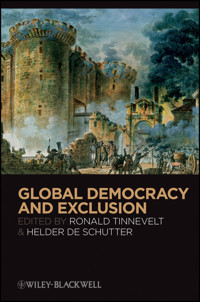
Global Democracy and Exclusion E-Book
21,99 €
Mehr erfahren.
- Herausgeber: John Wiley & Sons
- Kategorie: Geisteswissenschaft
- Serie: Metaphilosophy
- Sprache: Englisch
The essays in this book explore the consequences of globalization for democracy, covering issues which include whether democracy implies exclusion or borders, and whether it is possible to create a democracy on a global level.
- Explores the consequences of globalization for democracy
- Discusses whether democracy implies exclusion or boundaries
- Makes sense of democracy and human rights in a globalizing world
- Investigates what kind of common identity can and should support forms of global democracy
- Presents a state-of-the-art analysis of the foundations of global democracy
Sie lesen das E-Book in den Legimi-Apps auf:
Seitenzahl: 504
Veröffentlichungsjahr: 2011
Ähnliche




















Contents
Notes on Contributors
1 INTRODUCTION: GLOBAL DEMOCRACY AND EXCLUSION
The Chapters
Acknowledgments
References
2 COSMOPOLITANISM AND HUMAN RIGHTS: RADICALISM IN A GLOBAL AGE
Introduction
Cosmopolitanism and the Rights of Man: The Radicalisation of Natural Law
Cosmopolitanism and Social Theory: The Preservation and Transcendence of Natural Law
Cosmopolitanism and Human Rights: The Dialectics of Progress
Cosmopolitanism and the Crisis of Human Rights: The Turn to Judgment
Acknowledgments
References
3 THE RESURGENT IDEA OF WORLD GOVERNMENT
The Intensifying Dangers of International Anarchy
Global Governance Versus a World State
Is a World Government Possible?
Acknowledgments
References
4 STRUCTURING GLOBAL DEMOCRACY: POLITICAL COMMUNITIES, UNIVERSAL HUMAN RIGHTS, AND TRANSNATIONAL REPRESENTATION
Introduction
1. Political Communities and Human Rights Impacts in Transnational Democracy
2. Transnational Representation: Extending Participation in Cross-Border Decision Making
Acknowledgments
References
5 FEDERATIVE GLOBAL DEMOCRACY
1. Elements of a Global Federative Model
2. Allocation of Sovereign Competences over Territorial Jurisdictions
Conclusions
Acknowledgments
References
6 INTERACTION-DEPENDENT JUSTICE AND THE PROBLEM OF INTERNATIONAL EXCLUSION
The Problem of International Exclusion
Interaction-Dependent Justice: Failing Responses or Contributing Factors?
Interaction-Dependent Contextualist Theories: Statism and Nationalism
Interaction-Dependent Universalist Theories: Contractarianism, Nonharm Theories, and the “Cosmopolitan Democracy” Project
Conclusions
Acknowledgments
References
7 COSMOPOLITAN DEMOCRACY AND THE RULE OF LAW
1
2
3
Acknowledgments
References
8 A-LEGALITY: POSTNATIONALISM AND THE QUESTION OF LEGAL BOUNDARIES
Introduction
Political Reflexivity and the Boundaries of Legal Order
Legal Unity and Political Plurality
Question and Response
Human Rights and the Dialectic of Cosmopolitanism
Bidding Farewell to Communitarianism and Cosmopolitanism
Acknowledgments
References
9 THE CONFLICTING LOYALTIES OF STATISM AND GLOBALISM:
1. Introduction
2. Claims of Culture: Three Views
3. Coercion
4. Reciprocity
5. Conclusion
Acknowledgments
References
10 UNIVERSAL HUMAN RIGHTS AS A SHARED POLITICAL IDENTITY: IMPOSSIBLE? NECESSARY? SUFFICIENT?
1. A Sense of Community and the Need for Trust
2. Components of Common Identity
3. Objections Considered
Conclusion
Acknowledgments
References
11 MOTIVATING THE GLOBAL DEMOS
Introduction
On the "Naturalness" of National Partiality
What Cosmopolitans Might Learn from Nationalist Community Building
Community Building Through Instrumental Appeals to Morality
Conclusion
Acknowledgments
References
12 IS LIBERAL NATIONALISM INCOMPATIBLE WITH GLOBAL DEMOCRACY?
1. Introduction
2. Defining the Terms
3. The Global Democratic Potentials of Liberal Nationalism’s Main Tenets
4. David Miller’s Account
5. The Exclusion Problem
Acknowledgments
References
13 IMMIGRATION, NATIONALISM, AND HUMAN RIGHTS
1. Walzer and Miller: Nationalism and Solidarity
2. Habermas and Gould: Open Borders and Human Rights
3. Race, Immigration, and the American Exception
4. Wider Applications?
References
Index
METAPHILOSOPHY SERIES IN PHILOSOPHY
Series Editors Armen T. Marsoobian, Brian J. Huschle, and Eric Cavallero
The Philosophy of Interpretation, edited by Joseph Margolis and Tom Rockmore (2000)
Global Justice, edited by Thomas W. Pogge (2001)
Cyberphilosophy: The Intersection of Computing and Philosophy, edited by James H. Moor and Terrell Ward Bynum (2002)
Moral and Epistemic Virtues, edited by Michael Brady and Duncan Pritchard (2003)
The Range of Pragmatism and the Limits of Philosophy, edited by Richard Shusterman (2004)
The Philosophical Challenge of September 11, edited by Tom Rockmore, Joseph Margolis, and Armen T. Marsoobian (2005)
Global Institutions and Responsibilities: Achieving Global Justice, edited by Christian Barry and Thomas W. Pogge (2005)
Genocide’s Aftermath: Responsibility and Repair, edited by Claudia Card and Armen T. Marsoobian (2007)
Stem Cell Research: The Ethical Issues, edited by Lori Gruen, Laura Grabel, and Peter Singer (2007)
Cognitive Disability and Its Challenge to Moral Philosophy, edited by Eva Feder Kittay and Licia Carlson (2010)
Virtue and Vice, Moral and Epistemic, edited by Heather Battaly (2010)
Global Democracy and Exclusion, edited by Ronald Tinnevelt and Helder De Schutter (2010)
This edition first published 2010
Chapters © 2009 the Authors except for “The Resurgent Idea of a World Government,” © 2008 Campbell Craig, first published in Ethics and International Affairs 22, no. 2 (2008): 133–42; “InteractionDependent Justice and the Problem of International Exclusion,” © 2005 Raffaele Marchetti, first published in Constellations 12, no. 4 (2005): 487–501; “A-Legality: Postnationalism and the Question of Legal Boundaries,” © 2010 Hans Lindahl, first published in Modern Law Review 73, no. 1 (2010): 30–56; and “Cosmopolitan Democracy and the Rule of Law,” © 2002 William E. Scheuerman, first published in Ratio Juris 15, no. 4 (2002): 439–57. All articles reprinted here by permission of John Wiley & Sons, Ltd.
Book compilation © 2010 by Blackwell Publishing Ltd and Metaphilosophy LLC
Edition history: originally published as volume 40, no. 1 (January 2009) of Metaphilosophy unless otherwise stated above.
Blackwell Publishing was acquired by John Wiley & Sons in February 2007. Blackwell’s publishing program has been merged with Wiley’s global Scientific, Technical, and Medical business to form Wiley-Blackwell.
Registered Office
John Wiley & Sons Ltd, The Atrium, Southern Gate, Chichester, West Sussex, PO19 8SQ, United Kingdom
Editorial Offices
350 Main Street, Malden, MA 02148–5020, USA
9600 Garsington Road, Oxford, OX4 2DQ, UK
The Atrium, Southern Gate, Chichester, West Sussex, PO19 8SQ, UK
For details of our global editorial offices, for customer services, and for information about how to apply for permission to reuse the copyright material in this book please see our website at www.wiley.com/wiley-blackwell.
The right of Ronald Tinnevelt and Helder De Schutter to be identified as the authors of the editorial material in this work has been asserted in accordance with the Copyright, Designs and Patents Act 1988.
All rights reserved. No part of this publication may be reproduced, stored in a retrieval system, or transmitted, in any form or by any means, electronic, mechanical, photocopying, recording or otherwise, except as permitted by the UK Copyright, Designs and Patents Act 1988, without the prior permission of the publisher.
Wiley also publishes its books in a variety of electronic formats. Some content that appears in print may not be available in electronic books.
Designations used by companies to distinguish their products are often claimed as trademarks. All brand names and product names used in this book are trade names, service marks, trademarks or registered trademarks of their respective owners. The publisher is not associated with any product or vendor mentioned in this book. This publication is designed to provide accurate and authoritative information in regard to the subject matter covered. It is sold on the understanding that the publisher is not engaged in rendering professional services. If professional advice or other expert assistance is required, the services of a competent professional should be sought.
Library of Congress Cataloging-in-Publication data is available for this book.
9781444335682 (paperback)
NOTES ON CONTRIBUTORS
Eric Cavallero has taught at Yale and the University of Arizona, and is currently assistant professor of philosophy at Southern Connecticut State University and associate editor of Metaphilosophy. His research has been supported by the Center for Ethics and Public Affairs at Tulane and by the Harvard Program in Ethics and Health. His articles have appeared in Legal Theory, Philosophy, Politics and Economics, and the Journal of Political Philosophy.
Deen Chatterjee teaches philosophy at the University of Utah and is editor in chief of the forthcoming multivolume Encyclopedia of Global Justice and series editor of Studies in Global Justice. His publications include, most recently, Democracy in a Global World: Human Rights and Political Participation in the 21st Century.
Campbell Craig is professor of international politics at Aberystwyth University. He is the author or co-author of four books and many other works on the history of American foreign policy during the Cold War; his most recent book, cowritten with Fredrik Logevall, is America’s Cold War: The Politics of Insecurity (Belknap Press of Harvard University Press). He is currently editing a volume on the nuclear revolution in the post-Cold War world.
Helder De Schutter is assistant professor in social and political philosophy at the Katholieke Universiteit Leuven. He works on the normative foundations of language policy, nationalism, and federalism. He has published in a number of journals, including Inquiry, Journal of Applied Philosophy, Critical Review of International Social and Political Philosophy, Ethical Perspectives, Language Problems and Language Planning, and Algemeen Nederlands Tijdschrift voor Wijsbegeerte. In 2008–2009 he was a visiting research fellow at Oxford’s Centre for Social Justice and Nuffield College.
John Exdell is associate professor of philosophy at Kansas State University. His recent research is on racial justice issues, with a focus on the connection between American racial politics and the principle of justice as desert. He is also writing on the idea of humanitarian military intervention proposed by some liberal philosophers as a needed revision in traditional just-war theory and international law.
Robert Fine is professor of sociology at the University of Warwick, where he is active in the M.A. Programme in Social and Political Thought and the Social Theory Centre. He co-convenes the European Sociological Association Network on Racism and Antisemitism. His most recent books are Cosmopolitanism (Routledge, 2007), Democracy and the Rule of Law: Marx’s Critique of the Legal Form (Blackburn, 2002), and Political Investigations: Hegel, Marx and Arendt (Routledge, 2001). His current research is on understanding antisemitism.
Andreas Føllesdal (Ph.D. Harvard 1991) is professor of political philosophy and director of research at the Norwegian Centre for Human Rights, Faculty of Law, University of Oslo. He publishes in the field of political philosophy, with a focus on issues of international political theory and human rights, particularly as they arise in the wake of changes in Europe. He is the founding editor of the Themes in European Governance series at Cambridge University Press.
Carol C. Gould is professor of philosophy, Hunter College, and professor, Doctoral Programs in Philosophy and Political Science and director of the Center for Global Ethics and Politics, the Graduate Center, City University of New York. She is editor of the Journal of Social Philosophy and executive director of the Society for Philosophy and Public Affairs. She is the author of Marx’s Social Ontology, Rethinking Democracy, and Globalizing Democracy and Human Rights, is the editor of seven books, and has published numerous articles in social and political philosophy, philosophy of law, feminist theory, and applied ethics.
Hans Lindahl is professor of legal philosophy at Tilburg University in the Netherlands. His research focuses on issues of political representation, sovereignty, and collective identity, particularly in the context of the E.U. legal order. He has published articles in a wide range of journals and is the editor of the volume A Right to Inclusion and Exclusion? Normative Fault Lines of the EU’s Area of Freedom, Security and Justice (Hart, 2009).
Raffaele Marchetti is lecturer in International Relations at LUISS University and the University of Naples L’Orientale. His research focuses on international political theory and global politics, and his publications include Global Democracy: For and Against: Ethical Theory, Institutional Design, and Social Struggles (Routledge, 2008), European Union and Global Democracy (co-editor, CPI, 2009), Global Democracy: Normative and Empirical Perspectives (co-editor, Cambridge University Press, forthcoming), and Civil Society, Ethnic Conflicts, and the Politicization of Human Rights (co-editor, U.N. University Press, forthcoming).
William E. Scheuerman is professor of political science and West European Studies at Indiana University. He is the author of five books, including (most recently) Liberal Democracy and the Social Acceleration of Time (Johns Hopkins, 2004), Frankfurt School Perspectives on Globalization, Democracy and the Law (Routledge, 2008), and Hans J. Morgenthau: Realism and Beyond (Polity, 2009).
Ronald Tinnevelt is associate professor of legal philosophy at Radboud Universiteit Nijmegen. He is coeditor of Between Cosmopolitan Ideals and State Sovereignty (Palgrave, 2006), Does Truth Matter? (Springer, 2008), and Nationalism and Global Justice (Routledge, 2010), and he was recently awarded a Vidi scholarship from the Netherlands Organisation for Scientific Research (NWO).
Daniel Weinstock holds the Canada Research Chair in Ethics and Political Philosophy at the University of Montreal, where he is also director of the Ethics Research Center. He has written extensively on the management of diversity in liberal democracies, on nationalism and federalism, and on global justice. He is completing a book on the moral and political relationships between children, families, and the state, and is embarking upon a new research project on the political philosophy of cities.
1
INTRODUCTION: GLOBAL DEMOCRACY AND EXCLUSION
RONALD TINNEVELT AND HELDER DE SCHUTTER
Questions about the ethical and political significance of boundaries are at the center of the current debate on global justice. Can we take boundaries as inherent for ethical discourse? To what extent do we have duties of cosmopolitan justice? Can we justify severe and extensive global poverty if we strongly support the moral equality of all persons? Is cosmopolitanism at odds with rootedness in a particular culture? Do global political institutions provide the best framework for the protection of basic human rights?
These questions gain in relevance and depth in our globalizing era—an era in which we are witnessing a strong growth of transboundary problems and in which social and political space are “no longer wholly mapped in terms of territorial places, territorial distances and territorial borders” (Scholte 2000, 3).
One of the main consequences of this process of deterritorialization is that we need to rethink our concept of democracy. The assumption on which most theories of democracy have been based in the past—a symmetrical relationship between political decision-makers and the recipients of political decisions—has turned out to be naïve (Held 1995, 16). Those who shape global and transnational public policies are not (or not always) accountable to those affected by them. Border-crossing issues like migration flows and global warming attest to the untenability of this assumption.
But what, then, is the relevant constituency for these issues? Who is responsible for what, and to whom? Several normative theories and policy models have recently been developed to answer democracy’s boundary problem. Whereas some theorists deny the possibility of projecting genuine forms of democracy to the transnational and global level, others argue that democratic decision-making need not necessarily be bound to the territorial borders of sovereign nation-states.
Liberal nationalists and statists are probably the best-known proponents of the first group. David Miller, for example, argues that the challenges that the process of globalization poses to our national democracies don’t necessarily call for a widening of the demos or for considering “new ways of constituting the demos” (Miller 2009, 202). Analogous to the debate concerning the scope of justice, however, other positions within this first group could (in principle) be distinguished. One could claim, for example, that democracy requires a Rawlsian basic structure or a context of reciprocity. Although proponents of these alternatives need not deny that a global basic structure or a global reciprocal context may one day arise, they would argue that in the absence of these contexts global democracy makes no sense.
Enthusiasts of the case for transnational democracy, in contrast, often articulate a version of the “all-affected principle” to deal with the boundary problem. This principle states that whoever is affected by a public decision should be included in the democratic process that makes the decision. This leads to a justification for extending democracy beyond national boundaries, because it is no longer the case in the current world that the decisions of one state only affect citizens from that same state. Many decisions (such as on environmental, terrorism-related, or migration-related issues) affect people living in other states, and the all-affected principle stipulates that those people should be included in the democratic process in which the decision is made. So, depending on the scale and nature of political and socioeconomic problems, the required political solution and the proper scope of the relevant democratic community will differ. Local problems demand local responses and constituencies, whereas global political problems require supranational solutions and will affect a global constituency. Democracy should therefore be at least partly transnational in scope.
Interestingly, while the potentially inclusive ideal of the all-affected principle might at first sight be thought logically to lead to a cosmopolitan form of democracy instantiated within the bounds of a global people, few adherents of this principle are prepared to draw this conclusion. And indeed, virtually all political theorists today still propose to overcome or deal with the many postnational or globalized features of our present condition through bounded political communities, which preserve an explicit link between the principle of democracy on the one hand and either the principle of national or the principle of cultural-political identity on the other.
Jürgen Habermas, for instance, argues that a political community can only understand itself as a democracy if it can “distinguish between members and non-members” (2001, 107). Similar arguments can be found among a variety of politico-philosophical positions—liberalism, communitarianism, agonism, deliberative democracy, poststructuralism, and so on. At the heart of these arguments is the assumption that collective identity and self-determination imply a distinction between insiders and outsiders, or, as Carl Schmitt (1996) argues, between friends and enemies. Without such a distinction, claims Michael Walzer, “we would have no reason to form and maintain political communities” (1983, 64).1
But why does every definition of a “we” imply “the delimitation of a ‘frontier’ and the designation of a ‘them’”? (Mouffe 1993, 84.) Habermas explains the need for exclusion or closure on the basis of the fact that self-legislation necessarily presupposes a “clearly defined self” to which one can ascribe collectively binding decisions (2006, 76). Self-legislation, writes Seyla Benhabib, is always also self-constitution: “‘We, the people’ who agree to bind ourselves by these laws, are also defining ourselves as a ‘we’ in the very act of self-legislation. It is not only the general laws of self-government that are articulated in this process; the community that binds itself by these laws defines itself by drawing boundaries as well, and these boundaries are both territorial and civic” (2004, 45).
Within this kind of reasoning, however, the political culture of a world society will always lack the common ethical-political dimension—the social boundary between insiders and outsiders—that is essential for a corresponding democratic global community. The all-affected criterion and the principle of democracy will therefore collide at the highest political level.
The focus of this collection of chapters is on this potential conflict and its underlying values. Does democracy or popular sovereignty imply exclusion and drawing borders? And if so, what type of exclusion and borders, and what kind of justification can we give for them? More important, if democracy really requires some kind of exclusion, is global democracy then a paradoxical union of two contradictory ideals? Can we create a demos on the global level?
The Chapters
To answer these questions, one first needs to know more about the relationship between cosmopolitanism and human rights. Proposals for transnational citizenship and forms of global democracy, after all, are mostly grounded in moral cosmopolitanism and a concern for political agency. In his contribution to this book Robert Fine examines the connection between human rights and cosmopolitanism, and tries to determine whether critics like Costas Douzinas are right to claim that cosmopolitanism contains an idealisation of human rights. Fine specifically focuses on three historical “stages” of cosmopolitanism: the development of Enlightenment cosmopolitanism in the eighteenth century, its effect on the rise of the human sciences, and the human rights revolution of our day.
But what “political arrangement of international society” (Walzer 2003, 171) is capable of guarding against human rights atrocities? According to proponents of the idea of world government, the only possible solution is the creation of some form of international authority. Only an authoritative regime can secure peace and really tackle the global problems that our globalizing world faces. In his chapter Campbell Craig discusses the return of this idea to the domains of international relations theory and international political philosophy. Although the idea of world government has a long history, it has been picked up with renewed vigor by theorists like Alexander Wendt, Daniel Deudney, Otfried Höffe, and Luis Cabrera. Craig, however, reserves the term “world government” not only for the traditional idea of a formal world state but also for a looser system of global governance. David Held’s and Daniele Archibugi’s models of cosmopolitan democracy can, therefore, also be seen as forms of world government.
Given the intensifying dangers of a system of international anarchy, an important question is which of these two forms “world government” is best able to deal with collective action problems. Craig discusses the advantages of both models and examines whether some of the traditional arguments against world government really hold up under close scrutiny. These arguments fall roughly into two broad categories: practical arguments that center on the feasibility of a world state—such as its ungovernability or unaccountability—and normative ones that deal with its desirability.
Whereas Craig mainly discusses the feasibility and desirability of the idea of world government, Carol Gould, Eric Cavallero, and Raffaele Marchetti all develop a philosophical framework to make sense of democracy and human rights in a globalizing world. Globalization, after all, has transformed the conditions under which our liberal democracies can function (McGrew 1997). Nation-states are no longer able, by themselves, to guarantee the successful realization of their basic principles of justice and democracy. But what model of global democracy is best suited for our political and socioeconomic constellation?
Gould specifically addresses the emergence of cross-border communities and transnational public spheres. Building on her Globalizing Democracy and Human Rights (2004), she further develops the two criteria that are needed to determine the scope of democratic communities—common activities and impact on human rights—and examines what guidelines these criteria can offer for a democratization of international and transnational organizations. According to the “common activities” criterion, equal rights of participation are required whenever people—for example, in cross-border associations—engage in common activities. The “impact on human rights” criterion, on the other hand, depends not on organized common activities but on interdependence. People have a right to a substantial input in decision-making whenever the decisions of international organizations or other governments affect the fulfillment of their basic human rights.
In his contribution, Cavallero criticizes these two criteria because they are underinclusive as well as overinclusive. Suppose the United States—after a few nasty incidents with imported toys—decides to alter its consumer safety standards and to reduce drastically the importing of Chinese toys. Do Chinese factory workers really have a right to substantial input in decision-making because the fulfillment of their basic human rights is affected? According to Cavallero these effects are irrelevant from a democratic perspective. Rather than emphasizing basic human rights, he proposes that we interpret the all-affected principle on the basis of the idea of external costs: individuals are relevantly affected by the exercise of a sovereign competence if (1) its exercise imposes governance norms on them or (2) its exercise could otherwise be reasonably expected to impose external costs on them. This boundary criterion is part of a larger defense of a federative form of global democracy.
Raffaele Marchetti also zooms in on what is required for a claim of democratic participation to make sense. In particular, he analyzes the fact of political exclusion of foreigners as an instance of injustice. Those who bear the effects of political decisions taken abroad often do not have a political voice in the decision-making process. Marchetti locates the rationale for this form of transnational exclusion in an interaction-dependent conception of justice. Duties of justice, according to this conception, are only generated when individuals or collectivities actually interact. Beyond this context no duties of justice apply, and no duty exists to create some kind of interaction.
The central aim of Marchetti’s contribution is to analyze how this interaction-dependent conception of justice informs most (including some of the more progressive) stances in contemporary political theory. In particular, Marchetti uses this exclusion critique against realists, statists, nationalists, cosmopolitan democrats, supranational contractarians, and international “no harm” theorists. All these theorists support some form of”transnational exclusion.” At the end of his chapter, Marchetti points toward the case for an all-inclusive project of global democracy, encompassing every member of the human species. Everyone should be included in the democratic process of making decisions on global affairs.
Rather than focusing on what is required for claims of democracy to kick in, William Scheuerman concentrates in his chapter on the extent to which forms of cosmopolitan democracy as defended by Held and Archibugi require or depend on a cosmopolitan rule of law. He notes that cosmopolitan democrats are often both unfamiliar with and silent about the traditional notion of the rule of law, which states that state action should rest on legal norms and rules that are clear, public, and general, thus making arbitrary ruling impossible. Scheuerman argues that the absence of this notion in the work of cosmopolitan democrats may make it impossible for them to ensure that their democratic proposals can guard themselves both against problematic arbitrary supranational political intrusions and against problematic discretionary court authority. The result is that cosmopolitan democrats are more vulnerable than they often claim to the specter of a “planetary Leviathan,” a despotic world government. Scheuerman concludes that this analysis does not make cosmopolitan democracy an undesirable ideal; global democrats should take the traditional rule-of-law virtues more seriously and should come up with a more robust notion of the rule of law.
Although Scheuerman mainly focuses on the importance of the rule of law for the debate on global democracy, a wider lesson can be drawn from his chapter. Collective self-legislation (both on the national and on the transnational level) is not only an act of self-constitution but also an act of self-ordering: legal norms regulate human behavior in a specific way. In his chapter, Hans Lindahl critically examines this process of collective self-ordering. The main question he poses is: Are legal boundaries becoming irrelevant in our globalizing era, or are they the necessary condition of every postnational and global legal order?
If we follow Habermas’s proposal for a “world domestic polity without a world government,” legal boundaries are temporal and defeasible. Although Habermas argues that the “self-referential concept of collective self-determination demarcates a logical space for democratically united citizens who are members of a particular community” (2001, 107), he still accepts that a global legal order could progressively include formerly excluded groups and individuals. “The normative model for a community that exists without any possible exclusions,” according to him, “is the universe of moral persons—Kant’s ‘kingdom of ends.’ It is thus no coincidence that ‘human rights,’ i.e. legal norms with an exclusively moral content, make up the entire normative framework for a cosmopolitan community” (2001, 108). A similar line of thought can be found in the work of other proponents of forms of transnational and global democracy.
Lindahl scrutinizes this assumption in the first part of his chapter. He critically examines the different ways in which legal orders draw the boundary between legality on the one hand and illegality on the other. The distinction between inside and outside, according to Lindahl, is constitutive for all legal orders (national, regional, and global). Every legal order is bounded in a fourfold way: in terms of subject, matter, space, and time (“who ought to do what, when and where”). In the second part of his chapter Lindahl examines the implications of this connection between legal orders and their boundaries for the ideas of unity and plurality.
The issue of drawing boundaries has proven to be especially acute in the liberal egalitarian tradition. Liberals have in theory always defended a universal account of right and justice in which a strong notion of human rights predominates. Liberal polity, however, differs from this egalitarian ideal. Liberal democracies are (in certain respects) relatively closed societies, and justice is subordinated to the demands of states. In his contribution, Deen Chatterjee examines this conflict between moral equality and the liberal practice of exclusive membership. He argues that the idea of (democratic) equality need not be limited to the domestic order but can be extended to the international and supranational level. The conflicting loyalties of statism and globalism can be reconciled within a global democracy that is composed of nation-states.
But what kind of common identity can and should support forms of global democracy? Andreas Føllesdal focuses on a specific version of this question: Must citizens of (national or international) democratic societies share an identity that is unique to them and that they consequently don’t share with others? Liberal nationalists like David Miller and deliberative democrats like Jürgen Habermas argue that a unique identity is a presupposition of democratic self-determination. But why is this question relevant for the discussion on global democracy? What is wrong with the claim that a democratic society needs a unique political identity? The main reason why Føllesdal focuses on this claim is because it is often used to conclude that a global commitment to human rights cannot provide enough trust and solidarity to sustain a global democratic order. International human rights are too broadly shared to unite the members of a transnational or supranational political community. Against Miller and Habermas, Føllesdal argues that a democratic order does not presuppose an exclusionary political identity.
In our contributions, Daniel Weinstock and we, respectively, also discuss the liberal nationalist claim that democratic decision-making can best (and maybe even only) be realized within bounded political communities with a unique national identity. Weinstock and we differ, however, in our focus. Weinstock argues that liberal nationalists are wrong to claim that spontaneous communal feelings are the primary and most common source of feelings of solidarity, reciprocity, and trust. What motivates citizens to act according to political morality—to be responsible and committed members of a democratic society—is often determined by a mix of self-interest and coercion. In fact, the required motivation for democratic citizenship is in many cases the result of institutional design and presenting people with the right incentives. If the empirical conditions for democratic citizenship, however, are the result of political artifice and not the natural effect of a shared national identity, an important objection against transnational citizenship and “global community-building” has been countered. How such a global democratic polity can be constructed is the topic of the last part of Weinstock’s chapter.
In our chapter, we develop a different perspective on the relation between liberal nationalism and global democracy. It is not our aim to question liberal nationalism’s main claims, but we do explicitly deny that these necessarily lead to a rejection of forms of global democracy. In fact, liberal nationalists can even support certain proposals for global democracy. We specifically focus on three arguments that liberal nationalists use to defend their claim that liberal democratic communities should be national communities: the identity argument, the deliberative democracy argument, and the social justice argument. According to the first argument, sharing a national culture offers us a context of identity. The second, deliberative democracy argument implies that deliberative democracy (or republican citizenship) works best in nationally bounded communities. And the third, social justice argument stipulates that the sacrifices needed to make a welfare system work depend on the existence of a shared national culture. We argue that these liberal nationalist premises are not sufficient to refute global democratic ideals. Endorsing liberal nationalist premises is compatible with endorsing the case for global democracy.
John Exdell focuses on the social justice argument from a different angle in his chapter. He examines the empirical claim made by Walzer and others that unregulated migration has a negative effect on the feelings of solidarity and trust that are necessary to support the welfare system of liberal democratic societies. Restraint of entry serves to protect welfare (Walzer 1983, 39). To refute this claim and argue that claims for relatively open borders are not utopian, Exdell examines an important example that counters the social justice argument—the case of the United States. The United States, after all, combines a strong common identity with a dislike of liberal welfare policies.
Taken together, the chapters collected here present a state-of-the-art analysis of the normative foundations of global democracy. In the current world order, examining the case for global democracy is crucial. If it is indeed the case—as some cosmopolitans argue—that “either democracy is global or it is not democracy” (Marchetti 2008, 1), a more fundamental task for contemporary political theory can hardly be envisioned.
Acknowledgments
Many of the chapters in this collection grew out of a special workshop entitled “Global Democracy and Exclusion,” which we jointly convened within the framework of the XIIIth World Conference of Philosophy of Social Philosophy and Law (IVR) in Krakow in early August 2007. We thank the participants and speakers at the workshop for very fruitful discussions. We also wish to extend our sincere thanks for all their help to the editor in chief and the managing editor of Metaphilosophy, Armen T. Marsoobian and Otto Bohlmann.
References
Abizadeh, Arash. 2005. “Does Collective Identity Presuppose an Other? On the Alleged Incoherence of Global Solidarity.” American Political Science Review 99:45–60.
Benhabib, Seyla. 2004.The Rights of Others: Aliens, Residents and Citizens. Cambridge: Cambridge University Press.
Habermas, Jürgen. 2001. The Postnational Constellation: Political Essays. Cambridge, Mass.: MIT.
———. 2006. Time of Transitions. Cambridge: Polity Press.
Held, David. 1995.Democracy and the Global Order: From the Modern State to Cosmopolitan Governance. Cambridge: Polity Press.
Kymlicka, Will. 2001. “Territorial Boundaries: A Liberal Egalitarian Perspective.” In Boundaries and Justice: Diverse Ethical Perspectives, edited by David Miller and Sohail Hashmi, 249–75. Princeton: Princeton University Press.
McGrew, Anthony. 1997. “Democracy Beyond Borders? Globalization and the Reconstruction of Democratic Theory and Practice.” In The Transformation of Democracy: Globalization and Territorial Democracy, edited by Anthony McGrew, 231–66. Cambridge: Polity Press.
Marchetti, Raffaele. 2008.Global Democracy: For and Against: Ethical Theory, Institutional Design and Social Struggles. New York: Rout-ledge.
Miller, David. 2009. “Democracy’s Domain.” Philosophy and Public Affairs 37:201–28.
Mouffe, Chantal. 1993. The Return of the Political. London: Verso.
Schmitt, Carl. 1996. The Concept of the Political. Chicago: University of Chicago Press.
Scholte, Jan Aart. 2000. Globalization: A Critical Introduction. Basing-stoke: Macmillan.
Walzer, Michael. 1983.Spheres of Justice: A Defense of Pluralism and Equality. New York: Basic Books.
———. 2003. Arguing About War. New Haven: Yale University Press.
1 For an overview of these arguments, see Abizadeh 2005.
2
COSMOPOLITANISM AND HUMAN RIGHTS: RADICALISM IN A GLOBAL AGE
ROBERT FINE
Introduction
Let me begin with a rough and ready formulation of how the relationship between cosmopolitanism and human rights is normally conceived from a cosmopolitan point of view. Cosmopolitanism imagines a global order in which the idea of human rights is an operative principle of justice, with mechanisms of global governance established specifically for their protection. However, the cosmopolitan imagination is not restricted to this agenda. It incorporates wider issues concerning peace among states, social solidarity across borders, the efficacy of international law, and the activism of global civil society. It envisages the reformation of political community at the national level to render it compatible with cosmopolitan values and new forms of political community at the transnational level. It would still be implausible to think of the cosmopolitan imagination apart from some notion of human rights, that is, rights which belong to all people by virtue of their human status.
Lesen Sie weiter in der vollständigen Ausgabe!
Lesen Sie weiter in der vollständigen Ausgabe!
Lesen Sie weiter in der vollständigen Ausgabe!
Lesen Sie weiter in der vollständigen Ausgabe!
Lesen Sie weiter in der vollständigen Ausgabe!
Lesen Sie weiter in der vollständigen Ausgabe!
Lesen Sie weiter in der vollständigen Ausgabe!
Lesen Sie weiter in der vollständigen Ausgabe!
Lesen Sie weiter in der vollständigen Ausgabe!
Lesen Sie weiter in der vollständigen Ausgabe!
Lesen Sie weiter in der vollständigen Ausgabe!
Lesen Sie weiter in der vollständigen Ausgabe!




