


20,99 €
Mehr erfahren.
- Herausgeber: John Wiley & Sons
- Kategorie: Wissenschaft und neue Technologien
- Serie: Antipode Book Series
- Sprache: Englisch
Challenging the main ways we debate globalization, Global Displacements reveals how uneven geographies of capitalist development shape—and are shaped by—the aspirations and everyday struggles of people in the global South.
- Makes an original contribution to the study of globalization by bringing together critical development and feminist theoretical approaches
- Opens up new avenues for the analysis of global production as a long-term development strategy
- Contributes novel theoretical insights drawn from the everyday experiences of disinvestment and precarious work on people’s lives and their communities
- Represents the first analysis of increasing uneven development among countries in the Caribbean
- Calls for more rigorous studies of long accepted notions of the geographies of inequality and poverty in the global South
Sie lesen das E-Book in den Legimi-Apps auf:
Seitenzahl: 466
Veröffentlichungsjahr: 2015
Ähnliche



















Table of Contents
Cover
Title Page
Series Editors’ Preface
List of Abbreviations
List of Figures and Tables
Acknowledgements
1 Introduction
Sundays in Los Almácigos, Dominican Republic
Situating Global Displacements
From a Comparative to a Relational Geography of Haiti and the Dominican Republic
Theorizing Uneven Development: Global Production Networks, Coloniality, and the Production of Place
Global Displacements as Multi-Sited Fieldwork
Chapter Outline
2 Two Stories of Caribbean Development
Introduction
“Taiwanizing” the Caribbean? Garments-as-Globalization
Dominican Counterpoint: Garments-as-Regional Entrepreneurialism
Conclusion: Moving beyond “Global Forces” versus “Regional Paths” Approaches
3 From
Manufactura
to
Mentefactura
?
Introduction: Beyond “Cheap Labor” in the Dominican Republic?
Cibaeño Firm Restructuring and New Production Geographies
Gender and the Reworking of Sewing and Skill
Gendered Economic Dualisms: Enabling Export Restructuring as Development
Recuperating the Gender Politics of Uneven Development
4 Embodied Negotiations
The
Campo
and the Making of an Immigrant City
Workers’ Strategies as Embodied Negotiations
Conclusion: Producing Workers on the Threshold of the Idled Factory
5 Reworking Coloniality through the Haitian–Dominican Border
Introduction
Remaking the Border: The Haitian Embargo of 1991–1994 and the Growth of Ouanaminthe
Reordering Trade Zones between the Dominican Republic and Haiti
CODEVI: Haitian State Collapse and Unionization
Disposability at the Border: Managing the Trade Zone
Conclusion: Reworking the Geographies of Coloniality
6 Haiti, the Global Factory and the Politics of Reconstruction
Introduction: Shaking Ground, Breaking Ground
Poverty Reduction: An Embedded Liberal Moment
Trade Zones as Containment: The Imperative of Economic Security
From Poverty Reduction to Poverty Redistribution? Decentralization after the Earthquake
Making Space for Development Alternatives
7 Unsettling Dominant Crisis Narratives of the Caribbean
The Everyday and the Event of Crisis in “A Small Place”
Forging Livelihoods Out of Crisis in the Dominican Republic
Caribbean Crisis as Historical Debt
Towards an Alternative Ethics of Global Production and Consumption
8 Conclusion
Labor In and Out of Global Production Networks
Regulatory Uneven Development
Rethinking the Geographies of Uneven Development in the Caribbean and the Global South
Bibliography
Index
End User License Agreement
List of Tables
Chapter 02
Table 2.1 United States apparel imports by macro-region, 1987 and 1998
Table 2.2 Dominican trade zone employment, 1992–2004
Chapter 03
Table 3.1 Regional employment by sex and type of firm, FTZ garment sector
List of Illustrations
Chapter 01
Figure 1.1 Map of the Dominican Republic and Haiti, northern region
Chapter 03
Figure 3.1 Number of FTZ garment workers and factories, 2002–2012.
Figure 3.2 The Dominican Republic as a dual economy.
Chapter 05
Figure 5.1 Haitians exiting the CODEVI trade zone. The siting of the zone on the river’s oxbow privatizes a section of the border, allowing the administration to control Haitians’ access to the zone through a privately built and guarded bridge.
Guide
Cover
Table of Contents
Begin Reading
Pages
ii
iii
iv
vi
vii
viii
ix
x
xi
xii
1
2
3
4
5
6
7
8
9
10
11
12
13
14
15
16
17
18
19
20
21
22
23
24
25
26
27
28
29
30
31
32
33
34
35
36
37
38
39
40
41
42
43
44
45
46
47
48
49
50
51
52
53
54
55
56
57
58
59
60
61
62
63
64
65
66
67
68
69
70
71
72
73
74
75
76
77
78
79
80
81
82
83
84
85
86
87
88
89
90
91
92
93
94
95
96
97
98
99
100
101
102
103
104
105
106
107
108
109
110
111
112
113
114
115
116
117
118
119
120
121
122
123
124
125
126
127
128
129
130
131
132
133
134
135
136
137
138
139
140
141
142
143
144
145
146
147
148
149
150
151
152
153
154
155
156
157
158
159
160
161
162
163
164
165
166
167
168
169
170
171
172
173
174
175
176
177
178
179
180
181
182
183
184
185
186
187
188
189
190
191
192
193
194
195
196
197
198
199
200
201
202
203
204
205
206
207
208
209
210
211
212
213
214
215
Antipode Book Series
Series Editors: Vinay Gidwani, University of Minnesota, USA and Sharad Chari, CISA at the University of the Witwatersrand, South Africa
Like its parent journal, the Antipode Book Series reflects distinctive new developments in radical geography. It publishes books in a variety of formats – from reference books to works of broad explication to titles that develop and extend the scholarly research base – but the commitment is always the same: to contribute to the praxis of a new and more just society.
Published
Global Displacements: The Making of Uneven Development in the CaribbeanMarion Werner
Banking Across Boundaries: Placing Finance in CapitalismBrett Christophers
The Down-deep Delight of DemocracyMark Purcell
Gramsci: Space, Nature, PoliticsEdited by Michael Ekers, Gillian Hart, Stefan Kipfer and Alex Loftus
Places of Possibility: Property, Nature and Community Land OwnershipA. Fiona D. Mackenzie
The New Carbon Economy: Constitution, Governance and ContestationEdited by Peter Newell, Max Boykoff and Emily Boyd
Capitalism and ConservationEdited by Dan Brockington and Rosaleen Duffy
Spaces of Environmental JusticeEdited by Ryan Holifield, Michael Porter and Gordon Walker
The Point is to Change it: Geographies of Hope and Survival in an Age of CrisisEdited by Noel Castree, Paul Chatterton, Nik Heynen, Wendy Larner and Melissa W. Wright
Privatization: Property and the Remaking of Nature-SocietyEdited by Becky Mansfield
Practising Public Scholarship: Experiences and Possibilities Beyond the AcademyEdited by Katharyne Mitchell
Grounding Globalization: Labour in the Age of InsecurityEdward Webster, Rob Lambert and Andries Bezuidenhout
Privatization: Property and the Remaking of Nature-Society RelationsEdited by Becky Mansfield
Decolonizing Development: Colonial Power and the MayaJoel Wainwright
Cities of WhitenessWendy S. Shaw
Neoliberalization: States, Networks, PeoplesEdited by Kim England and Kevin Ward
The Dirty Work of Neoliberalism: Cleaners in the Global EconomyEdited by Luis L. M. Aguiar and Andrew Herod
David Harvey: A Critical ReaderEdited by Noel Castree and Derek Gregory
Working the Spaces of Neoliberalism: Activism, Professionalisation and IncorporationEdited by Nina Laurie and Liz Bondi
Threads of Labour: Garment Industry Supply Chains from the Workers' PerspectiveEdited by Angela Hale and Jane Wills
Life’s Work: Geographies of Social ReproductionEdited by Katharyne Mitchell, Sallie A. Marston and Cindi Katz
Redundant Masculinities? Employment Change and White Working Class YouthLinda McDowell
Spaces of NeoliberalismEdited by Neil Brenner and Nik Theodore
Space, Place and the New Labour InternationalismEdited by Peter Waterman and Jane Wills
Forthcoming
Money and Finance After the Crisis: Critical Thinking for Uncertain TimesEdited by Brett Christophers, Andrew Leyshon and Geoff Mann
Fat Bodies, Fat Spaces: Critical Geographies of ObesityRachel Colls and Bethan Evans
Enterprising Nature: Economics, Markets and Finance in Global Biodiversity PoliticsJessica Dempsey
The Metacolonial State: Pakistan, Critical Ontology, and the Biopolitical Horizons of Political IslamNajeeb A. Jan
Taken For A Ride: Neoliberalism, Informal Labour And Public Transport In An African MetropolisMatteo Rizzo
The Impunity Machine: Genocide and Justice in GuatemalaAmy Ross and Liz Oglesby
Frontier Road: Power, History, and the Everyday State in the Colombian AmazonSimón Uribe
Global Displacements
The Making of Uneven Development in the Caribbean
Marion Werner
This edition first published 2016© 2016 John Wiley & Sons, Ltd.
Registered OfficeJohn Wiley & Sons, Ltd., The Atrium, Southern Gate, Chichester, West Sussex, PO19 8SQ, UK
Editorial Offices350 Main Street, Malden, MA 02148-5020, USA9600 Garsington Road, Oxford, OX4 2DQ, UKThe Atrium, Southern Gate, Chichester, West Sussex, PO19 8SQ, UK
For details of our global editorial offices, for customer services, and for information about how to apply for permission to reuse the copyright material in this book please see our website at www.wiley.com/wiley-blackwell.
The right of Marion Werner to be identified as the author of this work has been asserted in accordance with the UK Copyright, Designs and Patents Act 1988.
All rights reserved. No part of this publication may be reproduced, stored in a retrieval system, or transmitted, in any form or by any means, electronic, mechanical, photocopying, recording or otherwise, except as permitted by the UK Copyright, Designs and Patents Act 1988, without the prior permission of the publisher.
Wiley also publishes its books in a variety of electronic formats. Some content that appears in print may not be available in electronic books.
Designations used by companies to distinguish their products are often claimed as trademarks. All brand names and product names used in this book are trade names, service marks, trademarks or registered trademarks of their respective owners. The publisher is not associated with any product or vendor mentioned in this book.
Limit of Liability/Disclaimer of Warranty: While the publisher and author have used their best efforts in preparing this book, they make no representations or warranties with respect to the accuracy or completeness of the contents of this book and specifically disclaim any implied warranties of merchantability or fitness for a particular purpose. It is sold on the understanding that the publisher is not engaged in rendering professional services and neither the publisher nor the author shall be liable for damages arising herefrom. If professional advice or other expert assistance is required, the services of a competent professional should be sought.
Library of Congress Cataloging-in-Publication data applied for
Werner, Marion. Global displacements : the making of uneven development in the Caribbean / Marion Werner. pages cm. – (Antipode book series) Includes bibliographical references and index.
ISBN 978-1-118-94199-7 (hbk.) – ISBN 978-1-118-94198-0 (pbk.) 1. Clothing trade–Caribbean Area. 2. Caribbean Area–Economic conditions–Regional disparities. 3. Globalization–Caribbean Area. I. Title. HD9940.C272 W47 2015 338.9729–dc23
2015022476
A catalogue record for this book is available from the British Library.
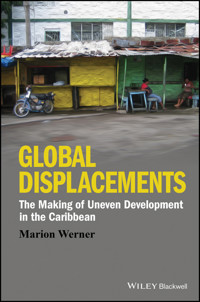
Cover image: Food vendors outside a garment factory, Santiago trade zone, Dominican Republic© Marion Werner, with Andy Lu
Series Editors’ Preface
The Antipode Book Series explores radical geography “antipodally,” in opposition, from various margins, limits, or borderlands.
Antipode books provide insight “from elsewhere,” across boundaries rarely transgressed, with internationalist ambition and located insight; they diagnose grounded critique emerging from particular contradictory social relations in order to sharpen the stakes and broaden public awareness. An Antipode book might revise scholarly debates by pushing at disciplinary boundaries, or by showing what happens to a problem as it moves or changes. It might investigate entanglements of power and struggle in particular sites, but with lessons that travel with surprising echoes elsewhere.
Antipode books will be theoretically bold and empirically rich, written in lively, accessible prose that does not sacrifice clarity at the altar of sophistication. We seek books from within and beyond the discipline of geography that deploy geographical critique in order to understand and transform our fractured world.
Vinay GidwaniUniversity of Minnesota, USA
Sharad ChariCISA at the University of the Witwatersrand, South Africa
Antipode Book Series Editors
List of Abbreviations
ADIH
Association des Industries d’Haïti (Haitian Industry Association)
APEDI
Asociación para el desarollo, Inc. (Association for Development, Inc.)
CARICOM
Caribbean Community
CBERA
Caribbean Basin Economic Recovery Act
CBI
Caribbean Basin Initiative
CBTPA
Caribbean Basin Trade Partnership Act
CD
Convergence Démocratique (Democratic Convergence)
CMT
Cut-make-trim
CNZFE
Consejo nacional de zonas francas de exportación (National Trade Zone Council)
CODEVI
Compagnie de Développement Industriel (Industrial Development Company)
Lesen Sie weiter in der vollständigen Ausgabe!
Lesen Sie weiter in der vollständigen Ausgabe!
Lesen Sie weiter in der vollständigen Ausgabe!
Lesen Sie weiter in der vollständigen Ausgabe!
Lesen Sie weiter in der vollständigen Ausgabe!
Lesen Sie weiter in der vollständigen Ausgabe!
Lesen Sie weiter in der vollständigen Ausgabe!
Lesen Sie weiter in der vollständigen Ausgabe!
Lesen Sie weiter in der vollständigen Ausgabe!
Lesen Sie weiter in der vollständigen Ausgabe!
Lesen Sie weiter in der vollständigen Ausgabe!
Lesen Sie weiter in der vollständigen Ausgabe!
Lesen Sie weiter in der vollständigen Ausgabe!




