


Global Heritage E-Book
53,99 €
Mehr erfahren.
- Herausgeber: John Wiley & Sons
- Kategorie: Geisteswissenschaft
- Serie: Blackwell Readers in Anthropology
- Sprache: Englisch
Examines the social, cultural and ethical dimensions of heritage research and practice, and the underlying international politics of protecting cultural and natural resources around the globe.
- Focuses on ethnographic and embedded perspectives, as well as a commitment to ethical engagement
- Appeals to a broad audience, from archaeologists to heritage professionals, museum curators to the general public
- The contributors comprise an outstanding team, representing some of the most prominent scholars in this broad field, with a combination of senior and emerging scholars, and an emphasis on international contributions
Sie lesen das E-Book in den Legimi-Apps auf:
Seitenzahl: 738
Veröffentlichungsjahr: 2015
Ähnliche




















CONTENTS
Cover
Title page
Notes on Contributors
Introduction: Globalizing Heritage
Developing Heritage
Interdisciplinary Heritage
Heritage Futures
ACKNOWLEDGMENTS
REFERENCES
1 UNESCO and New World Orders
UNESCO and Cultural Heritage
The History and Institutional Framework of World Heritage
Studying the World Heritage Arena
Case Studies: World Heritage Committee Mechanics
REFERENCES
2 Neoliberalism, Heritage Regimes, and Cultural Rights
Introduction
Neoliberalism in Heritage Studies and Anthropology
Neoliberal Governmentality and Community
Emerging Articulations of Heritage and Rights
Actually Existing Heritage: A Resource for Cultural Rights Practice
Conclusion
REFERENCES
3 Civil Societies? Heritage Diplomacy and Neo-Imperialism
Introduction
What Is Heritage?
What Is Diplomacy?
Heritage and Diplomacy
Diplomatic Tracks and Power
Heritage Diplomacy Apparatuses
Heritage Diplomacy as Contact Zone
Case 1: Re-Establishing the Contact Zone – Ambassadors and Heritage Diplomacy
Case 2: Mediterranean Diplomacy and Development
Conclusion: Ethical Dimensions of Heritage Diplomacy
REFERENCES
4 Bridging Cultural and Natural Heritage
Introduction
The Anthropocene
Culture–Nature Dualism
Postcolonial Ecologies and Ontologies
World Heritage Practice
The Sacred Natural Sites Initiative
Culture and Nature in the Vortex of Asian Modernity
Co-Management in the Global North: “Kluane” World Heritage Site
World Heritage as Sites of Indigenous People-Politics
Embracing Ontological Difference
Laponia: An Experiment in Co-Management
Conclusions
REFERENCES
5 Communities and Ethics in the Heritage Debates
Introduction
Ethics and the State
Mali, Heritage, and the Ethics of Self-Determination
The American Southwest, Communities, and Collaboration
Conclusion
REFERENCES
6 Heritage Management and Conservation: From Colonization to Globalization
Introduction
Heritage and/or Development
Traditional Management Systems
Colonial Heritage Management Systems
Postcolonial Heritage Management
Global Heritage Management: Africa and Asia
Conserving the Sacred: Angkor World Heritage Site
Mountain of the Gods: Tsodilo Cultural Landscape
Conclusions
REFERENCES
7 Heritage and Violence
Introduction
On Violence
Legacies of Violence
Civil Conflicts and State Violence
International Conflicts and Heritage
Heritage and State Violence in South America
Conflict and World Heritage in Sri Lanka
Legacies of Violence and Engaged Practice
REFERENCES
8 Urban Heritage and Social Movements
Introduction
Learning from Gezi Park
Heritage as Possession and Dispossession
Heritagization as Urban Governmentality
Dispossession and Resistance by Heritage I: Palestine/Israel
Dispossession and Resistance by Heritage II: Pom Mahakan
Dispossession and Resistance by Heritage III: Rome
REFERENCES
9 Sustainable Development: Heritage, Community, Economics
Introduction
Development
Disappointment and Redefinition
Sustainable Development
Sustainable Development and Culture
Sustainable Development and Heritage
Sustainable Development and Community
Sustainability, Economy, and the Value of Heritage
Case Studies
World Heritage and Mass Tourism
World Heritage and Communities
Conclusion
REFERENCES
10 Transnationalism and Heritage Development
Introduction
The Main Players
Safeguards and Compliance Archaeology
Heritage Development
Heritage and Development in Action
REFERENCES
11 Heritage and Tourism
Introduction
Heritage (in Global Tourism)
Tourists (Encountering Heritage)
World Heritage Tourism
Global Standards versus Local Distinctiveness
Challenges and Trends
Conclusion
REFERENCES
Index
End User License Agreement
List of Tables
Chapter 03
Table 3.1 UNESCO Conventions and Regulations related to Heritage
Guide
Cover
Table of Contents
Begin Reading
Pages
ii
iii
iv
v
viii
ix
x
xi
xii
1
2
3
4
5
6
7
8
9
10
11
12
13
14
15
16
17
18
19
20
21
22
23
24
25
26
27
28
29
30
31
32
33
34
35
36
37
38
39
40
41
42
43
44
45
46
47
48
49
50
51
52
53
54
55
56
57
58
59
60
61
62
63
64
65
66
67
68
69
70
71
72
73
74
75
76
77
78
79
80
81
82
83
84
85
86
87
88
89
90
91
92
93
94
95
96
97
98
99
100
101
102
103
104
105
106
107
108
109
110
111
112
113
114
115
116
117
118
119
120
121
122
123
124
125
126
127
128
129
130
131
132
133
134
135
136
137
138
139
140
141
142
143
144
145
146
147
148
149
150
151
152
153
154
155
156
157
158
159
160
161
162
163
164
165
166
167
168
169
170
171
172
173
174
175
176
177
178
179
180
181
182
183
184
185
186
187
188
189
190
191
192
193
194
195
196
197
198
199
200
201
202
203
204
205
206
207
208
209
210
211
212
213
214
215
216
217
218
219
220
221
222
223
224
225
226
227
228
229
230
231
232
233
234
235
236
237
238
239
240
241
242
243
244
245
246
247
248
249
250
251
252
253
254
255
256
257
258
259
260
261
262
263
264
265
266
267
268
269
270
271
Blackwell Readers in Anthropology
This series fulfils the increasing need for texts that do the work of synthesizing the literature while challenging more traditional or subdisciplinary approaches to anthropology.
Each volume offers seminal readings on a chosen theme and provides the finest, most thought-provoking recent works in the given thematic area. Many of these volumes bring together for the first time a body of literature on a certain topic. The series thus both presents definitive collections and investigates the very ways in which anthropological inquiry has evolved and is evolving.
The Anthropology of Globalization: A Reader
, Second EditionEdited by Jonathan Xavier Inda and Renato Rosaldo
The Anthropology of Media: A Reader
Edited by Kelly Askew and Richard R. Wilk
Genocide: An Anthropological Reader
Edited by Alexander Laban Hinton
The Anthropology of Space and Place: Locating Culture
Edited by Setha Low and Denise Lawrence-Zúñiga
Violence in War and Peace: An Anthology
Edited by Nancy Scheper-Hughes and Philippe Bourgois
Same-Sex Cultures and Sexualities: An Anthropological Reader
Edited by Jennifer Robertson
Social Movements: An Anthropological Reader
Edited by June Nash
The Cultural Politics of Food and Eating: A Reader
Edited by James L. Watson and Melissa L. Caldwell
The Anthropology of the State: A Reader
Edited by Aradhana Sharma and Akhil Gupta
Human Rights: An Anthropological Reader
Edited by Mark Goodale
The Pharmaceutical Studies Reader
Edited by Sergio Sismondo and Jeremy A. Greene
Global Heritage: A Reader
Edited by Lynn Meskell
Global Heritage: A Reader
Edited by
Lynn Meskell
This edition first published 2015© 2015 John Wiley & Sons, Inc.
Registered OfficeJohn Wiley & Sons, Ltd, The Atrium, Southern Gate, Chichester, West Sussex, PO19 8SQ, UK
Editorial Offices350 Main Street, Malden, MA 02148-5020, USA9600 Garsington Road, Oxford, OX4 2DQ, UKThe Atrium, Southern Gate, Chichester, West Sussex, PO19 8SQ, UK
For details of our global editorial offices, for customer services, and for information about how to apply for permission to reuse the copyright material in this book please see our website at www.wiley.com/wiley-blackwell.
The right of Lynn Meskell to be identified as the author of the editorial material in this work has been asserted in accordance with the UK Copyright, Designs and Patents Act 1988.
All rights reserved. No part of this publication may be reproduced, stored in a retrieval system, or transmitted, in any form or by any means, electronic, mechanical, photocopying, recording or otherwise, except as permitted by the UK Copyright, Designs and Patents Act 1988, without the prior permission of the publisher.
Wiley also publishes its books in a variety of electronic formats. Some content that appears in print may not be available in electronic books.
Designations used by companies to distinguish their products are often claimed as trademarks. All brand names and product names used in this book are trade names, service marks, trademarks or registered trademarks of their respective owners. The publisher is not associated with any product or vendor mentioned in this book.
Limit of Liability/Disclaimer of Warranty: While the publisher and author have used their best efforts in preparing this book, they make no representations or warranties with respect to the accuracy or completeness of the contents of this book and specifically disclaim any implied warranties of merchantability or fitness for a particular purpose. It is sold on the understanding that the publisher is not engaged in rendering professional services and neither the publisher nor the author shall be liable for damages arising herefrom. If professional advice or other expert assistance is required, the services of a competent professional should be sought.
Library of Congress Cataloging-in-Publication Data applied for.
Hardback 9781118768860Paperback 9781118768549
A catalogue record for this book is available from the British Library.
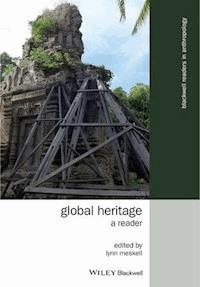
Cover image: Photograph taken in Angkor, Cambodia by Lynn Meskell
For Sherry, Lila, and Sylvia
Notes on Contributors
Christoph Brumann is Head of Research Group at the Max Planck Institute for Social Anthropology, Halle, and Honorary Professor of Anthropology at Martin Luther University Halle-Wittenberg in Germany. He is the author of Tradition, Democracy and the Townscape of Kyoto (2012) and co-editor of Making Japanese Heritage (2010) and Urban Spaces in Japan (2012). He has published widely on urban anthropology, the concept of culture, globalization, utopian communes, and Japanese gift exchange. Alongside his ethnographic study of the UNESCO World Heritage arena, he is currently preparing a new project on Buddhist temple economies in urban Asia.
Denis Byrne is Senior Research Fellow at the Institute for Culture and Society, University of Western Sydney, Australia. He has worked in both government and academic spheres of heritage conservation and has contributed to critical debates on heritage issues in Southeast Asia and indigenous Australia. He is author of Counterheritage: Critical Perspectives on Heritage Conservation in Asia (2013) and Surface Collection: Archaeological Travels in Southeast Asia (2007).
Chiara De Cesari is an anthropologist and Assistant Professor in European Studies and Cultural Studies at the University of Amsterdam. Her research focuses on heritage, memory, and cultural politics and how these change under conditions of globalization. She has published articles in American Anthropologist, Memory Studies, and Studies in Ethnicity and Nationalism, among others. She co-edited Transnational Memory (2014, with Ann Rigney) and is currently finishing a book entitled, Heritage and the Struggle for Palestine. Her most recent project explores the making of a new European collective memory in relation to its blind spots, particularly the carceral heritage of colonialism.
Chip Colwell is Curator of Anthropology at the Denver Museum of Nature and Science. He has written and edited ten books, and more than forty articles and book chapters. His research has been highlighted in such venues as Archaeology Magazine, Indian Country Today, the Huffington Post, and the New York Times.
Rosemary J. Coombe holds the Tier One Canada Research Chair in Law, Communication and Culture at York University in Toronto, where she is cross-appointed to the Departments of Anthropology and Social Science. Until 2000 she was Full Professor of Law at the University of Toronto. Her award-winning book, The Cultural Life of Intellectual Properties was reprinted in 2008. She publishes in the fields of anthropology, cultural studies, and legal studies on the politics of cultural property and heritage management at the intersections of neoliberalism, informational capital, and human rights.
Alfredo González-Ruibal is Staff Scientist with the Institute of Heritage Sciences of the Spanish National Research Council (Incipit-CSIC). His work focuses on the archaeology of the contemporary past and the negative heritage of modernity (war, dictatorship, colonialism). He has recently co-edited the collection Ethics and the Archaeology of Violence (with Gabriel Moshenska, 2014). His recent book, An Archaeology of Resistance: Materiality and Time in an African Borderland (2014) deals with his other research interests: resistance, egalitarianism, and the material culture of indigenous communities.
Peter G. Gould is a consulting scholar at the Penn Cultural Heritage Center of the University of Pennsylvania Museum of Archaeology and Anthropology and an Adjunct Professor of Archaeology at the American University of Rome. After a career as an economist and business executive, he received his Ph.D. from University College London, for which his research in Belize, Peru and Ireland concerned the governance features of sustainable community economic development projects associated with heritage sites. He is a founding director of the Sustainable Preservation Initiative, which supports community economic development projects associated with archaeological sites, initially in Peru.
Martin Hall is Vice Chancellor (President) of the University of Salford, Manchester and Professor Emeritus at the University of Cape Town (UCT). He was previously Professor of Historical Archaeology, inaugural Dean of Higher Education Development, and then Deputy Vice-Chancellor at UCT. He is a Fellow of the Royal Society of Arts, a Fellow of the Royal Society of South Africa, a Life Fellow of the University of Cape Town, and past President of the World Archaeological Congress. Martin Hall has published extensively on pre-colonial, colonial, and historical archaeology, and on the representation of the past in the present.
Michael Herzfeld is the Ernest E. Monrad Professor of the Social Sciences in the Department of Anthropology at Harvard University. Over his long career, he has authored ten books – including A Place in History (1991), Cultural Intimacy (2nd edition, 2005), and Evicted from Eternity (2009) – and numerous articles and reviews, and has also produced two ethnographic films about Rome. A former editor of American Ethnologist (1995–1998), he is Senior Advisor to the Critical Heritage Studies Initiative of the International Institute for Asian Studies (Leiden). His research in Greece, Italy, and Thailand encompasses historic conservation and gentrification, crypto-colonialism, nationalism and cultural intimacy, and artisanship and apprenticeship.
Charlotte Joy is a Lecturer in Social Anthropology at Goldsmiths College, University of London. She carried out fieldwork in Djenné, Mali, and at UNESCO in Paris and is the author of The Politics of Heritage Management in Mali (2013). Her research is concerned with developing an ethnographic approach to understanding the politics of cultural heritage and the links between cultural heritage, rights, and the ethics of the uses of the past in the present. Her new research documents the destruction and rehabilitation of cultural heritage during the current conflict in Mali.
Morag M. Kersel is Assistant Professor in the Department of Anthropology at DePaul University and affiliated faculty with the Center for Art, Museum, and Cultural Heritage Law at DePaul College of Law. She co-directs the archaeological and ethnographic “Follow the Pots Project” in Jordan (http://followthepotsproject.org/). She is a co-author (with Christina Luke) of U.S. Cultural Diplomacy and Archaeology: Soft Power, Hard Heritage (2013) and a co-editor of the volume Archaeology, Cultural Heritage and the Trade in Antiquities (2006). Her research interests include the prehistory of the Levant, cultural heritage policy and law, and the trade in archaeological artifacts.
Sophia Labadi is a Lecturer in Heritage and Director of the Centre for Heritage at the University of Kent. She has a Ph.D. and a Masters in Cultural Heritage Studies from the Institute of Archaeology, University College London and graduated from the Institute of Political Sciences in Grenoble (France). Since 2001, she has worked for a number of regional and international organizations. For UNESCO, she has worked in the Secretariat of the 1972 World Heritage Convention and the 2003 Intangible Cultural Heritage Convention. She was a Getty Conservation Guest Scholar in 2006–2007, the recipient of the Cultural Policy Research Award in 2008, a Senior Research Fellow at Durham University in 2012, and a fellow at the National Gallery of Denmark in 2014.
Kathryn Lafrenz Samuels is an Assistant Professor of Anthropology at the University of Maryland, whose research examines cultural heritage in the transnational sphere, in the ambit of international economic development, democracy promotion, human rights, and global climate change. In 2013–2014 she was a Fulbright fellow in Tromsø, Norway with the Norwegian Institute for Cultural Heritage Research (NIKU). She is co-editor of Cultures of Contact: Archaeology, Ethics, and Globalization (2007) with Sebastian De Vivo and Darian Totten, Making Roman Places: Past and Present (2012) with Darian Totten, and Heritage Keywords: Rhetoric and Redescription in Cultural Heritage (2015) with Trinidad Rico.
Ian Lilley is a Professor at the University of Queensland. He has worked in Australasian and Indo-Pacific archaeology and cultural heritage for thirty-five years. He currently does fieldwork in Australia and New Caledonia, and has just begun a major project examining Indigenous issues in World Heritage management. He is Secretary-General of the ICOMOS International Scientific Committee on Archaeological Heritage Management and also serves on two IUCN Commissions. His most recent books are a heritage management volume on Early Human Expansion and Innovation in the Pacific (2010) and the university textbook, Archaeology of Oceania: Australia and the Pacific Islands (2006).
Christina Luke teaches at Boston University, where she also serves as editor of the Journal of Field Archaeology. She works closely with US embassies and foreign ministries in various countries to explore the pivotal place of heritage in social life and personal experience. Her recent publications include U.S. Cultural Diplomacy and Archaeology (2013) and several articles focused on cultural policy and sovereignty. Her current research focuses on heritage studies, international development, and geopolitics in Turkey, the Balkans, and Latin America.
Lynn Meskell is Professor of Anthropology and Director of the Archaeology Center at Stanford University. Before coming to Stanford in 2005 she was Professor of Anthropology at Columbia University in New York. She is Honorary Professor at the University of the Witwatersrand, Johannesburg. Some of her recent books and edited collections include Cosmopolitan Archaeologies (2009) and The Nature of Culture: The New South Africa (2011). Some of her new research involves an institutional ethnography of UNESCO with a particular focus on heritage rights, sovereignty, and international politics.
Webber Ndoro is currently the Director of the African World Heritage Fund based in Johannesburg, South Africa. He is also Associate Research Fellow at the University of Cape Town. He was Project Manager at ICCROM in Rome, where he worked on the Africa 2009 programme. His recent books and edited collections include Great Zimbabwe: Your Monument Our Shrine (2000), Cultural Heritage and the Law: Protecting Immovable Heritage in Sub-Saharan Africa (2009), and The Archaeological Heritage of Africa (2014). He has published several articles on heritage management in Africa.
Noel B. Salazar is Research Professor in Anthropology at the University of Leuven. He is author of Envisioning Eden (2010) and numerous articles and book chapters on the anthropology of heritage tourism. He is chair of the IUAES Commission on the Anthropology of Tourism, founding member of the AAA Anthropology of Tourism Interest Group, and editorial board member of Annals of Tourism Research and Journal of Heritage Tourism. In addition, he is registered on UNESCO’s and UNWTO’s official roster of consultants, an expert member of the ICOMOS International Cultural Tourism Committee, and the UNESCO-UNITWIN Network “Culture, Tourism and Development.”
Gamini Wijesuriya is currently a staff member of ICCROM in Rome. He was Director of Conservation in the Sri Lankan Department of Archaeology from 1982 to 2000, and then a Principal Regional Scientist in the New Zealand Department of Conservation from 2001 until moving to ICCROM in 2004. He is engaged in a variety of international level training and capacity-building activities related to conservation and management of heritage, including World Heritage. He has published several articles on conservation and management of heritage.
Gro Birgit Ween is Associate Professor and a Keeper of the Arctic and the Australian Collection at the Cultural History Museum at the University of Oslo. She has done fieldwork on indigenous issues, such as rights, heritage, and nature practices in Northern Australia, Sápmi, and Alaska. She is a member of several research projects: Anthropos and the Material (University of Oslo), Arctic Domus: Human–Animal relations in the North (University of Aberdeen), the CICADA project (McGill), and Arctic Domestication in the Era of the Anthropocene (Norwegian Centre for Advanced Study at the Norwegian Academy of Science and Letters).
Lindsay M. Weiss recently completed a postdoctoral appointment in the Department of Anthropology and the Stanford Archaeology Center at Stanford University. Her current research explores the dynamics of heritage and history in the postcolonial context of South Africa. She is currently completing her manuscript on the relationship between liberation heritage and liberation history in South Africa, examining the role of national, corporate and, informal urban heritage in mediating social tensions in post-apartheid landscapes.
Yujie Zhu is currently a Postdoctoral Research Fellow in the Australian Centre on China in the World at the Australian National University. His research on the heritage cities of China explores heritage politics, cultural consumption and production, romanticism, and practices of everyday life. His work has appeared in leading tourism and anthropology journals, including Annals of Tourism Research and Current Anthropology. As part of his work in UNWTO, he co-edited the book Sustainable Tourism Management at World Heritage Sites (2009). Since 2013 he has served as the Vice Chair of Commission on the Anthropology of Tourism in International Union of Anthropological and Ethnological Sciences (IUAES).
Introduction: Globalizing Heritage
Lynn Meskell
The international conflicts in Iraq and Yugoslavia in the 1990s and the concomitant destruction of cultural property had profound effects for the study of archaeology and heritage. Archaeologists became more politically attuned and more self-reflective by seeing their materials deployed as targets or shields and connected communities deeply affected by the cultural cleansing, destruction of memory, and erasure of their material pasts. The shelling of Dubrovnik, the destruction of the Mostar Bridge, fighter jets stationed at Ur, the looting of the Baghdad museum – all of this collateral damage unfolded before our eyes. For the field of heritage something had irrevocably changed. The world watched live the wholesale and often targeted destruction, in some cases perpetrated by the liberators themselves as they trenched, bombed, and looted their way through years of conflict. For nations like Iraq and Afghanistan, this externally wrought destruction was immediately followed by international condemnation of their local inhabitants and then calls for salvage and assistance, leading to what might be seen as a cycle of internationally sanctioned destruction then reconstruction. Cultural commentators often expressed more grief over the loss of antiquity than the loss of life, leading many to question the ethical priorities of international preservationist initiatives.
Many of us came to realize that the creation of heritage is also the creation of heritage conflict. It is commonly said that heritage is history with a point or history that matters. However, history as a discipline is the account that gets authorized after conflict rather than that which is bound up in the midst of things. And while it is true that only select fragments of the human past, in particular places and times, are reified for their cultural significance and value, heritage is deeply enmeshed with materiality. Therefore it is not simply historical accounts or narratives that have salience for living populations, but rather tangible places and objects are necessary to mobilize identifications, significations, and memorialization. The post-9/11 world has only reinforced these observations (Meskell 2002). Whether for the social performance of memory, trauma, protest, or uplift, a material past is discursively assembled to serve as a physical conduit between past and present. Since sites and objects bear witness to particular pasts and have those histories woven into their very fabric, they physically embody and instantiate the past in the present in a way that no textual account can fully achieve. That being said, we have increasingly come to see what many indigenous communities have long realized and indeed practiced: that these physical landscapes, monuments, and objects cannot be separated from intangible beliefs and resonances. The artificial separation of these traits is itself a symbolic violence. And when the immaterial connection that people experience disappears, the significance of those same sites and objects may also decline in the public imaginary.
Lesen Sie weiter in der vollständigen Ausgabe!
Lesen Sie weiter in der vollständigen Ausgabe!
Lesen Sie weiter in der vollständigen Ausgabe!
Lesen Sie weiter in der vollständigen Ausgabe!
Lesen Sie weiter in der vollständigen Ausgabe!
Lesen Sie weiter in der vollständigen Ausgabe!
Lesen Sie weiter in der vollständigen Ausgabe!
Lesen Sie weiter in der vollständigen Ausgabe!
Lesen Sie weiter in der vollständigen Ausgabe!
Lesen Sie weiter in der vollständigen Ausgabe!
Lesen Sie weiter in der vollständigen Ausgabe!
Lesen Sie weiter in der vollständigen Ausgabe!
Lesen Sie weiter in der vollständigen Ausgabe!




