


Global Media Ethics E-Book
32,99 €
Mehr erfahren.
- Herausgeber: John Wiley & Sons
- Kategorie: Geisteswissenschaft
- Sprache: Englisch
Global Media Ethics
Global Media Ethics
Problems and Perspectives
“The book pleads convincingly that news media outlets and practitioners should urgently reconsider their practices and norms in a world gone global and digitally convergent. The various contributions broach the topic from completely different perspectives to create a very stimulating and constructive framework to identify and face the new ethical challenges of journalism and the news media.”
François Heinderyckx, Université libre de Bruxelles
“News that crosses boundaries of culture and geography means rethinking media ethics. The demands of role, audience, digital transmission, and an industry under fierce economic pressure require the insightful approach to ethical thinking this volume provides. From theory to practice, this book has something for scholars and professionals alike.”
Lee Wilkins, Journal of Mass Media Ethics
Global Media Ethics is a cross-cultural exploration of the conceptual and practical issues facing media ethics in a global world. Focusing on the ethical concepts, principles, and questions in an era of major change, this unique textbook explores the aims and norms that should guide the publication of stories that impact across borders, and which affect a globally linked, pluralistic world.
Through case studies, analysis of emerging practices, and theoretical discussion, a team of leading journalism and communication experts investigate the impact of major global trends on responsible journalism and lead readers to better understand changes in media ethics. Chapters look at how these changes promote or inhibit responsible journalism, how such changes challenge existing standards, and how media ethics can develop to take account of global news media. In light of the fact that media journalism is now, and will increasingly become, multimedia in format and global in its scope and influence, the book argues that global media impact entails global responsibilities: It is therefore critical that media ethics rethinks its basic notions, standards, and practices from a more cosmopolitan perspective.
Sie lesen das E-Book in den Legimi-Apps auf:
Seitenzahl: 675
Veröffentlichungsjahr: 2013
Ähnliche




















Table of Contents
Title Page
Copyright
Dedication
Notes on Contributors
Introduction: Media Ethics as Global
Plurality of Approaches
Structure of the Book
Themes
Part I: Media Ethics Worldwide
Chapter 1: Why Media Ethics Still Matters
Some Background
The Need for Media Ethics
The Need for Media Ethics
Conclusion
Chapter 2: Universals and Differences in Global Journalism Ethics
The Quest for Ethical Universals
Mapping Differences in Professional Ethics
Conclusions
Chapter 3: The Role of the Journalist in Reporting International Conflicts
The Journalist as Patriot
Safety and Legal Protection
The Journalist as Witness
Witnessing and War Crimes
Conclusion
Chapter 4: Global Journalism Networks: Funding and Ethical Hurdles
Rise of Nonprofits and Networks
Cross-cultural Standards
Funding the Conferences
Conference Independence and Transparency
US Government and Media Funding
Newsroom and Network Transparency
Greater Expectations
Influence and Broad Revenue Streams
Ethics Codes or Guidelines?
Appendix 4.A
Part II: Media and Diverse Public Spheres
Chapter 5: Contextual Ethics and Arab Mass Media
Contextual Ethics
Arab Media's “Special Circumstances” as Context
Cultural Influence
Shari'ah, Media Ethics, and Social Change
Free Religion, Speech, and Press in the Islamic Context
Codes of Ethics: Providing Professional Journalism Context
Al Jazeera's Ethical Dilemmas in Context
Conclusion
Chapter 6: From Journalism Ethics to an Ethics of Citizenship: Evidence from Colombia
The Colombian Context
Trusting Journalists
A Journalist's Trustworthiness
Journalism and Civic Engagement
Citizenship Ethics
Emerging Publics
Chapter 7: Media Ethics in a New Democracy: South African Perspectives on Freedom, Dignity, and Citizenship
Media Ethics in a New Democracy
Procedural Shifts
Substantive Debates
Conclusion: Challenges Ahead
Chapter 8: Democratization by Boilerplate: National Media, International Norms, and Sovereign Nation Building in Postwar Liberia
Those Who Belong Create the Nation: Short History of Belonging in Liberia
Democratization, Postconflict Reconstruction, and Free Press Advocacy
International Experts, Liberian Media, and National Discourse Making
Conclusion
Part III: Global Issues
Chapter 9: The Role of Global Media in Telling the Climate Change Story
How Solid Is the Science?
So Why All the Debate?
Understanding the Audience
The Challenge of Addressing Truth Claims
Managing the Tension Between Global and Local
Conclusion
Chapter 10: Ethics of Global Disaster Reporting: Journalistic Witnessing and Objectivity
Journalistic Witnessing as Emotional Labor
Journalism, Disaster, and Geopolitics: Limits of Compassion
Nonprofessional Eyewitnesses
Conclusion: Cosmopolitanism and Crisis Reporting
Chapter 11: Affective Expertise: The Journalism Ethics of Celebrity Sourcing
Celebrity as Cultural Authority
Journalism and Legitimacy
The Mission: News and the Narrative of Salvation
Conclusion
Chapter 12: Global Media Ethics, Justice, and Indian Journalism
Sen's Interpretative Use of Nyaya
Nyaya and Anyaya in Indian Journalism Practices
The Use (and Abuse) of Hidden Cameras
Uneven Injustices: Coverage of Crime
Nyaya in Global Media Ethics
Part IV: Theoretical Foundations
Chapter 13: Global Media Ethics?: Issues, Requirements, Challenges, Resolutions
Digital Media Ethics: A Primer
Cases and Issues in Contemporary Digital Media Ethics
Changing Media, Changing Selves—Changing Politics?
Chapter 14: Global Ethics and the Problem of Relativism
Philosophical Relativism
Moral Absolutism
Universalist Theory
Theories of Global Media Ethics
Conclusion
Chapter 15: Global Media Ethics: Utopian or Realistic?
Skeptical Objections: Utopianism
Responses
Realistic Expectations
Index
This edition first published 2013
© 2013 Blackwell Publishing Ltd.
Blackwell Publishing was acquired by John Wiley & Sons in February 2007. Blackwell's publishing program has been merged with Wiley's global Scientific, Technical, and Medical business to form Wiley-Blackwell.
Registered Office
John Wiley & Sons Ltd, The Atrium, Southern Gate, Chichester, West Sussex, PO19 8SQ, UK
Editorial Offices
350 Main Street, Malden, MA 02148-5020, USA
9600 Garsington Road, Oxford, OX4 2DQ, UK
The Atrium, Southern Gate, Chichester, West Sussex, PO19~8SQ, UK
For details of our global editorial offices, for customer services, and for information about how to apply for permission to reuse the copyright material in this book please see our website at www.wiley.com/wiley-blackwell.
The right of Stephen J. A. Ward to be identified as the author of the editorial material in this work has been asserted in accordance with the UK Copyright, Designs, and Patents Act 1988.
All rights reserved. No part of this publication may be reproduced, stored in a retrieval system, or transmitted, in any form or by any means, electronic, mechanical, photocopying, recording or otherwise, except as permitted by the UK Copyright, Designs, and Patents Act 1988, without the prior permission of the publisher.
Wiley also publishes its books in a variety of electronic formats. Some content that appears in print may not be available in electronic books.
Designations used by companies to distinguish their products are often claimed as trademarks. All brand names and product names used in this book are trade names, service marks, trademarks or registered trademarks of their respective owners. The publisher is not associated with any product or vendor mentioned in this book. This publication is designed to provide accurate and authoritative information in regard to the subject matter covered. It is sold on the understanding that the publisher is not engaged in rendering professional services. If professional advice or other expert assistance is required, the services of a competent professional should be sought.
Library of Congress Cataloging-in-Publication Data
Global media ethics : problems and perspectives / edited by Stephen J.A. Ward.
pages cm
Includes bibliographical references and index.
ISBN 978-1-4051-8392-5 (hardback)— ISBN 978-1-4051-8391-8 (paperback) 1. Journalistic ethics. 2. Mass media— Moral and ethical aspects. I. Ward,
Stephen J. A. (Stephen John Anthony), 1951– editor of compilation.
PN4756.G56 2013
174′.907– dc23
2012037007
A catalog record for this book is available from the British Library.
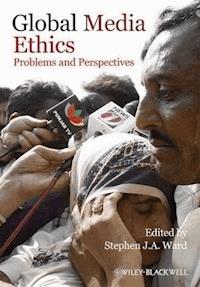
Cover image: Relatives of Pakistani national Khalid Mehmood at Wagah border post near Lahore, March 10, 2008. Mehmood, who had gone to India to watch a cricket series in 2005 and was arrested by Indian police, died in police custody. © Mohsin Raza / Reuters.
Cover design by RBDA.
1 2013
To Glenda Louise Thomson: steadfast companion, love of my life, global advocate for justice; a kind and beautiful soul.
Notes on Contributors
Introduction
Media Ethics as Global
Stephen J. A. Ward
Global media ethics seeks to articulate and critique the responsibilities of a news media that is now global in content, reach, and impact. It is the project of developing aims, principles, and norms of practice specifically formulated for a global, media-linked world.
The context for global media ethics is the current, often disorientating, revolution in media (Ward 2011a). Two major trends of this revolution are worth noting. First, the emergence of a “mixed news media” that is interactive and online. News media is “mixed” for two reasons. First, it is mixed because practitioners use many types of technology to create media content, for example, printed newspapers, blogs, websites, and social media such as Facebook and Twitter. Second, it is mixed because of the democratization of media—the fact that citizens have access to publishing technology. As a result, the number of media practitioners has increased dramatically in recent years, going far beyond the ranks of professional journalists to include web writers for NGOs, scientists with blogs, and citizen journalists.
A second and related trend is the globalization of news media, and media in general. We live in a world where “reality” is defined and mediated by a ubiquitous and powerful global media. News media are global in content because they report on global issues or events, whether the issue is immigration, climate change, world trade policies, or international security. News media are global in reach because they have the technology to gather information from around the world with incredible speed, and to use this information to create stories for a global public. News media are global in impact because the production of stories has impact across borders, sparking riots in distant lands or prompting global responses to natural disasters.
These two trends, mixed media and globalization, define the subject matter for global media ethics. The two trends create the problems and opportunities that motivate scholars and others to study global media ethics. However, to be clear, global media ethics is not the empirical study of globalization as a complex phenomenon affecting culture, economics, and communication. It is the analysis of the normative implications of globalization on a news media whose practices and norms were created for a nonglobal, nonmixed media.
The argument for global media ethics can be summarized in one short sentence: Global power entails global responsibilities. It is therefore appropriate—some would say urgent—to ask about the ethics of global media, and to what extent it differs from the previous ethics of a nonglobal media rooted in individual nations and regions of the world. The need for a global ethics is due not only to technological innovation and new ownership patterns; it is due to changes in the world that journalism inhabits. Of primary importance is the fact that our media-connected world brings together a plurality of different religions, traditions, ethnic groups, values, and organizations with varying political agendas, social ideals, and conceptions of the good. Media content deemed offensive by certain groups can spark not just domestic unrest but global tension. As happened with the publication of the cartoons of Mohammed by a Danish newspaper, news media (and other media) can spark cultural tensions and violence that ripples across borders. In such a climate, the role of media, and its ethics, must be re-examined.
A globally minded media is of great value because a biased and parochial media can wreak havoc in a tightly linked global world. North American readers may fail to understand the causes of violence in the Middle East or of a drought in Africa if they are not reported properly. Jingoistic reports can portray the inhabitants of other regions of the world as a threat. Reports may incite ethnic groups to attack each other. In times of insecurity, a narrow-minded, patriotic news media can amplify the views of leaders who stampede populations into war or the removal of civil rights for minorities. We need a cosmopolitan media that reports issues in a way that reflects this global plurality of views and helps groups understand each other better. We need globally responsible media to help citizens understand the daunting global problems of poverty, environmental degradation, and political instability.
However, one may ask: Why not apply existing principles of media ethics to the problems raised by a globalization of media? The answer is: Traditional media ethics is insufficient because traditional media ethics was, and is, parochial, not global. For traditional media ethics, the media owed responsibilities to a public within the borders of a nation. For traditional media ethics, journalists were first and foremost citizens of specific countries who should be patriotic in serving their country's national interest, not global citizens seeking to create global understandings or global justice. Therefore, we must reconceive media ethics as dealing with issues surrounding transnational publics and global problems.
For some or all of these reasons, global media ethicists believe that the rise of global media calls for a simultaneous development of a global media ethics. In my concluding Chapter 15, I discuss to what extent this project of global media ethics might be realized. Yet, whatever the answer is to the question of realization, the fact remains that the world needs a global ethics for its media.
Plurality of Approaches
Even if we understand the need for global media ethics, this does not mean that “global media ethics” refers to something clear and singular. As a field of study, “global media ethics” does not refer to a well-defined science with a consensus on methods and aims. It is not a mature academic discipline which builds, rigorously and systematically, upon previous established knowledge. “Global media ethics” does not refer to one thing, such as one, internationally accepted, code of media ethics. Instead, global media ethics refers to an evolving field. It is a “felt need” that motivates a loosely connected set of activities and studies united by the belief that ethics must go global, for the reasons cited above.
Another commonality among advocates of global media ethics is the view that journalists and other media practitioners need to undergo a global revolution in their self-consciousness and in the way they practice their craft. For example, some global ethicists argue (Ward 2010) that journalists and news outlets need to regard themselves as global citizens. They need to see their responsibilities from a cosmopolitan view that challenges the often negative influence of various forms of parochialism, such as narrow patriotism or extreme nationalism. If journalists become globally minded, they will change how they cover global issues and events.
These common beliefs leave plenty of room for different answers to questions about the most effective methods of inquiry, the most important problems, and the most important principles of a global media ethics. Today, global media ethics is characterized by a plurality of approaches, a plurality of types of theorizing, and a plurality of contending views concerning what global media ethics is or should be.
As the chapters in this book indicate, there are numerous types of inquiry in the field of global media ethics. Types of inquiry can be divided roughly into four kinds, depending on the degree of normative and philosophical emphasis in the studies: empirical, empirical-normative, applied, and philosophical.
The empirical category includes comparative studies of media cultures and surveys (Weaver 1998) of the attitudes, working conditions, and practices of journalists and other media practitioners in different countries. Empirical-normative studies include surveys and cross-culture comparisons, but these studies are more focused on the implications of such studies on our conception of global media ethics. Empirical-normative studies also examine the normative similarities and differences among media practitioners. For example, Chapter 2 of this book, by Hanitzsch, Plaisance, and Skewes, draws conclusions about universals and differences in journalism based on a multinational survey of journalists.
The third form of inquiry works in the area traditionally known as applied ethics—the study and critique of the principles of media professions. Applied ethics, in global media ethics, means a creative and bold extension of existing ideas to media as global. Global applied ethics means the construction of new principles, the critique of existing principles, and the reinterpretation of norms for the guidance of global media. For example, in this book several chapters question the relevance of traditional notions of journalistic objectivity and neutrality for certain types of media coverage and for different media cultures.
The fourth type of inquiry works at the meta-ethical (or philosophical) level. Inquirers examine the theoretical foundation of global media ethics. Foundational topics include the goals and basic principles of global media ethics, the existence of media universals, and the challenge of ethical relativism. For instance, in Chapter 14 of this book, Clifford G. Christians argues against relativism as a major obstacle to the construction of global ethics.1
Given these lines of research, global media ethics is best described as a project. A project is a practical affair. It brings together people of varied skills and interests in an attempt to realize valued objectives. To be a project is to be an ideal not yet realized. Global media ethics is a project in this sense, in that it is an ideal not yet realized. Global media ethics—as a widely accepted explicit set of principles—does not exist. What is more, the project of global media ethics is controversial. Advocates see the construction of global ethics as a worthy project, required by today's media. Yet plenty of ethicists and media practitioners are not engaged in the project. As I discuss in Chapter 15, some people regard the project as utopian or undesirable.
The project, then, must establish a beachhead for global media ethics in the face of parochial (nonglobal) ethics and skeptics of the very idea of global ethics, especially in media. To establish a beachhead, the project sometimes takes the form of an ethical movement, usually described as the “search” for a global media ethics (Ward and Wasserman 2010). At the center of the movement are scholars and media practitioners deeply interested in exploring the fundamental ideas of global media ethics. For example, one group have, since 2007, held international roundtables to stimulate discussion on what global ethics means for different media cultures. The roundtables have resulted in seminal publications.2 In addition, an increasing number of books and journal articles appear with global media ethics as their topic. The movement is supported by global media institutes and globally minded websites with an interest in global journalism and its ethics (Ward 2011b). These centers hold global media conferences and publish articles and newsletters which add to the conversation about global media ethics.
Skepticism of global media ethics because of its varied and contending perspectives is misplaced. It betrays a simplistic view of applied ethics and how it evolves. Global media ethics is a valid form of “emergent” applied ethics. A practice is emergent if its key normative elements are less developed than a more mature practice.3 A mature practice enjoys substantive agreement on the goals, methods, and norms of the practice. The normative concepts of emergent ethics may be less developed for two reasons: either because the practice is new, or because the practice is not new but agreement on key concepts has broken down and in a state of flux or reformulation. Reformulation is prompted by engagement with new problems of practice. The need for changes in the applied ethics of technology, the sciences, or professions is based on ever-evolving new conditions in these areas of society. For example, the development of bioethics and the ethics of technology with worrisome military applications are examples of emergent ethics. Some areas of ethics are not emergent and are relatively stable for long periods of time. The ethics of a religion may remain unchanged in essentials over many decades, or centuries. However, among such practices as journalism, emergent ethics is a familiar phenomenon because of regular and rapid changes in the conditions of practice. In the media professions, the need to address new normative problems is so practically urgent that they force practitioners to reformulate ethical guidelines and to gradually codify (and philosophically ground) these responses to problems. Emergent ethics, in media and elsewhere, evolve through a gradual resolution of key issues forged in the crucible of daily practice and public debate. For global media ethics, the new problems created by mixed media and globalization of media force journalists and media scholars to engage in an emergent process that redefines basic concepts.
Structure of the Book
This book takes seriously the idea of global media ethics as a project with many types of contributors and many types of contributions. The four parts of the book were selected to reflect the book's subtitle—the many problems and perspectives in this new field of global media ethics.
Part I introduces the reader to media ethics worldwide. Couldry and Tumber argue for the continuing relevance of ethics for global media in general and for reporting international conflicts. Tumber says the best description of the ethical role of war reporters today is that of “responsible engagement” with events and issues, rather than the view that the role of such reporters is that of the neutral or objective observer. Hanitzsch, Plaisance, and Skewes examine the idea of universals and differences across media cultures; Houston indicates how an emergent ethics is developing among global networks of nonprofit journalists.
Part II analyzes media ethics in different regions of the world. Berenger and Taha examine Arab mass media, while Rojas and Macafee study the impact of new media on the Colombian public sphere. Wasserman explains the ethical tensions among South African media, and Fair questions the approach of international media development agencies in Liberia.
Part III considers how a global media ethics might change practice, especially the coverage of global issues. Dunwoody and Konieczna recommend a number of approaches that would improve media coverage of climate change. Wahl-Jorgensen and Pantti argue for a more cosmopolitan approach to covering natural disasters. Bell questions the use of celebrities as sources on global issues, and Rao shows how Amartya Sen's theory of comparative justice could be used to guide how Indian journalists (and journalists elsewhere) cover stories that involve issues of justice, wrongdoing by officials, and social class.
The book's concluding Part IV addresses philosophical questions raised by the preceding parts. Ess argues for a widening of media ethics to include consideration of how communication technology is altering how citizens interact with others, and how this “new media” is affecting conceptions of self. Christians examines the problem of relativism for global media ethics. Ward defends the project of global media ethics against a range of objections, including claims that the project is utopian and will never be realized.
Themes
We obtain a better appreciation of the concerns and the varied lines of inquiry in global media ethics by noting some common themes among the 15 chapters. The chapters show that the controversies in global media ethics are instantiations of much broader controversies in ethics, cultural studies, and philosophy. One of the main controversies is the debate between universalists, who focus on common values among media cultures, and antiuniversalists (or global skeptics), who focus on normative differences among media cultures. Moreover, we see that global media ethics cannot avoid engagement with the difficult philosophical issues around the idea of universalism in ethics. Through this engagement, theory building in global media ethics becomes embroiled in complex discussions and intense debates surrounding the relationship of the local and the global with respect to culture and ethics.
Here are five themes found in the book's chapters that define the current state of inquiry and debate in global media ethics:
Universalism or contextualism?
In this book, the debate between the local and global arises from the assumption that a global media ethics must be a form of universalism. That is, it must assert that there are at least some universal principles that apply to media around the world. But this assertion runs up against at least two forms of skepticism. First, the existence and prevalence of universals: Are the principles of media ethics relative to particular societies? Are there any universal principles in media ethics (or in ethics)? Does the variety of types of media practice and media standards cast doubt on the possibility of universal media ethics? Second, universals and cultural difference: Is ethical universalism a form of cultural imperialism or cultural insensitivity? When we try to apply universal principles across borders do we show disrespect to local and regional variations among media cultures?
In this book, Hanitzsch, Plaisance, and Skewes argue that empirical research shows that there are both universals and differences across media cultures. Berenger and Taha contend that an abstract universalism of principles fails to capture significant ethical differences in the practice of Arab mass media. They prefer an approach called “contextualism” which studies how media norms operate in specific media cultures.
What type of ethical approach?
A second theme is best posed as a question: What approach to global media ethics will be most conducive to finding common values? Ess, Couldry, and Rojas and Macafee agree that media ethics remains important but the scope of media ethics should widen beyond professional journalists to citizens. Couldry argues that the plurality and complexity of media practice today makes a “top-down” approach unattractive in ethics. A top-down approach seeks common values by imposing principles on diverse media practices. Couldry promotes a flexible, “bottom-up” approach based in virtue ethics as the best way to begin a cross-cultural conversation on media ethics.
Interpreting global principles
A third theme is that global media ethics should provide nuanced and culturally sensitive interpretations of whatever concepts are put forward for inclusion in global media ethics. Among the candidates for inclusion are (1) ethical principles such as truth telling and objectivity, (2) forms of journalism such as watchdog investigative journalism, and (3) ideals such as “serving the public” or democracy. Wasserman examines the ways that journalists (and others) in transitional democracies like South Africa interpret the idea of media serving democracy. Should “serving democracy” in South Africa mean adopting a Western-style watchdog journalism focused on official wrongdoing or should it a mean a journalism focused on human dignity and social inequalities? Wasserman shows there is no simple, clear application of the abstract ideal of “media serving democracy.”
Fair draws the same type of moral from her study of how international media development agencies have attempted to create a Western-style free media in Liberia. The notion of a free democratic press, imported from the West, cannot (and should not) be imposed on the complex history, ethnic composition, and political terrain of an African country such as Liberia.
Global approaches to global issues
Another theme is how media, steeped in traditional forms of practice, result in suboptimal coverage of global issues. Dunwoody and Konieczna argue that coverage of climate change is episodic and influenced by a narrow definition of news. Reporters tend to apply a traditional notion of “balance” to climate change stories, which results in reports that give too much credibility to questionable views and experts. They recommend a “weight of evidence” approach to reporting differing viewpoints, and endorse a form of coverage that brings the local and global together.
Wahl-Jorgensen and Pantti contend that coverage of natural disasters is restricted by an attempt to report in an unemotional “objective” manner. In addition, news media cover disasters in a parochial manner. Which disasters they cover and how they cover them is overdetermined by the impact of the disaster on their own country. They recommend that journalists adopt a more cosmopolitan approach toward coverage of disasters, an approach that brings together the emotions and the rationality of journalists.
Parochialism partially transcended
These themes lead back to one fundamental point upon which most of the authors agree: Even if we cannot say with precision what a global media ethics should be, media practitioners should become more globally minded and seek to transcend, at least partially, their parochial attachments. These attachments can distort coverage of events and inhibit the global public's understanding of trends. Even if the project of global media ethics is only beginning, a media that is global in content, reach, and impact cannot escape the responsibility—today—to improve their coverage of global issues.
Notes
1 See Ward (2010) for the foundations of global journalism ethics.
2 Among the roundtable leaders are Profs. Clifford G. Christians of the University of Illinois, Shakuntala Rao of the State University of New York-Plattsburgh, Herman Wasserman of Rhodes University, South Africa, Lee Wilkins of Wayne State University-Detroit, and myself. Roundtables have been held in Stellenbosch, South Africa, in 2007, Dubai in 2010, and Delhi, India, in 2011. Presentations at the South African roundtable became the content for Media Ethics Beyond Borders (Ward and Wasserman 2010). Papers from the Dubai meeting formed the content of a special issue on global media ethics in Journalism Studies in December 2011, Vol. 12(6). Papers from the Indian roundtable will be published by Oxford University Press.
3 Beitz (2009: 43), for example, describes human rights practice as an emergent practice.
References
Beitz, C. R. 2009. The Idea of Human Rights. Oxford: Oxford University Press.
Ward, S. J. A. 2010. Global Journalism Ethics. Montreal: McGill-Queen's University Press.
Ward, S. J. A. 2011a. Ethics and the Media: An Introduction. Cambridge: Cambridge University Press.
Ward, S. J. A. 2011b. “Center for Journalism Ethics, School of Journalism and Mass Communication, University of Wisconsin-Madison.” Journalism Studies12(3): 392–8.
Ward, S. J. A. and Wasserman, H. Eds. 2010. Media Ethics Beyond Borders: A Global Perspective. New York: Routledge.
Weaver, D. Ed. 1998. The Global Journalist. New York: Hampton Press.
Part I
Media Ethics Worldwide
Chapter 1
Why Media Ethics Still Matters
Nick Couldry
Journalists who work for British tabloid or midmarket newspapers, which have nearly four-fifths of circulation in Britain,1 are trusted to tell the truth by less than a quarter of its population (10% for tabloid journalists, 22% for journalists on the midmarket press). It is small comfort that less than a third of people in Britain trust leading politicians, trade union leaders, or senior civil servants. Only BBC news journalists are trusted to tell the truth by a majority of Britain's population, although trust in them also fell drastically between 2003 and 2010 (Kellner 2010). And yet it is taken for granted that free media are essential to a working democracy.
There is more than a hint of paradox here. Media's freedom to publish does not automatically aid democracy: What if media regularly publish lies or untruths, as so many of the British population believe or suspect? As philosopher Onora O'Neill puts it, “the press has no licence to deceive; and we have no reasons to think that a free press needs such a licence” (O'Neill 2002: 100). The paradox goes further, since an untrustworthy media cannot provide a secure basis for trusting other public figures or processes. As O'Neill notes, “if we can't trust what the press report, how can we tell whether to trust those on whom they report?” (O'Neill 2002: 90). There is easily enough provocation here toward the development of a rigorous framework of media ethics, and indeed codes of journalistic ethics have existed for more than a century in many countries (Bertrand 2000).
I want, however, to argue in this chapter that the status of media ethics in media research is, in many respects, problematic and in need of robust defense. This is for at least two reasons. First, there is the increasingly ambiguous status of institutional media themselves within the proliferating complexity of the digital media age; second, and connectedly, there is the rising demand for a broader ethics of communication that would give no special prominence to the ethical problems raised by institutional media. The best response, I suggest, is to develop a media ethics that is flexible enough to provide starting points for new debate, and not merely the reaffirmation of old rules and norms. Making this argument will bring out the special contribution of the philosophical tradition of , by contrast with other approaches to the normative sphere, such as deontology. The distinction is important, although sometimes blurred in debate about media norms: By “ethics” I mean normative discourse focused on issues of the good and dispositions aimed at the good (virtue), while by “deontology” I mean normative discourse focused on duties (for a sharp treatment of the contrast, see Ricoeur 2007). Getting this distinction clear and so getting clear about the distinctive contribution that an ethics approach can bring to the normative dilemmas posed by media practice may, in turn, lay the foundations for a more robust communication ethics over the longer term.
Lesen Sie weiter in der vollständigen Ausgabe!
Lesen Sie weiter in der vollständigen Ausgabe!
Lesen Sie weiter in der vollständigen Ausgabe!
Lesen Sie weiter in der vollständigen Ausgabe!
Lesen Sie weiter in der vollständigen Ausgabe!
Lesen Sie weiter in der vollständigen Ausgabe!
Lesen Sie weiter in der vollständigen Ausgabe!
Lesen Sie weiter in der vollständigen Ausgabe!
Lesen Sie weiter in der vollständigen Ausgabe!
Lesen Sie weiter in der vollständigen Ausgabe!
Lesen Sie weiter in der vollständigen Ausgabe!
Lesen Sie weiter in der vollständigen Ausgabe!
Lesen Sie weiter in der vollständigen Ausgabe!
Lesen Sie weiter in der vollständigen Ausgabe!
Lesen Sie weiter in der vollständigen Ausgabe!
Lesen Sie weiter in der vollständigen Ausgabe!
Lesen Sie weiter in der vollständigen Ausgabe!
Lesen Sie weiter in der vollständigen Ausgabe!




