


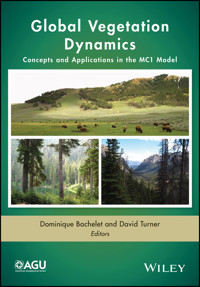
Global Vegetation Dynamics E-Book
132,99 €
Mehr erfahren.
- Herausgeber: John Wiley & Sons
- Kategorie: Wissenschaft und neue Technologien
- Serie: Geophysical Monograph Series
- Sprache: Englisch
Global Vegetation Dynamics: Concepts and Applications in MC1 model describes the creation in the mid 1990s, architecture, uses, and limitations of the MC1 dynamic global vegetation model (DGVM) that is being used by an increasing number of research groups around the world. The scientific foundation of most models is often poorly documented and difficult to access, and a centralized source of information for MC1, including the complete list of over eighty papers and reports with MC1 results will be useful to scientists and users who want to better understand the model and the output it generates.
Global Vegetation Dynamics: Concepts and Applications in MC1 model will be a valuable resource for students and researchers in the fields of climate change science, conservation science, biogeochemistry and ecology, as well as for land managers looking for a better understanding of the projections of climate change impacts and of the tools that have been developed to produce them.
Sie lesen das E-Book in den Legimi-Apps auf:
Seitenzahl: 568
Veröffentlichungsjahr: 2015
Ähnliche




















Table of Contents
COVER
TITLE PAGE
CONTRIBUTORS
PREFACE
ACKNOWLEDGMENTS
Part I: General Description of the Model MC1
1 History and General Description of the Dynamic Global Vegetation Model MC1
ABSTRACT
1.1. MODEL HISTORY
1.2. MC1 MODEL DESCRIPTION
1.3. INPUT DATA
1.4. MC1 RUN PROTOCOL
1.5. THE FIRE FORECAST MODEL
1.6. THE NEXT GENERATION; MC2, C++ IMPLEMENTATION
REFERENCES
2 Historical Climate and Suppression Effects on Simulated Fire and Carbon Dynamics in the Conterminous United States
ABSTRACT
2.1. INTRODUCTION
2.2. METHODS
2.3. RESULTS
2.4. DISCUSSION
2.5. CONCLUSIONS
ACKNOWLEDGMENTS
REFERENCES
3 Challenges and Limitations of Using a DGVM for Local to Regional Applications
ABSTRACT
3.1. INTRODUCTION
3.2. SCALE-RELATED CHALLENGES
3.3. OTHER MORE GENERAL (LESS SCALE-DEPENDENT) CHALLENGES
3.4. CONCLUSIONS
REFERENCES
4 The Making of a Dynamic General Vegetation Model, MC1
ABSTRACT
4.1. RATIONALE FOR BUILDING DYNAMIC GLOBAL VEGEGATION MODELS
4.2. GENERAL CONCEPT USED TO BUILD DYNAMIC GLOBAL VEGETATION MODELS
4.3. GENERAL CONSIDERATIONS ON BIOGEOGRAPHY
4.4. GENERAL CONSIDERATIONS ON BIOGEOCHEMISTRY
4.5. GENERAL CONSIDERATIONS ON DISTURBANCE
4.6. DGVM CALIBRATION AND VALIDATION
4.7. SCALING ISSUES: VEGETATION CHANGE, WILDFIRES, AND COARSE CLIMATE GRIDS
4.8. CONCLUSIONS–CURRENT STATUS AND FUTURE PROSPECTS
ACKNOWLEDGMENTS
REFERENCES
Part II: Examples of Projects Using MC1 at Various Spatial Scales
5 A Brief Description of the VINCERA Project; Vulnerability and Impacts of North American Forests to Climate Change: Ecosystem Responses and Adaptation
ABSTRACT
5.1. INTRODUCTION
5.2. METHODS
5.3. RESULTS
5.4. DISCUSSION
REFERENCES
6 Continent-wide Simulations of a Dynamic Global Vegetation Model over the United States and Canada under Nine AR4 Future Scenarios
ABSTRACT
6.1. INTRODUCTION
6.2. METHODS
6.3. RESULTS
6.4. DISCUSSION
ACKNOWLEDGMENTS
REFERENCES
7 Drivers of Future Ecosystem Change in the US Pacific Northwest
ABSTRACT
7.1. INTRODUCTION
7.2. METHODS
7.3. RESULTS
7.4. DISCUSSION
ACKNOWLEDGMENTS
REFERENCES
8 Application of MC1 to Wind Cave National Park
ABSTRACT
8.1. INTRODUCTION
8.2. METHODS
8.3. RESULTS
8.4. DISCUSSION
ACKNOWLEDGMENTS
REFERENCES
9 Simulating Effects of Climate and Vegetation Change on Distributions of Martens and Fishers in the Sierra Nevada, California, Using Maxent and MC1
9.1. INTRODUCTION
Lesen Sie weiter in der vollständigen Ausgabe!
Lesen Sie weiter in der vollständigen Ausgabe!
Lesen Sie weiter in der vollständigen Ausgabe!
Lesen Sie weiter in der vollständigen Ausgabe!
Lesen Sie weiter in der vollständigen Ausgabe!
Lesen Sie weiter in der vollständigen Ausgabe!
Lesen Sie weiter in der vollständigen Ausgabe!
Lesen Sie weiter in der vollständigen Ausgabe!
Lesen Sie weiter in der vollständigen Ausgabe!
Lesen Sie weiter in der vollständigen Ausgabe!
Lesen Sie weiter in der vollständigen Ausgabe!
Lesen Sie weiter in der vollständigen Ausgabe!
Lesen Sie weiter in der vollständigen Ausgabe!
Lesen Sie weiter in der vollständigen Ausgabe!
Lesen Sie weiter in der vollständigen Ausgabe!
Lesen Sie weiter in der vollständigen Ausgabe!
Lesen Sie weiter in der vollständigen Ausgabe!
Lesen Sie weiter in der vollständigen Ausgabe!
Lesen Sie weiter in der vollständigen Ausgabe!
Lesen Sie weiter in der vollständigen Ausgabe!
Lesen Sie weiter in der vollständigen Ausgabe!
Lesen Sie weiter in der vollständigen Ausgabe!
Lesen Sie weiter in der vollständigen Ausgabe!
Lesen Sie weiter in der vollständigen Ausgabe!




