


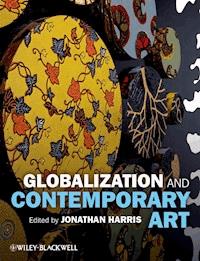
Globalization and Contemporary Art E-Book
36,99 €
Mehr erfahren.
- Herausgeber: John Wiley & Sons
- Kategorie: Geisteswissenschaft
- Sprache: Englisch
In a series of newly commissioned essays by both established and emerging scholars, Globalization and Contemporary Art probes the effects of internationalist culture and politics on art across a variety of media. Globalization and Contemporary Art is the first anthology to consider the role and impact of art and artist in an increasingly borderless world.
- First major anthology of essays concerned with the impact of globalization on contemporary art
- Extensive bibliography and a full index designed to enable the reader to broaden knowledge of art and its relationship to globalization
- Unique analysis of the contemporary art market and its operation in a globalized economy
Sie lesen das E-Book in den Legimi-Apps auf:
Seitenzahl: 1212
Veröffentlichungsjahr: 2011
Ähnliche




















Contents
List of Illustrations
Notes on Contributors
Introduction: Globalization and Contemporary Art: A Convergence of Peoples and Ideas
What is Globalization?
Contemporary Art Studied as a Global Phenomenon
Structure, Sequence and Concepts
Part 1: Institutions
Introduction
1 Real Time and Real Time at The Israel Museum, Jerusalem
“Beyond the Limitations of Borders”
Simmel and Intifada
Re:RealTime
Growth, Change, Uncertainty
Growth, Change, Uncertainty, Deconstructed
Growth, Change, Uncertainty, Reconstructed
Moving On
2 Peddling Time When Standing Still
Now is the Time
Killing Time
Battling for the Underfoot of Time
Witnesses Who Know Too Much
Fleshing Time
Descenders
Coda: Indigenes and Exiles
3 Homogeneity or Individuation?
Death by Homogenization
Recognition
Ownership
Reclamation
Response
4 Museums in the Colonial Horizon of Modernity
Epistemic and Aesthetic Disobedience: On Modernity/Coloniality and the Decolonial Option
Museums, Accumulation of Meaning and Accumulation of Money
The Role of Museums in a Corporate Oriented World and the Decolonial Option
What is Fred Wilson up to?
Fred Wilson and the Decolonial Option
5 Africus Johannesburg Biennale 1995
Introduction
Transition Stalled
Politics of Representation
Conclusion
Part 2: Formations
Introduction
6 Post-Crisis
The Crisis
The Urban Change
The High Culture Tour
The Rupture of 2001
Art’s Collectivization
7 Evolution within the Revolution
The 1920s: The Vanguardia and Afrocubanismo
Afro-Cuban Collectives, 1975 to 1985
Collectives Take to the Streets, 1984–1990
The 1990s and Beyond
Conclusion
8 Ka Muhe’e, He i’a Hololua
“Traditional” Kanaka Maoli Culture and Art
Colonization, Resistance and the Emergence of Kanaka Maoli Art
Joseph Kaho’oluhi Nawahi: Kanaka Maoli “Artist”
Kanaka Maoli Art: A “Fish” that Swims in Two Directions
Contemporary Kanaka Maoli Art: A Journey for Equity, Access and Understanding
Conclusion
9 Aboriginal Cosmopolitans
Cosmopolitans or Victims?
Age of Fire
The Age of Water
10 Working to Learn Together
Introduction
Specific Groups
Part 3: Means and Forces of Production
Introduction
11 The Two Economies of World Art
World Art
The Art Pyramid
Free or Equal?
The Two Economies
12 The Spectacle and Its Others: Labor, Conflict, and Art in the Age of Global Capital
Collisions: Economic Immigrants and Popular Culture post America’s 9/11
Ideologies: Manual Labor, Immaterial Labor, and the Screen
Histories: Local Struggles, Global Defeats
Complicities: What Extreme Conditions of Labor Can Do for You
Risks: Art, Labor, Knowledge, and Social Relations in Transnational Space
For, and About, Now
13 Cultural Mercantilism
New York, 1958
Modernism and Imperialism
Cultural Mercantilism
14 Audiovisionaries of the Network Planet
Part 4: Identifications
Introduction
15 Contemporary Asian Art and the West
16 World Pictures
Scholium
17 Leaves of Grass and Real Allegory
18 Collaboration in Art and Society
The Global Need for Collaboration
Four Characteristics of Collaborative Practice
Mediation and the Emergence of the New
Conclusion
Part 5: Forms
Introduction
19 Globalization Questions and Contemporary Art’s Answers
20 Political Islam and the Time of Contemporary Art
Eating Grass (2003)
The Cave (2004)
Read (2007)
21 Displaced Models
22 White Man Got No Dreaming
23 The Discourse of (L)imitation
“Japan’s Glory Upheld by Imitators”
The Historical Contexts of the Imitation Discourse
“Similar yet Dissimilar”: Group “I” vs. Oldenburg vs. Sekine
Part 6: Reproduction
Introduction
24 Art and Postcolonial Society
25 Why Art History is Global
Disciplines that Might Help Understand Contemporary Art
An Overview of the Recent Literature
Two Arguments Regarding Art History
Conclusion
26 The Agency of the Historian in the Construction of National Identity in Colombian Architecture
A Necessary Biographical Excursus
Architecture According to the History Book
Architecture Outside the Book: Unwritten Histories
27 Aboriginal Art and Australian Modernism
28 Gesturing No(w)here
The Local is the Global
The Global is the Local
Becoming Common
Part 7: Organization
Introduction
29 The Emergence of Powerhouse Dealers in Contemporary Art
The Castelli Factor
Museum Quality
The Circulation of Contemporary Art
Twenty-Five Power Dealers of Contemporary Art
Post-Gagosian
30 The Art Market in Transition, the Global Economic Crisis, and the Rise of Asia
31 Global Contemporary?
Vilnius, Lithuania: The Black Market Worlds Community (Club)
From the Second World to New Lithuania
Hyper-identity: Designing the Shanghai Biennale
Contemporary Art
Institutional Concepts and Venues
Claiming History
Cosmopolitan Contemporary Art
32 “Institutionalized Globalization,” Contemporary Art, and the Corporate Gulag in Chile
The Guggenheim Museum in New York versus the Museo de la Solidaridad Chile
The Censorship of Art in Chile by Military Forces Allied with the Guggenheim Museum’s Board of Trustees
The Introduction of Neoliberal Economic Policies in Chile by the Military Junta
Reflections on Neoliberalism, Globalization, and International Art Exhibits
33 Culture, Neoliberal Development, and the Future of Progressive Politics in Southeastern Europe
Select Bibliography
Illustration Credits
Index
To Albert and Myra Boime,citizens of Los Angeles and the world
This edition first published 2011© 2011 Wiley-Blackwell
Wiley-Blackwell is an imprint of John Wiley & Sons, formed by the merger of Wiley’s global Scientific, Technical and Medical business with Blackwell Publishing.
Registered OfficeJohn Wiley & Sons Ltd, The Atrium, Southern Gate, Chichester, West Sussex, PO19 8SQ,United Kingdom
Editorial Offices350 Main Street, Malden, MA 02148-5020, USA9600 Garsington Road, Oxford, OX4 2DQ, UKThe Atrium, Southern Gate, Chichester, West Sussex, PO19 8SQ, UK
For details of our global editorial offices, for customer services, and for information about how to apply for permission to reuse the copyright material in this book please see our website at www.wiley.com/wiley-blackwell.
The right of Jonathan Harris to be identified as the editor of this work been asserted in accordance with the UK Copyright, Designs and Patents Act 1988.
All rights reserved. No part of this publication may be reproduced, stored in a retrieval system, or transmitted, in any form or by any means, electronic, mechanical, photocopying, recording or otherwise, except as permitted by the UK Copyright, Designs and Patents Act 1988, without the prior permission of the publisher.
Wiley also publishes its books in a variety of electronic formats. Some content that appears in print may not be available in electronic books.
Designations used by companies to distinguish their products are often claimed as trademarks. All brand names and product names used in this book are trade names, service marks, trademarks or registered trademarks of their respective owners. The publisher is not associated with any product or vendor mentioned in this book. This publication is designed to provide accurate and authoritative information in regard to the subject matter covered. It is sold on the understanding that the publisher is not engaged in rendering professional services. If professional advice or other expert assistance is required, the services of a competent professional should be sought.
Library of Congress Cataloging-in-Publication Data
Globalization and Contemporary Art / Jonathan Harris.
p. cm.Includes bibliographical references and index.ISBN 978-1-4051-7951-5 (hardcover : alk. paper) – ISBN 978-1-4051-7950-8 (pbk. : alk. paper)1. Art and globalization–History–20th century. 2. Art and globalization–History–21stcentury. 3. Art, Modern–20th century. 4. Art, Modern–21st century. I. Harris, Jonathan (Jonathan P.), 1960– editor of compilation.N72.G55G59 2011701′.0309048–dc222010043499
A catalogue record for this book is available from the British Library.
This book is published in the following electronic formats: ePDFs 9781444396980; ePub 9781444396997
List of Illustrations
1.1 Adi Nes, Untitled, 1999
1.2 Barry Frydlender, The Flood, 2004
1.3 Sigalit Landau, Iranian Atom; RomaMania, from The Dining Hall, 2007
1.4 Ohad Meromi, The Boy from South Tel Aviv, 2001
1.5 (a) Al Mansfeld, sketch submitted to the architectural competition for a National Museum in Jerusalem, 1959 (b) The Israel Museum, Jerusalem, 2010, east elevation
1.6 Computerized rendering of the Israel Museum’s new Entrance Gallery Pavilion
1.7 Pavel Wolberg, Purim, Hebron, 2004
1.8 Adi Nes, Untitled (from the Boys series), 2000
2.1 Billboard with LED day-counter at the Quntari crossroad in Beirut
2.2 Ghassan Salhab, Le Dernier Homme, 100 minutes, 2006. Still from film
3.1 “Welsh Not”: Paul Davies confronted by Mario Merz at the National Eisteddfod of Wales, Wrexham, 1977
3.2 Brith Gof performance, “Rhydcymerau,” 1984–5
4.1 Fred Wilson, Mining the Museum: Cabinetmaking, 1992
4.2 Fred Wilson, Mining the Museum, Metalwork, 1793–1880
4.3 Fred Wilson, Modes of Transportation, 1770–1910
4.4 Detail from Fred Wilson, Modes of Transportation, 1770–1910
4.5 Fred Wilson, Installation view, Mining the Museum: An Installation by Fred Wilson
4.6 Fred Wilson, Site Unseen. Dwelling of the Demons, Goteborg, 2004
7.1 Juan-Sí González, Me han jodido el ánimo, street performance at Parque 23y G, Vedado, Havana, Cuba – 1988
7.2 Elio Rodríguez, Gone with the Macho, 1995, from the series The Pearls of your Mouth
9.1 Paddy Jupurrurla Nelson, Paddy Japaltjarri Sims, Paddy Cookie Japaltjarri Stewart, Neville Japangardi Poulson, Francis Jupurrurla Kelly, and Francis Bronson Jakamarra Nelson, Yarla, and Richard Long, Mud Circle, both installations at Magicians of the Earth, Paris, 1989
9.2 Johnny Warangkula Tjupurrula, Water Dreaming, 1972
9.3 Clifford Possum Tjapaltjarri (assisted by Tim Leura), Warlugulong (1976)
11.1 The Art Pyramid. Top living artists as ranked in 2008 by artifacts.com and artprice.com
12.1 Dulce Pinzón, Spiderman, from The Real Story of Superheroes, 2005–9
12.2 Francis Alÿs, When Faith Moves Mountains (Cuando la fe mueve montañas), Lima 2002
13.1 Tanaka Atsuko, Stage Clothes, Outdoor Gutai Art Exhibition, Ashiya, 1956
13.2 Alfred H. Barr Jr., cover of the exhibition catalogue Cubism and Abstract Art, 1936
14.1The Imposter in the Waiting Room, 2004
14.2The Imposter in the Waiting Room, 2004
15.1 Wilson Shieh, Koala Place, 1999
16.1 William Blake, Europe, A Prophecy. Copy B, 1794
16.2 William Blake, The Song of Los. Copy A, 1795
16.3 William Blake, The Book of Urizen. Copy G, 1794
16.4 Cover of Empire, by Michael Hardt and Antonio Negri
16.5 Hong Hao, The New World Order, 1995
18.1 Photograph of Qin Ga showing the tattoo of the Long March on his back
21.1 Sherrie Levine, President Profile, 1978
21.2 Ines Doujak, detail from Siegesgärten (Victory Garden), 2007
22.1 Julie Dowling, Warridah Melburra Ngupi, 2004
22.2 Julie Dowling, Aunties Playing Cards, 1999
23.1 Page of “The Future of Earthworks,” from “Japan’s Glory Upheld by Imitators,” Geijutsu Shinchō (August 1969)
23.2 Shinohara Ushio, Coca-Cola Plan, 1964
26.1 Las Torres del Parque, Bogotá (Colombia). Architect Rogelio Salmona
26.2 Library and Park Santo Domingo, Medellín (Colombia). Architect Giancarlo Mazzanti
26.3 Library and Park Santo Domingo, Medellín (Colombia). Architect Giancarlo Mazzanti
26.4 Library and Park Santo Domingo, Medellín (Colombia). Architect Giancarlo Mazzanti
27.1 Ninuku Artists painting, Ngintaka Group Canvas, 2009
27.2 Ina Scales and Yangi Yangi Fox looking at Ninuku Tjukurpa; Bilby Dreaming. Ninuku Arts Group Canvas 2008
28.1 Ergin Cavusoglu, Tahtakale, 2004
28.2Jigsaw Furnishing, 2001. Artists: Muruvvet Turkyilmaz and Selim Birsel
29.1 25th anniversary luncheon photograph of the Leo Castelli Gallery. February 1, 1982
29.2 “The Art Eco-System Model” of Morris Hargreaves McIntyre, 2004, Taste Buds: How to Cultivate the Art Market
30.1 There is every indication that in the future buying will be dominated by state-backed cultural funds
30.2 Contemporary (born post-1945) art July 2007–July 2008. Tertiary sales per country
30.3 The Art Market Confidence index
30.4 Global art market share in 2006
30.5 Performance table – Chinese ceramics, Old masters, American and contemporary art
30.6 Turnover of Asian modern and contemporary art in 2007
30.7 Contemporary art sales from the top ten auction houses 2007–8
30.8 Auction volume – Indian modern and contemporary art (2001–7)
32.1 Hans Haacke, Panel no. 1, “Solomon R. Guggenheim Museum, Board of Trustees,” 1974
32.2 Hans Haacke, Panel no. 5, “Solomon R. Guggenheim Museum, Board of Trustees,” 1974
32.3 Ramona Parra Brigade of Muralists. Street mural in Santiago, Chile, 1970
33.1 Dren Maliqi, Face to Face, 2003
33.2 A photo of the destruction of Dren Maliqi’s work (Illustration 1) in Kontekst Galerija, Belgrade, during the opening of the exhibition Exception: Contemporary Art from Pristina, February 7, 2008
Notes on Contributors
Rasheed Araeen is a civil engineer, an artist, writer and inventor – with an international patent. As an artist, he began his journey in 1953 and continued to pursue art while studying civil engineering at NED Engineering College in Karachi. After doing some important works in Karachi, seminal to his later pursuits, he left for London in 1964 and has since lived there. In 1965, he pioneered minimalist sculpture – representing perhaps the only Minimalism in Britain. After having been active in various groups supporting liberation struggles, democracy and human rights, he began to write in 1975, and then started publishing his own art journals: Black Phoenix (1978), Third Text (1987) and Third Text Asia (2008). He has also established online versions of Third Text in Cape Town, South Africa, entitled Third Text Africa, and the Spanish language Tercer Texto in Lima, Peru, both free to their readers. He has curated two important exhibitions: “The Essential Black Art” (1987), “The Other Story” (Hayward Gallery, 1989); and is a recipient of three honorary doctorates (PhDs) from universities of Southampton, East London, and Wolverhampton. He is now directing a project that will revise and produce the most comprehensive and inclusive history of art in postwar Britain. He has published an autobiographical book, Making Myself Visible (1984), comprising texts and visual images, and his latest book, Art Beyond Art/Ecoaesthetics: A Manifesto for the 21st Century, in September 2010.
Vivianne Barsky is an art historian living in West Jerusalem. Informed by a broader revision of the “national narrative,” her PhD dissertation (WSA University of Southampton) probes the genesis of the Israel Museum as an intermeshed ideological-political and architectural construction.
Natasha Becker is the Mellon Assistant Director in the Research and Academic Program at the Clark Art Institute since the summer of 2007. She oversees all Mellon-funded programming at the Clark. These include invitational colloquia, targeted at curators working on interdisciplinary exhibition projects and organizations serving the discipline, and major international collaborations, such as the contemporary African art workshops (2007–8) held at the Wits School of Arts in Johannesburg, the Clark, and New York City, and the East-Central European seminar series (2010–11) scheduled for Tallinn (Estonia), Brno (Czech Republic), and Bucharest (Romania). Before coming to the Clark, she taught courses on the history of photography in Africa, contemporary African art, and contemporary South African art, at Parsons School of Design, New School University, and the School of Visual Arts. Her areas of research are in contemporary art theory and methodology, contemporary South African art, and the history of exhibitions. Her research and scholarship privileges the empirical study of singular artist’s practices and art exhibitions. She is currently completing her PhD at Binghamton University in New York on the politics of art and representation in the Johannesburg Biennales, 1995 and 1997, in South Africa.
Albert Boime, who died in 2008, was one of the leading art historians of the second half of the twentieth century. Author of many books and hundreds of essays and reviews, his interest and faith in a fairer globalized world can be seen in his planned six-volume series, The Social History of Modern Art, published by University of Chicago Press between 1987 and 2008. He taught at the University of California, Los Angeles for many years.
Malcolm Bull teaches at the Ruskin School of Drawing and Fine Art at the University of Oxford.
Charlotte Bydler is Lecturer at the Department of Art History, Södertörn University, Stockholm. Publications include The Global Art world, Inc.: On the Globalization of Contemporary Art (Uppsala University, diss. 2004) and “A local global art history,” in J. Elkins (ed.), Is Art History Global? (2007). She is currently working on Sámi art and cosmopolitanism in internet art context.
Derrick Chong studied business administration and art history at universities in Canada and England, and has a PhD from the University of London. He is a faculty member in the School of Management at Royal Holloway, University of London, and holds an adjunct position at Sotheby’s Institute of Art. His writing focuses on the varied and complex relationships between business and the arts. Books include Arts Management and The Art Business.
Herman Pi’ikea Clark is an Associate Professor of Indigenous Art and Education at Te Whare Wananga o Awanuiarang, an indigenous University in New Zealand. Born and raised in Hawaii, Pi’ikea Clark has contributed to the field of indigenous art and design studies by way of his work as practicing artist, designer, educator, and researcher. Beyond artistic and academic work, Pi’ikea is a performing ukulele musician, husband, and father.
David Clarke is Professor in the Department of Fine Arts, University of Hong Kong. He has written extensively on both Chinese and western art and culture, with a primary focus on the twentieth century. His most recently book is Water and Art (2010), a cross-cultural study of water as medium and subject in modern and contemporary art.
David Craven is Distinguished Professor of Art History and Chair of the Department of Art and Art History at the University of New Mexico.
Sean Cubitt is Professor of Global Media and Communications at Winchester School of Art, University of Southampton. He is a Professorial Fellow in Media and Communications at the University of Melbourne, and an Honorary Professor of the University of Dundee. His publications include Timeshift (1991), Videography: Video Media as Art and Culture (1993), Digital Aesthetics (1998), Simulation and Social Theory (2001), The Cinema Effect (2004) and EcoMedia (2005). He is series editor for Leonardo Books at MIT Press.
Angela Dimitrakaki is Lecturer in Contemporary Art History at the University of Edinburgh. Her book Gender, Art/Work and the Global Imperative is forthcoming. She is co-editor of the volume Politics in A Glass Case: Exhibiting Feminist and Women’s Art, also forthcoming.
James Elkins is E. C. Chadbourne Professor in the Department of Art History, Theory, and Criticism, School of the Art Institute of Chicago. His most recent book is Chinese Landscape Painting as Western Art History, Hong Kong University Press.
Andrea Giunta received her PhD from the University of Buenos Aires, Argentina. She was the first Director of the Center of Documentation, Research and Publications, Centro Cultural Recoleta, Buenos Aires. In 2007 she published Avant-Garde, Internationalism, and Politics. Argentine Art in the Sixties. The Association of Latin American Art – affiliated to the College Art Association – named this as the Best Scholarly Book on the art of Latin America from the Pre-Columbian era to the present. She is currently director of the Permanent Seminar on Latin American Art at the University of Texas at Austin where she teaches.
Jonathan Harris, Research Professor in global art and design studies at Winchester School of Art, University of Southampton, is the author and editor of fourteen books, including Modernism in Dispute: Art since the Forties (1993), The New Art History: A Critical Introduction (2001) and Inside the Death Drive: Excess and Apocalypse in the World of the Chapman Brothers (2010).
Felipe Hernández, PhD, is an architect and professor of architectural design, history and theory at the University of Cambridge. He has published extensively on contemporary architecture in Latin America as well as on the development of the continent’s cities. He is the author of Beyond Modernist Masters: Contemporary Architecture in Latin America (2009) and Bhabha for Architects (2010), as well as co-editor of Rethinking the Informal City: Critical Perspectives from Latin America (2009) and Transculturation: Cities, Space and Architecture in Latin America (2005).
Jeanette Hoorn is Professor of Visual Cultures and Head of Cinema and Cultural Studies at the University of Melbourne. Her most recent book, Reframing Darwin, Art and Evolution in Australia (2009), accompanied a major exhibition at the Ian Potter Museum of Art.
Khaled Hourani lives and works in Ramallah. He currently works as Artistic Director of the International Academy of Art – Palestine. Previously, Hourani worked as General Director of the Fine Arts Department at the Palestinian Ministry of Culture from 2004–6. He was General Coordinator of the Jifna International Artists Workshop Palestine, Spring 2005. As an artist, he has exhibited his works in Palestine, Tunisia, Qatar, Egypt, Italy, Jordan, Norway, Japan, New York, Germany, the UK, and Switzerland. He has participated in numerous workshops and arts meetings and has been a resident artist in Switzerland, England, France, Netherlands, Egypt, Morocco, Tunisia, Turkey, Norway, Croatia, Austria, Sweden, Jordan, and Sharjah. He also writes about art and organizes and curates art exhibitions. In 1997, he founded Al-Matal Gallery in Ramallah.
Lewis Johnson teaches history and theory of art in the Department of Photography and Video, Faculty of Communication at Bahçes¸ehir University, Istanbul. Recent publications include essays on Turkish art and visual culture, on Ömer Uluç and postwar gestural painting (Journal of American Studies in Turkey, 2007) and Osman Hamdi as painter, photographer, and archeologist in Metamorphosis and Place (2009).
Darren Jorgensen lectures in art history at the University of Western Australia. He publishes on Aboriginal art in his own country, while internationally he publishes on science fiction, recently co-editing an edition of the journal Extrapolation the histories of the genre.
Zoya Kocur is an independent scholar who has served as an adjunct faculty member at New York University and at the Rhode Island School of Design. She is the editor, along with Simon Leung, of Theory in Contemporary Art since 1985, published by Blackwell. Her newest volume is Global Visual Cultures: An Anthology (Wiley-Blackwell, 2011).
Peter Lord is Research Fellow at the Centre for Research into the English Literature and Language of Wales (CREW), Swansea University. He is the author of The Visual Culture of Wales, a three-volume history of the subject, and, most recently, The Meaning of Pictures (2009).
Amna Malik is Lecturer in Art History and Theory at the Slade School of Fine Art, UCL. Her publications have examined diaspora and contemporary art. Her current project examines geographical movement of artistic practices in the work of diaspora artists who have disappeared from mainstream narratives of art history.
Ian McLean is currently Professor in the History of Australian Art at the University of Western Australia, and in 2011 will take up an appointment as Research Professor in Australian Art at the University of Wollongong. He has written extensively on Australian art. His most recent book, How Aborigines Invented the Idea of Contemporary Art: Writings on Aboriginal Contemporary Art (2011), chronicles the critical reception of Aboriginal art since the early 1980s.
Walter Mignolo is William H. Wannamaker Professor at Duke University and holds appointments in the Program of Literature, Romance Studies and Cultural Anthropology. He is Director of the Center for Global Studies and the Humanities. He curated an exhibition on “Decolonial Aesthetics” (Bogota, Colombia, 2010). He published an article, leading to the exhibition, in Calle 14, an art magazine published in 2010. His essay “The Darker Side of Modernity” was published in the catalogue for the exhibit MODERNOLOGIES (MACBA, Fall 2009), curated by Sabine Breitwiese. “Decolonizzare la cognoscenza,” an interview by Luigi Fassi, appeared in MAG 1, 2010 (Galleria Arte Moderna di Milano, issuu.com/studio_labxyz/docs/mag). It was reprinted in La Differenze (Mensile de Cultura), Roma, 2010, http://www.differenza.org/articolo.asp?ID=522. His book, The Darker Side of Western Modernity: Global Futures, Decolonial Options, is forthcoming (2011).
W. J. T. Mitchell is a theorist of art, literature, and media who has taught at the University of Chicago since 1977. He is the author of Iconology, Picture Theory, and What Do Pictures Want? His two latest books, Critical Terms for Media Studies (with Mark Hansen) and Cloning Terror, appeared in the spring and fall of 2010.
Nikos Papastergiadis is Professor of Media and Communications and Cultural Studies at the University of Melbourne. His most recent book is Spatial Aesthetics.
Iain Robertson, Head of Art Business Studies, Sotheby’s Institute of Art (2004–present), has worked for the British Council in East Asia and was a Senior Lecturer at City University’s Department of Arts Policy and Management. He has edited two books, Understanding International Art Markets and Management (2005) and The Art Business (2008). He has just completed another book, A New Art from Emerging Markets (2011). He is art market editor of the Art Market Report, advisor to the Asia Art Archive in Hong Kong and consultant to the database, Artfacts.
Judith Rodenbeck holds the Noble Chair in Modern Art and Culture at Sarah Lawrence College in Bronxville, NY. Author of the first major study of Allan Kaprow’s early happenings, she is also past editor-in-chief of Art Journal, and has written for October, Grey Room, Artforum, and Modern Painters, among other publications.
Walid Sadek is an artist and writer living in Beirut. His work thinks art and sociality in protracted civil war. He is Associate Professor at the Department of Architecture and Design at the American University of Beirut.
Nermin Saybasili is an Assistant Professor in the Department of Art History at Mimar Sinan University of Fine Arts, Istanbul, Turkey. She received her doctorate in visual culture from Goldsmiths College, University of London. Her research interests include contemporary art practices and critical theory with a particular emphasis on “visibilities” and “invisibilities” in the regime of the vision; the “element” of sound and voice in installation work and video art; urban space and migration in the networked culture. Saybasili’s recent publications include an essay in Norie Neumark, Ross Gibson, and Theo Van Leeuwen (eds), Voice: Vocal Aesthetics in Digital Arts and Media Art (2010).
Ming Tiampo is Associate Professor of Art History at Carleton University in Ottawa, Canada. She specializes in post-1945 Japanese art and examines the cultural consequences of globalization through her interest in transnational modernism. Her book, Gutai: Decentering Modernism (forthcoming, 2011), uses Gutai’s transnational activities as a case study to suggest new ways of framing modernism.
Reiko Tomii, PhD, is a New York-based independent scholar who investigates post-1945 Japanese art in global and local contexts. Her publications include her 2007 contributions to Art, Anti-Art, Non-Art and Collectivism after Modernism. She co-founded PoNJA-GenKon (www.ponja-genkon.net), a scholarly listserv, in 2003.
Zhivka Valiavicharska is a PhD Candidate in Rhetoric at the University of California, Berkeley. Working across the fields of modern political philosophy, social theory, and cultural studies, she has written on various aspects of socialist and post-socialist material culture and intellectual thought. Her current project explores the fate of left discourses and politics in Eastern Europe after the fall of the socialist states.
Introduction
Globalization and Contemporary Art: A Convergence of Peoples and Ideas
“Globalization,” like the terms “modernism” and “renaissance” before it, has entered into the language of artists, art historians, critics, curators and all those other individuals and groups that make up the art world. And like those two historically preceding categories – still indispensable within the study of contemporary art as well as in its making – “globalization” carries with it three qualifications. Firstly, that the term, although specialized in its art-historical and art-practice senses, also refers to the whole organization of society beyond art. Secondly, that although the term names forces that have shaped societies and civilizations across the globe, these originated principally in one part of it – the “West” – and have achieved dominance beyond Europe and the United States partly through centuries-long histories of western colonial and imperial conquest. Thirdly, that the meanings of the term, though now confidently expounded in scholarship, teaching, and public arenas, remain uncertain: “globalization” is not a finally agreed quantity either historically or in its likely future effects within the art world, or the wider world beyond. “Globalization,” therefore, is best understood and most useful as an heuristic – “trial and error” – analytic construct: a practical concept containing a set of testable hypotheses concerning the progressive ordering of the world and its hitherto separable societies, their peoples, activities and products, into a single system.
Globalization and Contemporary Art is concerned with one facet of this apparent systematization: the remaking of artists, art practices, styles, institutions for art collection, exhibition, sale and pedagogy within such a single, globalized order. These 33 essays all demonstrate that the artworks under scrutiny – contemporary or historical – cannot adequately be understood in isolation from the societies in which they were produced. This is true also of all art institutions and of the human agents active within the art world – artists themselves, dealers, curators, auctioneers, critics, academics, arts administrators and others. But the challenge the authors here have been set is to go radically beyond this established “social history of art” principle to examine how these agents, institutions, and products may now function within a single global system that transcends both national boundaries and regional or continental systems of interaction between peoples and nations which have existed for thousands of years.
“Globalization” has a long history – it didn’t start at the end of World War Two in 1945 or when the USSR abolished itself in 1991 – and its epochal development over thousands of years includes regional and continental patterns of migration, trade, conquest, and cultural borrowings. A globalizing market for goods and services of all kinds has a very long history – with trading between regions extending radically and seemingly irreversibly since the sixteenth century with trans-Atlantic and trans-Pacific exploration and migration – and within this market the place of art and metropolitan centers for its production and dissemination became increasingly important both economically and politically. Although the extension of these interactions has sometimes slackened or even been reversed at certain historical moments over the past, say, 1,500 years – due to a variety of causes, including mass disease or climate conditions – since 1945 the pace and depth of globalization (despite some powerful countervailing forces, such as the Cold War, 1945–1991) has dramatically increased in economic, cultural, ideological, and political terms. Much of this history is sketched out in the essays that follow.
Lesen Sie weiter in der vollständigen Ausgabe!
Lesen Sie weiter in der vollständigen Ausgabe!
Lesen Sie weiter in der vollständigen Ausgabe!
Lesen Sie weiter in der vollständigen Ausgabe!
Lesen Sie weiter in der vollständigen Ausgabe!
Lesen Sie weiter in der vollständigen Ausgabe!
Lesen Sie weiter in der vollständigen Ausgabe!
Lesen Sie weiter in der vollständigen Ausgabe!
Lesen Sie weiter in der vollständigen Ausgabe!
Lesen Sie weiter in der vollständigen Ausgabe!
Lesen Sie weiter in der vollständigen Ausgabe!
Lesen Sie weiter in der vollständigen Ausgabe!
Lesen Sie weiter in der vollständigen Ausgabe!
Lesen Sie weiter in der vollständigen Ausgabe!
Lesen Sie weiter in der vollständigen Ausgabe!
Lesen Sie weiter in der vollständigen Ausgabe!
Lesen Sie weiter in der vollständigen Ausgabe!
Lesen Sie weiter in der vollständigen Ausgabe!
Lesen Sie weiter in der vollständigen Ausgabe!
Lesen Sie weiter in der vollständigen Ausgabe!
Lesen Sie weiter in der vollständigen Ausgabe!
Lesen Sie weiter in der vollständigen Ausgabe!
Lesen Sie weiter in der vollständigen Ausgabe!
Lesen Sie weiter in der vollständigen Ausgabe!
Lesen Sie weiter in der vollständigen Ausgabe!
Lesen Sie weiter in der vollständigen Ausgabe!
Lesen Sie weiter in der vollständigen Ausgabe!
Lesen Sie weiter in der vollständigen Ausgabe!
Lesen Sie weiter in der vollständigen Ausgabe!
Lesen Sie weiter in der vollständigen Ausgabe!
Lesen Sie weiter in der vollständigen Ausgabe!
Lesen Sie weiter in der vollständigen Ausgabe!
Lesen Sie weiter in der vollständigen Ausgabe!
Lesen Sie weiter in der vollständigen Ausgabe!
Lesen Sie weiter in der vollständigen Ausgabe!
Lesen Sie weiter in der vollständigen Ausgabe!
Lesen Sie weiter in der vollständigen Ausgabe!
Lesen Sie weiter in der vollständigen Ausgabe!
Lesen Sie weiter in der vollständigen Ausgabe!
Lesen Sie weiter in der vollständigen Ausgabe!
Lesen Sie weiter in der vollständigen Ausgabe!
Lesen Sie weiter in der vollständigen Ausgabe!
Lesen Sie weiter in der vollständigen Ausgabe!
Lesen Sie weiter in der vollständigen Ausgabe!
Lesen Sie weiter in der vollständigen Ausgabe!
Lesen Sie weiter in der vollständigen Ausgabe!
Lesen Sie weiter in der vollständigen Ausgabe!
Lesen Sie weiter in der vollständigen Ausgabe!
Lesen Sie weiter in der vollständigen Ausgabe!
Lesen Sie weiter in der vollständigen Ausgabe!




