


25,99 €
Mehr erfahren.
- Herausgeber: John Wiley & Sons
- Kategorie: Wissenschaft und neue Technologien
- Serie: RGS-IBG Book Series
- Sprache: Englisch
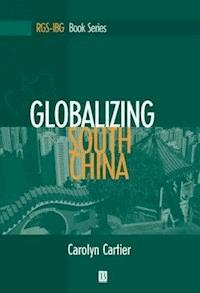
This insightful account demonstrates that capitalism in China has a history and a geography, and combines perspectives from both to demonstrate that regional economic restructuring in South China is far from an economic 'miracle's. Find out more information about the RGS-IBG journals by following the links below: AREA: http://www.blackwellpublishing.com/journal.asp?ref=0004-0894 The Geographical Journal: http://www.blackwellpublishing.com/journal.asp?ref=0016-7398 Transactions of the Insititute of British Geographers: http://www.blackwellpublishing.com/journal.asp?ref=0020-2754
Sie lesen das E-Book in den Legimi-Apps auf:
Seitenzahl: 615
Veröffentlichungsjahr: 2011
Ähnliche



















Contents
List of Plates
List of Figures and Tables
List of Maps
Series Editors’ Preface
Preface
1 Negotiating Geographical Knowledges
Region of Reform
Representing South China
Area studies debates
Transboundary Cultural Economy
Region, Place/Space, and Scale
Contextual Geographies
NOTES
2 Region and Representation
Geographical Representations
Rewriting South China
Regional Thinking
ACKNOWLEDGMENT
NOTES
3 Maritime Frontier/Mercantile Region
Region and Nature-Society Relations
Fringe of Empire
Early Coastal Settlement
Mercantile region
NOTES
4 Open Ports and the Treaty System
“Semicolonialism”
The Open Ports
Commercial Organization
Infrastructural Development
Mercantile society and mercantile cities
NOTES
5 Revolution and Diaspora
The Southern Revolutionary Axis: From Guangzhou to Shanghai
Revolution and the Overseas Chinese
Southeast Asian Chinese Communities
Malaysia and the National Culture Debates
Melaka:6 The Bukit China Movement
Rise of a social movement
Region as homeland
Negotiating absolute space
The social construction of place
Constructing the nationscape
Place and national culture
ACKNOWLEDGMENT
6 Gendered Industrialization
Who Cares?
Regional economy
Engendering Industrialization
Male bias in the development process
Gendered Reform Policies
Rural reform and the feminization of the agricultural labor force
The export-oriented industrialization regime
The new service sector: prostitution
Redirections
7 Zone Fever
The Proliferation of Special Development Zones
The Land Conversion Moratorium
Rapid Development and the “Arable Land Problem”
The Geographical Contradictions Collapse
Real Estate Fever and Financial Collapse
NOTES
8 Urban Triumphant
1997 and the Hong Kong Handover
Geographies of Globalization
Globalizing cities
NOTES
Epilogue
Reference
index
RGS-IBG Book Series
The Royal Geographical Society (with the Institute of British Geographers)Book Series provides a forum for scholarly monographs and edited collections of academic papers at the leading edge of research in human and physical geography. The volumes are intended to make significant contributions to the field in which they lie, and to be written in a manner accessible to the wider community of academic geographers. Some volumes will disseminate current geographical research reported at conferences or sessions convened by Research Groups of the Society. Some will be edited or authored by scholars from beyond the UK. All are designed to have an international readership and to both reflect and stimulate the best current research within geography.
The books will stand out in terms of:
the quality of researchtheir contribution to their research fieldtheir likelihood to stimulate other researchbeing scholarly but accessible.Published
Geomorphological Processes and Landscape Change: Britain in the Last 1000 Years
David L. Higgitt and E. Mark Lee (eds)
Globalizing South China
Carolyn Cartier
Copyright © Carolyn Cartier 2001
The right of Carolyn Cartier to be identified as author of this work has been asserted in accordance with the Copyright, Designs and Patents Act 1988.
First published 2001
2 4 6 810 9 7 53 1
Blackwell Publishers Ltd
108 Cowley Road
Oxford OX4 1JF
UK
Blackwell Publishers Inc
350 Main Street
Malden, Massachusetts 02148
USA
All rights reserved. Except for the quotation of short passages for the purposes of criticism and review, no part of this publication may be reproduced, stored in a retrieval system, or transmitted, in any form or by any means, electronic, mechanical, photocopying, recording or otherwise, without the prior permission of the publisher.
Except in the United States of America, this book is sold subject to the condition that it shall not, by way of trade or otherwise, be lent, resold, hired out, or otherwise circulated without the publisher’s prior consent in any form of binding or cover other than that in which it is published and without a similar condition including this condition being imposed on the subsequent purchaser.
British Library Cataloguing in Publication Data
A CIP catalogue record for this book is available from the British Library.
Library of Congress Cataloging-in-Publication Data
Cartier, Carolyn
Globalizing South China/Carolyn Cartier.
p. cm. — (RGS-IBG book series)
Includes bibliographical references and index.
ISBN 1–55786–887–5 (hbk: alk. paper) — ISBN 1–55786–888–3
(pbk: alk. paper)
1. China, Southeast—Economic conditions. 2. Globalization—Economic aspects—China, Southeast. 3. Globalization—Social aspects—China, Southeast. 4. China, Southeast—Foreign economic relations. 5. China, Southeast—Commerce. I. Title. II. Series.
HC428.S74.C37 2001
337.51'2—dc21
2001037468
Plates
4.1 Straits Chinese style architecture, Xiamen 5.1 Bukit China, aerial view 5.2 Bukit China summit, Eng Choon Association monument 6.1 Family planning billboard, XiamenFigures
2.1Growth triangles2.2Southern China natural economic territory3.1Xiamen walled city4.1Exports carried by the Liuqiu tribute mission, 18515.1“The war over San bao shan [Bukit China]”6.1Cartoons from One Country, Two Wives7.1Trends in arable land conversion under reform, selected coastal areas8.1Rendition of the future Hong Kong central business district8.2Rendition of the future Pudong New Area, Shanghai8.3The Jin Mao Building8.4The Shanghai World Financial CentreTable
7.1Decreases in cultivated land under reform, selected coastal areas, 1000 haMaps
1.1Coastal areas opened to foreign investment, 19961.2Macroregions and natural watersheds2.1Route of official journeys to south China2.2Kingdom of Chu3.1Coastal settlement, Qin dynasty3.2Regional soil quality3.3Coastal settlement, Ming dynasty3.4The monsoon3.5The Zheng He voyages3.6The Amoy network4.1“The Chinese world order”4.2(a) Number of Protestant communicants per 10,000 inhabitants. (b) Population density, Inner China4.3(a) Distribution of Protestant communicants, Fujian.(b) Population density, Fujian4.4Merchant organizations. (a) Fujian. (b) Guangdong. (c) Zhejiang. (d) Jiangxi. (e) Shandong. (f) Jiangsu5.1Dialect regions5.2Chinese overseas populations by dialect group5.3Melaka town and Bukit China7.1The Yangzi delta region7.2The China-Singapore Suzhou Industrial Park8.1(a) The Hong Kong SAR. (b) The Hong Kong-Shenzhen border area and Deep BaySeries Editors’ Preface
The RGS-IBG Book Series publishes the highest quality of research and scholarship across the broad disciplinary spectrum of geography. Addressing the vibrant agenda of theoretical debates and issues that characterize the contemporary discipline, contributions will provide a synthesis of research, teaching, theory and practice that both reflects and stimulates cutting-edge research. The series seeks to engage an international readership through the provision of scholarly, vivid and accessible texts.
Nick Henry and Jon Sadler
Series Editors
Preface
[G]eographical knowledge is too broad and too important to be left to geographers. Its reconstruction as a preparation for a civilized life and its synthesis as an endpoint of human understandings depends on overcoming the old Kantian distinctions between history (narration) and geography (spatial ordering) and between geography (the outer world of the objective material conditions) and anthropology (the inner world of subjectivities). It would probably require the reconstitution of some new structure of knowledge.
(David Harvey, 2000, p. 558)
This book is an inquiry into the possibilities of research on an urban and industrializing transboundary region, the south China coast, which has experienced some of the most rapid economic growth in world history. Numerous accounts about the region have examined its contemporary economic transformations. This analysis instead is based in critical perspectives on regional scholarship in geography and China area studies, and departs from existing work on regional economies in Asia. Alternatively, the book approaches regional analysis from the perspective of “intellectual globalization,” the debates about the organization of knowledge, in universities and scholarly research, and their adequacy for negotiating societal complexities in the contemporary era.1 How can organizations of knowledge suited to a cosmopolitan geographical ethic intersect in innovative ways that transcend the problems of (inter)disciplinary studies, and reinvigorate diverse worldviews, replacing partial knowledges with whole and situated accounts? The book that follows presents one answer to this epistemological problem through the region in south China, by foregrounding debates about its processes of formation and by replacing portrayals of rapid economic growth with critical perspectives about regional transformation. Thus “globalizing” south China means first working to open up a cosmopolitan knowledge about the region, in ways that recognize both historical processes at the basis of regional formation and how places in the contemporary region have experienced the transformations wrought by internationalized transboundary activity.
Because, in Fredric Jameson’s (1998b, p. 55) words, “globalization is a communicational concept, which alternately masks and transmits cultural or economic meanings,” entering the arena of scholarship about globalization requires some cautionary remarks. While the idea of globalization became popular in the late twentieth century, what may be “globalized” must be understood in the context of historic cultural practices, political activities, and economic processes, now transformed. Similarly, in this project globalization does not focus on the currently typical debates in political and economic studies, about the effects of globalizing processes on economic activity or nation-state power, because those debates, despite their important contributions, have tended not to sustain engagements with the emplaced conditions of regional formations. This project instead concerns how to understand the complexities of regional formations as situated intersections of cultural, political, and economic forms. In the same vein, what is globalization is not global in a landed geographical sense, but global as unprecedented possibilities for rapid transference and new combinations of resources, especially capital, labor, information, and ideas. Regional formations, where these and other resources originate, touch down, accumulate, recirculate, and generate new social relations, are especially important sites of globalizing processes. The largest cities of the south China coast have been the centers of transboundary regional activity and are a primary focus of the study.
While studies of “the local and the global” proliferated in geography and related fields through the 1980s and 1990s, the phrase often appeared more as a metaphorical signifier, substituting recognition of transnational and transboundary processes for examination of how such processes actually work out and how they connect diverse places and regions. The problems of the “local and the global” also effectively elided the region, whereas contemporary theorizations of dynamic scale relations help us to think through spatialities that constitute and interrelate places, regions, states, and other territories. The conceptualization of transboundary regional activity through relations of scale is one of the most important ways of moving toward seeing the realities of globalized activity. A focused study on scale relations in China would form its own subject of investigation, and so this book introduces concepts of scale and depends on a dialectical scale perspective as a framework for analysis.
The methodological orientation of this project reflects late twentiethcentury shifts in Anglo-American geography, when geographers began to adopt approaches reflecting the broader poststructural theoretical shift in the academy. The approach adopted in this study retains a material grounding yet understands constructivist knowledges in order to examine both realities of the south China coast and changing representations about the region over time. The analysis recognizes too the instability of human categories, and the importance of understanding “difference” in individuals and within cultural groups, in issues of class, race, ethnicity, gender, sex, and sexuality. This stance is not one that reflects methodological trends, but rather one that finds how theory has finally caught up with practice and empirical reality. Maintenance of a relatively fixed and unchanging identity is, on a world scale, often a privileged position of power and an elite and male-gendered opportunity. Feminist scholarship has allowed us to understand that the “normative” perspective is regularly a patriarchal position, and the analysis depends on feminist critiques to understand a range of issues, including embodied subjectivity and gendered economic activity.
The book is also a product of the era of Orientalism, Edward Said’s (1978) exposition of the practices and representations of European orientalisms. It uses the basic precepts of the Orientalism project as a tool to intervene in normative social scientific conceptualizations of Asia and China. I assume in this book that what Said achieved for humanistic scholarship, in conceptualizing how the West invented “the Orient” through myriad representations, has not been reliably achieved for social scientific analyses of Asia, and especially economic accounts. Because social scientific acceptance of the problem of representations has been incomplete if it has begun at all, this project challenges continuing Western-centrisms retained by many political economic analyses about China, and the larger Asian region. Organization of knowledge for a truly cosmopolitan ethic could not begin to proceed any other way.
Similarly, the critical interventions in Western political economic perspectives about China are not wholly indebted to the legacies of structural Marxism, not least because that mode has tended to presuppose places and processes of Western industrialized geographies. This book contends, as one of its central arguments, that Han Chinese cultural understandings of place and space, human-spatial relations, and some economic reworkings of the space economy in the industrial era have their own logic, and that they reflect a long history of cultural complexes and dynamic spatial relations in Chinese society, and organizational strategies of the Chinese state. One book can only begin to explore these issues, and for this reason alone, the approach must be historical. The critical edges do belong to understanding that globalization, in certain institutional contexts, is deployed as a euphemistic disguise for the neoliberal regime and its problems, a contemporary legacy of the Enlightenment project and diverse forms of imperialism. Still, treating globalization as the property of the West denies how ideas and experiences of globalization have global contexts and localized meanings. Ultimately, the critical interventions belong to concern for the problems of uneven development and ethical accountings of political economic activity, at all scales.
An important observation about neoliberal capitalism at the turn of the millennium is the set of experiential contradictions that have emerged as economic activity works its course and leaves new extremes in its wake: “it appears both to include and to marginalize in unanticipated ways; to produce desire and expectation on a global scale yet to decrease the certainty of work or the security of persons; to magnify class differences but to undercut class consciousness; above all, to offer up vast, almost instantaneous riches to those who master its spectral technologies – and simultaneously, to threaten the very existence of those who do not” (Comaroff and Comaroff, 2000, p. 298). In this complexity of extremes, the world economy promotes the learning of certain kinds of knowledges and the jettisoning of others. The contemporary south China coast has been a region of riches, and the stories repeated about it have been partial accounts that reflect the decades of rapid accumulation that ricocheted across the Pacific in the second half of the twentieth century. This book assembles regional knowledges that have not been reliably told.
Several chapters of this book draw on material published (or about to be published) in different versions elsewhere. A short section in chapter 1 is taken from “Origins and evolution of a geographical idea: the macroregion in China,” Modern China, 28(1), 2002. The discussion of the Bukit China movement in chapter 5 was originally published in “The dead, place/space, and social activism: constructing the nationscape in historic Melaka,” Environment and Planning D:Society and Space, 15(5), 1997. A longer version of chapter 7 appeared as “‘Zone fever’, the arable land debate, and real estate speculation: China’s evolving land use regime and its geographical contradictions,” Journal of Contemporary China, 10(28), 2001. Chapter 8 includes short sections from “Cosmopolitics and the maritime world city,” which appeared in TheGeographical Review, 89(2), 1999, and “The state, property development, and symbolic landscape in high rise Hong Kong,” Landscape Research, 24(2), 1999. I thank the editors and referees of these pieces for their helpful comments.
Over five years the conceptualization and materialization of this book spanned three colleges and universities in the USA, and work on three continents, from China and Southeast Asia, to the USA, and the UK, and I am especially grateful to the people and institutions who supported the project throughout. I owe a special debt to John Davey, who originally contracted the book for Blackwell, and to my editor, Sarah Falkus, who has followed the manuscript to completion. Joanna Pyke, the editorial controller, Brian Johnson, who managed the graphics, and John Taylor, my copy editor, were especially helpful during the publication process. I am grateful to the reviewers for the press who encouraged a leaner and restructured manuscript, and especially to Larry Ma, whose detailed suggestions were subtle, precise, and brilliantly insightful. Jane Sinclair, who produced the line illustrations, has been more a collaborator than a cartographer and created a set of distinctive contemporary illustrations to accompany the text. David Hooson read an earlier draft and staunchly supported my rewriting regional geography before it became fashionable again to do so, and Roland Greene read the manuscript from the perspective of a literary critic and encouraged development of the ideas about regionalism and geographical representations.
Diverse institutes and sources of funding supported research and writing related to the book: the Association of Asian Studies, the Centre for Advanced Studies at the National University of Singapore, the Chiang Ching-kuo Foundation, the Freeman Foundation, the Luce Foundation, the Nanyang Research Institute at Xiamen University, the University of California Humanities Research Institute at UC Irvine, the University of Oregon Department of Geography, and the University of Oregon Humanities Institute. I am deeply grateful to many individuals in China, Hong Kong, and Malaysia who granted interviews, some repeatedly, for material that appears in chapters 5, 7, and 8 of the book.
The process of producing this book has also been richer for conversations and correspondences with many colleagues and friends, especially John Agnew, Tony Bebbington, Bill Barron, Karen DeBres, Cynthia Brokaw, Bob Burnett, Bob Cartier, Cezanne Cartier, Kam Wing Chan, Josephine Chua, Lily Chua, Stephen Durrant, Maram Epstein, Mary Erbaugh, Cindy Fan, Susanne Freidberg, Katherine Gibson, Bryna Goodman, David S. G. Goodman, Julie Graham, Wang Gungwu, David Harvey, Laura Hess, Lisa Hopkinson, Richie Howitt, Denise Humphreys, Jean K. M. Hung, Nayna Jhaveri, John Paul Jones, Ron Knapp, Dick Kraus, Wendy Larson, Marcia Levenson, Alan Lew, Martin Lewis, Christine Loh, Li Si-Ming, George Lin, Larry Ma, Mary MacDonald, Janet Momsen, Dick Peet, Tim Oakes, Kim Rhody, Sang Sze-lan, Elizabeth Sinn, Victor Sit, Helen Siu, Chris Smith, Paul Starrs, Laura Steinman, Wing-shing Tang, Greg Veeck, Billy Villet, Peter Walker, Kären Wigen, Anthony Yeh, You-tien Hsing, and Yue-man Yeung. The China Specialty Group of the Association of American Geographers has served as a forum for initial presentation of some of the ideas in the book, and I am thankful to Cindy Fan especially for encouraging my central participation in the group.
The seeds of this book were in a dissertation I wrote at Berkeley in geography, when that department was experiencing the chaotic processes of a paradigm shift. Only after I left that milieu could I produce scholarship that transcended the political-intellectual boundaries that otherwise were entrenched there at the time. I am grateful to the Berkeley geography department for support over three degrees, and especially to David Hooson and Jay Vance, and also to Dick Walker. David Hooson and Jay Vance were unstintingly supportive, and Dick Walker coached me through postdoctoral academic politics. I am also appreciative to Michael Watts, for being the leading model of professionalism, Allan Pred, whose boundary breaking theoretical work has been an inspiration, and Bob Reed, who steered me toward Southeast Asian studies. I learned to think critically about Chinese historiography from courses with Frederic Wakeman in ways that have proved particularly sustaining over time.
The origins of this book more properly lie in a course I taught at Vassar College in 1993–4, “China and the Chinese Overseas.” I am thankful to the students of that class for apparently finding the subject matter about as interesting as I did. From Vassar I remember gratefully the collegialty of Gabrielle Cody, Miriam Cohen, Harvey Flad, Donald Gillin, Brian Godfrey, Lucy Johnson, David Kennett, Jannay Morrow, and Cindy Wall, none of whom bear any responsibility for my failure to acculturate to the east coast.
I sought to return to the west coast – from where Asia simply never could have been the “Far East” – to build an alternative basis for the kind of scholarship I wanted to produce. While I was at the University of Oregon, the university’s exchange with Xiamen University allowed me to spend the summer of 1995 in Xiamen, after a research period in Suzhou. The following summer I was at the Stanford Center for Chinese language study in Taipei, and the next summer at the National University of Singapore. These experiences proved foundational in my work to rethink the region, and I am grateful to the people who made them possible, especially Stephen Durrant, Cynthia Brokaw, Cui Gonghao, Liao Shaolian, Su Zixing, Kris Olds, and Peggy Teo. Wendy Larson, Bryna Goodman, and Cynthia Brokaw formed the faculty research group at Oregon, “Gender in Historical and Transnational China,” which sustained my intellectual interests there. Cynthia Brokaw, Bryna Goodman, Stephen Durrant, and Dick Kraus read parts of the first draft of the manuscript and offered valuable suggestions. My graduate students in geography at Oregon provided inspiration and some research assistance, especially Jeff Baldwin, Becky Mansfield, and Jessica Rothenberg-Alami. My research assistant, Xingli Zhang, a doctoral student in international relations at the University of Southern California, scrupulously compiled the index.
In a variation on a well turned phrase, this project could only have come together in Los Angeles: my warmest professional thanks are for my colleagues at the University of Southern California, Bernie Bauer, Michael Dear, Rod McKenzie, Stephanie Pincetl, Laura Pulido, Doug Sherman, Billie Shotlow, Chris Williamson, John Wilson, and Jennifer Wolch, who make the geography department an eminently collegial environment, without equal in my experience. I am especially thankful to Jennifer Wolch and Michael Dear for ensuring that I had the three resources at the basis of scholarly production – space, time, and money and the best professional counsel. Jennifer and Michael also introduced me to Los Angeles in ways that have made me feel incredibly fortunate. Jennifer particularly makes the department an energized place of the highest standards, and I have been grateful for her presence and mentorship.
The book is dedicated to the memory of my parents, Helen D. Boller Cartier and Raymond E. Cartier, whose ends of life have marked this project like monuments to historical eras. After prolonged illnesses, my father passed away before I left for my first journey to China and Southeast Asia, and my mother passed away while I was in middle of the final revisions of the manuscript for the press. I have much to thank them for, in propelling me into the international world, thinking the world of me, and in their various activities and passions, for reminding me of the limits of scholarship.
NOTE
1 On this subject see, in addition to Harvey (2000), ideas of Masao Miyoshi (1998) and Bill Readings (1996).
1
Negotiating Geographical Knowledges
As the last remaining socialist country with perhaps the fastest economic growth in the world today, China presents a challenge to critical thinking about globalization. It is imperative that the question of alternatives and other possibilities and potentialities be raised in any attempt at theorizing or conceptualizing the process of globalization. Globalization is generally perceived as the result of the collapse of Soviet-style socialism, as well as the unprecedented expansion of transnational capitalism. While avowedly Eurocentric in its hegemonic formations, globalization also sets up an indispensable structural context for analyzing what happens in the world today. Therefore, globalization must be grasped as a dialectical process: it refers at once to an idea, or an ideology – that is, capitalism disguised as a triumphant, universal globalism – and a concrete historical condition by which various ideas, including capitalism in its present guise, must be measured. China’s challenge to globalization can be perceived in both senses, first to global capitalism as an ideology and then to the “new world order,” or “world-system,” as an accepted reality. China has become increasingly integrated into the global economic system, yet retains its ideological and political self-identity as a third-world, socialist country. Will China offer an alternative?
(Liu Kang, 1998, p. 164)
Globalization has emerged as a common term, yet is an unwieldy conceptual idea used in diverse contexts and to signal, or disguise, a variety of different cultural, economic, and political positions. It is fundamentally associated with the increasing internationalization of capitalist practices, through firms and transnational corporate activities in the world economy, backed and challenged by political forces, accompanied by cultural forms, and mediated by local resistances. In the contemporary geographical imaginary, coastal south China is one area of the world whose economic processes and social relations, in dialectical formation with the world economy, have contributed to contemporary understandings about globalization. South China’s rise has also destabilized the national order of things on the Chinese domestic scene. These events, though, were not entirely new to the late twentieth century. For most of its history, the south China coast has been an internationalized transboundary region, the primary zone of contact between the larger empire of which it has been a part and the world economy. It has also been a region of social activism and revolution. Despite the totalizing qualities of some globalization narratives, regions, like coastal south China, continue to be distinctive in particular ways. The focus of this analysis is that basic geographical problem – the tension between the forces of globalization and the production of local and regional difference.
Lesen Sie weiter in der vollständigen Ausgabe!
Lesen Sie weiter in der vollständigen Ausgabe!
Lesen Sie weiter in der vollständigen Ausgabe!
Lesen Sie weiter in der vollständigen Ausgabe!
Lesen Sie weiter in der vollständigen Ausgabe!
Lesen Sie weiter in der vollständigen Ausgabe!
Lesen Sie weiter in der vollständigen Ausgabe!
Lesen Sie weiter in der vollständigen Ausgabe!
Lesen Sie weiter in der vollständigen Ausgabe!
Lesen Sie weiter in der vollständigen Ausgabe!




