


7,99 €
Mehr erfahren.
- Herausgeber: BookRix
- Kategorie: Wissenschaft und neue Technologien
- Sprache: Englisch
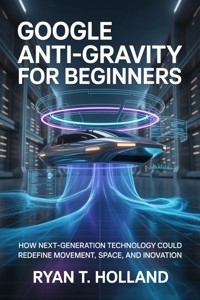
Imagine a world where gravity is no longer a constraint—a world where vehicles float effortlessly above the ground, space travel is faster and more efficient, and human innovation reaches previously unimaginable heights. Google Anti-Gravity For Beginners: How Next-Generation Technology Could Redefine Movement, Space, and Innovation offers an accessible, in-depth exploration of the cutting-edge science and futuristic concepts that could make this vision a reality.
This comprehensive guide takes readers on a journey through the fascinating world of anti-gravity research, from the fundamental physics behind gravity to the advanced technologies being explored by leading innovators like Google X. You’ll discover how quantum field manipulation, superconductors, zero-point energy, and artificial intelligence may converge to create breakthroughs in propulsion, energy, and transportation.
Designed for beginners and enthusiasts alike, this book explains complex ideas in a clear, conversational style while providing actionable insights into the potential applications, economic impact, and ethical considerations of anti-gravity technology. Learn how future cities, transportation systems, and space exploration missions could be transformed—and how you can prepare for the era of gravity-defying innovation.
Whether you’re a science enthusiast, aspiring researcher, tech professional, or simply curious about the future of human potential, this guidebook equips you with the knowledge, context, and imagination to understand and engage with one of the most exciting technological frontiers of our time.
Step into the future of movement, space, and innovation—and discover how humanity’s mastery over gravity could redefine the way we live, explore, and think.
Das E-Book können Sie in Legimi-Apps oder einer beliebigen App lesen, die das folgende Format unterstützen:
Veröffentlichungsjahr: 2026
Ähnliche


















Ryan T. Holland
Google Anti-Gravity For Beginners
How Next-Generation Technology Could Redefine Movement, Space, and Innovation
First published by Ryan T. Holland 2026
Copyright © 2026 by Ryan T. Holland
All rights reserved. No part of this publication may be reproduced, stored, or transmitted in any form or by any means, electronic, mechanical, photocopying, recording, scanning, or otherwise without written permission from the publisher. It is illegal to copy this book, post it to a website, or distribute it by any other means without permission.
Ryan T. Holland asserts the moral right to be identified as the author of this work.
First edition
This book was professionally typeset on Reedsy Find out more at reedsy.com
Contents
Disclaimer
Introduction
Understanding the Future of Anti-Gravity Innovation
The Fascination with Gravity and Human Curiosity
Why Anti-Gravity Captures the World’s Imagination
The Role of Big Tech in Advanced Research
Separating Science, Speculation, and Breakthrough Thinking
What This Book Will Help You Discover
Chapter 1
The Science of Gravity Made Simple
How Gravity Works: From Isaac Newton to Albert Einstein
Understanding Mass, Force, and Space-Time
What Is Gravitational Field Theory?
Can Gravity Be Reduced, Manipulated, or Neutralized?
Common Myths About Anti-Gravity
Chapter 2
The History of Anti-Gravity Research
Early Scientific Theories and Experiments
Cold War Experiments and Classified Projects
Private Sector Interest in Advanced Propulsion
The Rise of Silicon Valley Innovation
Lessons Learned from Past Attempts
Chapter 3
Google’s Role in Advanced Technological Research
Inside Google’s Innovation Ecosystem
Moonshot Thinking at X Development
Artificial Intelligence as a Research Multiplier
Quantum Computing and Its Relevance
Public Patents, Rumors, and Research Trends
Chapter 4
Anti-Gravity vs. Advanced Propulsion Systems
Understanding Electromagnetic Propulsion
Ion Drives and Space-Based Innovation
The Science Behind Magnetic Levitation (Maglev)
Comparing Traditional Physics with Experimental Theories
What Makes “True” Anti-Gravity Different
Chapter 5
The Technologies That Could Enable Anti-Gravity
Quantum Field Manipulation
Superconductors and Exotic Materials
Zero-Point Energy Concepts
Artificial Intelligence in Physics Modeling
Breakthrough Materials Science
Chapter 6
Applications That Could Transform the World
Transportation Without Friction
Floating Infrastructure and Smart Cities
Space Travel Without Rockets
Defense and Aerospace Applications
Consumer-Level Innovations
Chapter 7
The Economic Impact of Anti-Gravity Innovation
Disrupting the Global Transportation Industry
New Markets and Investment Opportunities
Energy Sector Transformation
Startup Ecosystems and Venture Capital
Risks, Regulations, and Market Readiness
Chapter 8
Ethical, Environmental, and Safety Considerations
Environmental Implications of Gravity Manipulation
Military vs. Civilian Applications
Regulatory Challenges Worldwide
Public Perception and Media Influence
Chapter 9
The Future of Space Exploration
Beyond Rockets: Reimagining Launch Systems
Deep Space Missions and Interplanetary Travel
Collaboration with Agencies Like NASA
Private Aerospace Companies and Innovation
The Road to a Multi-Planetary Civilization
Chapter 10
Preparing for an Anti-Gravity Future
Skills and Careers in Emerging Physics Fields
How Students and Researchers Can Get Involved
Understanding Scientific Literacy in the AI Era
Investing in Future Technologies
Staying Informed Without Falling for Hype
Conclusion
Redefining Movement, Space, and Human Potential
What We Know Today
What Remains Theoretical
The Power of Imagination in Scientific Progress
How Innovation Reshapes Civilization
Final Thoughts on the Next Technological Frontier
Disclaimer
The content in Google Anti-Gravity For Beginners: How Next-Generation Technology Could Redefine Movement, Space, and Innovation is intended for educational and informational purposes only. While every effort has been made to ensure the accuracy and reliability of the information presented, the field of anti-gravity technology and advanced physics is highly experimental and rapidly evolving. The concepts, theories, and potential applications discussed in this book are based on current research, publicly available information, and informed speculation.
This book does not provide professional, technical, or investment advice. Readers should not attempt to replicate experimental procedures, conduct unauthorized research, or make financial decisions based solely on the content herein. Any practical application of the ideas described may carry inherent risks, including physical, legal, or financial consequences.
The author and publisher disclaim any liability for any loss, injury, or damages incurred as a result of the use of, or reliance on, the information contained in this book. Readers are encouraged to consult qualified experts, verified research sources, and appropriate regulatory authorities before acting on any of the concepts discussed.
By reading this book, you acknowledge and agree that the content is for informational purposes only and that innovation in anti-gravity technology remains speculative, experimental, and subject to change.
Introduction
Understanding the Future of Anti-Gravity Innovation
Human history is, in many ways, the story of our attempt to rise. From the earliest myths of winged gods and flying chariots to the first fragile gliders built by daring inventors, we have always looked up at the sky and imagined breaking free from the invisible force that anchors us to the Earth. Gravity shapes every step we take, every object we lift, and every structure we build. It is so constant, so dependable, that most of us rarely pause to consider its profound influence on our lives. Yet the moment we do, we realize that gravity is not just a background force—it is one of the most fundamental laws governing existence.
Today, we stand at a fascinating crossroads. Advances in artificial intelligence, quantum computing, materials science, and space exploration are accelerating at a pace few could have imagined just decades ago. Tech giants are investing billions into research that stretches the limits of known physics. The phrase “anti-gravity” has moved from the pages of science fiction into the vocabulary of speculative research and innovation discourse. While true gravity cancellation remains theoretical, the broader concept of manipulating gravitational effects—or finding workarounds to reduce their limitations—has become an area of serious inquiry.
For beginners approaching this subject, it can feel overwhelming. The language of physics is complex. The headlines are often sensational. Rumors spread faster than peer-reviewed papers. You may have seen bold claims online suggesting secret projects, revolutionary propulsion systems, or hidden technologies that defy everything we know about physics. Some of these stories are imaginative exaggerations. Others stem from legitimate research that is still in its infancy. The challenge is learning how to distinguish curiosity-driven possibility from grounded scientific progress.
This book begins with a simple but powerful idea: understanding anti-gravity innovation is not about chasing fantasy. It is about exploring how modern technology is reshaping our relationship with movement, energy, and space. Whether gravity itself can be neutralized is still an open scientific question. But the technologies being developed today could dramatically reduce our dependence on conventional propulsion systems, revolutionize transportation, and transform space exploration.
As you move through this chapter, you will begin to see anti-gravity not merely as a speculative concept but as a lens through which to examine the future of innovation. We will unpack why humanity is so captivated by gravity, why anti-gravity inspires such intense imagination, how major technology companies are contributing to advanced research, and how to think critically about bold technological claims. Most importantly, you will gain clarity about what this book aims to offer: not hype, but informed exploration.
The Fascination with Gravity and Human Curiosity
Gravity is one of the few forces we experience every second of our lives. Drop a pen, and it falls. Jump, and you return to the ground. Throw a ball upward, and it arcs gracefully before descending. This predictability has made gravity seem almost mundane. Yet when you stop and reflect on it, gravity is astonishing. It binds oceans to planets. It keeps the Moon in orbit. It shapes galaxies. It determines the architecture of the cosmos.
The scientific understanding of gravity took a monumental leap in the seventeenth century when Isaac Newton described it as a universal force acting between masses. His equations allowed humanity to predict planetary motion and understand the mechanics of falling objects. For centuries, Newton’s description served as the foundation of classical physics. Then, in the early twentieth century, Albert Einstein revolutionized our understanding by proposing that gravity is not simply a force but a curvature of space-time itself. According to Einstein’s theory of general relativity, massive objects bend the fabric of space and time, and what we perceive as gravity is the result of objects moving along these curves.
Even for beginners, this shift in understanding is profound. It tells us that gravity is not just something pulling us downward; it is a property of the structure of the universe. When you imagine anti-gravity, you are not merely imagining a machine that pushes against a force. You are imagining the ability to alter or counteract the geometry of space-time itself. That is no small ambition.
Human curiosity has always been fueled by constraints. When we encounter a limitation, we instinctively ask whether it can be overcome. Gravity is perhaps the most obvious physical limitation we face. It makes transportation energy-intensive. It demands massive rocket engines to escape Earth’s pull. It dictates the structural design of buildings and vehicles. It determines how high we can jump and how fast we can accelerate without lifting off the ground.
Consider how much of human engineering revolves around managing gravity rather than eliminating it. Airplanes generate lift to counteract gravitational pull. Rockets produce thrust powerful enough to temporarily overpower it. Elevators and cranes work within its constraints. Even something as simple as a chair is designed to support weight against gravity. In this sense, nearly every tool and machine we use is a response to gravity.
Curiosity drives us to ask: what if we did not have to fight gravity at all? What if we could neutralize it locally? What if movement did not require overcoming weight? These questions have inspired generations of inventors, writers, and scientists. They represent the ultimate engineering dream—effortless motion.
At the same time, curiosity must be balanced with humility. Gravity is not an obstacle placed in our path; it is a fundamental feature of the universe. Attempting to “turn it off” is not like flipping a switch. It requires rethinking the deepest laws of physics. This tension—between ambition and realism—is at the heart of anti-gravity exploration.
Why Anti-Gravity Captures the World’s Imagination
Few scientific concepts capture the public imagination as powerfully as anti-gravity. The phrase alone evokes images of floating cities, hovering vehicles, and spacecraft gliding silently through space. It promises freedom from weight, from fuel constraints, from the heavy machinery that defines modern transportation.




