


7,99 €
Mehr erfahren.
- Herausgeber: BookRix
- Kategorie: Geisteswissenschaft
- Sprache: Englisch
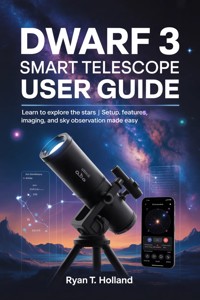
Unlock the mysteries of the night sky with the Dwarf 3 Smart Telescope User Guide: Learn to Explore the Stars | Setup, Features, Imaging, and Sky Observation Made Easy. This comprehensive, step-by-step guide is designed for beginners and amateur astronomers who want to make the most of the powerful Dwarf 3 smart telescope.
Inside, you’ll discover everything from unboxing and initial setup to mastering advanced features like AI-powered object recognition, automated tracking, and astrophotography techniques. Learn how to explore planets, stars, nebulae, galaxies, and even capture stunning long-exposure images—all while maximizing your telescope’s performance.
This guide also covers essential maintenance, troubleshooting, and practical tips for both nighttime sky observation and daytime viewing. With easy-to-follow instructions, expert advice, and practical strategies, you’ll gain the confidence to navigate the cosmos and make every stargazing session rewarding.
Whether you’re observing the Moon’s craters, tracking planets, or capturing the beauty of deep-sky objects, this book equips you with the skills, insights, and tools to take your astronomy experience to the next level. Perfect for beginners and hobbyists eager to explore the universe with precision and ease.
Das E-Book können Sie in Legimi-Apps oder einer beliebigen App lesen, die das folgende Format unterstützen:
Veröffentlichungsjahr: 2026
Ähnliche

















Ryan T. Holland
Dwarf 3 smart telescope User guide
Learn to Explore the Stars | Setup, Features, Imaging, and Sky Observation Made Easy
First published by Ryan T. Holland 2026
Copyright © 2026 by Ryan T. Holland
All rights reserved. No part of this publication may be reproduced, stored, or transmitted in any form or by any means, electronic, mechanical, photocopying, recording, scanning, or otherwise without written permission from the publisher. It is illegal to copy this book, post it to a website, or distribute it by any other means without permission.
Ryan T. Holland asserts the moral right to be identified as the author of this work.
First edition
This book was professionally typeset on Reedsy Find out more at reedsy.com
Contents
Disclaimer
Introduction
Introduction to the Dwarf 3 Smart Telescope
Understanding Smart Telescopes and Why They Matter
Who This Guide Is For
What Makes the Dwarf 3 Different
Key Benefits of AI-Powered Astronomy
How to Use This Book Effectively
Chapter 1
Getting to Know the Dwarf 3
Unboxing and What’s Included
Overview of Hardware Components
Understanding the Optical System
Built-In Camera and Imaging Capabilities
Ports, Buttons, and Indicators Explained
Chapter 2
Initial Setup and First-Time Configuration
Charging and Powering On
Installing and Connecting to the Companion App
Wi-Fi and Bluetooth Setup
Firmware Updates and System Optimization
Creating Your First Observation Profile
Chapter 3
Navigating the Dwarf 3 App Interface
Dashboard Overview
Manual vs. Automatic Modes
Sky Map and Object Search Features
Custom Settings and Preferences
Troubleshooting Connection Issues
Chapter 4
Understanding Telescope Alignment and Calibration
Why Alignment Is Important
Automatic Star Alignment Process
Manual Calibration Techniques
Improving Tracking Accuracy
Common Alignment Mistakes and Fixes
Chapter 5
Exploring the Night Sky
Understanding the Night Sky Basics
Observing the Moon in Detail
Viewing Planets Clearly
Deep-Sky Objects: Nebulae, Galaxies, and Star Clusters
Best Times and Conditions for Observation
Chapter 6
Astrophotography Made Simple
Introduction to Astrophotography
Camera Settings and Exposure Control
Stacking and Image Processing Basics
Capturing Long-Exposure Shots
Saving and Sharing Your Images
Chapter 7
Advanced Features and Smart Capabilities
AI Object Recognition
Automated Tracking and Follow Mode
Time-Lapse and Video Recording
Remote Control and Multi-Device Access
Cloud Storage and File Management
Chapter 8
Daytime Use and Dual-Purpose Viewing
Safe Solar Observation (With Proper Filters)
Landscape and Wildlife Viewing
Time-Lapse During Daylight
Switching Between Day and Night Modes
Protecting the Optics in Bright Conditions
Chapter 9
Maintenance, Care, and Performance Optimization
Cleaning the Lens and Sensors
Proper Storage and Transport
Battery Care and Longevity Tips
Updating Software Regularly
Maximizing Performance in Different Climates
Chapter 10
Troubleshooting and Frequently Asked Questions
Power and Charging Problems
Connectivity Issues
Blurry or Low-Quality Images
Tracking and Alignment Errors
When to Contact Customer Support
Conclusion
Conclusion and Your Next Steps in Astronomy
Recap of Key Skills Learned
Building Confidence as an Amateur Astronomer
Expanding Your Equipment Setup
Joining Astronomy Communities
Continuing Your Journey Through the Cosmos
Disclaimer
The information provided in Dwarf 3 Smart Telescope User Guide: Learn to Explore the Stars | Setup, Features, Imaging, and Sky Observation Made Easy is intended for educational and informational purposes only. While every effort has been made to ensure the accuracy, completeness, and reliability of the content, the author and publisher assume no responsibility for any errors, omissions, or outcomes resulting from the use of this guide.
Operating telescopes, performing astrophotography, and observing celestial or terrestrial objects involve inherent risks, including potential damage to equipment or personal injury. Users are responsible for following all safety instructions, manufacturer guidelines, and local regulations. Proper precautions should be taken when handling optical equipment, batteries, electrical components, and observing the Sun or bright objects.
This guide may reference third-party products, software, or services. Inclusion of such references does not constitute endorsement, and the author or publisher is not liable for the performance, quality, or reliability of any third-party products or services.
By using this guide, readers acknowledge and accept that all activities are undertaken at their own risk. The author and publisher disclaim any liability for direct, indirect, incidental, or consequential damages arising from the use or misuse of the information contained herein.
Introduction
Introduction to the Dwarf 3 Smart Telescope
Astronomy has always carried a certain magic. From the first time you looked up at the Moon and noticed its craters, to that unforgettable moment when you saw Saturn’s rings through a telescope, the night sky has a way of reshaping how you see the world. For centuries, exploring the cosmos required patience, technical knowledge, and often expensive equipment. But today, that barrier has dramatically lowered. We are living in a time where powerful technology fits in the palm of your hand, and observing deep-sky objects no longer demands a PhD in astrophysics.
The Dwarf 3 smart telescope represents this new era. It blends optics, digital imaging, automation, and artificial intelligence into a compact, user-friendly device. Instead of manually adjusting knobs in the dark or struggling with complex alignment procedures, you can now let intelligent systems guide you. It is astronomy made approachable without sacrificing depth or quality.
This book exists to help you move beyond simply owning the Dwarf 3. Anyone can unbox a device. Far fewer people unlock its full potential. There is a difference between casually pointing at the Moon and confidently planning an evening session to capture a nebula with optimized exposure settings. That difference lies in understanding—not just of the device, but of the sky itself.
As you move through this guide, you will notice that it does not assume you are an expert. It respects beginners while still offering depth for intermediate users who want to grow. Whether you purchased the Dwarf 3 out of curiosity, as a gift, or as part of a deeper passion for space, this chapter lays the foundation for everything that follows.
Before we dive into technical details and features, it’s important to understand the broader context. What exactly is a smart telescope? Why is it different from traditional instruments? And why does it matter right now? Let’s begin there.
Understanding Smart Telescopes and Why They Matter
A smart telescope is not just a telescope with a camera attached. It is an integrated system that combines optics, motors, sensors, onboard computing, wireless connectivity, and software into a single intelligent device. Traditional telescopes rely heavily on manual adjustments. You physically aim them, manually focus them, and often use printed star charts to find celestial objects. Smart telescopes change that experience completely.
At the core of a smart telescope is automation. Instead of aligning the telescope by manually locating reference stars, the system uses internal sensors and imaging technology to recognize star patterns automatically. This process, often called plate solving, allows the telescope to determine exactly where it is pointed in the sky within seconds. That means less guesswork and more observing.
Another defining characteristic is digital imaging. Traditional telescopes show you the sky in real time through an eyepiece. Smart telescopes use built-in digital sensors to capture light, enhance it, and display it on a connected device such as a smartphone or tablet. This not only makes viewing more comfortable, but also allows for image stacking—combining multiple exposures to reveal faint objects that are invisible to the naked eye.
Why does this matter? Because accessibility matters. For decades, astrophotography was considered a specialized field requiring equatorial mounts, guiding systems, external cameras, and advanced processing software. The learning curve was steep. Many people gave up before they even captured their first decent image. Smart telescopes remove much of that friction.
The Dwarf 3 is part of a broader shift in astronomy technology. We are seeing the convergence of AI, mobile computing, and optical engineering. These tools democratize stargazing. A beginner can now capture images of nebulae or galaxies within minutes of setup. Families can share live views on a tablet. Educators can bring astronomy into classrooms without transporting heavy, delicate equipment.




