


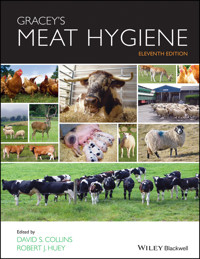
Gracey's Meat Hygiene E-Book
105,99 €
Mehr erfahren.
- Herausgeber: John Wiley & Sons
- Kategorie: Fachliteratur
- Sprache: Englisch
GRACEY'S MEAT HYGIENE
Gracey's Meat Hygiene, 11th edition, is the definitive reference for veterinarians working in meat hygiene control. This new edition of a classic text reflects the recent significant changes in science, legislation and practical implementation of meat hygiene controls in the United Kingdom, Europe and worldwide since the 10th edition was published in 1999. This book is an excellent practical guide for teaching food hygiene to veterinary students worldwide, laying the foundations of food animal anatomy, the humane slaughter of animals for food and practical production hygiene. New chapters address the increased concern of operators, inspectors and the public to issues of animal welfare and recognise the role of the profession, and interest from the consumer, in environmental protection.
Key features include the following
- Fully updated new edition, in a refreshed design with colour photographs and illustrations throughout
- Includes new content on meat hygiene inspection covering the components of an integrated food safety management system as well as animal health and welfare controls in the 'farm to fork' system
- A practical approach to health and safety in meat processing is outlined by identifying the hazards and then describing how these can be best controlled
- With contributions from veterinary and industry experts, this edition is both a valuable teaching aid and a practical reference for veterinarians and all food business operators and their staff
Sie lesen das E-Book in den Legimi-Apps auf:
Seitenzahl: 1085
Veröffentlichungsjahr: 2014
Ähnliche




















CONTENTS
Cover
Title page
Dedication page
Copyright page
Contributors
Preface
Acknowledgements
1 The food animals
Dietary factors
World livestock production
UK meat plants and throughputs
Cattle
Sheep
Pigs
Goats
Poultry
Rabbits
Deer
References
Further reading
Farm Animal Welfare Council
2 Anatomy
Osteology and arthrology
Digestive system
Respiratory system
Circulatory system (heart, arteries, capillaries and veins)
Lymphatic system (Fig. 2.10 and Fig. 2.12)
Lymph nodes of the ox
Lymph nodes of the pig (Fig. 2.13)
Urogenital system
Reproductive system
Endocrine system
Skin
Horns
Muscular system
Connective tissue
Fat
Determination of age by dentition
Determination of sex
Horse and ox differentiation
Reference
Further reading
3 Meat establishment construction and equipment
Lairage (see also Chapter 6)
Slaughterhall
Further reading
4 Preservation of meat
Meat curing
Production of bacon and ham
Refrigeration
Changes in frozen meat
Heat: Thermal processing
Other methods of meat preservation
References
Further reading
5 Plant sanitation
Reasons for cleaning and disinfecting plant
The chemistry of cleaning
Principles of disinfection
Hygiene equipment and application methods
Contamination and re-contamination
Cleaning procedures
Monitoring of hygiene
Training
Safety
Effluent and external odour control
Conclusion
References
6 From farm to slaughter
Production of clean, healthy livestock (see Fig. 6.1 and Fig. 6.2)
Transportation of livestock
Animal husbandry in the lairage
Pre-slaughter handling and meat quality
Traumatic injury
References
Further reading
7 Humane slaughter
Pre-slaughter handling/restraint
The slaughtering process
Assessment of unconsciousness at slaughter
Methods of stunning
Effect of stunning on meat quality
Slaughter of minor species
Other methods of slaughter
Slaughter of poultry (see also Ch. 10)
Electrical stunning of poultry
Assessment of unconsciousness in electrical water bath stunned poultry
Stunning/killing poultry with controlled atmospheres
Pithing
Bleeding
Efficiency of bleeding
Slaughter without pre-stunning
References
Further reading
8 Meat hygiene practice
Meat and animal by-products
Sources of contamination (See also Chapter 6)
Methods of reducing contamination
Dressing techniques – Removal of hide/fleece/hair
Post-slaughter decontamination
Outputs of the slaughterhouse
Treatment of edible co-products
Animal by-products
Hygiene requirements for animal by-product processing establishments
Rendering processes
References
9 Meat inspection protocols
The case for change
The holistic approach
Integrated Food Safety Assurance
Ante-mortem inspection
Post-mortem inspection
Decisions at post-mortem examination
Common post-mortem findings
Parasitic conditions
Control of hygienic production
Hazard analysis and critical control points (HACCP)
Implementation of an HACCP system
Worldwide food safety standards
References
Further reading
10 Poultry production, slaughter and inspection
Production of poultry
Ante-mortem health inspection
Post-mortem inspection in the plant
Decision of the official veterinarian at the post-mortem inspection
General contamination
Guidelines on trimming poultry
Miscellaneous conditions
References
Further reading
11 Exotic meat production
Rabbits
Farmed deer (Fig. 11.1)
Park deer
Wild deer
Ostriches
Commercial squab production
Further reading
12 Food poisoning and meat microbiology
Part 1: Food poisoning
Part 2: Meat microbiology
Part 3: Meat decomposition and spoilage
Further reading
13 Controls on veterinary drug residues in the European Union
Legal framework
The National Residue Control Plan in EU member states
Testing procedures and performance characteristics
Sampling of imported food
The Rapid Alert System for Food and Feed (RASFF)
Analytical methods: Technical aspects
References
14 Health and safety in meat processing
Accident statistics
UK legislation
General duties
Key topics requiring risk assessment
Zoonoses
References
Index
End User License Agreement
List of Tables
Chapter 01
Table 1.1 Average British diet fat consumption (g/person/day) (FAOSTAT) 2009
Table 1.2 Annual consumption of meat in the EU (kg/person/year) (FAOSTAT) 2009
Table 1.3 Total throughputs (2008) in the United Kingdom
Table 1.4 Throughputs in the United Kingdom by species in 2009
Table 1.5 Numbers of approved red meat slaughterhouses (RSL) and poultry meat slaughterhouses (PSL) in the United Kingdom in 2009
Chapter 02
Table 2.1 Vertebrae of the spine
Table 2.2 Ossification of the cartilaginous extensions of the spines of the first five dorsal vertebrae (bovines)
Table 2.3 Length of intestines (m)
Table 2.4 Yield of glands used in medicine
Table 2.5 Dental formula for the ox, sheep and goat
Table 2.6 Dental formula for the pig
Table 2.7 Dental formula for the horse
Table 2.8 Ages at which the permanent incisors appear
Table 2.9 Differentiation of carcases of sheep and goat
Chapter 03
Table 3.1 Energy benchmarks: Environment Agency, The Red Meat Processing (Cattle, Sheep and Pigs) Sector
Table 3.2 Benchmark water consumption: Environment Agency, The Red Meat Processing (Cattle, Sheep and Pigs) Sector
Table 3.3 Recommended minimum space per animal for the housing of livestock in abattoirs
Table 3.4 Average BOD values for some food processing operations
Chapter 04
Table 4.1 Curing salts and additives
Table 4.2 Chilled shrinkage of a pig carcase – 60 kg dressed weight
Table 4.3 Practical Storage Life (PSL) at different storage temperatures
Chapter 06
Table 6.1 Summary of main findings of Hide Improvement Project
Table 6.2 Hide contamination in different regions of Britain and Ireland
Table 6.3 Quantities of excreta, as slurry, produced by livestock
Table 6.4 Approximate ageing of bruises by physical appearance
Chapter 07
Table 7.1 Minimum recommended average current (mA) delivered to birds in water bath stunning systems EFSA (2004, 2006)
Chapter 08
Table 8.1 Prevalence of zoonotic agents on cattle hides (various studies)
Table 8.2 Fitness to work questionnaire
Table 8.3 Minimum water temperatures for knife sanitation, according to the minimum observed immersion time of knives during routine operation
Table 8.4 Average breakdown of 450 kg steer and 21 kg lamb
Table 8.5 Standards of rendered animal fat, depending on type
Table 8.6 Specified Risk Material (SRM)
Chapter 09
Table 9.1 USDA/FSIS data on carcase condemnation of dairy cows 2005–2007
Table 9.2 Guide to judgements on
C. bovis
findings
Table 9.3 Summary of time/temperature combinations for treatment of domestic pig meat for
Trichinella
Table 9.4 Time/temperature combination for treatment of domestic pig meat where core temperatures can be measured
Chapter 10
Table 10.1 Slaughterings of poultry meat
Table 10.2 Numbers of
Campylobacter
and
Salmonella
(log mpn/carcase) on chicken carcases scalded at three different temperatures
Table 10.3 Percentages of broiler carcases rejected because they were either DOA or diseased from farms with normal or high rates of rejection of carcases.
Chapter 12
Table 12.1 Bacterial causes of food-borne infection
Table 12.2 Water content of meat and offal
Chapter 13
Table 13.1 Compounds to be included in an EU National Residue Control Plan
Table 13.2 The residue or substance group measured for each commodity type
Table 13.3 The relationship between mass fragments and IPs earned
Table 13.4 Maximum permitted tolerances for relative ion intensities using a range of mass spectrometric techniques
Chapter 14
Table 14.1 Level of MSDs in meat processing by country
Table 14.2 Slips risks controls
Table 14.3 Trips risks controls
Table 14.4 Meat processing zoonoses (DEFRA, 2007)
Table 14.5 Assessing the risk from noise (reproduced with permission from Tolley).
Table 14.6 Assessment of first-aid needs checklist
Table 14.7 Aspects of pregnancy to be considered by management
List of Illustrations
Chapter 01
Figure 1.1 Friesian bulls.
Figure 1.2 English Longhorn.
Figure 1.3 Blonde D'Aquitaine.
Figure 1.4 Hereford.
Figure 1.5 Salers.
Figure 1.6 Simmental.
Figure 1.7 Limousin.
Figure 1.8 A ewe and lambs.
Figure 1.9 A Blackface ram.
Figure 1.10 Sheep being moved into lairage.
Figure 1.11 Middle White.
Figure 1.12 Gloucester Old Spot sow and litter.
Figure 1.13 Saddleback.
Figure 1.14 Large Black.
Figure 1.15 A red deer stag.
Chapter 02
Figure 2.1 Skeleton of ox. 1, atlas; 2, 7th cervical vertebra; 3, scapula; 4, ribs; 5, pelvic girdle; 6, femur; 7, patella; 8, tibia; 9, tarsus; 10, metatarsus; 11, phalanges; 12, humerus; 13, ulna; 14, radius; 15, sternum; 16, xiphiod process; 17, carpus; 18, metacarpus; 19, phalanges; 20, mandible; 21, cranium.
Figure 2.2 Stomach of ox, right side. Oes, oesophagus; 1, insula between right longitudinal groove below and accessory groove above; 2, caudal groove of rumen; 3 and 4, right dorsal and ventral coronary grooves; 5 and 6, caudodorsal and caudoventral blind sacs; 7, pylorus. The positions of the reticulum, omasum and abomasum have been altered by removal of the stomach from the abdominal cavity and inflation.
Figure 2.3 Projection of viscera of cow on body wall, left side. b.s., atrium of rumen; b.s.′, b.s.″, blind sacs of rumen; O, ovary; Oes, oesophagus; Ret., reticulum; Sp, spleen. The left kidney (L.K.) is concealed by the dorsal sac of the rumen and is indicated by dotted lines. The median line of the diaphragm is dotted.
Figure 2.4 Projection of viscera of bull on body wall, right side. B.g., bulbourethral gland; B.l., urinary bladder; G.b., gall bladder; L.K., left kidney; P. (above duodenum), pancreas; P. (below G.b.), pylorus; R.K. right kidney; V.s., vesicular gland. Costal attachment and median line of diaphragm are indicated by dotted lines.
Figure 2.5 Abdominal viscera of sheep, ventral aspect. For ‘anterior blind sac', read cranial end of ventral sac; for ‘posterior ventral blind sac', read caudoventral blind sac; for ‘posterior dorsal blind sac', read caudodorsal blind sac.
Figure 2.6 Liver of ox, diaphragmatic surface, hardened
in situ
.
Figure 2.7 Liver of sheep, visceral surface, hardened
in situ
. The papilliary process is the round projection between the omasal impression and the left branch of the portal vein.
Figure 2.8 Liver of pig, parietal surface. 1, large hepatic veins opening into caudal vena cava; 2, coronary ligament; 3, falciform ligament.
Figure 2.9 Liver of horse, visceral surface.
Figure 2.10 Lymph nodes of the bovine lungs. a, left bronchial partly covered by the aorta; b, right bronchial; c, middle bronchial; d, apical; e, posterior mediastinal; f, anterior mediastinal, related inferiorly to the oesophagus and trachea.
Figure 2.11 Spleen of ox, visceral surface. 1, area of attachment to rumen (non-peritoneal); 2, caudal border; 3, line of peritoneal reflection.
Figure 2.12 Carcase of bullock. (A) Position of lymph nodes: a, popliteal; b, superficial inguinal; c, precrural; d, deep inguinal; e, external iliac; f, internal iliac; g, ischiatic; h, sacral; i, lumbar; i″, renal; m, xiphoid; n, suprasternal; o, presternal; p, prepectoral; q, middle cervical; r, costocervical; s, intercostal. (B) Direction of the lymph flow: I, lymph from intestine; S, lymph from stomach; L, lymph from liver; R, receptaculum chyli; j, lymph from posterior mediastinal lymph node discharging into thoracic duct; k, lymph from bronchial lymph nodes; l, lymph from anterior mediastinal lymph nodes.
Figure 2.13 Side of pork showing position of lymph nodes: a, submaxillary; b, anterior or upper cervical; c, prepectoral; d, presternal; e, precrural; f, superficial inguinal; g, hock node; h, iliac; i, lumbar; j, renal.
Figure 2.14 Right kidney of ox, ventral surface. Organ hardened
in situ
. Fat has been removed from fissures between lobes.
Figure 2.15 Kidneys of pig
in situ
, ventral view. 1, hepatic artery; 2, splenic artery.
Figure 2.16 Lateral view of genital organs and adjacent structures of mare. 1, left ovary; 2, fallopian tube; 3, left horn of uterus; 4, right horn of uterus; 5, body of uterus [5′, cervix]; 6, broad ligament of uterus [6′ and 6″ show the extent of the broad ligament of the uterus]; 7, vagina; 8, vulva; 9, rim and commissures of vulva [9′ and 9″ show the extent of the rim and commissures of vulva]; 10, constrictor muscle of vulva; 11, vestibular bulb; 12, abdominal wall; 13, left kidney; 14, left ureter; 15, bladder; 16, urethra; 17, rectum; 18, anus; 19 and 19′ are the posterior and anterior of the anal sphincter muscle.
Chapter 03
Figure 3.1 Floor layout of a sheep slaughter establishment.
Figure 3.2 Typical water balance for areas in a pig abattoir: Environment Agency, The Red Meat Processing (Cattle, Sheep and Pigs) Sector.
Figure 3.3 General layout of the mobile slaughterhouse.
Figure 3.4 Well-designed sheep drinker.
Figure 3.5 Flow diagram: beef slaughter, cutting and packing.
Figure 3.6 Pork slaughter flow chart (skin on carcase). Asterisk denotes two options for processing carcases: skin on or skinned.
Figure 3.7 Vertical scalding of pigs showing, cross section of humidifying chamber, channel for recirculated air and humidifying zone.
Figure 3.8 Automated pig carcase splitting (Reproduced with permission from Henning).
Figure 3.9 Wedge wire rundown screen.
Figure 3.10 Typical DAF installation.
Figure 3.11 Fine bubble diffused air systems.
Chapter 04
Figure 4.1 (a) Pig carcases suspended in a chiller (Reproduced with permission from David Armstrong). (b) Beef carcases suspended by the ‘aitchbone' for chilling (Reproduced with permission from John Hood).
Figure 4.2 Modern food can showing section through seam.
Figure 4.3 Stages of can manufacture.
Chapter 05
Figure 5.1 Showing progressive wetting of a solid surface.
Figure 5.2 Wetting, roll-up and formation of emulsion.
Figure 5.3 Action of biocides on bacteria.
Figure 5.4 Showing mobile unit for foam/disinfection/rinse applications (a) and mobile unit for foam only applications (b).
Figure 5.5 Demonstration room showing installations of satellite foam and rinse stations.
Figure 5.6 Demonstration room showing installations of hybrid central/satellite foam and rinse stations.
Figure 5.7 The visual effect of replacing 82C water with Inspexx disinfectant solution, picture on the right.
Figure 5.8 Diagrammatic representation of a standard CIP system.
Figure 5.9 Diagrammatic representations of laminar and turbulent flow in different pipe diameters.
Figure 5.10 Spray ball types and mechanical cleaning effects in tank cleaning.
Figure 5.11 Shows a graphic representation of a complete CIP sequence.
Figure 5.12 Rapid hygiene monitoring using ATP-based bioluminescence.
Figure 5.13 Example graph showing trend analysis of total counts over time for sample points on different surfaces.
Chapter 06
Figure 6.1 Unacceptable faecal/soil contamination.
Figure 6.2 Excellent standards of animal cleanliness.
Figure 6.3 Swedish transport lorry.
Figure 6.4 Flight zones – after T. Grandin.
Chapter 07
Figure 7.1 Various types of percussive stunners. (a) Penetrative percussion stunner; incorporates special ‘no fire' system with low noise level. (b) Contact firing penetrative concussive stunner available for large and small animals. (c) Air-powered penetrative stunner for sheep and goats; contact and ‘no-fire' systems incorporated. (d) Penetrative concussive stunner 0.22 calibre; palm- or finger-activated trigger; firing pin pull to cock instrument. (e) Contact and failsafe non-penetrative concussive stunner for use in deep stunning pens; suitable for ritual slaughter. (f) Non-penetrative concussive stunner incorporating ‘no-fire' system; suitable for ritual slaughter.
Figure 7.2 Points of application for concussive stunning: (a) adult cattle; (b) calves; (c) horned sheep; (d) pigs; (e) horned goats.
Figure 7.3 Contact firing penetrative concussive stunner for cattle.
Figure 7.4 Captive bolt pistol, taken to pieces for daily cleaning.
Figure 7.5 CO
2
anaesthesia. Combi-compact system showing convenient shackling position after stunning.
Figure 7.6 Electrical stunning tongs in use.
Figure 7.7 Device for electrical stunning of rabbits.
Figure 7.8 Handheld electrical stunning of poultry.
Figure 7.9 Cattle bleeding over a blood collection channel.
Figure 7.10 Pigs bleeding over a blood collection channel.
Figure 7.11 (a) Rotating restraint pen of the Facomia type; (b) close-up of the head restraint.
Figure 7.12 (a) ASPCA restraint pen; (b) restraint pen side view; (c) head-hold mechanism.
Chapter 08
Figure 8.1 Clipped dirty cattle on the slaughter line.
Figure 8.2 Flip/flap steel.
Figure 8.3 The initial incision, which will be extended using the spear cut technique. Effective out-rolling of hide is shown at right.
Figure 8.4 Downward hide-puller; more hygienic than upward puller and can also skin head, previously prepared.
Figure 8.5 Vertical scalding of pigs with humidified air.
Figure 8.6 Elastrators with expanded rubber ring ready for placing over plastic bag or rectum.
Figure 8.7 Stainless steel rodder.
Figure 8.8 Steam pasteurisation chamber – water removal, pasteurisation and chill sections.
Chapter 09
Figure 9.1 Early centralised slaughter facility in the UK – Provided by the Association of Meat Inspector from their archive.
Figure 9.2 Integrated food safety assurance.
Figure 9.3 Ante-mortem inspection. (a) Taking the temperature of a suspect heifer and (b) examination of a suspect lamb.
Figure 9.4 Example of a pen card system.
Figure 9.5 Visual correlation of carcase with offals.
Figure 9.6 DARD Northern Ireland system for online recording of post-mortem findings.
Figure 9.7 Bovine ear tag, correlated with kill number ante-mortem.
Figure 9.8 Traditional post-mortem inspection of (a) the bovine head, (b) bovine red offal, (c) bovine heart and (d) bovine mesenteric lymph nodes.
Figure 9.9 Traditional post-mortem inspection of lamb carcases.
Figure 9.10 Traditional post-mortem inspection of the porcine head and submaxillary lymph nodes.
Figure 9.11 Life cycle of
T. saginata
/
T. solium
.
Figure 9.12 Adult female
T. spiralis
: (a) oral opening; (b) oesophagus; (c) newborn larva, just expelled from vulva; (d) larvae in interior portion of uterus; (e) fertilised and developing ova; (f) ovary; and (g) rectum, ×100.
Figure 9.13 Lesions of bovine TB.
Figure 9.14 Bovine spinal abscess associated with an infected carpus.
Figure 9.15 Oedema on bovine shoulder.
Figure 9.16 (a) Chronic pneumonia in apical and part cardiac lobes. (b) Bovine suppurative pneumonia.
Figure 9.17 Endocarditis – classic vegetative lesion right side of heart.
Figure 9.18 Pericarditis. (a) Simple fibrinous pericarditis. (b) Suppurative pericarditis with fibrino-purulent exudate.
Figure 9.19 Melanosis in a bovine lung.
Figure 9.20 Icterus/jaundice in a lamb carcase.
Figure 9.21 Life cycle of
Echinococcus multilocularis
.
Figure 9.22
C. ovis
in a lamb, courtesy of Ian Robinson, RMHI.
Figure 9.23 Lesions of
F. hepatica
, liver fluke.
Figure 9.24 Paramphistomiasis, bovine rumen fluke.
Figure 9.25 Flow diagram for fresh meat production and processing. ○ indicates a site of minor contamination. ● indicates a site of major contamination; CCP1, effective CCP; CCP2, not absolute.
Chapter 10
Figure 10.1 An indoor environmentally enriched broiler house.
Figure 10.2 Automatic poultry harvester.
Figure 10.3 Automatic poultry harvester.
Figure 10.4 Washing crate module.
Figure 10.5 Multi-phase controlled atmosphere stunning.
Figure 10.6 Aeroscalding – scalding without immersion into scalding.
Figure 10.7 Transfer from defeathering into eviscerating line.
Figure 10.8 High-speed automated evisceration.
Figure 10.9 Liver harvesting with drum washer.
Figure 10.10 Inside and outside washing.
Figure 10.11 Moistener spray cabin chilling.
Figure 10.12 Moistener spray cabin chilling.
Figure 10.13 Air chilling.
Figure 10.14 Immersion chilling.
Figure 10.15 Transfer from chilling line into selection line.
Figure 10.16 Intelligent reporting, inspection and selection system.
Figure 10.17 Transfer from selection line into cut-up line.
Figure 10.18 Whole-bird processing.
Figure 10.19 Automated cut-up line – front half cutting module.
Figure 10.20 Cut-up line – breast cap cutting module.
Figure 10.21 Cut-up line – leg processing module.
Figure 10.22 Cut-up line – leg processing module.
Figure 10.23 Cut-up line – wing processing.
Chapter 11
Figure 11.1 Fallow deer.
Figure 11.2 Stunning area and approach race.
Chapter 12
Figure 12.1 Surveillance for food-borne illness.
Figure 12.2 Salmonella recycling in food animals.
Figure 12.3 Non-destructive surface sampling swab.
Chapter 14
Figure 14.1 Chainmail glove on the non-dominant hand.
Figure 14.2 Prevalence of MSDs over the last 12 months among MIs working in cattle slaughter (Lee, 2008).
Figure 14.3 Prevalence of MSDs over the last 12 months among MIs working in pig slaughter (Lee, 2008).
Figure 14.4 Prevalence of MSDs over the last 12 months among MIs working in poultry slaughter (Lee 2008).
Figure 14.5 PPE for inspection of brucellosis reactors.
Guide
Cover
Table of Contents
Begin Reading
Pages
ii
iii
iv
xi
xiii
xv
xvi
1
2
3
4
5
6
7
8
9
10
11
12
13
14
15
16
17
19
20
21
22
23
24
25
26
27
28
29
30
31
32
33
34
35
36
37
38
39
40
41
42
43
45
46
47
48
49
50
51
52
53
54
55
56
57
58
59
60
61
62
63
64
65
67
68
69
70
71
72
73
74
75
76
77
78
79
80
81
82
83
84
85
86
87
88
89
90
91
92
93
94
95
96
97
98
99
100
101
102
103
104
105
106
107
108
109
110
111
112
113
114
115
116
117
118
119
120
121
122
123
124
125
126
127
128
129
130
131
132
133
134
135
136
137
138
139
140
141
142
143
144
145
146
147
148
149
150
151
152
153
154
155
156
157
158
159
160
161
162
163
164
165
166
167
168
169
170
171
172
173
174
175
176
177
178
179
180
181
182
183
184
185
186
187
188
189
190
191
192
193
194
195
196
197
198
199
200
201
202
203
204
205
206
207
208
209
210
211
212
213
214
215
216
217
218
219
220
221
222
223
224
225
226
227
228
229
230
231
232
233
234
235
236
237
238
239
240
241
242
243
244
245
246
247
248
249
250
251
252
253
254
255
256
257
259
260
261
262
263
264
265
266
267
268
269
270
271
272
273
274
275
276
277
278
279
280
281
282
283
284
285
286
287
288
289
291
292
293
294
295
296
297
298
299
300
301
302
303
304
305
306
307
308
309
310
311
312
313
314
315
316
317
319
320
321
322
323
324
325
326
327
328
329
Gracey's Meat Hygiene
Eleventh Edition
Edited by
David S. CollinsMVB, DVPH(MH), MRCVS
Robert J. HueyTD, MVB, DVPH(MH), MRCVS
This book is dedicated to the memory of two great veterinarians
Dr Joseph Forde Gracey (1918–2001)andDr James Andrew Storrar (1947–2006)
This edition first published 2015 © 2015 by John Wiley & Sons, Ltd
Registered OfficeJohn Wiley & Sons, Ltd, The Atrium, Southern Gate, Chichester, West Sussex, PO19 8SQ, UK
Editorial Offices9600 Garsington Road, Oxford, OX4 2DQ, UKThe Atrium, Southern Gate, Chichester, West Sussex, PO19 8SQ, UK1606 Golden Aspen Drive, Suites 103 and 104, Ames, Iowa 50010, USA
For details of our global editorial offices, for customer services and for information about how to apply for permission to reuse the copyright material in this book please see our website at www.wiley.com/wiley-blackwell
The right of the author to be identified as the author of this work has been asserted in accordance with the UK Copyright, Designs and Patents Act 1988.
All rights reserved. No part of this publication may be reproduced, stored in a retrieval system, or transmitted, in any form or by any means, electronic, mechanical, photocopying, recording or otherwise, except as permitted by the UK Copyright, Designs and Patents Act 1988, without the prior permission of the publisher.
Designations used by companies to distinguish their products are often claimed as trademarks. All brand names and product names used in this book are trade names, service marks, trademarks or registered trademarks of their respective owners. The publisher is not associated with any product or vendor mentioned in this book. It is sold on the understanding that the publisher is not engaged in rendering professional services. If professional advice or other expert assistance is required, the services of a competent professional should be sought.
The contents of this work are intended to further general scientific research, understanding, and discussion only and are not intended and should not be relied upon as recommending or promoting a specific method, diagnosis, or treatment by health science practitioners for any particular patient. The publisher and the author make no representations or warranties with respect to the accuracy or completeness of the contents of this work and specifically disclaim all warranties, including without limitation any implied warranties of fitness for a particular purpose. In view of ongoing research, equipment modifications, changes in governmental regulations, and the constant flow of information relating to the use of medicines, equipment, and devices, the reader is urged to review and evaluate the information provided in the package insert or instructions for each medicine, equipment, or device for, among other things, any changes in the instructions or indication of usage and for added warnings and precautions. Readers should consult with a specialist where appropriate. The fact that an organization or Website is referred to in this work as a citation and/or a potential source of further information does not mean that the author or the publisher endorses the information the organization or Website may provide or recommendations it may make. Further, readers should be aware that Internet Websites listed in this work may have changed or disappeared between when this work was written and when it is read. No warranty may be created or extended by any promotional statements for this work. Neither the publisher nor the author shall be liable for any damages arising herefrom.
Library of Congress Cataloging-in-Publication Data
Gracey's meat hygiene / edited by D.S. Collins, R.J. Huey. – Eleventh edition. p. ; cm. Meat hygiene Preceded by Meat hygiene / J.F. Gracey, D.S. Collins, R.J. Huey. 10th ed. c1999. Includes bibliographical references and index.
ISBN 978-1-118-65002-8 (cloth)I. Collins, D.S. (David S.), editor. II. Huey, R.J. (Robert J.), editor. III. Gracey, J.F. Meat hygiene.Preceded by (work): IV. Title: Meat hygiene. [DNLM: 1. Meat. 2. Food Inspection. 3. Food Safety. 4. Meat-Packing Industry. 5. Quality Control. WA 707] RA602.M4 363.19′29–dc23
2014016565
A catalogue record for this book is available from the British Library.
Wiley also publishes its books in a variety of electronic formats. Some content that appears in print may not be available in electronic books.
Cover images: Poultry top left: iStock © EEI_Tony; Poultry top right: iStock © ly-ly; Sheep centre right:Reproduced with permission of Ronald Siddle; Bull calves bottom: Reproduced with permission of David S. Collins; All other images: Reproduced with permission of Graham Fallows
Cover design by hisandhersdesign
Contributors
David S Collins, MRCVSVeterinarian, Belfast, UK
Robert J HueyChief Veterinary OfficerDepartment of Agriculture and Rural DevelopmentVeterinary ServiceBelfast, Northern Ireland, UK
Glenn KennedyVeterinary Sciences DivisionAgi-Food and Biosciences InstituteBelfast, UK
Rosemary LeeDepartment of Agriculture and Rural DevelopmentNorthern Ireland, UK
Chris LoughneyCountry Manager UK-IEEcolab Food and Beverage DivisionNorthwich, Cheshire, UK
Malcolm J Taylor, BSc(Hons), MScSenior Scientific OfficerFood Science BranchAgri-Food and Biosciences InstituteBelfast, UK
Preface
The aim of the book's authors is to maintain the standard of the previous edition and to produce a textbook which is of practical use to the veterinarian working in the slaughter and meat processing industry.
The world of meat hygiene has undergone a lot of changes since the publication of tenth edition in 1999. While we have introduced the concepts of ‘system control' and integrated food safety management, we have kept this to a high level and attempted to keep clear of the legislation which is subject to frequent change.
We have chosen to remove much of the text in the previous edition on animal disease, which is covered more comprehensively in other texts. In chapters on microbiology and pathology, we have also provided details that the front-line veterinarian should know and again concentrated on principles rather than specific detail.
While building on the work of those who have contributed to the previous editions, we have introduced new authors and new chapters to the book to reflect current trends. Chris Loughney builds on the work of Stan Brown in updating the sanitation chapter, Malcolm Taylor assisted with the editing of the work of Bill Reilly and others on microbiology and Glenn Kennedy produced a completely new chapter, with a new approach on the complex area of residues of veterinary medicines and contaminants.
Reflecting the increasing importance and changes in the priorities of society, Rosemary Lee has produced a comprehensive chapter on health and safety for all staff working in the potentially hazardous environment of the meat slaughter establishment. Her practical and authoritative text is a must read for all with a responsibility for management of staff in this workplace.
D.S. Collins & R.J. Huey
Acknowledgements
This edition is dedicated to two public health veterinarians, Dr J.R. (Joe) Gracey and Dr J. Andrew Storrar.
Both these men were passionate about Veterinary Public Health and Animal Welfare.
Joe qualified in 1942 from the Royal (Dick) Veterinary College and after a period in John Boyd Dunlop's private practice, he of tyre fame, in Belfast, served in the Royal Army Corps in Burma during the Second World War reaching the rank of Major.
Lesen Sie weiter in der vollständigen Ausgabe!
Lesen Sie weiter in der vollständigen Ausgabe!
Lesen Sie weiter in der vollständigen Ausgabe!
Lesen Sie weiter in der vollständigen Ausgabe!
Lesen Sie weiter in der vollständigen Ausgabe!
Lesen Sie weiter in der vollständigen Ausgabe!
Lesen Sie weiter in der vollständigen Ausgabe!
Lesen Sie weiter in der vollständigen Ausgabe!
Lesen Sie weiter in der vollständigen Ausgabe!
Lesen Sie weiter in der vollständigen Ausgabe!
Lesen Sie weiter in der vollständigen Ausgabe!
Lesen Sie weiter in der vollständigen Ausgabe!
Lesen Sie weiter in der vollständigen Ausgabe!
Lesen Sie weiter in der vollständigen Ausgabe!
Lesen Sie weiter in der vollständigen Ausgabe!
Lesen Sie weiter in der vollständigen Ausgabe!




