


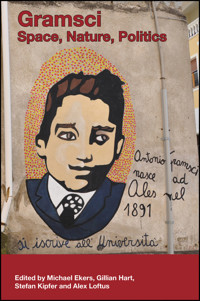
Gramsci E-Book
20,99 €
Mehr erfahren.
- Herausgeber: John Wiley & Sons
- Kategorie: Wissenschaft und neue Technologien
- Serie: Antipode Book Series
- Sprache: Englisch
This unique collection is the first to bring attention to Antonio Gramsci’s work within geographical debates. Presenting a substantially different reading to Gramsci scholarship, the collection forges a new approach within human geography, environmental studies and development theory.
- Offers the first sustained attempt to foreground Antonio Gramsci’s work within geographical debates
- Demonstrates how Gramsci articulates a rich spatial sensibility whilst developing a distinctive approach to geographical questions
- Presents a substantially different reading of Gramsci from dominant post-Marxist perspectives, as well as more recent anarchist and post-anarchist critiques
- Builds on the emergence of Gramsci scholarship in recent years, taking this forward through studies across multiple continents, and asking how his writings might engage with and animate political movements today
- Forges a new approach within human geography, environmental studies and development theory, building on Gramsci’s innovative philosophy of praxis
Sie lesen das E-Book in den Legimi-Apps auf:
Seitenzahl: 696
Veröffentlichungsjahr: 2012
Ähnliche




















Contents
Notes on Contributors
Abbreviations of Works by Antonio Gramsci
Preface
Acknowledgments
Framings
“A Barbed Gift of the Backwoods”: Gramsci’s Sardinian Beginnings
How to Live with Stones
Introduction
1 Gramsci
Introduction
A Gramscian Moment?
Considering Gramsci’s Geographies
Gramsci and Geography
Summary of the Book
New Paths, New Relationships, New Concepts
Part I Space
2 Traveling with Gramsci
Critical Consciousness and the Philosophy of Praxis
Passive Revolution and the Spatiality of the Risorgimento
Coda: Critical Consciousness and Transgressive Theory
3 “Gramsci in Action”
Introduction
Space, Solidarities, Political Trajectories
Cosmopolitanisms, Internationalisms, Articulations
Internationalist Trajectories and the Political Solidarities of the New Left
Conclusions
Acknowledgments
4 City, Country, Hegemony
Space and Gramsci’s Historicism
Historical Cities and Urbanization
The Countryside and Rural Questions
Urbanity and Rurality as Claims to Hegemony
Conclusion
Acknowledgments
5 State of Confusion
Civil Society: Hobbes, Hegel, Gramsci
Gramsci’s Civil Society
Money → Civil Society ∪ State
Part II Nature
6 The Concept of Nature in Gramsci
Acknowledgments
7 Space, Ecology, and Politics in the Praxis of the Brazilian Landless Movement
Introduction
Politics, Space, and Ecology in Gramsci’s Philosophy of Praxis
Historicizing Space and Politics in the MST’s Praxis
From Corporatist Struggles to Struggles for Hegemony
The Origins of a Political Ecological Praxis in the MST
The Transition to Agroecology
Scaling Up Political Ecology in MST Praxis
Conclusion
Acknowledgments
8 On the Nature of Gramsci’s “Conceptions of the World”
1
2
3
4
5
Acknowledgments
9 Gramsci, Nature, and the Philosophy of Praxis
Introduction
A Gramscian Political Ecology?
The Philosophy of Praxis
Ideologies of Nature
The Ideological Terrain
Common Sense
Conclusions
Acknowledgments
10 Difference and Inequality in World Affairs
Gramsci’s Method and the Logic of Difference
Gramsci and Racialized Difference: The Southern Question and Subalternity
Gramsci and Gendered Difference: “The Sexual Question”
Conclusion
11 Gramsci and the Erotics of Labor
A Brief Moment of Historicizing
Gramsci on Sexuality
Heterosexuality: Unnamed and Universalized
The Promise of Gramsci: Despite Himself
Concluding Remarks
Acknowledgments
Part III Politics
12 Cracking Hegemony
Introduction: Theorizing Accommodation – and Resistance
The Revolt of the “Trained Gorilla”
The Dialectics of Resistance in Gramsci
Fordism and Its Devolution
Conclusion
Acknowledgments
13 Gramsci at the Margins
A Micro-History of Rebellion
Gramsci and the Prehistory of the Maoist Revolution
Conclusion
Acknowledgments
14 Accumulation through Dispossession and Accumulation through Growth
Accumulation by Dispossession and Accumulation through Growth
India’s Economic Reforms
The History of Gramscian Approaches in India
Old and New Passive Revolutions
Political Parties and Economic Reforms
Gandhian Ecosocialism in India
Maoism in India
Conclusions
15 Gramsci, Geography, and the Languages of Populism
Iterations of Populism
Through a Gramscian Lens: Fascism, Populism, Philosophy of Praxis
The Language of Articulation
Beyond Interpellation
Articulations of Populism and Nationalism after Apartheid
Acknowledgments
Conclusion
16 Translating Gramsci in the Current Conjuncture
The Inadequacy of Declarative Politics
On Translation
With and Beyond Gramsci
The National Question
Modalities of Engagement
Acknowledgments
Index
Praise for Gramsci: Space, Nature, Politics
‘From the backwoods to the frontlines, Gramsci’s geographical imagination receives here the thorough going exploration it has always deserved. With deep and nuanced attention to Gramsci’s spatial historicism, this collection foregrounds the profoundly geographical nature of Gramsci’s critical consciousness and what it offers for thinking space, nature and politics relationally. As beautifully considered as its cover, this book is alive to the ‘earthliness of thought’ and its political possibilities.’
Cindi Katz, Earth and Environmental Sciences & Environmental Psychology Programs, The City University of New York
‘This well-crafted volume pushes the boundaries of current debates on Gramsci. Highlighting spatial and geographical relations, the diverse contributions pay detailed attention to Gramsci’s writings while opening an array of contemporary issues including struggles in Brazil, Nepal, India and South Africa; discussions of gender, class, race and ecology; and engagements with the theoretical work of Laclau & Mouffe, Lefebvre, Harvey, Hardt & Negri and Subaltern Studies. The contributors have set a hallmark in scholarship that will be very influential across many fields from critical geography and international relations to political theory, development studies and postcolonialism.’
Peter Ives, Department of Politics, University of Winnipeg, Canada
Antipode Book Series
Series Editors: Vinay Gidwani, University of Minnesota, USA and Sharad Chari, London School of Economics, UKLike its parent journal, the Antipode Book Series reflects distinctive new developments in radical geography. It publishes books in a variety of formats – from reference books to works of broad explication to titles that develop and extend the scholarly research base – but the commitment is always the same: to contribute to the praxis of a new and more just society.
Published
Gramsci: Space, Nature, PoliticsEdited by Michael Ekers, Gillian Hart, Stefan Kipfer and Alex Loftus
Places of Possibility: Property, Nature and Community Land OwnershipA. Fiona D. Mackenzie
The New Carbon Economy: Constitution, Governance and ContestationEdited by Peter Newell, Max Boykoff and Emily Boyd
Capitalism and ConservationEdited by Dan Brockington and Rosaleen Duffy
Spaces of Environmental JusticeEdited by Ryan Holifield, Michael Porter and Gordon Walker
The Point is to Change it: Geographies of Hope and Survival in an Age of CrisisEdited by Noel Castree, Paul Chatterton, Nik Heynen, Wendy Larner and Melissa W. Wright
Privatization: Property and the Remaking of Nature-SocietyEdited by Becky Mansfield
Practising Public Scholarship: Experiences and Possibilities Beyond the AcademyEdited by Katharyne Mitchell
Grounding Globalization: Labour in the Age of InsecurityEdward Webster, Rob Lambert and Andries Bezuidenhout
Privatization: Property and the Remaking of Nature–Society RelationsEdited by Becky Mansfield
Decolonizing Development: Colonial Power and the MayaJoel Wainwright
Cities of WhitenessWendy S. Shaw
Neoliberalization: States, Networks, PeoplesEdited by Kim England and Kevin Ward
The Dirty Work of Neoliberalism: Cleaners in the Global EconomyEdited by Luis L. M. Aguiar and Andrew Herod
David Harvey: A Critical ReaderEdited by Noel Castree and Derek Gregory
Working the Spaces of Neoliberalism: Activism, Professionalisation and IncorporationEdited by Nina Laurie and Liz Bondi
Threads of Labour: Garment Industry Supply Chains from the Workers’ PerspectiveEdited by Angela Hale and Jane Wills
Life’s Work: Geographies of Social ReproductionEdited by Katharyne Mitchell, Sallie A. Marston and Cindi Katz
Redundant Masculinities? Employment Change and White Working Class YouthLinda McDowell
Spaces of NeoliberalismEdited by Neil Brenner and Nik Theodore
Space, Place and the New Labour InternationalismEdited by Peter Waterman and Jane Wills
Forthcoming
Banking Across Boundaries: Placing Finance in CapitalismBrett Christophers
Fat Bodies, Fat Spaces: Critical Geographies of ObesityRachel Colls and Bethan Evans
The Down-Deep Delight of DemocracyMark Purcell
This edition first published 2013© John Wiley & Sons, Ltd.
Wiley-Blackwell is an imprint of John Wiley & Sons, formed by the merger of Wiley’s global Scientific, Technical and Medical business with Blackwell Publishing.
Registered OfficeJohn Wiley & Sons, Ltd, The Atrium, Southern Gate, Chichester, West Sussex, PO19 8SQ, UK
Editorial Offices350 Main Street, Malden, MA 02148-5020, USA9600 Garsington Road, Oxford, OX4 2DQ, UKThe Atrium, Southern Gate, Chichester, West Sussex, PO19 8SQ, UK
For details of our global editorial offices, for customer services, and for information about how to apply for permission to reuse the copyright material in this book please see our website at www.wiley.com/wiley-blackwell.
The right of Michael Ekers, Gillian Hart, Stefan Kipfer and Alex Loftus to be identified as the authors of the editorial material in this work has been asserted in accordance with the UK Copyright, Designs and Patents Act 1988.
All rights reserved. No part of this publication may be reproduced, stored in a retrieval system, or transmitted, in any form or by any means, electronic, mechanical, photocopying, recording or otherwise, except as permitted by the UK Copyright, Designs and Patents Act 1988, without the prior permission of the publisher.
Wiley also publishes its books in a variety of electronic formats. Some content that appears in print may not be available in electronic books.
Designations used by companies to distinguish their products are often claimed as trademarks. All brand names and product names used in this book are trade names, service marks, trademarks or registered trademarks of their respective owners. The publisher is not associated with any product or vendor mentioned in this book. This publication is designed to provide accurate and authoritative information in regard to the subject matter covered. It is sold on the understanding that the publisher is not engaged in rendering professional services. If professional advice or other expert assistance is required, the services of a competent professional should be sought.
Library of Congress Cataloging-in-Publication Data
Gramsci : space, nature, politics / edited by Michael Ekers … [et al.].p. cm.Includes bibliographical references and index.
ISBN 978-1-4443-3971-0 (cloth) – ISBN 978-1-4443-3970-3 (pbk.) 1. Gramsci, Antonio, 1891–1937. 2. Communism–Italy. 3. Marxian historiography. 4. Marxist philosophy. 5. Political science–Philosophy. I. Ekers, Michael, 1978–HX288.G7G753 2013335.43092–dc23
2012020900
A catalogue record for this book is available from the British Library.
Cover images: Collage of Orgosolo murals, Sardinia © Pietrina RubanuCover design: Darin Jensen and Cyan Design
Notes on Contributors
John Berger is an independent art critic, novelist, and author living in France.Michael Ekers is an Assistant Professor in Human Geography at the University of Toronto, Scarborough.David Featherstone is a Senior Lecturer in Human Geography at the University of Glasgow.Benedetto Fontana is an Associate Professor in the Department of Political Science at Baruch College, CUNY.Vinay Gidwani is an Associate Professor in the Department of Geography and Institute for Global Studies at the University of Minnesota.Jim Glassman is an Associate Professor in the Department of Geography at the University of British Columbia.Gillian Hart is Professor in the Department of Geography at the University of California, Berkeley and Honorary Professor at University of KwaZulu-Natal.Abdurazack Karriem is a Visiting Assistant Professor in the City and Regional Planning (CRP), College of Architecture, Art, and Planning at Cornell University.Stefan Kipfer is an Associate Professor in the Faculty of Environmental Studies at York University.Alex Loftus is a Senior Lecturer in the Department of Geography at King’s College London.Geoff Mann is an Associate Professor in the Department of Geography at Simon Fraser University and the Director of the Centre for Global Political Economy.Adam David Morton is Associate Professor in the School of Politics and International Relations at the University of Nottingham.Dinesh Paudel is a Doctoral Candidate in the Department of Geography at the University of Minnesota.Nicola Short is an Associate Professor in the Department of Political Science at York University.Joel Wainwright is an Associate Professor in the Department of Geography at Ohio State University.Judith Whitehead is an Associate Professor in the Anthropology Department at the University of Lethbridge.
Abbreviations of Works by Antonio Gramsci
FSPN
Further Selections from the Prison Notebooks, ed. and trans. D. Boothman, Lawrence & Wishart, London, 1995
HPC
History, Philosophy and Culture in the Young Gramsci, ed. P. Cavalcanti & P. Piccone, Telos Press, St. Louis, MO, 1975
LN
L’Ordine nuovo 1919–1920, Einaudi, Turin, 1955
LPI
Letters from Prison, vol. 1, ed. and trans. F. Rosengarten, University of Minnesota Press, Minneapolis, 1994
LPII
Letters from Prison, vol. 2, ed. and trans. F. Rosengarten, University of Minnesota Press, Minneapolis, 1994
MPW
The Modern Prince and Other Writings, ed. and trans. L. Marks, International Publishers, New York, 1957
PNI
The Prison Notebooks, vol. 1, ed. and intro. J. A. Buttigieg, trans. J. A. Buttigieg & A. Callari, Columbia University Press, New York, 1992
PNII
The Prison Notebooks, vol. 2, ed. and trans. J. A. Buttigieg, Columbia University Press, New York, 1996
PNIII
The Prison Notebooks, vol. 3, ed. and trans. J. A. Buttigieg, Columbia University Press, New York, 2007
PPW
Pre-Prison Writings, ed. R. Bellamy, trans. V. Cox, Cambridge University Press, Cambridge, 1994
QC
Quaderni del carcere: edidizione critica dell’Istituto Gramsci, 4 vols., ed. V. Gerratana, Einaudi, Turin, 1975
SCW
Selections from Cultural Writings, ed. D. Forgacs & G. Nowell-Smith, trans. W. Boelhower, Lawrence & Wishart, London, 1985
SPN
Selections from the Prison Notebooks, ed. and trans. Q. Hoare & G. Nowell-Smith, Lawrence & Wishart, London, 1971
SPWI
Selections from Political Writings, 1910–1920, ed. Q. Hoare, trans. J. Matthews, Lawrence & Wishart, London, 1977
SPWII
Selections from Political Writings, 1921–1926, ed. and trans. Q. Hoare, Lawrence & Wishart, London, 1978
VWAG
A Volume of Works of Antonio Gramsci, ed. S. Giovanili, Einaudi, Turin, 1975
Preface
The collective project from which this volume emerged began to take shape in a workshop on “Gramscian Geographies” held in January 2009 at Royal Holloway’s Bloomsbury premises and supported by the British Academy. Alex Loftus and Mike Ekers developed the initial proposal for the workshop; Joel Wainwright and Bob Jessop were great sources of support, enthusiasm, and ideas; and Geoff Mann’s work in earlier collaborations was also a tremendous boost. Although, disappointingly, several participants were unable to attend for a variety of reasons (the UK Border Agency deserves a special mention in this regard for erecting ridiculous obstacles to the free movement of people), the two days of discussion were rich, comradely, and generative, and we forged lasting friendships.
Something vital is contained in Gramsci’s philosophy of praxis. Our shared conviction that this approach can serve as a basis for breathing new life into concrete engagements with space, nature, and politics enabled the four of us to take the rich discussions in London forward. Although mainly working remotely (often on three different continents), we have been fortunate to be able to meet as editors in Toronto (2010) and Seattle (2011) along what has been a long but immensely rewarding and enriching journey toward final publication. Along the way, Rachel Pain responded positively and warmly to our requests for support from the Antipode Book Series, and it has been a pleasure working with Jacqueline Scott. Andy Merrifield was a generous friend who liaised with John Berger over the inclusion of the latter’s open letter to Subcommandante Marcos.
We would like to give special thanks to those who contributed so generously to the cover image and design. Tracey Heatherington put us in touch with Pietrina Rubanu in the town of Orgosolo in Sardinia, which is covered in marvelous murals. Many of them – including the image on the cover – were painted by art teacher Francesco Del Casino and his students. Pietrina, the author, together with Gianfranco Fistrale, ofMurales politici della Sardegna: guida, storia, percorsi (published by Massari in 1998), took the cover photograph one morning in April 2012, after having requested a driver to move a car parked in front of the mural. We are also immensely grateful to Darin Jensen, cartographer and graphic designer in the Department of Geography at the University of California, Berkeley for his extraordinary care and creativity in producing the cover design.
Last but not least, we would like to record our gratitude to our families, and to the many friends and colleagues who have supported us.
Acknowledgments
Benedetto Fontana’s chapter “The Concept of Nature in Gramsci” is areprinted version of an article that was originally published inPhilosophicalForum 27(3), 220–243, 1996 © John Wiley & Sons. This material is reproduced with permission of the author and John Wiley & Sons, Inc.
John Berger’s chapter “How to Live with Stones” is a reprinted version of an open letter published in Le Monde diplomatique and several other news outlets. This material is reproduced with permission of the author.
Framings
“A Barbed Gift of the Backwoods”
Gramsci’s Sardinian Beginnings
Michael Ekers, Gillian Hart, Stefan Kipfer, and Alex Loftus
Tom Nairn has said of Gramsci that “he was a product of the west’s most remote periphery, and of conditions which, half a century later, it became fashionable to call ‘Third World’” (1982: 161). No comparable western intellectual came from such a background, Nairn goes on to say, observing as well that “He was a barbed gift of the backwoods to the metropolis, and some aspects of his originality always reflected this difference” (161).
As we note in the Preface, the image on the cover of this book comes from a street mural in the town of Orgosolo in Sardinia. It depicts Gramsci’s departure from the port of Olbia for Turin in 1911, when he won a scholarship to study at the University of Turin. Together with John Berger’s letter to Subcomandante Marcos about Gramsci’s Sardinian birthplace (originally written as an open letter and reproduced below), the mural of the young Gramsci’s journey to a new political and intellectual life in the industrial heart of Italy frames this book. Berger’s wonderfully vivid meditation on Gramsci and Sardinia captures the key themes that tie the essays in this volume together – the resources Gramsci gives us for thinking about space, nature, and politics in relation to one another.
Woven throughout Berger’s essay is an awareness of how both space and nature subtend and inform political practice. Traces of different histories of habitation and resistance are inscribed in the Sardinian landscape – the pastures, piles of stones, the nuraghi, and the small rooms (domus de janas) carved out of the rocky terrain of the island.
For Berger, Gramsci’s political patience, not to be read as complacency, stems from his experiences of this landscape. The “stones” are companions to Gramsci, affording him an awareness of the accumulated histories and spaces of Sardinia that must be negotiated in any political movement. There is also a deep appreciation of Gramsci’s relational style of historical materialism expressed in Berger’s writing that extends to nonhuman life and objects, as captured in a letter the former wrote to his sons recounting a fable of a mouse that drinks a little boy’s milk. This relational Marxism informs the introduction to the collection that follows Berger’s piece and many of the contributions comprisingGramsci: Space, Nature, Politics.
At the University of Turin Gramsci studied geography, linguistics, and philosophy, all of which inform his pre-prison and prison writings. Increasingly drawn into political life in Turin, he transitioned from student to journalist and a prolific commentator. In 1915 he became editor of Avanti! (Forward!), the official newspaper of the Italian Socialist Party (PSI), and later was one of the co-founders of L’Ordine nuovo (The New Order). Gramsci’s journalistic contributions were closely tied to his relationship to Turin’s working-class movements, including the occupation of the Fiat factories in 1920.
Fig. 1 Nuraghi outside Ghilarza, Sardinia
Photo © Gillian Hart, 2004
His political engagements were shaped by both the particularities of the Italian situation and his involvement in the Third International. Alongside Amadeo Bordiga and others, Gramsci was a key figure in the founding of the Communist Party of Italy (PCdI), which grew out of opposition to the reformism of the PSI. Gramsci, a key antifascist activist, came to lead the PCdI and made several trips to Moscow to participate in the political debates and the planning of the International. Mussolini’s fascist regime arrested Gramsci in 1926, disregarding the immunity afforded to members of parliament, imprisoning him from 1926 until 1934, thereby fatally eroding his physical and emotional health. While incarcerated, Gramsci penned his famous Notebooks, a collection of writings comprising 33 notebooks, which addressed the wide-ranging themes that animated his writings and commentary. Written alongside the Notebooks were Gramsci’s letters to his friends and family. The Letters from Prison shed important light on his state of mind and health, his personal and political relationships, and his motives for writing the Notebooks. Responding to his deteriorating health, Italian authorities granted Gramsci conditional freedom in the fall of 1934; then, in 1937, he died in a clinic in Rome. Gramsci’s sister-in-law, Tatiana Schucht, smuggled the notebooks from Gramsci’s room, later sending them to Moscow. The chapters that follow are part of an ongoing intellectual and political project of grappling with the legacy of his Notebooks and other writings.
Reference
Nairn, T. (1982) “Antonu Su Gobbu.” In A. Showstack Sassoon (ed.), Approaches to Gramsci. Writers and Readers, London, pp. 159–179.
How to Live with Stones
John Berger
Marcos, I want to say something about a pocket of resistance. One particular one. My observations may seem remote, but as you say, “A world can contain many worlds, can contain all worlds.”
The least dogmatic of our century’s thinkers about revolution was Gramsci, no? His lack of dogmatism came from a kind of patience. This patience had absolutely nothing to do with indolence or complacency. (The fact that his major work was written in the prison in which the Italian fascists kept him for eight years, until he was dying at the age of 46, testifies to its urgency.)
His special patience came from a sense of practice which will never end. He saw close-up, and sometimes directed, the political struggles of his time, but he never forgot the background of an unfolding drama whose span covers incalculable ages. It was perhaps this which prevented Gramsci becoming, like many other revolutionaries, a millennialist. He believed in hope rather than promises and hope is a long affair. We can hear it in his words:
If we think about it, we see that in asking the question: What is Man? We want to ask: What can man become? Which means: Can he master his own destiny, can he make himself, can he give form to his own life? Let us say then that man is a process, and precisely, the process of his own acts. (Q10, §54; SPN 351)
Gramsci went to school, from the age of 6 until 12, in the small town of Ghilarza in central Sardinia. He was born in Ales, a small village nearby. When he was four, he fell to the floor as he was being carried, and this accident led to a spinal malformation which permanently undermined his health. He did not leave Sardinia until he was 20. I believe this island gave him or inspired in him his special sense of time.
In the hinterland around Ghilarza, as in many parts of the island, the thing you feel most strongly is the presence of stones. First and foremost it is a place of stones, and – in the sky above – of grey hooded crows. Every tanca – pasture – and every cork-oak plantation has at least one, often several piles of stones and each pile is the size of a large freight truck. These stones have been gathered and stacked together recently so that the soil, dry and poor as it is, can nevertheless be worked. The stones are large, the smallest would weigh half a ton. There are granites (red and black), schist, limestone, sandstone, and several darkish volcanic rocks like basalt. In certain tancas the gathered boulders are long rather than round, so they have been piled together like poles and the pile has a triangular shape like that of an immense stone wigwam.
Endless and ageless dry-stone walls separate the tancas, border the gravel roads, enclose pens for the sheep, or, having fallen apart after centuries of use, suggest ruined labyrinths. There are also little pyramid piles of smaller stones no larger than fists. Towards the west rise very ancient limestone mountains.
Everywhere a stone is touching a stone. And here, over this pitiless ground, one approaches something delicate: there is a way of placing one stone on another which irrefutably announces a human act, as distinct from a natural hazard.
And this may make one remember that to mark a place with a cairn constituted a kind of naming and was probably among the first signs used by man.
Knowledge is power [wrote Gramsci], but the question is complicated by something else: namely that it is not enough to know a set of relations existing at a given moment as if they were a given system, one also needs to know them genetically – that’s to say the story of their formation, because every individual is not only a synthesis of existing relations, but also the history of those relations, which means the résumé of all of the past. (Q10, §54; SPN 353)
On account of its strategic position in the western Mediterranean and on account of its mineral deposits – lead, zinc, tin, silver – Sardinia has been invaded and its coastline occupied during four millennia. The first invaders were the Phoenicians, followed by the Carthaginians, the Greeks, the Romans, the Arabs, the Pisans, the Spanish, the House of Savoy, and finally modern mainland Italy.
As a result Sardinians mistrust and dislike the sea. “Whoever comes across the sea,” they say, “is a thief.” They are not a nation of sailors or fishermen, but of shepherds. They have always sought shelter in the stony inaccessible interior of their land to become what the invaders called (and call) “brigands.” The island is not large (250 km × 100 km) yet the iridescent mountains, the southern light, the lizard-dryness, the ravines, the corrugated stone terrain, lend it, when surveyed from a vantage point, the aspect of a continent! And on this continent today, with their 3.5 million sheep and their goats, live 35,000 shepherds: 100,000 if one includes the families who work with them.
It is a megalithic country – not in the sense of being prehistoric – like every poor land in the world, it has its own history ignored or dismissed as “savage” by the metropols – but in the sense that its soul is rock and its mother stone. Sebastiano Satta (1867–1914), the national poet, wrote:
When the rising sun, Sardinia, warms your graniteYou must give birth to new sons.
This has gone on, with many changes but a certain continuity, for six millennia. The shepherd’s pipe of classical mythology is still being played. Scattered over the island there remain 7,000 nuraghi – dry-stone towers, dating from the late Neolithic period before the Phoenician invasion. Many are more or less ruins; others are intact and may be 12 meters in height, 8 meters in diameter, with walls 3 meters thick.
It takes time for your eyes to get used to the dark inside one. The single entrance, with a hewn architrave, is narrow and low; you have to crouch to get in. When you can see in the cool dark inside, you observe how, to achieve a vaulted interior without mortar, the layers of massive stones had to be laid one on top of the other with an overlap inwards, so that the space is conical like that of a straw beehive. The cone, however, cannot be too pointed, for the walls need to bear the weight of the enormous flat stones which close the roof. Some nuraghi consist of two floors with a staircase. Unlike the pyramids, a thousand years earlier, these buildings were for the living. There are various theories about their exact function. What is clear is that they offered shelter, probably many layers of shelter, for men are many-layered.
Thenuraghi are invariably placed at a nodal point in the rocky landscape, at a point where the land itself might, as it were, have an eye: a point from which everything can be silently observed in every direction – until, faraway, the surveillance is handed on to the nextnuraghi. This suggests that they had, amongst other things, a military defensive function. They have also been called “sun temples,” “towers of silence,” and, by the Greeks, “daidaleia” after Daedalus, the builder of the labyrinth.
Inside, you slowly become aware of the silence. Outside there are blackberries, very small and sweet ones, cacti whose fruit with stony pips the shepherds take the thorns out of and eat, hedges of bramble, barbed-wire, asphodels like swords whose hilts have been planted in the thin soil … perhaps a flock of chattering linnets. Inside the hive of stones (constructed before the Trojan Wars) silence. A concentrated silence – like tomato purée concentrated in a tin.
By contrast, all extensive diffused silence has to be continually monitored in case there is a sound that warns of danger. In this concentrated silence the senses have the impression that the silence is a protection. Thus you become aware of the companionship of stone.
The epithets “inorganic,” “inert,” “lifeless,” “blind” – as applied to stone – may be short-term. Above the town of Galtelli towers the pale limestone mountain which is called Monte Tuttavista – the mountain which sees all.
Perhaps the proverbial nature of stone changed when prehistory became history. Building became rectangular. Mortar permitted the construction of pure arches. A seemingly permanent order was established, and with this order came talk of happiness. The art of architecture quotes this talk in many different ways, yet for most people the promised happiness did not arrive, and the proverbial reproaches began: stone was contrasted with bread because it was not edible; stone was called heartless because it was deaf.
Before, when any order was always shifting and the only promise was that contained in a place of shelter, in the time of the nuraghis, stones were considered companions.
Stones propose another sense of time, whereby the past, the deep past of the planet, proffers a meager yet massive support to human acts of resistance, as if the veins of metal in the rock led to our veins of blood.
To place a stone upright so that it stands vertical is a symbolic recognition; the stone becomes a presence; a dialogue begins. Near the town of Macomer there are six such standing stones summarily carved into ogival forms; three of them, at shoulder-level, have carved breasts. The sculpting is minimal. Not necessarily through lack of means; perhaps through choice. An upright stone then did not depict a companion: it was one. The six bethels are of trachytic rock which is porous. As a result, even under a strong sun, they reach body heat and no more.
When the rising sun, Sardinia, warms your graniteYou must give birth to new sons.
Earlier than the nuraghi are the domus de janas, which are rooms hollowed out of rock-pediments, and made, it is said, to house the dead.
This one is made of granite. You have to crawl in, and inside you can sit but not stand. The chamber measures 3 meters by 2. Stuck to its stone are two deserted wasp nests. The silence is less concentrated than in the nuraghi and there is more light, for you are less deeply inside; the pocket is nearer to the outside of the coat.
Here the age of man-made place is palpable. Not because you calculate … mid-Neolithic … Calcolithic, but because of the relation between the rock you are in and human touch.
The granite surface has been made deliberately smooth. Nothing rough or jagged has been left. The tools were probably of obsidian. The space is corporeal – in that it seems to pulse like an organ in a body. (A little like a kangaroo’s pocket!) And this effect is increased by the remaining soft smears of yellow and reddish ochre where originally the surfaces were painted. The irregularities of the chamber’s shape must have been determined by variations in the rock formation. But more interesting than where they came from is where they are heading.
You lie in this hiding place, Marcos – there is a sweetish almost vanilla smell coming from some herb outside – and you can see in the irregularities the first probings toward the form of a column, the outline of a pilaster or the curves of a cupola – toward the idea of happiness.
By the foot of the chamber – and there’s no question which way the bodies, either alive or dead, were intended to lie – the rock is curved and concave and on this surface a human hand has chipped distinct radiating ribs as on a scallop shell.
By the entrance, which is no higher than a small dog, there was a protrusion like a fold in the rock’s natural curtain, and here a human hand tapered and rounded it so that it approached – but did not yet reach – the column.
All domus de janas face east. Through the entrances from the inside you can see the sun rise.
In a letter from prison in 1931 Gramsci told a story for his children, the younger of whom, because of his imprisonment, he had never seen. A small boy is asleep with a glass of milk beside his bed on the floor. A mouse drinks the milk, the boy wakes up and finding the glass empty cries. So the mouse goes to the goat to ask for some milk. The goat has no milk, he needs grass. The mouse goes to the field, and the field has no grass because it’s too parched. The mouse goes to the well and the well has no water because it needs repairing. So the mouse goes to the mason who hasn’t exactly the right stones. Then the mouse goes to the mountain and the mountain wants to hear nothing and looks like a skeleton because it has lost its trees. (During the last century Sardinia was drastically deforested to supply railway sleepers for the Italian mainland.) In exchange for your stones, the mouse says to the mountain, the boy, when he grows up, will plant chestnuts and pines on your slopes. Whereupon the mountain agrees to give the stones. Later the boy has so much milk, he washes in it! Later still, when he becomes a man, he plants the trees, the erosion stops, and the land becomes fertile.
P.S. In the town of Ghilarza, there is a small Gramsci museum, near the school he attended. Photos. Copies of books. A few letters. And, in a glass case, two stones carved into round weights about the size of grapefruits. Every day Antonio as a boy did lifting exercises with these stones to strength his shoulders and correct the malformation of his back.
Fig. 2 Display from the Gramsci museum in Ghilarza
Photo © Gillian Hart, 2004
Introduction
1
Gramsci
Space, Nature, Politics
Michael Ekers and Alex Loftus
Introduction
In one of his so-called “special notebooks,” Antonio Gramsci (Q10II, §9; SPN 399–400) questions the well-known claim that historical materialism originates from the highest development of “classical German philosophy, English classical economics and French political literature and practice.” Rejecting the idea that each of these movements simply contributes its own discrete part to the philosophy of praxis, he goes on to argue that “in the new synthesis, whichever ‘moment’ one is examining, the theoretical, the economic, or the political, one will find each of the three movements present as a preparatory ‘moment.’” This is a springboard for Gramsci’s agile “new concept of immanence” at the heart of his philosophy of praxis and signals a translation from a speculative to an absolute understanding. In this note, Gramsci outlines the relational nature of his development of Marxism, something that consistently informs the form and content of his notes (see Buttigieg 1992). In highlighting how theoretical, economic, and political moments are mutually co-determining, Gramsci calls for an integral Marxism that refuses to address discrete social processes in isolation from a broader suite of relations. Commenting on this new concept of immanence, Peter Thomas argues that we find within the Notebooks “a philology of relations of force, that is, a study of the differential intensity, efficacy and specificity of social practices in their historical becoming” (Thomas 2009b: 449; emphasis original).
This collection takes forward Gramsci’s absolute immanence, arguing that space, nature, and politics are constitutive moments within an overall philosophy of praxis. These three constitutive moments shape the possibilities within one another and are internally related. Moving between space, nature, and politics requires a process of translation and ultimately a new “moment” of synthesis and a distinctive approach to both geographical and Gramscian thought. The book is informed throughout by such a dialectical approach and by the ways in which it frames Gramsci’s Marxism, highlighting his rich spatial sensibility, distinct approach to the political, and conceptualization of “nature.” Interwoven throughout the themes of space, nature, and politics are repeated efforts to understand social difference through a Gramscian lens, which, at times, requires going beyond Gramsci, a point we will return to shortly. The project to foreground difference within the three moments of space, nature, and politics is an attempt to open up a distinctive, yet neglected approach to geographical questions while providing a set of interventions in broader Gramscian debates. This requires something of a double movement.
First, the contributions assess what Gramsci’s distinct philosophy of praxis contributes to conceptualizations of space in disciplines such as geography, urban studies, urban sociology, and planning. Within these, Gramsci has had a spectral presence, often informing theoretical debates and concrete research programs, yet rarely positioned at the forefront of radical scholarship. This is odd given his central presence elsewhere in the humanities and social sciences where a “Gramscian moment” is evident. We argue that an engagement with Gramsci provides a rich approach to space, nature, politics, and difference through emphasizing a historicist and spatial method that is rich in possibilities for political practice.
Second, we seek to contribute to Gramscian debates. The sprawling character of these conversations, in numerous different contexts and languages, as well as the tireless recent philological engagements with the Sardinian’s work, mean that to promise anything more than a modest contribution here would be hubristic. Nevertheless, we will draw attention to the spatial historicism that animates Gramsci’s oeuvre. If Gramsci is widely recognized as a deeply historicist thinker (something that has, paradoxically, led to both denunciations and celebrations of his work: Althusser 1970; Morera 1990; Thomas 2009b), more recently several contributions have signaled the spatiality of his work. Edward Said claims that Gramsci “created in his work an essentially geographical, territorial apprehension of human history and society” (2000: 464). Bob Jessop (2006) goes so far as to describe Gramsci as a “spatial theorist” while Adam Morton (2007) argues that geographical concerns are pivotal to a Gramscian understanding of state formation and resistance movements. Yet scholarship remains heavily weighted toward elucidating Gramsci’s historicism at the expense of the geographical inflection in his writings.
We draw attention to the ways in which this historicism is deeply spatialized. When Gramsci grounds his analysis and his concepts within specific historical conjunctures, the discussion is more often than not spatially inflected, as evident in his writings on passive revolution (Q10II, §61; SPN 116–118), the city and the country (Q19, §26; SPN 9–99; Q22, §3; SPN 296), regional questions (SPWII 441–462), comparative international relations (Q13, §§2, 17; SPN 176, 182), and the making of solidarities (SPWII 441–462; on these issues, also see Kipfer, Chapter 4; Featherstone, Chapter 3; Morton, Chapter 2). Yet it would be wrong to see this spatial sensibility as somehow distinct from a clear advocacy of an absolute historicism. It would also be wrong to confine geographical sensibilities to a concern with spatial questions; rather, the chapters draw out the articulated relationships between space, nature, politics, and social difference.
Woven through the collection’s double engagement is an attempt to identify and negotiate the limiting aspects of Gramsci’s work. In this respect, we reject a hagiographic reading, recognizing that no blueprint is offered in the Notebooks for radical change. Nor is there an unproblematic discussion of difference within them. It goes without saying that the current conjuncture presents radically different social rhythms from the political processes Gramsci reflected upon in his own time. Alongside the rise of feminist, antiracist, queer, and postcolonial and anticolonial political movements, new intellectual traditions have sought to reflect on the successes and failures of these movements, as well as on the “subjects” that animate them. Out of such configurations, Laclau and Mouffe (1985) argue that the germs of radical democratic theory might be found within Gramsci’s writings, but they go on to suggest that ultimately these are inadequately addressed. Gramsci’s errors, they claim, are his reliance on an essentialized working-class subject, his assertion of determination by “the economic” in the last instance, and a teleological understanding of history. Richard Day (2005), in turn, has declared Gramsci to be “dead,” claiming an inability in his writings to speak to the demands of the newest social movements. We work against both positions. Rather than concluding Gramsci is incapable of providing resources for understanding a new historical conjuncture, the authors in this collection engage with different social movements and intellectual traditions in order to examine the conceptual and political resources that Gramsci might provide, as we grapple with political movements that were either on the outside or on the fringes of his concerns.
Gramsci’s own method is instructive for how one might negotiate his texts in a distinct historical and geographical moment. Thus, when engaging with historical texts, he explains that philological rigor is needed to carefully delineate the “rhythms of thought” (Q4, §1; PNII 173). Yet he is also careful to historicize texts such as Machiavelli’s The Prince, within the particularities of a distinct historical conjuncture. This movement between the conceptual and particularities of history and geography is one of the hallmarks of Gramsci’s method (see Buttigieg 1992), and is reflected in the chapters that follow. Such a philosophy of praxis involves situating a writer “within practical historical and intellectual specificities – while deciding what is relevant and what might be historically limited about their concepts” (Morton 2007: 36). In a similar vein, Lacorte argues:
[The] notion of “translation” … includes also a methodological model for how we need to approach Gramsci’s writings in our times. They require a further “translation” into the context of our times, both the economic and technological changes of electronic, global, “late” capitalism and also the very different ideological and cultural currents of the twenty-first century. (Lacorte 2010: 220)1
Gramsci’s was an absolute, not an austere historicism, leading to an engagement with and against him. As with Lacorte’s insistence on translatability, this requires that we also “leave” (or betray, as Kipfer and Hart suggest in their conclusion to this volume) Gramsci, as well as traveling with him (see Morton, Chapter 2).
Translating Gramsci requires bringing his writings to bear on “new” situations, albeit always containing a number of historical and geographical social currents. As Buttigieg (1994) notes, what Gramsci describes as “living philology” is positioned against positivist forms of sociology that fall back on a set of predefined criteria to be applied universally. Gramsci’s method demands of us that we refine concepts in relation to historically and geographically situated practices. Knowledge is arrived at “through ‘active and conscious co-participation,’ through ‘compassionality,’ through experience of immediate particulars, through a system which one could call ‘living philology’” (Q11, §25; SPN 429). Thus, authors attempt such a “living philology,” excavating what Gramsci wrote about space, nature, politics, and social difference while also considering how his work might confront, and also be challenged by, contemporary intellectual and political traditions. However, the move to write with and against Gramsci is not simply a matter of considering new intellectual traditions but also entails bringing insights from Gramsci to bear on spaces beyond the European-American context, which was the focus of the Sardinian’s work. Historicizing and spatializing Gramsci requires that we explore what different contexts and political movements mean for our understandings of his work (see Gidwani and Paudel, Chapter 13; Hart, Chapter 15; Karriem, Chapter 7; Whitehead, Chapter 14). Is Gramsci’s oeuvre capable of understanding peasant movements in spaces such as Brazil and Nepal? To what degree can Gramsci adequately address the relationship of class and “race” in South Africa? Responding to these questions requires contributors to move beyond a philological reading of Gramsci, asking questions of how his writings might engage with and animate political movements in the present moment. Here, Gramsci is a companion in struggle, a fellow traveler with whom we might co-conspire for a more just and democratic world. The flourishing of Gramscian scholarship in recent years can only strengthen this co-conspiratorial relationship.
A Gramscian Moment?
Philological engagements
Since the mid-1990s, and gaining pace more recently, Gramscian scholarship has increased exponentially, animating both a new Marxist philosophy and new forms of praxis-based research. In part, this must be related to the rejuvenation of historical materialist thought elsewhere, as it has been liberated from the constraints of actually existing socialisms and transformed by feminist, antiracist, anticolonial, and queer scholarship. However, for anglophone scholars, such a “Gramscian moment” has also been fostered by the increasing availability of selected translations from the Prison Notebooks, in addition to the first three volumes of the critical edition edited by Joseph Buttigieg which bring readers tantalizingly close to Gramsci’s “special notebooks.” In part, this translation unshackles access to Gramsci’s work from the selective judgments of particular editors: increasingly, it permits readers to see the development of concepts, enabling the philological reading that Gramsci’s method implicitly and explicitly demands of us (Buttigieg 1992). Until recently, anglophone scholars have depended almost entirely on the superb, but nonetheless thematic, selections from the notebooks published by Lawrence & Wishart and translated by Quintin Hoare and Geoffrey Nowell-Smith (SPN), David Forgacs (SCW), and Derek Boothman (FSPN). The first Selections from the Prison Notebooks (SPN), in particular, followed the themes chosen to structure the Togliatti-sponsored Einaudi edition, edited by Felice Platone and published in Italy in the late 1940s and early 1950s. This project, more than successive ones, was necessarily bound up in the Italian Communist Party’s definition of itself in relation to the Soviet Union (among others, see Harman 1977; Davidson 2008). Critical editions of the Notebooks did not appear in Italy until 1976 and in Germany in 1991. As in recent years in the anglophone world, subsequent engagements with Gramsci’s work in both Italy and Germany have been marked by a philological approach and far greater attention to the development of Gramsci’s overall method, the philosophy of praxis. However, the work of both Femia (1981) and Hall (1980) demonstrates that such concerns do not rely on a philological approach, even if this has been one outcome of recent engagements.
In the Italian context, a series of debates has developed around the importance of Gramsci’s linguistic background. Gramsci never finished his degree in linguistics with Matteo Bartoli, although he was considered to be the latter’s star pupil, taking forward much of his work on “spatio-linguistics” (for an excellent summary, see Ives 2004a, 2004b). He appears to return to these ideas, as well as providing his own translations of both Marxist texts and folkloric tales, in several key passages in the Notebooks. Ives and Lacorte (2010) capture the main contributions to the subsequent debates around linguistics, including Lo Piparo’s (2010[1987]) controversial claim that the roots to Gramsci’s concept of hegemony are to be found not in his Marxism but in his linguistic studies. Some authors have rejected this claim of the non-Marxist roots to Gramsci’s thought, thereby positioning the Sardinian’s linguistic training within his broader philosophy of praxis (Borghese 2010[1981]; de Mauro 2010[1999]). Others have turned to specific concepts such as “translation” and “translatability” (Boothman 2010[2004]; Frosini 2010[2003]) as a means of delineating the specific contribution made by Gramsci. Carlucci (2009) makes the important connection between Gramsci’s linguistic experience, his specialist research into language, and his commitment to both diversity and unification. Far from shirking questions of difference in a relentless pursuit of homogeneity, as is often suggested, Carlucci (2009) demonstrates the ways in which Gramsci was continually motivated by questions of difference, pluralism, and democratic transformation.
These linguistic debates also form a backdrop to Peter Thomas’s (2009b) monumental work The Gramscian Moment. Although the book is, in part, structured around a confrontation with Althusser and Anderson (whose twin theses on Gramsci have had perhaps the most pervasive and arguably inhibiting influence in the English-speaking world), it is partially an attempt to bring Italian and German debates to an anglophone audience (see Negri 2011). Through engaging with these debates, Thomas demonstrates how the philosophy of praxis provides a far more specific and fecund contribution to the history of Marxist thought than was earlier recognized. Haug (2000) refutes the suggestion that the philosophy of praxis was merely a code word for Marxism, a claim appearing in the first Einaudi edition of the Notebooks, arguing that this was a deliberate attempt to equate Gramsci’s work with Marxism-Leninism. With the publication of critical editions, it has been possible to view the distinctiveness of Gramsci’s contribution and advocate a more vigorous refutation of the attempt to enroll him as an apologist for Stalinism or a forerunner of the Eurocommunist movement.
The philosophy of praxis can be understood as “coherent, but non-systemic thinking which grasps the world through human activity … It is a thinking that indeed addresses the whole, but from below, with a patient attention to particularity” (Haug 2000: 11). Similarly, Thomas provides a reading of the methodological contribution of the philosophy of praxis framed around Gramsci’s claim that “the philosophy of praxis is absolute ‘historicism,’ the absolute secularization and earthliness of thought, an absolute humanism of history” (Q11, §30; SPN 465). Through an exhaustive philological examination of absolute historicism, immanence, and humanism, Thomas demonstrates how Gramsci resists ahistorical formulations, challenges reductionist readings of “base” and “superstructure,” and reconfigures the political meaning of philosophy. Gramsci’s contributions here, in turn, must be seen as intimately related to his dialectical approach.
Gramsci’s development of the philosophy of praxis is made possible by, while also influencing, his dialectical approach. If the philosophy of praxis represents a philosophy “immanent to the things on which it philosophises” (Labriola, cited in Thomas 2009a: 33), with historically and geographically situated practices crucial to this immanence, we can begin to understand Gramsci’s considered objection to splitting the philosophy of praxis in two. Thus, in a note entitled “The dialectic,” he focuses his ire on Bukharin for whom the “philosophy of praxis is envisaged as split into elements: on the one hand a theory of history and politics conceived as sociology … and on the other a philosophy proper” (Q11, §2; SPN 434). Against both Bukharin and Croce, he argues:
The true fundamental function and significance of the dialectic can only be grasped if the philosophy of praxis is conceived as an integral and original philosophy which opens up a new phase of history and a new phase in the development of world thought. It does this to the extent that it goes beyond both traditional idealism and traditional materialism, philosophies which are expressions of past societies, while retaining their vital elements. (Q11, §2; SPN 434)
This statement would seem to challenge Finocchiaro’s (1988) Crocean-inspired reading of Gramsci’s dialectical approach, which results in a contestable claim of “Two Gramscian concepts of dialectic.” In our view, Haug provides much firmer foundations for interpreting Gramsci’s dialectical thought by historicizing the specific development of the philosophy of praxis in a way that foreshadows the work of Thomas. Both Gramsci and Brecht are shown to develop “a philosophy of praxis under antagonistic conditions” (Haug 2005: 365). This differs profoundly from problematic interpretations of Lenin’s “re-Hegelianisationof Marxist dialectics” (251). If not approached cautiously, this re-Hegelianization of the dialectic can suggest an evolutionist paradigm that has “lost all reference to the unexpected or the discontinuous, and denotes exactly a type of knowledge, derived from ‘the philosophy of history, regarding the predetermination of the future’” (252). Gramsci’s rejection of Bukharin can therefore also be taken as a rejection of the reading of dialectics found in Engels, Plekhanov, and Lenin.
Haug’s condensed analysis of these different threads helps us to contextualize the philosophy of praxis. It also helps us to navigate our way through some of the profoundly divergent readings of Gramsci’s approach in recent years. Thus, Finocchiaro’s (1988) attempt to measure Gramsci’s thought by the yardstick of Hegel strikes us as a contentious claim and reflects a failure to grasp the supersession of idealistic approaches within the Prison Notebooks. It imposes a Hegelian framework that obscures the innovations made within the philosophy of praxis, understood as a differentiated unity of thought and action. These different interpretations run throughout this volume and we have not sought to impose a singular reading on the different authors’ work. Indeed, recent philological and conceptual debates have led to renewed interest in the Sardinian’s work and Marxism more broadly that help us to negotiate these divergent traditions: historical materialism is enriched because of this. Nevertheless, despite the enduring lure and luster of theoretical debates, literature in this stream represents only one aspect of scholarly engagements with Gramsci. Alongside the philological debates, there have been numerous attempts to ground Gramsci’s insights in the particularities of distinct geographies and historical conjunctures, to which we now turn our attention.
Historical and spatial engagements
The impressive philological work that is now underway should not eclipse that which was carried out prior to Buttigieg’s ongoing translation of a critical edition. In part inspired by Gramsci’s reading of a new relationship between knowledges and historically and geographically situated practices, several strains of scholarship have sought to ground a philosophy of praxis within specific conjunctures. In this vein, engagements with Gramsci have been influenced by the concrete conditions in which scholar-activists have worked. Initially, Gramsci’s reflections on the Southern Question and subaltern rural classes provided Sarkar and Guha with the conceptual starting points for understanding how subaltern classes were protagonists in the making of their own histories (see Arnold 2000). Subsequently, the concept of passive revolution has traveled to India where it has been worked through in the context of the country’s breakneck modernization and newly emergent class constellations (Chatterjee 1986, 2008). More recent work has built critically on the early work of the subaltern school and attempted to retain its initial Marxist orientation while also generating insights into the relationship between identity formation and broader processes of capital accumulation (Ahmad 1992, 2000, 2002; Bannerji 2006). In a South African context, Gramscian insights have been taken forward in relation to the country’s attempt to grapple with the constitutive relationship between race and class in the making of apartheid and also in relation to theorizing the conditions of possibility within the terrain of the conjunctural (Hall 1980; Sitas 1990; Hart 2002). At stake in these Gramscian-inspired analyses of the multiple political movements found within India and South Africa is a process of translation in which Gramsci is brought to bear on distinct geographies, refashioning in the process received understandings of his work, a project extended in this collection by Gidwani and Paudel (Chapter 13), Karriem (Chapter 7), Kipfer (Chapter 4), and Whitehead (Chapter 14).
Within the disciplines of international political economy and international relations theory, a neo-Gramscian approach became a cornerstone of attempts to develop critical approaches (Cox 1981, 1987; Gill 1990; for an excellent summary of these debates see Morton 2007). Until recently, the spatiality of this work was relatively fixed, with scholars privileging the relationship between the state and the global (Cox 1981), or, in Gill’s (2003) somewhat deterritorialized approach, through an explicit focus on the global. Yet the emphasis on global processes and transnational institutions has tacitly erased the concreteness of space and its social and territorial differentiation. More recently, Morton’s (2007) work has both furthered and transformed such a neo-Gramscian approach, through historicizing the territorial state. Far from fetishizing the state, Morton examines how the state is consolidated through passive revolutions that occur at the regional and international levels. Throughout Morton’s work, one encounters Gramsci’s reflections on urban space, including architecture, the planning of the built environment, and even the politics of street names. Nevertheless, it is clear that his focus remains on the national and the international, thereby inviting a fuller interrogation of the urban-regional problematic (see Kipfer, Chapter 4).
The Birmingham School’s engagement with Gramsci differed profoundly from the neo-Gramscian readings dominant within international relations. Whereas the latter tended to emphasize political economic relations and institutions, theorists such as Stuart Hall (1996; see also Hall et al. 1977) and Paul Willis (1981) interrogated the cultural aspects of Gramsci’s work and his distinct understanding of ideology as a constitutive force in social life. While Hall is at times accused of underplaying political economic relations (Jessop et al. 1988), economic concerns feature as one moment within his broader focus on issues of culture, ideology, and difference (see Hall 1988). Overall, the Birmingham School trod a fine line between structuralism and a more empiricist British cultural studies. In the case of Hall, the Althusserian influence lingered, something that was later expressed in his turn to Foucault. Nevertheless, Hall’s contribution to an understanding of Gramsci’s method and relevance to theorizing race and class is seen in several other chapters in this collection (see Hart, Chapter 15, and Short, Chapter 10). In more concrete terms, Hall’s key contribution was to capture the dialectics of consent and coercion in the populist appeal of authoritarian social, political, and economic measures in 1980s Britain. Against this authoritarian populism, Hall proposed a war of position through which the Left might challenge Thatcherism (Hall et al. 1978, 1979). In large part through Hall’s work, Gramsci became a cornerstone of the attempt by some on the British Left to reinvent themselves as an oppositional force within the conservative political moment of the 1980s. In the current conjuncture, Hall (2011) again returns briefly to Gramsci to suggest that despite the permanent revolution waged by England’s neoliberal coalition government, the hegemony of such a project is never complete and is always troubled by those excluded from the central historic bloc, as signaled by the recent “riots” in England, events we return to later.
In the last few years, this sustained interest in Gramsci has developed into a positive efflorescence of Gramscian scholarship. Much of the work coming from subaltern studies, international relations, and British cultural studies has been included in recent collections (see Martin 2002; Green 2011), while other collections have focused on Gramsci and the postcolonial (Srivastava & Bhattachaya 2012), cultural and social theory (Francese 2009), and lastly, the linguistic debates introduced previously (Ives & Lacorte 2010). John Cammett’s bibliography of Gramscian scholarship, now collated by Marcus Green, captures the vast majority of these publications and articles appearing in journals: it brims with a vibrancy that confirms that this is indeed something of a “Gramscian moment” for Marxist thought. Paradoxically, the justification for yet another new volume on Gramsci might seem dubious given this efflorescence. In what follows, therefore, we consider not simply what Gramsci might bring to disciplines such as geography but also what the excavation of his spatial historicism, attention to nature, and conceptualization of politics might bring to the renewal of Gramscian thought more generally.
Considering Gramsci’s Geographies
It goes without saying that politics – the organized practice of deliberately altering social life – was central to Gramsci’s life and writings. Indeed, Gramsci’s wide-ranging writings on philosophy, intellectuals, folklore, history, different political movements are all directed toward understanding the conditions, strategies, and conceptions of the world necessary for producing a communist, democratic history. Given the centrality of politics in Gramsci’s oeuvre, politics and understandings of “the political” represent one of the central “moments” of the collection. However, in foregrounding political concerns, we also contend that spatial and ecological relations and questions of difference are bound up with Gramsci’s consistent concern to make history differently. As Fontana (1996 and Chapter 6 in this volume) claims, Gramsci’s multiple conceptualizations of nature serve to “channel and focus his conceptual and theoretical energy toward his overriding project – the transformation of reality” (1996: 221). Authors in this collection engage with this claim while making similar arguments regarding the spatiality of Gramsci’s understanding of politics and his engagement with difference. In excavating Gramsci’s writings on nature and space we respond to what we see as two blind spots in Gramscian studies while at the same time building on the extensive work that investigates Gramsci’s understanding of politics and difference. Through examining Gramsci’s writings on space, nature, politics, and difference we seek to do far greater justice to the widely circulating claim that Gramsci’s thought was fundamentally geographical (Said 2000).
Space
Although the influence of a spatial turn has been widely felt within social theory, this has left Gramsci’s writings relatively untouched. This collection moves forward from early spatial readings of Gramsci and repositions him as a historical-geographical materialist avant la lettre




