


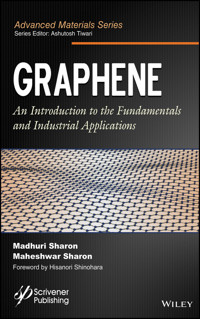
Graphene E-Book
153,99 €
Mehr erfahren.
- Herausgeber: John Wiley & Sons
- Kategorie: Fachliteratur
- Serie: Advance Materials Series
- Sprache: Englisch
Often described as a "miracle material", graphene's potential applications are extraordinary, ranging from nanoscale 'green' technologies, to sensors and future conductive coatings.
This book covers the topic of 'graphene' – the history, fundamental properties, methods of production and applications of this exciting new material. The style of the book is both scientific and technical – it is accessible to an audience that has a general, undergraduate-level background in the sciences or engineering, and is aimed at industries considering graphene applications.
As the graphene topic is a broad-reaching and rapidly moving field of research, the aim of this book is therefore to provide information about graphene and its current and future applications that are immediately implementable, relevant and concise. After reading this book, the reader will have sufficient knowledge and background to move forward independently into graphene R&D and to apply the knowledge therein. Although the book will be self-contained, each chapter has copious references to enable further reading, research and exploration of the chapter topics.
Sie lesen das E-Book in den Legimi-Apps auf:
Seitenzahl: 459
Veröffentlichungsjahr: 2015
Ähnliche




















Contents
Cover
Half Title page
Title page
Copyright page
Dedication
Forword
Preface
Chapter 1: The History of Graphene
Chapter 2: Structure and Properties of Graphene
2.1 The Structure of Graphene
2.2 Disorder in Graphene Structure
2.3 Properties of Graphene
2.4 Summary
Chapter 3: Nanographene and Carbon Quantum Dots (C-Dots)
3.1 Nanographene
3.2 Graphene Quantum Dots or Carbon Dots
3.3 Conclusions
Chapter 4: Identification and Characterization of Graphene
4.1 Introduction
4.2 Microscopic Methods
4.3 Spectroscopic Methods
4.4 Optical Property Analysis
4.5 Measurement of Mechanical Properties
4.6 Thermal Properties and Thermal Effect Analysis
4.7 Characterization of Electrical Properties
4.8 Work Function
4.9 Anomolous Quantum Hall Effect
4.10 Spin Transport
4.11 Summary
Chapter 5: Engineering Properties of Graphene
5.1 Introduction
5.2 Engineering Magnetic Properties
5.3 Engineering Graphene with Enhanced Mechanical Properties
5.4 Engineering the Field Emission (FE) Properties
5.5 Engineering Band Gap or Energy Gap of Graphene
5.6 Engineering the Electronic Properties of Graphene
5.7 Engineering Structural Properties of Graphene
5.8 Summary
Chapter 6: Applications of Graphene
6.1 Application Possibilities
6.2 Summary
Chapter 7: Towards Mass Production of Graphene: Lab to Industry (Scaling Up)
7.1 Exfoliation of Graphite: A Top-Down Approach
7.2 Length-Wise Unzipping of Carbon Nanotubes (CNT)
7.3 Chemical Vapor Deposition (CVD) Method
7.4 Epitaxial growth of Graphene on Silicon Carbide
7.5 Reduction of Graphene Oxide (GO)
7.6 Arc-Discharge Method
7.7 Solvothermal Method
7.8 Substrate-Free Gas Phase Synthesis Of Graphene
7.9 Other Growth Methods
7.10 Summary
Chapter 8: Direct Transfer or Roll-To-Roll Transfer of Graphene Sheet onto Desired Substrate
8.1 Introduction
8.2 Direct Transfer of Graphene by Etching and Scooping Method
8.3 Direct Transfer of Graphene by Etching and Scooping Method Using a Graphene Protecting Media
8.4 Roll-to-Roll Synthesis and Transfer of Graphene
8.5 Apparatus Used for Roll-to-Roll Transfer of Graphene Sheet
8.6 Considerations for Minimizing Defects or Cracking During Transfer
8.7 Summary
Chapter 9: Graphene in Industry, Commercialization Challenges, and Economics
9.1 Introduction
9.2 Graphene Industries
9.3 Graphene Commercialization
9.4 Economics of Graphene and Graphene-related Products
9.5 Graphene and the Future Possibilities
9.6 Graphene and Fantasies
9.7 Summary
References
Index
Graphene
Scrivener Publishing100 Cummings Center, Suite 541JBeverly, MA 01915-6106
Advanced Materials SeriesThe Advanced Materials Series provides recent advancements of the fascinating field of advanced materials science and technology, particularly in the area of structure, synthesis and processing, characterization, advanced-state properties, and applications. The volumes will cover theoretical and experimental approaches of molecular device materials, biomimetic materials, hybrid-type composite materials, functionalized polymers, supramolecular systems, information- and energy-transfer materials, biobased and biodegradable or environmental friendly materials. Each volume will be devoted to one broad subject and the multidisciplinary aspects will be drawn out in full.
Series Editor: Dr. Ashutosh TiwariBiosensors and Bioelectronics CentreLinköping UniversitySE-581 83 LinköpingSwedenE-mail: [email protected]
Publishers at ScrivenerMartin Scrivener([email protected])Phillip Carmical ([email protected])
Copyright © 2015 by Scrivener Publishing LLC. All rights reserved.
Co-published by John Wiley & Sons, Inc. Hoboken, New Jersey, and Scrivener Publishing LLC, Salem, Massachusetts.Published simultaneously in Canada.
No part of this publication may be reproduced, stored in a retrieval system, or transmitted in any form or by any means, electronic, mechanical, photocopying, recording, scanning, or otherwise, except as permitted under Section 107 or 108 of the 1976 United States Copyright Act, without either the prior written permission of the Publisher, or authorization through payment of the appropriate per-copy fee to the Copyright Clearance Center, Inc., 222 Rosewood Drive, Danvers, MA 01923, (978) 750-8400, fax (978) 750-4470, or on the web at www.copyright.com. Requests to the Publisher for permission should be addressed to the Permissions Department, John Wiley & Sons, Inc., 111 River Street, Hoboken, NJ 07030, (201) 748-6011, fax (201) 748-6008, or online at http://www.wiley.com/go/permission.
Limit of Liability/Disclaimer of Warranty: While the publisher and author have used their best efforts in preparing this book, they make no representations or warranties with respect to the accuracy or completeness of the contents of this book and specifically disclaim any implied warranties of merchantability or fitness for a particular purpose. No warranty may be created or extended by sales representatives or written sales materials. The advice and strategies contained herein may not be suitable for your situation. You should consult with a professional where appropriate. Neither the publisher nor author shall be liable for any loss of profit or any other commercial damages, including but not limited to special, incidental, consequential, or other damages.
For general information on our other products and services or for technical support, please contact our Customer Care Department within the United States at (800) 762-2974, outside the United States at (317) 572-3993 or fax (317) 572-4002.
Wiley also publishes its books in a variety of electronic formats. Some content that appears in print may not be available in electronic formats. For more information about Wiley products, visit our web site at www.wiley.com.
For more information about Scrivener products please visit www.scrivenerpublishing.com.
Library of Congress Cataloging-in-Publication Data:
ISBN 978-1-118-84256-0
To Our GrandchildrenANISHRACHAELANNIKAARYANYou four mean everything to us; you are our blessings, love and life
Foreword
Graphene is one of the most incredible materials in that it has just an atom-thinness but has millimeter or even centimeter size area. Before 2004 when the first preparation of single-layer graphene was reported, people had talked about and imagined graphene as ultimately thin “ideal” graphite and also as an “ingredient” of single-wall carbon nanotubes. Since then, partly because of the 2010 graphene Nobel Prize, a number of graphene-related studies has been published worldwide, and it is almost impossible to access and follow every conceivable studies of one’s related research area of graphene. The publication of a compact and yet the state-of the-art book on graphene has, therefore, been highly desired and anticipated by researchers.
Professors Madhuri and Maheshwar Sharon have beautifully and successfully realized these requirements by this new monograph. One may be surprised to see how fertile and productive chapters are involved in the book, ranging from basic structures, mechanical/electronic properties of graphene, to various applications of graphene technology and even to graphene in industry and commercialization.
April 2015Hisanori ShinoharaDepartment of ChemistryNagoya UniversityNagoya, Japan
Preface
Science is an ever-continuing quest to understand the intricacies of nature right from atomic scale to vastness of the universe. One of such realm of learning is venturing into materials at a particularly defined size of 1–100 nm—encompassing a science called nano-science and nanotechnology. Graphene is the outcome of research and knowledge based on carbon nanotechnology. Graphene is now at the pinnacle of glorious achievements and has motivated multi-disciplinary research towards developing feasible solutions in various sectors. There have been several advances in the field of graphene-based materials, such as in energy-related applications as fuel cells, super-capacitors and photovoltaic devices. Graphene, by virtue of its unique properties, and graphene composites have also found an important relevance in energy harvesting. Furthermore, applications of graphene in filtering heavy metal ions and other pollutants are also of importance in the current scenario. The recent Nobel Prize–winning research work on graphene has attracted significant attention on account of its exceptional capabilities particularly in the field of electronics.
This book is our humble effort to present the state of the art of graphene research intended for various applications. We have tried to place these developments in scientific, technical, as well as commercial and economic context to assess the likelihood of uptake of these technologies and their relevance to world’s pressing needs of energy, miniaturization, communication, transportation and health.
The scope of this book includes scientific and technological details along with present day industrial approach and needs. This book is intended for new entrants and active researchers in the field of graphene science and technology in industry and academia, medical, government officials responsible for research, innovation, entrepreneur and industrialists venturing into applications of graphene, students and interested lay persons. We assume readers have academic training, but no expertise in graphene-technology.
Madhuri SharonMaheshwar SharonMay 2015
Chapter 1
The History of Graphene
A pencil and a dream can take you anywhere.
Joyce A. Meyers
Prior to excavating the history of graphene, one has to know graphite, which is composed of many layers of graphene stacked together. This stacking makes a three-dimensional structure, the graphite, whereas graphene is a two-dimensional, one-atom-thick material. Evidence of the uses of graphite in Europe has been recorded in pottery decorated with graphite some 6000 years ago. The present concept and clarity about graphite is nearly 500 years old. Graphite ore (Figure 1.1) was found and mined in England in the sixteenth century.
Figure 1.1 Graphite ore. Courtesy: http://en.wikipedia.org/wiki/Graphite.
People used graphite to mark their sheep. However, it was believed that this mineral was lead ore and it was called “plumbago”. Scheele, in 1779, demonstrated that plumbago is actually carbon, not lead. Because people used it to write marks on their sheep, a German scientist, Verner (1789) named it graphite (a Greek word for “writing”). With the development of the pencil industry, it has been used as a writing material in a pencil (Figure 1.2) since the eighteenth century.
Figure 1.2 A lead pencil tip made of graphite. Courtesy: http://commons.wikimedia.org/wiki/File:Pencils_hb.jpg.
Because of its layered morphology and weak dispersion forces between adjacent sheets, it was utilized as solid lubricant. Before proceeding further with the history of graphene, it is necessary to define what a graphene is.
The term “graphene” first appeared in 1987 (Mouras et al. 1987) to describe single sheets of graphite as one of the constituents. The term “graphite layers” was replaced with “graphene” by the IUPAC commission. According to the recent definition, “graphene is a two-dimensional monolayer of carbon atoms, which is the basic building block of graphitic materials (i.e., fullerene, carbon nano tubes, graphite)”. Graphene is a two-dimensional material. It consists of a single layer of carbon atoms arranged in a honeycomb-like structure (Figure 1.3B).
Figure 1.3 Schematic diagram of (a) Graphite and (b) Four layers of graphene from graphite.
The carbon-carbon bond length in graphene is about 0.142 nanometers (Figure 1.3B). Its layer height was measured to be just 0.33nm (Figure 1.3A). It is the thinnest material known, and yet is also one of the strongest. Graphene is almost completely transparent. Its structure is so dense that even the smallest atom helium cannot pass through it. It conducts electricity as efficiently as copper and outperforms all other materials as a heat conductor.
In 1859 a British chemist, Benjamin Bordie, prepared a highly lamellar structure by thermally reducing graphite oxide by reacting graphite with potassium chlorate and fuming nitric acid, resulting in the formation of a suspension of graphene oxide crystallite. This graphene oxide was later woven into a paper. An early study the properties of this graphene oxide paper was completed by Kohlschutter and Haenni in 1919. Graphene, a molecule arranged in a single atomic plane, is accepted as a two-dimensional crystal. Earlier it was believed it could not be grown, because thermodynamics had been shown to prevent the formation of two-dimensional crystal in free state by Landau (1930).
Lesen Sie weiter in der vollständigen Ausgabe!
Lesen Sie weiter in der vollständigen Ausgabe!
Lesen Sie weiter in der vollständigen Ausgabe!
Lesen Sie weiter in der vollständigen Ausgabe!
Lesen Sie weiter in der vollständigen Ausgabe!
Lesen Sie weiter in der vollständigen Ausgabe!
Lesen Sie weiter in der vollständigen Ausgabe!
Lesen Sie weiter in der vollständigen Ausgabe!
Lesen Sie weiter in der vollständigen Ausgabe!
Lesen Sie weiter in der vollständigen Ausgabe!
Lesen Sie weiter in der vollständigen Ausgabe!




