


Graphene Field-Effect Transistors E-Book
142,99 €
Mehr erfahren.
- Herausgeber: Wiley-VCH GmbH
- Kategorie: Fachliteratur
- Sprache: Englisch
Graphene Field-Effect Transistors
In-depth resource on making and using graphene field effect transistors for point-of-care diagnostic devices
Graphene Field-Effect Transistors focuses on the design, fabrication, characterization, and applications of graphene field effect transistors, summarizing the state-of-the-art in the field and putting forward new ideas regarding future research directions and potential applications. After a review of the unique electronic properties of graphene and the production of graphene and graphene oxide, the main part of the book is devoted to the fabrication of graphene field effect transistors and their sensing applications.
Graphene Field-Effect Transistors includes information on:
- Electronic properties of graphene, production of graphene oxide and reduced graphene oxide, and graphene functionalization
- Fundamentals and fabrication of graphene field effect transistors, and nanomaterial/graphene nanostructure-based field-effect transistors
- Graphene field-effect transistors integrated with microfluidic platforms and flexible graphene field-effect transistors
- Graphene field-effect transistors for diagnostics applications, and DNA biosensors and immunosensors based on graphene field-effect transistors
- Graphene field-effect transistors for targeting cancer molecules, brain activity recording, bacterial detection, and detection of smell and taste
Providing both fundamentals of the technology and an in-depth overview of using graphene field effect transistors for fabricating bioelectronic devices that can be applied for point-of-care diagnostics, Graphene Field-Effect Transistors is an essential reference for materials scientists, engineering scientists, laboratory medics, and biotechnologists.
Sie lesen das E-Book in den Legimi-Apps auf:
Seitenzahl: 838
Veröffentlichungsjahr: 2023
Ähnliche




















Graphene Field‐Effect Transistors
Advanced Bioelectronic Devices for Sensing Applications
Edited by Omar Azzaroni and Wolfgang Knoll
Editors
Prof. Omar Azzaroni
INIFTA‐CONICET‐UNLP
Diagonal 113 y 64
1900 La Plata
Argentina
Prof. Wolfgang Knoll
Laboratory for Life Sciences and Technology
Faculty of Medicine and Dentistry
Danube Private University
3500 Krems
Austria
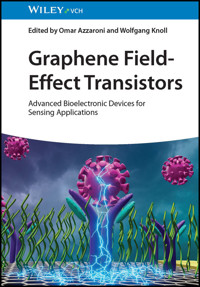
Cover Image: Surface engineering of graphene‐based FET biosensors for virus detection. Credit: Gonzalo E. Fenoy & M. Lorena Cortez
All books published by WILEY‐VCH are carefully produced. Nevertheless, authors, editors, and publisher do not warrant the information contained in these books, including this book, to be free of errors. Readers are advised to keep in mind that statements, data, illustrations, procedural details or other items may inadvertently be inaccurate.
Library of Congress Card No.: applied for
British Library Cataloguing‐in‐Publication Data:
A catalogue record for this book is available from the British Library.
Bibliographic information published by the Deutsche Nationalbibliothek
The Deutsche Nationalbibliothek lists this publication in the Deutsche Nationalbibliografie; detailed bibliographic data are available on the Internet at <http://dnb.d-nb.de>.
© 2023 WILEY‐VCH GmbH, Boschstr. 12, 69469 Weinheim, Germany
All rights reserved (including those of translation into other languages). No part of this book may be reproduced in any form – by photoprinting, microfilm, or any other means – nor transmitted or translated into a machine language without written permission from the publishers. Registered names, trademarks, etc. used in this book, even when not specifically marked as such, are not to be considered unprotected by law.
Print ISBN: 978‐3‐527‐34990‐6
ePDF ISBN: 978‐3‐527‐84339‐8
ePub ISBN: 978‐3‐527‐84338‐1
oBook ISBN: 978‐3‐527‐84337‐4
This book is dedicated to Elias Drake, Ivo, and Dante.
Foreword
Sensors are ubiquitous in modern life. They surround us, monitor our body function and our environment, protect us, help us communicate with each other, and make work more efficient and less strenuous. It is not at all surprising that the market demand for better and more efficient sensors is only increasing. For instance, in 2019, the sensor market size was of approximately US$ 167 billion, and it is expected to reach US$ 346 billion by 2028. However, progress in sensor's development passes unequivocally through the evolution of advanced materials that can convert different types of environmental energy into energy that can be processed either digitally or analogically with high accuracy, short response time, long‐term thermal and noise stability, linearity, low power consumption, and cost. These characteristics impose stringent constraints on the type of materials that can be used in sensor development. Since its isolation in 2004, graphene has been lauded as the ultimate material for sensing applications because of its unique physical properties, namely, high electrical and thermal conductivity, large Young modulus, high sensitivity to chemicals and strain, and, most of all, its large surface area to volume ratio. It is famously said that the interface is the device. We can also say that the surface is the sensor. Detection usually occurs at the surface of a material and, hence, the larger the ratio of surface area to the volume of the device, the higher the ability of the device to detect. Graphene sensors have high accuracy because graphene is a pure surface (no bulk) and can detect minute amounts of chemical, electrical, magnetic, and stress signals and convert them into signals that can be processed and communicated to other devices. The literature on graphene sensors has grown exponentially in the last decade, and it is quite hard to follow this growth and even separate “tares from wheat.” The book by Omar Azzaroni and Wolfgang Knoll on advanced bioelectronic devices for sensing applications using graphene field‐effect transistors is a breath of fresh air in this crowded research space. I believe it will become a fundamental reference for any researcher, engineer, or industrialist who is interested in learning why graphene is the ultimate sensor material.
Singapore,
November 2022
Prof. Antonio H. Castro Neto
Director, Centre for Advanced 2D Materials (CA2DM)
Co‐Director, Institute for Functional Intelligent Materials (I‐FIM)
Distinguished Professor, Department of Material Science Engineering
Distinguished Professor, Department of Physics
Professor, Department of Electrical and Computer Engineering
National University of Singapore
Preface
The discovery of a layer of graphene, one atom‐thin, by Andre Geim and Konstantin Novoselov (Nobel Prize in Physics 2010) at the University of Manchester (UK) in 2004 created a whole new scientific field and resulted in robust technologies that strongly contributed to the development of advanced devices.
Among different graphene‐based innovations, the graphene field‐effect transistor (GFET) represents a remarkable example of an advanced electronic device. GFETs employ the typical configuration of a field‐effect transistor (FET) device using a graphene channel – constituted of a lattice of carbon atoms that is only one atom thick! – between source and drain. Keeping this in mind, we can understand why GFETs exhibit unprecedented sensitivity, which can be exploited in a wide variety of sensing and biosensing applications. Contrary to the conventional view of bulk semiconductors, such as silicon, used in traditional FETs, the use of graphene to create FETs marks a profound departure from long‐established notions and approaches to create semiconductor devices and puts them into practice.
From a historical perspective, traditional transistor sensors are three‐dimensional semiconductor devices in which changes in electric charge at the surface of the channel do not always translate into a device response. As the reader can probably imagine, this fact can dramatically limit the sensitivity of the device.
In stark contrast, in GFETs, the channel is made from a two‐dimensional material, which directly exposes the channel to any molecules in the surroundings. In this scenario, the local gating effect is much more effective than that in conventional devices because the species modulating the electric field can be directly attached to the “entire” transistor channel.
While the use of GFETs in biosensing and bioelectronics has been in the experimental phase for years, it is only recently that this technology has gradually shifted to a commercial stage [1–3]. For instance, a report from McKinsey estimates that graphene‐related technologies will become a US$ 70B market by 2030 [4].
By nature, the subject of bioelectronics is diverse and interdisciplinary, and, as such, chemists, biologists, physicists, materials scientists, and engineers can make valuable contributions to the field. It is now clear within the scientific community that the successful translation of research in graphene transistors to commercial reality requires the harmonization of four universes: electronics, biology, physics, and chemistry. Indeed, the journey from basic science to technological applications has been compellingly described by Herbert Kroemer (Nobel Prize in Physics 2000) [5]: “Even if the process from science and technology to applications is opportunistic rather than deterministic, we can speed up this process by better cross‐discipline communication between scientists, technologists, and application engineers.” In this regard, a non‐negligible merit of engineers, physicists, biologists, and chemists has been their willingness to overcome the fences in which they have been traditionally confined and to promote collaboration with “apparently” unrelated research areas.
In this book, our aim is to show the wide potential of GFETs as advanced bioelectronic platforms and also to promote the potential of the technology among scientists, students, postdoctoral fellows, engineers, and industrial researchers. In addition, we also hope that this book will help convince decision‐makers from academia, government, and industry to cooperate in developing a comprehensive GFET roadmap to accelerate the manufacturing and commercialization of this promising technology.
We are pleased to have edited this book, and we are honored that so many contributors from all over the world (see map below) have accepted our invitation and taken time to write significant contributions. We are grateful to the authors who have always been very responsive and enthusiastic about the idea of the book. The invaluable efforts of these authors from 14 different countries with 38 different affiliations have helped build a comprehensive book that may be used as an advanced textbook by graduate students and young scientists, as well as a valuable reference for academic and industrial professionals performing research and development in the specific area of biosensing and bioelectronics.
Last, but not least, we thank Antonio H. Castro Neto, a pioneer in the field of graphene as an electronic material, for his Foreword, and we thank you so much for taking the time to read this book.
Wolfgang Knoll
Vienna
March 2023
Omar Azzaroni
La Plata
March 2023
References
1. Graphenea.
https://www.graphenea.com/
(accessed 30 March 2023).
2. Cardea.
https://www.cardeabio.com/
(accessed 30 March 2023).
3. Gisens Biotech.
https://www.gisensbiotech.com/
(accessed 30 March 2023).
4. Batra, G., Santhanam, N., Surana, K. (2018). Graphene: the next S‐curve for semiconductors? McKinsey Insights.
https://www.mckinsey.com/industries/semiconductors/our-insights/graphene-the-next-s-curve-for-semiconductors?utm_campaign=1millionth-sensor&utm_source=cision&utm_medium=cision&utm_term=mckinsey&utm_content=mckinsey
(accessed 30 March 2023).
5. Kroemer, H. (2005).
Phys. Status Solidi A
202: 957–964.




