


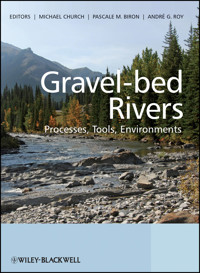
Gravel Bed Rivers E-Book
108,99 €
Mehr erfahren.
- Herausgeber: John Wiley & Sons
- Kategorie: Wissenschaft und neue Technologien
- Sprache: Englisch
Gravel-Bed Rivers: Processes, Tools, Environments presents a definitive review of current knowledge of gravel-bed rivers, derived from the 7th International Gravel-bed Rivers Workshop, the 5-yearly meeting of the world's leading authorities in the field. Each chapter in the book has been specifically commissioned to represent areas in which recent progress has been made in the field. The topics covered also represent a coherent progression through the principal areas of the subject (hydraulics; sediment transport; river morphology; tools and methods; applications of science). * Definitive review of the current knowledge of gravel-bed rivers * Coverage of both fundamental and applied topics * Edited by leading academics with contributions from key researchers * Thoroughly edited for quality and consistency to provide coherent and logical progression through the principal areas of the subject.
Sie lesen das E-Book in den Legimi-Apps auf:
Seitenzahl: 1693
Veröffentlichungsjahr: 2012
Ähnliche




















Contents
Cover
Title Page
Copyright
List of Contributing Authors
Preface
Secondary Flows in Rivers
Chapter 1: Secondary Flows in Rivers: Theoretical Framework, Recent Advances, and Current Challenges
1.1 Introduction
1.2 Theoretical Framework
1.3 Secondary Currents and Turbulence
1.4 Secondary Currents and Hydraulic Resistance
1.5 Secondary Currents, Sediments and Morphodynamics
1.6 Secondary Currents and Mixing Processes
1.7 Conclusions
1.8 Acknowledgements
1.9 References
1.10 Discussion
Chapter 2: Secondary Flows in Rivers: The Effect of Complex Geometry
2.1 Introduction
2.2 Background
2.3 Channel non-Uniformity and Secondary Flows
2.4 Discussion
2.5 References
Chapter 3: Aspects of Secondary Flow in Open Channels: A Critical Literature Review
3.1 Introduction
3.2 Secondary Flows and Channel Form
3.3 Secondary Flows and Channel Roughness
3.4 Secondary Flows and River Morphodynamics
3.5 Conclusions
3.6 References
Sediment Transport
Chapter 4: Gravel Transport in Granular Perspective
4.1 Introduction
4.2 Granular Flows
4.3 Full Mobility Transport
4.4 Surface Processes
4.5 Bedload Fluctuations, Sheets, and Patches
4.6 Perspectives and Conclusions
4.7 Acknowledgements
4.8 References
4.9 Discussion
4.10 Discussion References
Chapter 5: On Gravel Exchange in Natural Channels
5.1 Introduction
5.2 Geometric Limits to Exchange Sites
5.3 Gravel Exchange
5.4 Exchange Depths
5.5 Exchange and Size Segregation
5.6 Conclusions
5.7 Acknowledgements
5.8 References
5.9 Discussion
5.10 Discussion References
Modelling Morphodynamics
Chapter 6: Morphodynamics of Bars in Gravel-bed Rivers: Bridging Analytical Models and Field Observations
6.1 Introduction
6.2 Analytical Models of Bars in Gravel Bed Rivers: Formulation, Terminology, and Solution Approach
6.3 Morphodynamics of Steady Bars in Single-Thread Channels
6.4 Analytical Bar Models and Multiple-Thread Channel Morphodynamics
6.5 Conclusions and Research Perspectives
6.6 Acknowledgements
6.7 References
6.8 Discussion
6.9 Discussion References
Chapter 7: Field Observations of Gravel-bed River Morphodynamics: Perspectives and Critical Issues for Testing of Models
7.1 Introduction
7.2 Field Studies on Bar Dynamics: New Perspectives from Remote-Sensing Techniques?
7.3 Selection of Test Reaches: Equilibrium and Unstable Condition of River Channels
7.4 Active Channel Width in Braided Rivers
7.5 Final Remarks
7.6 Acknowledgements
7.7 References
Chapter 8: Morphodynamics of Bars in Gravel-bed Rivers: Coupling Hydraulic Geometry and Analytical Models
8.1 Introduction
8.2 Prediction of Channel Patterns
8.3 Summary and Conclusions
8.4 References
Chapter 9: Modelling Sediment Transport and Morphodynamics of Gravel-bed Rivers
9.1 Introduction
9.2 Erosion, Transport, and Deposition of Non-Uniform Sediment
9.3 Analytical Solutions
9.4 Bank Erosion and Bank Accretion
9.5 Vegetation Dynamics and Ecomorphology
9.6 Validation
9.7 Conclusions
9.8 Acknowledgements
9.9 References
9.10 Discussion
Chapter 10: The Potential of using High-resolution Process Models to Inform Parameterizations of Morphodynamic Models
10.1 Introduction
10.2 Process Modelling of Gravel Bed Rivers
10.3 Modelling Flow in a Gravel Bed River using a Computational Fluid Dynamics Approach
10.4 Is discrete particle modelLing an underused method in gravel-bed rivers?
10.5 Sediment transport predictions with high-resolution hydraulics
10.6 How can this information be used to scale up?
10.7 Discussion and Conclusions
10.8 References
Chapter 11: The Importance of Off-channel Sediment Storage in 1-D Morphodynamic Modelling
11.1 Introduction
11.2 Review of 1-D Profile Modelling Approaches
11.3 Inferences Based on Planimetric Centreline Evolution Models
11.4 1-D Profile Modelling with Active Reservoirs for Channel and Lateral Storage
11.5 A Simple 1-D Model with Off-Channel Storage
11.6 Conclusions
11.7 Acknowledgements
11.8 References
11.9 Notation
River Restoration and Regulation
Chapter 12: Stream Restoration in Gravel-bed Rivers
12.1 Introduction
12.2 Restoration Practice and the Research Perspective
12.3 Elements of A Successful Stream Restoration Profession
12.4 Challenges
12.5 Conclusions
12.6 References
12.7 Discussion
Chapter 13: River Restoration: Widening Perspectives
13.1 Introduction
13.2 Matters of Definition
13.3 Towards Intelligent Design: Sorting form from Functionand Alternatives to the Alluvial Paradigm
13.4 Improving Inventory from the Stock of Altered River Systems
13.5 The Societal and Social Dimensions
13.6 Conclusions
13.7 Acknowledgements
13.8 References
13.9 Discussion
Chapter 14: Restoring Geomorphic Resilience in Streams
14.1 Introduction
14.2 Reactions to the Wilcock Review
14.3 Restoration of Stream Geomorphic Resilience
14.4 Summary and Conclusions
14.5 Acknowledgements
14.6 References
Chapter 15: The Geomorphic Response of Gravel-bed Rivers to Dams: Perspectives and Prospects
15.1 Introduction
15.2 A Global Paucity of Data
15.3 Characterizing the Geomorphic Response of Rivers to Impoundment
15.4 Some Perspectives and Conclusions
15.5 Acknowledgements
15.6 References
15.7 Discussion
Chapter 16: Mitigating Downstream Effects of Dams
16.1 Introduction
16.2 Gravel Augmentation Downstream from Dams
16.3 Downstream Propagation and Response Time
16.4 Summary
16.5 References
Ecological Aspects of Gravel-Bed Rivers
Chapter 17: River Geomorphology and Salmonid Habitat: Some Examples Illustrating their Complex Association, from Redd to Riverscape Scales
17.1 Introduction
17.2 Salmonid Spawning Habitat
17.3 A “Riverscape” Perspective into Salmonid Habitat Science
17.4 Acknowledgements
17.5 References
Chapter 18: Incorporating Spatial Context into the Analysis of Salmonid–Habitat Relations
18.1 Introduction
18.2 Uncertainty in Fish–Habitat Relations
18.3 Problems with Density as a Measure of Abundance
18.4 Predicting the Locations of Areas with Locally High Abundance
18.5 Scaling up for Greater Predictive Power
18.6 Acknowledgements
18.7 References
Chapter 19: Animals and the Geomorphology of Gravel-bed Rivers
19.1 Introduction
19.2 It is not only “Habitat” that Matters
19.3 Geomorphological Impacts of Animals in Gravel-Bed Rivers
19.4 Understanding the Mechanisms of Animal Impacts: Laboratory and Field Experiments with Signal Crayfish
19.5 Conclusions
19.6 References
19.7 Discussion
Chapter 20: Geomorphology and Gravel-bed River Ecosystem Services: Workshop Outcomes
20.1 Introduction
20.2 Workshop Structure
20.3 Workshop Outcomes
20.4 Future Research and Challenges
20.5 Acknowledgements
20.6 References
20.7 Appendix A: Program of The Gbr7 Workshop on Gravel-Bed River Ecosystem Services Held 8 September, 2010 In Tadoussac, Québec (Canada)
20.8 Appendix B: Working List of Final Ecosystem Services Associated with Rivers
20.9 Appendix C: Working List of Geomorphological Intermediate Ecosystem Services Associated with Rivers
Tools for Study
Chapter 21: Remote Sensing of the Hydraulic Environment in Gravel-bed Rivers
21.1 Introduction
21.2 The Plan View of the River
21.3 The Vertical Dimension
21.4 Bed Sediment Size
21.5 Other Variables and Platforms
21.6 Future Needs and Directions
21.7 Acknowledgments
21.8 References
21.9 Discussion
21.10 Discussion References
Chapter 22: LiDAR and ADCP Use in Gravel-bed Rivers: Advances Since GBR6
22.1 Introduction
22.2 LIDAR
22.3 Application of ADCP for Combined Depth and Velocity Survey
22.4 Example Studies
22.5 Future Developments Towards GBR8
22.6 References
22.7 Discussion
22.8 Discussion References
Chapter 23: Remotely Sensed Topographic Change in Gravel Riverbeds with Flowing Channels
23.1 Introduction
23.2 The wetted channel problem
23.3 Extracting Meaningful Change in Bed Level and Volume from Remotely Sensed Surveys
23.4 Balancing Spatial Detail Against Vertical Accuracy
23.5 Conclusions
23.6 Acknowledgments
23.7 References
Chapter 24: Modern Digital Instruments and Techniques for Hydrodynamic and Morphologic Characterization of River Channels
24.1 Introduction
24.2 Acoustic River Instrumentation
24.3 Close-Range Remote-Sensing River Instrumentation
24.4 Demonstration of Instrument Capabilities
24.5 Discussion and Conclusions
24.6 Acknowledgements
24.7 References
24.8 Discussion
24.9 Discussion References
Chapter 25: Mapping Water and Sediment Flux Distributions in Gravel-bed Rivers Using ADCPs
25.1 Introduction
25.2 Gravel-Bed Versus Sand-Bed ADCP Measurements
25.3 Gravel-Bed Spatial Distributions
25.4 Discussion and Conclusions
25.5 References
Steep Channels
Chapter 26: Recent Advances in the Dynamics of Steep Channels
26.1 Definition of Steep Channels
26.2 Channel Morphology
26.3 Hydrodynamics and Flow Resistance in Steep Channels
26.4 Sediment Transport
26.5 Conclusions
26.6 Acknowledgements
26.7 References
26.8 Discussion
26.9 Discussion References
Chapter 27: Examining Individual Step Stability within Step-pool Sequences
27.1 Introduction
27.2 Current Research
27.3 New Analyses
27.4 Summary
27.5 Acknowledgements
27.6 References
Chapter 28: Alluvial Steep Channels: Flow Resistance, Bedload Transport Prediction, and Transition to Debris Flows
28.1 Introduction
28.2 Flow Resistance and Bedload Transport
28.3 Transition from Bedload Transport to Debris Floods and Debris Flows
28.4 Conclusions
28.5 Acknowledgements
28.6 References
Semi-Alluvial Channels
Chapter 29: Semi-alluvial Channels and Sediment-Flux-Driven Bedrock Erosion
29.1 Introduction
29.2 Controls on Channel Morphology and Steady State
29.3 Processes of Bedrock Erosion
29.4 Erosion Models
29.5 Bedrock Channels in The Stream Power Model Framework
29.6 The Role of Sediment
29.7 Conclusions and Research Needs
29.8 Acknowledgements
29.9 References
29.10 Discussion
29.11 Discussion References
Chapter 30: Transport Capacity, Bedrock Exposure, and Process Domains
30.1 Introduction
30.2 Transport Capacity in the Fluvial Zone
30.3 Upstream of the Fluvial Zone
30.4 References
Chapter 31: Nomenclature, Complexity, Semi-alluvial Channels and Sediment-flux-driven Bedrock Erosion
31.1 Introduction
31.2 Definition of Channel Types
31.3 Steady-State, Dynamic Equilibrium and the Role of Sediment
31.4 New Concepts
31.5 Acknowledgements
31.6 References
River Channel Change
Chapter 32: Changes in Channel Morphology Over Human Time Scales
32.1 Introduction
32.2 Scales of Channel Change
32.3 Spatial and Temporal Variability of Channel Change
32.4 Predicting Channel Change
32.5 Channel Stability and Hydroclimate
32.6 Conclusion
32.7 Acknowledgements
32.8 References
32.9 Appendix
32.10 References for Appendix
32.11 Discussion
32.12 Discussion References
Chapter 33: Channel Response and Recovery to Changes in Sediment Supply
33.1 Introduction
33.2 Magnitude, Frequency, and Effectiveness of Sediment Transport in Non-Equilibrium Systems
33.3 Case Studies
33.4 Closing Remarks: A Practical Case
33.5 Acknowledgements
33.6 References
Chapter 34: Alluvial Landscape Evolution: What Do We Know About Metamorphosis of Gravel-bed Meandering and Braided Streams?
34.1 Introduction
34.2 Data Sources
34.3 Defining Meandering and Braided Streams
34.4 Hydraulic Geometry and the Respective Influence of Water and Sediment Inputs
34.5 The Role of Soil Properties and Vegetation on Bank Stability
34.6 The Record of Channel Metamorphosis
34.7 Discussion and Concluding Remarks
34.8 Acknowledgements
34.9 References
34.10 Discussion
34.11 Discussion References
Chapter 35: Differences in Sediment Supply to Braided and Single-Thread River Channels: What Do the Data Tell Us?
35.1 Introduction
35.2 Key Variables for Estimating Bedload Transport Capacity
35.3 What do the Data and Observations tell us?
35.4 Conclusions
35.5 Acknowledgements
35.6 References
Chapter 36: Can We Link Cause and Effect in Landscape Evolution?
36.1 Introduction
36.2 Non-Linearity in Numerical Modelling
36.3 Model Investigations
36.4 Discussion
36.5 Conclusion
36.6 References
36.7 Discussion
Ice In Gravel-Bed Rivers
Chapter 37: River-Ice Effects on Gravel-Bed Channels
37.1 Introduction
37.2 Thermal Processes
37.3 Aufeis
37.4 Length, Time, and Dynamic Scales
37.5 Bed Material Transport
37.6 Channel Responses to Ice
37.7 Channel Banks
37.8 Defining Effects of Ice
37.9 Concluding Comments
37.10 References
Chapter 38: Is There a Northern Signature on Fluvial Form?
38.1 Introduction
38.2 Driving and Resisting Forces for Sediment Entrainment in Ice-Affected Rivers
38.3 River Ice and Geomorphologic Work
38.4 Universality of Fluvial Form in Ice-Affected Rivers
38.5 Concluding Remarks
38.6 References
Chapter 39: Long-term and Large-scale River-ice Processes in Cold-region Watersheds
39.1 Introduction
39.2 The Necopastic River Data Set
39.3 Some Perspectives on Long-Term and Large-Scale River-Ice Jam Dynamics
39.4 Conclusions
39.5 References
Index
Colour Plates
This edition first published 2012 © 2012 by John Wiley & Sons, Ltd
Wiley-Blackwell is an imprint of John Wiley & Sons, formed by the merger of Wiley's global Scientific, Technical and Medical business with Blackwell Publishing.
Registered office: John Wiley & Sons, Ltd, The Atrium, Southern Gate, Chichester, West Sussex, PO19 8SQ, UK
Editorial offices: 9600 Garsington Road, Oxford, OX4 2DQ, UKThe Atrium, Southern Gate, Chichester, West Sussex, PO19 8SQ, UK111 River Street, Hoboken, NJ 07030-5774, USA
For details of our global editorial offices, for customer services and for information about how to apply for permission to reuse the copyright material in this book please see our website at www.wiley.com/wiley-blackwell.
The right of the authors to be identified as authors of this work has been asserted in accordance with the UK Copyright, Designs and Patents Act 1988.
All rights reserved. No part of this publication may be reproduced, stored in a retrieval system, or transmitted, in any form or by any means, electronic, mechanical, photocopying, recording or otherwise, except as permitted by the UK Copyright, Designs and Patents Act 1988, without the prior permission of the publisher.
Designations used by companies to distinguish their products are often claimed as trademarks. All brand names and product names used in this book are trade names, service marks, trademarks or registered trademarks of their respective owners. The publisher is not associated with any product or vendor mentioned in this book. This publication is designed to provide accurate and authoritative information in regard to the subject matter covered. It is sold on the understanding that the publisher is not engaged in rendering professional services. If professional advice or other expert assistance is required, the services of a competent professional should be sought.
Library of Congress Cataloging-in-Publication Data
Gravel bed rivers: processes, tools, environments / edited by Michael Church, Pascale Biron, André G. Roy; with associate editors Peter Ashmore . . . [et al.].
p. cm.
ISBN 978-0-470-68890-8 (cloth)
1. River channels. I. Church, Michael Anthony, 1942- II. Biron, Pascale. III. Roy, André G. IV. Ashmore, Peter.
TC175.G765 2012
551.48′3–dc23 2011025981
A catalogue record for this book is available from the British Library.
Wiley also publishes its books in a variety of electronic formats. Some content that appears in print may not be available in electronic books.
List of Contributing Authors
Note: Bold names indicate the corresponding authors
Dominique Arseneault
Département de biologie, chimie et géographie, Université du Québec à Rimouski, Rimouski, Québec, Canada. [email protected]
Laurie Barrier
Institut du Physique du Globe de Paris, Jussieu, Paris, France. [email protected]
Colden V. Baxter
Idaho State University, Pocatello, Idaho, USA. [email protected]
Yves Bégin
Institut National de la Recherche Scientifique, Centre Eau-Terre-Environnement, St.Foy, Québec, Canada. [email protected]
Normand Bergeron
Institut national de la recherche scientifique, Centre Eau-Terre-Environnement, Québec, Canada [email protected]
Walter Bertoldi
School of Geography, Queen Mary University of London, London, UK and Dipartimento di Ingegneria Civile e Ambientale, University of Trento, Trento Italy. [email protected]
Pascale M. Biron
Department of Geography, Planning and Environment, Concordia University, Montreal, Quebec, Canada
Etienne Boucher
CEREGE, Europole Mediterranéen de l'Arbois, Aix-en-Provence, France. [email protected]
Thomas Buffin-Bélanger
Département de biologie, chimie et géographie, Université du Québec à Rimouski, Rimouski, Québec, Canada. [email protected]
John M. Buffington
USDA Forest Service, Rocky Mountain Research Station, Boise, Idaho, USA. [email protected]
Paul A. Carling
Geography and Environment, University of Southampton, Southampton, UK. [email protected]
Michael Church
Department of Geography, The University of British Columbia, Vancouver, British Columbia, Canada. [email protected]
Nicholas J. Clifford
Department of Geography, King's College, London, UK. [email protected]
Francesco Comiti
Faculty of Science and Technology, Free University of Bozen-Bolzano, Bolzano, Italy. [email protected]
Thomas J. Coulthard
Department of Geography, University of Hull, Hull, UK. [email protected]
Joanna Crowe Curran
Department of Civil and Environmental Engineering, University of Virginia, Charlottesville, Virginia, USA. [email protected]
Joseph L. Ebersole
US Environmental Protection Agency, National Health and Environmental Effects Research Laboratory, Western Ecology Division, Corvallis, Oregon, USA. [email protected]
Robert Ettema
Civil and Architectural Engineering Department, University of Wyoming, Laramie, Wyoming USA. [email protected]
Joanna Eyquem
Parish Geomorphic Ltd., Mississauga, Ontario, Canada. [email protected]
Philippe Frey
CEMAGREF, Unité de recherche Erosion Torrentielle, Neige et Avalanches, Saint-Martin-d'Hères, France. [email protected]
David Gaeuman
Trinity River Restoration Program, Weaverville California, USA. [email protected]
Gordon E. Grant
USDA Forest Service, Pacific Northwest Research Station, Corvalllis, Oregon, USA. [email protected]
Robert E. Gresswell
US Geological Survey, Northern Rocky Mountain Science Center, Bozeman, Montana, USA. [email protected]
Richard J. Hardy
Department of Geography, Durham University, Durham, UK. [email protected]
Judith K. Haschenburger
Department of Geological Sciences, University of Texas at San Antonio, San Antonio, Texas, USA. [email protected]
Marwan A. Hassan
Department of Geography, The University of British Columbia, Vancouver, British Columbia, Canada. [email protected]
George L. Heritage
JBA Consulting, The Bank Quay House, Sankey St., Warrington, UK. [email protected]
D. Murray Hicks
NIWA, Christchurch, New Zealand. [email protected]
Matthew F. Johnson
Department of Geography, Loughborough University, Loughborough, Leicestershire, UK. [email protected]
Edward W. Kempema
Civil and Architectural Engineering Department, University of Wyoming, Laramie, Wyoming USA. [email protected]
Dongsu Kim
Department of Civil and Environmental Engineering, Dankook University, Kyunggido, Korea. [email protected]
Michel Lapointe
Department of Geography, McGill University, Montreal, Québec, Canada. [email protected]
J. Wesley Lauer
Department of Civil and Environmental Engineering, Seattle University, Seattle, Washington, USA. [email protected]
Thomas E. Lisle
USDA Forest Service, Redwood Sciences Laboratory, Arcata, California, USA. [email protected]
Bruce MacVicar
Department of Civil and Environmental Engineering, University of Waterloo, Waterloo, Ontario, Canada. [email protected]
Luca Mao
Faculty of Science and Technology, Free University of Bozen-Bolzano, Bolzano, Italy. [email protected]
W. Andrew Marcus
Department of Geography, University of Oregon, Eugene, Oregon, USA. [email protected]
James P. McNamara
Department of Geosciences, Boise State University, Boise, Idaho, USA. [email protected]
Venkatesh Merwade
School of Civil Engineering, Purdue University, West Lafayette, Indiana, USA. [email protected]
Lyubov V. Meshkova
Geography and Environment, University of Southampton, Southampton, UK. [email protected]
François Métivier
Institut du Physique du Globe de Paris, Jussieu, Paris, France. [email protected]
David J. Milan
Department of Natural and Social Sciences, University of Gloucestershire, Cheltenham, Gloucestershire, UK. [email protected]
Robert G. Millar
Department of Civil Engineering, The University of British Columbia, Vancouver, British Columbia, Canada. [email protected]
Erik Mosselman
Inland Water Systems Unit, Deltares and Faculty of Civil Engineering and Geosciences, Delft University of Technology, Delft, The Netherlands. [email protected]
Erich R. Mueller
Geography Department, University of Colorado, Boulder, Colorado, USA. [email protected]
Marian Muste
IIHR-Hydroscience & Engineering and Civil & Environmental Engineering Department, The University of Iowa, Iowa City, Iowa, USA. [email protected]
Vladimir Nikora
School of Engineering, Kings College, Aberdeen, UK. [email protected]
Taha B.M.J. Ouarda
Institut National de la Recherche Scientifique, Centre Eau-Terre-Environnement, Québec, Canada. [email protected]
Athanasios (Thanos) N. Papanicolaou
IIHR-Hydroscience & Engineering and Civil & Environmental Engineering Department, The University of Iowa, Iowa City, Iowa, USA. [email protected]
John Pitlick
Geography Department, University of Colorado, Boulder, Colorado, USA. [email protected]
Ian Reid
Department of Geography, Loughborough University, Loughborough, Leicestershire, UK. [email protected]
Colin D. Rennie
Department of Civil Engineering, University of Ottawa, Ottawa, Ontario, Canada. [email protected]
Stephen P. Rice
Department of Geography, Loughborough University, Loughborough, Leicestershire, UK. [email protected]
Dieter Rickenmann
Swiss Federal Research Institute WSL, Birmensdorf, Switzerland. [email protected]
André G. Roy
Département de géographie, Université de Montréal, Montréal, Québec, Canada. [email protected]
Catalina Segura
Department of Forestry and Environmental Resources, North Carolina State University, Raleigh, North Carolina, USA. [email protected]
Noah P. Snyder
Department of Earth and Environmental Sciences, Boston College, Chestnut Hill, Massachusetts, USA. [email protected]
Nicola Surian
Dipartimento di Geografia, Università di Padova, Padova, Italy. [email protected]
Christian E. Torgersen
US Geological Survey, Forest and Rangeland Ecosystem Science Center, Cascadia Field Station, University of Washington, School of Forest Resources, Seattle, Washington, USA. [email protected]
Marco Tubino
Dipartimento di Ingegneria Civile e Ambientale, University of Trento, Trento Italy. [email protected]
Jens M. Turowski
Swiss Federal Research Institute WSL, Birmensdorf, Switzerland. [email protected]
Marco J. Van De Wiel
Department of Geography, University of Western Ontario, London, Ontario, Canada. [email protected]
Peter R. Wilcock
Department of Geography & Environmental Engineering, Johns Hopkins University, Baltimore Maryland, USA. [email protected]
André E. Zimmermann
Northwest Hydraulics Consultants, Ltd., North Vancouver, British Columbia, Canada. [email protected]
Guido Zolezzi
Dipartimento di Ingegneria Civile e Ambientale, University of Trento, Trento Italy. [email protected]
Preface
The 7th International Gravel Bed Rivers Workshop was held in Canada at Tadoussac, Québec, between 6 and 10 September, 2010. Tadoussac, located on the north shore of the St Lawrence River at the mouth of the Saguenay Fjord, is the oldest settlement in British North America to have been continually occupied by European settlers and their descendents, dating from the establishment of a fur trading station by French colonists in 1600 (the site of a Basque whaling station, intermittently occupied in the late 16th century, is located immediately to the east of Tadoussac). It is still a relatively quiet village and so well fits the tradition of the Gravel Bed Rivers workshops to seek meeting places that permit concentrated discussion, some relaxation, and good meals.
In further keeping with that tradition, the workshop was designed to present an authoritative review of recent progress in understanding the morphology and processes in gravel bed rivers, a review that you have in your hands. Accordingly, the workshop was constructed around a series of invited keynote presentations that reviewed the principal themes selected for the meeting. The format of the workshop was, however, varied from that of past meetings to the extent that formal discussion papers were invited to accompany each keynote paper, the authors of which were the referees of the keynote paper to which they were invited to respond. Those discussions appear in the book as regular chapters.
The themes of the conference, reflected in the title of the book, were processes, tools, and environments. Processes, to provide for reviews of progress in fundamental understanding of gravel bed rivers; tools, to emphasize the important advances of recent years in observing and measuring instruments and methods – particularly advances in remote-sensing methods; environments, to emphasize the diverse conditions that give rise to rivers flowing over coarse-grained materials.
We have, however, introduced some new themes into this conference, in part in recognition of the meeting in Canada, a cold, northern country with abundant rock and fast-flowing rivers, and in part to address emerging topics of high interest. There was a session on ice in gravel bed rivers. Recognizing the importance of hydroelectric power in Canada, a keynote paper specifically considered dams on gravel bed rivers within the larger context of river channel regulation and restoration. In a session on riverine ecology, rivers as the environment for salmonid fishes – a major Canadian resource – was emphasized. Semi-alluvial channels, ones flowing partly on rock, were for the first time considered in a keynote session. At a more fundamental level, the opening theme session was dedicated to secondary flows, an important mediator of river morphology that has not previously been emphasized in the workshops (nor, indeed, sufficiently considered in the discipline). Numerical modelling of gravel bed river morphodynamics, a rapidly advancing art, was featured in another session. River channel change over extended periods was also given theme attention. Sessions on steep channels and on sediment transport – perhaps the most fundamental theme of all – rounded out the meeting.
Our traditional “practical” exercise was also different at this meeting. Always devoted to field work in the past, we felt a bit overwhelmed at the scale of Canadian rivers as a site for a part-day excursion (the St Lawrence opposite Tadoussac is actually a part of an inland sea that occupies a tectonic basin – not gumboot and measuring tape territory). Therefore, we remained in our comfortable hotel and conducted a workshop facilitated by Normand Bergeron and Joanna Eyquem on ecosystem services provided by gravel bed rivers. Again, a new topic for the workshops, but an important and timely one, reported as a full chapter in this volume.
In addition to the keynote and formal discussion papers presented in this book, the meeting attracted 75 poster presentations, many of them by the graduate student contingent, as usual a highly motivated and enthusiastic group. A selection of those posters has become a formal collection presented in a special edition of Earth Surface Processes and Landforms, edited by Peter Ashmore and Colin Rennie.
The meeting, as usual, featured field trips before and after the meeting. Thomas Buffin-Bélanger and André Roy conducted a three-day excursion before the meeting that commenced at Rimouski, on the south shore of the St Lawrence and spent two days investigating the rivers of the Gaspésie region – steep, gravel bed rivers significantly influenced by seasonal ice and subjected to a recent history of intensive log-drives to sawmills at the river mouths. On Saturday evening we made the 62 km crossing of the Gulf of St Lawrence between Matane, in Gaspésie, and Baie-Comeau on the north shore, where hydropower rivers were investigated on the third day. After the conference, Normand Bergeron and Michel Lapointe led a trip from Tadoussac to Québec City that examined river habitat in gravel bed salmon rivers, intensively investigated in recent years by members of the Centre Interuniversitaire de Recherche sur le Saumon Atlantique (CIRSA).
There are many people to thank for the success of the meeting. First, our sponsors, Hydro-Québec and Parish Geomorphic; GEOIDE, the Canadian Research Network of Excellence in Geomatics; Boréas, groupe de recherche sur les environnements nordiques; la Chaire de recherche du Canada en dynamique fluviale; Concordia University; l'Institut National de la Recherche Scientifique: Eau, Terre et Environnement (INRS-ETE); McGill University; The University of British Columbia; l'Université de Montréal; The University of Ottawa; l'Université du Québec à Rimouski (UQAR); The University of Western Ontario. Thanks to Laurence Therrien and Hélène Lamarre who greatly helped with the organization and management of the conference, Linda Lamarre who gave organizational and financial advice, the staff of the Tadoussac Hotel, especially Véronique Gaudreault, who delivered highly professional support through all stages of preparing and conducting the meeting. Maxime Boivin, Laurence Chaput-Desrosiers, Sylvio Demers, Geneviève Marquis, Taylor Olsen, and Michèle Tremblay prepared and helped to conduct the field trips and managed the poster sessions. Eric Leinberger, cartographer at the University of British Columbia Department of Geography, made heroic efforts to standardize the presentation of the figures in the book. Finally, the staff at John Wiley & Sons, especially Rachael Ballard and Fiona Woods have been wonderfully helpful in bringing to publication this most important aspect of the meeting – the permanent record. Finally, we must thank our four editorial associates, who have done so much to ensure the timely production of the book.
Thanks also to Professor Rob Ferguson, who entertained the meeting as its featured banquet speaker with the unofficial and nearly entirely correct history of GBR.
We trust that this book, like its predecessors, will become part of the authoritative record of advances in knowledge and understanding of gravel bed rivers. And we wish the hosts of the next meeting, GBR8, to be held in Japan, as much success as we have enjoyed.
Mike Church
Secondary Flows in Rivers
Chapter 1
Secondary Flows in Rivers: Theoretical Framework, Recent Advances, and Current Challenges
Vladimir Nikora and André G. Roy
1.1 Introduction
Water currents in rivers have fascinated and inspired researchers (and artists) for centuries, as reflected in numerous observations and paintings from ancient times (e.g., 1963; 1995). Leonardo da Vinci's famous drawings are probably the most impressive and insightful examples of such observations. In his sketches and notes he highlighted a number of features of river flows whose signatures could be clearly observed at the water surface, especially behind obstacles and at stream confluences (Figure 1.1). ‘Spiral’ currents are particularly profound among these features and represent a key facet of nearly all of his water drawings. Using an analogy with curling hair, Leonardo summarized his observations as “Observe the motion of the surface of the water, how it resembles that of hair, which has two motions – one depends on the weight of the hair, the other on the direction of the curls; thus the water forms whirling eddies, one part following the impetus of the chief current, and the other following the incidental motion and return flow” (his written comment in Figure 1.1). It is fascinating how this description, given 500 years ago, is similar to a modern view of the mean flow structure as a superposition of the primary flow and the orthogonal secondary flows. Alternatively, Leonardo's comment may also be interpreted as the Reynolds decomposition of the instantaneous velocity into mean (i.e., time-averaged) and fluctuating turbulent components (2009), although the first interpretation seems better justified.
Lesen Sie weiter in der vollständigen Ausgabe!
Lesen Sie weiter in der vollständigen Ausgabe!
Lesen Sie weiter in der vollständigen Ausgabe!
Lesen Sie weiter in der vollständigen Ausgabe!
Lesen Sie weiter in der vollständigen Ausgabe!
Lesen Sie weiter in der vollständigen Ausgabe!
Lesen Sie weiter in der vollständigen Ausgabe!
Lesen Sie weiter in der vollständigen Ausgabe!
Lesen Sie weiter in der vollständigen Ausgabe!
Lesen Sie weiter in der vollständigen Ausgabe!
Lesen Sie weiter in der vollständigen Ausgabe!
Lesen Sie weiter in der vollständigen Ausgabe!
Lesen Sie weiter in der vollständigen Ausgabe!
Lesen Sie weiter in der vollständigen Ausgabe!
Lesen Sie weiter in der vollständigen Ausgabe!
Lesen Sie weiter in der vollständigen Ausgabe!
Lesen Sie weiter in der vollständigen Ausgabe!
Lesen Sie weiter in der vollständigen Ausgabe!
Lesen Sie weiter in der vollständigen Ausgabe!
Lesen Sie weiter in der vollständigen Ausgabe!
Lesen Sie weiter in der vollständigen Ausgabe!
Lesen Sie weiter in der vollständigen Ausgabe!
Lesen Sie weiter in der vollständigen Ausgabe!
Lesen Sie weiter in der vollständigen Ausgabe!
Lesen Sie weiter in der vollständigen Ausgabe!
Lesen Sie weiter in der vollständigen Ausgabe!
Lesen Sie weiter in der vollständigen Ausgabe!
Lesen Sie weiter in der vollständigen Ausgabe!
Lesen Sie weiter in der vollständigen Ausgabe!
Lesen Sie weiter in der vollständigen Ausgabe!
Lesen Sie weiter in der vollständigen Ausgabe!
Lesen Sie weiter in der vollständigen Ausgabe!
Lesen Sie weiter in der vollständigen Ausgabe!
Lesen Sie weiter in der vollständigen Ausgabe!
Lesen Sie weiter in der vollständigen Ausgabe!
Lesen Sie weiter in der vollständigen Ausgabe!
Lesen Sie weiter in der vollständigen Ausgabe!
Lesen Sie weiter in der vollständigen Ausgabe!
Lesen Sie weiter in der vollständigen Ausgabe!
Lesen Sie weiter in der vollständigen Ausgabe!
Lesen Sie weiter in der vollständigen Ausgabe!
Lesen Sie weiter in der vollständigen Ausgabe!
Lesen Sie weiter in der vollständigen Ausgabe!
Lesen Sie weiter in der vollständigen Ausgabe!
Lesen Sie weiter in der vollständigen Ausgabe!
Lesen Sie weiter in der vollständigen Ausgabe!
Lesen Sie weiter in der vollständigen Ausgabe!
Lesen Sie weiter in der vollständigen Ausgabe!
Lesen Sie weiter in der vollständigen Ausgabe!




