


Erhalten Sie Zugang zu diesem und mehr als 300000 Büchern ab EUR 5,99 monatlich.
- Herausgeber: Crown House Publishing
- Kategorie: Geisteswissenschaft
- Sprache: Englisch
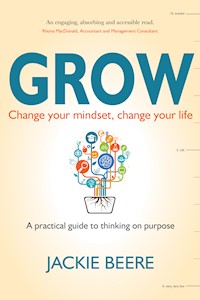
In GROW, Jackie Beere demonstrates how we can all change our mindsets, learn to learn and chose to think on purpose. Our thoughts and beliefs lead us to develop habits that can predict our success or failure. We can all choose to grow and coach our loved ones to do the same by fostering and sustaining a mindset that will keep us healthy and happy in future years. Jackie Beere believes the key to this is thinking on purpose and metacognition. Jackie shows you how you can understand yourself and others so that you can be flexible, fearless and happy.
Sie lesen das E-Book in den Legimi-Apps auf:
Seitenzahl: 325
Veröffentlichungsjahr: 2016
Das E-Book (TTS) können Sie hören im Abo „Legimi Premium” in Legimi-Apps auf:
Ähnliche
















Praise for Grow
I have thoroughly enjoyed reading Grow – it is easy-to-read, very clear and personal, and peppered with inspirational quotes, research and case studies. The practical ideas are super. It is an inspirational book to help us think about how we can develop a healthy, flexible, engaging and kind response to relationships in our every changing world, within the core settings of the work place, our homes, communities and our schools. It will be such a useful resource for anyone!
Caro Strover, Chartered Educational Psychologist
Reading Grow is like chatting with a friend. Deceptively straightforward and upbeat, Jackie’s narrative demystifies the scientific, philosophical and psychological theories that she believes underpin human happiness, linking ideas, telling stories and ultimately offering readers their own powerful path to positivity: thinking on purpose. Really accessible, fun and thought-provoking, this book is definitely a life changer.
Lisa Stone, Head of Coaching, Professional Tutor and Teacher of English, Akeley Wood School
Jackie Beere sets out to write a really practical book, full of gentle advice and free from jargon or technical terms: this is exactly what she has done. The most useful research and writing from over the last two decades – from the worlds of education, neuroscience, positive and cognitive psychology – have been woven together in an easy-to-read, down-to-earth book that will appeal to anybody interested in personal change.
Jackie makes an important case for ‘growth’ becoming the natural extension of ‘learning to learn’; that if we understand how our brains work, we can become much more purposeful with our understanding and unlock our true potential. Mindset, emotional intelligence and behavioural science are used to create a simple, yet powerful framework for change. Very compelling is the way, Jackie reframes ‘learning’ into ‘growth’; a minor shift in some respects, but a major paradigm shift for educators in particular. Imagine an education system where personal growth is the main driver – all of a sudden, knowledge acquisition is no longer enough and young people’s mental health matters as much as anything else. Hurray! However, this book is certainly not for educators alone. Aspiring to be happier, healthier and more productive in our relationships is something most of us strive for. This book shines a light on our current behaviours and offers us the choice of a possible new reality that we have the power to shape. Without judgement, and often using personal stories, Jackie offers alternative ways of dealing with very familiar situations, ways which ensure that we learn and grow stronger and more resilient. She also offers us the opportunity not only to affect change in ourselves but to support change in others by using coaching techniques.
Jackie does not pretend to offer anything radically new, but what she does do, with great humility, is offer a much needed, straightforward reminder of some incredibly powerful approaches that all parents, teachers, employees and employers cannot do without. I wish I could give this book to everyone I know!
Manjit Shellis, Director of Learning, University of the First Age
Inspiring and upbeat – felt the positive practical coaching throughout. Full of useful exercises and practical tips that help develop insight into behaviour. The most awesome element is discovering that real change is actually achievable – even I am convinced. I can do this!
Maureen Floyd, Children’s Social Work Manager
Reading Grow was a turning point for me when I was going through a crisis of meaning in my life. In terms of conventional success – a well-paid professional job, a very happy family, a good social network, fulfilling hobbies – I seemed to have it all. But somehow I felt deeply, profoundly unfulfilled. I struggled with this feeling for many years as I travelled in trains, planes and cars from client to client. I felt ungrateful for the bountiful existence fate had chanced to serve me and that I didn’t seem to want. I tried to knuckle down and ‘make lemonade from the lemons’. Then it all got too much, and I got to thinking seriously about my life. I realised I was judging ‘success’ the wrong way. I was using someone else’s definition of success, not my own. I sat down and wrote out what success really meant to me, and what it did not mean. I created my own success manifesto which helped me see that I was judging myself on totally the wrong benchmarks.
Over time I started to reset my life to fit in with my ideas of success, not anyone else’s. It was not – and still is not – an easy journey, because we are all hard-wired by society, consumerism and education to define success as certain attributes. We think of success in very specific, limited terms such as our profession, looks, wealth and possessions. We don’t stop to think of success in terms of wisdom gained, friendships made or moments experienced. Gradually I have started to loosen the tethers that bind me to one idea of success and align my whole life with another better idea, one that fits with how I feel deep inside. There is no way that I can tell anyone what success really means to them personally, but I do hope you can use Grow to help you find your own specific definition of success and, with the help of Jackie’s guidance throughout the book, move towards it with confidence and bravery.
Robert Beere, a more contented individual
We all seek happiness, but the question many people never ask themselves is … what does happiness look like for me? I found the happiness manifesto in Jackie Beere’s Grow very insightful in helping me to identify what happiness looks like to me. I was able to see the areas in my life which were incongruent and then look to make the changes I needed. It sounds so simple but it has been by far the most effective tool in my personal growth journey.
Sangeeta Sami, Digital Marketing Consultant
This is a great book which offers a practical and realistic approach to self-development. It proves an inspiring, insightful and intelligent approach to personal learning, which explains what holds us back and how to get on with the journey. Well worth a read.
Steph Coleman, IT and Customer Experience Director, Microlease
A well-judged balance between the academic, the informative and the anecdotal makes this an engaging, absorbing and accessible read. A book that brings together a plethora of current thinking and delivers a strong central message about our ability to grow as people – full of practical advice, tools for self-testing, excellent summaries and a clever device to answer the sceptics’ questions. A book to make you think, but so full of optimism and positivity it’s hard not to smile as well!
Rhona MacDonald, Accountant and Management Consultant
Grow is a treasure-trove of ideas and insights into why we think, react and interpret the world in the ways we do. This fantastic book unpacks findings from the fields of cognitive psychology, personal development and self-help and gives us immediate and practical ways to use them in our own lives. With Grow, everything is gathered in one place, drawing together great ideas and valuable lessons from leading thinkers, scientists and business gurus, all focused on helping the reader set their own path and fulfil their goals.
With helpful self-reflection questionnaires, real-life stories and practical advice, Grow is a book for everyone with an interest in learning more about themselves, their colleagues, family, partners and society. Grow will help any interested reader to take their next steps, set their next goals and face their next challenges.
Zoë Elder, Executive Director, Clevedon Learning Hub, Independent Education Consultant and author of Full On Learning
A practical guide to thinking on purpose
JACKIE BEERE
This book is dedicated to my dad, who loved to learn new things.
Contents
Introduction
‘In the 21st century, it is not the strongest people that thrive, nor the most intelligent, but those who respond best to change and choose to grow.’
As a teacher, writer, trainer, mother, wife, friend, worrier and optimist, I have been on a lifelong journey of self-discovery to see how to make life work well so that I can be both happy and successful. On the way I’ve experienced massive challenges and tragic events alongside unexpected achievements. My lifelong action research project has been to find out how to survive – and thrive.
I’ve discovered over and over again that the key to successful living and happy relationships depends on the way you think when you react to events.
We will all experience our share of tragedy and triumph – think, for example, of Amy Winehouse and Katie Piper. Different people, different outcomes. The difference between them is in how they reacted to events. Do you turn triumph into tragedy – or tragedy into triumph?
In order to move on in life, we have to adapt constantly to what happens around us – and to us. Our ability to cope well in a changing world is an essential element of a happy existence. How we react to events or respond to changes, both minor and major, determines whether or not we will experience success or failure in life.
Our response to change and to events affects what happens next. And that becomes the beginning of the next stage of our journey.
From thinking to feeling, then acting
The way you think impacts on the way you communicate, both internally and with others. The way you think creates habits and attitudes that influence your behaviour. The way you think helps you choose to grow – or not.
Thoughts can make you feel happy or sad, clever or stupid, beautiful or ugly – despite all the physical or other evidence to the contrary. What I call ‘thinking on purpose’ is a method of helping you understand and manage your feelings; a method that grows the emotional intelligence (EQ) you need to become happier, wiser, kinder and more successful.
This book aims to share some observations, stories and practical tools to help you, and others you care about, grow to become more resilient and adaptable. Thinking on purpose means managing your thoughts, and therefore your feelings, effectively. It’s a personal perspective, but one that is informed by wide reading and research. I have been particularly inspired by Daniel Goleman’s work on emotional intelligence, Carol Dweck’s research on the power of developing a growth mindset, the founding principles of neuro-linguistic programming, and the latest discoveries about our brains and how they work.
The journey into learning
It all begins with thinking.
What is thinking? We all think – it’s hard not to! Surely we don’t need a book to tell us how to do something we do all day long? According to Daniel Kahneman, we speak about 16,000 words a day, but we think using up to five times that many words.1 Our minds run a constant dialogue or commentary on the sights and sounds, highs and lows that we experience. And most of the time we’re not even aware of it. But this inner dialogue is often forming our reactions, creating our attitudes and shaping our behaviours… and we don’t realise it is having this effect.
Your thoughts might flit from food to television, to animals, to work, to friends, to the weather – all in the twinkling of an eye. If you tried to stop thinking, the word ‘stop’ would start a whole new set of connections. One thing is for sure: if I say, ‘Don’t think of an elephant’, an elephant will be the only thing you can think of!
This means ‘thinking on purpose’ can be tough because we have to learn to manage the pictures and words that create meaning for us. Creating meaning elicits a response; a response that feeds our emotions and beliefs. Thoughts really do change minds!
Understanding how we think, and acknowledging the chaos that reigns in our heads, helps us to challenge the way we sometimes think, and find out how to think on purpose in more systematic, productive ways. We can reframe how we see situations by thinking on purpose and develop a cognitive flexibility that will build our resilience and confidence.
How do you see learning?
For many people, the idea of ‘learning’ has negative associations. It started off well as you sauntered through your babyhood and early learning journeys into walking, talking, climbing and exploring. Sooner or later, though, someone judges you, measures your progress, and compares you to others. School does this constantly, with tests and exams – or even on the sports field you can be left feeling stupid or embarrassed when you struggle in front of your peers. It is easy to stop enjoying learning.
As an ex-teacher, I know that the school system isn’t perfect in terms of teaching or developing the habits of great learning in our children. Schools are often too bound up in systems, delivering Ofsted’s demands, measuring progress, quality control, exam results and all the rest. They often forget that the best learning comes from taking a risk and making mistakes. This can leave a legacy – and for many not a very positive one. This experience can make learning later in life more of a struggle. As they have not developed an understanding of learning, people then have to overcome the emotional barriers to learning that may have been generated at school.
Still, once you leave school you have the chance to take charge of your own learning. You can choose to learn at work or at home by reading, taking up hobbies, learning to play sport or music, or simply by watching others who are good at things. You can keep on growing new neural pathways until the day you die. Or you can choose to do none of these.
I’m not a psychologist or a neuroscientist, but I am fascinated by people and how they can change. I’ve been on many different kinds of training course, and read all the latest self-help books. My bookshelves at home tell the story of each of my decades. What did I try? Well, I explored a number of personal development theories which I’ll mention throughout this book, because some have worked for me. Some may also work for you, but taming your brain will be hard work and there is no quick fix. It is more like a lifelong journey.
Where this book came from
As I’ve said, lots of reading has informed this book, but my main inspirations have been:
Daniel Goleman’s work on emotional intelligence
Richard Bandler and John Grinder’s concept of neuro-linguistic programming (NLP), and
Carol Dweck’s work on mindsets.
Emotional intelligence
Daniel Goleman’s work encouraged me to consider the following as the driving forces of success:
Managing emotions. For me, this involves being able to control my instinctive emotional reaction to a situation so that I avoid acting on impulse; being able to stand back for a few moments and take stock of a situation before I think, say or do something that is inspired by fear or anger. Losing your temper – with yourself or others – can become an unhelpful habit. Managing your emotions so they don’t control you requires thinking on purpose!
Self-awareness. This is a basic requirement if you are going to be able to manage your emotions. You must understand your emotions, what they feel like, where they come from and how they help – or hinder – you.
Self-motivation. What makes you want to do anything? I am motivated by ticking off a list of jobs, and feeling I’ve finished them; by making a difference to other people, and seeing them grow; by doing something I’m scared of and surprising myself. It’s also enjoying simple things like riding to the shops on my bike to get the groceries. What motivates you?
Deferred gratification. Being able to do the ‘worst’ thing on your list of jobs first means you are able to defer your gratification. All learning requires deferred gratification because you have to go through the pain to get the gain. Goleman writes about the ‘marshmallow test’,2 in which young children are told that they can have one marshmallow now or, if they wait fifteen minutes, they can have two marshmallows. Some children as young as five were found to have the ability to distract themselves from eating the first marshmallow, to get the reward. These children are already practising thinking on purpose because they can consider how to put off what they want now to get something better later. This skill makes these children more likely to succeed at school, stick with relationships, and resist drugs and drink. I will return to this in more detail throughout the book.
Managing relationships. The key to happiness for so many people is friends and family – yet friends and family can also be a source of great unhappiness. For me, managing relationships is about understanding – really understanding – other people’s point of view. This is explored in Chapters 7 and 8. It is so important to realise that making other people happy will make you happy. The journey from selfishness to kindness and selflessness is a common theme in many films and dramas, from Shakespeare’s Shylock in The Merchant of Venice to Scrooge in Dickens’ A Christmas Carol.
Neuro-linguistic programming
Richard Bandler and John Grinder, who first developed neuro-linguistic programming (NLP), wanted to produce a practical manual to show how anyone could become excellent at something by studying the habits of others who excelled in their field.3 They found lots of people who did things really well and analysed exactly what they did, so that this could be replicated by anyone. In the process, they encountered or created a number of general rules that seemed to be common to these people, and which Bandler and Grinder found useful in understanding other people, the world and how to succeed. For example:
There is no such thing as failure, only feedback – this is a mantra which I’ll often refer to later, along with the others below.
The map is not the territory – this is useful to remind you that, even though you see a situation a certain way, other people may have a different view.
The meaning of your communication is the response you get – a warning to pay attention to the effect you are having on others.
Everyone has the resources inside them to achieve anything they want – a reminder that, when you meet a challenge, the first place to look for solutions is within yourself.
Every behaviour has a positive intention – people do things for their own reasons. The fact that their value system is different from yours doesn’t mean they are wrong and you are right. What you need to do is unravel the thought processes that led them to the decision to act in a certain way.
These interesting presuppositions are worth considering, and have underpinned much of my own thinking. They will be explored in more detail throughout this book.
Growth mindsets
More recently, the psychologist Carol Dweck has risen to the fore through her work with children and their mindsets.4 She believes that, in order to achieve the very best outcomes in learning, you need to concentrate on the way you think about yourself and respond to others: this has a massive impact on how well you will fulfil your potential.
She distinguishes between the growth mindset and the fixed mindset. Having a growth mindset means you:
believe intelligence can grow
prioritise learning over everything else, including results
see mistakes or failure as a challenge and an opportunity to improve
are inspired by other people’s success and the chance to learn from them
always want to push yourself outside your comfort zone in order to grow.
In contrast, having a fixed mindset means you:
believe intelligence is fixed – you have a certain IQ and that’s that
need to prove yourself over and over
tend to avoid challenges when the outcome is uncertain and you may be seen to fail
feel threatened by negative feedback, even when it is meant constructively
think you’re smart, so you shouldn’t have to try as hard – effort is for the less intelligent.
I’ll cover the implications of these different mindsets in Chapter 5.
My aim was to write a book that was free from jargon and technical terms but full of practical advice and personal stories that may help nudge your thinking to create more cognitive flexibility. If you can think in different ways, you can adapt your responses and create the outcome you want.
The relentless application of ‘thinking on purpose’ in my work and in my career as a teacher, and at home as a parent and wife, has probably driven my students and family crazy at times – but you know what? It works!
I wish you the best of luck exploring how this book could help you think and grow.
Jackie Beere OBE
1 D. Kahneman, Thinking, Fast and Slow (London: Penguin, 2011).
2 D. Goleman, Emotional Intelligence: Why it can matter more than IQ (London: Bloomsbury, 1996).
3 J. Grinder and R. Bandler, Frogs into Princes: Neuro linguistic programming (Moab, UT: Real People Press, 1981).
4 C. Dweck, Mindset: The new psychology of success (New York: Random House, 2007).
Chapter 1
Why we need to grow
‘Once you stop learning, you may as well stop living.’
Derrick Beere1
‘We must continually remind ourselves that there is a difference between what is natural and what is actually good for us.’
Sam Harris2
GROW: Produce, mature, expand, sprout, cultivate, flourish, thrive, develop, raise, nurture
I have discovered that the most important strategy for being happy and successful in work and in life is to consciously decide to be open-minded and flexible enough to grow through learning. In this book I use the term ‘grow’ to mean developing a mindset3 (attitude, outlook, way of thinking) that will help you navigate through the trials and tribulations of life, and still maintain your desire and ability to keep learning.
Choosing to grow is learning, in the widest sense of the word. It means developing new skills and knowledge, but also finding out about yourself and how you can communicate more effectively and manage your emotions. By doing this, I suggest, you are far more likely to feel happy and contented, achieve your potential and do things you never thought possible.
Choosing to grow ensures that everything we learn makes us stronger, wiser, more emotionally intelligent, and happier, healthier members of society. What’s not to like?
If we are good at learning, we can be more capable and comfortable with change – which, in our uncertain world, seems like a no-brainer. However, it is a lifelong challenge to keep learning from your good and bad experiences and then adapt your behaviour when you need to. Too often, we end up repeating the same mistakes, or find ourselves in a spiral of unhelpful habits that holds us back. For example, you may have a habit of arriving late wherever you go. You want to get there on time, but somehow there is always a last-minute distraction, phone call, email to check, or mascara that gets smudged. You promise yourself you will change and allow yourself more time, but at the same time there is another part of you that thinks, ‘Oh well, that’s just me – I’m a “late” person – everyone knows that and understands.’ So you get later and later until, one day, you miss a plane, interview or date – one that really matters.
To change unhelpful habits and beliefs takes hard work – but doing the work becomes increasingly satisfying. To choose to work out why you are stuck and how to better move forward with the big, important stuff as well as the minutiae of life – that is part of the process of growing. It is not a once-and-for-all thing, but a lifelong challenge in which you constantly learn from your mistakes and change behaviours that are not working.
Learning applies across the board: at work, in relationships, in families – wherever we encounter frustrations and difficulties which, unattended, can gnaw away at and undermine our contentment. When all our instincts, beliefs and emotions are urging us to do what we have always done, to stick to what feels safe and familiar, then we can find ourselves trapped by those bad habits or limiting beliefs. We know from looking around us that, despite our material wealth, many of us aren’t very happy or mentally healthy – and this starts when we are young.
Figure 1.1: What are our schools teaching?
I’ve shown the snippets of newspaper headlines in Figure 1.1 many times when I’ve been training teachers and leaders, to encourage discussion about the need to develop a culture for growth in our schools and organisations. It seems obvious to me that our success is linked to our ability to continue learning and growing our social and emotional skills, so why isn’t it absolutely endemic in our society or taught in our schools? What is stopping us from fulfilling our potential? Why are so many people unhappy, mentally ill, see threats everywhere, or are just plain scared of what might happen next?
Our world seems to be full of stories of children who self-harm by cutting, using drugs or starving themselves. There are adults who drink, eat and smoke too much. There are people and groups who hate others, who maintain old enmities over decades – even centuries. It is no wonder that our view of the world can be somewhat depressing.
Yet I remain an unrelenting optimist. Despite all the evidence that suggests human beings are wretched, I believe that things will turn out well. I know that awful things are happening, but I am also familiar with the other side: the children who work tirelessly to raise money for good causes, the people who survive appalling abuse or injury and are determined to lead productive lives, and the groups who cooperate and collaborate to build their communities. Seeing the good in other people and the world is part of my habitual, unconscious outlook, so it’s not too difficult for me to wake up in the morning, pull the curtains back with a cheery smile, and feel happy about the day ahead. Most of the time this is a virtuous circle, and I get my positive outlook reflected back to me.
One of the most important challenges I ever had was given to me at a training event when I was in my early twenties. I was told to ‘Try and make sure that everyone you come into contact with walks away from you feeling a little bit happier.’ So have I learned to be an optimist through years of self-coaching? Did I have to put in the effort and the practice, or was I born with this predisposition? Is it my own default setting, programmed through my genes?
I would say that my mindset is due to a mixture of these things. Although there could be a genetic influence, this still doesn’t mean that anyone’s mindset is fixed for life. Recent research into epigenetics4 has shown that there are aspects of our genetic make-up that are only triggered given the right conditions. In other words, the possibility of change and adaptation is built in, whoever you started life as. As Oliver James says in his recent book Not in Your Genes, there is a case for nurture overcoming nature in determining how your personality develops throughout your life.5
If I didn’t believe you can change, whatever you think your default setting might be, then I wouldn’t be writing this book.
For many people, even in affluent, peaceful Western societies, times have been tough over the last few years. But, relatively speaking, life, for almost everyone, is better than it ever has been. Compared to life one hundred years ago, or to the suffering in war-torn countries, people in these societies have never had it so good. Can you remember the days before mobile phones, Facebook and the internet? Was life better or worse without social media, online shopping, and video on demand? It was certainly different. Given all these aids to better communication and connectedness, we need to ask why more and more people feel isolated, depressed, anxious and unhappy. Suicide is the biggest killer of men under fifty. Our prisons are full of people with mental health issues – in a Ministry of Justice study, 49% of female and 23% of male prisoners were assessed as suffering from anxiety and depression6 – and stress is often cited as a cause of employment difficulties. In Affluenza (2007), Oliver James says that many societies with less material wealth than ours have happier citizens, so a lack of money does not guarantee unhappiness.7 In fact, some of the wealthiest people seem distinctly unable to use their money to make themselves happy. Imagine you won the lottery. What would you care about? Preserving your fortune? Would you fret about what to spend it on? Or would you increase it by making investments? All of these issues are great opportunities for worrying, and can be seen as burdens.
So what is the secret of happiness?
As a child I was outgoing, gregarious, a little bit naughty and ‘alternative’, and also an introspective extrovert. I did crazy, loud things then spent hours thinking over what I had said or done – often regretting it. That tension between our public and private selves I will explore later, but I think this conflict is what led to my first trauma, a fear of public speaking which hit me like a hammer in my late teens. At first my main coping strategies were avoidance, denial and escape – ‘I don’t want to do it and I won’t do it’. Privately, I read up about anxiety, mind management and positive thinking. Eventually I attended courses on NLP, paid for hypnotherapy, and joined a public speaking support group. Unknowingly, I had set out on a lifelong quest to grow the mindset that would make me happy, and able to learn from my mistakes, and find out what works for me.
The secret, I found, was to choose to grow. By this I mean I chose to keep challenging myself to do things that were outside my comfort zone. To do something that scared me every day. To learn new skills and knowledge, find new ways to do things, explore ideas, invent solutions, create art and music, rise to challenges, either on my own or alongside others. It’s hard to be gloomy when you’re in a learning state of mind. Why? Because your focus is not on yourself or your emotional state, but on what you are doing. Your attention is outwards, not inwards.
So is it easy to ‘just get learning’ and grow? No, because it exposes our weaknesses and makes us feel vulnerable, or even stupid.
All too often our experiences at school made learning feel more like pain than pleasure. Consequently, some of us developed limiting beliefs at an early age about our potential to rise to learning challenges. Even now, many of us don’t consider ourselves to be great learners – think back to the time you decided to try to learn to speak a new language or learn to play a musical instrument. We often feel reluctant to leave our comfort zone and become the lifelong learners we need to be. We would rather think we can’t do something, rather than choose to think ‘I can’t do that – yet!’
Connect to your inner baby
Who are naturally the happiest people on the planet, as long as their basic needs are met? Young children. Picture a one-year-old discovering how to stack bricks and then watching them fall over time after time. Or toddlers taking their first tentative steps, delighted to be upright and on the brink of freedom. One of the things that makes young children so happy is the intrinsic joy of overcoming learning challenges. They haven’t yet learned to become sensitive to the judgement of others, or aware of what success and failure mean. Adults see this early learning and think of the child creating new neural pathways; connecting knowledge to gain an understanding of how things work. For the child, it is pure enjoyment.
Children in their early years are generally wired to be avid, relentless learners, driven by curiosity to learn through play. Provided they are healthy and experience emotional connection with another they have no hang-ups about falling over, making mistakes, getting it wrong, looking foolish or being judged inadequate. They may feel frustrated, feel pain and have preferences, but their basic desires in life are to be loved, make emotional connections with others, and to learn. Curiosity about how things work makes them explore or stare. Determination makes them practise things over and over again and take huge risks – often without considering risk assessment procedures! Just watch a two-year-old fearlessly launch herself at a flight of stairs. Three-year-olds ask endless questions, but by the time children are older, often around eleven or twelve, they may have lost their curiosity or become too self-conscious to ask.
Being good at change and adapting to new challenges is all about learning new approaches and strategies. This is what healthy, happy babies instinctively and endlessly do all the time. We – and our growing children – need to keep in touch with our ‘inner baby’ aptitude for learning if we are to thrive (Figure 1.2).
Figure 1.2: Connect to your inner baby.
What happens to this natural inclination to love learning? If we all have that basic instinct to learn and grow, then why do some of us lose our instinctive enjoyment of, and enthusiasm for, learning? What happens? What gets in the way?
The pressures of education and work mean that life can be stressful and demanding. As children become aware of the judgement of others they develop beliefs which lead to habits that will help or hinder their future as learners. Suddenly the frustrations that we inevitably experience as learners – making mistakes, getting it wrong, falling down – are witnessed, and judged, by others around us. Our teachers and classmates can see, and give us feedback: ‘Well done, Jemmy, a good try’, ‘You got that wrong’, ‘What a nice picture’, ‘You speak funny’, ‘I choose you for my team’, ‘You need to work harder’, ‘I don’t want to be your friend’, ‘Can you catch this?’, ‘Make your numbers clearer’, ‘Think of a better story’, ‘That’s the wrong answer’, ‘Speak up’, ‘Be good’. And so it goes, endlessly.
In this way, we develop a view of the world and of ourselves which creates a framework of values and beliefs about our potential to be successful in life. Children and adults are exquisitely sensitive to the feedback they get. Praise can become addictive, and we strive to get more of it. On the other hand, criticism can feed doubts about our self-efficacy which linger in our unconscious and put limits on what we are willing to do – unless we reframe the criticism and see it instead as useful feedback, which can help us along the path to mastery. It’s this feedback that has an influence right from the start of life.
When I was at school I didn’t even really think that what I was doing was learning. It just felt like trying to remember stuff for exams and trying to avoid getting it wrong. I now feel as if all the valuable stuff I have learned has happened since leaving school and going to work.
Many of us don’t consider ourselves to be great learners. Learning that is associated with exams and testing, being judged and experiencing failure, skews the way we perceive it. Instead of perceiving learning as ‘growing’, we often begin to think of learning as a method by which we, and others, judge our intelligence and self-worth. If we can reframe that thinking so that learning comes to mean exponential discovery and exciting personal development, it suddenly becomes more attractive and engaging. Put simply, learning will then become the lifelong project of growing your brain.
Children also become adept at picking up on social hierarchies, and soon learn the pecking order of the groups they are in. And these distinctions get more powerful the older children get. Eventually, learning isn’t as important as appearing cool or streetwise and fitting in.
Our education system and the process of growing up can mean we lose touch with our inner baby and being learners for life. We become so used to comparing ourselves with other people that we forget that real growth is about our own journey and development. Instead of thinking, ‘She’s more knowledgeable, clever, successful than I am’, it’s more profitable to think in terms of how you are growing and changing. Do you ask how you are doing? What progress have you made compared to yesterday or last week? Are you more knowledgeable, clever and successful now? And do you ask where you need to direct your attention so you can take steps towards becoming who you want to be?
Think of the last time you proactively learned something. Maybe you cooked something new, using unfamiliar ingredients, or learned how to use your new mobile phone or tablet. Perhaps someone taught you how to play chords on the guitar or solve a computer problem. Was it easy or frustrating? Did you feel like giving up at times? What made you stick at it? When you cracked it, how did that feel? Did you want to do more? What really motivated you to grow that particular new neural pathway? Was it to impress someone else, or was it because you love to challenge yourself?
Growing your mindset using metacognition
If we all could focus on choosing to grow and develop a better mindset for life, maybe we could live in a happier, healthier and more successful society and feel better about ourselves. To be able to do this, we need to stand back from our thoughts and emotions, examine them, and be able to understand and change them.




