


69,99 €
Mehr erfahren.
- Herausgeber: John Wiley & Sons
- Kategorie: Wissenschaft und neue Technologien
- Sprache: Englisch
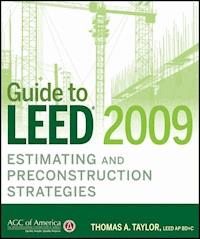
This guide walks the reader step by step through the LEED 2009 for New Construction process, offering advanced techniques for estimating the actual costs, in time and money, for building green. It serves as an essential primer to price-assessment strategies for high-performance commercial and institutional projects, which include office buildings, high-rise residential buildings, government buildings, recreational facilities, manufacturing plants, and laboratories. Written by an author with more than twenty years of green construction experience on more than 80LEED registered or certified projects, the book provides real-world case studies used to demonstrate the techniques and concepts revealed in the book, covers project documentation, and provides strategies to help the reader understand the real costs and scheduling implications associated with sustainable building.
Sie lesen das E-Book in den Legimi-Apps auf:
Seitenzahl: 386
Veröffentlichungsjahr: 2010
Ähnliche



















Contents
Part I: Introduction
Chapter 1: Establishing Parameters
Terms
Rating Systems
Chapter 2: The LEED Rating System
Leed Version 3
Leed Online
Leed Registered Projects
Leed Prerequisites
Leed Certified Projects
Administrative Changes to Leed
Action Plans and Progress Reports
Chapter 3: Before You Start
Where to Begin?
Chapter 4: LEED Process
Phased Submission
The Impact of Prerequisites and Points in LEED 2009
Sustainable Sites
Water Efficiency
Energy and Atmosphere
Materials and Resources
Indoor Environmental Quality
Chapter 5: Clarify Your Services
LEED Requirements
Part II: LEED 2009 and the Contractor
Chapter 6: Sustainable Sites
SSp1: Construction Activity Pollution Prevention
SSc1: Site Selection
SSc2: Development Density and Community Connectivity
SSc3: Brownfield Redevelopment
Alternative Transportation
SSc5.1: Site Development—Protect or Restore Habitat
SSc5.2: Site Development—Maximize Open Space
SSc6.1: Stormwater Design—Quantity Control
SSc6.2: Stormwater Design—Quality Control
Heat Island Effect
SSc8: Light Pollution Reduction
Chapter 7: Water Efficiency
WEp1: Water Use Reduction
WEc1: Water Efficient Landscaping
WEc2: Innovative Wastewater Technologies
WEc3: Water Use Reduction
Chapter 8: Energy and Atmosphere
EAp1: Fundamental Commissioning of the Building Energy Systems
EAp2: Minimum Energy Performance
EAp3: Fundamental Refrigerant Management
EAc1: Optimize Energy Performance
EAc2: On-Site Renewable Energy
EAc3: Enhanced Commissioning
EAc4: Enhanced Refrigerant Management
EAc5: Measurement and Verification
EAc6: Green Power
Chapter 9: Materials and Resources
MRp1: Storage and Collection of Recyclables
Building Reuse
MRc2: Construction Waste Management
MRc3: Materials Reuse
MRc4: Recycled Content
MRc5: Regional Materials
MRc6: Rapidly Renewable Materials
MRc7: Certified Wood
Chapter 10: Indoor Environmental Quality
IEQp1: Minimum Indoor Air Quality Performance
IEQp2: Environmental Tobacco Smoke (ETS) Control
IEQc1: Outdoor Air Delivery Monitoring
IEQc2: Increased Ventilation
IEQc3.1: Construction Indoor Air Quality Management Plan—During Construction
IEQc3.2: Construction Indoor Air Quality Management Plan—Before Occupancy
Low-Emitting Materials
IEQc4.1: Low-Emitting Materials—Adhesives and Sealants
IEQc4.2: Low-Emitting Materials—Paints and Coatings
IEQc4.3: Low-Emitting Materials—Flooring Systems
IEQc4.4: Low-Emitting Materials—Composite Wood and Agrifiber Products
IEQc5: Indoor Chemical and Pollutant Source Control
IEQc6.1: Controllability of Systems—Lighting
IEQc6.2: Controllability of Systems—Thermal Comfort
IEQc7.1: Thermal Comfort—Design
IEQc7.2: Thermal Comfort—Verification
IEQc8.1: Daylight and Views—Daylight
IEQc8.2: Daylight and Views—Views
Chapter 11: Innovation in Design
IDc1: Innovation in Design
IDc2: LEED Accredited Professional
Chapter 12: Regional Priority
RPc1: Regional Priority
Part III: Case Studies
Chapter 13: Case Studies
Project 1: William A. Kerr Foundation Office
Project 2
Project 3
Project 4
Project 5
Project 6
Project 7
Project 8
Project 9: Benedictine Women of Madison
Project 10
Project 11
Project 12: Alberici Headquarters
Project 13
Project 14
Index
Guide to LEED® 2009 ESTIMATING and PRECONSTRUCTION STRATEGIES
Copyright © 2011 by John Wiley & Sons, Inc. All rights reserved
Published by John Wiley & Sons, Inc., Hoboken, New Jersey
Published simultaneously in Canada
No part of this publication may be reproduced, stored in a retrieval system, or transmitted in any form or by any means, electronic, mechanical, photocopying, recording, scanning, or otherwise, except as permitted under Section 107 or 108 of the 1976 United States Copyright Act, without either the prior written permission of the Publisher, or authorization through payment of the appropriate per-copy fee to the Copyright Clearance Center, 222 Rosewood Drive, Danvers, MA 01923, (978) 750-8400, fax (978) 646-8600, or on the web at www.copyright.com. Requests to the Publisher for permission should be addressed to the Permissions Department, John Wiley & Sons, Inc., 111 River Street, Hoboken, NJ 07030, (201) 748-6011, fax (201) 748-6008, or online at www.wiley.com/go/permissions.
Limit of Liability/Disclaimer of Warranty: While the publisher and the author have used their best efforts in preparing this book, they make no representations or warranties with respect to the accuracy or completeness of the contents of this book and specifically disclaim any implied warranties of merchantability or fitness for a particular purpose. No warranty may be created or extended by sales representatives or written sales materials. The advice and strategies contained herein may not be suitable for your situation. You should consult with a professional where appropriate. Neither the publisher nor the author shall be liable for any loss of profit or any other commercial damages, including but not limited to special, incidental, consequential, or other damages.
For general information about our other products and services, please contact our Customer Care Department within the United States at (800) 762-2974, outside the United States at (317) 572-3993 or fax (317) 572-4002.
Wiley also publishes its books in a variety of electronic formats. Some content that appears in print may not be available in electronic books. For more information about Wiley products, visit our web site at www.wiley.com.
Library of Congress Cataloging-in-Publication Data:
Taylor, Thomas A., 1964-
Guide to LEED 2009 estimating and preconstruction strategies / Thomas A. Taylor.
p. cm.
Includes index.
ISBN 978-0-470-53371-0 (cloth); ISBN 978-0-470-90252-3 (ebk); ISBN 978-0-470-90253-0 (ebk); ISBN 978-0-470-90254-7 (ebk); ISBN 978-0-470-95037-1 (ebk); ISBN 978-0-470-95061-6 (ebk)
1. Sustainable buildings—Design and construction—Estimates. 2. Leadership in Energy and Environmental Design Green Building Rating System. I. Title.
TH880.T39 2011
720'.47—dc22
2010030984
PART I
Introduction
CHAPTER 1
Establishing Parameters
Before beginning a discussion about sustainable design and construction, we must narrow the scope of the conversation. While assembling the information for this book, the contributors collectively agreed that before a discussion of estimating and preconstruction of a sustainable or “green” project can proceed, several parameters must be defined, as each project is unique. Some owners use a prototype building model that has been proven time and time again, an experience that allows them to use a “cookie cutter” approach when delivering subsequent buildings. The contractors working on these projects will agree that the building components, materials and assemblies may be the same, but each project will have different constraints. Issues regarding requirements of the local municipality, seasonal effect on scheduled activities, availability of manpower, and possibly different subcontractors all can make each “cookie cutter” project distinctive.
For this reason, the contributors of this book feel it is necessary to establish a framework in which the discussions and examples are provided. It is the intent of the contributors to share information regarding the processes used to plan, estimate and execute a sustainable project. We have included case studies of projects that represent a cross-section of building types. These projects represent different geographical locations and levels of certification under the U.S. Green Building Council’s (USGBC) Leadership in Energy and Environmental Design (LEED®) Green Building Rating System. Our experience indicates that the problems, risks, and lack of understanding on projects are essentially the same regardless of what rating system is being used on a project. As LEED is the most widely used rating system in the United States, we have chosen to focus on projects delivered under the various LEED rating systems. We have also included examples to illustrate the impact that LEED requirements have on contractors. We include examples of extreme events that have impacted contractors in the past. It should not be inferred that these situations are the norm; rather they are provided to inform contractors of the potential effects that sustainable projects can have.
We want the reader to understand that there are several things that will influence the outcome of a LEED project, and in particular this information is intended to help contractors understand the LEED 2009 for New Construction rating system. Those of us in the construction industry know that no two projects are the same. The information in this book can be applied as one possible way, but not the only way, of estimating and producing a preconstruction plan for a project seeking LEED certification.
TERMS
Green building is a relatively new wave in the construction industry that has brought many new terms and phrases: green, green buildings, sustainable buildings, high-performance buildings, integrated design, zero net energy, integrated delivery, living buildings, regenerative design, and the list goes on. What do all of these terms mean? This may be the most difficult question to answer because these terms have different definitions depending on whom you ask. Often you will see these phrases used to define one another, and still others in the industry will mix and match these phrases as the way to explain a design or a building. Consider these passages, for example:
A green building, also known as a sustainable building, is a structure that is designed, built, renovated, operated, or reused in an ecological and resource-efficient manner. Green buildings are designed to meet certain objectives such as protecting occupant health; improving employee productivity; using energy, water, and other resources more efficiently; and reducing the overall impact to the environment.
California Integrated Waste Management Board
Most people would agree that a green building must be an energy efficient building.
EnergyStar
In the first example the terms “green building” and “sustainable building” are used to explain each other. In both examples, the definitions equate these buildings to the efficient use of various resources. The first example leads a reader to believe that the construction of a green/sustainable building results in less environmental impact while protecting the health of the building occupants, while the second focuses mainly on energy efficiency. The prevalence of definitions illustrates why there is so much confusion about green building. We will not attempt to debate the pros and cons of the multitude of definitions of green buildings. Instead we will set our first parameter: for the purposes of this book, we will define a “green” or “sustainable” building as one that has used the U.S. Green Building Council’s LEED Green Building Rating System.
RATING SYSTEMS
There are a variety of green building rating systems. Depending on what statistic is used, there are as many as 100 different programs worldwide and even more if you include guidelines and protocols in addition to the complete ratings systems. In the United States, the LEED rating systems are used as well as the Green Building Initiative’s Green Globes self-assessment and certification tool. There also are strong local programs such as the Austin Energy Commercial Green Building Program and Rating Tool, the State of Minnesota Sustainable Building Guidelines (Version 2.1), and the New York City Department of Design and Construction’s High Performance Building Guidelines. For residential construction, the USGBC offers LEED for Homes, the National Association of Home Builders has a National Green Building Standard, and there are many local programs such as the Atlanta-based program EarthCraft House. LEED and Green Globes both have their roots in international programs such as Go Green and the BRE Environmental Assessment Method (BREEAM). Teams that are new to the green building industry can quickly become confused when looking for the best or most applicable rating system for their projects. The LEED rating system, which is nearly ubiquitous in the U.S. market and is used internationally, will be the focus of this book.
LEED was developed by the U.S. Green Building Council (USGBC). Founded in 1993, USGBC’s stated mission is “to transform the way buildings and communities are designed, built, and operated, enabling an environmentally and socially responsible, healthy and prosperous environment that improves the quality of life.” LEED is a point-based system made up of prerequisites and voluntary credits. These prerequisites and points are distributed in seven distinct categories addressing:
1. Site issues: Sustainable Sites (SS)
2. Water conservation: Water Efficiency (WE)
3. Energy conservation: Energy and Atmosphere (EA)
4. Building materials and products: Material and Resources (MR)
5. Occupant comfort and health: Indoor Environmental Quality (IEQ)
6. Innovation: Innovation in Design (ID)
7. Regionalism: Regional Priority (RP)
The LEED 2009 for New Construction system contains eight prerequisites necessary for any level of certification. Projects must then achieve enough voluntary credits to be awarded one of four possible levels of certification: Certified, Silver, Gold, and Platinum.
USGBC has stated that the LEED rating system was created to provide third-party verification that a building or community was designed and built using strategies aimed at improving performance across all the metrics that matter most: energy savings, water efficiency, carbon dioxide (CO2) emissions reduction, improved indoor environmental quality, and stewardship of resources and sensitivity to their impacts.
Since the time of the initial launch of LEED-NC, USGBC has expanded the LEED rating system into a suite of products:
LEED-NCNew Construction and Major RenovationLEED-CICommercial InteriorsLEED-CSCore and ShellLEED-EBExisting Buildings: Operations and MaintenanceLEED-HomesHomes and low-rise residential structuresLEED-NDNeighborhood DevelopmentLEED-SchoolsEducational buildings designed for kindergarten through twelfth gradeThe latest iteration of the LEED program, LEED Version 3, made several changes to the administrative process and standardized the point scale across all rating systems to 100 base points with a total of 10 additional points available in the optional Innovation in Design and Regional Priority categories. Each of the systems remains unique to a particular building type or function. The newest version of the rating systems is called LEED 2009. The variety of LEED rating systems provides our second parameter: we will focus this book on the LEED 2009 for New Construction rating system. We will not examine detailed information regarding the other rating systems within the suite of LEED products. There may be times when examples within this work draw upon a project team’s experience working on LEED projects other than LEED-NC. We have included those examples to illustrate common issues a contractor may face while working on a project seeking LEED certification.
CHAPTER 2
The LEED Rating System
The LEED rating systems were developed by USGBC to be used on a voluntary basis by any team working on the construction or renovation of a project. Throughout the life of the project, the team designs, constructs, and documents activities that demonstrate compliance with the criteria set forth by the applicable LEED rating system.
LEED VERSION 3
On April 27, 2009, the USGBC introduced LEED Version 3 (v3). This LEED upgrade created the latest edition of the overall LEED green building rating system known as LEED 2009. Any project registered after the effective date of the introduction of the revised program is required to certify under LEED 2009. The prerequisites and credits discussed in this book follow the most current version of the rating system, LEED 2009 for New Construction. Due to LEED 2009’s recent release, much of the information contained in the case studies is based on older versions of the rating system. The changes incorporated into LEED 2009 are, for the most part, performance enhancements rather than substantive changes.
Prior to the introduction of LEED v3, each of the various rating system products had separate reference manuals and point systems. Under LEED v3, USGBC:
Sanctioned the Green Building Certification Institute (GBCI) to perform all project reviewsLesen Sie weiter in der vollständigen Ausgabe!
Lesen Sie weiter in der vollständigen Ausgabe!
Lesen Sie weiter in der vollständigen Ausgabe!
Lesen Sie weiter in der vollständigen Ausgabe!
Lesen Sie weiter in der vollständigen Ausgabe!
Lesen Sie weiter in der vollständigen Ausgabe!
Lesen Sie weiter in der vollständigen Ausgabe!
Lesen Sie weiter in der vollständigen Ausgabe!
Lesen Sie weiter in der vollständigen Ausgabe!
Lesen Sie weiter in der vollständigen Ausgabe!
Lesen Sie weiter in der vollständigen Ausgabe!
Lesen Sie weiter in der vollständigen Ausgabe!
Lesen Sie weiter in der vollständigen Ausgabe!
Lesen Sie weiter in der vollständigen Ausgabe!
Lesen Sie weiter in der vollständigen Ausgabe!




