


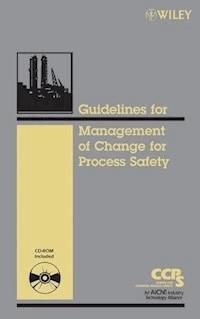
Guidelines for the Management of Change for Process Safety E-Book
116,99 €
Mehr erfahren.
- Herausgeber: John Wiley & Sons
- Kategorie: Fachliteratur
- Sprache: Englisch
Guidelines for the Management of Change for Process Safety provides guidance on the implementation of effective and efficient Management of Change (MOC) procedures, which can be applied to improve process safety. In addition to introducing MOC systems, the book describes how to design an initial system from scratch, including the scope of the system and the applications over a plant life cycle and the boundaries and overlaps with other process safety management systems. Note: CD-ROM/DVD and other supplementary materials are not included as part of eBook file.
Sie lesen das E-Book in den Legimi-Apps auf:
Seitenzahl: 241
Veröffentlichungsjahr: 2011
Ähnliche




















CONTENTS
Preface
Acknowledgements
Items on the CD Accompanying These Guidelines
List of Tables
List of Figures
Acronyms and Abbreviations
Glossary
Executive Summary
1 INTRODUCTION
1.1 Historical Perspective
1.2 Management of Change Element Overview
1.3 Motivations for MOC
1.4 Commitment Required for Effective MOC Systems
1.5 Organization and Use of These Guidelines
2 RELATIONSHIP TO RISK-BASED PROCESS SAFETY
2.1 Basic Concepts and Definitions
2.2 Overview of the RBPS System
3 DESIGNING AN MOC SYSTEM
3.1 Establishing Terminology
3.2 Determining the Implementation Context
3.3 Defining Roles and Responsibilities
3.4 Defining the Scope of the MOC System
3.5 Integrating with Other PSM Elements and Existing Company Practices and Programs
3.6 Requirements for Review and Authorization
3.7 Guidelines for Key MOC Issues
3.8 Making an MOC System Easier to Monitor
4 DEVELOPING AN MOC SYSTEM
4.1 Verifying Implementation Context
4.2 Identifying Potential Change Situations
4.3 Coordinating the MOC System with Existing Procedures
4.4 Establishing RFC Review and Approval Procedures
4.5 Developing Guidelines for Key MOC Issues
4.6 Designing MOC System Documentation
4.7 Defining Employee Training Requirements
4.8 Considering How to Modify the MOC System
4.9 Comparing the MOC System to the Design Specification
5 IMPLEMENTING AND OPERATING AN MOC SYSTEM
5.1 Preparing the Site Infrastructure
5.2 Managing the Culture Change
5.3 Integrating the MOC System with Existing Procedures
5.4 Developing a Phased Implementation Plan
5.5 Training Personnel Affected by MOC Procedures
5.6 Operating an MOC System
6 MONITORING AND IMPROVING AN MOC SYSTEM
6.1 Motivations for Improvement
6.2 Sources of Information to Launch and Guide Improvement
6.3 Identifying the Need to Improve
6.4 Identifying Opportunities for Corrective Action or Improvement
6.5 Implementing the Redesign/Improvement Effort
7 THE FUTURE OF CHANGE MANAGEMENT
APPENDIX A: EXAMPLES OF REPLACEMENTS-IN-KIND AND CHANGES FOR VARIOUS CLASSES OF CHANGE
APPENDIX B: MOC SYSTEM DESIGN STRUCTURE
APPENDIX C: EXAMPLES OF MOC SYSTEM PROCEDURE WORK FLOW CHARTS AND MOC REVIEW DOCUMENTATION FORMS
APPENDIX D: ELECTRONIC MOC APPLICATIONS
APPENDIX E: EXAMPLE MOC SYSTEM AUDIT CHECKLIST
APPENDIX F: EXAMPLE MOC PERFORMANCE AND EFFICIENCY METRICS
APPENDIX G: COMMON MOC PROBLEMS AND PROPOSED SOLUTIONS
REFERENCES
INDEX
This book is one in a series of process safety guideline and concept books published by the Center for Chemical Process Safety (CCPS). Please go to www.wiley.com/go/ccps for a full list of titles in this series.
It is sincerely hoped that the information presented in this document will lead to an even more impressivesafety record for the entire industry. However, neither the American Institute of Chemical Engineers,its consultants, CCPS Technical Steering Committee and Subcommittee members, their employers,their employers′ officers and directors, nor ABSG Consulting Inc. and its employees warrant orrepresent, expressly or by implication, the correctness or accuracy of the content of the information presentedin this document. As between (1) American Institute of Chemical Engineers, its consultants,CCPS Technical Steering Committee and Subcommittee members, their employers, their employers’ officersand directors, and ABSG Consulting Inc. and its employees and (2) the user of this document, theuser accepts any legal liability or responsibility whatsoever for the consequence of its use or misuse.
Copyright © 2008 by American Institute of Chemical Engineers,Inc. All rights reserved.
A Joint Publication of the Center for Chemical Process Safety of the American Institute of Chemical Engineers and John Wiley & Sons, Inc.
Published by John Wiley & Sons, Inc., Hoboken, New Jersey.Published simultaneously in Canada.
No part of this publication may be reproduced, stored in a retrieval system, or transmitted in any formor by any means, electronic, mechanical, photocopying, recording, scanning, or otherwise, except aspermitted under Section 107 or 108 of the 1976 United States Copyright Act, without either the priorwritten permission of the Publisher, or authorization through payment of the appropriate per-copy fee tothe Copyright Clearance Center, Inc., 222 Rosewood Drive, Danvers, MA 01923, (978) 750-8400, fax(978) 750-4470, or on the web at www.copyright.com. Requests to the Publisher for permission shouldbe addressed to the Permissions Department, John Wiley & Sons, Inc., 111 River Street, Hoboken, NJ07030, (201 ) 748-6011, fax (201 ) 748-6008, or online at http://www.wiley.com/go/permission.
Limit of Liability/Disclaimer of Warranty: While the publisher and author have used their best efforts inpreparing this book, they make no representations or warranties with respect to the accuracy orcompleteness of the contents of this book and specifically disclaim any implied warranties ofmerchantability or fitness for a particular purpose. No warranty may be created or extended by salesrepresentatives or written sales materials. The advice and strategies contained herein may not besuitable for your situation. You should consult with a professional where appropriate. Neither thepublisher nor author shall be liable for any loss of profit or any other commercial damages, includingbut not limited to special, incidental, consequential, or other damages.
For general information on our other products and services or for technical support, please contact ourCustomer Care Department within the United States at (800) 762-2974, outside the United States at(317) 572-3993 or fax (317) 572-4002.
Wiley also publishes its books in a variety of electronic formats. Some content that appears in print maynot be available in electronic format. For information about Wiley products, visit our web site atwww.wiley.com.
Library of Congress Cataloging-in-Publication Data is available.
ISBN 978-0-470-04309-7
Guidelines for Management of Change for Process Safetyis dedicated to the memory of
Sanford Schreiber1925 – 2007
Sandy Schreiber joined CCPS in 1986 after a 28-year career with Allied-Signal, where he was Director of Corporate Safety and Loss Prevention. Sandy’s early development of the twelve technical elements that must be part of any chemical process safety management program was a ground-breaking concept. These elements were published in A Challenge to Commitment and set CCPS on a path of influence and success. The subsequent development of the 4-volume series of process safety management guidelines, leading to the recent book, Guidelines for Risk Based Process Safety, owes a debt to Sandy’s vision.
We have lost a good friend, and the industry has lost a pioneer.
PREFACE
The American Institute of Chemical Engineers (AIChE) has been closely involved with process safety and loss control issues in the chemical and allied industries for more than four decades. Through its strong ties with process designers, constructors, operators, safety professionals, and members of academia, AIChE has enhanced communications and fostered continuous improvement of the industry’s high safety standards. AIChE publications and symposia have become information resources for those devoted to process safety and environmental protection.
AIChE created the Center for Chemical Process Safety (CCPS) in 1985 after the chemical disasters in Mexico City, Mexico, and Bhopal, India. The CCPS is chartered with developing and disseminating technical information for use in the prevention of major chemical accidents. The center is supported by more than 100 sponsors within the chemical process industry who provide the necessary funding and professional guidance to its technical committees. The major product of CCPS activities has been a series of guidelines to assist those implementing various elements of a process safety and risk management system. This book is part of that series.
Uncontrolled changes have directly caused or contributed to many major accidents that have occurred within the chemical process industry and allied industries. Many industries and companies recognize the importance of careful management of change (MOC) for ensuring the safety of process operations and the quality of manufactured goods. The concept and the need to properly manage change are not new; many companies have implemented MOC systems. Yet incidents and near misses attributable to inadequate MOC systems, or to subtle, previously unrecognized sources of change (e.g., organizational changes), continue to occur. To improve the performance of MOC systems throughout industry, managers need advice on how to better institutionalize MOC systems within their companies and facilities and to adapt such systems to managing non-traditional sources of change. CCPS is helping to fulfill this need through the publication of these guidelines.
The puipose of this book is to define the important features of MOC systems. MOC systems help ensure that changes to the design, operation, maintenance, and organization of facilities will not adversely affect employees, the public, or the environment. MOC systems are used not only for process safety purposes, but also to manage quality, security, environmental, and organizational risk issues. This document outlines a process that can be used for designing, developing, installing, operating, maintaining, and improving MOC systems at individual company sites and at corporate or support locations. The appendices contain examples, flowcharts, and forms that should be useful to personnel who are implementing new MOC systems or improving existing ones. The enclosed CD contains an MOC system design tool, an MOC system diagnostic tool, and examples of typical MOC system procedures and forms.
The hazards associated with a proposed change are not limited by the size or complexity of the facility in which the proposed change is to be implemented. Thus, just because a facility may be small or have relatively simple processes (e.g., storage and unloading), the need to properly manage change is no less important than at larger or more complex facilities. Also, managing change at small facilities is not necessarily easier than implementing an MOC system at a large facility. Each situation carries its own special challenges. Large facilities, where making adjustments to the facility culture is often more difficult, can find that gaining consensus on the procedures for managing change is equally difficult. Smaller facilities, which are often more receptive to change, may lack the resources (e.g., people, technical specialties) that are more common at large companies/facilities. To help meet the needs of smaller facilities, this book includes an overview of the MOC chapter from the CCPS book entitled Guidelines for Risk Based Process Safety, which promotes the efficient design, implementation, and improvement of “just fit-for-duty” management systems, including MOC.
This book is intended for an audience ranging from facility and corporate managers of process safety to workers who have differing levels of knowledge about the principles of safely managing change. This book is primarily designed to equip people responsible for MOC systems with new ideas for implementing and improving MOC systems. However, it may also be used as a training aid for companies teaching process safety management and MOC concepts to new employees.
ACKNOWLEDGMENTS
The American Institute of Chemical Engineers (AIChE) and its Center for Chemical Process Safety (CCPS) express their gratitude to all of the members of the Management of Change (MOC) subcommittee and their CCPS member companies for their generous efforts and technical contributions in the preparation of these guidelines.
The CCPS MOC committee was chaired by Jim Muoio (Lyondell). The committee included (in alphabetical order): Susan Behr (Sunoco), David Cummings (Du Pont), Tom Dileo (Aibemarle), Robert Dupree (Basell), Christy Franklin (RRS Engineering), Wayne Garland (Eastman), Bill Lash (BP), Steve Marwitz (Formosa Plastics), Mike Moriarty (Akzo Nobel), Lisa Morrison (BP), Jeffrey Philliph (Monsanto), Mike Rogers (Syncrude), Tony Santay (Air Products), Dan Wiff (Nova Chemicals), and Gary York (retired, formerly U.S. Rhodia). The CCPS MOC subcommittee Staff Consultant was Bob Ormsby. In addition, Appendix D on electronic MOC applications was based on materials provided by MOC subcommittee members Wayne Garland and Mike Rogers and peer reviewer David Drerup.
CCPS wishes to acknowledge Steve Arendt and Walt Frank of ABS Consulting who were the principle authors of this book. Bill Bradshaw and Jim Thompson of ABS Consulting also contributed to these guidelines, along with Leslie Adair and Karen Taylor, editors; Scott Campbell and Paul Olsen, graphic designers; and Susan Hagemeyer, word processor.
We thank the following people and their organizations who generously contributed their time and expertise in providing a peer review of the book:
John Alderman, RRS Engineering
Luigi Bordello, PPG Europe
Gary Carrithers, Rohm & Haas
Don Connolley, BP
Susan Cowher, ISP Technologies
David Drerup, Data Systems & Solutions
Bob Gale, Emerson
Greg Keeports, Rohm & Haas
Pete Lodal, Tennessee Eastman
Jack McCavit, JLM Consulting
Henry Ozog, io Mosaic
Adrian Sepeda, CCPS Emeritm
John Wincek, Croda
ITEMS ON THE CD ACCOMPANYING THESE GUIDELINES
MOC System Design Tool (Excel Spreadsheet)
MOC System Diagnostic Tool (Excel Spreadsheet)
Example MOC System Procedure and Forms
LIST OF TABLES
TABLE 1.1.Things That Have Happened in MOC Since 1992TABLE 1.2.Goals of these MOC GuidelinesTABLE 1.3.Examples of Changes that Should Be Managed or Could Increase RiskTABLE 1.4.Industry Initiatives to Implement MOCTABLE 1.5.Using Guidelines for Management of Change for Process SafetyTABLE 2.1.Important Issues to Address in a Process Safety Management SystemTABLE 2.2.CCPS Risk Based Process Safety ElementsTABLE 2.3.MOC Inputs and OutputsTABLE 3.1.Considerations for Designing an Early or Late Life-cycle MOC SystemTABLE 3.2.MOC System Design ConsiderationsTABLE 3.3.Examples of Changes that Should Be Considered for Inclusion in the Scope of an MOC System DesignTABLE 3.4.Key Issues to Resolve When Designing an MOC SystemTABLE 4.1.Comparison of MOC Design and Development TasksTABLE 4.2.Key Steps in an MOC SystemTABLE 4.3.Comparison of OSHA MOC and PSSR RequirementsTABLE 5.1.Issues that Should Be Considered Prior to MOC RolloutTABLE 6.1.Possible Motivations for Improving MOCTABLE 6.2.Possible Reasons for Wanting to Redesign an MOC SystemTABLE 6.3.Sources of Information for Improving an MOC SystemTABLE 6.4.MOC Key Principles and Essential FeaturesTABLE 6.5.Categories of MOC Effectiveness ProblemsTABLE 7.1.Possible MOC Growth AreasTABLE D.1.Anticipated Benefits of Choosing the eMOC ApproachTABLE D.2.Open MOC TemplateTABLE D.3.Questions to Address When Developing a Technical SpecificationTABLE D.4.Other Important Issues Related to eMOC SystemsLIST OF FIGURES
FIGURE 1.1.Flixborough Accident – Failure to Manage ChangeFIGURE 4.1.MOC System FlowchartFIGURE C.l.Example of an MOC System Procedure Work Flow ChartFIGURE C.2.Example of Simple MOC Review Documentation FormFIGURE C.3.Example of a Moderate MOC Review Documentation FormFIGURE C.4.Example of a Complex MOC Review Documentation Form (Including Checklists)FIGURE D.1.Simple Generic MOC Work FlowFIGURE D.2.Detailed Generic MOC Work FlowLesen Sie weiter in der vollständigen Ausgabe!
Lesen Sie weiter in der vollständigen Ausgabe!
Lesen Sie weiter in der vollständigen Ausgabe!
Lesen Sie weiter in der vollständigen Ausgabe!
Lesen Sie weiter in der vollständigen Ausgabe!
Lesen Sie weiter in der vollständigen Ausgabe!
Lesen Sie weiter in der vollständigen Ausgabe!
Lesen Sie weiter in der vollständigen Ausgabe!
Lesen Sie weiter in der vollständigen Ausgabe!
Lesen Sie weiter in der vollständigen Ausgabe!
Lesen Sie weiter in der vollständigen Ausgabe!
Lesen Sie weiter in der vollständigen Ausgabe!
Lesen Sie weiter in der vollständigen Ausgabe!
Lesen Sie weiter in der vollständigen Ausgabe!
Lesen Sie weiter in der vollständigen Ausgabe!
Lesen Sie weiter in der vollständigen Ausgabe!
Lesen Sie weiter in der vollständigen Ausgabe!
Lesen Sie weiter in der vollständigen Ausgabe!
Lesen Sie weiter in der vollständigen Ausgabe!




