


Erhalten Sie Zugang zu diesem und mehr als 300000 Büchern ab EUR 5,99 monatlich.
- Herausgeber: Alameda Casa Editorial
- Kategorie: Bildung
- Sprache: Englisch
After supporting Préval as the indispensable President of Haiti, the United States and France grew increasingly antagonistic to him and were bent on preventing the election of his handpicked successor, Jude Célestin. In fact, Seitenfus reveals that this antagonism reached the point where the Core Group led by Mulet attempted to remove Préval from office and send him into exile. Had it not been for the intervention of Seitenfus himself, Préval might well have had in Mulet's words "to leave the presidency and abandon Haiti." While the Core group failed to carry this gross and illegal coup, it nonetheless succeeded in creating a process that changed the results of the first round of the presidential elections and opened the way to Martelly's election in the second round. Seitenfus' explosive revelations are of great significance and deserve to be known by a wide audience. In addition, Seitenfus expands the thoughts he initially developed in an interview published in December 2010 that was highly critical of the international intervention in Haiti and that ultimately led to his firing by the OAS. Haiti: International Dilemmas and Failures shows convincingly that the intervention has been a failure. It has not contributed to any significant economic development, it has failed to stabilize the democratic transition, and it has a deeply flawed record on establishing the institutions required for a secure environment. He also makes the case that the agreements signed between the Haitian government and the UN allowing MINUSTAH to take control of the country were illegal; they lacked the endorsement of Haiti's president, and were thus unconstitutional. Seitenfus is not only critical of the foreign community; he has harsh words for the behavior of Haiti's venal political class and predatory elite. While he has good things to say about Préval, he is right in condemning his anarchic disdain for institutions and his slow and hesitant reaction to the earthquake. Préval was no dictator and probably did more for national reconciliation than any other Haitian leader, but he lacked a sense of purpose to guide the country in the aftermath of the devastating earthquake. In conclusion, Seitenfus has written a provocative and most persuasive and detailed account of the travail of the foreign occupation of Haiti. It will attract a wide audience; "Haitianists," academics and professionals studying international relations, humanitarian interventions, the Caribbean, Latin America, and the UN will be interested in Haiti: International Dilemmas and Failures. Seitenfus has thus written an important and critical book that will become a must read for anyone interested in Haiti, development, and humanitarian interventions. He shows persuasively that the type of foreign assistance that Haiti has been receiving does more harm than good. I am convinced that Haiti: International Dilemmas and Failures will be a major reference in Haitianist circles for a long time to come; it is an eloquent challenge to the prevailing system of foreign assistance and imperial interference. It is the work of a brave man and real humanist. July 21 2020 Robert Fatton Jr. Julia Cooper Professor of Politics Department of Politics University of Virginia
Sie lesen das E-Book in den Legimi-Apps auf:
Seitenzahl: 706
Veröffentlichungsjahr: 2020
Das E-Book (TTS) können Sie hören im Abo „Legimi Premium” in Legimi-Apps auf:
Ähnliche



















Copyright © 2020 Ricardo Seitenfus
Grafia atualizada segundo o Acordo Ortográfico da Língua Portuguesa de 1990, que entrou em vigor no Brasil em 2009.
Edição: Haroldo Ceravolo Sereza e Joana Monteleone
Editora assistente: Danielly de Jesus Teles
Assistente acadêmica: Tamara Santos
Projeto gráfico, diagramação e capa: Mari Ra Chacon Massler
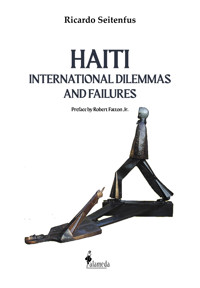
Imagem de capa: L’homme dénoncé par son ombre, escultura de Patrick Vilaire. Foto por Reginald Cohen.
Tradução: Luis Sandoval
CIP-BRASIL. CATALOGAÇÃO-NA-FONTE
SINDICATO NACIONAL DOS EDITORES DE LIVROS, RJ
___________________________________________________________________________
S463h
Seitenfus, Ricardo
Haiti [recurso eletrônico] : international dilemmas and failures / Ricardo Seitenfus ; prefácio Robert Fatton Jr. - 1. ed. - São Paulo : Alameda, 2020.
recurso digital
Formato: ebook
Requisitos dos sistema:
Modo de acesso: world wide web
Inclui bibliografia e índice
ISBN 978-65-86081-55-8 (recurso eletrônico)
1. Assistência econômica - Haiti. 2. Assistência humanitária - Haiti. 3. Haiti - Condições econômicas. 4. Livros eletrônicos. I. Título.
20-65727CDD: 330.97294
CDU: 338(729.4)
____________________________________________________________________________
Conselho Editorial
Ana Paula Torres Megiani
Eunice Ostrensky
Haroldo Ceravolo Sereza
Joana Monteleone
Maria Luiza Ferreira de Oliveira
Ruy Braga
Alameda Editorial
Rua Treze de Maio, 353 – Bela Vista
CEP: 01327-000 – São Paulo – SP
Tel.: (11) 3012-2403
www.alamedaeditorial.com.br
To Maria, my Caribbean princess, with love.
We cannot assert the innocence of anyone, whereas we can state with certainty the guilt of all.
Albert Camus, The Fall
Contents
List of Acronyms
List of Tables and Figures
Preface
Introduction
Fist Part – An Unchanging Haiti and Its Disagreements with the World
Chapter I – The Black Hole in the West’s Consciousness
Chapter II – The Nature of the Haitian Dilemma
Chapter III – A Coup for Democracy: The Downfall of Aristide
Chapter IV – Hope and Disappointment: Latin America in the Face of the Crisis
Chapter V – MINUSTAH: The Last Intervention?
Second Part – Deviations of the International Community: The Drama
Chapter VI – Nature’s Rage: The Earthquake
Chapter VII – The CIRH: The Crisis Within the Drama
Chapter VIII – The Nation of Haiti or the Land of NGOs?
Chapter IX – The Rage of Men
Chapter X – René Préval: The Florentine of the Caribbean
Part Three – The International Community Loses Its Way: A Parody
Chapter XI – A Mission Almost Impossible
Chapter XII – A Tense Election Day
Chapter XIII – The Escalation
Chapter XIV – A Simple Interview
Chapter XV – The Final Outcome
Conclusion
Bibliography
List of Acronyms
ABC – Agência Brasileira de Cooperação (Brazilian Cooperation Agency)
ABC Group – Argentina, Brazil and Chile Group
Acisos – Ações Cívico-Sociais (Social-Civic Actions)
ALBA – Alianza Bolivariana para las Américas (Bolivarian Alliance for the Americas)
BBC – British Broadcasting Corporation
BNH – Banque Nationale d’Haïti (National Bank of Haiti)
BRIDES – Bureau de Recherche en Informatique et en Développement Économique et Social (Bureau of Research in Computer Science and Economic and Social Development)
CARICOM – Caribbean Community
CC – Carter Center
CEP – Conseil Electoral Permanent (Permanent Electoral Council)
CEPAL – Comissão Econômica para América Latina e o Caribe (Economic Commission for Latin America and the Caribbean)
CERESS – Centre d’Education, de Recherches et d’actions en Sciences Sociales et pénales (Center for Education, Research and Social Sciences and Penal Actions)
CGI – Clinton Global Initiative
CIDA – Canadian International Development Agency
CIDC – Coalition for International Development Companies
CIRH – Commission Intérimaire pour la Reconstruction d’Haïti (Interim Haiti Reconstruction Commission)
CNE – Conseil National d’Équipement (National Center for Equipment)
CNO – Conseil National d’Observation des Élections (National Election Observation Council)
CONHANE – Conseil Haïtien des Acteurs non Étatiques (Haitian Council of Non-State Actors)
Core Group – Argentina, Brazil, Canada, Chile, European Union, France, Organization of American States, Spain, United Nations, and United States
CRESFED – Centre de Recherche et de Formation Économique et Sociale pour le Développement (Center for Economic and Social Research and Training for Development)
CTCP – Collège Transitoire du Conseil Electoral Permanent (Transitional College of the Permanent Electoral Council)
CTV – Centre de Tabulation de Votes (Vote Tabulation Center)
DALA – Damage and Loss Assessment
DAP – Disaster Accountability Project
DECO – Department of Electoral Cooperation and Observation, Organization of American States
DPKO – Department for Peacekeeping Operations, United Nations
EOM – Electoral Observation Mission
EU – European Union
FADISMA – Faculdade de Direito de Santa Maria (Santa Maria Law Faculty)
FAH – Forces Armées d’Haïti (Haitian Armed Forces)
FAL – fusil automatique léger (light automatic rifle)
FESPA – Forum Économique du Secteur Privé des Affaires (Private Sector Economic Forum)
Fokal – Fondassyon Konesans ak Libète (Foundation for Knowledge and Liberty)
FSP – Foro de São Paulo (São Paulo Forum)
HASCO – Haitian American Sugar Company
IACHR – Inter-American Commission on Human Rights
IADC – Inter-American Democratic Charter
IBESR – Institut du Bien-Etre Social et de Recherches (Institute of Social Welfare and Research)
IBSA – India, Brazil and South Africa
ICJ – International Court of Justice
IFES – International Foundation for Electoral Systems
IJDH – Institute for Justice and Democracy in Haiti
ILO – International Labor Organization
IMF – International Monetary Fund
IML – Instituto Médico Legal (Medical Legal Institute)
INTERPOL – International Criminal Police Organization
ISC – Initiative de la Société Civile (Civil Society Initiative)
MERCOSUR – Mercado Común del Sur (Southern Common Market)
MICIVIH – Mission Civile Internationale en Haïti (International Civilian Mission in Haiti)
MIF – Multinational Interim Force
MINUSTAH – Mission des Nations Unies pour la stabilisation en Haïti (United Nations Stabilization Mission in Haiti)
Moufhed – Mouvement des Femmes Haïtiennes pour l’Éducation et le Développement (Movement of Haitian Women for Education and Development)
MSF – Médecins Sans Frontières (Doctors Without Borders)
NDI – National Democratic Institute
NDSP – National Development Strategic Plan
NED – National Endowment for Democracy
NGO – Non-Governmental Organization
NIC – National Identity Card
NIEO – New International Economic Order
OAS – Organization of American States
OASPC – Organization of American States Permanent Council
OECD – Organisation for Economic Co-operation and Development
ONACA – Office National du Cadastre (National Land Registry Office)
ONI – Office National d’Identification (National Identification Office)
OPL – Organisation du Peuple en Lutte (Struggling People’s Organization)
PACEGI – Presidential Advisory Council for Economic Growth and Investment
PADF – Pan American Development Foundation
PAHO – Pan American Health Organization
PCB – Partido Comunista Brasileiro (Brazilian Communist Party)
PCC – Partido Comunista Cubano (Cuban Communist Party)
PCF – Parti communiste français (French Communist Party)
PDVSA – Petróleos de Venezuela S. A.
Petrobras – Petróleo Brasileiro S. A.
PNH – Police Nationale d’Haïti (Haitian National Police)
PSDB – Partido da Social Democracia Brasileira (Brazilian Social Democracy Party)
PT – Partido dos Trabalhadores (Brazilian Workers’ Party)
PwC – Price, Waterhouse and Coopers
RNDDH – Réseau National de Droits de l’Homme (National Human Rights Defense Network)
SONAPI – Société Nationale des Parcs Industriels (National Society of Industrial Parks)
STF – Supremo Tribunal Federal (Brazilian Supreme Federal Court)
SVC – Special Verification Commission
TNGO – Transnational Non-Governmental Organization
UEH – Université d’Etat d’Haïti (State University of Haiti)
UN – United Nations
UNAM – Universidad Nacional Autónoma de México (Mexican National Autonomous University)
UNASUR/UNASUL – Unión de Naciones Suramericanas/União de Nações Sul-Americanas (Union of South American Nations)
UNDP – United Nations Development Programme
UNESCO – United Nations Educational, Scientific and Cultural Organization
UNHRC – United Nations Human Rights Council
UNICEF – United Nations Children’s Fund
UNOCHA – United Nations Office for the Coordination of Humanitarian Affairs
UNPOL – United Nations Police
UNSC – United Nations Security Council
USAID – United States Agency for International Development
VOC – Verification Operations Center
WB – World Bank
WFP – World Food Programme
WHO – World Health Organization
List of Tables and Figures
Figure 1 – Slaves in Saint-Domingue
Figure 2: Phases in Haiti’s History
Figure 3 – United Nations Missions to Haiti (1993-2014)
Figure 4 – November 2000 Presidential Election
Figure 5 – Latin American involvement in United Nations peacekeeping operations
Figure 6 – Characteristics of the Principle of Non-Indifference
Figure 7 – MINUSTAH Composition, by Country of Origin
Figure 8 – MINUSTAH’s Composition, by Type of Specialization
Figure 9 – NGOs registered in Haiti (2009)
Figure 10 – Financial resources provided by the CIRH
Figure 11 – Organization Chart for the 2010 Election
Figure 12 – Number of National Identity Cards delivered (2010)
Figure 13 – November 2010 Presidential Election (Valid Votes – First Round)
Figure 14 – Distribution of Valid Votes (in % of Registered Voters)
Figure 15 – What Seitenfus Has Discovered
Figure 16 – 2011 Presidential Election (Valid Votes, 2nd round)
Preface
I am honored to write the preface for the English version of this important and fascinating book written by Ricardo Seitenfus, a real friend of Haiti.
Seitenfus, a Brazilian academic, was the Special Envoy of the Organization of American States (OAS) to Haiti from 2009 to 2011—a critical period of the country’s recent history. He arrived in Port-au-Prince in the aftermath of a series of major political crises that began with the forced departure of then President Aristide in 2004, continued with the short multilateral occupation of the nation by American, French, and Canadian troops which were eventually replaced by a United Nations “peace keeping” force dominated and headed by Latin American countries—the so-called MINUSTAH. Since 2004, Haiti has thus been under de-facto foreign control. It is in this environment that René Préval was elected for a second time President in 2006. By 2008, Haiti was slowly recovering from its political crisis; the country seemed embarked on a virtuous trajectory to political stability, national reconciliation, and modest economic growth.
Things drastically changed in January 2010 with the catastrophic earthquake that destroyed most of the country’s infrastructure and killed over 220,000 people. In addition, a persisting cholera epidemic brought by United Nations troops spread killing over 8,000 people and infecting close to a million inhabitants. Nature’s rage was compounded by a new political crisis rooted in the internal and external machinations surrounding the presidential elections of November 2010.
In Haiti: International Dilemmas and Failures Seitenfus gives us a most informed, astute, and vivid account of 2010, which he aptly defines as “Haiti’s annus horriblis.” In fact, his role as the Special Envoy of the OAS to Haiti gave him an insider’s understanding of the role of the international community in the political economy of Haiti. In addition, he came to know well the Haitian political class, befriending President Préval and Prime Minister Jean-Max Bellerive among others. Clearly, Seitenfus developed a great understanding of the rather byzantine world of Haitian politics. Moreover, he had access to critical information concerning the goals and strategies of the key members of the international community; he participated also in confidential meetings between international and Haitian authorities. He was both observer and participant in the most important forums and organizations that attempted to frame Haiti’s complicated and difficult economic and political reconstruction. Seitenfus’ verdict is clear: the international community failed Haiti. Not only did foreign powers misunderstood the country and portrayed it as more violent than it really was, but their policies weakened an already weak state and privileged foreign NGOs that were ill equipped to deal with Haiti’s problems. In other words, foreign assistance ignored Haitian preferences and knowledge, and imposed its own preconceived notions of what the country needed. The result is the transformation of Haiti into a dysfunctional ”de facto protectorate under United Nations tutelage.”
Seitenfus describes how the so-called Core Group (which includes Brazil, Canada, Spain, the United States, France, the UN, the OAS, and the European Union), has dominated Haitian politics. In fact, the Core Group and MINUSTAH as well are clearly under American hegemony; Seitenfus shows how this international arrangement serves to hide American imperial interests. In turn, the Latin American countries, particularly Brazil, used Haiti to advance their own national interest and improve their relations with the United States itself. The United States revealed its hegemonic status especially during the elections of 2010. By manipulating CARICOM, the OAS, the Provisional Electoral Council, and using the services of Edmond Mulet (the UN Secretary-General’s Special Representative and head of MINUSTAH), the United States managed to impose the presidential election of his chosen candidate, Michel Martelly.
After supporting Préval as the indispensable President of Haiti, the United States and France grew increasingly antagonistic to him and were bent on preventing the election of his handpicked successor, Jude Célestin. In fact, Seitenfus reveals that this antagonism reached the point where the Core Group led by Mulet attempted to remove Préval from office and send him into exile. Had it not been for the intervention of Seitenfus himself, Préval might well have had in Mulet’s words “to leave the presidency and abandon Haiti.” While the Core group failed to carry this gross and illegal coup, it nonetheless succeeded in creating a process that changed the results of the first round of the presidential elections and opened the way to Martelly’s election in the second round. Seitenfus’ explosive revelations are of great significance and deserve to be known by a wide audience. In addition, Seitenfus expands the thoughts he initially developed in an interview published in December 2010 that was highly critical of the international intervention in Haiti and that ultimately led to his firing by the OAS. Haiti: International Dilemmas and Failures shows convincingly that the intervention has been a failure. It has not contributed to any significant economic development, it has failed to stabilize the democratic transition, and it has a deeply flawed record on establishing the institutions required for a secure environment. He also makes the case that the agreements signed between the Haitian government and the UN allowing MINUSTAH to take control of the country were illegal; they lacked the endorsement of Haiti’s president, and were thus unconstitutional.
Seitenfus is not only critical of the foreign community; he has harsh words for the behavior of Haiti’s venal political class and predatory elite. While he has good things to say about Préval, he is right in condemning his anarchic disdain for institutions and his slow and hesitant reaction to the earthquake. Préval was no dictator and probably did more for national reconciliation than any other Haitian leader, but he lacked a sense of purpose to guide the country in the aftermath of the devastating earthquake.
In conclusion, Seitenfus has written a provocative and most persuasive and detailed account of the travail of the foreign occupation of Haiti. It will attract a wide audience; “Haitianists,” academics and professionals studying international relations, humanitarian interventions, the Caribbean, Latin America, and the UN will be interested in Haiti: International Dilemmas and Failures.
Seitenfus has thus written an important and critical book that will become a must read for anyone interested in Haiti, development, and humanitarian interventions. He shows persuasively that the type of foreign assistance that Haiti has been receiving does more harm than good. I am convinced that Haiti: International Dilemmas and Failures will be a major reference in Haitianist circles for a long time to come; it is an eloquent challenge to the prevailing system of foreign assistance and imperial interference. It is the work of a brave man and real humanist.
July 21 2020
Robert Fatton Jr.
Julia Cooper Professor of Politics
Department of Politics
University of Virginia
Introduction
The sea that leads to Cipango, and to those islands where men die mad and happy.
Albert Camus, The Fall
To address Haiti is to experience, all at once, strong and multiple contradictory sensations. This is a country that is extravagant, maximalist, irritating, exceptional, intriguing, bold, exciting, devastating, fragile, precious, dignified, proud, and unjust. The long list of adjectives should convince us that we are dealing with a country meant more for feeling than for analyzing.
After summing it all up, we are left with two contradictory feelings: desperation and fascination. The first one comes from various sources: from the analysis of cold social and economic statistics, from the knowledge of its political history after independence, from immersing oneself into the unbearable harshness of the vast majority of its people’s daily lives, or even from the promiscuous relations maintained with some international partners, who are always willing to lend the country a hand – although most of the time this is more like the hand of a drowning man.
The fascination derives from the sweet and cheerful force of its people, their unlimited love for life, the beautiful and elegant innocence of their children, their pioneering and unique epic struggle in the fight for human rights, their stoic and apparently infinitely flexible ability to endure unspeakable living conditions, from their multifaceted art based on a local reality that conveys universal values, and from their sublime and seductive landscapes that hide terrible and recurring dangers.
This dichotomous sensation haunts everyone who tries to approach Haiti. It is impossible to escape from it. An accurate view of Haiti only becomes possible after we set aside all Manichaeisms and set formulas, as well as the theories that simplify the indomitable, complex and contradictory reality. In other words, this is only possible after we refrain from choosing between black and white, since in reality, what predominates is the gray of shady areas.
The intertwining of Alejo Carpentier’s magical realism with Haiti’s contradictory realism suggests that in order for us to approach our subject, we must immerse ourselves deep under the skin of the other, free ourselves from preconceived ideas, get away from appearances that tend to obscure reality, divorce ourselves from the temptations that lead to hasty conclusions, and be able to listen more than we can talk. Only then can we have the slightest chance of navigating the meanders of a fascinating society, which over these last fifty years has challenged both modernity’s melodious chords, as well as its war drums. And yet, throughout history, we have had the exact opposite attitude, which has been the main driver of our failure to understand.
Since 1986, Haiti has experienced a period of low-intensity internal conflict. This is the inevitable struggle for power among political actors, but without a civil war situation, the risk of collective crimes, or even without the prospect of genocide. To the contrary, the incidence of violence in the country is among the lowest in the region. The only peculiarity of this political dispute is the fact that the rules of the democratic game are not respected.
Neither does Haiti constitute a threat to its neighbors. In 1995, the country abolished its armed forces and has only a National Police, which is poorly equipped and trained, in addition to being small in size.
Despite these conditions, between 1993 and 2013, no less than seven missions were sent to Haiti for military, police and civilian interventions sponsored by the United Nations (UN) with the support of the Organization of American States (OAS). Due to a lack of alternatives and a shortsighted perception of Haiti’s challenges, the United Nations Security Council (UNSC) took on the responsibility of allegedly “stabilizing” the country. Even the current intervention, which is intended to be the last one, is called the United Nations Stabilization Mission in Haiti (or in French, Mission des Nations Unies pour la stabilisation en Haïti, MINUSTAH).
The system for conflict prevention, especially the one under the United Nations, is not suitable for Haiti’s needs and context. How else can we explain this systemic failure to adapt, when within the span of a decade, it has been necessary for the UN to return to Haiti on six occasions with missions of various types?
Historically, Haiti has been the subject of negative attention by the international system. Perceived as a threat, Haiti and its relations with the world have been defined by this force and never by dialogue. Located in a Caribbean Basin that is considered by Washington to be its mare nostrum – a few miles separate it from the rebel island of Cuba – Haiti also pays for the consequences of its historic ties to France. All these alleged partners seek to attain a single objective: to freeze power and turn Haitians into prisoners of the island itself. The fear of boat people fleeing the island explains the international decisions with regards to Haiti. The desire is for Haitians to remain in the country at any cost.
Haiti is also victim of the actions of certain transnational non-governmental organizations (TNGOs),1 since there is a malign and perverse relation between these organizations’ power and the weakness of the Haitian state. Most of these organizations only exist because of Haiti’s misfortunes. The country is also victim of the charity of others, which cannot serve as the engine of its foreign relations. Finally, it is a victim of a mercantilist elite and a predatory political class.
More than 90% of the education and health systems are private. The country does not have the public resources to operate even the most basic state apparatus. The UN has failed by not taking into account cultural factors. To reduce Haiti’s challenges to a military action makes one of the country’s two main problems even worse: the weakness of its economic structure. The great challenge, apart from political, is also socioeconomic in nature. With the unemployment rate at 80% of the available workforce, it is counterproductive and immoral to mount a peace operation and to send soldiers under the false heading of a stabilization mission. There is nothing to stabilize and everything to build.
For over two centuries, the presence of foreign troops has alternated with the presence of dictators. Haiti’s original sin on the world stage was its liberation. In 1804, Haitians committed the unacceptable: a lèse majesté crime in a troubled world. At the time, the West was characterized by colonialism, slavery and racism and sustained itself through the exploitation of conquered lands. Thus, the Haitian revolutionary model frightened the colonialist and racist great powers. The United States recognized Haiti’s independence only until 1862 and France demanded a hefty sum in financial compensation for accepting this liberation. Within a short period of time, Haiti’s independence was compromised and the country’s development was hindered. Since then, the world has not known how to deal with Haiti and has therefore resolved to ignore it. And so it began, 200 years of solitude for Haiti on the international scene.
Haiti is where the international solidarity dramas and failures converge. The UN has blindly applied Chapter VII of its Charter and has deployed its troops to impose a peace operation. These actions were justified using the bureaucratic apology that the UN Security Council’s mandate does not include any operation that is not military in nature. But in fact, the conditions in Haiti limit such a mandate to maintaining the peace only in the cemeteries.
In proportion to the number of people living there, Haiti is the country supposedly receiving the largest amount of foreign aid, both private and public. Haitians are, according to the multiple and various available statistics, the most costly for international cooperation. Before the earthquake, it was already like this. After January 12, 2010, the phenomenon widened to the point that it is valid to question the features and results of this “gold rush” that Haiti became for the foreign aid industry.
Compared to the extremely large volume of the alleged aid the country has received, the results are insignificant. The programs financed by external funds tend to disappear as soon as these are transferred to Haitian partners, since projects completely lack sustainability. The country does justice to the not-so-flattering title of being a project cemetery. One could add that Haiti is the country of lost hopes and lost innocence, of infinite frustrations, of unraveled dreams, of a purgatory for good intentions.
The year 2010 was known as the worst in Haitian history, marked by three major events. The first one occurred on January 12, when an earthquake destroyed the Port-au-Prince metropolitan region, killing more than 230,000 people, injuring many others and leaving around 1.5 million people without shelter.
The second one began in mid-October and lasted for many years. Brought by Nepalese soldiers serving under MINUSTAH, the Vibrio cholera bacterium was introduced into the country for the first time ever. The inhumane sanitary conditions that prevail in Haiti allowed the epidemic to spread, killing 50,000 people and infecting another 1.000,000 in the process.
Finally, the third major event took place during the late November 2010 presidential elections, which paved the way for the interference – as unbelievable as it was shameful – by certain countries considered to be friends of Haiti and by the UN and the OAS, who imposed a candidate not only against popular will, but also against the basic rules of diplomacy and fundamental electoral principles. Rarely do we see such an open display of the weaknesses, contradictions and cowardice that befall the world when it focuses its attention on Haiti.
This book retraces, from an insider’s perspective, Haiti’s annus horribilis. It is divided into three parts. The first one establishes the premises for Haiti’s complex and fascinating reality, set against the vicissitudes of its foreign relations. The second part, which focuses on the January 2010 earthquake and the cholera epidemic brought to the Island of Hispaniola by the United Nations peace operation, describes the extent of the Haitian tragedy. Finally, the third part is dedicated to the political, electoral and power clashes unleashed by the process of electing President René Préval’s successor.
Being a constant presence throughout Haiti’s history – due to rejection or boycott, or to indifference in light of the country’s dramas – the West plays an essential role in the construction of myths and realities in today’s Haiti.
Although it purports to be analytic, what marks this book is the simplicity of a direct narrative and without any embellishment, written with the exclusive intention to contribute to the changes that must occur in the relations between the world and a restless and misunderstood island, which was once considered to be the Pearl of the Antilles.
In the event that the reader comes to look for the comfort of her wellbeing with this book, for a thankful pat on the shoulder for what the world contributes to Haiti or for complete formulas for understanding, explaining and resolving the dramas and dilemmas portrayed here, it would be better to stop reading before even starting. From the anxiety over Haiti’s daily drama, nothing else could come out but a text made of words that express concern, sensitivity, boldness, unpleasantness, and near desperation.
This book was not written to please anyone. Most likely, the vast majority of the institutional actors mentioned here will not appreciate it. Nonetheless, as Camus warns in The Fall, if we were in a democracy, we would all be guilty. This is not the case. In the face of the disaster that is the alleged international cooperation, the criminal collusion within the Haitian elite and the endless suffering by the majority of its people, it is impossible to compromise.
This is an engaged testimony, written by someone infused with the tenuous hope that he will contribute to reducing the amount of time needed for the world and Haiti to find another path for their mutual relations; a path that is different from the one they have taken so far.
1 This term refers exclusively to foreign non-governmental organizations (NGOs) that operate in Haiti.
FIRST PART
An unchanging Haiti and its disagreements with the world
Commitment is the decision taken for an imperfect cause.
Paul-Louis Landsberg
The country’s current catastrophe is embedded within a unique historical trajectory. Throughout this trajectory, there were both misfortunes and heroic acts. Marked by its constant and dramatic disagreements with the West, Haiti aroused a feeling of repulsion and fear – two major traits that forever pervaded the country’s relations with the rest of the world.
Once the cradle of Spain’s conquest of the New World – and later France’s – for two centuries Haiti brought to light both the most sublime and the most horrendous aspects of the human condition. It was under the incomparable luminosity of the Caribbean skies, reflected in the intense blue of its waters, that horrendous crimes were committed. And it was precisely in the Haitian cradle that the only revolt by the wretched of the earth took place. It was the Haitian highlands where the echoes of cries for liberty, dignity, justice, and equality came from. Before these cries were heard, however, the laments of an endless night ruled over the bodies and spirits.
CHAPTER I
The black hole in the west’s consciousness
Do you know what the problem with the Caribbean is? That everyone came to do here what they couldn’t do in Europe and that whole mess had to have historical consequences.
Gabriel García Márquez, Bohemia, Havana, 1979.1
On March 10, 2000, during a trip to Pointe-à-Pitre (Guadeloupe), I listened to French President Jacques Chirac announce that “Haiti has never been, properly speaking, a French colony”.
The absurdity of this phrase – although it implies the need to explicitly define what “properly speaking” means – incorporates a strong and many times underlying current of thought and action that is characterized by the desire to keep Haiti at a distance and to reject the country and all that it represents.
For over two centuries, France’s symptomatic and constant repulsion toward Haiti prevented all French heads of state from ever visiting its former colony. It was necessary for the terrible January 12, 2010 earthquake to occur in order for Nicolas Sarkozy to correct such opprobrium.
Although important, his brief stay of only a few hours and the French head of state’s profile reveal the unsurmountable barriers that exist in the relations between Port-au-Prince and Paris. Nicolas Sarkozy is an adherent of the revisionism view of the history of colonialims. In a speech about the African Man in February 2007, Dakar, Senegal, he claimed that,
The European dream that was the dream of Bonaparte in Egypt, of Napoleon III in Algeria, of Lyautey in Morocco, was not so much a dream of conquest, but rather a dream of civilization. Stop tarnishing France’s past. I would like to say to all the supporters of repentance: what gives you the right to demand that the sons repent for their parents’ faults, which have often been committed by their parents only in your imagination?
As the bastard and unwanted child of a promising colonization effort, which with the process of independence turned into a traumatic catastrophe, the West has worked hard to forget all that relates to colonialism and in particular, to Haiti. As a contemporary critic underscores, “the final moment of colonization consists in colonizing the history of colonialism.”2
The extraordinary success of the French colonial economic model as it was applied in Saint-Domingue and the no less extraordinary actions that lead to its decline in 1803, gave it an originality that permanently marked the relations between Haiti and the world.
The process of independence was the peak of a political, cultural and psychological process that was marked by the rejection of everything Haiti represents or that could be associated with it, as well as by the fear the West experiences whenever it is faced with Haitian reality. The latter represents the primal fear that invades and overpowers the majority of foreigners when they dare to approach Haiti.
Just as the roar of a thunder in the blue skies of colonialism, Haiti’s independence, which was the bearer of a message of equality among the races, turned into an unprecedented event.
The Haitian Revolution was perceived by the West as absurd and unacceptable. The fact that a group of black and illiterate slaves had defeated what was then considered the best equipped and trained army clashed with the spirit of the times.
Led by Charles Victoire Emmanuel Leclerc – Napoleon Bonaparte’s brother-in-law – after disembarking on the shores of Cap Français (French Cap), the Armée du Rhin (the Army of the Rhine) could still exhale the scent of gunpowder from the various victories it had won in the battlefields of Europe. This was a pioneering event: for the first time in history, a white army was defeated by armed forces from another race.3
The losers would attempt to erase all traces of the disaster from the collective memory. The victors would honor the heroic act by turning it into certainty with the birth of a nation and an example to be followed by all colonized peoples at the time.
The usurpation by the European academia – which imposed its Eurocentric, exclusive and unequivocal interpretation, as noted in the work of Jack Goody4 – of how humanity’s history is told acquires particular relevance in the case of Haiti. Aimé Césaire, in his 1950 essay, Discourse on Colonialism, had already proclaimed that Europe was “morally and spiritually indefensible”.
The objective was to erase from the collective memory any trace of the West’s responsibility in the dramatic shaping of Haitian society. In doing so, it deprived Haiti of its own past. It claimed the highest principles behind the Haitian Revolution as its own and transferred them to the French and American Revolutions. Since then, Haiti became the black hole in the West’s conscience.
As Eduardo Galeano highlights in a memorable article:
Consult any encyclopedia and look for the first country to be free in America. You will always find the same answer: the United States. But the United States declared its independence when it was a nation with six hundred and fifty thousand slaves, who continued to be slaves for another century…
And if you look in any encyclopedia for the first country to have abolished slavery, you will always get the same answer: England. But the first country that abolished slavery was not England; it was Haiti, which is still atoning for the sin of having dignity.5
According to this view, it becomes necessary, as proposed by Michel-Rolph Trouillot,6 to rewrite the history of humanity and add back the pieces that have been kept out regarding Haiti.
On the other hand, there is the paradoxical situation of having a discourse of liberty together with the practice of slavery. The radical nature of the Haitian Revolution challenged the most progressive premises of the main European humanist thinkers of the Enlightenment. What constituted the purest, most innovative, revolutionary and humanist aspects of the revolution, seemed gauche, inconsistent, contradictory and insufficient when confronted with the ideas, struggles and dramas coming from Saint-Domingue.
It is not surprising to note that Thomas Hobbes considered slavery as an “inevitable part of the logic of power”.7 Nor that John Locke, a “shareholder in the Royal African Company involved in American colonial policy in Carolina,”8 would define it as being a justifiable institution. Much less surprising is that, while getting rich through speculation in the stock market during the reign of Louis XVI, including through shares in companies that invested in Saint-Domingue, François-Marie Arouet – Voltaire – did not once express any opposition to the slavery regime.
This inconsistency is also apparent with the neglectful and conniving silence of Jean-Jacques Rousseau – a staunch defender of liberty – who never referred to the events in Saint-Domingue or even mentioned the practice of slavery in Africa.
An example that is full of meaning is that of Georg Wilhelm Friedrich Hegel. For 200 years, a heavy silence had lingered over his relations with Haitian slavery. The veil began to be lifted recently, revealing that Hegel was not only inspired by the Haitian Revolution when he wrote La Phénoménologie de l`esprit [The Phenomenology of Spirit] – in which he dissects the dialectic of master and slave (le maître et l’esclave) relations – but that he was also not immune to the racism that clouded and subjugated his contemporaries.9
The great Haitian poet and writer, René Depestre, has his own way of saluting Hegel’s betrayal in the following poem:
Hegel in the Caribbean10
Papa Hegel is the sovereign sap
flowing throuh the elm of philosophy:
His words of German philosopher
still travel triumphantly
around the beings, the birds,
and the beautiful things in life,
while his beacon remains blind
to the shipwreck of the Blacks of the Caribbean.
Is this why the sea is a tragic poet?
Papa Hegel knows by heart,
just as he knows his desk, the dialectic
of being and appearance in a plantation society:
Master and slave
colonizer/native
Christian saint/Vodou lwa
French/Creole
White/Black/Mulatto
and yet, his words form shadows around
the problems of masquerades and the truth.
Is this why my life is not a glass staircase?
Papa Hegel has the strong, garish hands
of a carpenter who fully illuminates
the laws and secrets of the great history
of the humanities, but he has no brotherly eyes
for the veins that run, distraught,
desolate, through the forest of black misfortune.
Is this why, my beloved black woman,
we eat and dance in the kitchen
when tonight is a night of celebration in the West?
With the guardians of liberty and equality taking these positions, the Haitian Revolution was left only with the violence of the act, the inhumanity of the battles and the supposedly unjust radicalism of a world dominated by superstition.
The racist and Eurocentric West created the colonial system, which since the 16th century has extended its tentacles throughout the world, dominating populations in other continents. More than an idea, there was the conviction of an uncontested white supremacy over the other races. Under these conditions, the West was not prepared to accept, even explain, such an indescribable defeat.
Furthermore, this was not just any military defeat. It was one full of symbology, for it contrasted with the lessons from colonial powers through a three-time revolutionary example, given that in addition to the military defeat and the abolition of the slavocratic system, the former slaves had installed an independent republic.
As Aimé Césaire notes, the recognition of Haiti’s independence by France resulted from the battle between two possible policy choices: one based on the principles of its own revolution and another one based on colonialist interests. In spite of anti-colonialist voices, such as Du Pont de Nemours – who stigmatized the racism that had spread throughout the young French Republic when he argued there should not be hesitation to “sacrifice the colonies, rather than a principle” – it was clear what the final choice of policy would be.
Paris had to react, for the Haitian case could serve as an example and show the way for the colonized peoples to seize their dignity. The colonialist and racist West, inspired by the French view, defined a strategy that would be implemented over two centuries, until today. This strategy has five dimensions:
1. To establish a cordon sanitaire to prevent Haiti from establishing and maintaining contact with the rest of the world;
2. To weaken the Haitian state, making the country ungovernable;
3. To create the cultural and psychological conditions in the West that lead to the perception that anything coming from Haiti is bad in itself;
4. To perceive Haiti as a society that threatens the foundations of international relations;
5. To feed a terrifying and cowardly fear of Haiti.
The initial reaction of the former parent state consisted in not giving de jure recognition to Haiti’s independence. Without this recognition, the new state found itself in political and legal limbo.
Finally, after more than two decades, a treaty was signed by the two countries in 1825. In that treaty, France demanded and obtained an amount equivalent to US$ 22 billion in current dollars in financial compensation. Imagining that the strict compliance with the agreed-upon terms would offer safe passage for its revolution to enter the Concert of Nations, the Haitian authorities were forced to seek loans from French banks in order to honor the debt. Thus, a cycle of dependence and indebtedness was started; one that would compromise the country’s economic development and mortgage its future.
The United States joined France in its strategy of denying Haiti’s existence. In 1801, President Thomas Jefferson declared that in the event the island attained independence, it should remain under the protection of France, the United States and Great Britain. This troika was to be in charge of isolating the virus that plagued Haiti. For Jefferson, a simple measure would eliminate any risk of contamination:
As long as we don’t allow the blacks to possess a ship we can allow them to exist and even maintain very lucrative commercial contacts with them.11
The strategy of maintaining Haitians as prisoners of their own island, which caused the Caribbean Sea to become an insurmountable barrier, prevented Haiti from ever having, throughout the course of 200 years, a merchant navy. More than a necessary tool for becoming integrated into the flow of world trade, ships represented an exchange of ideas and experiences, both of which, coming from Haiti, were dangerous things.
The view from the United States in the face of an independent Saint-Domingue left no doubt: “Haiti can exist as a great village of Maroons, a quilombo or a palenque. Without question, it will not be accepted in the concert of nations.”12
In 1820, the issue of recognizing Haiti was again debated in the United States Senate. South Carolina Representative, Robert Y. Hayne, put an end to the debate by stating that “With nothing connected with slavery can we treat with other nations. Our policy with regard to Haiti is plain. We never can acknowledge her independence.”13
Under the leadership of the extraordinary Lincoln, the United States would come to recognize Haiti’s independence in 1862, during the Civil War. Victory would allow for the abolition of its own slavery regime without, however, ending segregation. Half a century later, in 1915, apparently tired of the political turmoil, Washington occupied Haiti and made the country its colony.
Much more than being exceptional, the radical three-pronged outcome of the Haitian Revolution made an impression on Brazil’s masters, a country that was in the final throes of its colonial phase. The freedom attained by the Haitian slaves was considered a blasphemy that had to be combated. Any contact between the Brazilian freedom movements and the dangerous evil had to be prevented. Haitianism,
…became an expression that would define the movement’s influence on the political actions of blacks and mulattos, whether slaves or free citizens, in all four corners of the American continent [especially after 1805]… Jean Jacques Dessalines, his picture decorated the medals hanging from the necks of black militiamen in Rio de Janeiro.14
For the slavocrats, this was the absolute evil that had to be extirpated from Brazilian society.
The Haitian revolutionaries had set the premises of the fundamental political rights that formed the basis for the decolonization process that began in the 1950s. Thus, the principle of the self-determination of peoples – claimed and seized through fire and sword by the Haitian revolutionaries – would become the cornerstone of international relations during the second half of the last century.
The victorious Haitian Revolution would also give birth to the pioneer and violent clamor for the defense of equality in the human race.
We are black, it is true, but tell us, gentleman, you who are so judicious, what is the law that says that the black man must belong to and be the property of the white man? … Yes, gentleman, we are free like you, and it is only by your avarice and our ignorance that anyone is still held in slavery up to this day, and we can neither see nor find the right that you pretend to have over us. We are your equals then, by natural right, and if nature pleases itself to diversify colors within the human race. It is not a crime to be born black not an advantage to be white.15
Marked by the originality, violence and misery that allegedly came from it, the Haitian Revolution was turned into a source of meaning. That is, it became the point of convergence for all “the discourses and representations of slavery, and everything that derived from it.”16 The Haitian Revolution provoked changes in international markets. In particular, it caused an increase in the price of sugar, but also an increase in the measures used to control slave work: “From Virginia to Rio Grande do Sul, harsher laws, a less tolerant attitude toward free colored, and a generalized fear of slave revolts were to be the social and political legacy of the Haitian experience.”17
Obsessed with asserting its independence, with the respect for the principle of racial equality and faced with the world’s hostility, Haiti would never be able to create a sufficiently strong and just model for the rule of law, capable of preventing anarchy and dictatorship from looming on its horizon. On the contrary, both of these marked the country’s history throughout its two centuries of independence.
***
Two features would indelibly permeate the relations of the future Haiti with the world. On one hand, there was the savage and indiscriminate violence that marked the conquest, the colonial era and the years of struggle for independence, which drenched the Island of Hispaniola in blood. On the other, as we shall see below, we have the misunderstandings that derive from the mythical and religious beliefs.
It all began on October 12, 1492, the day when Christopher Columbus – sent by the Spanish Catholic monarchs, Fernando and Isabel – found firm land, which he thought to be the mythical Island of Cipango (today’s Japan). In fact, he had “discovered” what would become the New World. He had arrived at an islet in the Bahamas archipelago, which he named San Salvador (currently known as Watlings Island). According to Columbus, the natives “who appeared to have no religion” were welcoming and noted the existence of hundreds of islands in the region and that two of them – the Island of Colba (Cuba) and the Island of Bohio or Haiti – were very large and not far from each other.
After some weeks of surveying the small islands – most of all, Cuba – Columbus crossed the Windward Passage that separates the two main islands and began, on December 6, 1492, the exploration of Haiti’s northern coastline. In his diary, he later refers to the latter as Hispaniola, for it was “the most beautiful thing in the world.”
Columbus had been seduced by the beauty of the abundant tropical vegetation, by paradisiacal islands and beaches surrounded by a turquoise-blue sea, but most of all, by the affable welcoming he received from the inhabitants. After a first moment of panic that caused the natives to flee inland, they later returned, since they understood that the Christians had not come from the Island of Carib (or Caniba) – the place where natives who practiced cannibalism lived – but had been instead “sent from the sky,” giving everyone beautiful objects. According to Columbus, there was no hostile reaction, since “in the entire world there can be no better people, nor more docile.”
In his famous work, Bartolomé de Las Casas also makes reference to the “most delightful Island of Hispaniola,” which was inhabited by persons that were “the most simple, without malice, humble, peaceful, without rancor, hate or desire for vengeance, obedient and most faithful to their natural lords and to Christians.”
Having already spotted golden adornments in some of the natives, the Christians later became interested in discovering where that precious metal came from. Gold was later found in some rich gold mines, located on the eastern side of Hispaniola (Cibao).
Continuing with his survey of the island’s northern coastline, on January 6, 1493, Columbus arrived at a bay where he encountered some natives, from whom he attempted to purchase bows and arrows. For that purpose, seven sailors came ashore and found approximately 50 natives. Then, after they had agreed to the sale, the natives “hurried away, apparently to look for [the items], but instead they returned with ropes with the objective of strapping the Christians” and making them prisoners. There was a brief skirmish that resulted in the death of various natives. Since then, the place is known as the Gulf or Bay of Arrows.
That single episode constituted the first expression of resistance by the natives against the colonization of the Americas. Less than three months of Spanish presence in the New World were enough to confirm that the colonization process would be able to attain its objective, but that this would have to be done through fire and sword. Columbus had experienced what would become the tone of the relations between Christians and natives. The Spaniards were then forced to review their idyllic perception of the first weeks. Over the next few years, as Las Casas describes, they threw themselves “like cruel and famished wolves, tigers and lions” at the defenseless prey.
Massacres, exploitation and rape marked the beginning of Spanish exploitation. The natives were later convinced that although the Christians had not come from the Island of Carib, they had neither come from the sky. Some resistance was immediately planned out, but it was quickly quelled by the Spaniards, given that the bellicose means at their disposal made their wars look like “child’s play”. Thus, the Christians, with their horses, swords and spears, turned the killings and cruelties into their modus operandi. In a crude and vigorous manner, Las Casas describes the genocide perpetrated on the Island of Hispaniola:
The Spaniards would enter into the towns and would slaughter children, the old and pregnant women. They would place wagers among themselves to see who could, with a single stroke, split a man in half or cut his head or disembowel him. They would erect gallows for thirteen victims at a time, and in honor and reverence of Our Redeemer and the twelve apostles, they would arrange wood and fire, and would burn them alive. They would kill the leaders by burning them over a slow fire so that their cries and desperate torment would chase away their souls. I saw all of this and many other acts by men that were inhuman, merciless and ferocious beasts, annihilators and enemies of the human progeny.
The gallery of horrors described by Las Casas had a great impact and he was accused of treason against Spain. His work was published dozens of times in the other colonizing countries. In Spain, however, it was boycotted until the 20th century and there is only one edition available, from 1645.
His work is poignant and written to be persuasive. It is the author’s attempt at his own redemption. In fact, attracted by easy wealth and eager for adventure, Las Casas arrived in Hispaniola on April 15, 1502, and for eight years, he was part of the fight against the natives. However, he was able to turn into the “protector of the Indians” and the source of inspiration for the New Laws of the Indies, adopted in 1542, which attempted to put an end to the scorched-earth policy that had been practiced until then and which exempted the natives from slavery.
When it comes to destroying other cultures the white colonizer acts quickly and masterfully. In no other place in the New World did the extermination of the indigenous population reached such speed and such ferocity as in the case of the magnificent Hispaniola. Thus, approximately 600,000 natives were massacred, mostly from the Taíno indigenous tribe, whose only legacy was the name “Haiti” (“country of mountains” in the Taíno language) and who would be later avenged during the process for independence.
At all stages of the conquest, the colonizers imposed their dominance at different levels: at the demographic, political, economic, cultural, social and religious levels. In spite of this, it was only in the Antilles, and particularly in the Hispaniola Island, that the totality of the indigenous population was wiped off the map. So much so, that for the first time, in 1513, it had already become necessary to bring natives from neighboring islands. This was in vain, for the natives refused to be enslaved.
In 1516, following the death of Ferdinand (the Catholic), Cardinal Cisneros assumed the regency and nominated three hieronymite monks to administrate the Hispaniola Island. Although reluctant, the hieronymites came to agree that the island’s economy could not do without the use of slave labor. Since the natives proved to be unsuitable, Las Casas suggested using slaves from Africa. In his fight to protect the natives, Las Casas made an argument that would deeply mark the human occupation of the Hispaniola Island and one he would regret for the rest of his life.
Since around the mid-13th century, Portuguese traders had been dedicated to trading slaves native to the Barbary Coast. With their later penetration into the Gulf of Guinea, they now had the conditions to supply the Iberian market, especially after 1460.
It was easy to convince the conquistadors. With the fleet commanded by Fray Nicolás de Ovando – the true founder of Hispaniola and the island’s governor from 1501 to 1509 – some black slaves arrived to Hispaniola. However, the first true shipment of black Ladinos, who spoke Spanish, arrived in Hispaniola in 1505 and after 1518 – always with the support of the hieronymite monks – this flow would increase significantly.
It was later decided that it would be from Hispaniola – where Cristopher’s brother, Bartholomew, had founded Santo Domingo – that Spain would launch the foundations for its empire in the Americas. However, this carried a large risk, since the more Spain set out to conquer new territories the more it jeopardized the colonization of the island.
This example was emblematic, since the extermination of Hispaniola’s native population and the ransacking of its natural resources were early signs given by the conquistadors to peoples they deemed to be inferior. Lacking any moral scruples or institutional checks, and comforted by Catholicism’s barbaric blindness, the conquistadors found the free rein and spiritual comfort to carry out what would become the largest carnage in human history.
Spain was a lousy colonizer and an excellent exploiter. Hispaniola’s gold seams were not plentiful and were quickly depleted. Later, easily accessible sources of natural wealth were discovered in Mexico and Peru, in contrast to the lack of precious metals in the island. The only thing that the few settlers on the island had to offer was an increasing stock of cattle. Meanwhile, not satisfied with this, Spain decided to impose abusive tariffs given its monopoly on trade, forcing the settlers to engage in contraband. The situation worsened to such an extent that on August 4, 1603, the Spanish king, Phillip II, decided to retake effective control of the island’s economy. He did this in a radical and unthinkable manner: by ordering the depopulation of the western part of the island and concentrating people on the eastern side. All cities located along the western coastline were destroyed. Slaves and animals were evacuated. Thus, the economy on the western side of the island was mutilated, turning into scorched earth and no man’s land (terra nullius).
Taking advantage of the Spaniards’ negligence, and later their abandonment of the island, the first French pirates arrived on the Île de la Tortue (the Tortuga Island) and began to carry out incursions into Hispaniola territory. These were the first signs of a reversal in the island’s history, since it was through the protective shield of the pirates that the French state arrived on what is now Haiti. This was not just any state, but France as a world power at its peak, with Richelieu and Colbert. Thus, the French Saint-Domingue colony emerged.
The de facto French occupation on the western part of the island was a reality by the mid-17th century. European international law would give it de jure recognition through the Treaty of Nijmegen (1678), and especially, through the Treaty of Ryswick (1697). The division of the island that still exists today had been consecrated. At the same time, there was a reversal in the roles of the two sides of the island: the Eastern part stagnated, fulfilling its needs through cattle ranching and Spanish feudal methods, while the French part experienced extraordinary development thanks to the strength of French capitalism. The Island of Hispaniola offers a striking example of the clash between a decaying feudalist system and dynamic capitalism.
With massive investment, technological improvements and an organized system of production – called plantation agriculture – the vast lands were effectively worked and exploited through the use of slave labor. Apart from establishing the cultivation of cotton, France also applied the lessons from its success with sugar cane and coffee in Brazil and in other islands in the Antilles, and systematically introduced these two highly productive crops.
By 1720, Saint-Domingue was already producing 21 million pounds of sugar, and by 1788, it reached an impressive 52 million pounds. More than 750 large ships, manned by 80,000 sailors, were responsible for transporting the island’s agricultural wealth to the empire’s capital. At the time, the future Haiti accounted for one third of France’s foreign trade. In 1789, for example, of the 17 million pound sterling in French exports, 11 million came from the Saint-Domingue colony.
This situation made the colony famous – the colony came to be known as the Pearl of the Antilles – and many investors rushed toward the extremely profitable venture. Firms were created and stocks would rapidly increase in value and exchange hands, to the point of convincing personalities such as Voltaire to invest in the island’s economy.
The increase in Saint-Domingue’s production was accompanied by a growing number of slaves, as shown in the figure below.
Figure 1 – Slaves in Saint-Domingue
As a result of the French Revolution, and in relation to the massive number of slaves, there were only 40,000 whites and 28,000 freedmen, almost all of them mulatto. On the Spanish side of the island, the situation was entirely different. The population there was less than 20% that of the French part, with 35,000 whites, 38,000 freedmen and 30,000 slaves.
Despite the island’s exiguous condition, there was a sharp duality in terms of the occupation, colonization and history of the two peoples. Different cultures, languages, interests, and social behaviors left a permanent mark on the turbulent relationship. The contrast between the island’s two sides was absolute: Hispaniola was deemed to be the poor relative, while the French side was dominant and confident in its future. Thus, Haitians began to have a feeling of superiority over their neighbors – even during the slavery period. The expression pagnol (the contraction in French of the term, espagnol) began to be used pejoratively to refer to the poor Spanish whites that would sell their animals on the western half of the island. Compared to their French white masters – sons of the Enlightenment – Spaniards, and by extension, Latin Americans, were belittled by Haitians. Despite the terrible course of history, such feelings are still alive today.
On the sugar plantations,18 approximately 80% of the slaves would work directly in the farming process through three activities, which were allocated as follows: the Grand Atelier would gather able men and women and was in charge of the arduous job of cutting and transporting the sugarcane and the preparation of the land for planting; the Second Atelier was comprised of slaves with some type of illness; and finally, the Petit Atelier had children between 8 and 13 years of age.
As a result of long work days, the terrible working conditions and the incidence of contagious diseases, the useful work life of a slave would not exceed seven years. A high infant mortality also contributed to a life expectancy of barely 20 years.
The slave families had a communal way of life and lived in mud shacks covered with straw. Their form of social organization within the plantation resembled an Africa that had been lost: it was monogamous, albeit with a large offspring; it prohibited incest among siblings and unions between first cousins; it had numerous weddings – although few followed the Catholic ritual – due to the frequent destruction of marital bonds as spouses were sold.
Concerned with the possibility of organizing among the slaves, the settlers would make sure that they mixed the different ethnic, religious and linguistic groups, making social ties within the plantation as superficial as possible. This forced slaves to create their own language – Kreyòl – which resulted from their distorted, although phonetic, comprehension of French and the addition of various idiomatic expressions of African origin.
The slaves were subject to two social control and justice systems. The first system was internal to the community and was implemented through elements that had supposedly been given magical powers. The second one, which was imposed by the masters, was the Code Noir




