


7,00 €
Mehr erfahren.
- Herausgeber: Garnet Publishing
- Kategorie: Gesellschafts- und Liebesromane
- Sprache: Englisch
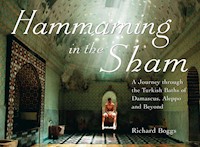
Legend has it that Damascus once had 365 hammams or 'Turkish baths': one for each day of the year. Originally part of an ancient Roman tradition, hammams were absorbed by Islam to such an extent that many became almost annexes to nearby mosques. For centuries, hammams were an integral part of community life, with some 50 hammams surviving in Damascus until the 1950s. Since then, however, with the onslaught of modernization programmes and home bathrooms, many have been demolished; fewer than 20 Damascene working hammams survive today. In "Hammaming in the Sham", Richard Boggs travels the length and breadth of modern Syria, documenting the traditions of bathing in Damascus, Aleppo and elsewhere, and his encounters with Syrians as they bathe. In his portrayal of life in the hammams he reveals how these ancient institutions cater for both body and soul, and through his conversations with the bathers within, he provides insights into the grass roots of contemporary Syrian society. Approximately 100 colour photographs accompany the text, portraying the traditional neighbourhoods of Damascus and Aleppo, and the almost religious feel of the hammams. The author's intimate portraits of the baths' employees and bathers show a unique side of Syria rarely exposed to the outside world.
Das E-Book können Sie in Legimi-Apps oder einer beliebigen App lesen, die das folgende Format unterstützen:
Veröffentlichungsjahr: 2012
Ähnliche



















Hammamingin theSham
A Journey through the Turkish Baths of Damascus, Aleppo and Beyond
Richard Boggs
HAMMAMING IN THE SHAMA Journey Through the Turkish Bathsof Damascus, Aleppo and Beyond
Published by Garnet Publishing Limited 8 Southern Court South Street Reading RG1 4QS UK
www.garnetpublishing.co.ukwww.twitter.com/ Garnetpubwww.facebook.com/Garnetpubwww.garnetpub.wordpress.com
Copyright © Richard Boggs, 2010
All rights reserved. No part of this book may be reproduced in any form or by any electronic or mechanical means, including information storage and retrieval systems, without permission in writing from the publisher, except by a reviewer who may quote brief passages in a review.
First Edition
ISBN-13: 978-1-85964-325-9
British Library Cataloguing-in-Publication Data A catalogue record for this book is available from the British Library
Typeset by Samantha BardenJacket design by David Rose
Printed and bound in Lebanon by International Press: [email protected]
To my father, and in memory of my mother
CONTENTS
ACKNOWLEDGEMENTS
GLOSSARY
INTRODUCTION
1 HAMMAMING IN BILAD AL-SHAM
2 CATHEDRALS OF THE FLESH
3 ALEPPO AND BEYOND
4 REVIVAL
EPILOGUE
INDEX
ACKNOWLEDGEMENTS
I would like to thank the managers and workers in the hammams of Syria for allowing me to enter their world.
Thanks also to Alan Cockburn, Laurence Bardout, Omar Berakdar and my sister Diane for reading the text. Any mistakes are my own!
My thanks to my brother Jonathan and his wife Karen for time by the sea in Cloughey.
Finally, I would like to thank Dan Nunn and Samantha Barden at Garnet. I wrote the text and took the photographs, but they have created this book.
GLOSSARY
The meaning of words given below is for how they are used in this text.
Ablaq
Banding of contrasting stone
Bab
Gateway, door or city gate
Badieh
The wilderness
Barakah
Blessing or spiritual power believed to reside in holy places and persons
Barrani
The first of the hammam’s three bathing rooms where temperatures are not very hot; the first main room of the hammam
Beit al-nar
The hot part of the floor in the jouwani over the heating duct
Bilad al-Sham
The region bordering the eastern Mediterranean that is roughly equivalent to the modern states of Syria and Lebanon and part of Palestine
Derwish
Sufi mystic; poor person
Finjan
A small cup with no handle, for coffee
Foul
Brown fava beans
Futa
A long piece of cloth like a light towel that is worn when bathing
Hadith
Saying attributed to the Prophet Mohammed
Hajj
The pilgrimage to Mecca
Halal
Lawful or permitted in Islamic law
Hamam
Variant spelling of hammam, used to refer to public baths in Turkey
Hammam
Public bathing house, often called a Turkish bath in English; rooms for bathing in a private house
Haram
Forbidden in Islam. Informally, you might show disapproval of someone’s actions by saying Haram!
Haramlek
The private family area of an Ottoman house
Hijama
A traditional kind of blood letting in which ‘bad blood’ is removed through the use of suction cups
Hijri
The Islamic calendar, the first year of which dates from the Prophet Mohammed’s migration from Mecca to Medina
Imam
The leader of a mosque’s congregation
Jelabiyah
A tunic-like garment that usually reaches the ankles
Jinn
Spirits believed by Muslims to have free will and to influence humanity
Jouwani
The hottest room in the hammam (apart from the steam room) where bathers sweat it out
Kibbeh
A traditional Syrian food of fried bulgur and minced beef
Leef
A circular sisal scrub that is used to clean the bather’s skin
Madrassah
School; school for religious studies
Maqqam
A shrine
Maqsurah
Smaller, more private room off the main rooms in a hammam
Maristan
A hospital (often attached to a mosque)
Mashrabiyah
Latticed window overlooking a street
Mi’allim
The manager, the one in charge
Minbar
Pulpit
Miraj
The Prophet Mohammed’s ascent into the heavens
Mukeyyis
The person whose job is to exfoliate the bather’s skin in the hammam
Muqarnas
Decoration that gives a ‘stalactite’ effect to a dome or entrance
Nargileh
Pipe for smoking, the smoke being cooled through water
Naoura
Water wheel used to raise water from a river
Ramadan
The Islamic month of fasting
Sebil
A drinking fountain
Selamlek
The public quarters of an Ottoman home
Shebab
Youths; the lads
Sheikh
An elderly leader of the community
Silsileh
Chain
Sirwal
Loose-fitting trousers traditionally worn in the Arab world
Suq
Market; market place
Tasai
Bowl used for pouring water over the body when washing
Wall
A saintly person; governor
Waqf
Endowment or trust
Wasta
Someone who acts as an intermediary
Wastani
The moderately warm room in the hammam which connects the barrani with the jouwani
Ziyarah
Pilgrimage to, or worshipping at, a holy person’s tomb or holy site
INTRODUCTION
The Ecclesiastical History of Socrates talks of Bishop Sisinnios, who ‘was accustomed to indulge himself by wearing smart new garments, and by bathing twice a day in the public baths. When someone asked him why he, a bishop, bathed himself twice a day, he replied: “Because you do not give me time for a third.’”William Dalrymple1
WITH THE FIRST LIEUTENANT
It was in a restaurant in Damascus that I announced my intention. I would often go to eat with the first lieutenant when he had officially finished his duties, and we would dip together into the usual dishes of foul beans and hummus as the waiters served us with affable ease.
Despite his position, the lieutenant had a mischievous approach to life, and we sometimes discussed topics that were not normally broached in Syria. (I never knew whether his work extended into the evenings when we ate out or drank arak together on the balcony of my flat, or whether it was just his enquiring mind that led the lieutenant to seek out the company of foreigners.)
Eventually I confided in the first lieutenant my project. But the announcement wasn’t met with the lieutenant’s usual laughter (like when he raised his glass of arak on the balcony and called out an irreverent toast). Indeed, on hearing my plans the lieutenant was genuinely shocked:
– You can’t do that! You must have permission!
I would write a book about the hammams of Syria, recording their traditions even as they disappeared. Strangely enough, although he disapproved of the project, and knew some things about hammams, the first lieutenant had never actually been to one. His explanation for this was clear enough:
– We are a simple people in Lattakia, and we bathe in the sea.
I laughed it off, the first lieutenant’s disapproval, for this was where our outlooks would never match. I was a man with a mission, but not the kind of assignment that most foreigners are suspected of entertaining in this region of the world. Like in that film The Swimmer where Burt Lancaster strips bare and dives into American society, crossing swimming pool after suburban pool across Connecticut, so, with only a towel wrapped around my waist (a waist that is somewhat expanding with Syrian cuisine and middle age), and with a bar of Aleppo soap scented of bay and myrtle in my hand, I would hammam my way across Syria, from Damascus right up to Aleppo, if not beyond.
NOTES
1 Dalrymple, William, From the Holy Mountain (Harper Collins, 1997), p. 37.
1HAMMAMING IN BILAD AL-SHAM
‘The hamam, after all, was an Islamic interpretation of the Roman bath.’1
A HISTORY LESSON IN A HAMMAM
Damascus is not without its history.
In the mountains above Damascus Cain is said to have killed Abel, the very mountainside opening in horror at the deed. But then Adam himself is said to have been formed from the clay of the River Barada2 that rises in the snowy mountains of the ante-Lebanon and waters the desert plain, creating a green girdle of orchards around the city, ‘like a halo around the moon’.
If you climb up the illegal settlements above the Friday Market you can still visit the shrine on Mount Qassioun that marks the first spilling of human blood. The guide to the shrine will genially point out where a hand is imprinted in the rock, with the word ‘Allah’ in the rock alongside it, above where the rock surface is dabbed with a splash of red paint, just for effect. Fashionable young women cover themselves and earnestly pray at the shrine, or light a candle perhaps, for in Syria such holy places are often common to both Christians and Muslims.
From the mountaintop Damascus can be seen spreading out in the oasis below, the dull brown of the city shaped like a comet’s tail3 in the surrounding vegetation, before the greenness yields to desert. From the line of cafés cut across the mountain, parts of the city are quite distinct below: the jumble of flat roofs of those who have just settled beneath; the cupolas of the line of mosques and tombs that is Salihiye; the boulevard of Abu Roumaneh stretching through the posh suburbs where I taught. Through the haze you might just make out the maze of alleys that is the old city, and even the minarets and dome of the Umayyad Mosque, the landmark towards which everything is orientated.
My interest, however, lies not so much in the mosque as in the hammams near its doors. Two of the best hammams in Syria are just outside the walls of the Umayyad Mosque, and in one of these, Hammam al-Malek al-Zaher, I had perhaps my simplest lesson in Syrian history.
The hammam is named after the Mamluk sovereign who drove the Crusaders out of Syria, but in fact predates al-Malek al-Zaher’s rule, for the baths were once part of a tenth-century house. One corner of the hammam has a Roman pillar incorporated into its structure, no doubt borrowed from the site of the nearby temple and, maybe a millennium later, still not returned.
The Umayyad Mosque in Damascus
I knew the hammam from the days when it was plastered over in tiles of dubious effect. If the beauty of the east is veiled, hidden so that it is not exposed to the public eye, this has certainly been true of the hammams of Syria: hammams going back seven or eight hundred years have been covered in the kind of tiles that might have graced your auntie’s bathroom in the 1970s.
As I crossed the hammam one day in my wooden clogs (clogs are the traditional footwear of the hammam, to avoid contact with the impurities of another’s bath water) I had my usual banter with the attendants:
– Ya, Irlandi! I called to one of the workers.
He laughed, and one of the other attendants joined in:
– And why do you call him Irish?
– Well, look at his red hair!
– And what would you call me?
– You? You’re absolutely Damascene.
– Not me! I’m Caucasian.
And indeed, although the country is officially called the Syrian Arab Republic, there is a wealth of non-Arab minorities within its borders. On closer examination the attendant’s looks did support his claim.
– I’m Caucasian. My family were from Turkey.
My geography of the region wasn’t good enough to challenge the equation of the Caucasus with Turkey, but I concurred:
– Ah! Like the hammam itself! We are after all in a Turkish bath.
At this point I was most decidely corrected by the ‘Caucasian’ attendant:
– Not at all. This bath isn’t Turkish; it’s Roman.
And here there is a linguistic problem, for the word used in Arabic for the public baths – hammam – can most easily be translated into English as ‘Turkish bath’, a term which is probably inappropriate for the hammams I explore, and a phrase this attendant objected to. I conceded:
– Okay. It’s not Turkish. It’s probably Mamluk.
We were standing in a hammam named after a great Mamluk leader, and the Mamluks were, after the Romans, bathers sans pareil. The attendant, however, would not compromise:
– No, the hammam is Roman. Even this arch in front of you is Roman.
I wasn’t convinced by the arch, for the interiors of hammams are often much modified, and this hammam underwent a makeover or two even during my time in Syria. I had to admit, however, that the other great hammam just down the way, Hammam Silsileh, did advertise itself as a ‘Roman Bath’. But here in Hammam al-Malek al-Zaher, as we stood by the stacks of green Aleppan soap made from laurel and olives, and the piled circles of saisal with which the next bathers would scrub themselves down in their communal wash, I received the simplest explanation of the development of the hammams in Syria.
The attendant gave me my history lesson in colloquial Arabic, for if he had little classical Arabic, I had none:
– Here we are just by the Umayyad Mosque. The mosque was once the Roman Temple of Jupiter.
I agreed with the obvious. And before it had been Jupiter’s it had been a site of worship for Haddad, an Aramean god. Haddad had not so much been ousted in a religious coup as absorbed into the civilisation which followed, just as in Lebanon the Virgin Mary has been absorbed into traditions of Rome’s Diana, and has been traditionally pictured with the moon beneath her feet.4
The attendant went on:
– So the Romans would have bathed here before going to the Temple.
I concurred:
– And the hammam is built according to the classic Roman structure of three rooms. And after the Romans came the Christians. And they made the temple into a church.
– Okay.
– And they would have bathed before they went to church.
– Maybe.
The Umayyad Mosque
(I had my doubts about this one, for there were people who claimed that those who were baptised in Christ had no need of further washing.)
– And after Christianity came Islam.
– And Muslims bathe here in this hammam before Friday prayers.
It all made sense: civilisation after civilisation had taken the city, adapting the site that was once a temple to the god Haddad for their religious needs. But the conquerors must have claimed not just the holy site but the neighbouring hammams, for some kind of ritual cleansing is generally part and parcel of religious duties.
I doubted whether this hammam had ever been Roman, although archaeologists are excavating a Roman hammam at the Umayyad Mosque’s south gate. But the first principle of hammaming was clear: Syria’s hammaming traditions were inherited from the Romans.
APHAMEA
A friend had told me of a hammam in Aphamea, the ruins of a city of the Seleucid Empire, famed for the cavalry horses bred among its rich pastures.5 My stated goal was the hammam, but who could come to Syria and not visit Aphamea? Antony and Cleopatra had once passed through its colonnades.
In pursuit of this hammam, I got off the bus after the Arab castle of Shayzar, beyond which the Orontes River flows by ancient water wheels. An unhurried throng of motorbikes at an intersection was functioning as a taxi fleet. Soon I was passing through rolling countryside with Mohammed, not unhandsome in the red-checked keffiyeh wrapped around his head à la Arafat. The great plain of the Orontes below us was all neatly cultivated squares, and I savoured a landscape of cornfields and olives.
We drove through wheat fields that seemed to stretch as far as the distant haze of the Ansariye Mountains, until at a T-junction two men in seriously grey suits stopped us. They seemed a little out of place in the cornfields around us; guarding an embassy in Damascus might have been more their milieu. They asked Mohammed where he was taking me. Surely we weren’t trying to avoid the ticket office?
The ruins of the hammam in Aphamea
They seemed to know Mohammed, and I relaxed a bit. I could even buy a ticket at the Syrian not the foreigners’ rate, they suggested. Or even better, why didn’t we enter the ruins by the far side and avoid the ticket office altogether? Or, best of all (and here, for some reason, there was a bit of a chuckle), Mohammed himself could take me directly to the hammam! I must admit I was a little surprised to think of the hammam as still functioning – it must have been some kind of natural spring that the locals still used. And so we set off again over the gentle undulations, a breeze almost caressing us through the wheat as we travelled.
Suddenly the colonnades of Aphamea rose up from among the corn. That is all there was: two clean lines of limestone colonnades stretching for a mile above the swirling patterns of corn, with the harvesters making their way through the wheat.
True to his promise, Mohammed avoided the golden splendour of the pillars and took me directly to the hammam. The locals certainly were not bathing, for here there was neither fountain nor pool; my destination was a dried-out ruin part way along the colonnade. Two fairly spacious rooms formed the ruined Roman hammam: a curved inner room that sported a fig tree growing out of the rubble, and another room with a central arch that framed part of the colonnade. I had to admit that although the hammam itself was a bit of a let-down, it had a prime site by the cardo maximus and one of the best views in Syria.
After Mohammed and I had argued over the fare, for he had refused to let me pay anything, my driver disappeared, and a local ‘guide’ arrived, offering both information (‘the colonnade has 1,200 columns…’) and local antiquities. The antique coins offered – one Byzantine, one from the time of Queen Zenobia in Palmyra, and one ‘Arab’ – were rather tempting, and they could have been bought with an easy conscience, for they had probably just been manufactured up the road in Homs.
When the guide went off, I sat in the shade of the votive column near the baths. The fields were half-harvested, the reapers were resting in the shade of a lorry, and sheep were munching as gleaners among the stubble. My only companions were now the birds: kites flew overhead, swallows chirped among imperial glory, and an owl perched on the colonnade looked down on everything, even though it was midday. Where else in the world could you arrive at such a site and be the only visitor?
I sat in the stillness of the afternoon and read from a book of poems that I had picked up in a tired old Mamluk hammam in Homs that functioned not just as a place for the poor to wash, but as a second-hand bookshop for undergraduates. A hammam in Homs might seem a rather unlikely place to buy the Penguin Book of English Verse, but there has been an interesting relationship between books and hammams. Wasn’t a library an essential part of the Roman hammam? Bathers may once have reclined to read in the hammam I had just visited.
The corn grew right up to the columns, and spilled onto the paving stones where the ruts made by the cartwheels of travellers on their way to Antioch maybe two millennia ago could still be seen. I settled down to some pre-Elizabethan poetry:
They flee from me that sometime did me seek
With naked fote stalking within my chamber.
This is how it would be at almost any site I visited in Syria. In the oasis city of Palmyra, below the towers of the dead, I found hammam ruins scattered by the desert colonnade. At Serjilla, one of the many ‘Dead Cities’ between Hama and Aleppo, the hammam was so grand I at first mistook it for a Byzantine church. This civilisation – once rich in olives and wine and wheat –had fallen into stony oblivion, perhaps as the Byzantines and Umayyads fought it out. The hammam, however, survives as the greatest monument of town life; bathing was civilisation.
The entrance to the hammam in the ruins of Serjilla
A ROMANTRADITION
It is perhaps in Bosra that the Roman baths of Syria are most evident, but even in the Ismaili town of Selamiyah the Roman origins of its hammam are evident. It wasn’t really by design that I went to Bosra; on my way to Dera’a (where T. E. Lawrence lived out his fantasies with the Turks) a Palestinian passenger on the bus invited me to visit Bosra instead. It is a foolish traveller who doesn’t forgo the set itinerary in response to a spontaneous invitation, and I accepted.
Sunlight pours through the roof of the hammam in Selamiyah
After travelling through barren, basalt landscapes, I found myself taking in the ruins of Bosra’s South Baths, a massive structure with a columned porch, as impressive as Bosra’s Byzantine cathedral to the east. Through the porch was a domed vestibule where the bather would have undressed in spacious splendour. The hammam’s architecture reflected the stages through which the bather would have progressed. The vestibule led to the cold room, which in turn led to the warm room, which had a hot room on either side where bathers would have sweated it out.
The South Baths in Bosra
Hammam Manjak in Bosra
A cross in a stone in the wall in Hammam Manjak
But the South Baths is not the only hammam in Bosra. Opposite the Mosque of the Caliph Omar I found Hammam Manjak. This hammam is not Roman but was constructed in the fourteenth century by those great builders of hammams, the Mamluks. Although it does not have the T-shape of Bosra’s Roman hammam, the Mamluk hammam essentially mirrors the Roman hammam’s structure.
Built opposite a mosque rather than near a temple, (a mosque with Byzantine pillars absorbed into its walls), its entrance rooms led to a reception room where a raised pool filled the central floor. From here a corridor led to the hammam proper. But I had problems checking the hammam within; the building was locked. One of the great travel quests in the Arab world is to find the man with the key to the public monument, but I jumped up on to one of the walls to view the maze of piped cubicles beneath.
Here pilgrims who had left Damascus to travel to Mecca on the hajj would have cleansed themselves before setting out again on their desert crossing. Clearly the Mamluks were into recycling, for stones with crosses from some nearby church and symbols that were precursors of the swastika from a place of worship were incorporated into the walls of the hammam’s outer rooms.
Bosra had appeal: the ruins were not just at the heart of a community, but incorporated into the homes, the stones of the great monuments having been carried off to build the local houses. (It is the same all over Syria: the citadel in Aleppo was stripped of the casing that covered its slopes to furnish the buildings beneath, just as in Cairo the limestone that once covered the pyramids was recycled to furnish the mosques.)
Near the local bakery citizens set circles of unleavened bread to cool on the remains of ancient pillars. That for me was the charm of the place: these were living ruins – and I had the place to myself. But unfortunately, in order to conform to the perceived tastes of Westerners doing tours of the Levant, many of the local people had been moved out of their homes and their basalt-built houses were now blocked up. Sanitisation in the name of tourism – the authentic local culture replaced with something artificial – was already underway.
In terms of size, Bosra’s Roman hammam could have competed with the local Byzantine cathedral, but not with its amphitheatre. I thought of the Swiss explorer John Lewis Burckhardt, who had travelled through the basalt landscapes of the Houran two centuries earlier, but missed Bosra’s greatest monument: one of the biggest amphitheatres outside Rome then lay beneath the sands. Further down the road in what is now Jordan, Burckhardt did receive his consolation prize; pursuing rumours of a hidden city, he stumbled across Petra and its Nabatean sepulchres, the mountains carved out to house the dead in monumental splendour.
I could live with Bosra without its amphitheatre, for I never felt that Syria for me should be a reverent perusal of historical sites. When I think back on Bosra it is not just its basalt monuments that I remember; there was the Palestinian home with its begonias in pots and Islamic texts and photographs of the brothers on the walls and a supper of cheese and olives. In the evening, my host’s brother, a student at the technical school, sat next to me in his khakis, his arm slung over my shoulder. Even when travelling there is no escape from the role of English teacher, and I was given his course book to explain:
The good tradesman always takes a pride in his work… Even when his boss is absent he continues to work, for it is his work that he loves…
It was further along that bleak basalt landscape, in the Druze area near Suweida, that I sat with friends by the ruins of a Byzantine church with vine leaves carved on its entrance, and sarcophagi scattered in its depths. In vain we scanned the landscape for the grove of oaks mentioned in the guide book. Finally we realized that the grove that evaded us was in fact the single surviving oak right above our heads.
I suppose that was the day that put Roman pillars and Byzantine ruins in perspective for me. In that basalt plateau of the Druze there is hardly a roundabout or a garden wall that doesn’t exhibit a sculpted lion or a Roman pillar, or some unread Greek inscription across the lintel of a doorway.
Syria for me was not going to be a diligent exploration of dead ruins. I would study a more living architecture – the hammams, and the world that they contained.
A TRADITION ABSORBED
At the end of the eighteenth century two British doctors living in Aleppo wrote their Natural History of Aleppo. (A European presence in Aleppo was nothing new, for there had been a Venetian consulate in the Coppersmiths’ Khan opposite a hammam in the suq since the days of Shakespeare.)
True to the spirit of the Enlightenment, and precursing Napoleon’s documenting of Egyptian life, the doctors took out their thermometers and recorded not the fevers of their patients but the temperatures of a hammam in Aleppo, moving from room to room:
In the month of February, when the mercury in Farhenheit’s thermometer stood at fifty-four, in the open air, it rose in the burany to sixty-four… From this chamber a door opens into a narrow passage, leading to the wustany or middle chamber… The thermometer in the passage rose to seventy-five, and in this chamber to ninety. From the middle chamber a door opens immediately into the inner chamber, or juany, which is much larger than the wustany, and considerably hotter, the mercury rising here to one hundred.6
What the Russells were documenting was the quintessential structure of the Roman hammam, reflected in the South Baths I had seen in Bosra. The first Islamic baths would have been modelled on the Roman structure, with the three-room composition typical of a Roman bath (frigidarium, tepidarium and calidarium) imitated in the Islamic bath. Bathing involved three rooms, with temperatures coolish in the barrani, moderately warm in the wastani (the room which connects the outer and inner rooms) and intensely hot in the jouwani, where the bather would have really sweated it out. In addition, hammams developed a spacious dressing room where bathers would undress and later relax after their hammam. It seemed to my amateur eye, however (scholars of Islamic architecture might see things differently!), that in many hammams the barrani and dressing room were one and the same.
What has changed in the structure of hammams since Mark Antony gave Syria to Cleopatra as a wedding gift, is the heating system. The Romans had a system beneath the floors of raised pillars through which heat circulated. Right in the centre of Beirut the Roman hammam system can still be seen, and at Umm Quais in the far north of Jordan, with the Sea of Galilee a haze in the distance, I came across the heating system of a Roman hammam which still retained its essential components. In Syria, however, a system evolved in which heat and smoke from a furnace passed along a duct under the floor of the jouwani to a chimney.7 Nowadays though it is steam from diesel boilers that heats the hammams.
The Arabs absorbed the Roman hammam structure, but renamed the rooms. It’s simple: the outer room, the coolest, is called the barrani. The middle room, with a moderate heat, is called the wastani. The innermost room – the hottest where you experience the hammam proper – is called the jouwani. These three words for the main rooms of the hammam – barrani, wastani and jouwani – are the essential Arabic for this book.
The aesthetics of each room can be quite different. Surprisingly, one of the most beautiful Ottoman hammams in Syria can be found in the heart of the fairly characterless city of Homs; even the great documenter of Syrian monuments, Ross Burns, found little of interest in this ‘rather drab city’.8 The Ottoman hammam in the suq however is a wonder. The first room where you undress on raised platforms is not unlike the interior of a Methodist chapel with a rickety balcony. The wastani rooms connect to the innermost hammam – these are spacious and moderately cool and are really just a transitional area where you might change out of your wet towel beneath exquisite roofs or wash alone in moderate warmth. The jouwani, the hottest room, is the most atmospheric with its algaed walls and daylight sifting through lingering steam.
The heating system at the Roman hammam in Umm Quais
The barrani, or dressing room, at Hammam Othmania in Homs
Since the Russells documented Aleppan life, many hammaming traditions have survived, but the number of bathers has certainly decreased. And I suspect that if the Russells were alive today their thermometers might not record quite the same temperatures; with the price of heating oil nowadays some hammams no longer maintain their intense heat.
The wastani dome at Hammam Othmania
The atmosphere too will have changed; the candles or oil lamps that would have lit the hammams from some niche in the wall have been replaced by the harsh glare of fluorescent lights. Who could document the Arab love affair with the fluorescent tube, not to mention the loudspeaker! With one flick of a switch the dreamy afternoon light in the hammam is shattered, and the fluorescent tubes hanging like a trapeze artist’s bars from the dome fix all and sundry with their unforgiving glare.
The jouwani at Hammam Othmania in Homs
Fluorescent tubes in Hammam al Naem, Allepo




