


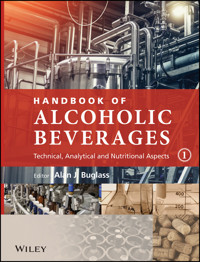
Handbook of Alcoholic Beverages E-Book
329,99 €
Mehr erfahren.
- Herausgeber: John Wiley & Sons
- Kategorie: Fachliteratur
- Sprache: Englisch
HANDBOOK OF ALCOHOLIC BEVERAGES
A comprehensive two-volume set that describes the science and technology involved in the production and analysis of alcoholic beverages
HANDBOOK OF ALCOHOLIC BEVERAGES
Technical, Analytical and Nutritional Aspects
At the heart of all alcoholic beverages is the process of fermentation, particularly alcoholic fermentation, whereby sugars are converted to ethanol and many other minor products. The Handbook of Alcoholic Beverages tracks the major fermentation process, and the major chemical, physical and technical processes that accompany the production of the world’s most familiar alcoholic drinks. Indigenous beverages and small-scale production are also covered to a significant extent.
The overall approach is multidisciplinary, reflecting the true nature of the subject. Thus, aspects of biochemistry, biology (including microbiology), chemistry, health science, nutrition, physics and technology are all necessarily involved, but the emphasis is on chemistry in many areas of the book. Emphasis is also on more recent developments and innovations, but there is sufficient background for less experienced readers. The approach is unified, in that although different beverages are dealt with in different chapters, there is extensive cross-referencing and comparison between the subjects of each chapter.
Appropriate for food professionals working in the development and manufacture of alcohol-based drinks, as well as academic and industrial researchers involved in the development of testing methods for the analysis and regulation of alcohol in the drinks industry.
Divided into five parts, this comprehensive two-volume work presents:
- INTRODUCTION, BACKGROUND AND HISTORY: a simple introduction to the history and development of alcohol and some recent trends and developments.
- FERMENTED BEVERAGES: BEERS, CIDERS, WINES AND RELATED DRINKS: the latest innovations and aspects of the different fermentation processes used in beer, wine, cider, liqueur wines, fruit wines, low-alcohol and related beverages.
- SPIRITS: covers distillation methods and stills used in the production of whisky, cereal- and cane-based spirits, brandy, fruit spirits and liqueurs.
- ANALYTICAL METHODS: covering the monitoring of processes in the production of alcoholic beverages, as well as sample preparation, chromatographic, spectroscopic, electrochemical, physical, sensory and organoleptic methods of analysis.
- NUTRITION AND HEALTH ASPECTS RELATING TO ALCOHOLIC BEVERAGES: includes a discussion on nutritional aspects, both macro- and micro-nutrients, of alcoholic beverages, their ingestion, absorption and catabolism, the health consequences of alcohol, and details of the additives and residues within the various beverages and their raw materials.
Sie lesen das E-Book in den Legimi-Apps auf:
Seitenzahl: 3167
Veröffentlichungsjahr: 2011
Ähnliche




















Contents
Cover
Cover
Title Page
Copyright
List of Contributors
General Acknowledgements and Thanks
Title Page
Copyright
List of Contributors
General Acknowledgements and Thanks
VOLUME 1
Part 1: Introduction, Background and History
1.1: Alcoholic Beverages of the World: An Introduction to the Contents of This Book
1.2: History and Development of Alcoholic Beverages
1.2.1 The Beginnings (From the earliest Times to ca. 1100 AD)
1.2.2 Medieval Times and Beyond (ca. 1100–1750)
1.2.3 The Industrial Revolution and the Influences of Science and Technology (ca. 1750–1900)
1.2.4 Modern Times and Newer Processes (ca. 1900–Present Day)
1.2.5 The Development of Analytical Methods
1.3: Some Recent Trends and Developments
1.3.1 Overview
1.3.2 Big is Beautiful: Multinational Companies and the Globalization of Alcoholic Beverages
1.3.3 Small is Beautiful: The Growth in Microbreweries and Craft Breweries and the Localization of Products
1.3.4 Revival of Traditional Beer Styles
1.3.5 Changes in Beer Drinking Habits
1.3.6 Global Growth in Wine Drinking
1.3.7 Development of New Wine Industries
1.3.8 Revival of Cider and Perry: the Magic of Ice
1.3.9 The Rise of Flavored Alcoholic Beverages (‘Alcopops’)
1.3.10 Calorie-Counting and Health Perception of Alcoholic Drinks
1.3.11 Binge Drinking
1.3.12 Organic and Biodynamic Production of Alcoholic Beverages
1.3.13 Use of Genetically Modified (GM) Crops and Microorganisms
Part 2: Fermented Beverages: Beers, Ciders, Wines and Related Drinks
2.1: Introduction: Overview of Fermentation and Microorganisms
2.1.1 Yeasts
2.1.2 Lactic Acid Bacteria
2.1.3 Molds and Spoilage Organisms
2.2: Alcoholic Fermentation
2.2.1 Introduction
2.2.2 Physiology and Morphology of Yeast
2.2.3 Nutritional Requirements of Yeast
2.2.4 The Use of Naturally Occurring (‘Wild’) Yeasts in Fermentations
2.2.5 The Killer Factor
2.2.6 The Use of Selected (Cultured) Yeast Strains
2.2.7 Fermentation Vessels
2.2.8 The Growth of a Yeast Population
2.2.9 An Overview of Alcoholic Fermentation
2.2.10 Flocculation
2.2.11 Aroma Compounds and Fermentation
2.3: Malolactic Fermentation
2.3.1 Introduction
2.3.2 Malolactic Bacteria: Morphology and Physiology
2.3.3 Identification of Malolactic Bacteria
2.3.4 Factors Affecting the Growth of Malolactic Bacteria
2.3.5 Interactions Between Bacteria and Other Organisms
2.3.6 Spontaneous Malolactic Fermentation
2.3.7 Inoculation with MLB Starter Culture
2.3.8 The Growth of Bacterial Populations
2.3.9 The Malolactic Fermentation Process
2.3.10 Production of Diacetyl
2.3.11 Microbial Stability
2.3.12 Monitoring Malolactic Fermentation
2.3.13 Finishing and/or Preventing Malolactic Fermentation
2.3.14 Production of Biogenic Amines by Malolactic Bacteria
2.3.15 Other Effects of MLF
2.3.16 Malolactic Fermentation and Aroma
2.3.17 Lactic Spoilage
2.4: Acetic and Other Fermentations
2.4.1 Introduction
2.4.2 Acetic Acid Bacteria
2.4.3 Lactic Acid Bacteria
2.4.4 The Activities of Yeasts other than Saccharomyces
2.4.5 Film Forming Yeasts
2.4.6 Molds
2.4.7 Prevention of Spoilage
2.5: Preservatives Used in the Production of Alcoholic Beverages
2.5.1 Introduction
2.5.2 Sulfur Dioxide (SO2)
2.5.3 The Roles of SO2
2.5.4 Sorbic Acid
2.5.5 DMDC (Velcorin)
2.5.6 Ascorbic Acid (Vitamin C)
2.5.7 Pimaricin (Natamycin)
2.5.8 Other Preservatives
2.6: Beer
2.6.1 The Basic Brewing Processes
2.6.2 Malting and Mashing
2.6.3 Boiling the Wort
2.6.4 Fermentation
2.6.5 Top Fermentation
2.6.6 Bottom Fermentation
2.6.7 Other Fermentations
2.6.8 Modern Methods of Fermentation
2.6.9 Beer Treatment: Fining, Filtration and Pasteurization
2.6.10 Packaging of Beer: Casking, Kegging, Bottling and Canning
2.6.11 Dispensing of Draught Beers
2.6.12 Oxidation and the Staling of Beer
2.6.13 Beer styles
2.7: Cereal-based and Other Fermented Drinks of Asia, Africa and Central/South America
2.7.1 The Rice ‘Wines’ of Asia
2.7.2 Native Fermented Drinks of Africa and South America
2.8: Cider and Perry
2.8.1 Introduction
2.8.2 The Basic Ingredients
2.8.3 Harvesting, Crushing and Pressing
2.8.4 Fermentation and Maturation
2.8.5 Traditional and Small-Scale Cider and Perry Production: Fermentation and Beyond
2.8.6 Large-Scale (Factory) Production of Cider and Perry: Fermentation and Beyond
2.8.7 Newer Techniques, Recent Developments and Innovations
2.8.8 Cider and Perry from Around the World
2.9: Wine
2.9.1 White Winemaking
2.9.2 Red Wine Production
2.9.3 Sparkling Wines
2.9.4 Fining, Filtration and Clarification
2.9.5 Wine Maturation and Ageing
2.9.6 Some Current Trends in Wine Production
2.10: Fortified Wines and Liqueur Wines
2.10.1 Overview and Scope
2.10.2 Sherry and Other Flor Wines
2.10.3 Flor and Oxidation in Sherry Wines
2.10.4 Other Flor Wines
2.10.5 Madeira
2.10.6 Estufagem and Cask Maturation of Madeira Wine
2.10.7 Port
2.10.8 Marsala and Málaga
2.10.9 Vins Doux Naturels, Liqueur Muscat and Similar Wines
2.10.10 Vins de Liqueurs and Similar Beverages
2.11: Fruit Wines and Other Nongrape Wines
2.11.1 Overview and Scope
2.11.2 Comparison of Fruit for Winemaking
2.11.3 Making Fruit Wines
2.11.4 Country Wine Styles
2.11.5 Mead
2.12: Aromatized Wines
2.12.1 Introduction and Brief History of Aromatization of Wine
2.12.2 Vermouth
2.12.3 Other Aromatized Wines and Apéritifs
2.13: Low Alcohol and Non-Alcoholic Beers, Ciders and Wines
2.13.1 Overview
2.13.2 Production of Low Alcohol Beverages by Limited or Checked Alcohol Methods
2.13.3 Dealcoholization Methods
Part 3: Distilled Spirits
3.1: Introduction: Distillation Methods and Stills
3.1.1 A Brief History and Theory of Distillation
3.1.2 Batch Distillation
3.1.3 Continuous Column Distillation
3.2: Scotch Whisky
3.2.1 Introduction and Brief History
3.2.2 The Raw Materials
3.2.3 Malting, Mashing, Cooking and Fermentation
3.2.4 Distillation
3.2.5 Maturation, Blending and Other Postdistillation Processes
3.2.6 The Flavor and Styles of Scotch Malt Whiskies
3.3: Whiskeys
3.3.1 Scope
3.3.2 Irish Whiskey
3.3.3 The Whiskeys of America
3.3.4 Bourbon and Tennessee Whiskey
3.3.5 American Rye and Corn Whiskies
3.3.6 Whiskies from Other Countries
3.4: Other Cereal Based Spirits
3.4.1 Introduction and Scope
3.4.2 Gin and Similar Juniper Flavored Spirits
3.4.3 Akvavit (Aquavit) and Vodka
3.4.4 Asian Grain Spirits
3.5: Cane Spirits, Vegetable Based Spirits and Aniseed Flavored Spirits
3.5.1 Overview and Scope
3.5.2 History and Basic Description of Rum and Cachaça
3.5.3 Fermentation and Distillation Practices in the Production of Cachaça and Rum
3.5.4 Flavor Characteristics of Rum and Cachaça
3.5.5 Arrack, Mezcal and Tequila
3.5.6 Aniseed Flavored Spirits
3.6: Brandy
3.6.1 Introduction and Brief History
3.6.2 Cognac
3.6.3 Armagnac
3.6.4 Other Brandies
3.6.5 Quality Control in Brandy Production
3.6.6 Evaluating Brandy
3.7: Grape and Other Pomace Spirits
3.7.1 Introduction
3.7.2 Production of Pomace Spirits
3.7.3 Types of Pomace Spirits and Sensory Characteristics
3.8: Fruit Spirits
3.8.1 Introduction
3.8.2 Apple and Pear Spirits
3.8.3 Fruit Spirits of Central Europe
3.8.4 Plum Spirits of Eastern Europe
3.8.5 Other Fruit Spirits
3.9: Liqueurs and Their Flavorings
3.9.1 Introduction and Scope
3.9.2 Fruit and Fruit Flavored Liqueurs
3.9.3 Flower, Herb, Spice and Bitter Liqueurs
3.9.4 Cocoa, Coffee and Tea Liqueurs
3.9.5 Nut and Emulsion Liqueurs
3.9.6 Production and Use of Essences and Concentrates
VOLUME 2
Part 4: Analytical Methods
4.1: Introduction
4.1.1 Why Analyze Alcoholic Beverages? An Overview of the Need for Analysis
4.1.2 Process Monitoring
4.1.3 Identification of Origin, Determination of Authenticity and Detection of Fraud
4.1.4 Determination and Characterization of Beverage Components and Processes
4.1.5 Development of New Analytical Methods
4.2: Extraction and Focusing Methods in Sample Preparation
4.2.1 Overview
4.2.2 Liquid Extraction Techniques
4.2.3 Distillation Methods
4.2.4 Solid Phase Extraction and Related Methods (Sorption Techniques)
4.2.5 Headspace Methods
4.2.6 Combinations of Methods (With Particular Application to Enological Products)
4.2.7 Summary
4.3: Chromatographic Methods
4.3.1 Thin Layer Chromatography and Related Methods
4.3.2 Capillary Gas Chromatography
4.3.3 Liquid Chromatography
4.3.4 Counter Current Chromatographic Methods
4.4: Spectroscopic Methods
4.4.1 Nuclear Magnetic Resonance
4.4.2 Infrared Spectroscopy
4.4.3 Colorimetry, UV-Visible Spectroscopy and Fluorometry
4.4.4 Atomic Absorption and Emission Spectroscopy
4.4.5 Mass Spectrometry
4.5: Electrochemical Methods
4.5.1 Potentiometric Methods
4.5.2 Voltammetric Methods
4.5.3 Electrochemical Sensors
4.6: Other Methods
4.6.1 Electrophoretic Techniques
4.6.2 Flow Injection Techniques
4.6.3 Chemical and Physical Methods
4.7: Sensory Analysis
4.7.1 Introduction
4.7.2 Olfaction and Taste
4.7.3 Odor Theshold, Odor Activity and Low Impact Odorants
4.7.4 Sensory Tests
Part 5: Nutritional and Health Aspects
5.1: General Introduction
5.1.1 ‘Alcohol’ in Perspective
5.1.2 The Extent and General Implications of Alcoholic Beverage Consumption
5.1.3 Ingredients, Processing and the Nutrient Content of Alcoholic Beverages
5.1.4 Nutritional Considerations
5.1.5 Summary
5.2: Factors Influencing the Nutrient Content of Alcoholic Beverages
5.2.1 Wines
5.2.2 Beers
5.2.3 Cider and Perry
5.2.4 Distilled Beverages
5.2.5 Fortified wines
5.2.6 Alcopops
5.2.7 Cocktails
5.3: Macronutrient Content of Alcoholic Beverages
5.3.1 Water
5.3.2 Alcohol
5.3.3 Carbohydrates (Including Fiber)
5.3.4 Nitrogenous Compounds: Proteins, Peptides, Amino Acids, Amines and Nucleotides
5.4: Micronutrient Content of Alcoholic Beverages
5.3.5 Lipids
5.4.1 Vitamins
5.4.2 Electrolytes and Functional Elements (Minerals and Trace Elements)
5.4.3 Phytochemicals
5.5: Alcohol Ingestion, Absorption and Catabolism: Metabolic and Nutritional Consequences
5.5.1 Alcohol Catabolism
5.5.2 Methanol Catabolism
5.5.3 Effects of Alcohol on Intake of Foods and Energy
5.5.4 Consequences for Intermediary Metabolism of Alcohol Catabolism
5.5.5 Effects of Alcohol and its Metabolites on Absorption, Metabolism and Utilization of Key Nutrients
5.6: Health Consequences of Alcohol Intake
5.6.1 Overview: Alcoholic Beverages and Society
5.6.2 Harmful Effects of Excessive Alcohol Intake
5.6.3 Possible Benefits of Low to Moderate Consumption of Alcoholic Beverages
5.6.4 Conclusion
5.7: Carbohydrates in Alcoholic Beverages and Health
5.7.1 Metabolizable Carbohydrate
5.7.2 Low Carbohydrate Beers
5.7.3 High Carbohydrate Beers
5.7.4 Nonmetabolizable Carbohydrate
5.8: Antioxidant Value of Alcoholic Beverages
5.8.1 Overview
5.8.2 Summary of Aerobic Cell Metabolic Processes
5.8.3 Short Review of Oxygen in Cell Metabolic Processes
5.8.4 Incomplete Reduction of Oxygen, the Formation of Reactive Oxygen Species and Cell Damage
5.8.5 Natural Antioxidants in Food
5.8.6 Phenolic Substances in Alcoholic Beverages
5.8.7 Some Chemical Characteristics of Phenolic Compounds
5.8.8 Health Benefits and Antioxidant Potency of Alcoholic Beverages, their Phenolic Extracts and their Individual Phenolic Components
5.8.9 Mechanisms of In Vivo Health Benefits of Dietary Phenols: Antioxidants or Otherwise?
5.9: Additives in Alcoholic Beverages
5.9.1 Introduction
5.9.2 Sulfur Dioxide and Other Preservatives
5.9.3 Fining Agents and Adjuncts
5.9.4 Other Additives
5.9.5 Regulations and Legislation Relating to Additives
5.10: Residues in Alcoholic Beverages
5.10.1 Introduction
5.10.2 Pesticides
5.10.3 Metal and Nonmetal Residues
5.10.4 Industrial Contaminants
5.11: Other Trace Substances in Alcoholic Beverages
5.11.1 Introduction
5.11.2 Phytochemicals
5.11.3 Nitrogenous Allergenic Substances
5.11.4 Mycotoxins
5.11.5 Other Trace Substances
Appendix 1: Units of Measurement and Interconversions
Units of Length
Square Measure
Cubic Measure
Weights
Capacity or Volume
Energy
Appendix 2
Approximate Relationships
Appendix 3: Pressure and Temperature Unit Conversions, and Numerical Values of Constants
Pressure Units
Temperature Units
Important Constants
Glossary
Index
This edition first published 2011 Copyright © 2011 John Wiley & Sons
Registered officeJohn Wiley & Sons Ltd, The Atrium, Southern Gate, Chichester, West Sussex, PO19 8SQ, United Kingdom
For details of our global editorial offices, for customer services and for information about how to apply for permission to reuse the copyright material in this book please see our website at www.wiley.com.
The right of the author to be identified as the author of this work has been asserted in accordance with the Copyright, Designs and Patents Act 1988.
All rights reserved. No part of this publication may be reproduced, stored in a retrieval system, or transmitted, in any form or by any means, electronic, mechanical, photocopying, recording or otherwise, except as permitted by the UK Copyright, Designs and Patents Act 1988, without the prior permission of the publisher.
Wiley also publishes its books in a variety of electronic formats. Some content that appears in print may not be available in electronic books.
Designations used by companies to distinguish their products are often claimed as trademarks. All brand names and product names used in this book are trade names, service marks, trademarks or registered trademarks of their respective owners. The publisher is not associated with any product or vendor mentioned in this book. This publication is designed to provide accurate and authoritative information in regard to the subject matter covered. It is sold on the understanding that the publisher is not engaged in rendering professional services. If professional advice or other expert assistance is required, the services of a competent professional should be sought.
The publisher and the author make no representations or warranties with respect to the accuracy or completeness of the contents of this work and specifically disclaim all warranties, including without limitation any implied warranties of fitness for a particular purpose. This work is sold with the understanding that the publisher is not engaged in rendering professional services. The advice and strategies contained herein may not be suitable for every situation. In view of ongoing research, equipment modifications, changes in governmental regulations, and the constant flow of information relating to the use of experimental reagents, equipment, and devices, the reader is urged to review and evaluate the information provided in the package insert or instructions for each chemical, piece of equipment, reagent, or device for, among other things, any changes in the instructions or indication of usage and for added warnings and precautions. The fact that an organization or Website is referred to in this work as a citation and/or a potential source of further information does not mean that the author or the publisher endorses the information the organization or Website may provide or recommendations it may make. Further, readers should be aware that Internet Websites listed in this work may have changed or disappeared between when this work was written and when it is read. No warranty may be created or extended by any promotional statements for this work. Neither the publisher nor the author shall be liable for any damages arising herefrom.
Library of Congress Cataloging-in-Publication Data
Handbook of alcoholic beverages : technical, analytical and nutritional aspects / edited by Alan J. Buglass. p. cm. Includes bibliographical references and index. ISBN 978-0-470-51202-9 (cloth) 1. Alcoholic beverages–Handbooks, manuals, etc. I. Buglass, Alan J., 1946– TP510.H35 2011 663′.1–dc22 2010036849
A catalogue record for this book is available from the British Library.
Print ISBN: 978-0-470-51202-9 eBook ISBN: 978-0-470-97651-7 oBook ISBN: 978-0-470-97652-4 e-Pub ISBN: 978-0-470-97665-4
List of Contributors
Alan J. Buglass
Department of Chemistry, Korea Advanced Institute of Science and Technology, 335 Gwahangno, Yuseong-gu, Daejeon 305-701, South Korea
Darren J. Caven-Quantrill
Frutarom (UK) Ltd, Turnells Mill Lane Denington Industrial Estate, Wellingborough NN8 2RN, UK
Nigel J. Fuller
School of Medicine, Health Policy and Practice, University of East Anglia, Norwich NR4 7TJ, UK
John A. Hudson
Graythwaite, Loweswater, Cockermouth, Cumbria CA13 0SU, UK
Chang Gook Lee
KT&G Central Research Institute, 302 Shinseong-dong, Yuseong-gu, Daejeon 305-805, South Korea
Suk Hean Lee
5-12 87 Beon-gil, Noeundong-ro, Noeun-dong, Yuseong-gu, Daejeon 305-325, South Korea
Marianne McKay
Department of Oenology and Viticulture, Stellenbosch University, Private Bag X1, 7602 Matieland, South Africa
General Acknowledgements and Thanks
The following is a thank you note to individuals who have provided help and inspiration in one form or another and have made the writing of this book all the more enjoyable.
David Ando (publishing consultant), Dartford, UK
Roger Bennett (head brewer), Holden’s Brewery, Woodsetton, UK
Winrich von Bierbrauer of Bühler GmbH, Braunschweig, Germany
Cindy Burchfield of Alaskan Brewing Co., Juneau, Alaska, USA
Philip Darby and Niven Balfour of the Nottingham Brewery Co Ltd, UK
Jenny Cossham, Richard Davies, Amie Marshall, Zoe Mills and Jonathan Peacock at John Wiley and Sons Ltd, Chichester, UK
Andrew Davis and Laura Harter of Sierra Nevada Brewing Co., Chico, USA
Bob Douglas, Ken Morrison and Nick Sewter of Magpie Brewery, Nottingham, UK
Alison Duke of Vancouver Island Brewery, Canada
Jerôme Dupont of SARL Domaine Familial Louis Dupont, Victot-Pontfol, France
George Evripiotis of Keo Ltd, Limassol, Cyprus
Julie Faber and Alex Hill of Vigo Ltd, Dunkeswell, UK
Jim Ferguson and Pete Lynn of Whin Hill Cider Co., Wells-next-the Sea, UK
Paul Gerber of the Department of Viticulture and Oenology, University of Stellenbosch, South Africa
Professor Pieter Goussard of the Department of Viticulture and Oenology, University of Stellenbosch, South Africa
Philip Haslehurst of Rum Story, Whitehaven, UK
Dr Ian S Hornsey (consultant and author of several books)
George Howell (head brewer) and Susan Fraser of Belhaven Brewery Co Ltd, Dunbar, Scotland
Jim Inkster and Jerome Schooler of Lurgashall Winery, Lurgashall, UK
Kim Jae Wook of Hite Co., Seoul, South Korea
Geneviéve Lalonde, Brasserie McAuslan, Montréal, Canada
Dirk Lindeman of Lindemans Brewery, Vlezenbeek, Belgium
Christine Logan of Lady of the Isles, Islay, Scotland
Jess Longhurst of Black Sheep Brewery Ltd, Masham, UK
Corrie W. Martin of Farnum Hill Ciders and Poverty Lane Orchards, New Hampshire, USA
Iain Masson, former head brewer of (now defunct) Hardys and Hansons Brewery, Kimberley, UK
Derek Pritchard of Dunkerley Vineyard, UK
Kelly Roberts of Coopers Brewery, Adelaide, Australia
Andi Rose of New Belgium Brewing Co., Fort Collins, USA
Jonathan Scott of Ian Macleod Distillers Ltd (Glengoyne Distillery), Scotland
Sandra Schmid of G. Schneider & Sohn GmbH, Germany
Jamie C. Smith of Firestone Walker Brewing, Paso Robles, USA
Julian Temperley of Royal Somerset Distillery, Kingsbury Episcopi, UK
Karen Varty and Peter Laws (former head brewer) of Jennings plc, Cockermouth, UK
Donna Warner of Heritage Brewing and Scotch Irish Brewing, Canada
Anthony Wills of Kilchoman Distillery, Islay, Scotland
This edition first published 2011 Copyright © 2011 John Wiley & Sons
Registered officeJohn Wiley & Sons Ltd, The Atrium, Southern Gate, Chichester, West Sussex, PO19 8SQ, United Kingdom
For details of our global editorial offices, for customer services and for information about how to apply for permission to reuse the copyright material in this book please see our website at www.wiley.com.
The right of the author to be identified as the author of this work has been asserted in accordance with the Copyright, Designs and Patents Act 1988.
All rights reserved. No part of this publication may be reproduced, stored in a retrieval system, or transmitted, in any form or by any means, electronic, mechanical, photocopying, recording or otherwise, except as permitted by the UK Copyright, Designs and Patents Act 1988, without the prior permission of the publisher.
Wiley also publishes its books in a variety of electronic formats. Some content that appears in print may not be available in electronic books.
Designations used by companies to distinguish their products are often claimed as trademarks. All brand names and product names used in this book are trade names, service marks, trademarks or registered trademarks of their respective owners. The publisher is not associated with any product or vendor mentioned in this book. This publication is designed to provide accurate and authoritative information in regard to the subject matter covered. It is sold on the understanding that the publisher is not engaged in rendering professional services. If professional advice or other expert assistance is required, the services of a competent professional should be sought.
The publisher and the author make no representations or warranties with respect to the accuracy or completeness of the contents of this work and specifically disclaim all warranties, including without limitation any implied warranties of fitness for a particular purpose. This work is sold with the understanding that the publisher is not engaged in rendering professional services. The advice and strategies contained herein may not be suitable for every situation. In view of ongoing research, equipment modifications, changes in governmental regulations, and the constant flow of information relating to the use of experimental reagents, equipment, and devices, the reader is urged to review and evaluate the information provided in the package insert or instructions for each chemical, piece of equipment, reagent, or device for, among other things, any changes in the instructions or indication of usage and for added warnings and precautions. The fact that an organization or Website is referred to in this work as a citation and/or a potential source of further information does not mean that the author or the publisher endorses the information the organization or Website may provide or recommendations it may make. Further, readers should be aware that Internet Websites listed in this work may have changed or disappeared between when this work was written and when it is read. No warranty may be created or extended by any promotional statements for this work. Neither the publisher nor the author shall be liable for any damages arising herefrom.
Library of Congress Cataloging-in-Publication Data
Handbook of alcoholic beverages : technical, analytical and nutritional aspects / edited by Alan J. Buglass. p. cm. Includes bibliographical references and index. ISBN 978-0-470-51202-9 (cloth) 1. Alcoholic beverages–Handbooks, manuals, etc. I. Buglass, Alan J., 1946– TP510.H35 2011 663′.1–dc22 2010036849
A catalogue record for this book is available from the British Library.
Print ISBN: 978-0-470-51202-9 eBook ISBN: 978-0-470-97651-7 oBook ISBN: 978-0-470-97652-4 e-Pub ISBN: 978-0-470-97665-4
List of Contributors
Alan J. Buglass
Department of Chemistry, Korea Advanced Institute of Science and Technology, 335 Gwahangno, Yuseong-gu, Daejeon 305-701, South Korea
Darren J. Caven-Quantrill
Frutarom (UK) Ltd, Turnells Mill Lane Denington Industrial Estate, Wellingborough NN8 2RN, UK
Nigel J. Fuller
School of Medicine, Health Policy and Practice, University of East Anglia, Norwich NR4 7TJ, UK
John A. Hudson
Graythwaite, Loweswater, Cockermouth, Cumbria CA13 0SU, UK
Chang Gook Lee
KT&G Central Research Institute, 302 Shinseong-dong, Yuseong-gu, Daejeon 305-805, South Korea
Suk Hean Lee
5-12 87 Beon-gil, Noeundong-ro, Noeun-dong, Yuseong-gu, Daejeon 305-325, South Korea
Marianne McKay
Department of Oenology and Viticulture, Stellenbosch University, Private Bag X1, 7602 Matieland, South Africa
General Acknowledgements and Thanks
The following is a thank you note to individuals who have provided help and inspiration in one form or another and have made the writing of this book all the more enjoyable.
David Ando (publishing consultant), Dartford, UK
Roger Bennett (head brewer), Holden’s Brewery, Woodsetton, UK
Winrich von Bierbrauer of Bühler GmbH, Braunschweig, Germany
Cindy Burchfield of Alaskan Brewing Co., Juneau, Alaska, USA
Philip Darby and Niven Balfour of the Nottingham Brewery Co Ltd, UK
Jenny Cossham, Richard Davies, Amie Marshall, Zoe Mills and Jonathan Peacock at John Wiley and Sons Ltd, Chichester, UK
Andrew Davis and Laura Harter of Sierra Nevada Brewing Co., Chico, USA
Bob Douglas, Ken Morrison and Nick Sewter of Magpie Brewery, Nottingham, UK
Alison Duke of Vancouver Island Brewery, Canada
Jerôme Dupont of SARL Domaine Familial Louis Dupont, Victot-Pontfol, France
George Evripiotis of Keo Ltd, Limassol, Cyprus
Julie Faber and Alex Hill of Vigo Ltd, Dunkeswell, UK
Jim Ferguson and Pete Lynn of Whin Hill Cider Co., Wells-next-the Sea, UK
Paul Gerber of the Department of Viticulture and Oenology, University of Stellenbosch, South Africa
Professor Pieter Goussard of the Department of Viticulture and Oenology, University of Stellenbosch, South Africa
Philip Haslehurst of Rum Story, Whitehaven, UK
Dr Ian S Hornsey (consultant and author of several books)
George Howell (head brewer) and Susan Fraser of Belhaven Brewery Co Ltd, Dunbar, Scotland
Jim Inkster and Jerome Schooler of Lurgashall Winery, Lurgashall, UK
Kim Jae Wook of Hite Co., Seoul, South Korea
Geneviéve Lalonde, Brasserie McAuslan, Montréal, Canada
Dirk Lindeman of Lindemans Brewery, Vlezenbeek, Belgium
Christine Logan of Lady of the Isles, Islay, Scotland
Jess Longhurst of Black Sheep Brewery Ltd, Masham, UK
Corrie W. Martin of Farnum Hill Ciders and Poverty Lane Orchards, New Hampshire, USA
Iain Masson, former head brewer of (now defunct) Hardys and Hansons Brewery, Kimberley, UK
Derek Pritchard of Dunkerley Vineyard, UK
Kelly Roberts of Coopers Brewery, Adelaide, Australia
Andi Rose of New Belgium Brewing Co., Fort Collins, USA
Jonathan Scott of Ian Macleod Distillers Ltd (Glengoyne Distillery), Scotland
Sandra Schmid of G. Schneider & Sohn GmbH, Germany
Jamie C. Smith of Firestone Walker Brewing, Paso Robles, USA
Julian Temperley of Royal Somerset Distillery, Kingsbury Episcopi, UK
Karen Varty and Peter Laws (former head brewer) of Jennings plc, Cockermouth, UK
Donna Warner of Heritage Brewing and Scotch Irish Brewing, Canada
Anthony Wills of Kilchoman Distillery, Islay, Scotland
Part 1
Introduction, Background and History
John A. Hudson and Alan J. Buglass
“Drink! for you know not whence you came, nor why; Drink! for you know not why you go, nor where.”
—Omar Khayyam.
1.1
Alcoholic Beverages of the World: An Introduction to the Contents of This Book
In many parts of the world, alcoholic beverages are an important part of day-to-day life. Their moderate consumption in a social environment is seen as a boon for both body and soul. Many are the proposals of marriage, forging of business partnerships and fruitful scientific discussions that have taken place through the centuries over a drink or two in a bar, or over dinner at home. It is not by chance that Francis Crick and James Watson celebrated their discovery of the double helix structure for DNA over pints of ale in the bar of The Eagle, an old coaching inn close to the centre of Cambridge. Indeed, public drinking places are more often than not meeting places: focal points for merriment, discussion, liaison and the sharing of dreams. From the cosy English country pub, the sunny German Biergarten and the elegant Parisian café to the tavernas of Italy and Greece, the small taverns high in the Andes, the bars of South Africa and the jumak of Korea, the multitudes of alcoholic drinks consumed in all these places are potent social lubricants.
There is truly a fantastic range of alcoholic beverages to enjoy – something to suit almost everyone for almost every occasion. At the heart of all alcoholic beverages is fermentation (Part 2), particularly alcoholic fermentation, whereby sugars are converted to ethanol and many other minor products (Chapters 2.1 and 2.2). Many different fungi are able to promote at least some conversion of sugar to ethanol, but in doing so they are often able to stamp their personalities on the beverage by producing characteristic flavor profiles (Chapter .2), thus contributing to the rich diversity of alcoholic drinks. Likewise malolactic bacteria, by performing malolactic fermentations under the right conditions, are able to positively influence the character of alcoholic beverages (Chapter .3). Fermentations caused by certain other bacteria or fungi can have undesirable influences on aroma and flavor (Chapter .4), but these are usually suppressed in favor of the action of desirable microorganisms by the use of antiseptics and preservatives such as sulfites (Chapter .5).
Beers are enjoyed all over the world: they are brewed according to many different recipes and procedures, giving many hundreds of different brands or styles, from pale Pilsners and wheat beers to brown ales, porters and stouts (Chapter .6). Beverages brewed from cereals other than barley or wheat, such as maize, millet and rice (and without the use of hops) are enjoyed by millions of people in Africa, Asia, and Central and South America (Chapter .7). Some general information on beer and cereal beverages, and where they are brewed can be found in Figures 1.1.1 and 1.1.2.
Figure 1.1.1 Beer and Cider in Europe, Africa, Asia and Australasia. Thanks are due to Belhaven Brewery Ltd, Coopers Brewery Ltd, Domaine Familial L. Dupont, Hite Co., Jennings plc, Keo Ltd, Brasserie Lindemans, Nottingham Brewery Ltd, G. Schneider & Sohn GmbH and Whin Hill Cider for permission to use label and bottle images
Figure 1.1.2 Beer and cider in the Americas. Thanks are due to the Alaskan Brewing Co., Farnham Hill Cider, Firestone Walker Brewing Co., McAuslan Brewing Inc., New Belgium Brewing, Red Hook Ale Brewery, Scotch-Irish Brewing, Sierra Nevada Brewing Co. and Vancouver Island Brewery for permission to use label images
Cider and perry are produced in many countries in a wide range of styles and flavors by a variety of methods (Section 2.8). Although from a biochemical and sensory viewpoint, cider and perry are closer to wine than beer, socially they are closer to beer, and so for the latter reason general information on these two drinks can be found in Figures 1.1.1 and 1.1.2, alongside beers.
Wines are similarly enjoyed throughout the world, produced in a wide range of styles from many vine varieties by numerous methods. They range from light sparkling wines and still, dry white wines through rosé, red and sweet, white table wines (Chapter .9) to fortified wines (Chapter .10) and fortified/flavored wines (Chapter .12). These are all made from grapes and some general facts concerning their production and styles are given in Figures 1.1.3 and 1.1.4. Wines from fruit other than grapes or even from vegetables, flowers, honey or sap (Chapter .11) are made in many parts of the world: general information on these drinks can be also be found in Figures 1.1.3 and 1.1.4.
Figure 1.1.3 Wine in Europe, Africa, Asia and Australasia
Figure 1.1.4 Wine in the Americas
Apart from the multitude of biochemical reactions that occur during fermentation, important biochemical, chemical and physical processes occur at other stages during the manufacture of alcoholic drinks. Included here is the boiling process in the brewing of beer (Section 2.6.3); different wine maturation processes, such as those for fino Sherry (Section 2.10.3) and Madeira (Section 2.10.6); clarification processes (centrifugation, filtration and fining) and pasteurization (see for example Sections 2.6.9, 2.8.5, 2.8.6, 2.9.4, 3.2.5); and blending and packaging (see Sections 2.6.10, 2.10.2 and 3.2.5).
Certain alcoholic beverages are brewed specifically for distillation, which converts them into distilled beverages or spirits (Part 3). These are produced using a variety of distillation techniques and a range of types of stills (Chapter .1). Thus malted cereal beverages are used to produce Scotch whisky (Chapter .2) and other whiskeys (Chapter .3), as well as a number of other distilled drinks (Chapter .4) such as akvavit, gin and vodka. Canes, roots, tubers and saps can also be used to make distilled beverages, such as arrack, rum, schnapps and tequila (Chapters 3.5 and 3.8). Brandy is distilled wine and is produced in nearly all wine-producing countries (Chapters 3.6 and 3.7). Likewise, fruit wines such as plum wine or cherry wine can be converted to fruit brandies such as slivovitz and kirsch (Chapter .8) and spirits like brandy, gin or Scotch whisky can be infused with fruit, herbs or spices and (often after redistillation), sweetened with sugar or honey to make liqueurs (Chapter .9). Figures 1.1.5 and 1.1.6 give some general information on the wide variety of distilled beverages and where they are made.
Figure 1.1.5 Spirits in Europe, Africa, Asia and Australasia. Thanks are due to Familial Dupont, Kilchoman Distillery Co. Ltd., Keo Ltd., Glengoyne Distillery and The Rum Story, for permission to use label and bottle images
Figure 1.1.6 Distilled spirits and liqueurs in the Americas
Science and technology now play major roles at all stages in the production of most alcoholic drinks – from genesis in the barley field, hop garden, orchard or vineyard, through manufacture by fermentation, distillation and other processes to maturation, clarification, blending and packaging. Quality assurance and control have elevated the overall quality of many beverages to consistently high levels (Section 1.2.5). The analytical methods that are used for the maintenance of quality are described in Part 4. Many of these techniques also increase our knowledge and understanding of the various materials and processes involved in alcoholic drinks production, as well as helping the brewer or winemaker to maximize the quality of his or her product. The biological and chemical natures of the raw materials (Sections 2.6.2, 2.6.3, 2.8.2, 2.11.2, 2.12.2, 3.2.2, for example) are of prime importance in the making of alcoholic beverages, as is the chemical composition of the finished product, particularly with regard to sensory analysis (Chapter .7). The quality and authenticity of a beverage can often be judged by the absence or presence (and relative quantity) of certain constituents, as determined by one or more of the numerous methods described in Part 4: by chromatographic (Chapter .3), spectroscopic (Chapter .4) or electrochemical methods (Chapter .5), for example.
The levels of many alcoholic beverage components are now subject to legislative restriction, which means samples must be checked by government or approved laboratories from time to time to ensure such components are present below their maximum allowed levels or maximum residue levels (MRLs). Many producers also perform analyses throughout the production process, as part of their quality assurance programs. These components include some that are added deliberately as part of the production process (additives; see Chapter .9 and plant flavorings; see Chapters 2.12 and Sections 3.9.3 and 5.11.2), as well as some that are derived from the basic raw materials (e.g nitrogenous allergenic substances, Section 5.11.3) and some, such as ethyl carbamate (Section 5.11.5) that are sometimes formed during the manufacturing process. Also included here are pesticide residues and various other contaminants (Chapter .10).
It has long been known that alcoholic beverages possess nutritional and health values, in both positive (beneficial) and negative (detrimental) senses (Part 5). As public awareness and interest in nutrition and health issues have grown during the past two or three decades, so scientific interest in the nutritional value of alcoholic drinks and their components has increased (Chapters 5.1–5.5). Several alcoholic drinks are important for their macronutrients such as carbohydrates (Chapters 5.3 and 5.7) and many possess significant quantities of micronutrients (Chapter .4) and ‘prebiotic’ components, such as oligosaccharides, lactic acid bacteria and yeast. Ethanol, although it has a high calorific value itself, its presence in the diet can negatively influence uptake and metabolism of nutrients (Chapter .5). The past 10 years in particular have also witnessed a rapid growth in scientific interest in the health values of specific components of beverages, notably ethanol (Chapter .6), carbohydrates (Chapter .7), phenolic compounds (Chapter .8), additives (Chapter .9) and trace components (Chapter .11). Similarly, growth in public interest in health, safety, pollution and environmental issues has catalyzed increased scientific activity in the study of pesticide residues and other contaminants of alcoholic beverages and the raw materials from which they originate (Chapter .10).
The various alcoholic drinks industries are important parts of the food and drinks industry: they contribute to a nation’s economic prosperity to a significant degree. Indeed in some countries, such as several in the Caribbean area, the contribution is a major one. Moreover, the alcoholic drinks industries support numerous other diverse industries, like glass, plastics, cork, engineering and tourist industries. Additionally, agriculture has important ties with the alcoholic drinks industries: the growing of barley and other cereals for beer and spirits production, hops for the brewing of beer, apples for cider making, grapes for the production of wine and brandy, sugar cane for making rum and so on. Forestry provides cork, oak or chestnut wood to make casks for the maturation of wine or spirits and other kinds of timber to produce stakes for the support of crops such as grapevines.
According to the Wine Institute of California, in 2008, the wine industry in that state provided 309 000 jobs, produced an annual $51.8 billion in economic value for that state, generated $125.3 billion for the US economy, paid $10.1 billion in wages in Calfornia ($25.2 billion nationwide), made $13 billion in state and federal tax payments, attracted 19.7 million tourists per annum and generated wine-related tourism expenditures of $2 billion in California. The Californian wine industry also gives $115 million in annual charitable contributions and offers numerous intangible benefits to local communities, such as (amongst other things) enhancing the general quality of life, bringing positive visibility to the community, building local pride, offering cultural attractions, supporting local businesses, promoting responsible farming and winemaking, and providing scenic pastoral landscapes. The Californian wine industry can reasonably be regarded as a microcosm of the alcoholic beverage industry as a whole, where wineries, breweries and distilleries all over the world play similar roles in support of their local and national communities. Although the alcoholic drinks industry per se is not discussed in detail in this book, its presence obviously permeates the text of Parts 2 and 3 in particular, and also to a lesser extent that of Part 5.
1.2
History and Development of Alcoholic Beverages
1.2.1 The Beginnings (From the earliest Times to ca. 1100 AD)
Serendipity is defined as the art of making fortunate chance discoveries. In prehistory a number of such serendipitous events occurred, all of which were to have enormous consequences for humankind. We can only speculate as to how these discoveries were made, and they probably took place on several separate occasions. Amongst them was the observation that clay could be permanently hardened by the application of a high temperature. This discovery was probably made by a sharp-eyed individual while examining the remains of the fire around which the family had sat a few hours previously, and from this observation there ultimately arose the art of making pottery. The first tiny beads of a smelted metal may likewise have been observed in an old fire ring where hot charcoal in the fire had come into contact with a stone that contained an appropriate ore, and as a result humans eventually progressed from the Neolithic Age to the Bronze Age. The alcoholic beverages industry has over the years employed the products of both the potter and the metalworker, but a serendipitous discovery of more immediate concern to us is that of fermentation, by which sugar is converted to alcohol by microbial action. As in the cases of pottery manufacture and metal extraction, we can speculate as to how this discovery might have taken place, but in this instance there is a charming legend that describes the event.
Lesen Sie weiter in der vollständigen Ausgabe!
Lesen Sie weiter in der vollständigen Ausgabe!
Lesen Sie weiter in der vollständigen Ausgabe!
Lesen Sie weiter in der vollständigen Ausgabe!
Lesen Sie weiter in der vollständigen Ausgabe!
Lesen Sie weiter in der vollständigen Ausgabe!
Lesen Sie weiter in der vollständigen Ausgabe!
Lesen Sie weiter in der vollständigen Ausgabe!
Lesen Sie weiter in der vollständigen Ausgabe!
Lesen Sie weiter in der vollständigen Ausgabe!
Lesen Sie weiter in der vollständigen Ausgabe!
Lesen Sie weiter in der vollständigen Ausgabe!
Lesen Sie weiter in der vollständigen Ausgabe!
Lesen Sie weiter in der vollständigen Ausgabe!
Lesen Sie weiter in der vollständigen Ausgabe!
Lesen Sie weiter in der vollständigen Ausgabe!
Lesen Sie weiter in der vollständigen Ausgabe!
Lesen Sie weiter in der vollständigen Ausgabe!
Lesen Sie weiter in der vollständigen Ausgabe!
Lesen Sie weiter in der vollständigen Ausgabe!
Lesen Sie weiter in der vollständigen Ausgabe!
Lesen Sie weiter in der vollständigen Ausgabe!
Lesen Sie weiter in der vollständigen Ausgabe!
Lesen Sie weiter in der vollständigen Ausgabe!
Lesen Sie weiter in der vollständigen Ausgabe!
Lesen Sie weiter in der vollständigen Ausgabe!
Lesen Sie weiter in der vollständigen Ausgabe!
Lesen Sie weiter in der vollständigen Ausgabe!
Lesen Sie weiter in der vollständigen Ausgabe!
Lesen Sie weiter in der vollständigen Ausgabe!
Lesen Sie weiter in der vollständigen Ausgabe!
Lesen Sie weiter in der vollständigen Ausgabe!
Lesen Sie weiter in der vollständigen Ausgabe!
Lesen Sie weiter in der vollständigen Ausgabe!
Lesen Sie weiter in der vollständigen Ausgabe!
Lesen Sie weiter in der vollständigen Ausgabe!
Lesen Sie weiter in der vollständigen Ausgabe!
Lesen Sie weiter in der vollständigen Ausgabe!
Lesen Sie weiter in der vollständigen Ausgabe!
Lesen Sie weiter in der vollständigen Ausgabe!
Lesen Sie weiter in der vollständigen Ausgabe!
Lesen Sie weiter in der vollständigen Ausgabe!
Lesen Sie weiter in der vollständigen Ausgabe!
Lesen Sie weiter in der vollständigen Ausgabe!
Lesen Sie weiter in der vollständigen Ausgabe!
Lesen Sie weiter in der vollständigen Ausgabe!
Lesen Sie weiter in der vollständigen Ausgabe!
Lesen Sie weiter in der vollständigen Ausgabe!
Lesen Sie weiter in der vollständigen Ausgabe!
Lesen Sie weiter in der vollständigen Ausgabe!
Lesen Sie weiter in der vollständigen Ausgabe!
Lesen Sie weiter in der vollständigen Ausgabe!




