


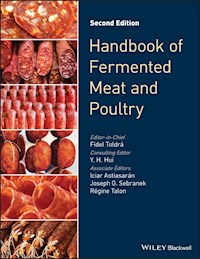
Handbook of Fermented Meat and Poultry E-Book
183,99 €
Mehr erfahren.
- Herausgeber: John Wiley & Sons
- Kategorie: Fachliteratur
- Sprache: Englisch
Fermented meat products have been consumed for centuries in many different parts of the world and constitute one of the most important groups of food. Bacterial cultures are used in their manufacture to preserve the meat and confer particular textures and sensory attributes. Examples of fermented meats include salami, chorizo, pepperoni and saucisson.
This fully revised and expanded reference book on meat fermentation presents all the principle fermented meat products and the processing technologies currently used in their manufacture. The 54 chapters of this substantial book are grouped into the following sections:
- Meat fermentation worldwide: overview, production and principles
- Raw materials
- Microbiology and starter cultures for meat fermentation
- Sensory attributes
- Product categories: general considerations
- Semidry-fermented sausages
- Dry-fermented sausages
- Other fermented meats and poultry
- Ripened meat products
- Biological and chemical safety of fermented meat products
- Processing sanitation and quality assurance
There are five new chapters in the second edition that address the following topics: Smoking and new smoke flavourings; Probiotics; Methodologies for the study of the microbial ecology in fermented sausages; Low sodium in meat products; and Asian sausages.
Handbook of Fermented Meat and Poultry, Second Edition provides readers with a full overview of meat fermentation, the role of microorganisms naturally present and/or added as starter cultures, safety aspects and an account of the main chemical, biochemical, physical and microbiological changes that occur in processing and how they affect final quality. Finally, readers will find the main types of worldwide fermented meat products, typically produced in different areas, with the description of their main characteristics.
Sie lesen das E-Book in den Legimi-Apps auf:
Seitenzahl: 1796
Veröffentlichungsjahr: 2014
Ähnliche




















Table of Contents
Title Page
Copyright
List of Contributors
Preface
Part I: Meat Fermentation Worldwide: Overview, Production, and Principles
Chapter 1: Dry-Fermented Sausages and Ripened Meats: An Overview
1.1 Introduction
1.2 Fermented sausages and ripened meats around the world
1.3 The importance of fermented sausages
Acknowledgement
References
Chapter 2: Production and Consumption of Fermented Meat Products
2.1 Introduction
2.2 Current products
2.3 The Future
References
Chapter 3: Principles of Meat Fermentation
3.1 Introduction
3.2 Fermentation
3.3 Factors influencing fermentation
3.4 Proteolysis
3.5 Lipolysis
3.6 Antagonistic effects
References
Chapter 4: Principles of Curing
4.1 Definition of curing
4.2 History of curing
4.3 Legislation
4.4 Chemistry of nitrite and nitrate
4.5 Nitrite and nitrate in meat products
4.6 Nitrosomyoglobin (NOMb)
4.7
N
-nitrosamine formation
4.8 Conclusion
References
Chapter 5: Principles of Drying
5.1 Introduction
5.2 Basic principles of drying
5.3 Hurdle technology applied to dried meat and poultry products
5.4 Fundamentals of the drying of meat and poultry products
5.5 Drying kinetics modeling
5.6 Air conditioning and circulation in meat drying
References
Chapter 6: Principles of Smoking
6.1 Introduction
6.2 Wood-smoke composition
6.3 The preserving effect
6.4 The flavoring effect
6.5 Benefits and risks
6.6 Food engineering approach
6.7 Smoking procedures
References
Part II: Raw Materials
Chapter 7: The Biochemistry of Meat and Fat
7.1 Introduction: muscle structure
7.2 Meat composition
7.3 Muscle proteases and lipases
7.4 Adipose tissue lipases
7.5 Post mortem muscle metabolism and quality
References
Chapter 8: Ingredients
8.1 Introduction
8.2 Lean
8.3 Fat
8.4 Factors affecting the suitability of lean and fat for processing
8.5 Other ingredients
References
Chapter 9: Additives
9.1 Introduction
9.2 Acids and related additives
9.3 Antioxidants
9.4 Colorants
9.5 Emulsifiers
9.6 Flavor enhancers
9.7 Flavoring agents
9.8 Preservatives
9.9 Multipurpose additives: phosphates
References
Chapter 10: Spices and Seasonings
10.1 Introduction
10.2 Ethnic preferences
10.3 Commonly used spices in processed meats
10.4 Botanical properties
10.5 Product forms and appearances
10.6 Chemical properties
10.9 Applications in fermented meat processing
10.10 Conclusion
References
Chapter 11: Casings
11.1 Introduction
11.2 Natural casings
11.3 Artificial casings
11.4 Regulatory compliance
11.5 Handling casings
11.6 Quality determination
11.7 Conclusion
References
Part III: Microbiology and Starter Cultures
Chapter 12: Microorganisms in Traditional Fermented Meats
12.1 Introduction
12.2 Traditional sausage manufacture
12.3 Description of ecosystems
12.4 Identification of technological microbiota
12.5 Conclusion
References
Chapter 13: The Microbiology of Fermentation and Ripening
13.1 Introduction
13.2 The manufacture of fermented sausages
13.3 Technological microflora
13.4 Spoilage microflora
13.5 Foodborne pathogens
13.6 Starter cultures
References
Chapter 14: Bacteria
14.1 Introduction
14.2 Bacterial starter cultures used for fermented meats
14.3 Starter cultures: technological advantage in the meat environment
14.4 Safety of selected meat starter-culture bacteria
14.5 Conclusion
References
Chapter 15: Bioprotective Cultures
15.1 Introduction
15.2 Starter cultures for meat fermentation
15.3 Competitiveness of starter cultures
15.4 Bioprotective cultures for fermented meat products
15.5 Conclusion
References
Chapter 16: Yeasts
16.1 Introduction
16.2 Presence of yeasts on meat sausages
16.3 Role of yeasts in meat products
16.4 Yeast starter cultures
References
Chapter 17: Molds
17.1 Introduction
17.2 Fungal contamination in ripening environments
17.3 Fungal starter cultures
17.4 Lipolytic and proteolytic activity of starter cultures
17.5 Growth and competitiveness of starter cultures
17.6 Conclusion
References
Chapter 18: Probiotics
18.1 Introduction
18.2 Probiotics and probiotic foods
18.3 Probiotics and meat products
18.4 Prebiotics and synbiotics
18.5 Conclusion
References
Chapter 19: The Genetics of Microbial Starters
19.1 Introduction
19.2 Chromosome elements
19.3 Plasmids
19.4 DNA transfer and genetic tools
19.5 Post-genomics studies
References
Chapter 20: The Influence of Processing Parameters on Starter Culture Performance
20.1 Introduction
20.2 Influence of raw materials
20.3 Influence of temperature
20.4 Influence of added fermentable carbohydrates
20.5 Influence of salting and drying
20.6 Influence of curing agents
20.7 Influence of spices
20.8 Influence of sausage caliber
20.9 Influence of maturation and molding
20.10 Conclusion
Acknowledgments
References
Chapter 21: Methodologies for the Study of Microbial Ecology in Fermented Sausages
21.1 Introduction
21.2 Molecular approaches to the study of microbial ecology in fermented sausages
21.3 Culture-independent methods
21.4 Definition of the microbial ecology in fermented sausages by culture-independent methods
21.5 Culture-dependent methods
21.6 Definition of the microbial ecology in fermented sausages by culture-dependent methods
21.7 Conclusion
References
Part IV: Sensory Attributes
Chapter 22: Sensory Analyses-General Considerations
22.1 Introduction
22.2 Sensory methods
22.3 Sensory analysis of fermented meat products
References
Chapter 23: Color
23.1 Introduction
23.2 Color-forming compounds
23.3 Chemistry of meat color
23.4 Influence of fermentation parameters on color
23.5 Bacterial role in meat color
23.6 Natural and organic cured meat
23.7 Color stability of cured meat products
23.8 Conclusion
Acknowledgment
References
Chapter 24: Texture
24.1 Introduction
24.2 Texture of commercial products
24.3 Texture development during fermentation
24.4 Texture development during ripening
24.5 Texture development during cooking (nondried/semidried)
24.6 Effects of processing parameters
24.7 Effects of product modification with non-meat ingredients
24.8 Conclusion
References
Chapter 25: Flavor
25.1 Introduction
25.2 Precursor generation reactions of fermented meat flavor
25.3 Volatile compound generation reactions
25.4 Extraction and identification of volatile compounds
25.5 Elucidation of aroma active compounds
25.6 Relevance of volatile compounds in fermented meats
References
Part V: Product Categories: General Considerations
Chapter 26: Composition and Nutrition
26.1 Introduction
26.2 Nutrient supply from meat and meat products
26.3 Meat and meat products in healthy nutrition
26.4 Recommended meat intakes
26.5 Effects of fermentation on the nutritional and health properties of meat
References
Chapter 27: Functional Dry-Fermented Sausages
27.1 Introduction
27.2 Modification of the mineral content in dry-fermented sausages
27.3 Fat modifications in dry-fermented sausages
27.4 Incorporation of fiber into dry-fermented sausages
27.5 Use of dry-fermented sausages as probiotics
27.6 Incorporation of vitamins
27.7 Conclusion
References
Chapter 28: Low-Sodium Products
28.1 Introduction
28.2 Relevance of salt in fermented meats
28.3 Strategies for sodium reduction
28.4 Effects of sodium reduction on quality and safety
References
Chapter 29: International Standards: United States
29.1 Introduction
29.2 US regulatory process
29.3 Regulatory definitions and specifications
29.4 HACCP options
29.5 Validation
References
Chapter 30: International Standards: Europe
30.1 Introduction
30.2 Quality
30.3 Microbiological safeguarding in food chains
30.4 Generating microbiological data in practice
30.5 Microbiological criteria for foodstuffs in Reg. (EC) 2073/2005
References
Chapter 31: Packaging and Storage
31.1 Introduction
31.2 Functions of food packaging
31.3 Packaging materials
31.4 Packaging systems
31.5 Storage
References
Part VI: Semidry-Fermented Sausages
Chapter 32: US Products-Semidry Sausage
32.1 Introduction
32.2 Methods of acidification
32.3 Food safety
32.4 Manufacturing processes
32.5 Different types of US semidry sausage
Reference
Chapter 33: European Products
33.1 Introduction
33.2 Definition of “semidry-fermented sausage” in Europe
33.3 General remarks on the manufacture of European-style semidry-fermented sausages
33.4 Types of European-style semidry-fermented sausage
33.5 Safety and stability
33.6 Conclusion
References
Part VII: Dry-Fermented Sausages
Chapter 34: US Products-Dry Sausage
34.1 Introduction
34.2 European versus US products
34.3 Definitions
34.4 US manufacturing processes for dried sausages
34.5 Basic formulations and processes for selected large-diameter dried sausages
34.6 Safe production of dried sausages in the United States
34.7 Process control points for dried sausage manufacturing
References
Chapter 35: Mediterranean Products
35.1 Introduction
35.2 Production of Mediterranean dry-fermented sausages
35.3 Changes during ripening of Mediterranean dry-fermented sausages
35.4 Innovation in Mediterranean dry-fermented sausages
35.5 Conclusion
References
Chapter 36: Northern European Products
36.1 Introduction
36.2 Characteristics of Northern European sausages
36.3 Sausages of Central Europe
36.4 Sausages of Eastern Europe
36.5 Sausages of the Nordic countries
References
Chapter 37: Asian Products
37.1 Introduction
37.2 Chinese products
37.3 South East Asian products
37.4 Himalayan fermented meat products
References
Part VIII: Fermented Products from Poultry and Other Meats
Chapter 38: Fermented Poultry Sausages
38.1 Introduction
38.2 Fermented poultry sausages
38.3 Other fermented products
References
Chapter 39: Fermented Sausages from Other Meats
39.1 Introduction
39.2 Fermented products from other meats
39.3 Scientific studies on other meats
References
Part IX: Ripened Meat Products
Chapter 40: US Products-Dry-Cured Hams
40.1 Introduction
40.2 Country ham standards
40.3 Commercial dry-cured ham production in the United States
40.4 Ham curing at home
40.5 Safety
40.6 Cooking
40.7 Research
References
Chapter 41: Central and South American Products
41.1 Introduction
41.2 Meat consumption and habits
41.3 Meat production in Latin American countries
41.4 Typical meat products, microbial ecology, and safety risks
41.5 Conclusion
References
Chapter 42: Mediterranean Products
42.1 Introduction
42.2 Production of dry-cured hams
42.3 Spanish dry-cured hams
42.4 Italian dry-cured hams
42.5 French dry-cured hams
References
Chapter 43: Nordic Products
43.1 Introduction
43.2 Norwegian fenalår
43.3 Norwegian pinnekjøtt
43.4 Norwegian dry-cured ham (spekeskinke)
43.5 Icelandic hangikjöt
43.6 Faroese skerpikjøt
43.7 Greenlandic mattaq and igunaq
43.8 Finnish Lapin Poron kylmäsavuliha
43.9 Finnish Lapin Poron kuivaliha
References
Chapter 44: Asian Products
44.1 Introduction
44.2 History and traits of Jinhua ham
44.3 Processing of Jinhua ham
44.4 Possible factors causing differences in Chinese dry-cured hams
References
Part X: Biological and Chemical Safety of Fermented Meat Products
Chapter 45: Spoilage Microorganisms: Risks and Control
45.1 Introduction
45.2 Putative spoilage microorganisms
45.3 Examples of spoilage occurring in fermented sausage
45.4 Strategies for spoilage control
45.5 Conclusion
References
Chapter 46: Pathogens: Risks and Control
46.1 Introduction
46.2 Hazard identification
46.3 Hazard characterization: defense mechanism
46.4 Exposure assessment
46.5 Control measures
References
Chapter 47: Biogenic Amines: Risks and Control
47.1 Introduction: biogenic amine classification and relevance
47.2 Health risks of biogenic amines in fermented sausages
47.3 Aminogenesis in fermented sausages and measures for its control
47.4 Conclusion
References
Chapter 48: Toxic Compounds of Chemical Origin
48.1 Introduction
48.2 N-nitrosamines
48.3 Polycyclic aromatic hydrocarbons (PAHs)
48.4 Oxidation
48.5 Veterinary drug residues
48.6 Environmental contaminants
References
Chapter 49: Foodborne Outbreaks
49.1 Introduction
49.2
Staphylococcus aureus
49.3
Salmonella
spp.
49.4 Verotoxigenic strains of
Escherichia coli
49.5
Yersinia enterocolitica
49.6
Listeria monocytogenes
49.7 Thermotolerant
Campylobacter
49.8 Parasites
49.9 Conclusion
References
Part XI: Processing Sanitation and Quality Assurance
Chapter 50: Basic Sanitation
50.1 Introduction
50.2 Raw materials and ingredients
50.3 Plant environment
50.4 Personnel hygiene and training
References
Chapter 51: Processing Plant Sanitation
51.1 Introduction
51.2 Fermented meat products and poultry
51.3 Fermented sausage processing plant sanitation
51.4 Methods of evaluating the sanitation state of a plant
51.5 Final considerations
References
Chapter 52: Quality Control
52.1 Introduction
52.2 Quality controls at each stage of processing
52.3 Control of drying
52.4 Control of sensory quality
References
Chapter 53: HACCP: Hazard Analysis and Critical Control Points
53.1 The HACCP concept: why use it
53.2 HACCP model for fermented sausages: a generic model for HACCP implementation in traditional establishments and small fermented sausage plants
53.3 Validation of the operative HACCP plan
53.4 Revision of the HACCP plan
53.5 Certification of food safety management systems
References
Chapter 54: Quality Assurance Plan
54.1 Introduction
54.2 General remarks on the purchase and selection of raw materials
54.3 Quality assurance plans and records for fermented sausages
54.4 Quality assurance plans and records for raw dry hams
54.5 Slicing, packaging, and storage of fermented sausages and raw dry hams
54.6 End-product testing
54.7 General remarks about the structure and extent of documentation
References
Index
Food Science and Technology Books
End User License Agreement
Pages
xvii
xviii
xix
xx
xxi
3
4
5
6
7
8
9
10
11
13
14
15
16
17
19
20
21
22
23
24
25
26
27
28
29
30
31
32
33
34
35
36
37
38
39
40
41
42
43
44
45
49
50
51
52
53
54
55
56
57
58
59
60
61
62
63
64
65
66
67
69
70
71
72
73
74
75
76
77
79
80
81
82
83
84
85
86
87
88
89
90
91
92
93
94
95
96
99
100
101
103
102
104
105
107
108
109
110
111
112
113
114
115
117
118
119
120
121
122
123
124
125
126
127
128
129
130
131
132
133
134
135
136
137
139
140
141
142
143
144
145
146
147
148
149
150
151
152
153
155
156
157
158
159
160
161
162
163
164
165
166
167
168
169
170
171
172
173
174
175
177
178
179
180
181
182
183
184
185
186
187
188
191
192
193
194
195
196
197
198
199
200
201
202
203
204
205
207
208
209
210
211
212
213
214
215
217
218
219
220
222
223
221
224
225
229
230
231
232
233
234
235
236
237
238
239
240
241
242
243
244
245
246
247
248
249
250
251
252
253
254
255
256
257
259
260
261
262
263
264
265
266
267
268
269
270
271
273
274
275
276
277
278
279
280
283
284
285
287
288
289
290
291
292
295
296
297
298
299
301
302
303
304
305
306
307
308
309
310
311
312
313
314
315
316
317
318
319
320
321
322
323
324
325
326
327
331
332
333
334
335
336
337
338
339
340
341
342
343
347
348
349
350
351
352
353
354
355
356
357
358
359
360
361
362
363
364
365
366
367
368
369
371
372
373
374
375
376
377
378
379
380
381
385
386
387
388
389
390
391
392
396
393
394
395
397
398
399
400
401
402
403
404
405
406
407
408
409
410
411
412
413
414
415
416
417
418
419
420
421
424
422
423
425
426
427
428
429
430
431
432
433
434
435
436
437
438
439
443
444
445
446
447
448
449
451
452
453
454
455
456
457
458
459
461
462
463
464
465
466
467
469
470
471
472
473
474
475
476
477
479
480
481
478
482
483
484
485
487
488
489
490
491
492
493
495
496
497
498
499
Guide
Cover
Table of Contents
Preface
Part I: Meat Fermentation Worldwide: Overview, Production, and Principles
Begin Reading
List of Illustrations
Figure 4.1
Figure 4.2
Figure 4.3
Figure 4.4
Figure 4.5
Figure 4.6
Figure 4.7
Figure 4.8
Figure 4.9
Figure 4.10
Figure 4.11
Figure 4.12
Figure 4.13
Figure 5.1
Figure 5.2
Figure 5.3
Figure 5.4
Figure 5.5
Figure 5.6
Figure 5.7
Figure 5.8
Figure 5.9
Figure 5.10
Figure 6.1
Figure 6.2
Figure 6.3
Figure 6.4
Figure 6.5
Figure 6.6
Figure 6.7
Figure 8.1
Figure 8.2
Figure 8.3
Figure 8.4
Figure 8.5
Figure 8.6
Figure 8.7
Figure 8.8
Figure 13.1
Figure 13.2
Figure 20.1
Figure 20.2
Figure 21.1
Figure 22.1
Figure 23.1
Figure 23.2
Figure 23.3
Figure 23.4
Figure 23.5
Figure 23.6
Figure 24.1
Figure 24.2
Figure 24.3
Figure 25.1
Figure 25.2
Figure 30.1
Figure 30.2
Figure 30.3
Figure 35.1
Figure 35.2
Figure 35.3
Figure 36.1
Figure 38.1
Figure 38.2
Figure 40.1
Figure 40.2
Figure 40.3
Figure 40.4
Figure 41.1
Figure 42.1
Figure 42.2
Figure 42.3
Figure 42.4
Figure 42.5
Figure 43.1
Figure 43.2
Figure 43.3
Figure 44.1
Figure 44.2
Figure 44.3
Figure 44.4
Figure 44.5
Figure 44.6
Figure 44.7
Figure 44.8
Figure 44.9
Figure 44.10
Figure 47.1
Figure 51.1
Figure 51.2
Figure 53.1
Figure 53.2
Figure 53.3
Figure 53.4
Figure 54.1
Figure 54.2
List of Tables
Table 2.1
Table 2.2
Table 2.3
Table 4.1
Table 4.2
Table 4.3
Table 4.4
Table 4.5
Table 4.6
Table 4.7
Table 4.8
Table 4.9
Table 7.1
Table 7.2
Table 7.3
Table 7.4
Table 9.1
Table 9.2
Table 9.3
Table 9.4
Table 9.5
Table 9.6
Table 9.7
Table 9.8
Table 10.1
Table 10.2
Table 10.3
Table 10.4
Table 10.5
Table 10.6
Table 10.7
Table 10.8
Table 10.9
Table 10.10
Table 11.1
Table 11.2
Table 11.3
Table 11.4
Table 11.5
Table 11.6
Table 12.1
Table 12.2
Table 12.3
Table 14.1
Table 15.1
Table 15.2
Table 15.3
Table 16.1
Table 17.1
Table 17.2
Table 17.3
Table 17.4
Table 18.1
Table 18.2
Table 18.3
Table 19.1
Table 19.2
Table 19.3
Table 21.1
Table 24.1
Table 24.2
Table 24.3
Table 24.4
Table 24.5
Table 24.6
Table 25.1
Table 25.2
Table 26.1
Table 26.2
Table 26.3
Table 26.4
Table 26.5
Table 26.6
Table 26.7
Table 26.8
Table 26.9
Table 27.1
Table 27.2
Table 28.1
Table 28.2
Table 29.1
Table 29.2
Table 30.1
Table 30.2
Table 30.3
Table 30.4
Table 30.5
Table 31.1
Table 31.2
Table 33.1
Table 33.2
Table 33.3
Table 34.1
Table 34.2
Table 35.1
Table 35.2
Table 36.1
Table 37.1
Table 38.1
Table 38.2
Table 40.1
Table 40.2
Table 41.1
Table 42.1
Table 42.2
Table 43.1
Table 46.1
Table 46.2
Table 46.3
Table 46.4
Table 47.1
Table 47.2
Table 47.3
Table 48.1
Table 48.2
Table 48.3
Table 50.1
Table 51.1
Table 51.2
Table 51.3
Table 51.4
Table 52.1
Table 52.2
Table 52.3
Table 52.4
Table 53.1
Table 53.2
Table 53.3
Table 53.4
Table 53.5
Table 53.6
Table 53.7
Table 54.1
Table 54.2
Table 54.3
Table 54.4
Table 54.5
Table 54.6
Handbook of Fermented Meat and Poultry
Second Edition
Editor-in-Chief
Fidel ToldráInstituto de Agroquímica y Tecnología de Alimentos (CSIC), Paterna, Valencia, Spain
Consulting Editor
Y. H. HuiScience Technology System, West Sacramento, CA, USA
Associate Editors
Iciar AstiasaránDepartment of Food Science, Nutrition and Physiology, University of Navarra, Pamplona, Spain
Joseph G. SebranekFood Science and Human Nutrition, Iowa State University Ames, IA, USA
Règine TalonINRA, UR454 Microbiologie, Saint-Genès Champanelle, France
This edition first published 2015 © 2015 by John Wiley & Sons, Ltd
Registered office: John Wiley & Sons, Ltd, The Atrium, Southern Gate, Chichester, West Sussex, PO19 8SQ, UK
Editorial offices: 9600 Garsington Road, Oxford, OX4 2DQ, UK
The Atrium, Southern Gate, Chichester, West Sussex, PO19 8SQ, UK
111 River Street, Hoboken, NJ 07030-5774, USA
For details of our global editorial offices, for customer services and for information about how to apply for permission to reuse the copyright material in this book please see our website at www.wiley.com/wiley-blackwell.
The right of the author to be identified as the author of this work has been asserted in accordance with the UK Copyright, Designs and Patents Act 1988.
All rights reserved. No part of this publication may be reproduced, stored in a retrieval system, or transmitted, in any form or by any means, electronic, mechanical, photocopying, recording or otherwise, except as permitted by the UK Copyright, Designs and Patents Act 1988, without the prior permission of the publisher.
Designations used by companies to distinguish their products are often claimed as trademarks. All brand names and product names used in this book are trade names, service marks, trademarks or registered trademarks of their respective owners. The publisher is not associated with any product or vendor mentioned in this book.
Limit of Liability/Disclaimer of Warranty: While the publisher and author(s) have used their best efforts in preparing this book, they make no representations or warranties with respect to the accuracy or completeness of the contents of this book and specifically disclaim any implied warranties of merchantability or fitness for a particular purpose. It is sold on the understanding that the publisher is not engaged in rendering professional services and neither the publisher nor the author shall be liable for damages arising herefrom. If professional advice or other expert assistance is required, the services of a competent professional should be sought.
Library of Congress Cataloging-in-Publication Data
Handbook of fermented meat and poultry / editor-in-chief, Fidel Toldrá; associate editors, Y.H. Hui,
I. Astiasarán, J.G. Sebranek, & R. Talon.—2nd edition.
pages cm
Includes bibliographical references and index.
ISBN 978-1-118-52269-1 (hardback)
1. Fermented foods–Handbooks, manuals, etc. 2. Meat–Preservation–Handbooks, manuals, etc.
3. Fermentation–Handbooks, manuals, etc. I. Toldrá, Fidel.
TP371.44.H357 2015
664′.024—dc23
2014024540
A catalogue record for this book is available from the British Library.
Wiley also publishes its books in a variety of electronic formats. Some content that appears in print may not be available in electronic books.
Cover image: Fresh spicy Pepper Salami © iStock.com/sasimoto; Spanish chorizo © iStock.com/THEPALMER; Tasty meat sausages during manufacturing process before sale © iStock.com/blanscape; Asia sausage in market - red sausage © iStock.com/seagames50; Close up Salami © iStock.com/Juanmonino; Salami sausages in the market © iStock.com/tomazl
List of Contributors
Dong Uk Ahn
Department of Animal Science Department, Iowa State University, Ames, IA, USA
Valentina Alessandria
Università di Torino, Dipartimento di Scienze Agrarie, Forestali e Alimentari, Turin, Italy
J. Anba-Mondoloni
INRA, UMR1319 Micalis, Jouy-en-Josas, France; AgroPArisTech, UMR Micalis, Jouy-en-Josas, France
Ana Andres
Institute of Food Engineering for Development, Food Science and Technology Department, Universitat Politècnica de València, Valencia, Spain
Diana Ansorena
Department of Food Science, Nutrition and Physiology, University of Navarra, Pamplona, Spain
Keizo Arihara
School of Veterinary Medicine, Kitasato University, Towada-shi, Aomori, Japan
M. Concepción Aristoy
Instituto de Agroquímica y Tecnología de Alimentos (CSIC), Paterna, Valencia, Spain
E. Arnaud
UMR QUALISUD, CIRAD, France
Iciar Astiasarán
Department of Food Science, Nutrition and Physiology, University of Navarra, Pamplona, Spain
Lars Axelsson
Nofima, Ås, Norway
Teresa Aymerich
Institute for Food and Agricultural Research and Technology (IRTA), Food Safety Program, Monells, Spain
José M. Barat
Food Science and Technology Department, Universitat Politècnica de València, Valencia, Spain
Shai Barbut
Food Science Department, University of Guelph, Guelph, ON, Canada
A.S. Barreto
Faculdade de Medicina Veterinária CIISA, Universidade de Lisboa, Lisbon, Portugal
Lopa Basu
Ohio State University, Columbus, OH, USA
Elettra Berni
Department of Microbiology, SSICA, Parma, Italy
Nicholas L Berry
Department of Animal Science, Iowa State University, Ames, IA, USA
Sara Bover-Cid
IRTA Food Safety Programme, Institute for Food and Agricultural Research and Technology, Finca Camps i Armet, Monells, Spain
Elizabeth Boyle
Department of Animal Sciences and Industry, Kansas State University, Manhattan, KS, USA
Patricia Castellano
Centro de Referencia para Lactobacilos (CERELA), CONICET, Tucumán, Argentina
Marie-Christine Champomier-Vergès
INRA, UMR1319 Micalis, Jouy-en-Josas, France; AgroPArisTech, UMR Micalis, Jouy-en-Josas, France
Ming-Ju Chen
Department of Animal Science and Technology, National Taiwan University, Taipei, Taiwan, Republic of China
Suey Ping Chi
Department of Animal Products Processing, Livestock Research Institute, Council of Agriculture, Hsinhua, Taiwan, Republic of China
Souad Christieans
ADIV, Clermont-Ferrand Cedex, France
Pier Sandro Cocconcelli
Istituto di Microbiologia, Centro Ricerche Biotecnologiche, Università Cattolica del Sacro Cuore, Piacenza-Cremona, Italy
Luca Cocolin
Università di Torino, Dipartimento di Scienze Agrarie, Forestali e Alimentari, Turin, Italy
A. Collignan
UMR QUALISUD, Institut des Régions Chaudes, Montpellier, France
Lorenzo de la Hoz
Departamento de Nutrición, Bromatología y Tecnología de los Alimentos, Facultad de Veterinaria, Universidad Complutense de Madrid, Madrid, Spain
Daniel Demeyer
Laboratory of Animal Production and Animal Product Quality, Department of Animal Production, Ghent University, Melle, Belgium
L. De Vuyst
Vrije Universiteit Brussel, Research Group of Industrial Microbiology and Food Biotechnology (IMDO), Brussels, Belgium
Ana M. Diez
Department of Biotechnology and Food Science, University of Burgos, Burgos, Spain
Paola Dolci
Università di Torino, Dipartimento di Scienze Agrarie, Forestali e Alimentari, Turin, Italy
E. Dordet-Frisoni
INRA, UR454 Microbiologie, Saint-Genès Champanelle, France
Mario Estévez
Department of Food Technology, University of Extremadura, Extremadura, Spain
Silvina Fadda
Centro de Referencia para Lactobacilos (CERELA), CONICET, Tucumán, Argentina
Chris Fedler
Department of Food Science and Human Nutrition, Iowa State University, Ames, IA, USA
Manuela Fernández
Departamento de Nutrición, Bromatología y Tecnología de los Alimentos, Facultad de Veterinaria, Universidad Complutense de Madrid, Madrid, Spain
Mónica Flores
Instituto de Agroquímica y Tecnología de Alimentos (CSIC), Paterna, Valencia, Spain
Cecilia Fontana
Istituto di Microbiologia, Centro Ricerche Biotecnologiche, Università Cattolica del Sacro Cuore, Piacenza-Cremona, Italy
M.J. Fraqueza
Faculdade de Medicina Veterinária CIISA, Universidade de Lisboa, Lisbon, Portugal
Reinhard Fries
Panel Veterinary Public Health, Institute of Meat Hygiene and Technology, Faculty of Veterinary Medicine, Freie Universität Berlin, Berlin, Germany
M.L. García
Departamento Nutrición, Bromatología y Tecnología de los Alimentos, Facultad Veterinaria, Universidad Complutense, Madrid
Margarita Garriga
Institute for Food and Agricultural Research and Technology (IRTA), Food Safety Program, Monells, Spain
T. Goudman
Vrije Universiteit Brussel, Research Group of Industrial Microbiology and Food Biotechnology (IMDO), Brussels, Belgium
Raúl Grau
Food Science and Technology Department, Universitat Politècnica de València, Valencia, Spain
Dana J Hanson
Food, Bioprocessing & Nutrition Sciences, North Carolina State University, Raleigh, NC, USA
Torunn Thauland Håseth
Animalia—the Norwegian Meat Research Centre, Oslo, Norway
Even Heir
Nofima, Ås, Norway
Eva Hierro
Departamento de Nutrición, Bromatología y Tecnología de los Alimentos, Facultad de Veterinaria, Universidad Complutense de Madrid, Madrid, Spain
Askild Holck
Nofima, Ås, Norway
Karl O. Honikel
Max Rubner-Institute, Federal Research Centre for Nutrition and Food, Kulmbach, Germany
Y.H. Hui
Science Technology System, West Sacramento, CA, USA
Melvin C. Hunt
Department of Animal Sciences and Industry, Kansas State University, Manhattan, KS, USA
Tom C. Johannessen
Nofima, Ås, Norway
Sisse Jongberg
Food Chemistry, Department of Food Science, University of Copenhagen, Frederiksberg, Denmark
M. Luz Latorre-Moratalla
Departament de Nutrició i Bromatologia, Campus de l'Alimentació de Torribera, Universitat de Barcelona-INSA-Xarta, Santa Coloma de Gramenet, Spain
Isabelle Lebert
INRA, UR454 Microbiologie, Saint-Genès Champanelle, France
F. Leroy
Vrije Universiteit Brussel, Research Group of Industrial Microbiology and Food Biotechnology (IMDO), Brussels, Belgium
Sabine Leroy
INRA, UR454 Microbiologie, Saint-Genès Champanelle, France
Friedrich-Karl Lücke
Hochschule Fulda (University of Applied Sciences), Fulda, Germany
Robert Maddock
Department of Animal & Range Sciences, North Dakota State University, Fargo, ND, USA
Beatriz Melero
Department of Biotechnology and Food Science, University of Burgos, Burgos, Spain
W. Benjy Mikel
Department of Food Science, Nutrition, and Health Promotion, Mississippi State University, Mississippi State, MS, USA
Byungrok Min
Food Science and Technology Program, Department of Agriculture, Food, and Resource Sciences, University of Maryland Eastern Shore, Princess Anne, MD, USA
Jens K.S. Møller
Chr. Hansen A/S, Natural Colors Division, Hoersholm, Denmark
David Morcuende
Department of Food Technology, University of Extremadura, Extremadura, Spain
Asgeir Nilsen
Matforsk A/S, Ås, Norway
George-John E. Nychas
Laboratory of Microbiology and Biotechnology of Foods, Department of Food Science & Human Nutrition, Agricultural University of Athens, Athens, Greece
Herbert W. Ockerman
Ohio State University, Columbus, OH, USA
Alicia Olivares
Instituto de Agroquímica y Tecnología de Alimentos (CSIC), Paterna, Valencia, Spain
Juan A. Ordóñez
Departamento de Nutrición, Bromatología y Tecnología de los Alimentos, Facultad de Veterinaria, Universidad Complutense de Madrid, Madrid, Spain
Emin Burçin Özvural
Department of Food Engineering, Faculty of Engineering, Çankırı Karatekin University, Çankırı, Turkey
Ronald B. Pegg
Department of Food Science & Technology, University of Georgia, Athens, GA, USA
Trinidad Pérez-Palacios
School of Veterinary Science, University of Extremadura, Caceres, Spain
Esko Petäjä-Kanninen
Department of Food Technology, University of Helsinki, Helsinki, Finland
Colin Pierre
French Food Safety Agency, Technopôle Brest-Iroise, Plouzané, France
S. Planchon
CTCPA, Site Agroparc, Avignon, France
Ken Prusa
Department of Food Science and Human Nutrition, Iowa State University, Ames, IA, USA
Eero Puolanne
Department of Food Technology, University of Helsinki, Helsinki, Finland
Kalliopi Rantsiou
Università di Torino, Dipartimento di Scienze Agrarie, Forestali e Alimentari, Turin, Italy
Milagro Reig
Instituto de Ingeniería de Alimentos para el Desarrollo, Universitat Politècnica de València, Ciudad Politécnica de la Innovación, Valencia, Spain
Gregg Rentfrow
Department of Animal and Food Science, University of Kentucky, Lexington, KY, USA
Marit Rødbotten
Matforsk A/S, Ås, Norway
Pedro Roncalés
Department of Animal Production and Food Science, Laboratory of Food Technology, Faculty of Veterinary Sciences, University of Zaragoza, Zaragoza, Spain
Jordi Rovira
Department of Biotechnology and Food Science, University of Burgos, Burgos, Spain
Jorge Ruiz
Department of Food Science, University of Copenhagen, Copenhagen, Denmark
Robert E. Rust
Iowa State University, Ames, IA, USA
S.J. Santchurn
Department of Agricultural and Food Science, University of Mauritius, Faculty of Agriculture, Réduit, Mauritius
M. Wes Schilling
Department of Animal and Food Science, University of Kentucky, Lexington, KY, USA
M.D. Selgas
Departamento Nutrición, Bromatología y Tecnología de los Alimentos, Facultad Veterinaria, Universidad Complutense, Madrid
Maan Singh Sidhu
The Research Council of Norway, Oslo, Norway
Zdzisław E. Sikorski
Department of Food Chemistry, Technology, and Biotechnology, Gdańsk University of Technology, Gdańsk, Poland
Izabela Sinkiewicz
Department of Food Chemistry, Technology, and Biotechnology, Gdańsk University of Technology, Gdańsk, Poland
Panagiotis Skandamis
Laboratory of Food Quality Control and Hygiene, Department of Food Science & Human Nutrition, Agricultural University of Athens, Athens, Greece
Leif H. Skibsted
Food Chemistry, Department of Food Science, University of Copenhagen, Frederiksberg, Denmark
Kenneth J Stalder
Department of Animal Science, Iowa State University, Ames, IA, USA
Régine Talon
INRA, UR454 Microbiologie, Saint-Genès Champanelle, France
Gudjon Thorkelsson
University of Iceland, Reykjavik, Iceland
Fidel Toldrá
Instituto de Agroquímica y Tecnología de Alimentos (CSIC), Paterna, Valencia, Spain
Rung-Jen Tu
Livestock Research Institute, Council of Agriculture, Executive Yuan, Tainan, Taiwan, Republic of China
M. Teresa Veciana-Nogués
Departament de Nutrició i Bromatologia, Campus de l'Alimentació de Torribera, Universitat de Barcelona-INSA-Xarta, Santa Coloma de Gramenet, Spain
Jesús Ventanas
Department of Food Technology, University of Extremadura, Extremadura, Spain
Sonia Ventanas
Department of Food Technology, University of Extremadura, Extremadura, Spain
M. Carmen Vidal-Carou
Departament de Nutrició i Bromatologia, Campus de l'Alimentació de Torribera, Universitat de Barcelona-INSA-Xarta, Santa Coloma de Gramenet, Spain
Graciela Vignolo
Centro de Referencia para Lactobacilos (CERELA), CONICET, Tucumán, Argentina
Halil Vural
Department of Food Engineering, Faculty of Engineering, Hacettepe University, Ankara, Turkey
Sheng-Yao Wang
Department of Animal Science and Technology, National Taiwan University, Taipei, Taiwan, Republic of China; Experimental Farm, National Taiwan University, Taipei, Taiwan, Republic of China
Yun Chu Wu
Department of Animal Science and Biotechnology, Tunghai University, Taiwan, Republic of China
Monique Zagorec
INRA, UMR 1014 Secalim, France; LUNAM Université, Oniris, Nantes, France
Gai-Ming Zhao
College of Food Science and Technology, Henan Agricultural University, Zhengzhou, Republic of China
Guang-Hong Zhou
Key Laboratory of Meat Processing and Quality Control, MOA, College of Food Science and Technology, Nanjing Agricultural University, Nanjing, Republic of China
Preface
Fermented meat products have been consumed for centuries in many different parts of the world and constitute one of the most important types of food. Based on the natural meat microbiota, a wide range of products have been prepared since ancient times; different products are created by varying the mixture of meats and salt and through the addition of spices and seasonings, giving rise to a great variety of flavors and textures. Fermented meat products are today receiving increased interest from consumers all over the world, who are seeking new gustatory experiences. Most of these products still rely primarily on local, traditional manufacturing processes, since little scientific information is available on their creation, but scientific knowledge has become an important tool for consistent production of high-quality and safe products.
The first edition of this book dates from 2007 and contains topics spread across 50 chapters. New developments have evolved very rapidly in recent years and this new second edition contains 54 chapters: both updated and revised versions of the old ones and new chapters on low-sodium meats, probiotics, and methodologies for the study of microbial ecology, as well as expanded detail on drying and smoking techniques. These are grouped into 11 parts. Part I deals with general aspects such as curing, fermentation, drying, and smoking. Part II describes the main characteristics and uses of raw materials and ingredients. Part III is focused on the microbiology involved in meat fermentation and describes the most commonly applied starter cultures and methodologies for the study of microbial ecology. Part IV looks into the sensory properties of fermented meat products, while Part V examines their composition and nutritional quality, as well as low-sodium meat products, packaging, and international standards. Parts VI and VII cover the manufacture and characteristics of semidry-fermented and dry-fermented sausages, respectively. Fermented poultry sausages and other fermented meats are described in Part VIII, while Part IX looks at the manufacture and characteristics of ripened meat products, especially dry-cured hams. Part X covers biological and chemical safety aspects, and, finally, Part XI is focused on sanitation and quality assurance.
This Handbook provides an updated and comprehensive overview of meat fermentation. It includes important developments that have occurred in the last few decades, including the role of microorganisms naturally present in meat or added as starter cultures, important modern safety aspects, information regarding nutritional quality and sensory attributes, and the primary chemical, biochemical, physical, and microbiological changes that occur during processing and a summary of how they influence the final product quality. It also provides a detailed description of the major fermented meat products found around the world and the processing technologies currently applied in meat processing plants.
This book is the result of the expertise of more than 90 international contributors from 18 different countries. These experts from industry, government, and academia have been led by an editorial team of 5 members from 4 different countries. The editorial team wishes to thank all the contributors for making this book possible and remember those who sadly passed away either before or during the preparation of this book: Esko Petäjä-Kanninen, Lorenzo de la Hoz, and especially Karl O Honikel, a very good friend and excellent meat scientist. We also thank the production team at Wiley Blackwell, giving special recognition to David McDade, Senior Commissioning Editor and the coordinator of the project, and Fiona Seymour, Senior Project Editor.
We sincerely hope that you will find this book enlightening and that it provides you with a better understanding of fermented meat and poultry products.
Fidel ToldráY.H. HuiIciar AstiasaránJoseph G. SebranekR Talon
Part IMeat Fermentation Worldwide: Overview, Production, and Principles
Chapter 1Dry-Fermented Sausages and Ripened Meats: An Overview
Fidel Toldrá1 and Y.H. Hui2
1Instituto de Agroquímica y Tecnología de Alimentos (CSIC), Paterna, Valencia, Spain
2Science Technology System, West Sacramento, CA, USA
1.1 Introduction
Drying and smoking were probably the first food-preservation techniques to be developed, in ancient Greece and Rome (Zeuthen, 2007). In fact, the names “sausage” and “salami” probably originate from the Latin words “salsiccia” and “salumen,” respectively (Toldrá, 2012). Historically, the manufacturing procedures used to make fermented sausages were adapted to the climatic conditions of the production area. For instance, Mediterranean meat products are dried to low water activity (aw) values, taking advantage of the long dry and sunny days, while in Northern Europe fermented sausages require smoking for further preservation (Toldrá, 2006, 2014a). Summer sausage is traditionally produced in the summer and is heated for safety reasons (Zeuthen, 1995).
Preservation results from a series of specific factors known as “hurdle effects” (Leistner, 1992):
addition of nitrite, salt, and/or sugar;
reduction of redox potential;
introduction of lactic acid bacteria (LAB);
lowering of pH;
decreasing of a
w
;
smoking.
The sausage remains stable throughout this sequence of hurdles (Leistner, 1995).
LAB play important roles in safety, nutrition, and sensory quality (Toldrá et al., 2001), and develop important reactions essential to the development of adequate color, texture, and flavor (Demeyer & Toldrá, 2004). Details can be found in Parts II and III of this book.
This chapter lists some of the most important fermented sausages produced worldwide. Further details of sausages and ripened meat products from North America, the Mediterranean, and Northern Europe and Asia can be found in Parts VI, VII, VIII, and IX. Space limitation prohibits an in-depth discussion of fermented sausages from other parts of the world; the interested reader can refer to the references for further information.
1.2 Fermented sausages and ripened meats around the world
1.2.1 North America
Manufacturing practices were brought to North America by the first European settlers. Today, many European fermented sausages can be found in northern states such as Wisconsin (Toldrá & Reig, 2007). Lebanon bologna is a semidry-fermented sausage originating from Lebanon County, Pennsylvania. It is produced from beef and black pepper, fermented to a very high pH, and heavily smoked (Rust, 2004). Pepperoni is produced from pork and/or beef and seasoned with red pepper, ground cayenne pepper, pimento, aniseed, and garlic. It has a small diameter and is smoked.
1.2.2 South and Central America
There is a general Spanish and Italian influence on fermented meat products in many Latin America countries. Italian milano and cacciaturi are consumed in Uruguay, Brazil, and Mexico, among other places. In the Andes, traditional fermented sausages are made from llama meat and guanaco.
1.2.3 The Mediterranean
Many types of dry-fermented sausage are produced in the Mediterranean area. They are usually dried, due to the climate, and are rarely smoked. They have a variety of diameters, shapes, sizes, spices, seasonings, and sensory characteristics. Their names differ according to the geographic origin, sometimes even between very close areas (Toldrá, 2006). Pork is the main meat, and fungi starters may be used for development on the external surface (Talon et al., 2004). Salamis of medium diameter (around 6 cm) include French menage, French saucisson d'Alsace, Italian turista, and Spanish salchichón, while those of larger diameter include French varzi, Italian milano, and Italian crespone; the latter may be ripened for more than 60 days (Toldrá & Flores, 2014). Coppa is an Italian salami with cylindrical shape. It is made from pork shoulder butt salted for 7–10 days and dried for 2–4 weeks. Spanish chorizo, which has a strong red color, is seasoned with garlic, pepper, and oregano (Toldrá, 2002). Mortadella bologna is produced from pork meat and fat, and the final sausage is thermally treated to an internal temperature of 68 °C (Toldrá, 2014a).
Dry-cured ham is extensively consumed in Mediterranean countries. It is a dry-cured whole-meat product produced by curing, salting, drying, and ripening for as long as 24, or sometimes even 36, months (Toldrá, 2014b). It receives different names according to the region, such as serrano or ibérico in Spain, prosciutto di Parma or San Danielle in Italy, Bayonne in France, and Ardennes in Belgium (Toldrá, 2014a).
1.2.4 Northern Europe
A good number of fermented meats are produced in Northern Europe. The greuβner salami is produced in Thuringia, Germany. It is a sliceable sausage produced from beef and some pork, as well as fat, and flavored with garlic, pepper, and other spices. It undergoes a long-term fermentation process and cold smoking. The rügenwalder teewurst is a semidry-fermented sausage, also produced from beef and pork, which is fermented and cold-smoked (Gibis & Fischer, 2004). The Austrian katwurst is a long, dried sausage. The Swedish metwursk contains some potato, in addition to spices and seasonings. Other meats can be added to the formulation of sausages in Scandinavian countries, such as horse meat in farepolse, toppen, trondermorr, stabbur, and sognekorr in Norway and kotimainen meetwurst in Finland; lamb meat in lambaspaeipylsa in Iceland; and reindeer meat in poro meetwurst in Finland and rallersnabb gilde in Norway (Campbell-Platt, 1995).
Several fermented sausages are produced in Poland, mainly from pork, but also beef, game, and poultry (Pisula, 2004). Krakowscha sucha is produced from pork and beef, plus black pepper, nutmeg, and garlic. It is dry-cured, smoked, cooked, and dried for about 3 weeks. Kabanosy is produced from pork and black pepper, nutmeg, and caraway. It is smoked and dried for 3–5 days. Jalowcowa is produced from pork and a little beef, plus pepper and juniper. It is dry-cured, smoked, cooked, and dried for 3–5 days (Pisula, 2004).
1.2.5 Eastern Europe
The Hungarian salami is a good example of a typical salami. It is intensively smoked and then its surface is inoculated with mold starters or spontaneous mold growth (Incze, 2004). It is seasoned with white pepper, garlic, red wine, and paprika. Similar sausages include winter salami, also produced in Hungary, and hermannstädler, produced in Romania (Roca & Incze, 1990). Russian salami and Moscow salami are produced in Russia from pork, and sometimes some beef.
1.2.6 The Middle East
Fermented sausages are produced from many different animals (beef, buffalo, mutton, lamb, goat, camel, and horse) in Middle Eastern countries. Pork meat is not used, because of religious prohibition. Sausages, which can contain rice, wheat, corn, and rice flour, are cured and smoked. Different flavors are imparted by the addition of olive oil, garlic, cinnamon, onion, paprika, black pepper, rosemary, and so on. Fermented and strongly smoked beef sausages were first produced in Lebanon and then spread to other countries (El-Magoli & Abd-Allach, 2004). Soudjouk sausages, using only beef, buffalo, and/or mutton and fat-tailed sheep, are produced in Turkey (Gökalp & Ockerman, 1985). They may be heavily seasoned by garlic, red and black pepper, cumin, pimento, and olive oil.
Pastırma is extensively consumed in Turkey and North African countries. It is a dry-cured whole-meat product produced by curing, pressing, and drying. Up to 21 different types can be found, depending on what part of the animal (usually water buffalo or beef) is used (Yalinkiliç et al., 2014). It is usually covered with a layer prepared from water, garlic, red pepper, paprika, and flour from the seed of Trigonella foenum-graecum (Ceylan & Aksu, 2011). Pastırma production typically occurs in October/November, a period called “pastırma yazı” (“summer of pastırma”).
1.2.7 Africa
Biltong is a typical South African meat product. It is produced from young and lean carcasses of either cattle or game, especially from the round, loin, and tenderloin. The meat is ripened and dried until losses exceed 50%. Salt, sugar, pepper, and roasted ground are added. Vinegar and saltpeter can also be used (Strydom, 2004).
Other typical fermented and sun-dried products are summarized by Campbell-Platt (1995). Most are produced in north-eastern Africa. Miriss and mussran are made from the fat surrounding a lamb's stomach and small intestine, respectively. Similar products include twini-digla and um-tibay. Beirta is made in Sudan from goat meat and offal, kaidu-digla is made from chopped bones, and dodery, mulaa el-sebit, and aki-el-muluk are made from crushed bones, marrow, and fat.
1.2.8 East Asia
Most of the information in this chapter on fermented sausages from East Asian countries is derived from recipe books in both Chinese and English. The English references include: Aidells & Bruce (2000), Campbell-Platt (1995), Inglis et al. (1998), Leistner (1995), Rogers (2003), Solomon (2002), and Trang (2006). Although their descriptions here do not detail the fermentation stage, most East Asian sausages require short or long-term fermentation during the manufacturing processes.
India, Indonesia, Japan, Malaysia, and various other countries do not have specialty fermented sausages, although ethnic groups within these countries have their own ethnic heritage sausages, such as the Chinese, the Thais, and so on. European-style sausages are now produced in Japan and India.
1.2.8.1 Chinese sausages
“Lap cheong” (la chang) is a general term for Chinese sausages, but it can also be used to describe Chinese pork sausages. Literally, it means winter (lap) intestines (cheong), which can be interpreted as “intestines stuffed in the winter.” Traditionally lap cheong is made in the winter months to take advantage of the lower temperatures, which reduce the chance of spoilage during curing after the sausages are stuffed. The ingredients vary from place to place, but essentially they are cut-up pork and pork fat (today ground pork and fat), sugar, and salt, plus optional ingredients such as soy sauce, alcoholic beverages, spices, and others. The amount of pork fat used also varies, with regular and low-fat types of lap cheong more common nowadays. Traditionally, when the intestines or casings are stuffed at the beginning of the winter season, they are hung by a string in a ventilated area to gradually dry the ingredients and the surface, and to produce the typical flavor (odor, color, and texture). With the decrease in aw and moisture content, the product hardens and can be kept edible (after cooking) for the winter and spring months. It is not uncommon to see mold and yeast development on the surface of the dried product when the relative humidity is high. In order to extend the self-life, some people store a small amount of the dried product in oil in a sealed container in a cool place. This can keep the product available for the summer and even the autumn months. For several decades, industrial production of lap cheong has involved curing or drying of the green sausage in temperature- and humidity-controlled dryers, in order to speed up the process. The product is now packed in vacuum-sealed pouches and it is recommended these be stored in refrigerators in order to maintain quality year-round. However, the traditional procedure is still practiced in rural areas of China.
Aap gon cheong
Aap (duck) gon (liver) cheong (sausage) is a specialty Cantonese product made in a similar manner to lap cheong, but with cut-up duck liver replacing the pork. The amount produced is small due to the low availability of duck liver. Traditionally, soy sauce is one of the main ingredients in the making of duck-liver sausage, and it contributes to the special flavor.
Gam ngan cheong
Gam (gold) ngan (silver) cheong (sausage) is a very special Cantonese product that is made without a casing. A chunk of pork fat is cut into a wedge shape and wrapped with thin slices of pork liver that have been marinated with salt and sugar. The gam ngan cheong is then dried naturally in the same way lap cheong is cured. Because of concerns over cholesterol and fat intakes, this product has become less popular recently.
Chicken-liver sausage, with or without pig liver
This is a modification of aap gon cheong, with chicken and/or pig liver replacing the duck liver.
1.2.8.2 Singaporean sausages
Singaporean sausages are similar to Chinese sausages. This is understandable as the majority of the population in Singapore is of Chinese ethnic origin. They include special-grade (reduced-fat) pork sausage, chicken sausage, and pig-liver sausage.
1.2.8.3 Thai sausages
Sai ua (a dried northern Thai sausage)
Sai ua is made by stuffing pork with Thai curry paste (onion, galangal, lemon grass, parsley's root, curcuma, chili, and salt mashed in shrimp paste) into a pork casing. It is dried and roasted before consumption.
North-eastern sour Thai-style sausage
North-eastern sour Thai sausage is made with ground pork, cooked rice, nitrite, erythorbate, pepper, salt, and sugar. After the mixture is stuffed into a pork casing, it is kept at room temperature for about 24 hours to allow lactic acid fermentation. The sour sausage requires thorough cooking (such as roasting or frying) before consumption.
Nham (Thai fermented sausage)
Nham is made similarly to north-eastern Thai sour sausage, except that chili and pork skin are also added, and the mixture is packed in bamboo leaf or plastic film. After keeping (fermenting) for 3–4 days at room temperature, the sausage is ready for cooking and consumption. Currently, some manufacturers apply irradiation treatment to kill parasites and ensure safety.
Goon Chiang
Goon chiang is made by first marinating the pork with nitrite at refrigerating temperature for 24 hours, and then grinding and mixing it with sugar and erythrobate and stuffing it into pork casing. It is dried at 60 °C to appropriate dryness. This sausage requires cooking before consumption.
1.2.8.4 Filipino sausage
Longamisa
Longamisa is a sweet–sour sausage made rurally using lean pork, pork fat, white vinegar, soy sauce, and sugar. After stuffing, it can be smoked or cooked fresh.
1.2.8.5 Korean sausages
Sundae
This Korean stuffed sausage is popularly sold by street vendors. It is made with pig's blood, rice, green onions, garlic, minced pork, and sweet-potato vermicelli, all stuffed into small and large pig's intestines. It is steamed before consumption.
Soonday
Soonday is also popularly sold at public markets. The stuffing consists of firmly cooked rice, crushed garlic and cloves, crushed fresh ginger, black or white pepper, Korean sesame oil, crushed sesame seeds, crushed scallions, and either beef or pork blood. The mixture is stuffed into small beef intestines. The sausages are cooked in water before consumption.
1.2.8.6 Nepalese sausages
Nepalese sausage is similar to German sausage except that chicken is used as the main meat ingredient.
1.2.8.7 Sri Lankan sausages
Sri Lankan sausage is made with lean pork, pork fat, toasted and ground coriander seeds, ground cinnamon, ground cloves, ground black pepper, finely grated nutmeg, salt, and vinegar. After stuffing, it is cold smoked at temperature not higher than 30 °C for a few hours, to appropriate dryness. It requires proper cooking before consumption.
1.2.9 The Pacific Rim
Pepperoni is produced in Australia. Vento salami, made from beef with peppercorns and red wine, is also produced there (Campbell-Platt, 1995).
1.3 The importance of fermented sausages
Fermented sausages are very popular with most population groups that consume meat. Science and technology have played an important role in improving the quality and storage time of fermented sausages, especially in Europe and Central, South, and North America. However, the development and production processes in countries such as China are still more art than science.
Most of us like fermented sausages, and this type of processed meat product has been and will continue to be significant in our diets.
Acknowledgement
The authors thank their personal friends and colleagues in East Asia for contributing significant information on sausages associated with their native countries.
References
Aidells B, Bruce B. 2000.
Aidells's Complete Sausage Book
. Ten Speed Press, Berkeley, CA, USA.
Campbell-Platt G. 1995. Fermented meats—a world perspective. In:
Fermented Meats
. G Campbell-Platt, PE Cook (eds), pp. 39–51. London: Blackie Academic & Professional.
Ceylan S, Aksu Mİ. 2011. Free amino acids profile and quantities of “sırt,” “bohca” and “sekerpare” pastirma, dry cured meat products.
Journal of the Science of Food and Agriculture
, 91, 956–962.
Demeyer D, Toldrá F. 2004. Fermentation. In:
Encyclopedia of Meat Sciences
. W Jensen, C Devine, M Dikemann (eds), pp. 467–474. London: Elsevier Science.
El-Magoli SB, Abd-Allach MA. 2004. Ethnic meat products: Middle East. In:
Encyclopedia of Meat Sciences
. W Jensen, C Devine, M Dikemann (eds), pp. 453–455. London: Elsevier Science.
Gibis M, Fischer A. 2004. Ethnic meat products: Germany. In:
Encyclopedia of Meat Sciences
. W Jensen, C Devine, M Dikemann (eds), pp. 444–451. London: Elsevier Science.
Gökalp HY, Ockerman HW. 1985. Turkish-style fermented sausage (soudjouk) manufactured by adding different starter cultures and using different ripening temperatures.
Fleischwirtschaft
, 65, 1235–1240.
Incze K. 2004. Mold-ripened sausages. In:
Handbook of Food and Beverage Fermentation Technology
. YH Hui, LM Goddik, J Josephsen, PS Stanfield, AS Hansen, WK Nip, F Toldrá (eds), pp. 417–428. New York: Marcel Dekker.
Inglis K, Francione G, Invernizzi L. 1998.
Tropical Asian Style
. North Clarendon, VT: Periplus Editions.
Leistner L. 1992. The essentials of producing stable and safe raw fermented sausages. In:
New Technologies for Meat and Meat Products
. JM Smulders, F Toldrá, J Flores, M Prieto (eds), pp. 1–19. Nijmegen, The Netherlands: Audet.
Leistner L. 1995. Stable and safe sausages world-wide. In:
Fermented Meats
. G Campbell-Platt, PE Cook (eds), pp. 161–175. London: Blackie Academic & Professional.
Pisula A. 2004. Ethnic meat products: Poland. In:
Encyclopedia of Meat Sciences
. W Jensen, C Devine, M Dikemann (eds), pp. 456–458. London: Elsevier Science.
Roca M, Incze K. 1990. Fermented sausages.
Food Reviews International
, 6, 91–118.
Rogers J. 2003.
The Essential Asian Cookbook
. Berkeley, CA: Thunder Bay Press.
Rust RE. 2004. Ethnic meat products: North America. In:
Encyclopedia of Meat Sciences
. W Jensen, C Devine, M Dikemann (eds), pp. 455–456. London: Elsevier Science.
Solomon C. 2002.
The Complete Asian Cookbook
. North Clarendon, VT: Tuttle Publishing.
Strydom PE. 2004. Ethnic meat products: Africa. In:
Encyclopedia of Meat Sciences
. W Jensen, C Devine, M Dikemann (eds), pp. 440–441. London: Elsevier Science.
Talon R, Leroy-Satrin S, Fadda S. 2004. Dry fermented sausages. In:
Handbook of Food and Beverage Fermentation Technology
. YH Hui, LM Goddik, J Josephsen, PS Stanfield, AS Hansen, WK Nip, F Toldrá (eds), pp. 397–416, New York: Marcel Dekker.
Toldrá F. 2002.
Dry-Cured Meat Products
. Trumbull, CT: Food & Nutrition Press.
Toldrá F. 2006. Meat fermentation. In:
Handbook of Food Science, Technology and Engineering
, Vol. 4. YH Hui, E Castell-Perez, LM Cunha, I Guerrero-Legarreta, HH Liang, YM Lo, DL Marshall, WK Nip, F Shahidi, F Sherkat, RJ Winger, KL Yam (eds), pp. 181-1–181-12. Boca Raton, FL: CRC Press.
Toldrá F. 2012. Biochemistry of fermented meat. In:
Food Biochemistry and Food Processing
, 2 edn. BK Simpson, LML Nollet, F Toldrá, S Benjakul, G Paliyath, YH Hui (eds), pp. 331–343. Ames, IA: Wiley-Blackwell.
Toldrá F. 2014a. Ethnic meat products: Mediterranean. In:
Encyclopedia of Meat Sciences
, 2 edn. W Jensen, C Devine, M Dikemann (eds). London: Elsevier Science.
Toldrá F. 2014b. Curing: dry. In:
Encyclopedia of Meat Sciences
, 2 edn. W Jensen, C Devine, M Dikemann (eds). London: Elsevier Science.
Toldrá F, Flores M. 2014. Sausages, types of: dry and semidry. In:
Encyclopedia of Meat Sciences
, 2 edn. W Jensen, C Devine, M Dikemann (eds). London: Elsevier Science.
Toldrá F, Reig M. 2007. Sausages. In:
Handbook of Food Product Manufacturing
. YH Hui (ed.), pp. 249–262. John Wiley Interscience.
Toldrá F, Sanz Y, Flores M. 2001. Meat fermentation technology. In:
Meat Science and Applications
. YH Hui, WK Nip, RW Rogers, OA Young (eds), pp. 537–561. New York: Marcel Dekker.
Trang C. 2006.
The Asian Grill: Great Recipes, Bold Flavors
. San Francisco, CA: Chronicle Books.
Yalinkiliç B, Aristoy MC, Toldrá F. 2014.
Proteolysis in pastırma, a dry-cured meat product
. Meat Science, submitted.
Zeuthen P. 1995. Historical aspects of meat fermentations. In:
Fermented Meats
. G Campbell-Platt, PE Cook (eds), pp. 53–67. London: Blackie Academic & Professional.
Zeuthen, P. 2007. A historical perspective of meat fermentation. In:
Handbook of Fermented Meat and Poultry
. F Toldrá, YH Hui, I Astiasarán, WK Nip, JG Sebranek, ETF Silveira, LH Stahnke, R Talon (eds), pp. 1–8. Ames, IA: Blackwell Publishing.




