


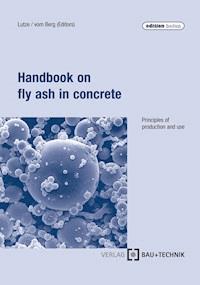
Handbook on fly ash in concrete E-Book
47,99 €
Mehr erfahren.
- Herausgeber: Verlag Bau+Technik
- Kategorie: Fachliteratur
- Sprache: Englisch
When used as an addition and binder component, fly ash has become an indispensable construction material for many concrete applications. The conditions produced in power stations when firing fine pulverized coal result in the formation of a reactive, flour-fine, pozzolanic mineral material from the accompanying rock in the coal. Owing to its specific characteristics it has a positive impact on the properties of fresh and hardened concrete and facilitates cost-effective production of high-grade, durable concretes. The authors of this handbook have combined the latest discoveries from the field of research with practical experience of the use and effects of fly ash in concrete. This handbook provides the necessary information and makes interesting suggestions for selective use of fly ash in concrete.
Das E-Book können Sie in Legimi-Apps oder einer beliebigen App lesen, die das folgende Format unterstützen:
Veröffentlichungsjahr: 2013
Ähnliche




















Lutze / vom Berg (Editors)
Handbook on fly ash in concrete
Handbook on fly ash in concrete
Principles of production and use
The team of authors
Dipl.-Ing. N. Benscheidt, DinslakenDr.-Ing. W. vom Berg, AachenDr.-Ing. H.-J. Feuerborn, EssenProf. Dr.-Ing. D. Heinz, MünchenDr.-Ing. I. Hohberg, FrankfurtDipl.-Ing. A. Hugot, DinslakenDipl.-Ing. D. Lutze, DortmundDipl.-Ing. M. Mengede, Oslo/NorwegenDipl.-Min. R. Pierkes, DüsseldorfDipl.-Ing. E. Schneider, Baden-BadenDr.-Ing. U. Wiens, Berlin
Background for the translation of the “Handbook on fly ash in concrete”
The Handbook on Fly Ash in Concrete was first published in 2003 in Germany. It is serving as an information guide for concrete producers, regulators and experts in science, technology and civil engineering regarding the properties of fly ash and the benefits of the use of fly ash as concrete addition. It compiles results of research on the use of fly ash in concrete.
In addition it describes the specific regulations in Germany on the use of fly ash in concrete. The use of fly ash in concrete developed differently in the EU member states because of the differences in already existing national concrete standards and boundary conditions. By now, it was not possible to standardize the use of fly ash in concrete in detail on the European level of standardisation. Therefore different regulations based on national experience still exist in the EU member states.
In view of the fact that the handbook on fly ash for concrete is mainly related to the German approach the members of the European Coal Combustion Product Association (ECOBA) consider it useful to provide an English translation in order to make the compiled information available to the experts across Europe and to provide a contribution to future discussions on the best use of fly ash in concrete.
Essen, April 2010ECOBA – European Coal Combustion Products AssociationHans-Joachim Feuerborn
VLB-Meldung
Lutze, Dietmar / vom Berg, Wolfgang (Editors):Handbook on fly ash in concrete Principles of production and use N. Benscheidt, W. vom Berg, H.-J. Feuerborn, D. Heinz, I. Hohberg, A. Hugot, D. Lutze, M. Mengede, R. Pierkes, E. Schneider, U. WiensTranslation of the 2nd German editionDüsseldorf: Verlag Bau+Technik GmbH, 2010
ISBN 978-3-7640-0527-6eISBN 978-3-7640-0537-5
© by Verlag Bau+Technik GmbH, Duesseldorf 2004Total production: Verlag Bau+Technik GmbH,P.O. Box 12 01 10, 40601 Duesseldorfwww.verlagbt.de
Printing: B.O.S.S Druck und Medien GmbH, 47561 Goch
Foreword to the First Edition
As an addition and a binder component, fly ash is nowadays an indispensable material for many applications of concrete. Our current level of knowledge and experience is based on a technical development that started in Germany in the mid-1960s and has been continued worldwide with intensive and extensive research work.
The conditions existing in power stations when firing pulverized coal cause a flour-fine, pozzolanic mineral material to form from the accompanying rock in the coal. Owing to its specific characteristics, it has a positive impact on the properties of fresh and hardened concrete, and enables high-grade, durable concretes to be produced in a cost-effective manner.
The use of fly ash in concrete is also highly beneficial from an economic and ecological perspective, as the smaller quantities of cement and aggregate used enable valuable resources to be conserved, energy to be saved and pollution and carbon dioxide emissions, which are unavoidable in the production of building materials, to be reduced.
In this book, the authors have combined the latest discoveries from the field of research with practical experience of the use and effects of fly ash in concrete for the user. We hope that this book delivers all the necessary information and provides interesting suggestions for the targeted use of fly ash in concrete, thus promoting the use of this valuable raw material.
Dortmund and Essen, December 2003
Dietmar LutzeDr. Wolfgang vom Berg
Foreword to the Second Edition
After five years, the results of new research into the effect of fly ash in concrete and the properties of fly ash concrete, and their implementation in the rapidly changing regulations on the production of concrete have inspired the authors to extensively revise and update the Handbook on Fly Ash in Concrete. The situation as regards standards relating to this field as of August 2008 has also been incorporated. The authors hope that this Second Edition will prove to be a helpful, practical resource for the production of concrete with fly ash in compliance with the applicable standards.
Dortmund and Aachen, August 2008
Dietmar LutzeDr. Wolfgang vom Berg
Content
Foreword to the first and second editions
1 Basic principles
1.1
Definition
1.2
Historical development
1.3
Raw materials, production and quality control of fly ash
1.3.1
Raw materials
1.3.2
Production
1.3.3
Monitoring and certification
1.4
Material properties of fly ash
1.4.1
Mineral and chemical composition
1.4.2
Physical parameters
1.4.3
Environmental and health compatibility
2 Effect of fly ash in concrete
2.1
Physical effect
2.2
Chemical effect
2.3
Properties of the pore structure
2.4
Properties of the contact zone between aggregate and hardened cement paste
3 Use of fly ash in concrete
3.1
General
3.2
Fly ash as a concrete addition
3.2.1
Requirements
3.2.2
Concrete conforming to DIN EN 206-1/DIN 1045-2
3.2.3
Concrete for concrete products
3.3
Production of concrete containing fly ash
3.3.1
Transporting, storing and conveying
3.3.2
Metering and mixing
3.3.3
Placing and processing
3.3.4
Curing and removal of formwork
3.4
Fly ash as a main constituent of cement
4 Properties of concrete containing fly ash
4.1
Fresh concrete
4.1.1
Water demand
4.1.2
Workability
4.1.3
Early stiffening
4.1.4
Setting
4.2
Hardened concrete
4.2.1
Evolution of heat of hydration and tendency to cracking
4.2.2
Strength
4.2.3
Deformation
4.2.4
Durability
4.2.5
Environmental and health compatibility
5 Special concretes and types of construction
5.1
High strength concrete
5.2
Liquid-impermeable concrete
5.3
Self compacting concrete (SCC)
5.4
Concrete with high sulfate resistance
5.5
Concrete with increased resistance to acid attack
5.6
Concrete with high resistance to freeze-thaw with and without de-icing agent
5.6.1
Concrete with high freeze-thaw resistance
5.6.2
Concrete with high resistance to freeze-thaw with de-icing agent
5.7
Sand-rich concrete
5.8
Fibre-reinforced concrete
5.9
Fair-faced concrete
5.10
Mass concrete
5.11
Dry building materials
5.12
Sprayed concrete
5.13
Recycled concrete / concrete with recycled aggregate
5.14
Concrete for road surfacing
5.15
Roller compacted concrete
5.16
Underwater concrete
5.17
Bored pile concrete / diaphragm wall concrete
5.18
Lightweight concrete
5.19
Precast concrete elements
5.20
Concrete products
5.21
Textile reinforced concrete
Appendix
1 Codes of practice
2 Guidelines
3 Standards and legal regulations
4 Members of the European Coal Combustion Products Association
1 Basic Principles
1.1 Definition
According to DIN EN 450-1 “Fly ash for concrete” [N 6], fly ash is a fine powder of mainly spherical, glassy particles derived from burning of pulverized coal. It has pozzolanic properties and consists essentially of SiO2 and Al2O3, the content of reactive SiO2 being at least 25 mass %. Fly ash is obtained by electrostatic or mechanical precipitation of dust-like particles from the flue gases of furnaces fired with pulverised coal, with or without co-combustion materials.
With the exception of one lignite fly ash approved by the building authorities, all types of fly ash used as a concrete addition in Germany have a low reactive lime content and a high reactive SiO2 content. They are known as siliceous or silicon-rich fly ash and may also come from lignite-fired power plants.
To date, calcareous fly ash (reactive CaO > 10 mass %) has not been provided for use as a concrete addition in Germany (aside from the aforementioned exception). However, according to DIN EN 197-1 [N 3], calcareous fly ash may be used as a main constituent in the production of fly ash cement CEM II/A-W or CEM II/B-W. As cements of this type are not produced as yet in Germany, and the use of calcareous fly ash as a concrete addition is also not generally permitted at the present time, this type of fly ash will not be discussed here.
In this book, fly ash should be understood to mean siliceous fly ash in accordance with DIN EN 450-1. This type of fly ash is generally obtained by firing hard coal and is therefore frequently referred to in the literature as hard coal fly ash.
Lesen Sie weiter in der vollständigen Ausgabe!
Lesen Sie weiter in der vollständigen Ausgabe!
Lesen Sie weiter in der vollständigen Ausgabe!
Lesen Sie weiter in der vollständigen Ausgabe!
Lesen Sie weiter in der vollständigen Ausgabe!
Lesen Sie weiter in der vollständigen Ausgabe!
Lesen Sie weiter in der vollständigen Ausgabe!




