


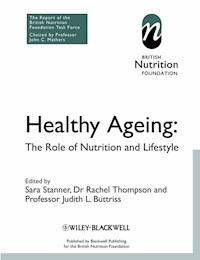
Healthy Ageing E-Book
95,99 €
Mehr erfahren.
- Herausgeber: John Wiley & Sons
- Kategorie: Fachliteratur
- Serie: British Nutrition Foundation
- Sprache: Englisch
Year on year, countries across the world continue to see an increase in life expectancy, largely attributed to the impact of modern medicine and disease eradication. There is now increasing evidence that environmental factors such as diet and lifestyle also have a significant role to play.
However with this increase in years there often comes an unfortunate rise in chronic morbidity, with the quality of later life severely compromised by ill health.
With age being the single greatest risk factor for a large proportion of common medical conditions, this latest report from the British Nutrition Foundation looks in detail at the role nutrition and physical activity can play in ensuring that the older adults of tomorrow can lead not only longer, but healthier lives.
- Written by a team of well known and respected experts
- Describes the role of diet and lifestyle in the ageing process of the major body organs and tissues including the brain, heart, gastrointestinal tract, musculoskeletal tissues, eyes, teeth and skin, as well as immune and endocrine systems
- Provides essential information for anyone involved in promoting health and quality of life for older people
- Each chapter includes a summary of the key points, as well as important recommendations to help identify long-term strategies for healthy ageing
- An overview of the main messages of the report are provided in a practical question and answer format suitable for lay readers
Full of invaluable information on a subject which is set to increase in importance as the average age of populations rise worldwide, this book is crucial reading for students of nutrition, dietetics and food science, clinical nutritionists, public health nutritionists and policy makers. It will also provide an excellent reference for those working in the food industry and for nutritional supplement manufacturers and pharmaceutical companies.
Sie lesen das E-Book in den Legimi-Apps auf:
Seitenzahl: 1289
Veröffentlichungsjahr: 2013
Ähnliche




















Contents
Foreword
Terms of Reference
British Nutrition Foundation Healthy Ageing: The Role of Nutrition and Lifestyle Task Force Membership
1 Diet and Nutrition Issues Relevant to Older Adults
1.1 Introduction
1.2 Ageing and health
1.3 Ageing, gender and ethnicity
1.4 Costs of an ageing population
1.5 Nutritional requirements of older people and current recommendations
1.6 Food patterns, nutrient intakes and nutritional status of older people
1.7 Determinants of food and nutrient intake and status in older people
1.8 Conclusions
1.9 Key points
1.10 Recommendations for future research
1.11 Key references
2 The Basic Biology of Ageing
2.1 Definitions
2.2 Current understanding of ageing and its genetic basis
2.3 Mechanisms of cellular damage
2.4 Metabolic factors affecting ageing
2.5 Energy (calorie) restriction in rodents
2.6 Early life effects
2.7 Nutrition and antioxidants
2.8 Nutrition and inflammation
2.9 Nutrigenomics
2.10 Conclusions
2.11 Key points
2.12 Recommendations for future research
2.13 Key references
3 Healthy Ageing: Teeth and the Oral Cavity
3.1 Changing oral health status with age
3.2 Impact of nutrition on oral disease
3.3 Impact of the oral environment on nutrition
3.4 Taste and smell
3.5 Texture
3.6 Key points
3.7 Recommendations for future research
3.8 Key references
4 Healthy Ageing: Bone Health
4.1 Introductory remarks
4.2 Nutritional influences on bone health
4.3 Discussion
4.4 Key points
4.5 Recommendations for future research
4.6 Key references
5 Healthy Ageing: The Joints
5.1 Introduction
5.2 The inflammatory arthropathies
5.3 Osteoarthritis
5.4 Conclusion
5.5 Key points
5.6 Recommendations for future research
5.7 Key references
6 Healthy Ageing: Skeletal Muscle
6.1 Introduction
6.2 Functions of skeletal muscle
6.3 Sarcopenia
6.4 Muscle fibre type composition and ageing
6.5 Proximal causes of age-related changes in skeletal muscle
6.6 Ageing and glucose metabolism
6.7 Protein turnover
6.8 Implications for protein requirements
6.9 Caloric restriction
6.10 The effects of physical activity/exercise
6.11 Can nutraceuticals help maintain muscle mass?
6.12 Skeletal muscle spasms with progressive ageing
6.13 Summary and recommendations
6.14 Key points
6.15 Recommendations for future research
6.16 Key references
7 Healthy Ageing: The Skin
7.1 Introduction
7.2 Skin structure and function
7.3 Intermediate metabolism
7.4 Skin research models
7.5 Vitamin D and health
7.6 Skin ageing
7.7 Nutritional influences on skin health
7.8 Vitamins essential for skin
7.9 Nutrition, UV protection and skin ageing
7.10 Nutrition and wound healing
7.11 Dietary intake and skin conditions
7.12 Gene–nutrient interactions and skin
7.13 Skin nutrition: topical or dietary?
7.14 Key points
7.15 Recommendations for future research
7.16 Key references
8 Healthy Ageing: The Brain
8.1 Introduction
8.2 Stroke
8.3 Dementia
8.4 Depression
8.5 Parkinson’s disease
8.6 Implications for research and public health
8.7 Key points
8.8 Recommendations for future research
8.9 Key references
9 Healthy Ageing: The Eye
9.1 Introduction
9.2 AMD and cataract: classic conditions of ageing?
9.3 Brief review of structure and function of the lens
9.4 Brief overview of retinal structure and function
9.5 The role of diet: evidence from epidemiological studies
9.6 Role of diet: evidence from randomised trials
9.7 Key points
9.8 Recommendations for future research
9.9 Key references
10 Healthy Ageing: The Cardiovascular System
10.1 Pathophysiology
10.2 The scale of the problem
10.3 Ageing and CVD risk
10.4 Risk factors for CVD in the general population
10.5 Age trends in CVD risk factors
10.6 Relevance of CVD risk factors after the age of 65 years
10.7 The role of dietary and nutritional factors in CVD prevention
10.8 Physical activity and CVD
10.9 The need for a life-course approach
10.10 Treating and preventing CVD in the elderly
10.11 Key points
10.12 Recommendations for future research
10.13 Key references
11 Healthy Ageing: The Immune System
11.1 Overview of the immune system
11.2 Immune changes during ageing
11.3 Genetics and immune ageing
11.4 Inflammation and ageing
11.5 Immune ageing and infections
11.6 Immune ageing and cancer
11.7 Diet and lifestyle routes to control inflammation
11.8 Nutrition and immunity
11.9 Key points
11.10 Recommendations for future research
11.11 Key references
12 Healthy Ageing: The Gastrointestinal Tract
12.1 Introduction
12.2 The oesophagus
12.3 The stomach
12.4 The small intestine
12.5 The large intestine
12.6 Key points
12.7 Recommendations for future research
12.8 Key references
13 Healthy Ageing: The Endocrine System
13.1 Introduction
13.2 The endocrine system and the effects of ageing
13.3 Effect of age-related changes in hormonal status on risk of disease
13.4 The influence of diet and physical activity on the endocrine system
13.5 Key points
13.6 Recommendations for future research
13.7 Key references
14 Taking the Science Forward: Public Health Implications
14.1 Introduction
14.2 Current trends in morbidity and quality of life
14.3 Summary of the Task Force’s findings for different organ systems
14.4 Common themes
14.5 Current trends in diet and the way forward
14.6 Current trends in physical activity and the way forward
14.7 Recommendations: life-course strategies
14.8 Key points
14.9 Key references
15 Conclusions of the Task Force
15.1 Chapter 1
15.2 Chapter 2
15.3 Chapter 3
15.4 Chapter 4
15.5 Chapter 5
15.6 Chapter 6
15.7 Chapter 7
15.8 Chapter 8
15.9 Chapter 9
15.10 Chapter 10
15.11 Chapter 11
15.12 Chapter 12
15.13 Chapter 13
15.14 Chapter 14
16 Recommendations of the Task Force
16.1 Recommendations for the research community
16.2 General recommendations to other key stakeholders
17 Healthy Ageing: Answers to Common Questions
17.1 The causes and consequences of our ageing population
17.2 The effect of ageing on diet and nutritional needs
17.3 Impact of genes vs. environmental factors on life expectancy
17.4 Ageing and oral health
17.5 Ageing and bone health
17.6 Effect of nutrient intake/status on bone health
17.7 Ageing and joint health
17.8 Ageing and muscle loss
17.9 Ageing and skin damage
17.10 Effect of lifestyle factors on stroke and cognitive function in later life
17.11 Vision problems in ageing adults
17.12 Nutrition and lifestyle factors and the ageing eye
17.13 Ageing and cardiovascular disease
17.14 Effect of diet and lifestyle on risk of cardiovascular disease
17.15 Ageing and the immune system
17.16 Ageing and the digestive system
17.17 Ageing and hormones
17.18 Dietary and lifestyle advice to promote healthy ageing
17.19 Dietary interventions and policies
Glossary
References
Index
This edition first published 2009
© 2009 British Nutrition Foundation
Blackwell Publishing was acquired by John Wiley & Sons in February 2007. Blackwell’s publishing programme has been merged with Wiley’s global Scientific, Technical, and Medical business to form Wiley-Blackwell.
Registered office
John Wiley & Sons Ltd, The Atrium, Southern Gate, Chichester, West Sussex, PO19 8SQ, United Kingdom
Editorial offices
9600 Garsington Road, Oxford, OX4 2DQ, United Kingdom
2121 State Avenue, Ames, Iowa 50014-8300, USA
For details of our global editorial offices, for customer services and for information about how to apply for permission to reuse the copyright material in this book please see our website at www.wiley.com/wiley-blackwell.
The right of the author to be identified as the author of this work has been asserted in accordance with the Copyright, Designs and Patents Act 1988.
All rights reserved. No part of this publication may be reproduced, stored in a retrieval system, or transmitted, in any form or by any means, electronic, mechanical, photocopying, recording or otherwise, except as permitted by the UK Copyright, Designs and Patents Act 1988, without the prior permission of the publisher.
Wiley also publishes its books in a variety of electronic formats. Some content that appears in print may not be available in electronic books.
Designations used by companies to distinguish their products are often claimed as trademarks. All brand names and product names used in this book are trade names, service marks, trademarks or registered trademarks of their respective owners. The publisher is not associated with any product or vendor mentioned in this book. This publication is designed to provide accurate and authoritative information in regard to the subject matter covered. It is sold on the understanding that the publisher is not engaged in rendering professional services. If professional advice or other expert assistance is required, the services of a competent professional should be sought.
Library of Congress Cataloging-in-Publication Data
Healthy ageing : the role of nutrition and lifestyle : the report of a British Nutrition Foundation task force / chaired by John C. Mathers; edited by Sara Stanner, Rachel Thompson, Judith L. Buttriss.
p. ; cm.
Includes bibliographical references and index.
ISBN 978-1-4051-7877-8 (pbk. : alk. paper) 1. Older people—Health and hygiene. 2. Older people—Nutrition. 3. Aging—Nutritional aspects. 4. Health behavior. 5. Lifestyles—Health aspects. I. Mathers, John C. II. Stanner, Sara. III. Thompson, Rachel, Dr. IV. Buttriss, Judith. V. British Nutrition Foundation. [DNLM: 1. Aging. 2. Aged. 3. Health Behavior. 4. Life Style. 5. Nutrition Physiology. WT 104 H434803 2009]
RA564.8.H456 2009
613′.0438—dc22
2008031224
A catalogue record for this book is available from the British Library.
1 2009
Foreword
Over the past couple of centuries, one of the most remarkable human achievements has been the apparently inexorable increase in life expectancy observed in most countries. For example, life expectancy of Japanese women has increased by about 40 years in the last 160 years and one in four Japanese girls born in the millennium year 2000 can expect to celebrate their 100th birthday. Sadly, in most cases the greater number of life years has brought with it more years of chronic morbidity so that much of humankind’s experience of ill health and expenditure on medical and social care (especially in Western countries) are concentrated in the later years of life. Indeed, for a large proportion of common chronic medical conditions, age is the single greatest risk factor.
This worldwide increase in lifespan is evidence of considerable malleability in the ageing process and the challenge is to understand the factors influencing ageing so that strategies which facilitate healthy ageing (maintenance of the healthy ageing phenotype) can be maximised. Emerging evidence suggests that nutrition and lifestyle may be key environmental determinants of ageing because they have profound effects on the genomic and cellular damage which appears to be the fundamental cause of reduced function and increasing frailty which characterise physiological ageing. With this background, it was very timely for the British Nutrition Foundation to set up a Task Force to assess the role of nutrition and, to a lesser extent, physical activity in ageing. After an overview of the basic biology of ageing, we opted to take a systems approach and reviewed the evidence that nutrition influenced ageing of several of the major body organs and tissues including brain, gastrointestinal tract, musculoskeletal tissues, eyes, cardiovasculature and skin as well as the immune and endocrine systems. As far as possible, we focused attention on evidence from studies in humans rather than in experimental animals. Each chapter was drafted by one or two Task Force members and then critiqued by the rest of the Task Force.
It soon became clear that we need to take a life-course approach to nutrition and ageing and that, whilst there is encouraging epidemiological evidence that dietary choices influence ageing, there is a paucity of intervention studies which have tested the impact of particular nutrients, foods or dietary patterns on ageing in general or ageing of particular body systems. The significant gaps in knowledge are highlighted as priorities for future research and we hope that these recommendations will be useful to funding agencies, as well as to researchers, as increasing attention is focused on addressing the biological, medical and social aspects of the almost universal demographic shift in the age profiles of populations. In addition, as is now usual, this Task Force Report summarises the key points of each chapter in a question and answer format and considers the practical implications for public health.
In preparation of this Task Force Report, I have been privileged to work with a very talented and enthusiastic group of experts to whom I offer my grateful thanks. In addition, on behalf of the external Task Force members, I thank the BNF scientists who, in addition to authoring a number of chapters, provided a very efficient secretariat. Their support has been invaluable.
Professor John C. Mathers
Chair of the Task Force
Terms of Reference
The Task Force was invited by the Council of the British Nutrition Foundation to:
British Nutrition Foundation Healthy Ageing: The Role of Nutrition and Lifestyle Task Force Membership
Chair:
Professor John C. Mathers, Professor of Human Nutrition, Human Nutrition Research Centre, School of Clinical Medical Sciences, University of Newcastle, Newcastle upon Tyne NE2 4HH
Members:
Professor Judith L. Buttriss
Director General
British Nutrition Foundation
High Holborn House
52–54 High Holborn
London WC1V 6RQ
Dr Robert Clarke
Reader in Epidemiology and Public Health Medicine
Clinical Trial Service Unit and Epidemiological Studies Unit
University of Oxford
Richard Doll Building, Old Road Campus
Roosevelt Drive
Oxford OX3 7LF
Professor Paul Dieppe
MRC Senior Scientist and Professor of Musculoskeletal Sciences
Nuffield Department of Orthopaedic Surgery
University of Oxford
Windmill Road
Oxford OX3 7LD
Professor Astrid E. Fletcher
Professor
Department of Epidemiology and Population Health
London School of Hygiene & Tropical Medicine
Keppel Street
London WC1E 7HT
Professor Thomas B.L. Kirkwood
Director, Institute for Ageing and Health and Centre for Integrated Systems Biology of Ageing and Nutrition
Henry Wellcome Laboratory for Biogerontology Research
Newcastle University
Campus for Ageing and Vitality
Newcastle upon Tyne NE4 SPL
Dr Susan A. Lanham-New
Reader in Nutrition
Nutritional Sciences Division
Faculity of Health and Medical Sciences
University of Surrey
Guildford GU2 7XH
Dr Nigel Loveridge
Senior Scientist, Bone Research Group (Medical Research Council)
Department of Medicine
University of Cambridge Clinical School
Addenbrooke’s Hospital (Box 157)
Cambridge CB2 2QQ
Dr Jonathan R. Powell
Unilever Corporate Research
Colworth Park
Sharnbrook
Bedford MK44 1LQ
Professor Michael J. Rennie
Professor of Clinical Physiology
University of Nottingham
School of Graduate Entry Medicine and Health
Derby City Hospital
Uttoxeter Road
Derby DE22 3DT
Professor Ian R. Rowland
Head of the Hugh Sinclair Unit of Human Nutrition
University of Reading
Whiteknights
Reading
Berkshire RG6 6AS
Ms Sara Stanner
Senior Nutrition Scientist
British Nutrition Foundation
High Holborn House
52–54 High Holborn
London WC1V 6RQ
Professor Angus Walls
Professor of Restorative Dentistry
Newcastle University
School of Dental Sciences
Framlington Place
Newcastle upon Tyne NE2 4BW
Dr Emilie A. Wilkes
Clinical Research Fellow
Graduate Entry Medical School
University of Nottingham
Derby City Hospital
Uttoxeter Road
Derby DE22 3DT
Observer:
Dr Alison Tedstone
Food Standards Agency
Aviation House
125 Kingsway
London WC2B 6NH (observer from January 2003)
Contributors:
Ms Julie M. Thompson
Unilever Corporate Research (at time of writing)
Colworth Park
Sharnbrook
Bedford MK44 1LQ
Mologic Ltd (current address)
Colworth Park
Sharnbrook
Bedford MK44 1LQ
Ms Brigid McKevith
Senior Nutrition Scientist (until 2006)
British Nutrition Foundation
High Holborn House
52–54 High Holborn
London WC1V 6RQ
Dr Linda J. Wainwright
Unilever Research and Development
Colworth Park
Sharnbrook
Bedford MK44 1LQ
Dr Martin R. Green
Unilever Research and Development
Colworth Park
Sharnbrook
Bedford MK44 1LQ
Dr Gail Jenkins
Unilever Research and Development
Colworth Park
Sharnbrook
Bedford MK44 1LQ
Dr Rosalyn J. Forsey
Unilever Corporate Research (at time of writing)
Colworth Park
Sharnbrook
Bedford MK44 1LQ
LCG Bioscience (current address)
Bourn Hall Ltd
Bourn
Cambridge CB3 7TR
Dr Graham Pawelec
Tübingen Ageing and Tumour Immunology Group
Centre for Medical Research, ZMF
University of Tübingen Medical School
Waldhornlestrasse 22
D-72072 Tübingen
Germany
External reviewer:
Professor Stuart Milligan
Professor of Reproductive Biology
Room 2.11N Hodgkin Building
King’s College London
Guy’s Campus
London Bridge
London SEI 1UL
Editors:
Ms Sara Stanner
Senior Nutrition Scientist
British Nutrition Foundation
High Holborn House
52–54 High Holborn
London WC1V 6RQ
Dr Rachel Thompson
Senior Nutrition Scientist
British Nutrition Foundation
High Holborn Hous
52–54 High Holborn
London WC1V 6RQ
Professor Judith L. Buttriss
Director General
British Nutrition Foundation
High Holborn House
52–54 High Holborn
London WC1V 6RQ
Secretariat:
Ms Brigid McKevith
Senior Nutrition Scientist (until 2006)
British Nutrition Foundation
High Holborn House
52–54 High Holborn
London WC1V 6RQ
Ms Heather Caswell
Research Assistant
British Nutrition Foundation
High Holborn House
52–54 High Holborn
London WC1V 6RQ
1
Diet and Nutrition Issues Relevant to Older Adults
1.1 Introduction
This Task Force Report aims to identify steps that can be taken from a nutritional perspective to help the older adults of tomorrow to lead healthier lives. Subsequent chapters will discuss:
the basic biology of ageing;
the effect of ageing on a range of different organ systems and how a life-course food and nutrition approach, together with regular physical activity, may minimise or delay these effects; and
public health recommendations and approaches that should be undertaken to improve the health of future older adults.
This first chapter sets the scene. It provides some details of the demographics of ageing and describes current patterns of ageing and health. It highlights some of the diet and nutrition issues relevant to today’s older adults, many of which will be expanded in subsequent chapters.
Within this Task Force Report, definitions from the World Health Organization (WHO) are used; that is ‘older’ refers to a person aged 65 years or over and the ‘oldest old’ refers to those aged 80 years or over. However, it is important to recognise that definitive categorisation of older people is difficult, as ‘old’ is an individual-, culture-, country- and gender-specific term. For example, in developing countries many people are functionally ‘old’ in their forties and fifties (World Health Organization 2001). This means that older adults are a very heterogeneous group.
1.1.1 Demographics
Over the past hundred years many changes have impacted on people’s lives. In some parts of the world during this time, life expectancy has almost doubled, at the same time fertility rates have declined, leading to changes in the demographics of the population.
Population ageing (characterised by a decline in the proportion of children and young people and an increase in the proportion of older people) has, until recently, been associated with the more developed regions of the world. For example, nine out of the ten countries with more than 10 million inhabitants, and with the largest proportion of older people, are in Europe (World Health Organization 2002a). However, the number of older people living in less developed regions is expected to increase from ~400 million.
1.1.1.1 Worldwide
The number of older people is set to increase (Figure 1.1), although it is important to note that the proportion of older people within the total population varies widely among countries e.g. from about 4% in Cambodia to around 14% in Japan in 2004 (World Health Organization Regional Office for the Western Pacific Region). From 1970 to 2025, a 223% growth in older adults is expected worldwide, so by 2025 there will be ~1.2 billion people over the age of 60. Decreasing fertility rates and increasing longevity will ensure the continued ‘greying’ of the world’s population, despite setbacks in life expectancies in some African countries (due to AIDS) and in some newly independent states (due, for example, to increased deaths caused by cardiovascular disease and by violence).
Figure 1.1: World population by age groups, 1950–2050.
Source: United Nations Population Division, World Population Prospects: The 2006 Revision. Fact Sheet. Series A. New York: United Nations Department of Economic and Social Affairs, March 2007.
Over half the world’s older people live in Asia and it is expected that Asia’s share of the world’s oldest people will continue to increase by the greatest amount. For example, it is projected that, by 2025, the proportion of older adults in Japan will increase to 26% of the population, and in China from 6.5% to 12% (World Health Organization Regional Office for the Western Pacific Region).
In 2002, globally, people over the age of 80 numbered ~69 million, the majority of whom lived in more developed regions of the world. This age group is the fastest growing segment of the older population (World Health Organization 2002a), owing to increased longevity, and is expected to increase with the post-Second World War baby-boom generation approaching their sixties (Ministry of Health 2002).
1.1.1.2 The UK
As in many other developed countries, life expectancy in the UK has continued to rise (Figure 1.2). In 1901, life expectancy at birth for females was 49 years and for males 45 years, whereas by 2002 life expectancy had risen to 81 and 76 years respectively. Consequently, the number of older people in the UK is increasing. The proportion of people aged 50 years or over has increased from 16 million in 1961 to 19.8 million people in 2002, a 24% increase. It is estimated that this number will continue to increase, with an estimated 27 million people aged 50 years or over by 2031 (National Statistics Online 2004) (see also Chapter 14, Section 14.1).
Lesen Sie weiter in der vollständigen Ausgabe!
Lesen Sie weiter in der vollständigen Ausgabe!
Lesen Sie weiter in der vollständigen Ausgabe!
Lesen Sie weiter in der vollständigen Ausgabe!
Lesen Sie weiter in der vollständigen Ausgabe!
Lesen Sie weiter in der vollständigen Ausgabe!
Lesen Sie weiter in der vollständigen Ausgabe!
Lesen Sie weiter in der vollständigen Ausgabe!
Lesen Sie weiter in der vollständigen Ausgabe!
Lesen Sie weiter in der vollständigen Ausgabe!
Lesen Sie weiter in der vollständigen Ausgabe!
Lesen Sie weiter in der vollständigen Ausgabe!
Lesen Sie weiter in der vollständigen Ausgabe!
Lesen Sie weiter in der vollständigen Ausgabe!
Lesen Sie weiter in der vollständigen Ausgabe!
Lesen Sie weiter in der vollständigen Ausgabe!
Lesen Sie weiter in der vollständigen Ausgabe!
Lesen Sie weiter in der vollständigen Ausgabe!
Lesen Sie weiter in der vollständigen Ausgabe!
Lesen Sie weiter in der vollständigen Ausgabe!
Lesen Sie weiter in der vollständigen Ausgabe!




