


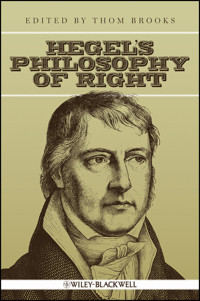
Hegel's Philosophy of Right E-Book
27,99 €
Mehr erfahren.
- Herausgeber: John Wiley & Sons
- Kategorie: Geisteswissenschaft
- Sprache: Englisch
Hegel's Philosophy of Right presents a collection of new essays by leading international philosophers and Hegel scholars that analyze and explore Hegel's key contributions in the areas of ethics, politics, and the law. * The most comprehensive collection on Hegel's Philosophy of Right available * Features new essays by leading international Hegel interpreters divided in sections of ethics, politics, and law * Presents significant new research on Hegel's Philosophy of Right that will set a new standard for future work on the topic
Sie lesen das E-Book in den Legimi-Apps auf:
Seitenzahl: 438
Veröffentlichungsjahr: 2011
Ähnliche




















Contents
Cover
Title Page
Copyright
Notes on Contributors
Acknowledgments
Introduction
1 Background
2 The Philosophy of Right: New Essays, New Insights
References
Part I: Ethics
Chapter 1: Consequentialism and Deontology in the Philosophy of Right
1
2
3
4
5
6
7
References
Chapter 2: The Empty Formalism Objection Revisited: §135R and Recent Kantian Responses
1 Empty Formalism in the Philosophy of Right
2 Kantian Reply Strategies
Acknowledgments
Abbreviations
References
Chapter 3: On Hegel's Critique of Kant's Ethics: Beyond the Empty Formalism Objection
1 Hegel's Empty Formalism Objection and the Concessive Kantian Response
2 Hegel's Intuitionism: Against a “Supreme Principle of Morality”
3 Kant on the Supreme Principle of Morality: Socratic or Pythagorean?
4 Kant and Hegel: A Reconciliation?
Acknowledgments
Abbreviations
References
Part II: Politics
Chapter 4: Hegel and the Unified Theory of Punishment
1 Introduction
2 The Key Idea
3 Punishment in the Philosophy of Right
4 The Reception amongst British Idealists
5 The Prospects of a Unified Theory of Punishment
References
Chapter 5: Hard Work: Hegel and the Meaning of the State in his Philosophy of Right
1 Reading the Philosophy of Right
2 The Terms of Ethical Life
3 The Hard Work of Freedom
4 Conclusion
References
Chapter 6: Gender, the Family, and the Organic State in Hegel's Political Thought
1 Women's Place in the Hegelian State
2 The Organic State and Individual Freedom
3 Tensions in the Organic Model: For and Against Sex Equality
4 Animal State, Vegetal State: Hegel versus Early German Romanticism
Abbreviations
References
Part II: Law
Chapter 7: Natural Law Internalism
1 Introduction
2 Classical Natural Law
3 Modern Natural Law
4 Hegel's Natural Law Internalism
5 Natural Law Internalism or Externalism?
6 Conclusion
References
Chapter 8: Hegel on the Relation between Law and Justice
1 Introduction
2 The Ideal Form of Mutual Recognition
3 Hegel's State of Nature
4 De Facto Authority
5 De Jure Authority
6 Legitimate Authority
7 Constitutional Authority
8 Conclusion
References
Index
This edition first published 2012
© 2012 Blackwell Publishing Ltd
Blackwell Publishing was acquired by John Wiley & Sons in February 2007. Blackwell's publishing program has been merged with Wiley's global Scientific, Technical, and Medical business to form Wiley-Blackwell.
Registered Office
John Wiley & Sons Ltd, The Atrium, Southern Gate, Chichester, West Sussex, PO19 8SQ, United Kingdom
Editorial Offices
350 Main Street, Malden, MA 02148-5020, USA
9600 Garsington Road, Oxford, OX4 2DQ, UK
The Atrium, Southern Gate, Chichester, West Sussex, PO19 8SQ, UK
For details of our global editorial offices, for customer services, and for information about how to apply for permission to reuse the copyright material in this book please see our website at www.wiley.com/wiley-blackwell.
The right of Thom Brooks to be identified as the editor of the editorial material in this work has been asserted in accordance with the UK Copyright, Designs and Patents Act 1988.
All rights reserved. No part of this publication may be reproduced, stored in a retrieval system, or transmitted, in any form or by any means, electronic, mechanical, photocopying, recording or otherwise, except as permitted by the UK Copyright, Designs and Patents Act 1988, without the prior permission of the publisher.
Wiley also publishes its books in a variety of electronic formats. Some content that appears in print may not be available in electronic books.
Designations used by companies to distinguish their products are often claimed as trademarks. All brand names and product names used in this book are trade names, service marks, trademarks or registered trademarks of their respective owners. The publisher is not associated with any product or vendor mentioned in this book. This publication is designed to provide accurate and authoritative information in regard to the subject matter covered. It is sold on the understanding that the publisher is not engaged in rendering professional services. If professional advice or other expert assistance is required, the services of a competent professional should be sought.
Library of Congress Cataloging-in-Publication Data
Hegel's Philosophy of right / edited by Thom Brooks.
p. cm.
Includes bibliographical references and index.
ISBN 978-1-4051-8813-5 (hardcover : alk. paper)
1. Hegel, Georg Wilhelm Friedrich, 1770-1831. 2. Hegel, Georg Wilhelm Friedrich, 1770-1831.
Grundlinien der Philosophie des Rechts. 3. Law–Philosophy. 4. Natural law. 5. State, The. 6. Ethics. 7.
Political science. I. Brooks, Thom.
K230.H43.A647 2012
340'.1–dc23
2011024993
A catalogue record for this book is available from the British Library.
This book is published in the following electronic formats: ePDFs 9781444354225; Wiley Online
Library 9781444354256; ePub 9781444354232; Mobi 9781444354249
Notes on Contributors
Thom Brooks is Reader in Political and Legal Philosophy at Newcastle University. He is editor and founder of the Journal of Moral Philosophy. His research interests are in British and German Idealism, democratic theory, global justice, punishment, and theories of justice. He is the author of Hegel's Political Philosophy: A Systematic Reading of the Philosophy of Right (2007) and Punishment (2012) and editor of several books, including Rousseau and Law (2005), The Global Justice Reader (2008), The Right to a Fair Trial (2009), New Waves in Ethics (2011), and Punishment (forthcoming). He is currently editing a collection, Rawls's Political Liberalism, with Martha C. Nussbaum.
Alan Brudner is Albert Abel Professor of Law and Professor of Political Science at the University of Toronto. He is the author of Punishment and Freedom (2009), Constitutional Goods (2004), and The Unity of the Common Law: Studies in Hegelian Jurisprudence (1995), as well as articles on a variety of topics in legal and political theory.
Fabian Freyenhagen is Lecturer in Philosophy at the University of Essex. His research interests are in moral and political philosophy as well as in modern European philosophy (especially Kant and Adorno). He is co-investigator in the AHRC-funded Essex Autonomy Project and has published in journals such as Kantian Review and Inquiry.
Kimberly Hutchings is Professor of International Relations at the London School of Economics. She is the author of Kant, Critique and Politics (1996), International Political Theory: Re-thinking Ethics in a Global Era (1999), Hegel and Feminist Philosophy (2003), Time and World Politics: Thinking the Present (2008), and Global Ethics: An Introduction (2010). She is also the co-editor, with Tuija Pulkkinen, of Hegel and Feminist Thought: Beyond Antigone? (2010). Her interests include the work of Kant and Hegel; international, feminist, and postcolonial ethical and political theory; and politics and violence. She is currently working on a series of co-written papers (with Elizabeth Frazer) on conceptions of the relation between politics and violence in the western tradition of political thought.
Dean Moyar is Associate Professor in the Department of Philosophy at Johns Hopkins University. He received his B.S. from Duke University and his Ph.D. from the University of Chicago. His essays have appeared in the Journal of Moral Philosophy and Hegel-Studien, among other journals. He is the co-editor (with Michael Quante) of Hegel's Phenomenology of Spirit: A Critical Guide (2007), the editor of The Routledge Companion to Nineteenth Century Philosophy (2010), and the author of Hegel's Conscience (2011).
Robert Stern is Professor of Philosophy at the University of Sheffield. He is the author of Hegel, Kant, and the Structure of the Object (1990) and Hegel and the “Phenomenology of Spirit” (2002), as well as of numerous papers, many of which appear in his collection Hegelian Metaphysics (2009).
Alison Stone is Senior Lecturer in Philosophy at Lancaster University and is the author of Petrified Intelligence: Nature in Hegel's Philosophy (2004), Luce Irigaray and the Philosophy of Sexual Difference (2006) and An Introduction to Feminist Philosophy (2007). She is currently working on a book on Feminism, Psychoanalysis, and Maternal Subjectivity, which is forthcoming.
Acknowledgments
There are several debts accumulated in the production of this collection of essays that must be recorded. First of all, my most sincere thanks must go to Nick Bellorini for his strong support of the project since the beginning, which has been crucial, as well as for his excellent advice. I must also express my special thanks to Jeff Dean and Tiffany Mok for their help at several points and, most especially, for their patience as this collection came together. My largest thanks must go to the contributors to this important volume for what are, in my view, genuinely outstanding essays that deepen and broaden our knowledge of one of philosophy's most important texts. This volume is dedicated to them – Alan, Alison, Dean, Fabian, Kimberly, and Robert – for making it all that it is. Finally, I must note that research on this book benefited from my term of research leave at both Newcastle University and the University of Oxford.
Thom BrooksOxford
Introduction
Thom Brooks
G. W. F. Hegel's Philosophy of Right is widely acknowledged as one of the most important texts in the history of moral and political philosophy. It has exercised a direct influence on several philosophical movements, such as British Idealism, communitarianism, critical theory, and Marxism. Its influence continues today through the work of several leading figures, such as Axel Honneth, John Rawls, and Charles Taylor. Hegel's Philosophy of Right aspires to provide the most significant collection of essays in recent years on this important text, breaking new ground across the areas of ethics, politics, and law from both historical and contemporary perspectives. This introduction will discuss the background to this project, the general arguments of Hegel's Philosophy of Right, and the essays included in the volume.
1 Background
Hegel's Philosophy of Right has received significant attention in previous important work. Perhaps the leading classic collection of essays on the Philosophy of Right was edited by Z. A. Pelczynski in his Hegel's Political Philosophy: Problems and Perspectives (1971a). This collection contained now classic essays exploring Hegel's views on ethics, punishment, the state, war, and much more (see Cooper 1971; Ilting 1971; Pelczynski 1971a, 1971b, 1971c; Shklar 1971; Verene 1971). Moreover, wide-ranging work set a clear bar for all work following afterward.
There has been excellent work since Pelczynski's collections which I do not have the space to survey here, although work since has tended to have a more narrow focus whether it is on Hegel's ethics, politics, or law. The present book is the first to speak substantively to these three areas in its pages and for good reason. The Philosophy of Right is not merely a book that addresses ethics, politics, and law, but whose analysis is deeply interwoven with elements of each area that speak to other areas. It is therefore difficult to substantively address even the majority of the Philosophy of Right and its rich array of arguments by only focusing on one particular area to the exclusion of others. While this book may not address all topics, it does seek to speak across a wide range of areas concerning Hegel's Philosophy of Right and to cover new ground.
2 The Philosophy of Right: New Essays, New Insights
The full title of Hegel's text is Groundwork of the Philosophy of Right or Natural Law and Political Science in Outline (Grundlinien der Philosophie des Rechts oder Naturrecht und Staatswissenschaft im Grundrisse). This title illustrates the nature of this text: the Philosophy of Right is composed of outlines to Hegel's lectures for use by his students. His first lectures on ethics and politics took place during his time in Heidelberg in 1817–1818. Hegel then moved to Berlin where he lectured on these topics again in the 1818/1819 and 1819/1820 academic years before publishing his lecture outlines in 1821. It was published during a turbulent time where there was academic suppression by the then Prussian authorities, for which some contemporaries wrongly accused Hegel of supporting.1
The essays in this volume are divided into three sections: ethics, politics, and law. The idea is that the collection will have significant, but also provide sufficient, breadth in the range of topics treated covering a wide variety of the Philosophy of Right's contents. These new essays each offer us new insights into this important work in particular and philosophical discussions more generally.
The first section focuses on ethics with contributions by Dean Moyar, Fabian Freyenhagen, and Robert Stern. Moyar addresses the relationship of Hegelian ethics with contemporary debates in value theory such as that between deontologists and consequentialists. He argues that Hegel's Philosophy of Right has much in common with the latter over the former (although this is not to deny several deontological “side constraints” that are also present). In fact, Hegel's value theory is both consequentialist and deontological even if consequentialist considerations may hold a certain priority.
Both Freyenhagen and Stern address the so-called “empty formalism” objection that Hegel directs at Immanuel Kant's moral philosophy. This is perhaps the most well-known criticism of Kant and the essays included here attempt to move the debate in new directions. Freyenhagen claims that the debate has thus far ended in a stalemate. He envisages several Kantian reply strategies to Hegel's criticism in a philosophical boxing match where Hegelians win a split decision on points. Stern argues that, in fact, it might be possible to bring peace to both sides in a perhaps uneasy truce. Thus, Kant's position may be made more compatible with the form of intuitionism favored by Hegel and, if so, resolve hostilities in a possible reconciliation between them.
The second section focuses on politics, with contributions by Thom Brooks, Kimberly Hutchings, and Alison Stone. Brooks argues not simply that past interpreters of Hegel's theory of punishment have mischaracterized it, but that Hegel offers a new and compelling theory called the unified theory of punishment (see Brooks 2010; forthcoming). Interpreters have previously believed that Hegel offers a retributivist theory of punishment. This view fails to consider the multifaceted nature of Hegel's penal theory. He does not merely claim that punishment should be meted only on the deserving in proportion to their wrong, not unlike many retributivist accounts, but he also claims that punishment can incorporate deterrent, rehabilitative, and expressivist elements in a unified account. This fact was not lost on British Idealists who tried to develop the unified theory of punishment further in the late nineteenth century. This view of punishment is compelling because it helps us better understand how we might provide a theory of punishment that can contain different principles of punishing within a new and coherent framework. There is a need for such a coherent theory in light of the Model Penal Code. This Code is widely influential in helping judges determine sentences, but it has often been criticized for lacking a coherent theory of how its different principles may be brought safely together. Hegel's unified theory of punishment is a welcome step in the right direction by offering just such a useful account.
Hutchings focuses on the different dimensions of ethical life present in Hegel's Philosophy of Right. These dimensions are explored with a view to interrelationship of logic, history, and practice in his political thought. She argues that we should take Hegel's historicism seriously in the interpretation of his work. This permits us to best assess how Hegel's work speaks to many of our contemporary dilemmas concerning political organization and the hard work of freedom in a fruitful and revealing way.
Stone considers Hegel's understanding of the family, an area of his work that has gone less explored. She notes a clear tension in Hegel's treatment. On the one hand, Hegel posits that all citizens should have opportunities for full participation in their political communities. On the other hand, this participatory sphere appears reserved for men alone. Stone argues that this latter denial of full opportunities to women is not an accident, but follows from core elements in Hegel's political philosophy. This need not mean that his philosophy is irredeemably sexist, but rather points toward the need to imagine anew his organic conception of the state in order to best spell out its egalitarian elements. Hegel's philosophy can address this problem after all, but only if we focus more clearly on the relationship between his political philosophy and his work on the philosophy of nature concerning organicism.
The third and final section focuses on law, with contributions by Thom Brooks and Alan Brudner. Brooks's essay concerns Hegel's philosophy of law. While many commentators agree that Hegel's legal philosophy was a form of natural law, they have largely failed to recognize the significant differences that Hegel introduces. Natural lawyers claim that some laws may be understood as better (or more “true”) than others in relation to how well they cohere with a standard of justice. Of course, there is deep disagreement on how we determine the standard of justice. Nevertheless, all determine this standard and then apply it to help us analyze law. Hegel accepts that some laws and legal systems may be better than others according to a standard of justice. The crucial difference is that his natural law is internalist while the natural law of others is externalist. Others have a natural law externalist theory because they apply a standard of justice whose origins are external to the law. Hegel's natural law internalism is different in that the standard of justice employed is internal to law. Brooks then considers the many merits of this novel understanding of law before bowing before its demerits. The chief demerit is that it is unclear whether Hegel's natural law internalism can determine internal standards of justice with safety without spelling these standards out in advance: how can we be sure we do not find what we are looking for?
This ambiguity in Hegel's work about the relation between law and justice concerns Brudner as well. Brudner turns his attention to the question of whether Hegel systematically addresses the question of whether the concept of law does (or does not) entail the justice of law. While Hegel may appear to give several contradictory answers, we can make good progress. Brudner highlights the importance of mutual recognition and its development. Legal authority has its roots in the idea of mutual recognition: authority gains its existence from the character of recognition subjects voluntarily agree to offer. De facto authority is a worse form of authority because it fails to attract the voluntary mutual recognition as an authority from its subjects. The possibility of mutual recognition speaks to the importance of several different procedural elements of legality, such as generality, publicity, and clarity, that help secure recognition. There is then a different kind of inner morality from that of Lon Fuller (1969). Brudner argues that Hegel's legal thought contains resources within itself to critique authority's jurisprudential authority without the need to invoke an external standard of justice, in contrast to most other accounts of natural law. Ultimately, Hegel's legal thought positions itself in a space between that occupied by many natural lawyers and legal positivists offering an attractive picture of how we may better understand legal authority.
Together, these essays aspire to improve our understanding of Hegel's seminal Philosophy of Right across a broad range of topics to a new standard. Each is written for advanced students and scholars of Hegel's philosophy largely (but not exclusively) focusing on the Anglophone literature on Hegelian philosophy.
Abbreviations
ELG. W. F. Hegel, Elements of the Philosophy of Right, ed. Allen W. Wood, trans. H. B. Nisbet. Cambridge: Cambridge University Press, 1991.PRG. W. F. Hegel, The Encyclopaedia Logic: Part I of the Encyclopaedia of Philosophical Sciences with the Zuslsquätze, trans. T. F. Geraets, W. A. Suchting, and H. S. Harris. Indianapolis: Hackett, 1991.Note
1. Such accusations were levied by contemporaries such as Jakob Friedrich Fries and much criticism centered on Hegel's well-known saying, “What is rational is actual; and what is actual is rational” (PR 20). For helpful analyses of this saying, see EL and Stern 2006. For a useful discussion of the relevant historical context, see Pinkard 2001.
References
Brooks, Thom (2010) “Punishment and British Idealism.” In Jesper Rybergand J. Angelo Corlett, eds., Punishment and Ethics: New Perspectives. Basingstoke: Palgrave Macmillan, pp. 16–32.
Cooper, David E. (1971) “Hegel's Theory of Punishment.” In Z. A. Pelczynski, ed., Hegel's Political Philosophy: Problems and Perspectives. Cambridge: Cambridge University Press, pp. 151–167.
Fuller, Lon L. (1969) The Morality of Law, rev. edn. New Haven: Yale University Press.
Ilting, K.-H. (1971) “The Structure of Hegel's Philosophy of Right.” In Z. A. Pelczynski, ed., Hegel's Political Philosophy: Problems and Perspectives. Cambridge: Cambridge University Press, pp. 90–110.
Pelczynski, Z. A., ed. (1971a) Hegel's Political Philosophy: Problems and Perspectives. Cambridge: Cambridge University Press.
Pelczynski, Z. A. (1971b) “The Hegelian Conception of the State.” In Pelczynski 1971a: 1–29.
Pelczynski, Z. A. (1971c) “Hegel's Political Philosophy: Some Thoughts on its Contemporary Relevance.” In Pelczynski 1971a: 230–241.
Pinkard, Terry (2001) Hegel: A Biography. Cambridge: Cambridge University Press.
Shklar, Judith N. (1971) “Hegel's Phenomenology: An Elegy for Hellas.” In Pelczynski 1971a: 73–89.
Stern, Robert (2006) “ Hegel's Doppelsatz: A Neutral Reading.” Journal of the History of Philosophy 44: 235–266.
Verene, D. P. (1971) “Hegel's Account of War.” In Pelczynski 1971a: 168–180.
Part I
Ethics
Chapter 1
Consequentialism and Deontology in the Philosophy of Right
Dean Moyar
1
Hegel's philosophy resists our familiar ways of categorizing theories. This resistance presents a challenge for viewing Hegel through a contemporary lens, but it hardly prevents us from asking where his views fit within contemporary debates. Since conceptual distinctions are the way in which we understand the meaning of a position, a theory in which no distinctions could get a grip would be uninteresting and perhaps even unintelligible. Hegel himself appreciates this point very well, and he is among the tradition's most strident critics of the kind of philosophy of identity in which distinctions and oppositions are completely washed out. Though his conceptions of the Absolute Idea and Absolute Spirit do incorporate and thus in some sense overcome fundamental oppositions, Hegel has a place for many of our familiar philosophical distinctions within (and indeed as constitutive of the boundary between) the conceptual levels that characterize each part of his overall system.
Lesen Sie weiter in der vollständigen Ausgabe!
Lesen Sie weiter in der vollständigen Ausgabe!
Lesen Sie weiter in der vollständigen Ausgabe!
Lesen Sie weiter in der vollständigen Ausgabe!
Lesen Sie weiter in der vollständigen Ausgabe!
Lesen Sie weiter in der vollständigen Ausgabe!
Lesen Sie weiter in der vollständigen Ausgabe!
Lesen Sie weiter in der vollständigen Ausgabe!
Lesen Sie weiter in der vollständigen Ausgabe!
Lesen Sie weiter in der vollständigen Ausgabe!




