


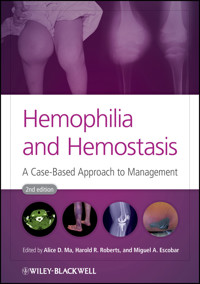
Hemophilia and Hemostasis E-Book
85,99 €
Mehr erfahren.
- Herausgeber: John Wiley & Sons
- Kategorie: Fachliteratur
- Sprache: Englisch
There is a general need amongst healthcare professionals for practical advice on the management of patients with bleeding disorders. This book is an essential resource for all those working in the fields of coagulation, hemostasis and thrombosis. It covers the major cases one might encounter in diagnosing, managing and treating hemophilia and hemostasis. It provides a practical and informative guide to the broad range of topics concerning both bleeding and clotting disorders.
The book is divided into major chapter sections depending on the type of bleeding disorder it fits into. Each chapter includes a brief overview of the disorder covering: history of the disorder; molecular basis of the disorder; class presentation; genetics; current laboratory tests and monitoring. Cases associated with each disorder are presented alongside practical questions and answers from a wide range of contributors. As practice can vary from center to center, controversial areas are clearly marked and discussed throughout.
New to this edition: coverage of the newer techniques; newer treatment modalities; new oral anticoagulants; update on hemophilia management; more on ITP and greater coverage of new cases as suggested by reviewers.
Sie lesen das E-Book in den Legimi-Apps auf:
Seitenzahl: 226
Veröffentlichungsjahr: 2012
Ähnliche




















Contents
Contributors
Foreword
PART 1 Hemophilia A and Hemophilia B
SECTION I General Overview
INTRODUCTION 1 The Hemophilic Ankle: An Update
Pathogenesis of synovitis and cartilage damage in hemophilia: experimental studies
Radiosynovectomy
Hemophilic arthropathy of the ankle and subtalar joints
Rehabilitation and physiotherapy
Conclusions
INTRODUCTION 2 The Hemophilic Knee: An Update
Joint aspiration (arthrocentesis)
Conclusions
SECTION II Hemophilia with Inhibitors
CASE STUDY 1 Inhibitor Patient Requiring High Dose Therapy with rVIIa as well as Sequential Therapy with FEIBA
CASE STUDY 2 Prophylactic Therapy in a Patient with a High Titer Inhibitor
CASE STUDY 3 Immune Tolerance Induction
CASE STUDY 4 Monitoring During Immune Tolerance Induction
CASE STUDY 5 Factor IX Inhibitors
CASE STUDY 6 Severe Hemophilia B with High Response Inhibitor and Anaphylactic Reaction to Factor IX
CASE STUDY 7 Inhibitor Patient and Dental Surgery
SECTION III Hemophilic Treatment for Procedures
CASE STUDY 8 Deep Vein Thrombosis Prophylaxis in Patients with Hemophilia A Undergoing Orthopedic Surgery
CASE STUDY 9 Prostate Surgery and Hemophilia
CASE STUDY 10 Mild Hemophilia and Intraocular Injections
CASE STUDY 11 Endoscopy/Colonoscopy and Hemophilia
CASE STUDY 12 Dialysis and Hemophilia
CASE STUDY 13 Circumcision
CASE STUDY 14 Pharmacokinetic Studies for Surgery
CASE STUDY 15 Compartment Syndrome
CASE STUDY 16 Successful Eradication of Factor VIII Inhibitor in Patient with Mild Hemophilia A Prior to Hemipelvectomy for Extensive Hemophilic Pseudotumor
CASE STUDY 17 Coronary Artery Disease and Hemophilia
CASE STUDY 18 Valve Replacement and Hemophilia
SECTION IV Treatment for Other Conditions
CASE STUDY 19 Thyroid Biopsy and Hemophilia
CASE STUDY 20 Atrial Fibrillation and Bleeding Disorders
CASE STUDY 21 Chronic Upper Gastrointestinal Bleeding and Hemophilia
CASE STUDY 22 Hematuria
SECTION V Other Issues in Hemophilia Care
CASE STUDY 23 Reproductive Options for Hemophilia A Carriers
CASE STUDY 24 Mild Hemophilia A with Discrepant FVIII Activity Levels
SECTION VI Compound Diagnoses
CASE STUDY 25 Hemophilia A with Tuberous Sclerosis and CNS Bleed
CASE STUDY 26 Familial Risk Assessment for Individuals with Hemophilia A and von Willebrand Disease
CASE STUDY 27 Hemophilia A and Hereditary Hemorrhagic Telangiectasia
PART II von Willebrand Disease
SECTION I Management during Procedures
CASE STUDY 28 Type 1 von Willebrand Disease and Tonsillectomy
CASE STUDY 29 von Willebrand Disease and Dental Surgery
CASE STUDY 30 von Willebrand Disease and Gastrointestinal Surgery
Gynecologic and Obstetric Considerations: von Willebrand Disease and Obstetric/Gynecologic Procedures
SECTION II Rare Forms of von Willebrand Disease
CASE STUDY 31 Type 2A von Willebrand Disease and Recurrent Gastrointestinal Bleeding
CASE STUDY 32 Type 2B von Willebrand Disease and Thoracic Surgery
CASE STUDY 33 von Willebrand Disease 2N
PART III Other Bleeding Disorders
CASE STUDY 34 Prothrombin Deficiency
CASE STUDY 35 Factor V Deficiency
CASE STUDY 36 Factor VII Deficiency
CASE STUDY 37 Factor X Deficiency
CASE STUDY 38 Factor XI Deficiency
CASE STUDY 39 Factor XIII Deficiency
CASE STUDY 40 Combined Factor V and Factor VIII Deficiency
CASE STUDY 41 Glanzmann Thrombaesthenia
CASE STUDY 42 Gardner–Diamond Syndrome and von Willebrand Disease
CASE STUDY 43 Qualitative Platelet Disorder
PART IV Acquired Bleeding Disorders
CASE STUDY 44 Acquired FVIII Inhibitor and B Cell Neoplasm
CASE STUDY 45 FVIII Inhibitor and Lupus Inhibitor
CASE STUDY 46 Acquired von Willebrand Disease
CASE STUDY 47 A Woman with Bleeding Gums
CASE STUDY 48 Bleeding after Cardiac Surgery
CASE STUDY 49 Bleeding in a Dialysis Patient
CASE STUDY 50 A Woman with Anemia and Hematuria
CASE STUDY 51 Scalp Bleeding in an Older Gentleman
CASE STUDY 52 Hyperfibrinolysis
PART V Thrombotic Disorders
CASE STUDY 53 Heparin-Induced Thrombocytopenia with Thrombosis
CASE STUDY 54 Heparin Skin Necrosis
CASE STUDY 55 Warfarin Skin Necrosis
CASE STUDY 56 Thoracic Outlet Syndrome
CASE STUDY 57 Antithrombin Deficiency
CASE STUDY 58 May–Thurner Syndrome
CASE STUDY 59 Thrombosis in a Liver Transplant Patient
CASE STUDY 60 Combined Thrombophilia
Index
This edition first published 2013, © 2007, 2013 by John Wiley & Sons Limited.
Wiley-Blackwell is an imprint of John Wiley & Sons, formed by the merger of Wiley’s global Scientific, Technical and Medical business with Blackwell Publishing.
Registered Office: John Wiley & Sons, Ltd, The Atrium, Southern Gate, Chichester, West Sussex, PO19 8SQ, UK
Editorial Offices: 9600 Garsington Road, Oxford, OX4 2DQ, UKThe Atrium, Southern Gate, Chichester, West Sussex, PO19 8SQ, UK111 River Street, Hoboken, NJ 07030-5774, USA
For details of our global editorial offices, for customer services and for information about how to apply for permission to reuse the copyright material in this book please see our website at www.wiley.com/wiley-blackwell
The right of the author to be identified as the author of this work has been asserted in accordance with the UK Copyright, Designs and Patents Act 1988.
All rights reserved. No part of this publication may be reproduced, stored in a retrieval system, or transmitted, in any form or by any means, electronic, mechanical, photocopying, recording or otherwise, except as permitted by the UK Copyright, Designs and Patents Act 1988, without the prior permission of the publisher.
Designations used by companies to distinguish their products are often claimed as trademarks. All brand names and product names used in this book are trade names, service marks, trademarks or registered trademarks of their respective owners. The publisher is not associated with any product or vendor mentioned in this book. This publication is designed to provide accurate and authoritative information in regard to the subject matter covered. It is sold on the understanding that the publisher is not engaged in rendering professional services. If professional advice or other expert assistance is required, the services of a competent professional should be sought.
The contents of this work are intended to further general scientific research, understanding, and discussion only and are not intended and should not be relied upon as recommending or promoting a specific method, diagnosis, or treatment by physicians for any particular patient. The publisher and the author make no representations or warranties with respect to the accuracy or completeness of the contents of this work and specifically disclaim all warranties, including without limitation any implied warranties of fitness for a particular purpose. In view of ongoing research, equipment modifications, changes in governmental regulations, and the constant flow of information relating to the use of medicines, equipment, and devices, the reader is urged to review and evaluate the information provided in the package insert or instructions for each medicine, equipment, or device for, among other things, any changes in the instructions or indication of usage and for added warnings and precautions. Readers should consult with a specialist where appropriate. The fact that an organization or Website is referred to in this work as a citation and/or a potential source of further information does not mean that the author or the publisher endorses the information the organization or Website may provide or recommendations it may make. Further, readers should be aware that Internet Websites listed in this work may have changed or disappeared between when this work was written and when it is read. No warranty may be created or extended by any promotional statements for this work. Neither the publisher nor the author shall be liable for any damages arising herefrom.
Library of Congress Cataloging-in-Publication Data
Hemophilia and hemostasis : a case-based approach to management / edited by Alice D. Ma,Harold R. Roberts, Miguel A. Escobar. -- 2nd ed.p. ; cm.Rev. ed. of: Haemophilia and haemostasis. c2007.Includes bibliographical references and index.
ISBN 978-0-470-65976-2 (hardback : alk. paper)I. Ma, Alice. II. Roberts, H. R. (Harold Ross) III. Escobar, Miguel A. IV. Haemophilia and haemostasis.[DNLM: 1. Blood Coagulation Disorders, Inherited--therapy--Case Reports. 2. Thrombosis--therapy--Case Reports. WH 322]616.1'572--dc23
2012017384
A catalogue record for this book is available from the British Library.
Wiley also publishes its books in a variety of electronic formats. Some content that appears in print may not be available in electronic books.
Contributors
Anas Alrwas, MDResident, Internal MedicineUniversity of Texas Health Science Center at HoustonHouston, TX, USATyler Buckner, MDHematology FellowPediatric Hematology/OncologyAdult HematologyUniversity of North Carolina School of MedicineChapel Hill, NC, USABenjamin Carcamo, MDClinical Assistant ProfessorPediatric Hematology OncologyProvidence Memorial HospitalTexas Tech University, School of MedicineEl Paso, TX, USAMiguel A. Escobar, MDAssociate Professor of Medicine and PediatricsDivision of HematologyUniversity of Texas Health Science Center at HoustonDirector, Gulf States Hemophilia and Thrombophilia CenterHouston, TX, USAMatthew Foster, MDAssistant Professor of MedicineDivision of Hematology/OncologyUniversity of North Carolina School of MedicineChapel Hill, NC, USARaj Sundar Kasthuri, MDAssistant Professor of MedicineDivision of Hematology/OncologyUniversity of North Carolina School of MedicineChapel Hill, NC, USAKristy Lee, MS, CGCClinical Assistant ProfessorDepartment of GeneticsUniversity of North Carolina School of MedicineChapel Hill, NC, USAAlice D. Ma, MDAssociate Professor of MedicineDivision of Hematology/OncologyUniversity of North Carolina School of MedicineChapel Hill, NC, USAMarshall Mazepa, MDSenior FellowDivision of Hematology/OncologyUniversity of North Carolina School of MedicineChapel Hill, NC, USATrinh T. Nguyen, DOAssistant Professor of PediatricsDivision of HematologyUniversity of Texas Health Science Center at HoustonGulf States Hemophilia and Thrombophilia CenterHouston, TX, USANidra Rodriguez, MDAssistant Professor of PediatricsDivision of HematologyThe University of Texas Health Science Center at HoustonMD Anderson Cancer CenterGulf States Hemophilia & Thrombophilia CenterHouston, TX, USAE. Carlos Rodriguez-Merchan, MD, PhDConsultant Orthopaedic Surgeon and Associate Professor of OrthopaedicsLa Paz University HospitalUniversidad AutonomaMadrid, SpainJenny M. Splawn, PharmDProvidence Memorial HospitalEl Paso, TX, USATzu-Fei Wang, MDFellowDivisions of Hematology and OncologyWashington University School of MedicineSaint Louis, MO, USA
Foreword
I am delighted to respond to the invitation to provide a brief introduction to the second edition of Hemophilia and Hemostasis: A Case-Based Approach to Management. The popularity of this text stems from its unique case-based approach. Drs Roberts, Ma, and Escobar are renowned and frequently consulted experts in the management of patients with bleeding disorders. Although the hemophilias and other inherited bleeding disorders have been the focus of a comparatively large body of literature, there are remarkably few randomized-controlled clinical trials on which to base firm evidence-based recommendations. This fact was most recently brought home to me as a member of the team charged with revising the World Federation of Hemophilia’s Treatment Guidelines; our goal was to provide appropriately graded recommendations of the literature and generally accepted practices for the practicing clinician. Unfortunately, the paucity of high-quality level 1 evidence does not obviate the need to make clinical decisions on a daily basis when caring for patients with bleeding disorders. The authors address these management dilemmas in a comprehensive series of “mini-chapters” that provide an easy reference format for the reader. In this day and age of electronic fingertip access to state-of-the-art reviews on PubMed, it is sometimes said that textbooks are obsolete before they are even published. While there may be some truth to this viewpoint in the case of standard texts, no amount of electronic searching can provide the ready access to the august consensus opinions of these seasoned experts, who have “been down that same road” before. As such, this book is a must for every hematologist or nurse who is charged with taking care of patients with bleeding disorders.
Nigel S. Key MB ChB FRCPHarold R. Roberts Distinguished Professor of Medicineand Pathology and Laboratory MedicineChief, Section of HematologyDirector, UNC Hemophilia and Thrombosis CenterChapel Hill, NC
PART I
Hemophilia A and Hemophilia B
SECTION I
General Overview
INTRODUCTION 1
The Hemophilic Ankle: An Update
E. Carlos Rodriguez-Merchan
La Paz University Hospital and Universidad Autonoma, Madrid, Spain
It is well known that the ankles in hemophilic patients tend to bleed, beginning at an early age of 2–5 years. The synovium is only able to reabsorb a small amount of intra-articular blood; if the amount of blood is excessive, the synovium will hypertrophy as a compensating mechanism, so that eventually the affected joint will show an increase in size of the synovium, leading to hypertrophic chronic hemophilic synovitis. The hypertrophic synovium is very richly vascularized, so that small injuries will easily make the joint rebleed. The final result will be the vicious cycle of hemarthrosis–synovitis–hemarthrosis, which eventually will result in hemophilic arthropathy ().
Lesen Sie weiter in der vollständigen Ausgabe!
Lesen Sie weiter in der vollständigen Ausgabe!
Lesen Sie weiter in der vollständigen Ausgabe!
Lesen Sie weiter in der vollständigen Ausgabe!
Lesen Sie weiter in der vollständigen Ausgabe!
Lesen Sie weiter in der vollständigen Ausgabe!
Lesen Sie weiter in der vollständigen Ausgabe!
Lesen Sie weiter in der vollständigen Ausgabe!
Lesen Sie weiter in der vollständigen Ausgabe!
Lesen Sie weiter in der vollständigen Ausgabe!
Lesen Sie weiter in der vollständigen Ausgabe!
Lesen Sie weiter in der vollständigen Ausgabe!
Lesen Sie weiter in der vollständigen Ausgabe!
Lesen Sie weiter in der vollständigen Ausgabe!
Lesen Sie weiter in der vollständigen Ausgabe!
Lesen Sie weiter in der vollständigen Ausgabe!
Lesen Sie weiter in der vollständigen Ausgabe!
Lesen Sie weiter in der vollständigen Ausgabe!
Lesen Sie weiter in der vollständigen Ausgabe!
Lesen Sie weiter in der vollständigen Ausgabe!
Lesen Sie weiter in der vollständigen Ausgabe!
Lesen Sie weiter in der vollständigen Ausgabe!
Lesen Sie weiter in der vollständigen Ausgabe!
Lesen Sie weiter in der vollständigen Ausgabe!
Lesen Sie weiter in der vollständigen Ausgabe!
Lesen Sie weiter in der vollständigen Ausgabe!
Lesen Sie weiter in der vollständigen Ausgabe!
Lesen Sie weiter in der vollständigen Ausgabe!
Lesen Sie weiter in der vollständigen Ausgabe!
Lesen Sie weiter in der vollständigen Ausgabe!
Lesen Sie weiter in der vollständigen Ausgabe!
Lesen Sie weiter in der vollständigen Ausgabe!
Lesen Sie weiter in der vollständigen Ausgabe!
Lesen Sie weiter in der vollständigen Ausgabe!
Lesen Sie weiter in der vollständigen Ausgabe!
Lesen Sie weiter in der vollständigen Ausgabe!
Lesen Sie weiter in der vollständigen Ausgabe!
Lesen Sie weiter in der vollständigen Ausgabe!
Lesen Sie weiter in der vollständigen Ausgabe!
Lesen Sie weiter in der vollständigen Ausgabe!
Lesen Sie weiter in der vollständigen Ausgabe!
Lesen Sie weiter in der vollständigen Ausgabe!
Lesen Sie weiter in der vollständigen Ausgabe!
Lesen Sie weiter in der vollständigen Ausgabe!
Lesen Sie weiter in der vollständigen Ausgabe!
Lesen Sie weiter in der vollständigen Ausgabe!
Lesen Sie weiter in der vollständigen Ausgabe!
Lesen Sie weiter in der vollständigen Ausgabe!
Lesen Sie weiter in der vollständigen Ausgabe!
Lesen Sie weiter in der vollständigen Ausgabe!
Lesen Sie weiter in der vollständigen Ausgabe!
Lesen Sie weiter in der vollständigen Ausgabe!
Lesen Sie weiter in der vollständigen Ausgabe!
Lesen Sie weiter in der vollständigen Ausgabe!
Lesen Sie weiter in der vollständigen Ausgabe!
Lesen Sie weiter in der vollständigen Ausgabe!
Lesen Sie weiter in der vollständigen Ausgabe!
Lesen Sie weiter in der vollständigen Ausgabe!
Lesen Sie weiter in der vollständigen Ausgabe!
Lesen Sie weiter in der vollständigen Ausgabe!
Lesen Sie weiter in der vollständigen Ausgabe!
Lesen Sie weiter in der vollständigen Ausgabe!
Lesen Sie weiter in der vollständigen Ausgabe!
Lesen Sie weiter in der vollständigen Ausgabe!
Lesen Sie weiter in der vollständigen Ausgabe!
Lesen Sie weiter in der vollständigen Ausgabe!
Lesen Sie weiter in der vollständigen Ausgabe!
Lesen Sie weiter in der vollständigen Ausgabe!
Lesen Sie weiter in der vollständigen Ausgabe!
Lesen Sie weiter in der vollständigen Ausgabe!
Lesen Sie weiter in der vollständigen Ausgabe!
Lesen Sie weiter in der vollständigen Ausgabe!
Lesen Sie weiter in der vollständigen Ausgabe!
Lesen Sie weiter in der vollständigen Ausgabe!




