


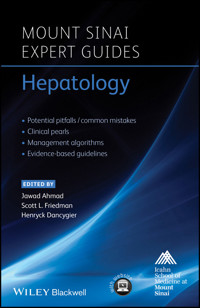
Hepatology E-Book
62,99 €
Mehr erfahren.
- Herausgeber: John Wiley & Sons
- Kategorie: Fachliteratur
- Serie: Mount Sinai Expert Guides
- Sprache: Englisch
Mount Sinai Expert Guides: Hepatology will provide gastroenterology and hepatology trainees with an extremely clinical and accessible handbook covering the major liver diseases and symptoms, their diagnosis and clinical management.
Perfect as a point-of-care resource on the hospital wards and also as a refresher for board exam preparation, the focus throughout is on providing rapid reference, essential information on each disease to allow for quick, easy browsing and assimilation of the must-know information. All chapters follow a consistent template including the following features:
- An opening bottom-line/key points section
- Classification, pathogenesis and prevention of disease
- Evidence-based diagnosis, including relevant algorithms, laboratory and imaging tests, and potential pitfalls when diagnosing a patient
- Disease management including commonly used medications with dosages, when to perform surgery, management algorithms and how to prevent complications
- How to manage special populations, ie, in pregnancy, children and the elderly
- The very latest evidence-based results, major society guidelines (AASLD/EASL) and key external sources to consult
In addition, the book comes with a companion website housing extra features such as case studies with related questions for self-assessment, key patient advice and ICD codes. Each guide also has its own mobile app available for purchase, allowing you rapid access to the key features wherever you may be.
If you're specialising in hepatology and require a concise, practical guide to the clinical management of liver disease, bought to you by one of world's leading hospitals, then this is the perfect book for you.
This title is also available as a mobile App from MedHand Mobile Libraries. Buy it now from iTunes, Google Play or the MedHand Store.
Sie lesen das E-Book in den Legimi-Apps auf:
Seitenzahl: 899
Veröffentlichungsjahr: 2014
Ähnliche




















Table of Contents
Title page
Copyright page
List of Contributors
Series Foreword
Preface
Abbreviation List
About the Companion Website
PART 1: HEPATOLOGY
CHAPTER 1: Approach to the Patient with Abnormal Liver Tests
Section 1: Background
Section 2: Prevention
Section 3: Diagnosis
Section 4: Treatment
Section 5: Special Populations
Section 6: Prognosis
Section 7: Reading List
Section 8: Guidelines
Section 9: Evidence
Section 10: Images
CHAPTER 2: Approach to the Patient with Jaundice
Section 1: Background
Section 2: Prevention
Section 3: Diagnosis
Section 4: Treatment
Section 5: Special Populations
Section 6: Prognosis
Section 7: Reading List
Section 8: Guidelines
Section 9: Evidence
Section 10: Images
CHAPTER 3: Drug-Induced Liver Injury
Section 1: Background
Section 2: Prevention
Section 3: Diagnosis
Section 4: Treatment
Section 5: Special populations
Section 6: Prognosis
Section 7: Reading List
Section 8: Guidelines
Section 9: Evidence
Section 10: Images
CHAPTER 4: Hepatitis A and E
Section 1: Background
Section 2: Prevention
Section 3: Diagnosis
Section 4: Treatment
Section 5: Special Populations
Section 6: Prognosis
Section 7: Reading List
Section 8: Guidelines
Section 9: Evidence
Section 10: Images
CHAPTER 5: Hepatitis B and D
Section 1: Background
Section 2: Prevention
Section 3: Diagnosis
Section 4: Treatment
Section 5: Special Populations
Section 6: Prognosis
Section 7: Reading List
Section 8: Guidelines
Section 9: Evidence
Section 10: Images
CHAPTER 6: Hepatitis C: Diagnosis, Management and Treatment
Section 1: Background
Section 2: Prevention
Section 3: Diagnosis
Section 4: Treatment
Section 5: Special Populations
Section 6: Prognosis
Section 7: Reading list
Section 8: Guidelines
Section 9: Evidence
Section 10: Images
CHAPTER 7: HIV/HCV and HIV/HBV Co-infections
Section 1: Background
Section 2: Prevention
Section 3: Diagnosis
Section 4: Treatment
Section 5: Special Populations
Section 6: Prognosis
Section 7: Reading List
Section 8: Guidelines
Section 9: Evidence
Section 10: Images
CHAPTER 8: Hepatic Abscess
Amebic Liver Abscess
Section 1: Background
Section 2: Prevention
Section 3: Diagnosis
Section 4: Treatment
Section 5: Special Populations
Section 6: Prognosis
Section 7: Reading List
Section 8: Guidelines
Section 9: Evidence
Section 10: Images
Pyogenic Liver Abscess
Section 1: Background
Section 2: Prevention
Section 3: Diagnosis
Section 4: Treatment
Section 5: Special Populations
Section 6: Prognosis
Section 7: Reading List
Section 8: Guidelines
Section 9: Evidence
Section 10: Images
CHAPTER 9: Biliary Infections
Section 1: Background
Section 2: Prevention
Section 3: Diagnosis
Section 4: Treatment
Section 5: Special Populations
Section 6: Prognosis
Section 7: Reading List
Section 8: Guidelines
Section 9: Evidence
Section 10: Images
CHAPTER 10: Alcoholic Hepatitis
Section 1: Background
Section 2: Prevention
Section 3: Diagnosis
Section 4: Treatment
Section 5: Special Populations
Section 6: Prognosis
Section 7: Reading List
Section 8: Guidelines
Section 9: Evidence
Section 10: Images
CHAPTER 11: Non-Alcoholic Fatty Liver Disease
Section 1: Background
Section 2: Prevention
Section 3: Diagnosis
Section 4: Treatment
Section 5: Special Populations
Section 6: Prognosis
Section 7: Reading List
Section 8: Guidelines
Section 9: Evidence
Section 10: Images
CHAPTER 12: Autoimmune Hepatitis and Overlap Syndromes
Section 1: Background
Section 2: Prevention
Section 3: Diagnosis
Section 4: Treatment
Section 5: Special Populations
Section 6: Prognosis
Section 7: Reading List
Section 8: Guidelines
Section 9: Evidence
Section 10: Images
CHAPTER 13: Primary Biliary Cirrhosis
Section 1: Background
Section 2: Prevention
Section 3: Diagnosis
Section 4: Treatment
Section 5: Special Populations
Section 6: Prognosis
Section 7: Reading List
Section 8: Guidelines
Section 9: Evidence
Section 10: Images
CHAPTER 14: Primary Sclerosing Cholangitis
Section 1: Background
Section 2: Prevention
Section 3: Diagnosis
Section 4: Treatment
Section 5: Special Populations
Section 6: Prognosis
Section 7: Reading List
Section 8: Guidelines
Section 9: Evidence
Section 10: Images
CHAPTER 15: Hereditary Hemochromatosis
Section 1: Background
Section 2: Prevention
Section 3: Diagnosis
Section 4: Treatment
Section 5: Special Populations
Section 6: Prognosis
Section 7: Reading List
Section 8: Guidelines
Section 9: Evidence
Section 10: Images
CHAPTER 16: Wilson Disease
Section 1: Background
Section 2: Prevention
Section 3: Diagnosis
Section 4: Treatment
Section 5: Special Populations
Section 6: Prognosis
Section 7: Reading List
Section 8: Guidelines
Section 9: Evidence
Section 10: Images
CHAPTER 17: Alpha-1 Antitrypsin Deficiency
Section 1: Background
Section 2: Prevention
Section 3: Diagnosis
Section 4: Treatment
Section 5: Special Populations
Section 6: Prognosis
Section 7: Reading List
Section 8: Guidelines
Section 9: Evidence
Section 10: Images
CHAPTER 18: Portal Hypertensive Bleeding
Section 1: Background
Section 2: Prevention
Section 3: Diagnosis
Section 4: Treatment
Section 5: Special Populations
Section 6: Prognosis
Section 7: Reading List
Section 8: Guidelines
Section 9: Evidence
Section 10: Images
CHAPTER 19: Ascites
Section 1: Background
Section 2: Prevention
Section 3: Diagnosis
Section 4: Treatment
Section 5: Special Populations
Section 6: Prognosis
Section 7: Reading List
Section 8: Guidelines
Section 9 Evidence
Section 10: Images
CHAPTER 20: Spontaneous Bacterial Peritonitis
Section 1: Background
Section 2: Prevention
Section 3: Diagnosis
Section 4: Treatment
Section 5: Special Populations
Section 6: Prognosis
Section 7: Reading List
Section 8: Guidelines
Section 9: Evidence
Section 10: Images
CHAPTER 21: Hepatic Encephalopathy
Section 1: Background
Section 2: Prevention
Section 3: Diagnosis
Section 4: Treatment
Section 5: Special Populations
Section 6: Prognosis
Section 7: Reading List
Section 8: Guidelines
Section 9: Evidence
Section 10: Images
CHAPTER 22: Hepatorenal Syndrome
Section 1: Background
Section 2: Prevention
Section 3: Diagnosis
Section 4: Treatment
Section 5: Special Populations
Section 6: Prognosis
Section 7: Reading List
Section 8:Guidelines
Section 9: Evidence
Section 10: Images
CHAPTER 23: Hepatopulmonary Syndrome
Section 1: Background
Section 2: Prevention
Section 3: Diagnosis
Section 4: Treatment
Section 5: Special Populations
Section 6: Prognosis
Section 7: Reading List
Section 8: Guidelines
Section 9: Evidence
Section 10: Images
CHAPTER 24: Portopulmonary Hypertension
Section 1: Background
Section 2: Prevention
Section 3: Diagnosis
Section 4: Treatment
Section 5: Special Populations
Section 6: Prognosis
Section 7: Reading List
Section 8: Guidelines
Section 9: Evidence
Section 10: Images
CHAPTER 25: Pregnancy-Related Liver Disease
Section 1: Background
Section 2: Prevention
Section 3: Diagnosis
Section 4: Treatment
Section 5: Special Populations
Section 6: Prognosis
Section 7: Reading List
Section 8: Guidelines
Section 9: Evidence
Section 10: Images
CHAPTER 26: Acute Liver Failure
Section 1: Background
Section 2: Prevention
Section 3: Diagnosis
Section 4: Treatment
Section 5: Special Populations
Section 6: Prognosis
Section 7: Reading List
Section 8: Guidelines
Section 9: Evidence
Section 10: Images
CHAPTER 27: Budd–Chiari Syndrome
Section 1: Background
Section 2: Prevention
Section 3: Diagnosis
Section 4: Treatment
Section 5: Special Populations
Section 6: Prognosis
Section 7: Reading List
Section 8: Guidelines
Section 9: Evidence
Section 10: Images
CHAPTER 28: Portal Vein Thrombosis
Section 1: Background
Section 2: Prevention
Section 3: Diagnosis
Section 4: Treatment
Section 5: Special Populations
Section 6: Prognosis
Section 7: Reading List
Section 8: Guidelines
Section 9: Evidence
Section 10: Images
CHAPTER 29: Non-Cirrhotic Portal Hypertension
Section 1: Background
Section 2: Prevention
Section 3: Diagnosis
Section 4: Treatment
Section 5: Special Populations
Section 6: Prognosis
Section 7: Reading List
Section 8: Guidelines
Section 9: Evidence
Section 10: Images
CHAPTER 30: Liver Lesions
Section 1: Background
Section 2: Prevention
Section 3: Diagnosis
Section 4: Treatment
Section 5: Special Populations
Section 6: Prognosis
Section 7: Reading List
Section 8: Guidelines
Section 9: Evidence
Section 10: Images
CHAPTER 31: Cystic Lesions of the Liver
Section 1: Background
Section 2: Prevention
Section 3: Diagnosis
Section 4: Treatment
Section 5: Special Populations
Section 6: Prognosis
Section 7: Reading List
Section 8: Guidelines
Section 9: Evidence
Section 10: Images
CHAPTER 32: Surgery in Patients with Liver Disease
Section 1: Background
Section 2: Prevention
Section 3: Diagnosis
Section 4: Treatment
Section 5: Special Populations
Section 6: Prognosis
Section 7: Reading List
Section 8: Guidelines
Section 9: Evidence
Section 10: Images
CHAPTER 33: Nutrition in Liver Diseases
Section 1: Background
Section 2: Prevention
Section 3: Diagnosis
Section 4: Treatment
Section 5: Special Populations
Section 6: Prognosis
Section 7: Reading List
Section 8: Guidelines
Section 9: Evidence
Section 10: Images
PART 2: PEDIATRICS
CHAPTER 34: Diagnosis and Management of Acute Liver Failure: A Pediatric Perspective
Section 1: Background
Section 2: Prevention
Section 3: Diagnosis
Section 4: Treatment
Section 5: Special Populations
Section 6: Prognosis
Section 7: Reading List
Section 8: Guidelines
Section 9: Evidence
Section 10: Images
CHAPTER 35: Liver Function Tests in Childhood
Section 1: Tests that Evaluate Liver Injury
Section 2: Tests that Evaluate Impaired Bile Flow or Cholestasis
Section 3: Tests that Evaluate Synthetic Capacity of the Liver
Section 4: Tests that Evaluate Excretory Function of the Liver
Section 5: Tests that Evaluate Metabolic Function
Section 6: Other Laboratory Tests
Section 7: Reading List
Section 8: Guidelines
Section 9: Evidence
Section 10: Images
CHAPTER 36: Approach to Jaundice in Infancy
Section 1: Background
Section 2: Prevention
Section 3: Diagnosis
Section 4: Treatment
Section 5: Special Populations
Section 6: Prognosis
Section 7: Reading List
Section 8: Guidelines
Section 9: Evidence
Section 10: Images
CHAPTER 37: Management of End-Stage Liver Disease in Children
Section 1: Background
Section 2: Prevention
Section 3: Diagnosis
Section 4: Treatment
Section 5: Special Populations
Section 6: Prognosis
Section 7: Reading List
Section 8: Guidelines
Section 9: Evidence
Section 10: Images
CHAPTER 38: Liver Transplantation: A Pediatric Perspective
Section 1: Background
Section 2: Prevention
Section 3: Diagnosis
Section 4: Treatment
Section 5: Special Populations
Section 6: Prognosis
Section 7: Reading List
Section 8: Guidelines
Section 9: Evidence
Section 10: Images
PART 3: TRANSPLANTATION
CHAPTER 39: Evaluation of Patients for Liver Transplantation
Section 1: Background
Section 2: Prevention
Section 3: Diagnosis
Section 4: Treatment
Section 5: Special Populations
Section 6: Prognosis
Section 7: Reading List
Section 8: Guidelines
Section 9: Evidence
Section 10: Images
CHAPTER 40: Live Donor Transplantation Evaluation
Section 1: Background
Section 2: Prevention
Section 3: Diagnosis
Section 4: Treatment
Section 5: Special Populations
Section 6: Prognosis
Section 7: Reading List
Section 8: Guidelines
Section 9: Evidence
Section 10: Images
CHAPTER 41: Surgical Evaluation for Liver Transplantation
Section 1: Background
Section 2: Prevention
Section 3: Diagnosis
Section 4: Treatment
Section 5: Special Populations
Section 6: Prognosis
Section 7: Reading List
Section 8: Guidelines
Section 9: Evidence
Section 10: Images
CHAPTER 42: Post-Operative Care of The Liver Transplantation Patient
Section 1: Background
Section 2: Prevention
Section 3: Diagnosis
Section 4: Treatment
Section 5: Special Populations
Section 6: Prognosis
Section 7: Reading List
Section 8: Guidelines
Section 9: Evidence
Section 10: Images
CHAPTER 43: Diagnostic Approach to Abnormal Liver Tests Following Liver Transplantation
Section 1: Background
Section 2: Prevention
Section 3: Diagnosis
Section 4: Treatment
Section 5: Special Populations
Section 6: Prognosis
Section 7: Reading List
Section 8: Guidelines
Section 9: Evidence
Section 10: Images
CHAPTER 44: Acute Rejection
Section 1: Background
Section 2: Prevention
Section 3: Diagnosis
Section 4: Treatment
Section 5: Special Populations
Section 6: Prognosis
Section 7: Reading List
Section 8: Guidelines
Section 9: Evidence
Section 10: Images
CHAPTER 45: Chronic Rejection
Section 1: Background
Section 2: Prevention
Section 3: Diagnosis
Section 4: Treatment
Section 5: Special Populations
Section 6: Prognosis
Section 7: Reading List
Section 8: Guidelines
Section 9: Evidence
Section 10: Images
CHAPTER 46: Primary Non-Function
Section 1: Background
Section 2: Prevention
Section 3: Diagnosis
Section 4: Treatment
Section 5: Special Populations
Section 6: Prognosis
Section 7: Reading List
Section 8: Guidelines
Section 9: Evidence
Section 10: Images
CHAPTER 47: Ischemia Reperfusion Injury after Liver Transplantation
Section 1: Background
Section 2: Prevention
Section 3: Diagnosis
Section 4: Treatment
Section 5: Special Populations
Section 6: Prognosis
Section 7: Reading List
Section 8: Guidelines
Section 9: Evidence
Section 10: Images
CHAPTER 48: Vascular Complications of Liver Transplantation
Hepatic Venous Occlusion
Section 1: Background
Section 2: Prevention
Section 3: Diagnosis
Section 4: Treatment
Section 5 Special Populations
Section 6 Prognosis
Portal Vein Thrombosis
Section 1: Background
Section 2: Prevention
Section 3: Diagnosis
Section 4: Treatment
Section 5: Special Populations
Section 6: Prognosis
Hepatic Artery Thrombosis
Section 1: Background
Section 2: Prevention
Section 3: Diagnosis
Section 4: Treatment
Section 5: Special Populations
Section 6: Prognosis
Section 7: Reading List
Section 8: Guidelines
Section 9: Evidence
Section 10: Images
CHAPTER 49: Biliary Complications after Liver Transplantation
Section 1: Background
Section 2: Prevention
Section 3: Diagnosis
Section 4: Treatment
Section 5: Special Populations
Section 6: Prognosis
Section 7: Reading List
Section 8: Guidelines
Section 9: Evidence
Section 10: Images
CHAPTER 50: Approach to Prophylaxis and Management of Infections after Liver Transplantation
Section 1: Background
Section 2: Prevention
Section 3: Diagnosis
Section 4: Treatment
Section 5: Special Populations
Section 6: Prognosis
Section 7: Reading List
Section 8: Guidelines
Section 9: Evidence
Section 10: Images
CHAPTER 51: Malignancy after Liver Transplantation
Section 1: Background
Section 2: Prevention
Section 3: Diagnosis
Section 4: Treatment
Section 5: Special Populations
Section 6: Prognosis
Section 7: Reading List
Section 8: Guidelines
Section 9: Evidence
Section 10: Images
CHAPTER 52: Hepatitis C Post-Liver Transplantation
Section 1: Background
Section 2: Prevention
Section 3: Diagnosis
Section 4: Treatment
Section 5: Special Populations
Section 6: Prognosis
Section 7: Reading List
Section 8: Guidelines
Section 9: Evidence
Section 10: Images
CHAPTER 53: Recurrent Disease Post-Liver Transplantation: Autoimmune Diseases, Hepatitis B and NASH
Section 1: Background
Section 2: Prevention
Section 3: Diagnosis
Section 4: Treatment
Section 5: Special Populations
Section 6: Prognosis
Section 7: Reading List
Section 8: Guidelines
Section 9: Evidence
Section 10: Images
CHAPTER 54: Health Maintenance after Liver Transplantation
Section 1: Background
Section 2: Prevention
Section 3: Diagnosis
Section 4: Treatment
Section 5: Special Populations
Section 6: Prognosis
Section 7: Reading List
Section 8: Guidelines
Section 9: Evidence
Section 10: Images
Supplemental Images
Index
This edition first published 2014 © 2014 by John Wiley & Sons, Ltd
Registered office: John Wiley & Sons, Ltd, The Atrium, Southern Gate, Chichester, West Sussex, PO19 8SQ, UK
Editorial offices: 9600 Garsington Road, Oxford, OX4 2DQ, UK
The Atrium, Southern Gate, Chichester, West Sussex, PO19 8SQ, UK
111 River Street, Hoboken, NJ 07030-5774, USA
For details of our global editorial offices, for customer services and for information about how to apply for permission to reuse the copyright material in this book please see our website at www.wiley.com/wiley-blackwell
The right of the author to be identified as the author of this work has been asserted in accordance with the UK Copyright, Designs and Patents Act 1988.
All rights reserved. No part of this publication may be reproduced, stored in a retrieval system, or transmitted, in any form or by any means, electronic, mechanical, photocopying, recording or otherwise, except as permitted by the UK Copyright, Designs and Patents Act 1988, without the prior permission of the publisher.
Designations used by companies to distinguish their products are often claimed as trademarks. All brand names and product names used in this book are trade names, service marks, trademarks or registered trademarks of their respective owners. The publisher is not associated with any product or vendor mentioned in this book. It is sold on the understanding that the publisher is not engaged in rendering professional services. If professional advice or other expert assistance is required, the services of a competent professional should be sought.
The contents of this work are intended to further general scientific research, understanding, and discussion only and are not intended and should not be relied upon as recommending or promoting a specific method, diagnosis, or treatment by health science practitioners for any particular patient. The publisher and the author make no representations or warranties with respect to the accuracy or completeness of the contents of this work and specifically disclaim all warranties, including without limitation any implied warranties of fitness for a particular purpose. In view of ongoing research, equipment modifications, changes in governmental regulations, and the constant flow of information relating to the use of medicines, equipment, and devices, the reader is urged to review and evaluate the information provided in the package insert or instructions for each medicine, equipment, or device for, among other things, any changes in the instructions or indication of usage and for added warnings and precautions. Readers should consult with a specialist where appropriate. The fact that an organization or Website is referred to in this work as a citation and/or a potential source of further information does not mean that the author or the publisher endorses the information the organization or Website may provide or recommendations it may make. Further, readers should be aware that Internet Websites listed in this work may have changed or disappeared between when this work was written and when it is read. No warranty may be created or extended by any promotional statements for this work. Neither the publisher nor the author shall be liable for any damages arising herefrom.
Library of Congress Cataloging-in-Publication Data
Mount Sinai expert guides. Hepatology / edited by Jawad Ahmad, Scott L. Friedman, Henryk Dancygier.
p. ; cm.
Hepatology
Includes bibliographical references and index.
ISBN 978-1-118-51734-5 (alk. paper) – ISBN 978-1-118-74251-8 (emobi) – ISBN 978-1-118-74252-5 (epub) – ISBN 978-1-118-74253-2 (epdf) – ISBN 978-1-118-74862-6
I. Ahmad, Jawad (Hepatologist), editor of compilation. II. Friedman, Scott L., editor of compilation. III. Dancygier, Henryk, editor of compilation. IV. Title: Hepatology.
[DNLM: 1. Liver Diseases. 2. Liver Transplantation. WI 700]
RC845
616.3’62–dc23
2013024785
A catalogue record for this book is available from the British Library.
Wiley also publishes its books in a variety of electronic formats. Some content that appears in print may not be available in electronic books.
Cover image: iStock file File #6124416 © David Marchal
Cover design by Ruth Bateson
List of Contributors
Jawad Ahmad MD
Associate Professor of Medicine
Division of Liver Diseases
Icahn School of Medicine at Mount Sinai
New York, NY, USA
Abdulelah Alhawsawi MD
Surgical Fellow
Recanati/Miller Transplantation Institute
Mount Sinai Hospital
New York, NY, USA
Costica Aloman MD
Associate Professor of Medicine
University of Illinois
Chicago, IL, USA
Ronen Arnon MD, MHA
Associate Professor of Pediatrics and Surgery
Department of Pediatrics
Icahn School of Medicine at Mount Sinai
New York, NY, USA
Nancy Bach MD
Assistant Professor of Medicine
Division of Liver Diseases
Icahn School of Medicine at Mount Sinai
New York, NY, USA
Meena B. Bansal MD
Associate Professor of Medicine
Division of Liver Diseases
Icahn School of Medicine at Mount Sinai
New York, NY, USA
Charissa Y. Chang MD
Assistant Professor of Medicine
Division of Liver Diseases
Icahn School of Medicine at Mount Sinai
New York, NY, USA
Jaime Chu MD
Assistant Professor of Pediatrics
Division of Hepatology
Icahn School of Medicine at Mount Sinai
New York, NY, USA
Alan G. Contreras Saldivar MD
Attending Transplant Surgeon
Instructor of Surgery
Mount Sinai Hospital
Icahn School of Medicine at Mount Sinai;
Recanati/Miller Transplantation Institute
Mount Sinai Hospital
New York, NY, USA
Henryk Dancygier MD, PhD
Professor of Medicine
Chair, Departments of Medicine II and IV
Sana Klinikum Offenbach, Goethe University
Frankfurt am Main, Germany;
Adjunct Professor of Medicine
Department of Medicine
Division of Liver Diseases
Icahn School of Medicine at Mount Sinai
New York, NY, USA
Eric G. Davis MD
Assistant Professor of Surgery
University of Louisville School of Medicine
Louisville, KY, USA
Douglas T. Dieterich MD
Professor of Medicine
Division of Liver Diseases
Icahn School of Medicine at Mount Sinai
New York, NY, USA
Deepti Dronamraju MD
Fellow
Division of Liver Diseases
Icahn School of Medicine at Mount Sinai
New York, NY, USA
Marcelo E. Facciuto MD, MPH
Associate Professor of Surgery
Recanati/Miller Transplantation Institute
Mount Sinai Hospital
New York, NY, USA
Donna J.C. Fanelli CRNP
Division of Liver Diseases
Icahn School of Medicine at Mount Sinai
New York, NY, USA
M. Isabel Fiel MD
Professor of Pathology
Department of Pathology
Icahn School of Medicine at Mount Sinai
New York, NY, USA
Sander S. Florman MD
The Charles Miller, MD Professor of Surgery
Director, Recanati/Miller Transplantation Institute
Mount Sinai Hospital
New York, NY, USA
Scott L. Friedman MD
Fishberg Professor of Medicine
Dean for Therapeutic Discovery
Chief, Division of Liver Diseases
Icahn School of Medicine at Mount Sinai
New York, NY, USA
Priya Grewal MD
Associate Professor of Medicine
Division of Liver Diseases
Icahn School of Medicine at Mount Sinai
New York, NY, USA
Shirish Huprikar MD
Director, Transplant Infectious Diseases Program
Associate Professor
Division of Infectious Diseases
Department of Medicine
Icahn School of Medicine at Mount Sinai
New York, NY, USA
Nanda Kerkar MD
Professor of Clinical Pediatrics
Medical Director Liver and Intestinal Program
Director Hepatology Program
Children's Hospital of Los Angeles
University of Southern California
Los Angeles, CA, USA
Vivek Kesar MD
Internal Medicine Resident
Lenox Hill Medical Center
New York, NY, USA
Leona Kim-Schluger MD
Professor of Medicine
Division of Liver Diseases
Icahn School of Medicine at Mount Sinai
New York, NY, USA
Elizabeth A. Kula CRNP
Division of Liver Diseases
Icahn School of Medicine at Mount Sinai
New York, NY, USA
Marie E. Le MD
Surgical Fellow
Recanati/Miller Transplantation Institute
Mount Sinai Hospital
New York, NY, USA
Lawrence U. Liu MD
Assistant Professor of Medicine
Division of Liver Diseases
Icahn School of Medicine at Mount Sinai
New York, NY, USA
Tamir Miloh MD
Director of Pediatric Liver and Liver Transplant Program
Department of Gastroenterology and Hepatology
Phoenix Children's Hospital;
Associate Professor of Pediatrics
University of Arizona, College of Medicine Phoenix, AZ;
Associate Professor in Pediatrics
Mayo Clinic
USA
Joseph A. Odin MD, PhD
Director, Autoimmune Liver Diseases Program
Associate Professor of Medicine
Division of Liver Diseases
Icahn School of Medicine at Mount Sinai
New York, NY, USA
James S. Park MD, CNSC
Assistant Professor of Medicine
Division of Gastroenterology
NYU School of Medicine
New York, NY, USA
Gopi Patel MD, MS
Assistant Professor
Division of Infectious Diseases
Icahn School of Medicine at Mount Sinai
New York, NY, USA
Ponni V. Perumalswami MD, MS
Assistant Professor of Medicine
Division of Liver Diseases
Icahn School of Medicine at Mount Sinai
New York, NY, USA
Juan P. Rocca MD
Assistant Professor of Surgery
Icahn School of Medicine at Mount Sinai;
Surgical Director, Live Donor Kidney Program
Associate Director, Transplant Surgery Fellowship
Recanati/Miller Transplantation Institute
Mount Sinai Hospital
New York, NY, USA
Thomas D. Schiano MD
Professor of Medicine
Medical Director, Liver Transplantation
Clinical Director, Hepatology
Division of Liver Diseases
Icahn School of Medicine at Mount Sinai
New York, NY, USA
Hiroshi Sogawa MD, FACS
Assistant Professor of Surgery
Director, Transplant Surgery Fellowship Program
Thomas E. Starzl Transplantation Institute
University of Pittsburgh Medical Center
Pittsburgh, PA, USA
Alicia C. Stivala NP
Nurse Practitioner
Division of Infectious Diseases
Icahn School of Medicine at Mount Sinai
New York, NY, USA
Matthew Y. Suh MD
Surgical Fellow
Recanati/Miller Transplantation Institute
Mount Sinai Hospital
New York, NY, USA
Marie-Louise C. Vachon MD, MSc
Fellow
Division of Liver Diseases
Icahn School of Medicine at Mount Sinai
New York, NY, USA
Series Foreword
Now more than ever, immediacy in obtaining accurate and practical information is the coin of the realm in providing high quality patient care. The Mount Sinai Expert Guides series addresses this vital need by providing accurate, up-to-date guidance, written by experts in formats that are accessible in the patient care setting: websites, smartphone apps and portable books. The Icahn School of Medicine, which was chartered in 1963, embodies a deep tradition of pre-eminence in clinical care and scholarship that was first shaped by the founding of the Mount Sinai Hospital in 1855. Today, the Mount Sinai Health System, comprised of seven hospitals anchored by the Icahn School of Medicine, is one of the largest health care systems in the United States, and is revolutionizing medicine through its embracing of transformative technologies for clinical diagnosis and treatment. The Mount Sinai Expert Guides series builds upon both this historical renown and contemporary excellence. Leading experts across a range of disciplines provide practical yet sage advice in a digestible format that is ideal for trainees, mid-level providers and practicing physicians. Few medical centers in the US could offer this type of breadth while relying exclusively on its own physicians, yet here no compromises were required in offering a truly unique series that is sure to become embedded within the key resources of busy providers. In producing this series, the editors and authors are fortunate to have an equally dynamic and forward-viewing partner in Wiley Blackwell, which together ensures that health care professionals will benefit from a unique, first-class effort that will advance the care of their patients.
Scott Friedman MD
Series Editor
Dean for Therapeutic Discovery
Fishberg Professor and Chief, Division of Liver Diseases
Icahn School of Medicine at Mount Sinai
New York, NY, USA
Preface
The last 20 years has seen hepatology emerge as a distinct discipline, separate from gastroenterology, reflecting the profound advances in our understanding of the pathophysiology, diagnosis and management of liver diseases. Concurrently, academic centers throughout the world now have faculty who function exclusively as hepatologists, and even in these institutions there is often further distinction between non-transplant and transplant hepatologists, with a similar trend emerging in pediatrics.
In recognition of these trends, international liver societies in the US (American Society for the Study of Liver Diseases), Europe (European Association for the Study of the Liver) and Asia (Asian Pacific Association for the Study of the Liver), seek evidence-based guidelines to standardize management of the most common liver diseases. This expert guide is intended to address this need for a concise and practical guide to patient management. While many textbooks provide detailed descriptions of pathophysiology, they may not be well suited to provide practical, accessible treatment options in the clinical setting where information is urgently needed and time is short. For students and trainees, a basic understanding of epidemiology and pathogenesis of disease entities is important, but guidance for the management of a specific clinical condition is the real world need.
This book is separated into three sections: hepatology, pediatrics and transplantation, with each chapter organized in a standardized format. The first section of each chapter provides the reader a bottom-line of ‘take home’ points that emphasizes the most important aspects of the chapter. This is followed by sections on background, prevention and diagnosis. Key features across the chapters are: easily accessible evidence-based management algorithms, with appropriate laboratory and imaging tests and commonly used medications with dosages. Short reading lists with society guidelines complete the text. Also accompanying the book is a companion website which provides the reader with case histories and multiple choice questions for those preparing for specialty exams. An additional multimedia resource available for purchase is an app with highlights of each chapter for smartphone users.
We have sought to provide a comprehensive list of diseases and situations that clinicians will confront in general hepatology and transplant hepatology practices. The pediatric and surgical chapters have been included to ensure that adult hepatologists understand problems they are likely to encounter in these related specialities in practice, but not as a guide specifically for pediatricians and surgeons.
We thank the staff at Wiley Blackwell, particularly Oliver Walter and Jennifer Seward, for ensuring such a smooth publication process. We also gratefully acknowledge the many Mount Sinai residents and hepatology fellows for their enthusiasm, dedication to their patients and candid feedback throughout the preparation of this text.
Finally, we are indebted to our Mount Sinai colleagues in the Divisions of Liver Diseases and Infectious Diseases, the Departments of Pediatrics and Pathology, and in the Recanati/Miller Transplantation Institute. The editors are fortunate to work with such superb physicians, but what truly distinguishes our colleagues is their selfless dedication to mentoring the next generation of trainees in caring for patients with liver disease. This book reflects their exceptional generosity as clinicians, teachers and role models.
Jawad Ahmad
Scott L. Friedman
Henryk Dancygier
Abbreviation List
Lesen Sie weiter in der vollständigen Ausgabe!
Lesen Sie weiter in der vollständigen Ausgabe!
Lesen Sie weiter in der vollständigen Ausgabe!
Lesen Sie weiter in der vollständigen Ausgabe!
Lesen Sie weiter in der vollständigen Ausgabe!
Lesen Sie weiter in der vollständigen Ausgabe!
Lesen Sie weiter in der vollständigen Ausgabe!
Lesen Sie weiter in der vollständigen Ausgabe!
Lesen Sie weiter in der vollständigen Ausgabe!
Lesen Sie weiter in der vollständigen Ausgabe!
Lesen Sie weiter in der vollständigen Ausgabe!
Lesen Sie weiter in der vollständigen Ausgabe!
Lesen Sie weiter in der vollständigen Ausgabe!
Lesen Sie weiter in der vollständigen Ausgabe!
Lesen Sie weiter in der vollständigen Ausgabe!
Lesen Sie weiter in der vollständigen Ausgabe!
Lesen Sie weiter in der vollständigen Ausgabe!
Lesen Sie weiter in der vollständigen Ausgabe!
Lesen Sie weiter in der vollständigen Ausgabe!
Lesen Sie weiter in der vollständigen Ausgabe!
Lesen Sie weiter in der vollständigen Ausgabe!
Lesen Sie weiter in der vollständigen Ausgabe!
Lesen Sie weiter in der vollständigen Ausgabe!
Lesen Sie weiter in der vollständigen Ausgabe!
Lesen Sie weiter in der vollständigen Ausgabe!
Lesen Sie weiter in der vollständigen Ausgabe!
Lesen Sie weiter in der vollständigen Ausgabe!
Lesen Sie weiter in der vollständigen Ausgabe!
Lesen Sie weiter in der vollständigen Ausgabe!
Lesen Sie weiter in der vollständigen Ausgabe!
Lesen Sie weiter in der vollständigen Ausgabe!
Lesen Sie weiter in der vollständigen Ausgabe!
Lesen Sie weiter in der vollständigen Ausgabe!
Lesen Sie weiter in der vollständigen Ausgabe!
Lesen Sie weiter in der vollständigen Ausgabe!
Lesen Sie weiter in der vollständigen Ausgabe!
Lesen Sie weiter in der vollständigen Ausgabe!
Lesen Sie weiter in der vollständigen Ausgabe!
Lesen Sie weiter in der vollständigen Ausgabe!
Lesen Sie weiter in der vollständigen Ausgabe!
Lesen Sie weiter in der vollständigen Ausgabe!
Lesen Sie weiter in der vollständigen Ausgabe!
Lesen Sie weiter in der vollständigen Ausgabe!
Lesen Sie weiter in der vollständigen Ausgabe!
Lesen Sie weiter in der vollständigen Ausgabe!
Lesen Sie weiter in der vollständigen Ausgabe!
Lesen Sie weiter in der vollständigen Ausgabe!
Lesen Sie weiter in der vollständigen Ausgabe!
Lesen Sie weiter in der vollständigen Ausgabe!
Lesen Sie weiter in der vollständigen Ausgabe!
Lesen Sie weiter in der vollständigen Ausgabe!
Lesen Sie weiter in der vollständigen Ausgabe!
Lesen Sie weiter in der vollständigen Ausgabe!
Lesen Sie weiter in der vollständigen Ausgabe!
Lesen Sie weiter in der vollständigen Ausgabe!
Lesen Sie weiter in der vollständigen Ausgabe!
Lesen Sie weiter in der vollständigen Ausgabe!
Lesen Sie weiter in der vollständigen Ausgabe!
Lesen Sie weiter in der vollständigen Ausgabe!
Lesen Sie weiter in der vollständigen Ausgabe!




