


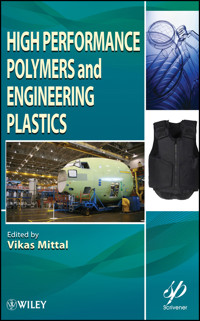
High Performance Polymers and Engineering Plastics E-Book
171,99 €
Mehr erfahren.
- Herausgeber: John Wiley & Sons
- Kategorie: Fachliteratur
- Sprache: Englisch
This book describes advances in synthesis, processing, and technology of environmentally friendly polymers generated from renewable resources. With contents based on a wide range of functional monomers and contributions from eminent researchers, this volume demonstrates the design, synthesis, properties and applications of plant oil based polymers, presenting an elaborate review of acid mediated polymerization techniques for the generation of green polymers. Chemical engineers are provided with state-of-the-art information that acts to further progress research in this direction.
Sie lesen das E-Book in den Legimi-Apps auf:
Seitenzahl: 520
Veröffentlichungsjahr: 2011
Ähnliche




















Contents
Cover
Half Title page
Title page
Copyright page
Preface
Contributors
Chapter 1: High Performance Polymers: An Overview
1.1 Introduction
1.2 Poly(ether amide) and Poly(ether amide-imide)
1.3 Poly(arylene ether)
1.4 Benzoxazine Polymers
1.5 Poly(ether ether ketone) (PEEK)
1.6 Polytriazole
1.7 Hyperbranched Conjugated Polymers
1.8 Alternating Copolymers
1.9 References
Chapter 2: Synthesis and Properties of Polyoxadiazoles
2.1 Introduction
2.2 Synthesis of Polyoxadiazoles in Poly(phosphoric acid)
2.3 Thermal and Mechanical Properties of Polyoxadiazoles
2.4 Application Fields
2.5 References
Chapter 3: Conjugated Polymers Based on Benzo[1,2-b:4,5-b’]dithiophene for Organic Electronics
3.1 Introduction
3.2 General Synthetic Methods for BDT Monomers and Polymers
3.3 Application of BDT-Based Polymers in OFET and PSC
3.4 Outlook
3.5 References
Chapter 4: Polysulfone-Based Ionomers
4.1 Introduction
4.2 Polysulfone Backbone and Selection of the Ionic Function
4.3 Ionomer Synthesis and Characterization
4.4 Conclusion
4.5 References
Chapter 5: High-Performance Processable Aromatic Polyamides
5.1 Introduction
5.2 Monomers
5.3 Polymerization
5.4 Major Problem with Aromatic Polyamides
5.5 Approaches to Processable Polyamides
5.6 Processable Linear Aromatic Polyamides
5.7 Processable Hyperbranched Aromatic Polyamides
5.8 Properties
5.9 Applications
5.10 Conclusion
5.11 References
Chapter 6: Phosphorus-Containing Polysulfones
6.1 Introduction
6.2 Synthesis of Phosphorus Containing Polysulfones
6.3 Properties of Phosphorus-Containing Polysulfones (P-PSF)
6.4 High Performance Applications of Phosphorus-Containing Polysulfones
6.5 References
Chapter 7: Synthesis and Characterization of Novel Polyimides
7.1 Introduction
7.2 Synthesis of Polyimides
7.3 Properties of Aromatic Polyimides
7.4 Conclusions
7.5 References
Chapter 8: The Effects of Structures on Properties of New Polytriazole Resins
8.1 Introduction
8.2 The Preparation of Polytriazole Resins
8.3 Reactivity of Crosslinkable Polytriazole Resins
8.4 Glass Transition Temperatures of Polytriazole Resins
8.5 Mechanical Properties of Polytriazole Resins
8.6 Dielectric Properties of Polytriazole Resins
8.7 Thermal Stabilities of Polytriazole Resins
8.8 Conclusions
8.9 Acknowledgement
8.10 References
Chapter 9: High Performance Fibers
9.1 PIPD or “M5” Rigid Rod
9.2 “Zylon” PBO Rigid Rod Polymer Fibers
9.3 Aromatic Polyamide-Rigid Rod “Kevlar” Poly(p-Phenylene Terephthalamide) Fibers
9.4 Spectra, Dyneema UHMWPE Flexible Polymer Chain
9.5 Carbon Fibers
9.6 Advances in Improving Performance of Conventional Fibers
9.7 Conclusions
9.8 Acknowledgments
9.9 References
Chapter 10: Synthesis and Characterization of Poly (aryl ether ketone) Copolymers
10.1 Introduction
10.2 General Synthetic Methods of PAEK Copolymers
10.3 Synthesis and Characterization of Structural Poly (aryl ether ketone) Copolymers
10.4 Synthesis and Characterization of Liquid Crystalline Poly (aryl ether ketone) Copolymers
10.5 Synthesis and Characterization of Poly (aryl ether ketone) Copolymers with Pendent Group
10.6 Synthesis and Characterization of poly (aryl ether ketone) copolymers with Containing 2,7-Naphthalene Moieties
10.7 References
Chapter 11: Liquid Crystalline Thermoset Epoxy Resins
11.1 Liquid Crystals
11.2 Liquid Crystalline Thermosets Based on Epoxy Resins
11.3 Synthesis and Physical Properties of LCERs
11.4 References
Index
High Performance Polymers and Engineering Plastics
Scrivener Publishing3 Winter Street, Suite 3Salem, MA 01970
Scrivener Publishing Collections Editors
James E. R. CouperKen DragoonRichard ErdlacRafiq IslamPradip KhaladkarVitthal KulkarniNorman LiebermanPeter MartinW. Kent MuhlbauerAndrew Y. C. NeeS. A. SherifJames G. SpeightPublishers at ScrivenerMartin Scrivener ([email protected])Phillip Carmical ([email protected])
Copyright © 2011 by Scrivener Publishing LLC. All rights reserved.
Co-published by John Wiley & Sons, Inc. Hoboken, New Jersey, and Scrivener Publishing LLC, Salem, Massachusetts.Published simultaneously in Canada.
No part of this publication may be reproduced, stored in a retrieval system, or transmitted in any form or by any means, electronic, mechanical, photocopying, recording, scanning, or otherwise, except as permitted under Section 107 or 108 of the 1976 United States Copyright Act, without either the prior written permission of the Publisher, or authorization through payment of the appropriate per-copy fee to the Copyright Clearance Center, Inc., 222 Rosewood Drive, Danvers, MA 01923, (978) 750-8400, fax (978) 750-4470, or on the web at www.copyright.com. Requests to the Publisher for permission should be addressed to the Permissions Department, John Wiley & Sons, Inc., 111 River Street, Hoboken, NJ 07030, (201) 748-6011, fax (201) 748-6008, or online at http://www.wiley.com/go/permission.
Limit of Liability/Disclaimer of Warranty: While the publisher and author have used their best efforts in preparing this book, they make no representations or warranties with respect to the accuracy or completeness of the contents of this book and specifically disclaim any implied warranties of merchantability or fitness for a particular purpose. No warranty may be created or extended by sales representatives or written sales materials. The advice and strategies contained herein may not be suitable for your situation. You should consult with a professional where appropriate. Neither the publisher nor author shall be liable for any loss of profit or any other commercial damages, including but not limited to special, incidental, consequential, or other damages.
For general information on our other products and services or for technical support, please contact our Customer Care Department within the United States at (800) 762-2974, outside the United States at (317) 572-3993 or fax (317) 572-4002.
Wiley also publishes its books in a variety of electronic formats. Some content that appears in print may not be available in electronic formats. For more information about Wiley products, visit our web site at www.wiley.com.
For more information about Scrivener products please visit www.scrivenerpublishing.com.
Library of Congress Cataloging-in-Publication Data:
ISBN 978-1-118-01669-5
Preface
During the last years, several new families of high performance polymers and engineering plastics have been reported which find enhanced application potential in the more challenging areas like aerospace, defense, energy, electronics, automotives etc. as compared to the commodity or conventional polymers. Such polymers provide improved set of properties like higher service-temperatures at extreme conditions and good mechanical strength, dimensional stability, thermal degradation resistance, environmental stability, gas barrier, solvent resistance, electrical properties etc. even at elevated temperatures. Various categories of high performance polymers include poly(phenylene ether), polysulfones, poly(aryl ether ketone), poly(oxadiazole), poly(imide), poly(ether amide), poly(ether amide imide), poly(naphthalene), liquid crystalline polymers and poly(amide imide) etc. Owing to the large number of such high performance polymers with accurately designable structure property correlations developed and reported in the recent years, the book aims to focus on up-to-date synthesis details, properties and applications for such systems in order to stress the high potential of these engineering polymers.
The subject of high performance polymers and engineering plastics is introduced in Chapter 1 where a review of various categories of materials such as poly(ether amide), poly(ether amide-imide), poly(arylene ether), benzoxazine polymers, poly(ether ether ketone) (PEEK), polytriazole, hyperbranched conjugated polymers, are presented. Chapter 2 focuses on the synthesis and properties of polyxadiazoles. The applications of these polymers are also discussed. Chapter 3 describes conjugated polymers based on benzo-dithiophene for organic electronics. Polsulfone based iononers are discussed in Chapter 4. Various routes of ionomer synthesis are described. High performance processable aromatic polyamides are reviewed in Chapter 5. Various polymerization strategies as well as applications of such polymer systems are presented. Properties and applications of phosphorus-Containing polysulfones are the focus of Chapter 6. Synthesis and characterization of novel polyimides are then described in Chapter 7. The effect of chemical structure of the polytriazole resins on thermal, mechanical, and dielectric properties are discussed in Chapter 8 while Chapter 9 describes various high performance fibers synthesized from high performance polymer matrices. Synthesis and characterization of poly (aryl ether ketone) copolymers is the subject of Chapter 10 whereas synthesis and properties of liquid crystalline thermoset epoxy resins are presented in Chapter 11.
It gives me immense pleasure to thank Scrivener Publishing and John Wiley for kind acceptance to publish the book. I dedicate this book to my mother for being constant source of inspiration. I express heartfelt thanks to my wife Preeti for her continuous help in co-editing the book as well as for her ideas to improve the manuscript.
Vikas MittalMay 10, 2011
List of Contributors
Mehdi Afshari is currently Research and Development Scientist at Fiberweb Inc., and Adjunct Assistant Professor at North Carolina State University. He obtained his PhD in Polymer and Fiber Science from Amirkabir University of Technology in 2002. In 2006, he joined North Carolina State University as a Research Associate and then became a Research Assistant Professor. From 2002–2006 he was an Assistant Professor in Textile Engineering Department at Yazd University, Iran.
Susanta Banerjee is currently an Associate Professor in the Materials Science Centre, Indian Institute of Technology, Kharagpur, India. His research interests includes high performance polymers, membrane based separations and polymeric materials in general. He has published more than 100 research papers in international journals and supervised more than 25 students for their master and PhD degrees.
Peng Chen is working at Ningbo Institute of Materials Technology and Engineering in China and earned his PhD in Polymer Engineering. He was Research Associate at North Carolina State University from 2006–2008.
Lei Du is an honorable Professor at East China University of Science & Technology.
Yanpeng E is pursuing his PhD in the School of Materials Science and Engineering at ECUST. His current research interests include click chemistry, adhesives, and heat-resistant polymers and composites.
Dominique de Figueiredo received his PhD in 2002 from the Universidade Federal do Rio de Janeiro, Brazil and in 2002 she moved to Germany where she worked at GKSS on her postdoctoral activities. In 2006 she was awarded with the direction of a Helmholtz-University Young Investigators Group on the development of functionalized polyoxadiazole nanocomposites in cooperation with the Technical University of Hamburg-Harburg. After moving to the chemical industry, she gained her six sigma green belt in 2009. She is currently working at Lehmann & Voss & Co. in Hamburg with the development of LUVOCOM® high performance engineering thermoplastic compounds.
Yanhong Hu is engaged in the research of polymer design and synthesis, especially for the resins and their carbon fibers reinforced composites with high properties, such as interface modification of fiber reinforced resin matrix composites. She is also familiar with the analyses and characterization of polymers and chemicals. She has published articles in more than 30 journals in recent years as well as authoring 4 patents.
Farong Huang is a member of the Chinese Society of Composites and Director of Key Laboratory for Specially Functional Polymeric Materials and Related Technology of the Ministry of Education at ECUST. His research interests focus on the design, synthesis and chemical modification of specialty polymers, the surface, interfaces and manufacture techniques of advanced polymeric composites, and the functional polymeric materials. He is an author or coauthor of more than 200 article as well as 4 books. He has contributed to more than 30 Chinese patents.
Cristina Iojoiu graduated as a Chemical Engineer and obtained her PhD in 2001 from the Montpelier 2 University, France and “Gh. Asachi” University, Iasi, Romania. She is a CNRS scientist at LEPMI, France and her research focuses on the development of electrolytes for electrochemical devices based on polymers and ionic liquids (PEMFC, lithium batteries and photovoltaic cells). She has published more than 40 peer-reviewed papers, 3 book chapters and is co-inventor of 8 patents.
P. Kannan obtained his PhD degree from Anna University, Chennai in 1988 and worked as a Research Associate at the Indian Institute of Science, Bangalore during 1988–1991. He joined the Department of Chemistry, Anna University in 1991 as a lecturer and has been a Professor since 2008. He worked as a Post-Doctoral Fellow at Washington University of St. Louis, during 1999–2000. Fourteen students have earned their PhD under his supervision. He has published 90 research papers in national and international journals.
His research interests are in the domains of fire retardant, photo-crosslinkable, liquid crystalline polymers, LC thermosets, polymer-metal complexes, optical data storage, and photo and electrically switchable polymers.
Richard Kotek is Associate Professor in the College of Textiles at North Carolina State University since 1999. He graduated from the Man-Made Fibers Institute at Lodz Polytechnic, Poland. Following completion of his PhD he worked at the Man-Made Fibers Institute and then as Research Associate at Duke University, and finally joined the R&D department at BASF.
Yujing Li is pursuing her PhD in the School of Materials Science and Engineering at ECUST. Her current research interests include click chemistry, novel rigid polytriazole resins and their composites.
Samarendra Maji is working as a postdoctoral researcher in the Department of Chemistry at the Philipps-Universität Marburg. He obtained his PhD from the Indian Institute of Technology, Kharagpur, India. His research interests includes high performance polymers, biodegradable and biocompatible polymers, structure property-relationship studies of polymers.
Atsushi Morikawa studied organic materials science at the Tokyo Institute of Technology. In 1992 he obtained his doctor’s degree on siloxane dendrimers and polyimide-silica hybrid materials by sol-gel method. After a two-year spell as a research engineer at Asahi Chemical Company, he transferred to the Faculty of Engineering at Ibaraki University to continue his research on poly(ether ketone) dendrimers and polyimides.
Oana Petreus is a senior researcher at “Petru Poni” Institute of Macromolecular Chemistry from Iasi, Romania. She has a PhD in chemistry (1979) and has published 3 books and more than 120 articles in international journals. She is the author of 17 patents. She leads and is a coworker to many national and international scientific programs and is a specialist in synthesis of organic and macromolecular compounds with phosphorus, halogens, nitrogen and sulfur used as flame retardants.
Tudor Petreus, MD and PhD (cell and molecular biology), is an Assistant Professor and researcher at “Gr.T.Popa” University of Medicine and Pharmacy Iasi, Romania and vice president of Iasi Branch of the Romanian Society for Biomaterials. He has published 3 books (as co-author) and more than 50 journal articles. He is leading a research team on matrix metalloproteinase’s inhibitors. His other main research areas are extracellular matrix proteins investigation and the biomaterials-cell interface investigation by a proteomic approach.
Racki Sood obtained in 2009 a Masters of Science diploma in the field of Functionalized & Advanced Materials - Erasmus Mundus Joint program (Grenoble-INP, France & University of Liege, Belgium). She is now working on her PhD in the field of Polymer Electrolytes for Fuel Cells collaborating with three laboratories in France: LEPMI-St. Matin D’Heres; SPrAM-CEA-Grenoble; LMPB-Claude Bernard 1- Lyon University.
P. Sudhakara obtained his PhD from Anna University, Chennai in 2010. He was awarded Senior Research Fellowship by Council of Scientific & Industrial Research (CSIR), New Delhi, India in 2009. He joined as a Post-doctoral Researcher in the Department of Mechanical Engineering, Changwon National University, Changwon, South Korea in 2011. He has published 8 papers in national and international journals in the domain of photocross-linkable, liquid crystalline polymers, fire retardant LC thermosets, and natural fiber composites.
Liqiang Wan obtained his PhD in ECUST. He is now an Associate Professor at Key Laboratory for Specially Functional Polymeric Materials and Related Technology of the Ministry of Education at ECUST. His major interests are in the high properties resins and their fiber reinforced composites. He has published more than 20 papers, submitted more than 10 Chinese patent applications of which 4 have been approved.
Guibin Wang received his BS degree in 1988 from Jilin Institute of Engineering and Technology. He went to work at Jilin University where he obtained his PhD in 2000 in polymer chemistry and physics. In 2001 he became a full Professor. Wang’s research interests are in synthesis, modification and processing of high performance polymer.
Wei You obtained his BS from University of Science and Technology of China in 1999. He obtained his PhD from the University of Chicago in 2004 and completed his postdoctoral training at Stanford University in 2006. He later joined the University of North Carolina at Chapel Hill as an Assistant Professor in Chemistry. His research interests include organic solar cells, molecular electronics and spintronics.
Huaxing Zhou is currently a PhD candidate at the University of North Carolina at Chapel Hill. He obtained his BS degree in polymer chemistry from University of Science and Technology of China in 2007. His current research interests focus on rational design of conjugated polymers for organic solar cells.
Chapter 2
Synthesis and Properties of Polyoxadiazoles
Dominique de Figueiredo Gomes
*GKSS Research Centre Geesthacht GmbH, Institute of Materials Research, Geesthacht, Germany
Abstract
This chapter is focused on polyoxadiazoles, whose mechanical properties are high enough to enable their use as film, fibers, membranes, sheets or polymer matrices for composites. Although the synthesis of polyoxadiazoles, has been a known process for more than forty years, many aspects related to the synthesis of high molecular weight polyoxadiazoles have not been properly understood yet. Probably the observed experimental fluctuations in laboratory scale have been the major drawback for the systematic use of polyoxadazole in certain applications and for the design and scale-up of its synthesis. An understanding and proper control of its synthesis is described here as an essential prerequisite to achieve tailor-made polyoxadiazoles with great potential for engineering applications requiring thermally and chemically resistant polymers.
Lesen Sie weiter in der vollständigen Ausgabe!
Lesen Sie weiter in der vollständigen Ausgabe!
Lesen Sie weiter in der vollständigen Ausgabe!
Lesen Sie weiter in der vollständigen Ausgabe!
Lesen Sie weiter in der vollständigen Ausgabe!
Lesen Sie weiter in der vollständigen Ausgabe!
Lesen Sie weiter in der vollständigen Ausgabe!
Lesen Sie weiter in der vollständigen Ausgabe!
Lesen Sie weiter in der vollständigen Ausgabe!
Lesen Sie weiter in der vollständigen Ausgabe!
Lesen Sie weiter in der vollständigen Ausgabe!




