


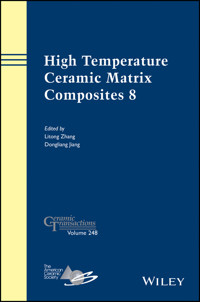
High Temperature Ceramic Matrix Composites 8 E-Book
136,99 €
Mehr erfahren.
- Herausgeber: John Wiley & Sons
- Kategorie: Fachliteratur
- Serie: Ceramic Transaction Series
- Sprache: Englisch
This proceedings contains 78 papers from the 8th International Conference on High Temperature Ceramic Matrix Composites, held September 22-26, 2013 in Xi'an, Shaanxi, China. Chapters include: * Ceramic Genome, Computational Modeling, and Design * Advanced Ceramic Fibers, Interfaces, and Interphases * Nanocomposite Materials and Systems * Polymer Derived Ceramics and Composites * Fiber Reinforced Ceramic MatrixComposites * Carbon-Carbon Composites: Materials, Systems, and Applications * Ultra High Temperature Ceramics and MAX Phase Materials * Thermal and Environmental Barrier Coatings
Sie lesen das E-Book in den Legimi-Apps auf:
Seitenzahl: 1108
Veröffentlichungsjahr: 2014
Ähnliche




















Contents
Cover
Half Title page
Title page
Copyright page
Introduction
Preface
Symposia Organizers
Ceramic Genome, Computational Modeling, and Design
Design of New Gradient Cemented Carbides and Hard Coatings Through Ceramic Genome
Abstract
Introduction
Establishment of The Ceramic Genome
Experimental
Results and Discussion
Schematical Ceramic Genome
Conclusion
Acknowledgement
References
The Effects of Nesting and Stacking Sequence on the Structural and Gas Transport Properties of Plain Woven Composites during Chemical Vapor Infiltration Process
Abstract
Introduction
The Macro-Pore Model
Results and Discussion
Conclusion
Acknowledgements
References
An Efficient Approach to Determine the Effective Properties of Random Heterogeneous Materials
Abstract
Introduction
Homogenization
Extrapolation
Numerical Results
Conclusion
Acknowledgement
References
Contribution of Image Processing Techniques to the Simulation of Chemical Vapor Infiltration of SiC in CMCs
Abstract
Introduction
Overall Strategy
Image Analysis Tools
Image Synthesis
Infiltration Simulations
Summary and Outlook
Acknowledgements
References
Image-Based Numerical Simulation of Thermal Expansion in C/C Composites
Abstract
Introduction
Material and Characterizations
Strategy and Methods
Results and Discussion
Summary and Outlook
Acknowledgements
References
Analysis and Molecular Modeling of Pyrolytic Carbons Nanotextures
Abstract
Introduction
Materials
Numerical Methods
Results and Discussion
Summary and Outlook
Acknowledgements
References
A New Kinetic Monte-Carlo/Volume-of-Fluid Solver for the Anisotropic Surface Recession of C/C Composites by Ablation
Abstract
Introduction
Method: Principle and Implementation
Test Cases : Presentation and Quasi-Analytic Solutions
Test Results
Application Example
Summary and Conclusion
Acknowledgements
References
Numerical Simulation of Oxidation-Assisted Failure of CMC-SiC at Intermediate Temperature
Abstract
Introduction
Microstructural Characteristics of Micro CMC-SiC
Microstructure Modeling of Oxidized Micro CMC-SiC
Oxidation Kinetics Model
Modelling the Oxidized Microstructure
Computation Method of Stress Distribution and Failure Behavior of Oxidized Micro CMC-SiC
Periodical Boundary Conditions
Failure Analysis Strategy
Numerical Examples
Failure of Micro Sic/Sic
Failure of Micro C/Sic
Conclusion
Acknowledgement
References
Advanced Ceramic Fibers, Interfaces, and Interphases
Suppression of α-Al2O3 Formation from Alumina Gel Fibers by Urea-Catalyzed TEOS-Derived Silica
Abstract
Introduction
Experimental
Results and Discussion
Conclusion
References
Ceramix Matrix Microcomposites Prepared by P-RCVD Within the (Ti-Si-B-C) System
Abstract
Introduction
Experimental
Results and Discussion
Conclusion
Acknowledgement
References
Fabrication and Properties of Zr/SiC and Zr/Si3N4 Laminated Composites
Abstract
1. Introduction
2. Experiment
4. Conclusion
Acknowledgement
References
Silicon Carbide Fibers Made from Nano-Powders
Abstract
Introduction
Experimental Procedure
Results and Discussion
Conclusions
Acknowledgements
References
Composition and Reactivity of Various Silicon Carbide Fibres
Abstract
Introduction
Conclusions
Acknowledgements:
References:
The Investigation of Pyrolytic Coating on Carbon Monofilament by Cold Wall CVD using Ethanol as Precursor
Abstract
Introduction
Experimental
Results and Discussion
Conclusion
References
Nanocomposite Materials and Systems
Carbon Nanotube-Reinforced Ceramic Matrix Composites: Processing and Properties
Abstract
Introduction
Processing of Cnt-Reinforced CMCs
Mechanical Properties
Functional Properties
Conclusions
Acknowledgment
References
Fabrication of ZAO Ceramic Target and Effect on the Photoelectric Properties of its Film
Abstract
Introduction
Experimental
Results and Discussion
Conclusion
References
Mechanical Properties of Carbon Nanotube Reinforced Composites: A Review
Abstract
Introduction
Research Progress in Cnts/Pmc
Research Progress in Cnts/Mmc
Research Progress in Cnts/Cmc
Summaries and Remarks
Acknowledgements
References
Effect of the Electrodeposition Parameters on Deposition Morphologies of CNTs on Carbon Fibers
Abstract
Introduction
Experimental
Results and Discussion
Conclusions
Acknowledgements
References
Microstructure and Growth Mechanism of SiC Whiskers Synthesized by Carbothermal Reduction of Silicon Nitride
Abstract
Introduction
Experimental
Results and Discussion
Conclusion
Acknowledgement
References
Polymer Derived Ceramics and Composites
High Temperature Dielectric and Microwave Absorption Properties of Polymer Derived SiCN Ceramic in X Band
Abstract
Introduction
Experimental
Results and Discussion
Conclusions
Acknowledgment
References
SiCN-Nanowhiskers Self-Reinforcing CMC Quasi-3D Structure Forming by PIP
Abstract
1. Introduction
2. Experiments
3. Results and Discussion
References
Ablation Behavior of C/C-Zrb2-SiC Carbon-Ceramic Composites
Abstract
1. Introduction
2. Materials and Methods
3. Results and Discussions
4. Conclusions
References:
Fiber Reinforced Ceramic Matrix Composites
Effect of Heat Exposure on the Flexural Strength of Reinforced Carbon and Glass Fibers Geopolymer Matrix Composites
Abstract
Introduction
Experimental
Results and Discussion
Conclusion
Acknowledgement
References
Reaction Mechanism of Titanium with Carbon During Reactive Melt Infiltration of a Carbon Fiber Reinforced TiC and Carbon Composite
Abstract
Introduction
Experimental
Result and Discussion
Conclusion
References
Modelling the Behaviour of CMC Using Damage Mechanics
Abstract
Introduction
Crack Network Modelling
Oxidative Damage Modelling
Tensile Test on A Dog-Bone Specimen at High Temperature and Under Oxidizing Environment
Conclusion
References
MMS Technology: First Results and Prospects
Abstract
Introduction
Experimental
Results and Discussion
Conclusions
Acknowledgements
References
Effect of Oxidation Damage on the Totel Emissivity of 2D C/SiC Composites
Abstract
Introduction
Experimental Procedure
Results and Discussion
Conclusion
References:
Effect of Water Vapor on the Oxidation Behavior of CVD-BCx
Abstract
Introduction
Experimental
Results and Discussion
Conclusion
Acknowledgments
References
Microstructure and Mechanical Properties of the 2D C/SiC/Tc4 Joints Brazed with Cu-Ti + Mo
Abstract
1. Introduction
2. Materials and Experimental Procedures
3. Results and Discussion
4. Conclusions
Acknowledgements
References
Uniaxial Macro-Mechanical Property and Failure Analysis of A 2D-Woven Sic/SiC Composite
Abstract
Introduction
Experiment
Stress-Strain Behaviors and Damage Evolution
Mechanical Properties and Failure Mechanisms
Conclusions
References
A Biaxial Flexural Test for Short Carbon Fiber-Reinforced Sic-Matrix Composites
Abstract
Introduction
Experimental
Results and Discussion
Summary
Acknowledgement
References
C/C-SiC Materials Based on Melt Infiltration - Manufacturing Methods and Experiences from Serial Production
Abstract
Cmc Manufacturing Via Melt Infiltration
Properties of Mi Derived C/SiC and C/C-SiC
Applications of Mi Derived C/C-SiC and C/SiC
Development of Brake Pads for the Propeller Brake of A400M
Experiences from Pre-Series Manufacture
Summary
References
Internal Friction Behavior of SiC Ceramics Subjected to Water Vapor Corrosion
Abstaract
Introduction
Experimental
Results and Discussion
Conclusion
References
Fatigue Behavior of C/SiC Ceramic Matrix Composites at Room and Elevated Temperatures
Abstract
Introduction
Material and Experimental Procedures
Experimental Results
Hysteresis Theory and Fatigue Life Prediction Model
Experimental Comparisons
Conclusion
Acknowledgement
References
The Effects Originated from Low Earth Orbit Thermal Cycling and Atomic Oxygen on C/SiC Composites
Abstract:
1. Introduction
2. Experimental
3. Results and Discussion
4. Conclusion
Acknowledgements
References
Processing and Properties of the C/SiBCN Ceramic Matrix Composites Prepared by PIP
Abstract
Introduction
Experiment
Results and Discussion
Conclusion
Acknowledgement
References
Analysis and Characterization of Amorphous Boron Carbide Coatings Deposited from BCl3-CH4-H2 Mixtures
Abstract
1. Introduction
2. Experiment Procedure
3. Results and Discussion
4. Summary
Acknowledgments
References
Chemical Vapor Deposition of Boron-Doped Carbon Coating from BCl3-C3H6-H2Ar Gas Mixture
Abstract
1. Introduction
2. Experimenal
3. Results and Discussion
4. Conclusions
Acknowledgments
References
Preparation and Mechanical Properties of 3D-Cf/Mullite Composites Fabricated by Sol-Gel Process
Abstract:
1. Introduction
2. Experimental Procedure
3. Results and Discussion
4. Conclusions
Acknowledgement
References
An Alternative to Ceramic Matrix Composites
Abstract
Introduction
Experimental
Conclusions
Acknowledgements
Fabrication of Short Fiber Reinforced SiCN by Injection Molding of Preceramic Polymers
Abstract
Introduction
Experimental Materials
Characterization Methods.
Sample Preparation.
Results and Discussion
Compound Development.
Compound Preparation.
Sample Characterization.
Microstructure
Conclusions
Acknowledgement
References
Abstract
Introduction
Interphase Concept as Applied to Sic/SiC Composites
Cvi: A Unique Process to Engineer the Interphase in Sic/SiC Composites
Conventional Interphases
Other Potential Interphases
Conclusions
References
Temperature Effect on C/SiC Composite with SiC Nanowires Grown in Situ
Abstract
Introduction
Experimental
Results and Discussion
Conclusions
Acknowledgement
References
Evaluation of Different Carbon Precursors for the Liquid Silicon Infiltration Process
Abstract
Introduction
Experimental
Results and Discussion
Conclusion
Acknowledgement
References
Microstructure and Mechanical Properties of C/C-SiC Composites Reinforced with Fibers Treated at Elevated Temperatures
Abstract
Introduction
Experimental Procedure
Results and Discussion
Summary
Acknowledgments
References
Oxidation Behavior of C/C-SiC Composites with Varied Matrix Composition
Abstract
Introduction
Experimental
Results and Discussion
Summary
Acknowledgments
References
Evaluation and Validation of Elastic Properties and a Failure Criterion for an Oxide Wound Ceramic Composite Material
Abstract
1 Introduction and Motivation
2 Modeling Approach
3 Experimental
4 Results and Discussion
5 Conclusions
References
Mechanical and Ablation Properties of Ultra-High Temperature Composites with a Variable Matrix-Composition
Abstract
1. Introduction
1. Experimental
3. Results and Discussion
4. Conclusions
References:
Carbon-Carbon Composites: Materials, Systems, and Applications
Effects of Preform Structures on Rhenium Coating Prepared on C/C Composites by Chemical Vapor Deposition
Abstract
Introduction
Experimental
Results and Discussion
Conclusions
References
Application Status of C/C Composites for Thermal Protection System in Re-Entry Spacecraft
Abstract
1. Introduction
2. Fabrication Process
3. Conclusion
4. References:
Techniques about Fabrication of Thin-Wall Preforms with Complex Shape for Ceramic Composites
Abstract
1 Introduction
2 Preform Fabrication Technologies
3 Conclusion and Future Work
4 Acknowledgments
Reference
Carbon/Carbon Greenbodies for Space Mirrors and Their Thermal Performance
Abstract
1. Introduction
2. Experimental Procedure
3. Results and Discussion
4. Conclusion
Reference
Oxidation Behavior of SiC Reinforced ZrB2 Composite Coating Prepared by Low Pressure Plasma Spray
Abstract
Introduction
Experiments
Results and Discussions
Conclusions
Acknowledgement
Reference
Structural Analysis of Carbon-Fiber / Pyrolytic Carbon Matrix Composites
Abstract
Introduction
Results and Discussion
Conclusion
Acknowledgment
References
Preparation of β-Sialon Anti-Oxidation Ceramic Coating for C/C Composites and Infrared Stealthy Characteristic
Abstract
Introduction
Experimental
Results and Discussion
Infrared Stealthy Characteristic
Conclusion
Acknowledgement
References
Ultra High Temperature Ceramics and MAX Phase Materials
Effect of Carbon Content on the Formation of Ti3SiC2 in the Liquid Silicon Infiltration Process
Abstract
Introduction
Experimental
Results and Discussion
Conclusion
Acknowledgement
References
Modification of Titanium Carbide Powders by Silicidation with Gaseous SiO
Abstract
Introduction
Experimental
Results and Discussion
Conclusion
Acknowledgement
References
Combustion Synthesis of Ti3SiC2-Based Ceramic Matrix Composites Using Non-Powder Reactant Solids
Abstract
Introduction
Experimental
Results and Discussion
Conclusion
Acknowledgements
References
Microstructure Evolution of α-SiC in the Liquid Phase Sintering Process
Abstract
Introduction
Experimental
Result and Discussion
Conclusion
References
Mechanical Properties and Thermal Shock Resistance of Anisotropic Zrb2-SiC-Graphite Ceramic
Abstract
Introduction
Experimental Procedures
Theoretical and Numerical Calculation
Results and Discussion
Conclusions
Acknowledgement
References
Ablation Behavior of Zrb2/SiC Composite by Oxyacetylene Flame
Abstract
1 Introduction
2 Experiment Procedures
3 Results and Discussions
4 Conclusions
References:
Synthesis of Zrc-Zrb2 Composite Powders by Pirac Method
Abstract
Introduction
Experimental Procedure
Results and Discussion
Conclusion
Acknowledgement
References
Thermal and Environmental Barrier Coatings
Formation of Fine Ceramics Layer and Intermetallics Network by Thermal Nanoparticles Spraying and Pattering
Abstract
Introduction
Experimental Procedure
Results and Discussions
Conclusion
References
Formation of Inter-splat Bonding and Intra-splat Microstructure During Plasma Spraying of Ceramic Coating
Abstract
Introduction
Splat Cooling Features During Plasma Spraying
Inter-Splat Interface Bonding
Effect of Inter-Splat Bonding and Deposition Temperature on the Intra-Splat Microstructure
Summary
Acknowledgements
References
Preparation and Ablation Properties of Zrc-Tac Co-Deposition Coating for Carbon-Carbon Composites
Abstract:
1. Introduction
2. Experiment
2 Results and Discussion
3. Conlusions
Acknowledgments
References
Phase Stabilities and Corrosion/Recession Properties of Rare Earth Silicates Under High Speed Steam Jet
Abstract
Introduction
Experimental
Results and Discussion
Summary
References
Integration Technologies, Component Testing, and Evaluation
Wettability in Joining of Advanced Ceramics and Composites: Issues and Challenges
Abstract
Introduction
Wettability
Infiltration
Brazing of CMCs: General Considerations
Conclusions
References
Study on the Ablation Behavior of 3D Needled C/SiC in the Rocket Combustion Environments
Abstract
Introduction
Experimental Procedures
Results and Discussion
Conclusion
References
The Degradation of Hi-Nicalon Monofilament after Proton Irradiation
Abstract
Introduction
Experimental Procedure
Results and Discussion
Conclusions
Acknowledgements
References
Damage Evaluation in Glass-Ceramic Matrix Composites Via Combined Infrared Thermography and Acoustic Emission
Abstract
Introduction
Experimental
Results and Discussion
Conclusions
Acknowledgment
References
Hybrid Ceramic – Metallic Composite Pipes for High Temperature Power Plant Application
Abstract
Introduction
Numerical and Experimental Work
Results and Discussion
Conclusion
Acknowledgement
References
An Experimental Investigation on Shear Behaviors of Single-Lap Four-Pin 2D C/SiC Joints
Abstract
1. Introduction
2. Experimental Details
3. Results and Discussion
4. Conclusions
Acknowledgements
References
The Effect of Dimension Parameters on the Tensile Properties of A C/SiC Pipe
Abstract
Introduction
Experiment
Result and Analysis
Conclusion
Acknowledgment
References
The Application Research of New Testing Technique on Mechanical Experiment for Large-Size CMC Structure
Abstract
Introduction
Application of the Wireless Laser Measuring Technique in Thermal Modal Test of CMC Structure
The Characteristics of Acoustic Emission Test for CMC Material
Applications of High Temperature Acoustic Emission Technique(Htae) to Ground Test of CMC Large Scale Structure
Conclusion
References
Joining of Glassy Carbon with A C/C-SiC Composite by Brazing for an Innovative High Temperature Sensor
Abstract
Introduction
Experimental
Results
Discussion
Conclusion
Acknowledgement
References
Strengthening/Toughening of Laminated (Sicw+Sicp)/SiC Ceramic Composites
Abstract
Introduction
Experimental
Results and Discussion
Conclusion
Acknowledgement
References
Mechanical Properties of Carbon/Silicon Carbide Composites Materials Bolts
Abstract
Introduction
Test
Results
Conclusions
Reference
Development of Full Scale Ramjet Nozzle with C/SiC Ceramic Matrix Composite
Abstract
Introduction
Working Conditions
Manufacturing Process
Analysis for Failure of Nozlle Hydraulic Pressure Test
Ablation Behavior
Deposition Properties
Conclusions
Reference
Author Index
High Temperature Ceramic Matrix Composites 8
Copyright © 2014 by The American Ceramic Society. All rights reserved.
Published by John Wiley & Sons, Inc., Hoboken, New Jersey.Published simultaneously in Canada.
No part of this publication may be reproduced, stored in a retrieval system, or transmitted in any form or by any means, electronic, mechanical, photocopying, recording, scanning, or otherwise, except as permitted under Section 107 or 108 of the 1976 United States Copyright Act, without either the prior written permission of the Publisher, or authorization through payment of the appropriate per-copy fee to the Copyright Clearance Center, Inc., 222 Rosewood Drive, Danvers, MA 01923, (978) 750-8400, fax (978) 750-4470, or on the web at www.copyright.com. Requests to the Publisher for permission should be addressed to the Permissions Department, John Wiley & Sons, Inc., 111 River Street, Hoboken, NJ 07030, (201) 748-6011, fax (201) 748-6008, or online at http://www.wiley.com/go/permission.
Limit of Liability/Disclaimer of Warranty: While the publisher and author have used their best efforts in preparing this book, they make no representations or warranties with respect to the accuracy or completeness of the contents of this book and specifically disclaim any implied warranties of merchantability or fitness for a particular purpose. No warranty may be created or extended by sales representatives or written sales materials. The advice and strategies contained herein may not be suitable for your situation. You should consult with a professional where appropriate. Neither the publisher nor author shall be liable for any loss of profit or any other commercial damages, including but not limited to special, incidental, consequential, or other damages.
For general information on our other products and services or for technical support, please contact our Customer Care Department within the United States at (800) 762-2974, outside the United States at (317) 572-3993 or fax (317) 572-4002.
Wiley also publishes its books in a variety of electronic formats. Some content that appears in print may not be available in electronic formats. For more information about Wiley products, visit our web site at www.wiley.com.
Library of Congress Cataloging-in-Publication Data is available.
ISBN: 978-1-118-93298-8
ISSN: 1042-1122
Introduction
Ceramic matrix composites (CMCs) are becoming a set of indispensable materials for a number of applications in aerospace, power generation, ground transportation, nuclear, environmental and chemical industries involving high temperatures and extreme environments. In China, there has been tremendous progress in CMCs in the areas of scientific research, technological development, and commercialization.
The HTCMC conference was introduced by Prof. Roger Naslain in 1993 and takes place every three years at alternating locations around the globe: Bordeaux (France, 1993), Santa Barbara (USA, 1995), Osaka (Japan, 1998), Munich (Germany, 2001), Seattle (USA, 2004), New Delhi (India, 2007), and Bayreuth (Germany, 2010).
HTCMC-8, held September 22–26, 2013 in Xi’an, Shaanxi, China was a successful platform for the community of high temperature ceramics and composites to share innovative ideas in research and development as well as up-to-date applications of CMCs. We would like to gratefully thank the symposium organizers (see page xvii) for their hard work and dedication for making HTCMC-8 a success.
Prof. Litong Zhang Academician, CAE Northwestern Polytechnical University Xi’an, China
Prof. Dongliang Jiang Academician, CAE Shanghai Institute of Ceramics Shanghai, China
Preface
The High Temperature Ceramic Matrix Composites (HTCMC) conference series was initiated by Prof. Roger Naslain, Honorary professor of University of Bordeaux, in 1993 in Bordeaux (France), and then in Santa Barbara (USA, 1995), Osaka (Japan, 1998), Munich (Germany, 2001), Seattle (USA, 2004), New Delhi (India, 2007) and Bayreuth (Germany, 2010). HTCMC-8 conference was hold in Xian (China, 2013).
In 2013, HT-CMC conference series comes to its 20th year. Over the past two decades, ceramic matrix composites (CMCs) are becoming a set of indispensable materials for a number of applications in aerospace, power generation, ground transportation, nuclear, environmental and chemical industries involving high temperatures and extreme environments. Tremendous progress in CMCs has been made in scientific research, technological development, and commercialization.
With the rapid development of related new materials, simulation and process methods, the HTCMC-8 conference has been expanded to comprise nine symposia, and more and more participants have been involved in this conference. In HTCMC-8, there were 320 participants from 18 countries, in which 210 participants came from China and 110 from the other countries. There were 260 oral talks, including 36 keynotes and 52 invited talks, and 75 posters. The HTCMC conference is becoming an influential conference and an excellent platform for academic communication.
Facing the challenges of harsh service environments, novel high-temperature ceramic composite materials for functional/structural-integrated applications have been developed by means of designing the phase composition and microstructure of fiber, interface, matrix and coating. These kinds of research are very attractive and challengeable, which provide great opportunities for discovery of new materials. We believe the development and the application of CMCs would be promoted by effective international exchange and cooperation.
After a peer-review process, 78 papers are accepted for inclusion in this proceedings. We acknowledge all the authors’ dedications, and appreciate the symposium editors, Jing-Yang Wang, Gregory Morscher, Hui Mei, Peter Greil, Tatsuki Ohji, He-Jun Li, Yan-Chun Zhou, Hua-Tay Lin, and Lai-Fei Cheng for their contributions during the entire evaluating and reviewing process. We also appreciate Greg Geiger of The American Ceramic Society for his great work on the publication of this proceedings.
PROF. LITONG ZHANGAcademician, CAE Northwestern Polytechnical University Xi’an, China
PROF. DONGLIANG JIANGAcademician, CAE Shanghai Institute of Ceramics Shanghai, China
Symposia Organizers
Symposium 1: Ceramic Genome, Computational Modeling, and Design
Jingyang Wang, China
Yong Du, China
Zhiqiang Feng, France
Weihong Zhang, China
Gérard Vignoles, France
Symposium 2: Advanced Ceramic Fibers, Interfaces, and Interphases
Gregory Morscher, USA
Lifu Chen, China
Yongcai Song, China
Hubert Jäger, Germany
Yutaka Kagawa, Japan
Symposium 3: Nanocomposite Materials and Systems
Sanjay Mathur, Germany
Hisayuki Suematsu, Japan
Soshu Kirihara, Japan
Zhengwei Pan, USA
Wei-Hsing Tuan, Taiwan
Yubai Pan, China
Lalit M. Manocha, India
Symposium 4: Polymer Derived Ceramics and Composites
Peter Greil, Germany
Paolo Colombo, Italy
Raj Bordia, USA
Linan An, USA
Günter Motz, Germany
Yiguang Wang, China
Dong-Pyo Kim, Korea
Ralf Riedel, Germany
Symposium 5: Fiber Reinforced Ceramic Matrix Composites
Shaoming Dong, China
Tatsuki Ohji, Japan
Walter Krenkel, Germany
Jacques Lamon, France
Gilbert Fantozzi, France
Dietmar Koch, Germany
Laifei Cheng, China
Xiaowei Yin, China
Frank Zok, USA
David Marshall, USA
Symposium 6: Carbon-Carbon Composites: Materials, Systems, and Applications
Hejun Li, China
Hong Cui, China
Xiang Xiong, China
Walter Krenkel, Germany
Hiroshi Hatta, Japan
Lalit M. Manocha, India
Gérard Vignoles, France
Symposium 7: Ultra High Temperature Ceramics and MAX Phase Materials
Guojun Zhang, China
Yanchun Zhou, China
Sylvia Johnson, USA
Alida Bellosi, Italy
Yoshio Sakka, Japan
Xinghong Zhang, China
Shibo Li, China
Symposium 8: Thermal and Environmental Barrier Coatings
Hua-Tay Lin, USA
Wei Pan, China
Hagen Klemm, Germany
Yiguang Wang, China
Dileep Singh, USA
Symposium 9: Integration Technologies, Component Testing, and Evaluation
Laifei Cheng, China
Mrityunjay Singh, USA
Monica Ferraris, Italy
Roland Weiß, Germany
Rajiv Asthana, USA
Martin Frieß, Germany
Ceramic Genome, Computational Modeling, and Design
DESIGN OF NEW GRADIENT CEMENTED CARBIDES AND HARD COATINGS THROUGH CERAMIC GENOME
Weibin Zhanga, Yong Dua,*, Li Chena, Yingbiao Penga, Peng Zhoua, Weimin Chena, Kaiming Chenga, Lijun Zhanga, Wen Xieb, Guanghua Wenb, and Shequan Wangb
a State Key Lab of Powder Metallurgy, Central South University, Hunan, 410083, China
b Zhuzhou cemented carbide cutting tools limited company, Zhuzhou, Hunan, 412007, China
ABSTRACT
The concept of ceramic genome is briefly introduced, and its combination with CALPHAD (CALculation of PHAse Diagrams) method is a powerful tool for materials process optimization and alloy design. The quality of CALPHAD-type calculations is strongly dependent on the quality of the thermodynamic and diffusivity databases. The development of thermodynamic and diffusivity databases for cemented carbides is described. Several gradient cemented carbides sintered under vacuum and various partial pressures of N2 have been studied via experiment and simulation. Examples of ceramic genome applications in design and manufacture for different kinds of cemented carbides are shown using the databases and comparing where possible against experimental data, thereby validating their accuracies. Metastable Ti-Al-N coatings have been well acknowledged as protective layer for industrial applications due to their excellent mechanical, chemical and thermal properties. Here, we study the effect of Zr addition on structure and thermal properties of Ti1-xAlxN based coatings under the guidance of ab initio calculations. The preparation of TiAlZrN by magnetron sputtering verifies the suggested cubic (NaCl-type) structure for below 0.6–0.7 and ≤ 0.4. Alloying with Zr also promotes the formation of cubic domains but retards the formation of stable wurtzite AlN during thermal annealing.
Lesen Sie weiter in der vollständigen Ausgabe!
Lesen Sie weiter in der vollständigen Ausgabe!
Lesen Sie weiter in der vollständigen Ausgabe!
Lesen Sie weiter in der vollständigen Ausgabe!
Lesen Sie weiter in der vollständigen Ausgabe!
Lesen Sie weiter in der vollständigen Ausgabe!
Lesen Sie weiter in der vollständigen Ausgabe!
Lesen Sie weiter in der vollständigen Ausgabe!
Lesen Sie weiter in der vollständigen Ausgabe!
Lesen Sie weiter in der vollständigen Ausgabe!
Lesen Sie weiter in der vollständigen Ausgabe!
Lesen Sie weiter in der vollständigen Ausgabe!
Lesen Sie weiter in der vollständigen Ausgabe!
Lesen Sie weiter in der vollständigen Ausgabe!
Lesen Sie weiter in der vollständigen Ausgabe!
Lesen Sie weiter in der vollständigen Ausgabe!
Lesen Sie weiter in der vollständigen Ausgabe!
Lesen Sie weiter in der vollständigen Ausgabe!
Lesen Sie weiter in der vollständigen Ausgabe!
Lesen Sie weiter in der vollständigen Ausgabe!
Lesen Sie weiter in der vollständigen Ausgabe!
Lesen Sie weiter in der vollständigen Ausgabe!
Lesen Sie weiter in der vollständigen Ausgabe!
Lesen Sie weiter in der vollständigen Ausgabe!
Lesen Sie weiter in der vollständigen Ausgabe!
Lesen Sie weiter in der vollständigen Ausgabe!
Lesen Sie weiter in der vollständigen Ausgabe!
Lesen Sie weiter in der vollständigen Ausgabe!
Lesen Sie weiter in der vollständigen Ausgabe!
Lesen Sie weiter in der vollständigen Ausgabe!
Lesen Sie weiter in der vollständigen Ausgabe!
Lesen Sie weiter in der vollständigen Ausgabe!
Lesen Sie weiter in der vollständigen Ausgabe!
Lesen Sie weiter in der vollständigen Ausgabe!
Lesen Sie weiter in der vollständigen Ausgabe!
Lesen Sie weiter in der vollständigen Ausgabe!
Lesen Sie weiter in der vollständigen Ausgabe!
Lesen Sie weiter in der vollständigen Ausgabe!
Lesen Sie weiter in der vollständigen Ausgabe!
Lesen Sie weiter in der vollständigen Ausgabe!
Lesen Sie weiter in der vollständigen Ausgabe!
Lesen Sie weiter in der vollständigen Ausgabe!
Lesen Sie weiter in der vollständigen Ausgabe!
Lesen Sie weiter in der vollständigen Ausgabe!
Lesen Sie weiter in der vollständigen Ausgabe!
Lesen Sie weiter in der vollständigen Ausgabe!
Lesen Sie weiter in der vollständigen Ausgabe!
Lesen Sie weiter in der vollständigen Ausgabe!
Lesen Sie weiter in der vollständigen Ausgabe!
Lesen Sie weiter in der vollständigen Ausgabe!
Lesen Sie weiter in der vollständigen Ausgabe!
Lesen Sie weiter in der vollständigen Ausgabe!
Lesen Sie weiter in der vollständigen Ausgabe!
Lesen Sie weiter in der vollständigen Ausgabe!
Lesen Sie weiter in der vollständigen Ausgabe!
Lesen Sie weiter in der vollständigen Ausgabe!
Lesen Sie weiter in der vollständigen Ausgabe!
Lesen Sie weiter in der vollständigen Ausgabe!
Lesen Sie weiter in der vollständigen Ausgabe!
Lesen Sie weiter in der vollständigen Ausgabe!
Lesen Sie weiter in der vollständigen Ausgabe!
Lesen Sie weiter in der vollständigen Ausgabe!
Lesen Sie weiter in der vollständigen Ausgabe!
Lesen Sie weiter in der vollständigen Ausgabe!
Lesen Sie weiter in der vollständigen Ausgabe!
Lesen Sie weiter in der vollständigen Ausgabe!
Lesen Sie weiter in der vollständigen Ausgabe!
Lesen Sie weiter in der vollständigen Ausgabe!
Lesen Sie weiter in der vollständigen Ausgabe!
Lesen Sie weiter in der vollständigen Ausgabe!
Lesen Sie weiter in der vollständigen Ausgabe!
Lesen Sie weiter in der vollständigen Ausgabe!
Lesen Sie weiter in der vollständigen Ausgabe!
Lesen Sie weiter in der vollständigen Ausgabe!
Lesen Sie weiter in der vollständigen Ausgabe!
Lesen Sie weiter in der vollständigen Ausgabe!
Lesen Sie weiter in der vollständigen Ausgabe!
Lesen Sie weiter in der vollständigen Ausgabe!
Lesen Sie weiter in der vollständigen Ausgabe!
Lesen Sie weiter in der vollständigen Ausgabe!
Lesen Sie weiter in der vollständigen Ausgabe!
Lesen Sie weiter in der vollständigen Ausgabe!
Lesen Sie weiter in der vollständigen Ausgabe!
Lesen Sie weiter in der vollständigen Ausgabe!
Lesen Sie weiter in der vollständigen Ausgabe!
Lesen Sie weiter in der vollständigen Ausgabe!




