


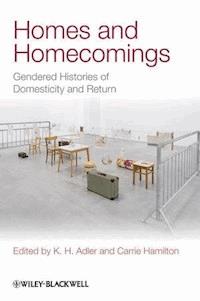
Homes and Homecomings E-Book
21,99 €
Mehr erfahren.
- Herausgeber: John Wiley & Sons
- Kategorie: Geisteswissenschaft
- Serie: Gender and History Special Issues
- Sprache: Englisch
In Homes and Homecomings an international group of scholars provide inspiring new historical perspectives on the politics of homes and homecomings. Using innovative methodological and theoretical approaches, the book examines case studies from Africa, Asia, the Americas and Europe. * Provides inspiring new historical perspectives on the politics of homes and homecomings * Takes an historical approach to a subject area that is surprisingly little historicised * Features original research from a group of international scholars * The book has an international approach that focuses on Africa, Asia, the Americas and East and West Europe * Contains original illustrations of homes in a variety of historical contexts
Sie lesen das E-Book in den Legimi-Apps auf:
Seitenzahl: 653
Veröffentlichungsjahr: 2011
Ähnliche




















Contents
NOTES ON CONTRIBUTORS
Gendering Histories of Homes and HomecomingsK. H. ADLER
Notes
1 Communist Comfort: Socialist Modernism and the Making of Cosy Homes in the Khrushchev EraSUSAN E. REID
An obsession with domesticity
The great transmigration
Mediating the move: giving public meaning to the separate apartments
Accommodating industrial, standardised construction
Rationalisation and modernisation of uiut
Home as a site for display of cultural level and aesthetic discernment
Handicraft
Practice
Conclusion
Notes
2 Corporate Domesticity and Idealised Masculinity: Royal Naval Officers and their Shipboard Homes, 1918–39QUINTIN COLVILLE
Notes
3 Men Making Home: Masculinity and Domesticity in Eighteenth-Century BritainKAREN HARVEY
Missing men
Meanings of home
At home or abroad?
The extensive sense of oeconomy
Conclusion
Notes
4 ‘Who Should Be the Author of a Dwelling?’ Architects versus Housewives in 1950s FranceNICOLE RUDOLPH
Building homes, rebuilding a nation
The architectural profession and French reconstruction
The grand ensemble ‘cell’
The Referendum Apartment
Famille et habitation: whose functionalism? Whose expertise?
State planners adapt
Conclusion
5 Ideal Homes and the Gender Politics of Consumerism in Postcolonial Ghana, 1960–70BIANCA MURILLO
Background: independence and economic decline
Exhibition politics and motivations
The Ghanaian home and national stability
Disciplined domesticity
Conclusion
Notes
6 ‘The Dining Room Should Be the Man’s Paradise, as the Drawing Room Is the Woman’s’: Gender and Middle-Class Domestic Space in England, 1850–1910JANE HAMLETT
Conclusion
Notes
7 ‘There Is Graite Odds between A Mans being At Home And A Broad’: Deborah Read Franklin and the Eighteenth-Century HomeVIVIAN BRUCE CONGER
The Franklin house: ‘The Material Culture of Gender, the Gender of Material Culture’
Conclusion
Notes
8 Sexual Politics and Socialist Housing: Building Homes in Revolutionary CubaCARRIE HAMILTON
Socialism and housing9
Revolutionary homes
Memories of home
Sex, gender and housing
Queer homes
Towards a history of sexuality and housing
Notes
9 ‘The White Wife Problem’: Sex, Race and the Contested Politics of Repatriation to Interwar British West AfricaCARINA E. RAY
Riots, repatriation and the policy of prevention
Citizenship and repatriation policy
The class caveat
Epilogue
Notes
10 From Husbands and Housewives to Suckers and Whores: Marital-Political Anxieties in the Anxieties in the ‘House of Egypt’, 1919–48LISA POLLARD
Notes
11 Double Displacement: Western Women’s Return Home from Japanese Internment in the Second World WarCHRISTINA TWOMEY
Empire, internment and gendered understandings of war
Homecoming, sex and femininity
Internment, war and empire
Internment, return and romance
Notes
index
Gender & History Special Issue Book Series
Gender & History, an international, interdisciplinary journal on the history of femininity, masculinity, and gender relations, publishes annual special issues which are now available in book form.
Bringing together path-breaking feminist scholarship with assessments of the field, each volume focuses on a specific subject, question or theme. These books are suitable for undergraduate and postgraduate courses in history, sociology, politics, cultural studies, and gender and women’s studies.
Titles in the series include:
Homes and Homecomings: Gendered Histories of Domesticity and Return
Edited by K. H. Adler and Carrie Hamilton
Gender and Change: Agency, Chronology and Periodisation
Edited by Alexandra Shepard and Garthine Walker
Translating Feminisms in China
Edited by Dorothy Ko and Wang Zheng
Visual Genders, Visual Histories: A Special Issue of Gender & History
Edited by Patricia Hayes
Violence, Vulnerability and Embodiment: Gender and History
Edited by Shani D’Cruze and Anupama Rao
Dialogues of Dispersal: Gender, Sexuality and African Diasporas
Edited by Sandra Gunning, Tera Hunter and Michele Mitchell
Material Strategies: Dress and Gender in Historical Perspective
Edited by Barbara Burman and Carole Turbin
Gender, Citizenships and Subjectivities
Edited by Kathleen Canning and Sonya Rose
Gendering the Middle Ages: A Gender and History Special Issue
Edited by Pauline Stafford and Anneke B. Mulder-Bakker
Gender and History: Retrospect and Prospect
Edited by Leonore Davidoff, Keith McClelland and Eleni Varikas
Feminisms and Internationalism
Edited by Mrinalini Sinha, Donna Guy and Angela Woollacott
Gender and the Body in the Ancient Mediterranean
Edited by Maria Wyke
Gendered Colonialisms in African History
Edited by Nancy Rose Hunt, Tessie P. Liu and Jean Quataert
This edition first published 2010
Chapters © 2010 Blackwell Publishing Ltd
Editorial organization © 2010 Blackwell Publishing Ltd
Edition history: originally published as Volume 21, Issue 3 of Gender & History
Blackwell Publishing was acquired by John Wiley & Sons in February 2007. Blackwell’s publishing program has been merged with Wiley’s global Scientific, Technical, and Medical business to form Wiley-Blackwell.
Registered Office
John Wiley & Sons Ltd, The Atrium, Southern Gate, Chichester, West Sussex, PO19 8SQ, United Kingdom
Editorial Offices
350 Main Street, Malden, MA 02148-5020, USA
9600 Garsington Road, Oxford, OX4 2DQ, UK
The Atrium, Southern Gate, Chichester, West Sussex, PO19 8SQ, UK
For details of our global editorial offices, for customer services, and for information about how to apply for permission to reuse the copyright material in this book please see our website at www.wiley.com/wiley-blackwell.
The right of K. H. Adler and Carrie Hamilton to be identified as the authors of the editorial material in this work has been asserted in accordance with the UK Copyright, Designs and Patents Act 1988.
All rights reserved. No part of this publication may be reproduced, stored in a retrieval system, or transmitted, in any form or by any means, electronic, mechanical, photocopying, recording or otherwise, except as permitted by the UK Copyright, Designs and Patents Act 1988, without the prior permission of the publisher.
Wiley also publishes its books in a variety of electronic formats. Some content that appears in print may not be available in electronic books.
Designations used by companies to distinguish their products are often claimed as trademarks. All brand names and product names used in this book are trade names, service marks, trademarks or registered trademarks of their respective owners. The publisher is not associated with any product or vendor mentioned in this book. This publication is designed to provide accurate and authoritative information in regard to the subject matter covered. It is sold on the understanding that the publisher is not engaged in rendering professional services. If professional advice or other expert assistance is required, the services of a competent professional should be sought.
Library of Congress Cataloging-in-Publication data is available for this book
9781444336504 (paperback)
A catalogue record for this book is available from the British Library.
NOTES ON CONTRIBUTORS
K. H. Adler teaches history at the University of Nottingham. She is author of Jews and Gender in Liberation France and is working on a book about homecomings in post-war France. She is co-editor of Gender & History.
Quintin Colville is curator of naval history at the National Maritime Museum, London. He has held a Caird Senior Research Fellowship at the National Maritime Museum and a Junior Research Fellowship at Linacre College, Oxford, and was awarded the Royal Historical Society’s Alexander Prize in 2002.
Vivian Bruce Conger is Associate Professor of History at Ithaca College, New York. She is the author of The Widows’ Might: Widowhood and Gender in Early British America (2009). She is currently working on a book exploring gender in the early republic through the lives of Deborah Read Franklin and Sarah Franklin Bache.
Carrie Hamilton teaches History and Spanish at Roehampton University, London. She is the author of Women and ETA: The Gender Politics of Radical Basque Nationalism (2007) and numerous articles on cultural memory, oral history, gender and political violence and histories of activism. She is currently completing a monograph entitled Sexual Revolutions: Passion and Politics in Socialist Cuba.
Jane Hamlett is a lecturer in Modern British History at Royal Holloway University of London. She has published in Women’s History Review, Quaderni Storici, Culturaland Social History and the Journal of Consumer Culture. Her book Material Relations:Middle-Class Families and Domestic Interiors in England, 1850–1910, is forthcoming from Manchester University Press.
Karen Harvey is Senior Lecturer in Cultural History at the University of Sheffield. She has ongoing research interests in gender, masculinity, the body, print culture (both visual and textual) and material culture during the British long eighteenth century. Her most recent book is the edited collection History and Material Culture (2009). Her next book will be Domesticating Patriarchy: Male Authority in the Eighteenth-CenturyEnglish Home (to be published by Oxford University Press).
Bianca Murillo is Assistant Professor of History at Willamette University where she teaches courses on modern Africa. Her research interests include the history of global markets and trade, postcolonial state and society, and comparative consumer cultures. The chapter published here is based on research for a full-length book project, Market Relations: Retailing, Distribution, and the Politics of Consumption in Ghana, 19301970s.
Lisa Pollard is Associate Professor in the History Department at the University of North Carolina, Wilmington. She is the author of Nurturing the Nation: The FamilyPolitics of Modernizing, Colonizing and Liberating Egypt (1805–1919) (2005) and co-editor (with Lynne Haney) of Families of a New World: Gender, Politics, and StateDevelopment in a Global Context (2003). Her current projects include an examination of competing contemporary interpretations of the Sudanese Mahdiyya uprising (188185) and a history of the rise and spread of Egyptian social organisations under British colonial rule.
Carina E. Ray is Assistant Professor of History at Fordham University where she teaches African and Black Atlantic history. She is currently completing her book, Policing Sexual Boundaries: The Politics of Race in Colonial Ghana. She is co-editor of Darfur and the Crisis of Governance in Sudan: A Critical Reader (Cornell University Press, 2009) and Navigating African Maritime History (Memorial University of Newfoundland, 2010).
Susan E. Reid is Professor of Russian Visual Culture in the Department of Russian and Slavonic Studies, University of Sheffield. She has published widely on art, visual and material culture, and has edited numerous volumes, most recently, with David Crowley, Pleasures in Socialism: Leisure and Luxury in the Bloc (2010). The chapter published here draws on research for a book-length project, Khrushchev Modern: Making Home and Becoming a Consumer in the Soviet 1960s.
Nicole Rudolph is Assistant Professor in the Department of Languages and International Studies at Adelphi University, New York. She is working on a book called AtHome in Post-war France: The Design and Construction of Domestic Space, 19451975 and has previously published in Modern and Contemporary France.
Christina Twomey is a senior lecturer in the School of Historical Studies at Monash University, Australia. She is a cultural historian of war, and interested in issues of witnessing, captivity, the photography of atrocity, gender and memory. Her most recent book is Australia’s Forgotten Prisoners: Civilians Interned by the Japanese in WorldWar II (2007).
Gendering Histories of Homes and Homecomings
K. H. Adler
In the summer of 2009, a British government social attitudes survey which was designed to discover the happiest location in England, used an index of whether people felt that they belonged to the place where they lived.1 The sense of belonging, the survey suggested, differed across the country by a margin of almost a third, with just 42 per cent of residents of the east London district of Tower Hamlets feeling as though they belonged there, against 71 per cent of the inhabitants of the rural county of Shropshire. Feeling as though one belonged, it would appear, was considered a real determinant of happiness in early twenty-first-century England, and something that could be geographically located. Indeed, the study was called the Place Survey and it seems to have been motivated by a concern to trace the feelings generated by certain locations though not, interestingly, to distinguish between inhabitants by other aspects such as their age, occupation, wealth or gender: ‘belonging’, we are meant to understand, is not only a generic sentiment uncoloured by social factors but one that is very much affected by geography and an individual’s position in space.
The authors in this volume would no doubt refine and challenge these not uninteresting but somewhat crude findings. In their explorations of historical meanings of homes and homecomings, the chapters presented here investigate how the gendered interplay of a sense of belonging – or exclusion – have been made to work across time and space. Whether ‘home’ was a district – as the Place Survey claims – or a nation or community, or indeed just a dwelling, by looking at historical and gendered aspects of homes and homecomings we aim to upset historical assumptions about who belonged where in a dwelling, or what sort of impact the state and its agents might have on inhabitants. The kind of questions that this work asks are, why did the material objects that every home contains, and their arrangement, arouse such gendered fears? What type of surveillance was deemed necessary of the intimate relationships that the inhabitants of a home had with each other or those outside? If the nation represents itself as a home, what meanings might be attached to both? And what conditions are laid on those who move away or return? Assumptions made about the nature of the home, by those who designed it or sought to control it, are pared down to their ideological framework, much as the walls of Finnish artist Tea Mäkipää’s full-scale rendition of the wonky but working skeleton of a typical northern European, suburban house are stripped away to reveal its inner workings.2 Here, burning electric lamps are in perilous mid-air suspension and taps run water into sinks divested of all furniture and apparent human intervention. Mäkipää’s refusal of the usual limits between public and private, by the simple expedient of removing all walls, ceilings and doors, exposes the extent to which those limits remain; the viewer ‘sees’ their presence and, by their very absence, knows all the more the work that they normally do. The very banality of the house’s inner workings, in their western European context – the white ceramic lavatory, a stainless steel sink, a dull and unremarkable lampshade, as well as the wires and pipes via which these objects’ functionality must derive – force reflection on the habits of those who live surrounded by such features, as well as on those who do not. But this particular incitement to reflection, while provocative, is still located in the present. It is the relation between the knowledge of the sense of home and its historical coming into being and developmental shifts at other times that the authors collected in this volume begin to explore.
A project to explore the historical sense of home recognises that ‘home’ is made up of more than actual or metaphorical sinks and pipes; as Mäkipää’s skeletal house indicates, it is something full of constructed meanings.3 But the nature of ‘a’ home as a single dwelling or community is in many instances defied. In her 1982–83 performance work, Under Siege, the artist Mona Hatoum elaborated the following interview dialogue:
M: I like to walk through London with friends.
What do you talk about when you’re walking?
M: We don’t talk, we shout.
I’m sorry, I don’t understand.
···
M: I spend day after day on the phone, dialling and redialling.
Who are you calling?
M: I’m trying to locate my parents.
Why is it such a problem phoning home?
M: I’m not phoning home.
I’m sorry, I don’t understand.4
M is holding this conversation with her dim-witted interlocutor in the early 1980s, right around the time of the war in the Lebanon, where Hatoum spent much of her childhood with her family in exile from Israel. (More prosaically, this piece coincided with the release of the hit science fiction movie E.T. whose nostalgic command, ‘phone home’, rapidly entered Euro-American popular memory.)5 The early 1980s was a period in which discussion of the refugee, the exile and the cultural dislocations that migration often entails was much less ubiquitous than it subsequently became. Nonetheless, a quarter of a century later, Under Siege retains an acuity to pinpoint the idea that ‘family’ and ‘home’ may each be located in entirely different places, that home might not be a place to which it is possible to return, and that these facts might condition ordinary behaviour so that it becomes extraordinary, even in a mundane activity – not possible in conditions of war – such as walking down the road with friends. The performance of Under Siege, described variously as lasting three or seven hours, was, in Gannit Ankori’s words, ‘gruelling’, and it must have been for both artist and audience: the artist was contained in a transparent plastic box, struggling against a mixture of mud and clay, repeatedly trying to stand up and falling down, while speakers in the room where the box stood blasted out several three-hour tapes in Arabic, English and French, the languages of Hatoum’s childhood and education.6 Nevertheless, the interviewee’s reply, ‘we don’t talk, we shout’ amuses, not just in the bafflement of the questioner but in how the response sidesteps the original query and spotlights one of the most common aspects of misbehaviour unwittingly or consciously enacted by the migrant. The inappropriate loudness of migrants to western Europe, and what was perceived as their monstrous distortions of language, were often cause for concern from at least the late nineteenth century;7 later on, for example, such was the fear of the potential disruption that outsiders might cause, that Jewish refugees arriving in Britain from Nazi-occupied Germany, Austria and Czechoslovakia before the Second World War were routinely handed a bilingual booklet of assimilatory guidance, admonishing them to avoid involvement with politics, and issuing the instruction, ‘do not make yourself conspicuous by speaking loudly, nor by your manner or dress’.8 Loudness is thus emblematic of the fact that home is both somewhere else and here; it is a series of multiplied homes; or a conglomeration; or a home nowhere. Home for many, for reasons of gender and sexual, as well as political, exile might be unreachable, unsafe or hostile. Home may well also be multiple, fragmented and transnational; not all of these conditions should be unconditionally interpreted as problematic.
If migrants’ language has aroused disquiet, what are we to make of the language of home itself? What did home mean in the different contexts and periods that the authors in the volume address and in other contexts more broadly? How people understood their own ‘being at home’ is by no means self-evident, as a brief, and rather unscientific, linguistic excursion will make clear.9 English is unusual in its ability to combine in one word the place where one lives and the sense of being in it: home. In English we are ‘at home’ when we are in our place of residence and when we are comfortable with our condition. That single word can express a multiplicity of relations and sensations. Not so other languages. ‘So you’re working on Heimat!’ was the greeting my Germanist colleagues tended to repeat during the months leading up to publication of this volume whenever I mentioned Homes and Homecomings to them. The word ‘Heim’, as a literal translation of ‘home’, appears rarely in colloquial German, and its use (aside from complex sorts of residences, such as retirement homes) is confined to southern Germany and Austria. As a stem word it is far more common in the term Heimat, a concept that implies a certain Romantic, provincialised and gendered way of thinking about the home as an amalgam of the nation and its people, and their ideologically unequivocal attachment to the land. My colleagues’ assumption indicates just how axiomatic it has become, when thinking about ‘home’ in the modern period in Germany, to refer to and problematise not the individual condition of homeliness but the nation. Of course, how a nation becomes a home, or stops being one, is one of the aspects of home that this volume seeks to tease out. But the German concept of Heimat, and its ‘vacuously ideal’ earth-bound, peasant inhabitants of a mythic nation, inaugurated in the Third Reich something very far from domesticity and homeliness, and the set of conceptual maps that Heimat implies have been revivified again and again in popular culture.10
While modern German draws on ideas of landscape and territory to define home and homeland, the classical languages suggest a vast array of different elements that can be expressed with a single word. In ancient Greek, oíκoς (oikos) could apply equally to the house, its inhabitants and their economic relations (i.e., the household), or to what we understand as the family. In other words, oikos contained suggestions about particular social relationships and their conduct. That root word now appears in our economic, as well as our ecological, considerations, and its meaning is discussed more fully by Karen Harvey in her chapter below. On the other hand, as far as forebears in medieval England, Wales and Scotland were concerned, the Latin word domus (home) delineated a structure, not what went on within its walls. It could be applied to any number of dwellings that housed anything from royalty to rabbits. It was built for activities far beyond living in the plain sense of eating, sleeping or receiving guests: domus might be a toll-house, a brothel, a prison or an office. It could house nuns, widows or scholars. In short, the house or home in medieval Britain had almost limitless functions, involving practically anything that went on in a building, that itself could be as enduring as a palace or as makeshift as a privy.11 While this one Latin term could be applied to dozens of uses, in other modern languages, to say one is ‘at home’ requires the use of several other words, often using the metonym, ‘house’. So one is à la maison in French, en casa in Spanish, doma in Russian, ba bayit in Hebrew, alla casa in Italian, zu Hause in German and watan in Arabic. Thus literally ‘being in the house’ – that is, being in a building – is a preferred way to express the idea of ‘being at home’ even in those languages such as German or Spanish where the word ‘home’ exists but is little used, or used in only a few regional settings (das Heim or daheim, and el hogar respectively). But the meaning of these terms is not necessarily similar, even if they appear to express the same thing. The Arabic ‘watan’ (lit. ‘where you dwell’), has evolved since the nineteenth century to imply the dwelling within a nation, rather than a house, while the other term for ‘being at home’, bil beit, literally means ‘where you spend the night’. ‘Bil beit’ further carries the implication of being with family members, not being alone. Furthermore, several other linguistic cultures do not confine the expression of being at home to a building; the concept of being with oneself, with another or with the family, can equally imply ‘being at home-ness’ in French (chez soi), German (bei mir), Hebrew (etz li) or Italian (alla famiglia). It should be clear, therefore, that of the few languages discussed here, English is extremely rare in having the term ‘home’; it would be worth bearing this in mind when we come to analyse and translate the homes and homecomings of people in other linguistic groups, let alone in other historical periods.12 Moreover, this is before we have even begun to embark on a discussion of the gendered and homely terminology of nation – patria, Vaterland, Rodina, and so on – which so often refer to the mother, the father, or even, as in the case of the French la mère patrie, both.13
It should be clear by now that ‘home’ is full of tangled meaning and that is certainly the case in Mona Hatoum’s work, whose Mobile Home II features on the cover of this volume. The immense power of Mobile Home II derives in part from its transparency. The work consists of a space delimited by silvery metal barriers, ‘within’ which are several mundane objects on the floor. Above them trundle several pieces of cloth pegged to a moving clothesline. The viewer is invited visually to replace the metal bars with more solid walls, but the nature of the objects bounded by them a cheap battered suitcase, some tatty teacloths, a flimsy laminated table, a rolled-up rug, some chairs arranged not to promote conviviality but in a way that indicates the absent sitters’ separation from each other – only emphasise their, and the home’s, provisionality. Hatoum’s work has often featured planes made from metal bars; these ones are like the crash barriers used by western European police as a means of crowd control during demonstrations or visits by untouchable dignitaries. They are there to exclude. So we are confronted by a simultaneity of public and private: the apparently private walls of a dwelling, the home, are in this instance things normally seen on the street in the most public of contexts. Equally multi-layered is the mobility of Mobile Home II: not only do the children’s drawings and teacloths pinned to the clothesline physically move, and the suitcases mark anticipated flight or recent arrival (or both), but again, the point of crash barriers is that they are moveable. Are we in fact looking at something discovered on a street? Or does the incessant circular movement of the washing line imply the sort of stasis combined with temporariness emphasised by one Palestinian interviewee in another art work, the video art project, Roofs: ‘PublicPrivate’ Open Spaces in the Camp? This project, by the feminist Palestinian architect, Sandi Hilal, explores via extended interviews the way that female residents of West Bank refugee camps experience their homes, in this instance, the spaces on the roofs. This particular interviewee explains in detail her love of running, and describes the geography of her neighbourhood, distinguished by a letterbox at the end of the road. Such are the gendered social constraints imposed by other residents of the refugee camp, however, in a place where there is little privacy, that she is forced to run round and round the flat roof of her building instead of down the road, with her husband measuring out the distance in recognisable terms.14 ‘Have I reached the post-box yet?’ she reports herself asking, imagining that she is in fact running along the road outside her house, an activity forbidden to her because she is a woman. Thus, extraordinary amounts of movement, in this case running for the sheer pleasure of the sport, only serve to emphasise confinement and stasis, not passage or travel. To return to MobileHome II, then, whether we see a mobility of flight, arrival or confined nervousness, Hatoum’s whole installation evokes both sadness and confusion, far from any other of the culturally variable meanings its title may imply, be that pleasant family outing or impoverished marginality.
If contemporary art can remind one of the melancholy of home and of home’s unreachability, much of the analytical work on these topics over the last two or three decades has emerged from a variety of disciplinary bases from which historians are often absent. For example, references to ‘the growing, diverse and interdisciplinary study of home across the humanities and social sciences’ by two geographers of gender and home, Alison Blunt and Ann Varley, point to anthropology, literature, material and visual cultures, sociology and feminist cultural studies – but not to history.15 While much of the most exciting work on home has emerged from the discipline of geography, a great deal of it focused on the past as well as the present (and indeed the future), historians have tended to be absent from much of the recent theorising about home.
Feminist interest in the home, spurred in Britain and the USA by works such as Betty Friedan’s classic, The Feminine Mystique or Ann Oakley’s searing Housewife, explored what was effectively women’s captivity in the home, and the housewife’s sentence to a life of pointless cleaning.16 While Friedan, as is well documented, concentrated on white, middle-class American women, sidelining the issues facing poor and black women after the Second World War-a critique that could not be levelled at Oakley – the association between the home and the normative place that women were required to occupy within it had been successfully made. Feminist historians took these ideas in several directions, most notably on the privacy of the dwelling against the public nature of the world beyond,and the gendered implications of such a divide. Their work aimed initially to establish that such a divide existed, though never to the extent that successive critics claimed,17 and subsequently suggested interesting ways in which the separation of home and the world beyond helped in the development of a variety of social constructs.18 These explorations were largely associated with the development of modernity in western Europe from the mid-eighteenth to the late nineteenth centuries, and made claims about how urban or urbanising women’s increasing confinement to the home and areas associated with it – typically shops or philanthropy – laid the basis for social and socio-economic patterns that stretched into the twentieth century, in what Hilde Heynen calls ‘a certain complicity between modernity and domesticity’.19
On one trajectory, this radical thinking about public and private coalesced imaginatively with new critical theoretical debates on space and mapping, with contributions by practitioners in the field of architecture and visual culture,20 as well as, crucially, anthropologists and literary critics.21 Questions of space and women’s position in the home begin to cohere when the material cultures of home come under investigation. The scrutiny of domestic material objects is not simply a matter of bourgeois indulgence, but can contain the very bones of the heterosexual imperative that governed homemaking and people’s lives for so long.22 ‘Stuff’ was not merely a by-product of home, a class-bound and more or less irrelevant obsession with frippery and décor. As several of the authors in this volume indicate, and as Hatoum’s Mobile Home II stresses, objects can often make a home in fundamental ways. Moreover, the retrieval of a lost home can be symbolised by efforts made to reacquire things, even when the actual spaces and the people they were supposed to contain, remained unavailable. Many of these efforts at retrieval are gendered.23 Thus, for example, the articulations of ‘at-homeness’ made by Jewish claimants in their demands for the restitution of their stolen furniture in post-occupation Paris hide assertions of gender relations as well as relations to the state.24 These relations to the state, and to the powers that control it, continue to provoke thinking around the public and private,25 and the nation, for example, in the suggestion that particular methods of housework can become associated with national identity.26 Discussions of public and private, combined with those of space, also led to new feminist – and consequently gendered and raced – ways to account for the nation, and its larger spatial, colonial ambitions.27 With the idea of the home such a dynamic field, then, and with a reduction in the political desire for women to be released from the shackles of housework, it is not surprising that the gaze is now being turned towards homemaking as productive, and as a ‘necessarily incomplete project’.28 Clearly the home, in its domestic guise, generates pleasure as well as pain, but I am troubled that the work to restore the idea of pleasure to the analysis of the making of home and being in a home may wrest from it the politics that feminists worked so hard to extract.
The present volume to a large extent sidesteps the long-running deliberations on separate spheres. But the absence of historians in current debates about home is clear. As the editors of the journal Home Cultures, launched in 2004, clarify, part of their desire to publish such a journal was because,
…the Editors have each felt somewhat cut off from other disciplines, as disciplinary boundaries and traditions have isolated scholars who take the domestic sphere as their primary unit of analysis. Consequently, it has often been rather difficult to find out what others in various fields have discovered. Discussions seem to be confined within anthropology, architectural history, design history, literary criticism and geography, to name just a few areas where the domestic as a unit of analysis has proven to be particularly pertinent.29
That said, it is clear from their editorial, that the site of interest for Home Cultures is largely the problematisation of the dwelling and the domestic sphere it invokes. While questions about gender are put to the fore, and a historicisation of arguments is seen to be necessary, the home as something shifting or multiple does not appear to have been considered. On the other hand, gender might get short shrift even on some occasions when the complexity of home is taken into account. Nigel Rapport and Andrew Dawson’s critical collection, Migrants of Identity, on the anthropologies of being at home and away, as it were, considers questions of home and movement, the politics of home, home and the expatriate, the immigrant, the dissident, the nation, the child, the house, urbanity and community. Yet in all these important approaches to home, none privileges an understanding of gender (and ‘gender’ is not even a term in the index), even though the making of a home has conventionally been seen to require the presence of a domestic arbiter, generally a female one.30
This volume sets out to reinvigorate many of these areas and to address some of the lacunae alluded to above. The sorts of homes and the way their inhabitants belonged in them that the authors collected here explore were all conditioned by multiple factors, but united by the significance of gender to those belongings or exclusions. What none of the authors in Homes and Homecomings considers, at least overtly, is the question of space. While this has preoccupied theorists for the last twenty years, its applicability to such a divergent set of understandings, and its inherent emptiness, also come in for some critique.31 The apparently limitless readings available when one considers ‘space’ need to be set against the necessary materiality of historical study, even in its most theoretical guises, and it may be this that explains these chapters’ disregard for the concept of space: it is place, and its social and economic control, as well as the relations that it provokes or that are permitted or forbidden to operate in it that, in part, motivate our interest here.
Whether investigating how people made themselves at home in eighteenth-century England or twentieth-century France, or the ways that domestic concerns played upon national demands in Egypt or the Soviet Union, we find that the gender of inhabitants, things, spaces and the domestic context overall, was significant in telling and sometimes surprising ways that Homes and Homecomings sets out to explore. The volume is divided into four parts which, if considered in terms of a dwelling itself, broadly move from the home’s interior towards the outside, and survey several aspects of homeliness: Comfort, Utility, Inhabitants and Boundaries. In the first section, ‘Comfort’, the authors explore the elaborate, and elaborately gendered, means by which homes in the past were made homely. These efforts were significantly against the odds, in Susan Reid’s case, involving resistance to Soviet state injunctions against the squishy and the baroque when it came to interior décor. Karen Harvey considers how masculinity was able to figure in eighteenth-century British ideas of home, while Quintin Colville explores the unlikely homemaker in the person of the British naval officer at war. Against ‘comfort’, planners and designers often set ‘Utility’, the subject of the next section.Here the nation comes more to the fore, when the duty to control the layout and function of a home became a battleground in post-war France, as Nicole Rudolph clarifies. Just what should go into a home and where, is set out in the 1960s Ghanaian case by Bianca Murillo, and the nineteenth-century British one by Jane Hamlett. The third section, ‘Inhabitants’, investigates who gets to live in a home and, more pertinently, make decisions over it. The instance of elite eighteenth-century north America is examined by Vivian Bruce Conger, who finds that the house designed by Deborah Franklin for her and her absent husband Benjamin raises questions not just about the ability of wealthy women to make major architectural decisions, but how the household is defined when not all assumed members are present. Similar questions are tackled in completely contrasting ways by Carrie Hamilton, whose investigation of access to housing by poor Cubans since the Revolution, particularly lesbian and gay Cubans, reveals much about changing ideas of sexuality and the constraints that ideologies of home impose. It is the imposition of ideologies of home that are more deeply studied in the final section of this volume, ‘Boundaries’. Here, the availability of homes, and the assumptions about who might belong in them, on both micro and macro levels, come under scrutiny. Carina Ray’s chapter investigates what happened when people married across ‘race’, and wanted to live together in British-controlled west Africa. Lisa Pollard explores representations of marital strife as national anxiety in twentieth-century Egypt, while Christina Twomey investigates western women’s return from Japanese internment after the Second World War. All three of these chapters suggest that anxieties about women being in the wrong place can provide ample evidence of how nations imagined themselves as home, as well as telling forgotten or long-buried stories about people whose homes the authorities frequently went to great lengths to make far from homely.
While most of the chapters collected here concentrate on single nations, they open up several new ways that historians can think about home. They take into account homes as sites to amass material objects, both hidden and displayed; they explore conflicts over the rights to construct and imagine a home; and they confront us with what happens when only some people are accorded rights to a home. In all of their explorations, gender is fundamental to elaborating our understanding of the historical meanings of homes and homecomings. But, given the amplitude of meanings of ‘home’ in the English language, this collection will necessarily range widely. Only one thing is definite: that, historically, there was something called ‘home’. Precisely what the home is, though, is a little less certain.
Notes
I am very grateful to Carrie Hamilton and Sally Phillips for helping to make editing this volume such a pleasure.
1. The 2008 Place Survey. See http://www.communities.gov.uk/publications/corporate/statistics/placesurvey 2008;http://www.guardian.co.uk/news/datablog/2009/jun/24/communities-localgovernment (accessed 24 June 2009). Other indicators were whether respondents felt satisfied with their area as a place to live; thought that people of different backgrounds could get on well there; regarded anti-social behaviour as a problem; and thought their health was good. The survey did not analyse Wales or Scotland.
2. Tea Mäkipää’s house at the exhibition Neue Heimat, Berlinische Galerie, Berlin, 2007. See http://www.berlinischegalerie.de/index.php?id=505&L=0 (accessed 1 June 2009).
3. For a relatively early excursion into the notion that home was a concept, see Witold Rybczynski, Home: AShort History of an Idea (1986; repr. London: Heinemann, 1988). For refinement and development of this idea, see Alison Blunt and Robyn Dowling, Home (London: Routledge, 2006).
4. Mona Hatoum, Under Siege (1983), in Michael Archer, Guy Brett and Catherine de Zegher, Mona Hatoum, (2nd edn. 1997; repr. Oxford: Phaidon, 1998), p. 122.
5. Steven Spielberg, E.T.: The Extra-Terrestrial (USA, 1982).
6. Gannit Ankori, ‘“Dis-Orientalisms”: Displaced Bodies/Embodied Displacements in Contemporary Palestinian Art’, in Sara Ahmed, Anne-Marie Fortier, Mimi Sheller and Claudia Castaneda (eds), Uprootings/Regroundings: Questions of Home and Migration (Oxford: Berg, 2003), pp. 59–90, here p. 64. See also Edward W. Said, ‘The Art of Displacement: Mona Hatoum’s Logic of Irreconcilables’, in Mona Hatoum: The Entire World as a Foreign Land (London: Tate Gallery, 2000), pp. 7–17.
7. If not considerably earlier. See e.g., Roberto Fernandez Retamar, ‘Caliban: Notes Toward a Discussion of Culture in Our America’, tr. Lynn Garafola, David Arthur McMurray and Robert Marquez, MassachusettsReview 15 (1974), pp. 7–72; Sander L. Gilman, The Jew’s Body (New York and London: Routledge, 1991).
8. German Jewish Aid Committee, While You Are in England: Helpful Information and Guidance for EveryRefugee (London: Jewish Board of Deputies, c.1938), p. 12.
9. I make no claims to expertise in linguistics. The brief and highly provisional – not to say perfunctory comments that follow are intended to be suggestive not conclusive. I am grateful to Ross Balzaretti, Julia Barrow, Lisa Pollard, Franziska Meyer, Sylvain Cypel, Carrie Hamilton, Hugh Goddard and Nick Baron for discussions about several languages.
10. Elizabeth Boa and Rachel Palfreyman, Heimat: A German Dream. Regional Loyalties and National Identityin German Culture 1890–1990 (Oxford: Oxford University Press, 2000), quote on p. 5; see also Peter Blickle, Heimat: A Critical Theory of the German Idea of Homeland (London: Camden House, 2002). It should be noted that the land associated with Heimat is not confined to the place we understand as ‘Germany’, but at various times encompassed the German State’s expanding and contracting colonies in Africa and Europe.
11. R. E. Latham and D. R. Howlett (eds), Dictionary of Medieval Latin from British Sources fasc. III (London: Oxford University Press, 1986), pp. 719–21.
12. On the lack of transferability between one language of home and another, see e.g., Volker Bückmann’s discussion of the roots of the German term for a united or federal Europe, ‘Haus Europa’: http://www.linse.unidue.de/linse/publikationen/Hass/Bueckmann_HausEuropa.pdf (accessed 24 July 2009).
13. Interestingly, Russia can be both Rodina (motherland) and Otechestvo (fatherland). A distinction is drawn between fighting for the nation’s survival, where an oath is sworn to the motherland, and glorifying in its victory, where it becomes the fatherland. Note that the synonym of the British English term ‘homely’ is ‘homey’ in north American English; ‘homely’ in Britain carries none of the disdain that it does in America; on the contrary, it expresses comfort and what in German might be called Gemütlichkeit.
14. Part of Sandi Hilal, Al-Qasas Project (2008), at the exhibition, ‘Palestine: La Création dans tous ses États’, Institut du Monde Arabe, Paris, 2009. (My understanding is that this project was made in collaboration with Alessandro Petti and Eyal Weizman.)
15. Alison Blunt and Ann Varley, ‘Geographies of Home’, Cultural Geographies 11 (2004), pp. 3–6, here pp. 3,5.
16. Betty Friedan, The Feminine Mystique (London: Victor Gollancz, 1963); Ann Oakley, Housewife (London: Allen Lane, 1974).
17. See e.g., the now canonised Leonore Davidoff and Catherine Hall, Family Fortunes: Men and Women ofthe English Middle Class, 1780–1850 (London: Hutchinson, 1987).
18. There are plenty of works on separate spheres. I will just mention Amanda Vickery, ‘Golden Age to Separate Spheres? A Review of the Categories and Chronology of English Women’s History’, Historical Journal 36 (1993), pp. 383–414; Marian Kaplan, The Making of the Jewish Middle Class: Women, Family, and Identity in Imperial Germany (New York: Oxford University Press, 1991).
19. Hilde Heynen, ‘Modernity and Domesticity: Tensions and Contradictions’, in Hilde Heynen and Gülsüm Baydar (eds), Negotiating Domesticity: Spatial Productions of Gender in Modern Architecture (London: Routledge, 2005), pp. 1–29, here p. 9.
20. See e.g., Shirley Ardener (ed.), Women and Space: Ground Rules and Social Maps (London: Croom Helm, 1981); Linda McDowell and Joanne P. Sharp (eds), Space, Gender, Knowledge: Feminist Readings (London: Arnold, 1997); Jane Rendell, Barbara Penner and Iain Borden (eds), Gender Space Architecture: An Interdisciplinary Introduction (London: Routledge, 2000); Leslie Kanes Weisman, Discrimination by Design: A Feminist Critique of the Man-Made Environment (Urbana and Chicago: University of Illinois Press, 1994); Mary Evans and Clare Ungerson (eds), Sexual Divisions: Patterns and Processes (London and New York: Tavistock Publications, 1983).
21. Mary Douglas, ‘The Idea of a Home: A Kind of Space’, Social Research 58 (1991), pp. 287–307; New Formations 17: special issue on ‘The Question of “Home”’ (1992); David Bell and Gill Valentine (eds), Mapping Desire: Geographies of Sexualities (London and New York: Routledge, 1995).
22. As Laura Mulvey suggested in ‘Melodrama Inside and Outside the Home’, in Laura Mulvey, VisualCultures and Other Pleasures (Basingstoke: Macmillan, 1989), cited in Beatriz Colomina, ‘The Split Wall: Domestic Voyeurism’, in Beatriz Colomina (ed.), Sexuality and Space (New York: Princeton Architectural Press, 1992), pp. 72–128, here p. 82. Among Walter Benjamin’s several modernist, Marxist aspersions that he cast on the softness and dark-coloured muddle he associated with nineteenth-century bourgeois women, see the section ‘Blumeshof 12’, in Walter Benjamin, Berlin Childhood around 1900, tr. Howard Eiland (Cambridge: Belknap Press of Harvard University Press, 2006), pp. 86–92. Susan Reid develops this idea more fully in her chapter in this volume.
23. As I argued when discussing Jewish women’s search for their stolen objects after their return to post-war Paris in K. H. Adler, Jews and Gender in Liberation France (Cambridge: Cambridge University Press, 2003), pp. 150–59.
24. Leora Auslander, ‘Coming Home? Jews in Postwar Paris’, Journal of Contemporary History 40 (2005), pp. 237–59, quote on p. 253.
25. For a recent investigation, see Amy Milne-Smith, ‘Club Talk: Gossip, Masculinity and Oral Communities in Late Nineteenth-Century London’, Gender & History 21 (2009), pp. 86–106.
26. Nancy Reagin, ‘The Imagined Hausfrau: National Identity, Domesticity, and Colonialism in Imperial Germany’, Journal of Modern History 73 (2001), pp. 54–86, here p. 58. Here the whole notion of home as homeland, and its imagined construction, needs to be mentioned, though I do not discuss it in detail. For important works which nonetheless ignore gender, see e.g., Salman Rushdie, ‘Imaginary Homelands’, in Salman Rushdie, Imaginary Homelands: Essays and Criticism 1981–1991 (London: Granta, 1991), pp. 9-21; Benedict Anderson, Imagined Communities: Reflections on the Origin and Spread of Nationalism (London: Verso, 1983). For a useful reflection on home, gender and nation, see Wendy Webster, Imagining Home: Gender, ‘Race’ and National Identity, 1945–64 (London: UCL Press, 1998).
27. See e.g., Catherine Hall and Sonya O. Rose (eds), At Home with the Empire: Metropolitan Culture and the Imperial World (Cambridge: Cambridge University Press, 2006).
28. Sarah Pink, Home Truths: Gender, Domestic Objects and Everyday Life (Oxford: Berg, 2004), p. 57.
29. Victor Buchli, Alison Clarke and Dell Upton, ‘Editorial’, Home Cultures 1 (2004), pp. 1–4, here p. 2.
30. Nigel Rapport and Andrew Dawson (eds), Migrants of Identity: Perceptions of Home in a World ofMovement (Oxford: Berg, 1998).
31. Peter Wynn Kirby, ‘“Lost in Space”: An Anthropological Approach to Movement’, pp. 2–3; Tim Ingold, ‘Against Space: Place, Movement, Knowledge’, both in Peter Wynn Kirby (ed.), Boundless Worlds: AnAnthropological Approach to Movement (Oxford: Berghahn, 2009), pp. 1–28 and 29–43.
1
Communist Comfort: Socialist Modernism and the Making of Cosy Homes in the Khrushchev Era
Susan E. Reid
The theme of this chapter – ‘communist comfort’ and the propagation, in Soviet mass housing of the 1950s-60s, of a socialist modernist aesthetics of domesticity – is rich with oxymoron.1
First, modernism was assigned, in the Cold War’s binary model of the world, exclusively to the capitalist ‘camp’. ‘Socialist’ and ‘modernist’ were positioned as incompatible. Although the conjunction of political and artistic radicalism in Soviet Russia of the 1920s is well known, the renascence there in mid-century of socialist modernism was unthinkable in Cold War terms and has only recently begun to be taken seriously.
Lesen Sie weiter in der vollständigen Ausgabe!
Lesen Sie weiter in der vollständigen Ausgabe!
Lesen Sie weiter in der vollständigen Ausgabe!
Lesen Sie weiter in der vollständigen Ausgabe!
Lesen Sie weiter in der vollständigen Ausgabe!
Lesen Sie weiter in der vollständigen Ausgabe!
Lesen Sie weiter in der vollständigen Ausgabe!
Lesen Sie weiter in der vollständigen Ausgabe!
Lesen Sie weiter in der vollständigen Ausgabe!
Lesen Sie weiter in der vollständigen Ausgabe!
Lesen Sie weiter in der vollständigen Ausgabe!




