


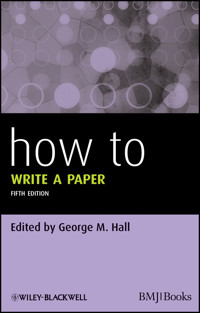
How To Write a Paper E-Book
33,99 €
Mehr erfahren.
- Herausgeber: John Wiley & Sons
- Kategorie: Fachliteratur
- Serie: HOW - How To
- Sprache: Englisch
This concise paperback is one of the best known guides to writing a paper for publication in biomedical journals. Its straightforward format – a chapter covering each of part of the structured abstract – makes it relevant and easy to use for any novice paper writer.
How to Write a Paper addresses the mechanics of submission, including electronic submission, and how publishers handle papers, writing letters to journals abstracts for scientific meetings, and assessing papers. This new edition also covers how to write a book review and updated chapters on ethics, electronic publication and submission, and the movement for open access.
Sie lesen das E-Book in den Legimi-Apps auf:
Seitenzahl: 278
Veröffentlichungsjahr: 2012
Ähnliche




















Table of Contents
Cover
Title page
Copyright page
List of Contributors
Preface to the Fifth Edition
Preface to the Fourth Edition
Chapter 1 Structure of a scientific paper
Introduction
Methods
Results
Discussion
Chapter 2 Introduction
Before beginning, answer the basic questions
Tell readers why you have undertaken the study
Clarify what your work adds
Following the best advice
Keep it short
Make sure that you are aware of earlier studies
Be sure your readers are convinced of the importance of your question, but don’t overdo it
Don’t baffle your readers
Give the study’s design but not the conclusion
Think about using journalistic tricks sparingly
Conclusion
Chapter 3 Methods
Testing hypotheses
Statistics
Design
Participants and materials
Summary
Chapter 4 Results
The text
Tables
Figures
Conclusion
Chapter 5 Discussion
Principal findings
Methodology
Previous work
Implications
Further studies
Conclusion
Acknowledgements
Chapter 6 Titles, abstracts and authors
What information belongs in an abstract and title?
How should your title and abstract be written?
Authorship issues
How can your title and abstract be improved?
Chapter 7 Who should be an author?
Chapter 8 References
Introduction
Searching the literature
Managing references
Reference management software
Referencing your paper
Reference formats
Conclusion
Chapter 9 Electronic submissions
Setting the scene
Who benefits?
Speed
Ethics
Statistics
Multimedia
Drawbacks
Into the future
Chapter 10 Open access
What is open access?
Why should I care about open access?
How do I make my articles open access?
Open access publications (‘Gold’ open access)
Hybrid and partially open access journals
Broad-scope open access journals and peer review innovation
Self-archiving (‘Green’ open access)
Arguments in favour of open access
Arguments against open access
Research funders’ policies
Chapter 11 How to write a letter
General considerations
Etiquette and style for letters in response to an article
Other forms of letter
Chapter 12 How to prepare an abstract for a scientific meeting
Introduction
Selection of abstracts
Online submission of abstracts
Snail mail submissions
Preparation of the abstract
From draft to final version
Presenting the data
Conclusion
Chapter 13 How to write a case report
Why publish a case report?
Choosing your journal
The structure of the case report
Consent
Authorship
Submitting the article
Chapter 14 How to write a review
The content and format
The reviewing process
Conclusions
Chapter 15 How to write a book review
Introduction
Purpose
Process
Read the book
Write the review
Why review books?
Chapter 16 The role of the manuscript assessor
Introduction
Specialist versus generalist journals
The process
The best and the worst reviews
Improving the quality
Dealing with an appeal
Referee, reviewer or assessor
Improving the quality of the review
Conflict of interest
Research misconduct
New concepts in peer review
Conclusion
Chapter 17 The role of the editor
New manuscripts
Immediate rejection
Revised manuscripts
Problem manuscripts
Rejected manuscripts
Editorials, reviews and correspondence
Assembling an lssue
Impact factor
Appearance of a scientific journal
Team play
Transparency
Complaints
Ethical issues
Confidentiality
Conclusions
Chapter 18 What a publisher does
Editorial
Production
Fulfilment and distribution
Sales and marketing
Marketing
Finance
Conclusion
Chapter 19 Style: what it is and why it matters
Logical presentation
Clear and accurate presentation
Concise presentation
A second opinion
Why style matters
Chapter 20 Ethics of publication
Introduction
Getting your funding
Designing your study
Collecting your data, analysing your data, deriving your results
Writing your paper
Choosing your journal
Surviving peer review
Dealing with the press and embargoes
Publishing your paper
Conclusion
Disclosures
Index
This edition first published 2013, © 2013 by John Wiley & Sons, Ltd.
First published 1994 by BMJ
Second edition 1998
Third edition 2003
Fourth edition 2008
BMJ Books is an imprint of BMJ Publishing Group Limited, used under licence by Blackwell Publishing which was acquired by John Wiley & Sons in February 2007. Blackwell’s publishing programme has been merged with Wiley’s global Scientific, Technical and Medical business to form Wiley-Blackwell.
Registered office: John Wiley & Sons, Ltd, The Atrium, Southern Gate, Chichester, West Sussex, PO19 8SQ, UK
Editorial offices: 9600 Garsington Road, Oxford, OX4 2DQ, UK
The Atrium, Southern Gate, Chichester, West Sussex, PO19 8SQ, UK
111 River Street, Hoboken, NJ 07030-5774, USA
For details of our global editorial offices, for customer services and for information about how to apply for permission to reuse the copyright material in this book please see our website at www.wiley.com/wiley-blackwell
The right of the author to be identified as the author of this work has been asserted in accordance with the UK Copyright, Designs and Patents Act 1988.
All rights reserved. No part of this publication may be reproduced, stored in a retrieval system, or transmitted, in any form or by any means, electronic, mechanical, photocopying, recording or otherwise, except as permitted by the UK Copyright, Designs and Patents Act 1988, without the prior permission of the publisher.
Designations used by companies to distinguish their products are often claimed as trademarks. All brand names and product names used in this book are trade names, service marks, trademarks or registered trademarks of their respective owners. The publisher is not associated with any product or vendor mentioned in this book. This publication is designed to provide accurate and authoritative information in regard to the subject matter covered. It is sold on the understanding that the publisher is not engaged in rendering professional services. If professional advice or other expert assistance is required, the services of a competent professional should be sought.
The contents of this work are intended to further general scientific research, understanding, and discussion only and are not intended and should not be relied upon as recommending or promoting a specific method, diagnosis, or treatment by physicians for any particular patient. The publisher and the author make no representations or warranties with respect to the accuracy or completeness of the contents of this work and specifically disclaim all warranties, including without limitation any implied warranties of fitness for a particular purpose. In view of ongoing research, equipment modifications, changes in governmental regulations, and the constant flow of information relating to the use of medicines, equipment, and devices, the reader is urged to review and evaluate the information provided in the package insert or instructions for each medicine, equipment, or device for, among other things, any changes in the instructions or indication of usage and for added warnings and precautions. Readers should consult with a specialist where appropriate. The fact that an organization or Website is referred to in this work as a citation and/or a potential source of further information does not mean that the author or the publisher endorses the information the organization or Website may provide or recommendations it may make. Further, readers should be aware that Internet Websites listed in this work may have changed or disappeared between when this work was written and when it is read. No warranty may be created or extended by any promotional statements for this work. Neither the publisher nor the author shall be liable for any damages arising herefrom.
Library of Congress Cataloging-in-Publication Data
How to write a paper / edited by George M. Hall. – 5th ed.
p. ; cm.
Includes bibliographical references and index.
Summary: “This concise paperback is about writing a paper for publication in biomedical journals. Its straightforward format – a chapter covering each of part of the structured abstract – makes it relevant and easy to use for any novice paper writer. How to Write a Paper addresses the mechanics of submission, including electronic submission, and how publishers handle papers, writing letters to journals abstracts for scientific meetings, and assessing papers. This new edition also covers how to write a book review and updated chapters on ethics, electronic publication and submission, and the movement for open access” – Provided by publisher.
ISBN 978-0-470-67220-4 (pbk.)
I. Hall, George M. (George Martin)
[DNLM: 1. Writing. 2. Publishing. WZ 345]
808.06'661–dc23
2012030230
A catalogue record for this book is available from the British Library.
Wiley also publishes its books in a variety of electronic formats. Some content that appears in print may not be available in electronic books.
List of Contributors
Robert N. AllanEditor, Clinical MedicineRoyal College of PhysiciansLondon, UKFormerly: Consultant Physician and GastroenterologistUniversity Hospital BirminghamNHS Foundation TrustBirmingham, UK
Mark W. DaviesSenior Staff Specialist in NeonatalogyAssociate Professor of NeonatalogyRoyal Brisbane & Women’s HospitalQueensland, Australia
Michael DohertyProfessor of RheumatologyUniversity of NottinghamNottingham, UKFormerly: Editor, Annals of the Rheumatic Diseases
Gordon B. DrummondHonorary Clinical Senior LecturerUniversity Department of Anaesthesia and Pain MedicineUniversity of EdinburghEdinburgh, UKFormerly: Editor, British Journal of Anaesthesia
Kevin W. EvaSenior Scientist, Centre for Health Education ScholarshipAssociate Professor, Director of Education Research & ScholarshipDepartment of MedicineUniversity of British ColumbiaVancouver, CanadaEditor-in-Chief, Medical Education
Paul GlasziouDirectorCentre for Research in Evidence-Based Practice (CREBP)Bond UniversityQueensland, AustraliaFormerly: Editor, Evidence-Based Medicine
Chris GrafEditorial DirectorHealth SciencesWileyRichmond, Australia
George M. HallProfessor of AnaesthesiaDepartment of Anaesthesia & Intensive Care MedicineSt George’sUniversity of LondonLondon, UKFormerly: Chairman, British Journal of Anaesthesia
Charles W. HogueProfessor of Anesthesiology & Critical Care MedicineThe Johns Hopkins University School of MedicineBaltimore, USAAssociate Editor, Anesthesia & Analgesia
Richard HortonEditor-in-Chief/Publisher, The LancetLondon, UK
Simon HowellSenior Lecturer in AnaesthesiaUniversity of LeedsLeeds, UKEditor, British Journal of Anaesthesia
Jennifer M. HunterEmeritus Professor of Anaesthesia/Honorary Clinical FellowUniversity of LiverpoolLiverpool, UKFormerly: Editor-in-Chief, British Journal of Anaesthesia
Luke A. JardineSenior Staff Specialist in NeonatalogyAssociate Professor of NeonatalogyRoyal Brisbane & Women’s HospitalQueensland, Australia
Sharon LengTechnical Editor, BJU InternationalWileyOxford, UK
Domhnall MacAuleyEditor, Primary CareBMJLondon, UK
Liz NeillyMedical LibrarianUniversity of LeedsLeeds, UK
Martin Neil RossorProfessor of Clinical NeurologyEditor, Journal of Neurology, Neurosurgery and PsychiatryDementia Research CentreInstitute of Neurology, University College LondonThe National Hospital for Neurology and NeurosurgeryLondon, UK
Gavin SharrockPublisherHealth Sciences Journals EditorialWileyOxford, UK
Richard Smith CBEDirectorOvations, UnitedHealth GroupLondon, UKFormerly: Editor, BMJ
Mark WareVice President & Lead AnalystOutsell (UK) LtdLondon, UK
Elizabeth WhelanAssociate Editorial DirectorHealth Sciences Journals EditorialWileyOxford, UK
Michael WillisEditorial Services ManagerWileyOxford, UK
Elissa WilsonAssociate Journal Publishing ManagerLife SciencesWileyRichmond, Australia
Preface to the Fifth Edition
For the fifth edition, it is a pleasure to welcome Mark W. Davies, Kevin W. Eva, Chris Graf, Charles W. Hogue, Luke A. Jardine, Sharon Leng, Gavin Sharrock, Elizabeth Whelan and Michael Willis as new contributors. A new chapter ‘How to Write a Book Review’ has been added.
I am grateful to all the authors for revising their chapters and, in particular, to Robert N. Allan, Michael Doherty, Gordon B. Drummond and Richard Smith for contributing to all five editions.
George M. Hall
Preface to the Fourth Edition
For the fourth edition, it is a pleasure to welcome Paul Glasziou, Jennifer M. Hunter, Liz Neilly, Martin Rosser and Mark Ware as new contributors. An additional chapter ‘Open Access’ has been added.
I am grateful to all the authors for revising their chapters and, in particular, to Robert N. Allan, Michael Doherty, Gordon B. Drummond, Richard Smith and Alex Williamson for contributing to all four editions.
George M. Hall
Chapter 1
Structure of a Scientific Paper
George M. Hall
Department of Anaesthesia & Intensive Care Medicine, St George’s, University of London, London, UK
The research you have conducted is obviously of vital importance and must be read by the widest possible audience. It probably is safer to insult a colleague’s spouse, family and driving than the quality of his or her research. Fortunately, so many medical journals now exist that your chances of not having the work published somewhere are small. Nevertheless, the paper must be constructed in the approved manner and presented to the highest possible standards. Editors and assessors without doubt will look adversely on scruffy manuscripts – regardless of the quality of the science. All manuscripts are constructed in a similar manner, although some notable exceptions exist, like the format used by . Such exceptions are unlikely to trouble you in the early stages of your research career.
Lesen Sie weiter in der vollständigen Ausgabe!
Lesen Sie weiter in der vollständigen Ausgabe!
Lesen Sie weiter in der vollständigen Ausgabe!
Lesen Sie weiter in der vollständigen Ausgabe!
Lesen Sie weiter in der vollständigen Ausgabe!
Lesen Sie weiter in der vollständigen Ausgabe!
Lesen Sie weiter in der vollständigen Ausgabe!
Lesen Sie weiter in der vollständigen Ausgabe!
Lesen Sie weiter in der vollständigen Ausgabe!
Lesen Sie weiter in der vollständigen Ausgabe!
Lesen Sie weiter in der vollständigen Ausgabe!
Lesen Sie weiter in der vollständigen Ausgabe!
Lesen Sie weiter in der vollständigen Ausgabe!
Lesen Sie weiter in der vollständigen Ausgabe!
Lesen Sie weiter in der vollständigen Ausgabe!
Lesen Sie weiter in der vollständigen Ausgabe!
Lesen Sie weiter in der vollständigen Ausgabe!
Lesen Sie weiter in der vollständigen Ausgabe!
Lesen Sie weiter in der vollständigen Ausgabe!
Lesen Sie weiter in der vollständigen Ausgabe!




