


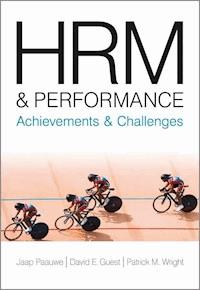
HRM and Performance E-Book
45,99 €
Mehr erfahren.
- Herausgeber: John Wiley & Sons
- Kategorie: Fachliteratur
- Sprache: Englisch
The link between HRM and performance has become an important policy issue at both a national and a corporate level.
HRM and Performance draws on the knowledge and expertise of a number of leading international scholars in the field of HRM to provide a comprehensive overview of the current state of HRM and identify fruitful directions for theory, research and practice. A central question throughout is - what's next for HRM and what are the keys to the future of managing people and performance?
Sie lesen das E-Book in den Legimi-Apps auf:
Seitenzahl: 560
Veröffentlichungsjahr: 2012
Ähnliche




















CONTENTS
Preface
Editor biographies
Author biographies
Chapter 1: HRM and Performance: What Do We Know and Where Should We Go?
What do we know about the HRM–performance relationship?
Theoretical ambiguity
Empirical invalidity
Which HRM practices?
How should HRM practices be measured?
What is performance?
How are HRM practices implemented?
How do HRM practices impact performance?
How do we statistically model the HRM–performance relationship?
Answering the unanswered questions
Chapter 2: HRM, Well-Being and Performance: A Theoretical and Empirical Review
Introduction
Conceptual focus and definitions
Alternative models of the HRM–WB–OP relationship
Theoretical arguments and analytical approaches
Review of research on the HRM–WB–OP relationship
Contextual and contingency factors
Suggestions for future research
Conclusions
Chapter 3: Building Highly-Performing Work Systems: Analysing HR Systems and Their Contribution to Performance
The analytical approach to HRM
HPWSs: background and critique
Going forward: studying HR systems and their contribution to performance
Mediators and methods
Mutuality and sustainability
Conclusions
Chapter 4: Reconceptualizing Fit in Strategic Human Resource Management: ‘Lost in Translation?’
Abstract
Introduction
Best-fit approaches in human resource management
The early fit models and the next generation fit models in HRM
Missing elements
Integration of fit approaches and discussion
Conclusion
Chapter 5: HRM and Performance: The Role of Effective Implementation
A framework for the analysis of effective implementation of HRM
Effectiveness of the decision to introduce HRM practices
The quality and effectiveness of HR practices
Line managers’ decision to implement HR practices
The quality of the line managers’ implementation of HRM
The role of top management in the implementation of HRM
The role of line managers as key implementers of HRM
The role of the HR function in the implementation of HRM
Future research
Chapter 6: Strategic HRM and Organizational Behaviour: Integrating Multiple Levels of Analysis
Variance as a scientific concept
Variance and SHRM
SHRM across levels of analysis
Linkages as avenues for gaining increased understanding
Summary and conclusions
Chapter 7: Measuring Human Capital: A Strategic Human Resource Management Perspective
Human capital and competitive advantage
Human capital measurement at different levels of analysis
General and specific human capital
Critical issues for human capital measurement
Conclusion
Chapter 8: Measurement of Human Resource Practices: Issues Regarding Scale, Scope, Source and Substantive Content
Introduction
Rating scale issues
Scope issues
Source issues
Substantive content issues
Summary
Chapter 9: Research on Human Resources and Effectiveness: Some Methodological Challenges
Introduction
A simple model of HR and performance
‘Significance’ and effect sizes
Challenges in inferring causality and potential solutions
Conclusion
Chapter 10: Progress and Prospects for HRM–Performance Research in Small and Medium-Sized Businesses
Introduction
HRM–performance research in SMEs: a state-of-the-art
Selection of articles
SMEs: what’s in a name?
Human resource management
Firm performance
Theoretical frameworks linking HRM and firm performance
What do we know?
HRM–performance research in SMEs: some prospects
SME specificity and heterogeneity: children are not little grown-ups, and no two are alike
Suggestions for future HRM–performance research in SMEs
Family ownership and management (SME specificity)
Presence of social dialogue/trade unions (SME specificity and heterogeneity)
Owners/managers’ leadership style (SME heterogeneity)
Where do we need to go?
Chapter 11: Progress and Prospects
References
Index
“Does HR enhance organizational success?’ is a question every organization leader, policy-maker, employee and management scholar must consider. This book is important reading, because it describes what decades of research tells us – and what it does not, featuring a worldwide group of the most respected and widely-published scholars in the HR field.”
—John Boudreau – University of South Carolina – South Carolina - USA
This is a very timely book by an impressive array of international scholars. Here we have – in one neat package – the intellectual impetus and insights that will take the HR strategy literature to the next level”.
—Lee Dyer – Cornell University – Ithaca - USA
“This is the book we have been waiting for. The distinguished author team provide a tour de force of the HRM and performance debate. The coverage is comprehensive and both advocates and critics will find much to inspire their research. I strongly recommend this book to academics, managers, postgraduate masters students and doctoral candidates worldwide.”
—Patrick Flood – Dublin city University – Dublin - Ireland
“Written by leading scholars in the field, this book is a must-read for all who are interested in further understanding the HRM-performance linkages from different perspectives. Paauwe, Guest and Wright have done a great job via eleven chapters in the book in picking-up the core issues in the field and propose a meaningful way forward.”
—Pawan Budwhar – Aston Business School – Birmingham - United Kingdom
“This is a must read book for everyone researching the subject of human resource management and performance. Paauwe, Wright and Guest (three of the leaders in the field) have put together an excellent volume with an outstanding international cast of authors; it is a lucid and cogent coverage of the current state of research and sets up a rich agenda for future scholary endeavour. It will become the standard reference in this research area.”
—Adrian Wilkinson – Griffith University – Brisbane - Australia
“Unraveling how HRM influences firm performance is one of those HARD research problems that really is worth the effort. To crack this problem, we need to get beyond generic HR systems research to the heart of how things work. This collection of research from scholars both within and outside the U.S. is just the sort of critical work that will help to advance the field.”
—Clinton Chadwick – University of Kansas - USA
“Edited by three leading scholars long associated with this field, this book lays out all the critical and supportive arguments that have arisen in the HRM-performance debate. It is a powerful summary of what we know and what remains unanswered and successfully starts a new conversation about, and creates a roadmap for, how we can improve on theory, method and evidence.”
—Paul Sparrow – Lancaster University – Lancaster - United Kingdom
This edition first published 2013
© 2012
Registered office
John Wiley & Sons Ltd, The Atrium, Southern Gate, Chichester, West Sussex, PO19 8SQ, United Kingdom
For details of our global editorial offices, for customer services and for information about how to apply for permission to reuse the copyright material in this book please see our website at www.wiley.com.
The right of the author of this work has been asserted in accordance with the Copyright, Designs and Patents Act 1988.
All rights reserved. No part of this publication may be reproduced, stored in a retrieval system, or transmitted, in any form or by any means, electronic, mechanical, photocopying, recording or otherwise, except as permitted by the UK Copyright, Designs and Patents Act 1988, without the prior permission of the publisher.
Wiley publishes in a variety of print and electronic formats and by print-on-demand. Some material included with standard print versions of this book may not be included in e-books or in print-on-demand. If this book refers to media such as a CD or DVD that is not included in the version you purchased, you may download this material at http://booksupport.wiley.com. For more information about Wiley products, visit www.wiley.com.
Designations used by companies to distinguish their products are often claimed as trademarks. All brand names and product names used in this book are trade names, service marks, trademarks or registered trademarks of their respective owners. The publisher is not associated with any product or vendor mentioned in this book.
Limit of Liability/Disclaimer of Warranty: While the publisher and author have used their best efforts in preparing this book, they make no representations or warranties with the respect to the accuracy or completeness of the contents of this book and specifically disclaim any implied warranties of merchantability or fitness for a particular purpose. It is sold on the understanding that the publisher is not engaged in rendering professional services and neither the publisher nor the author shall be liable for damages arising herefrom. If professional advice or other expert assistance is required, the services of a competent professional should be sought.
Library of Congress Cataloging-in-Publication Data
A catalogue record for this book is available from the British Library.
ISBN 978-1-405-16833-5 (paperback)
ISBN 978-1-118-48261-2 (emobi)
ISBN 978-1-118-48262-9 (epdf)
ISBN 978-1-118-48263-6 (epub)
PREFACE
For more than two decades the three of us have been involved in the topic of HRM and Performance. We kept track of all the publications, both theoretical as well as empirical and also contributed to the field ourselves in various ways. We also tried to build bridges between the USA, UK and mainland Europe. And, we organized in various places and at various times seminars, meetings to discuss findings, developments and progress and . . . obstacles to further progress to ensure that academics from around the world can benefit from each other’s insights. And we will continue to do so. More specifically the first meeting related to this book dates back to a seminar organized in 2004 at Erasmus University in order to celebrate and present the book HRM and Performance: Achieving long term viability (Paauwe, 2004). During that conference a number of interesting papers were being discussed, which led us to think it would be a good idea to collect these papers under the heading HRM and Performance: What’s Next?. Since that time, papers were replaced by new papers, the field progressed and also young, bright scholars entered the domain. So, right now we finally have a collection of papers, which bundles both the achievements of the past two decades, but more importantly looks forward to future challenges. Moreover, we have been able to include generations of researchers as authors of the different chapters with a mixture of more established academics, the ‘about to take over’ generation and new upcoming academics. We also made sure to include the macro (organizational) perspective and the micro (individual) perspective as well as the multitude of linkages between these two perspectives; linkages that will take the field forward.
We hope you will enjoy reading this volume and that it will indeed inspire others to take up the challenges for future research. We - as editors- owe much to our contributing fellow-authors from across the globe, who also represent a global community of dedicated academics, always open to the debate, and always eager to take the field forward.
Jaap Paauwe
David Guest
Patrick Wright
EDITOR BIOGRAPHIES
Patrick Wright is Thomas C. Vandiver Bicentennial Chair in the Darla Moore School of Business at the University of South Carolina. Prior to joining USC he has served on the faculties at Cornell University, Texas A&M University, and the University of Notre Dame.
Professor Wright teaches, conducts research, and consults in the area of Strategic Human Resource Management (SHRM), particularly focusing on how firms use people as a source of competitive advantage and the changing nature of the Chief HR Officer role. For the past 8 years he has been studying the CHRO role through a series of confidential interviews, public podcasts, small discussion groups, and conducting the Cornell/CAHRS Survey of Chief HR Officers. In addition, he is the faculty leader for the Cornell ILR Executive Education/NAHR program “The Chief HR Officer: Strategies for Success” aimed at developing potential successors to the CHRO role. He served as the lead editor on the recently released book “The Chief HR Officer: Defining the New Role of Human Resource Leaders” published by John Wiley and Sons.
He has published over 60 research articles in journals as well as over 20 chapters in books and edited volumes. He has co-authored two textbooks titled Human Resource Management: Gaining Competitive Advantage (now in its third edition) and Management of Organizations. He has co-edited a special issue of Research in Personnel and Human Resources Management titled “Strategic Human Resource Management in the 21st Century,” and Guest Edited a special issue of Human Resource Management Review titled “Research in Strategic HRM for the 21st Century.”
He has conducted programs and/or consulted for a number of large organizations including Comcast, Royal Dutch Shell, KennaMetal, AstraZeneca, BT, and BP. He currently serves as a member on the Board of Directors for the National Academy of Human Resources (NAHR). He is a former board member of HRPS, SHRM Foundation and World at Work (formerly American Compensation Association). In 2011 he was named by HRM Magazine as one of the 20 “Most Influential Thought Leaders in HR”.
David E Guest is one of the leading academic experts on human resource management and related aspects of work and organizational psychology. He has a first degree in Psychology and Sociology from Birmingham University and PhD in Occupational Psychology from London University.
His first job was a research officer in the Department of Occupational Psychology at Birkbeck College. He then spent three years as behavioural science adviser to British Rail before joining the London School of Economics in 1972. He moved to Birkbeck in 1990 and for ten years was Professor of Occupational Psychology and head of the Department of Organizational Psychology. During that period he had a spell as a Governor of Birkbeck and as Pro-Vice Master. He moved to King’s College in 2000 where he has served as Head of The Department of Management and Deputy Head of the School of Social Science and Public Policy.
He has written and researched extensively in the areas of human resource management, employment relations and the psychological contract, motivation and commitment, and careers. His most recent book is “Psychological Contracts, Employment Contracts and Employee Well-Being: An International Study” (Oxford University Press, 2010). He is a member of the editorial advisory board of a number of journals. He has been a member of the NHS SDO Commissioning Board and of UK Skills and Employment Advisory Group. Over the years, he has worked closely with a range of companies including Shell, IBM, HSBC, Hong Kong MTRC, as well as with the UK National Health Service and a number of government departments.
His current research is concerned with the relationship between human resource management, organisational performance and employee well-being in the private and public sectors; the role of human resource departments; the individualization of employment relations and the role of the psychological contract; flexibility and employment contracts; partnership at work; and the future of the career. For five years up to July 2012 he was Programme Director for Workforce issues and also Managing Director of the King’s NIHR Patient Safety and Service Quality Research Centre, engaged in research on human resource issues in healthcare.
Jaap Paauwe (PhD, Erasmus University Rotterdam) is Professor of Human Resource Studies at Tilburg University, The Netherlands. Before joining Tilburg he worked as a full professor of Organization at Erasmus University Rotterdam, School of Economics. At Erasmus University he is still involved in supervising PhD students in the area of HRM and performance in the health care.
He has written and co-authored books on human resource management and published more than 150 papers/chapters in international refereed journals and books. In 1991 he was Academic Visitor at the London School of Economics. In 1996 he was Visiting Professor at Templeton College, Oxford University. Before joining the university he worked for the trade union movement (Head of CNV Research Department 1983-1988) and a Dutch based multinational company (SHV 1980-1983). His main research interests are in the area of HRM, performance and well-being, HR function and -delivery, corporate strategy, governance and risk management, organizational change and industrial relations. These research and consultancy activities mainly take place in the market sector in close cooperation with internationally operating firms/MNC’s.
Also active in the health care sector, with a special focus on the HR function and the relationship between HRM, organizational climate and performance.
In 2005 he joined Cornell University (Ithaca, USA) as a visiting fellow. In addition he is a fellow at the TIASNIMBAS Business school and fellow of the Judge Business School/Cambridge University (UK) and academic director of the executive Advanced Human Resource Program of the People Management Centre (PMC), which aims to build bridges between the university and the HR practitioners’ community. In 2010 he spent his sabbatical leave at Pablo de Olavide University in Seville, Spain. His latest book is on HRM and Performance: achieving long term viability (Oxford University Press, June 2004), for which he received the Dutch HRM network Award in 2005. Together with Cambridge, INSEAD and Cornell University he is involved in a large scale international research project on improving the excellence of the HR function within multinational companies. Next to this project the research group at Tilburg has initiated a similar international project, but then focused on the role of the HR-function in corporate governance and risk management. In 2010 he received -together with his co-authors the international HRM Scholarly Research Award from the Academy of Management-HR Division. Next to his academic work Jaap is also involved in more practice oriented research, coaching and acting as a moderator for a leading group of HR directors.
AUTHOR BIOGRAPHIES
Beijer Susanne Beijer is a PhD candidate at the Department of Human Resource Studies at Tilburg University. Susanne’s research interests and PhD project both focus on the concept of HR practices and their relationship with employee well-being and organizational outcomes. [email protected]
Boon Corine Boon is Assistant Professor at the department of Human Resource Management and Organizational Behaviour of the University of Amsterdam Business School. Her research interests include strategic human resource management, person-environment fit, and job crafting. [email protected]
Boselie Paul Boselie (PhD, MSc) is Professor in the Utrecht School of Governance at Utrecht University (The Netherlands). His research traverses human resource management, institutionalism, strategic management and industrial relations. [email protected]
Boxall Peter Boxall is professor of human resource management in the department of management and international business at the University of Auckland and author, with John Purcell, of Strategy and Human Resource Management (Palgrave Macmillan). [email protected]
Den Hartog Prof dr. Deanne N. Den Hartog is professor of Organizational Behavior and head of the HRM-OB section of the University of Amsterdam Business School. Her research interests include leadership, proactive and innovative work behavior, HRM, trust, culture, and teams. [email protected]
Federman Federman – Jessica E. Federman is a doctoral candidate in human resource management in the School of Industrial and Labor Relations at Cornell University. Her research interests include motivation, leadership, problem-solving, creativity and communication. [email protected]
Gerhart Barry Gerhart is a professor at the Department of Management and Human Resources at the Wisconsin School of Business. His research interests include compensation, human resource management, incentives, and staffing. [email protected]
Harris Dr. Harris has teaching and research interests in the areas of human resource management and organizational behavior. Prior to joining Marietta College, Dr. Harris gained international teaching and research experience as a professor in the Netherlands. He has taught a variety courses in the management field at both the undergraduate and graduate levels. [email protected]
Hermans Michel Hermans is working towards the completion of his PhD in Industrial and Labor Relations at Cornell University. His research interests include strategic human resources management, inter-organizational work arrangements and their implications for HRM, and HRM in Latin America. [email protected]
Klein – Gemaild: [email protected]
Heavey Angela Langevin Heavey joined Florida International University as an Assistant Professor of Management and International Business after receiving her Ph.D. in Human Resource Studies from the ILR School at Cornell University. Angela’s research interests include employee perceptions of HR practices, employee turnover and withdrawal, and age in the workplace. [email protected]
Martinson Brian Martinson is currently an Assistant Professor of Human Resource Management in the Department of Management, Marketing and Administrative Systems at Tarleton State University. Brian’s research interests include human resource management practices, human capital, and leader/member exchange, and their linkages with employee behaviors and performance. [email protected]
McClean Elizabeth McClean is a PhD student in the Human Resources Department in the School of Industrial and Labor Relations. Elizabeth’s research interests include employee voice, leadership, and strategic HR management. [email protected]
McMahan Dr. Gary C. McMahan is associate professor at the University of Texas at Arlington. His Current interests include strategic human resource management, work motivation, issues in organization change and development, empowerment/employee involvement, rewards, and job design. [email protected]
Nishii Lisa Nishii joined the faculty of the Human Resource Studies department at the ILR School, Cornell University, after receiving her Ph.D. and M.A. in Organizational Psychology from the University of Maryland, and a B.A in economics and psychology from Wellesley College. Nishii’s research focuses on diversity and inclusion, particularly in global organizations [email protected]
Peccei Riccardo Peccei is Professor of Organizational Behavior and Human Resource Management in the Department of Management at King’s College London. He is also a Research Fellow in the Department of Human Resource Studies at Tilburg University. His current research interests, within a multilevel perspective, are in the areas of HRM, employee well-being and organizational performance. [email protected]
Sels Luc Sels (Merksem, 1967) is Dean of the Faculty of Economics and Business. He joined the Faculty in 1996 as an assistant professor and became full professor in 2004. His research interests center around active ageing and (corporate) demography, individual and organisational career management, the relationship between investments in HR management and firm performance (ROI) and features of strong HRM systems. [email protected]
Van Veldhoven Marc van Veldhoven joined Tilburg University/the department of HR Studies in 2002, and was appointed full professor there in November 2010 and his mainly interest is in occupational health psychology and organizational behavior literature. Before joining Tilburg University he worked as an independent consultant for larger companies. [email protected]
Van de Voorde Karina Van De Voorde is an assistant professor at the department of Human Resource Studies (Tilburg University). Her research is focused on aligning the Organizational Behavior/Occupational Health Psychology orientation towards the topic of HRM and organizational performance.
De Winne Sophie De Winne is associate professor at the Faculty of Business and Economics (University of Leuven, Belgium). Her main research interests include the relationship between HRM and firm performance, HRM system strength, the role of line managers in HRM, HR differentiation and the relationship between firm demography, employee turnover and firm performance. Sophie. [email protected]
CHAPTER 1
HRM AND PERFORMANCE: WHAT DO WE KNOW AND WHERE SHOULD WE GO?
JAAP PAAUWE, PATRICK, WRIGHT AND DAVID GUEST
‘Based on four national surveys and observations on more than 2000 firms, our judgment is that the effect of a one standard deviation change in the HR system is 10–20% of a firm’s market value.’ (Huselid & Becker, 2000, p. 851; emphasis added)
‘The existing evidence for a relationship between HRM and performance should be treated with caution.’ (Wall & Wood, 2005, p. 454)
‘After hundreds of research studies we are still in no position to assert with any confidence that good HRM has an impact on organization performance.’ (Guest, 2011, p. xx)
Practitioners interested in human resources management (HRM) have long sought to convince others of its value. Drucker (1954) referred to ‘personnel’ managers as constantly worrying about ‘their inability to prove that they are making a contribution to the enterprise’ (p. 275). More recently Tom Stewart described HR leaders as being ‘unable to describe their contribution to value added except in trendy, unquantifiable and wannabe terms’ (Stewart, 1996, p. 105).
In response to this longstanding and often repeated criticism that HR does not add value to organizations, academic research has exploded over the past 20 years, seeking to show that HRM practices are related to firm performance. Huselid’s (1995) groundbreaking study showed that a set of HR practices he called ‘high-performance work systems’ (HPWSs) were related to turnover, accounting profits and firm market value. This study served as the springboard for a significant body of research confirming empirical relationships between HR and performance.
However, in spite of the vast body of research that has emerged over the past two decades, as these quotes from some distinguished academic researchers suggest, divergence exists regarding what we can conclude about the relationship between HRM practices and firm performance. Is the HRM–performance relationship one that is strong, universal and causal, or is it potentially weak, contingent and even spurious? More importantly, what is the underlying research base from which we can answer that question, and how can we improve that base in order to answer it in a way that is valid, reliable and practically important? The purpose of this book is to attempt to bring together some of the leading researchers in this area to provide insights into what we know, what we need to know, and how we can begin on a journey to improve our knowledge of the relationship between HR and firm performance.
Lesen Sie weiter in der vollständigen Ausgabe!
Lesen Sie weiter in der vollständigen Ausgabe!
Lesen Sie weiter in der vollständigen Ausgabe!
Lesen Sie weiter in der vollständigen Ausgabe!
Lesen Sie weiter in der vollständigen Ausgabe!
Lesen Sie weiter in der vollständigen Ausgabe!
Lesen Sie weiter in der vollständigen Ausgabe!
Lesen Sie weiter in der vollständigen Ausgabe!
Lesen Sie weiter in der vollständigen Ausgabe!
Lesen Sie weiter in der vollständigen Ausgabe!
Lesen Sie weiter in der vollständigen Ausgabe!
Lesen Sie weiter in der vollständigen Ausgabe!




