


Erhalten Sie Zugang zu diesem und mehr als 300000 Büchern ab EUR 5,99 monatlich.
- Herausgeber: Pushkin Press
- Kategorie: Gesellschafts- und Liebesromane
- Sprache: Englisch
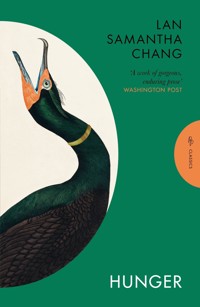
A modern classic of American fiction: a haunting collection of stories that explore the lost loves and complex desires of Chinese-American immigrant familiesThe novella and five stories that make up this collection tell of displaced lives, and exiled imaginations. Far away from their ancestral home, a grandmother tells her granddaughters stories of their river ancestors. Having relocated to the American Midwest, a young couple purposefully drive all remnants of their lives in China into the shadows. In the title novella, a woman recounts her tragic marriage to an exiled musician, whose own disappointments nearly destroy their two daughters.In exquisitely crisp, spare and subtle prose, Lan Samantha Chang untangles how an immigrant can hunger for love, for acceptance, and for what they have left behind. An undeniable classic of modern American literature, Hunger is a haunting collection of stories, suffused with quiet beauty and longing.
Sie lesen das E-Book in den Legimi-Apps auf:
Seitenzahl: 284
Veröffentlichungsjahr: 2023
Das E-Book (TTS) können Sie hören im Abo „Legimi Premium” in Legimi-Apps auf:
Ähnliche



















‘Luminously elegiac stories… Complex and rueful, her fiction gives voices to internal struggles, catalogues of loss’
NEW YORK TIMES BOOK REVIEW
‘A dazzling collection’
OBSERVER
‘The spare beauty of the writing turns the disappointments of family life into a deeply disturbing fairytale’
THE TIMES
HUNGER
LAN SAMANTHA CHANG
PUSHKIN PRESS CLASSICS
For my mother and father
Contents
Acknowledgements
Many thanks to James A. Michener and the Copernicus Society of America, the Henfield Foundation, the Truman Capote Literary Trust, the University of Iowa Writers’ Workshop and the Stanford Creative Writing Program for their generous support during the writing of this book.
I would also like to thank Sarah Chalfant, my agent, and Jill Bialosky, my editor at W. W. Norton, for their belief in me and their hard work on my behalf.
I am deeply grateful to all of my teachers, especially Frank Conroy, Margot Livesey, James Alan McPherson, Marilynne Robinson and Elizabeth Tallent. Many thanks also to John L’Heureux, who gave wise counsel above and beyond the call of duty.
The following people have inspired me through their advice and living example: Eavan Boland, Connie Brothers, Gish Jen, D. R. MacDonald, Gay Pierce, Susan Power, Lois Rosenthal and Tobias Wolff. Thanks also to Nell Bernstein and the writers at Pacific News Service.
I am indebted to these friends for their insightful assistance with the manuscript: Geoffrey Becker, Helen Cho, Eileen Chow, Nan Cohen, Alyssa Haywoode, V. Diane WoodBrown, Deborah Yaffe and, for reading my work more often than anyone else, Ray Isle. To the following friends, also, I give my deepest thanks for their kindness, wit and listening skills that have kept me going: Eileen Bartos, Andrea Bewick, Craig Collins, Scott Johnston and especially Elizabeth Rourke.
Finally, I would like to thank my wise and inspiring parents, Helen Chung-Hung Chang and Nai Lin Chang, and my sisters, who can do anything: Ling Chang, Tina Chang and Tai Chang Terry.
HUNGER
I often dream about the restaurant where I met Tian. Late at night, in these blue rooms, the memory flickers up before me, dim and silent, never changing. I see the simple neon sign that reads ‘Vermilion Palace’. The drifting snow blows up against the scarlet double doors. I see myself walking towards those doors – a slight, brown girl with hair like an inkbrush, tilted eyes and a wary mouth.
For my first few months in New York City, I could not stay warm. I wore a heavy coat and wound myself in woollen scarves, but the chill went deep beneath my skin and the winter wind found every crevice as I walked to the restaurant on numb feet, past the subway stop, the university and the music school, my gaze fixed on the icy pavement to keep myself from falling. I could not taste my food or feel the softness of my narrow bed. I had been in the city for two months before I even noticed the music school. And then one evening I heard a student practising. Walking past a basement window, I caught the thread of a violin melody, high and sweet as a woman’s voice. The sound rose up through a crack in the window and between the safety bars; it shimmered through me, a wave of colour, blooming past the grey tenements and towards the narrow sky. I drew one cold, sweet breath of air and truly understood that I had arrived in America.
A few days later, I saw Tian. He might have been to the restaurant a dozen times before, but I do not remember seeing him until after the music. I noticed him on a stormy evening near the end of winter. He arrived just at the time of day when the low, grey light changes to dusk. I was standing at the window, watching the falling snow make bright flecks in the headlamps of the taxi-cabs, when a man appeared in the doorway, carrying a violin case. ‘One person,’ he said, in confident English.
At that time, in 1967, many new Chinese had come to live on Manhattan’s Upper West Side. Most of them turned up at the restaurant, sooner or later. But not many spoke English with such ease. He wore a brown felt hat and his overcoat seemed cut to fit his shoulders; most of the other men seemed content to wear whatever would make do.
‘Come with me,’ I replied, in Mandarin. I did not want him to hear my voice in broken English words.
I seated him and poured his tea, looking down at the swirl of leaves in the water. I felt the heat of the steam in my face, the warm steel handle in my hands; I watched the tea-leaves drift and slide against the blue-and-white cup. He thanked me in Chinese. His dark eyes followed the line of my face, my throat, down to my starched white shirt. For the first time, I felt warm.
Before I left Taiwan my mother had said, ‘Beware abnormally pale men. Beware a man whose cheek-bones are too high or low. Watch out for one who smiles too much. And stay away from a man who gambles.’ Her warnings implied that I had a choice; that these things lay under my control. But when I was a child she had often talked about the Chinese myth that every man and every woman was joined at birth to their mate by an invisible, enchanted thread. With this story, she said that there could be no controlling fate.
The strange man ordered beef noodle soup and drank it quickly. He had placed his violin case in the opposite chair, upright and facing him like a lover. I watched his ivory chopsticks flash and I envied the violin case, dark and slender, curved like a woman. Then he glanced at his watch. He flung down a dollar, seized his coat and violin, and walked out the door. I looked twice to make sure it was true: he had forgotten his hat on the chair.
To this day I don’t know why I stole Tian’s hat. Perhaps his solitude gave me strength. I looked around to make sure no one watched me. Then I slipped over to his table and picked up the hat, brought it back behind my counter. He had printed his name inside: Tian Sung.
I waited through my shift. Da Dao, the manager, left to fix a leak in the kitchen, so I stood at the window, idle, as the wind blew mittens and lost bus passes past my eyes. The traffic thinned out and a red-striped awning tumbled down the avenue. Towards the end of my shift I caught Da Dao in the storeroom sipping from a flask. He offered to snap a week of beans in exchange for my silence, but I promised I wouldn’t tell anyone.
Late that night, when the busboys had begun to vacuum under the chairs, the man reappeared in the doorway. I still remember his bare, wet head and sodden trench coat, creased with snow. He walked over and stood before me. ‘You might have something of mine,’ he said, in Mandarin this time.
‘I don’t think so.’
‘Would you please take a look?’
I bent and looked under the counter. There was the hat, where I had hidden it, on the shelf behind some extra bud vases. I knelt and took it into my hands.
Seconds passed. ‘Did you find a hat?’ I heard him ask. I stood up and nodded, then shook my head.
‘Are you all right?’
I held my hands behind the counter and did not answer.
I could not give him the hat. My hands grew cold; I could not breathe. I looked at him. The storm had streaked his hair into his eyes – surely the blackest eyes of any man I’d ever met, the eyelashes laid flat with melting snow. They held an expression of deep and painful privacy. And at that moment I believed I knew what would come to be. When I returned the hat, I would exchange it for the man who wore it. My senses opened; I grew large. I believed I heard, in the howling wind, a voice of admonition, but in the end I listened to the plunge and whistle of my blood. I put the hat into his beautiful, long-fingered hands.
Behind this painted wall, beneath this layer of new sheathing, hides the story of our lives together. I have been silent many years and my daughters have chosen to forget, but our family story lingers here. It waits under the floor; it has slid into the crawl space, wound around the stubborn beams and girders that were already old thirty years ago, when Tian and I first came to live in Brooklyn.
At that time, the brownstones had begun to wear away. They stood in patient rows, like tablets in a soldier’s graveyard, crumbled and soft around the edges. We considered other places: a Chinatown walk-up owned by Dao, a draughty room near the music school and even a little Midtown flat, as clean and perfect as a jewel box; but we decided to live here. It seemed that nothing in the world could disturb us on this neglected street, in these softly falling houses.
Our third-floor flat, the ‘servants’ quarters’, pleased me with its wide back windows, sloping floors, and odd-shaped rooms that had been planned and built according to someone’s idea of what servants might want or need. The spacious kitchen and living-room invited company, togetherness and warmth.
The two small bedrooms stared from opposite ends of the flat. In the back bedroom, off the kitchen, I planned a nursery for the son I hoped to bear. I loved to stand in that room and look out of its one large window, past the iron fire stairs and over the small backyards, criss-crossed by a lattice of laundry lines. I saw rows of neat, grey rooftops, treetops, electricity lines and, far away, depending on the weather, the grey or glittering cut-out of Manhattan. And it seemed to me that all the safety in the world had been tucked into this space, that my children would look out at the world and know that all was well.
Tian focused his desires on a different part of the house. Behind the foyer stood a spacious walk-in closet that had been refitted as a greenhouse, with a skylight and glass shelves. This would be his music room. He removed the shelves, soundproofed the walls with pressed Styrofoam and repainted them eggshell white. He found an old upright piano at a junk shop on Coney Island Beach and convinced someone at the restaurant to help him move it up the stairs. Finally, he produced from his briefcase a metal music stand, which unfolded at the top into fragile steel wings.
‘Now I can work and be near you.’ He reached to touch my face. I stood perfectly still, arrested by the scent of his hand. Desire soaked through my skin – this warmth, which had first blossomed while I poured his tea and now flowed through me at his touch. In those early days the feeling would come over me even when I was alone, looking out the window, or standing behind the counter at the restaurant. My breath would stop in my throat, my skin would flush and I would feel the warmth steeping through my blouse until I had to step out for fresh air or run to the bathroom to wash my face.
We made love on the floor of the new practice room. I remember my belief – a moment of certainty just prior to abandoning thought – that our moans and cries and our foreign words of love would permeate the walls of the apartment and transform the place.
Later, after I had gone to sleep, the telephone rang: it was my mother calling from Taiwan. I sat on the bed in the dark with the phone in my hand, looking out the window, where light from the street lamp streamed over the cracked sidewalk like frost.
‘I have been thinking of you,’ my mother said. ‘I have been thinking about you all day.’
She had a way of guessing what I wanted. This ability, which had been so comforting to us both when I was young, had grown more difficult as I had got older, and after the death of my father it had become unbearable for both of us. For this reason, among others, we agreed I should go to the United States. My mother wrote a letter to a man who had owed my father a favour, asking him to claim me as a paper relative.
‘I’m fine,’ I said. ‘There’s nothing new.’
‘How is your English class?’ I had stopped attending months before.
‘It’s fine.’
‘You need to learn English,’ she told me.
‘I know a lot of it,’ I said.
‘You aren’t studying,’ my mother said. ‘Instead, you have met a man and married.’
‘That is not how or why it happened.’
‘Where is he now?’
‘He is in the music room, practising.’
I listened to the thrum of the lines between us. Far away, I could hear the faint thread of the violin. Had I said something wrong? I took a breath and waited for sharp words. But she said simply, ‘It is yuanfen.’ For as long as I remembered, she used this expression only when discussing marriage, but she never would explain.
‘What do you mean by yuanfen?’
She thought for a minute and replied, ‘It means: that apportionment of love which is destined for you in this world.’
Tian’s connection to the music school was, in his view, tenuous. After completing a master’s degree he had been kept on as an instructor of pre-college students, a position that gave him, and several others, an opportunity to display their teaching and performing skills in pursuit of an assistant professorship. He planned to give his junior-faculty recital in March. That winter, after we moved to Brooklyn, he shut himself in the tiny room for hours every day. He always kept the door closed – he had reached a point with these recital pieces where the smallest issues were significant and demanded his private concentration. From the kitchen, I listened to his faint practising; the soundproofing did not completely block the music but blurred and softened it, absorbing it deep within the wall.
On the morning of Tian’s recital, I woke up alone. As I lay in bed, listening to his swooping, dizzying warm-up scales, I suddenly felt our narrow room pitch up and down like a ship on a swell. I tumbled out of bed and staggered to the bathroom, where I bent down and seized the toilet, waiting there until I was sick. As I knelt against the cold floor and vomited again, I understood that Tian and I would have a child. It seemed to me that some spiritual power had focused upon me – that I knelt before a tablet of our ancestors. I wanted to meditate, burn incense as a sign of thanks to them and as a caution against any harm that might come, and my heart filled with a powerful gratitude and relief.
A moment later I found myself in the hallway, breathing hard, my hand on the knob of the door to Tian’s little room. The music stopped. Cautiously I turned the knob. But he had not heard; he re-tuned his instrument and impatiently began his piece again. Perhaps it would not be wise to share my news, so close to his recital. After all, we had not planned for this. I tiptoed away.
That evening we had a light dinner and left early. We boarded the subway, sitting side by side as if we were brother and sister. I stretched my legs in front of me to make him notice my new shoes. But he did not notice. I stared at the soft black shoes myself as we lurched along in the empty car.
The steel car roared and rushed. We held Tian’s violin case over our laps; he clutched the canvas cover tightly. The fluorescent lights cast bruised shadows on his high, sallow cheek-bones and lavender mouth. I would have tried to reassure him, but I felt as if I were encased in a bubble of happiness and illness. I did not want to ruin his concentration. I folded my gloved, trembling hands over the violin case; I had dressed protectively in a hat, a scarf and a long wool coat.
We arrived early, to an almost empty recital hall. Far to the left, by himself, sat an older man with a thick head of grey hair and a big moustache. This, Tian whispered, was Professor Spaeth, his former teacher and now his dean. Every now and then, someone would come up and chat with Spaeth for a minute or two, but his responses were brief, and none of the visitors stayed for long.
Tian vanished into a door next to the stage. I sat alone in the third row, too shy to turn round and watch the students and colleagues who came in groups of twos or threes and scattered themselves among the seats. They spoke fluently, as carelessly as the American customers in the restaurant. I listened to their English and knew that I would not be able to hold my own in any conversation. I could only make out a few words, including ‘teacher’, ‘China’, ‘curious’.
Before I came to this country, I felt at home in the Chinese language, the way a fish feels at home in the sea. When I came to New York I vowed to practise speaking English, but it was difficult, working in the restaurant. I did not talk to customers; I did not own a television. I took classes at a community college, but made little progress with the humped and tangled grammar. Instead, I spent my spare time reading novels I bought and traded with the other waitresses, books that had seduced me with their bright, familiar covers, lined up along the shelves in the Chinatown stores.
Now, as I sat alone, I was overtaken by fear. I longed to be back home in Brooklyn, curled up in Tian’s big chair, with a Chinese storybook in my hand. The lights dimmed and Tian took the stage with John O’Neill, his accompanist and office mate. I had never met John, although Tian often spoke about him, and I was surprised by his height, his reddish beard. The audience gave a generous welcome. The clapping died down, the two men bowed, then took their places, Tian in front of the piano.
His bow struck the strings. It seemed to drop from above, the way a hawk will plunge with sudden swiftness to its victim. Tian bent and swayed in the vivid light, dark and wild and foreign, altogether unfamiliar. A vein in his right jaw, which I had only briefly noticed, rippled and stood out. It was like watching a man have a seizure. He terrified me. His music shuddered through me with a violence I am not sure I can describe – now delicate and now enormous, but always more powerful than his swaying, fragile figure on the stage. I felt as if he had achieved these sounds through a feat of magic or theft. I found myself pulling away from him, my back pressed tight against the chair.
How could I have chosen such an unforgiving man? I knew nothing about music, but I could hear in these sounds a man who would accept no excuse from anyone or anything close to him. The violin, uncaged from the practice room, filled the recital hall with a clear intensity; each note attacked the air, quick and piercing as a dagger. I fought an urge to run from the auditorium. Finally, he stopped. There came a prolonged and steady storm of applause. I kept my wet hands tightly folded. Tian looked straight at me and smiled, reappearing from this monstrousness. Then I did applaud. He raised the violin and began his next piece.
Afterwards, we stood next to a bowl of orange punch. Tian spoke to the people who crowded us. Sometimes he made an introduction: ‘Min, this is Jennings. He and I share a practice locker.’ I nodded and smiled. ‘He did fine job! He very good!’ they assured me, so I nodded and smiled again. Sometimes I turned to Tian for a translation, but he seemed to be having problems with his English; he stumbled over certain words and leaned towards the others as if he couldn’t hear what they were saying.
He wouldn’t move from my side and he clutched his violin case in his hand. I noticed it needed a new cover and the leather straps on the handle looked worn. I frowned; it seemed wrong that his colleagues should see him with such old things. His black wingtips were brightly polished but rounded at the soles and heels. The lapels of his jacket had frayed a little. Since our marriage I had watched over his eating and sleeping habits, but I needed to spend more time mending his clothes and coaxing him to buy new things. I felt relieved that his overcoat hung round the corner, on the coat rack, where no one would see how shabby it was.
Tian’s colleagues lingered on, congratulating him. They fixed upon him with alert attention, as if he had sprung up, suddenly, into the light. This puzzled me, since I had seen them before while visiting the school and they had paid Tian little notice.
I remember one woman in particular, redheaded and milky pale. This was Lydia Borgmann, whom Tian had told me about: an instructor in the same year as Tian, one of his colleagues who was vying for a professorship. She was only about my size, but she wore stacked heels that brought her closer in height to the others. She kept putting her hand on Tian’s arm – not necessarily to flirt, I decided after watching her closely, but to give an impression of friendship. Tian felt so happy about the recital he did not even notice. He bent his head in the Chinese way and fended off their compliments.
After a while, my toes in the high-heeled shoes began to lose all sense of feeling. The glass globe lamps seemed to dim and brighten. Tian looked at me. ‘We need to leave,’ he said in Chinese. ‘You look tired.’ He turned to the other musicians. ‘We’re going,’ he said. ‘I’ve got to get Min home in time to sleep. She is not—’ he paused and struggled with his English ‘—she’s not one of us crazy musician types.’
‘Don’t leave so soon! Come and have a beer,’ said John.
Tian shook his head. ‘No, we should really be getting home.’
We waited through a moment of silence. Then the redheaded woman said, ‘Come on, Tian. Don’t be a party-pooper.’ Her green-shadowed eyes widened as she spoke.
John said, his voice still cheerful, ‘Liddy is right.’
‘No,’ Tian repeated. ‘Min is tired.’
‘I – okay,’ I said. It had begun to seem that we would lose face if we didn’t go.
Tian turned to me. ‘I know you,’ he said, in Chinese. ‘You’re tired.’
‘No secret codes allowed! What did you say to her, Tian?’ Lydia demanded. Her face loomed close: the pale bright eyes, the freckles faintly glowing under a coat of powder, the slash of lipstick, orange in the light.
We all stood for a minute and then I said, ‘It is okay.’ My voice cracked against the words. They fixed their eyes on me.
‘Come on,’ said Tian. He took my arm and pulled me round the corner, to the coat rack.
‘I’m not that tired; I could have gone out with them.’ I relaxed as I slipped into the familiar Mandarin language, thoughts forming easily again. ‘Why did you want to leave so much?’
Tian put his arm round me. ‘We don’t need them,’ he said. ‘Aside from John, they’re not my friends. I want to go home.’
I leaned into him. I could smell sweat, feel a deep heat rising from beneath his white shirt, and it was with some uneasiness that I realised he was happier than I had ever seen him. That was when I blurted out, ‘Your playing scares me.’
He laughed. ‘It’s because of the way you are. It’s why you’re happy reading novels. You’re only comfortable with a piece of the world that you can hold in your hand.’ I considered my hands, small and ordinary in black wool gloves.
Tian laid his cheek against my hair. ‘I don’t mean to hurt your feelings,’ he said. ‘Sometimes I’m afraid of music, too. I think that’s the reason I married you.’
We found our coats and left the hall, walked into the clear winter night, where the lights from the taller buildings surrounded us like stars. Tian took my arm. The pain in my feet vanished and we walked towards the subway stop.
‘When I get promoted,’ Tian said, ‘we’ll move to Manhattan and then I’ll be able to spend more time at home.’
‘Professor Sung.’
‘Professor Sung. Professors’ wives don’t take the subway. You’ll ride heated cabs everywhere.’
‘I’ll get into a cab whenever I’m bored and want something to do.’
‘And you’ll never snap another bean,’ Tian added, pointing at the Vermilion Palace, across the street. Its neon sign glowed red.
‘Did Spaeth say anything to you afterwards?’ I asked.
‘Oh, he got up and left right away. He always does that.’
‘He never goes out to have a drink with his students?’
‘He is antisocial.’
‘So it is acceptable to be antisocial?’
‘I never thought about it,’ he said. ‘I suppose so. Why do you ask?’
We were at the top of the subway stairs. I reached into my coat pocket for our tokens. My gloved fingers touched an object there, something smooth and narrow and heavy. I pulled it out and held it under the street light. It was a tuning fork.
‘What?’ I stopped walking. ‘How did this get here?’
Tian took the fork; it glinted in his palm. ‘Who knows?’ he said. ‘This is a nice one.’ He struck the fork on his knee. ‘Hold still,’ he said, and he set the base knob on my forehead.
I stood still. I could feel it, like a current running all the way down my spine and between my legs, the powerful tiny thrumming of a perfect ‘A’.
Tian put his gloved hands on both sides of my head and kissed me where the tuning fork had been. I heard in his laugh a fierce recklessness. He dropped the fork into his pocket. ‘A gift from heaven,’ he said. I heard the powerful rush of the train, like a monster rumbling deep below. He grabbed my arm and we ran down the stairs.
I was quick-witted in those days, versatile and sly. If Tian ate a little less dinner one day, I would take care not to serve that dish again. He did not like our downstairs neighbour, Mrs Lici, so I avoided her. One afternoon we went for a walk in the park and I noticed him staring at a little boy. I threw a penny in the wishing-pond; I hoped our child would be a boy.
It mattered more to please him than to understand him. But as time went on, I wondered why he felt the way he did.
He had strong feelings about many little things. He insisted that we keep the chopsticks in a certain drawer. The forks and spoons went in another. And he had a special idea as to the rhythms of our days. Mornings must begin with a bowl of porridge, fermented tofu, and youtiao, a fried bread that I learned to pick up regularly in Chinatown. Over these dishes he would smile and joke. Evenings were another story. Often he would drift into a silent melancholy. He would sit in his small armchair, watching the patterns made from the setting sun through a wave in the window glass. This moody distance grew worse after his recital.
A few nights after the performance he stopped by the restaurant to pick me up on his way home. When he had finished at school he often came by the restaurant and waited for me, helped us finish our work by snapping beans or peapods. As I worked the register, I watched him sitting with the men at the corner table around an enormous steel bowl of beans. Da Dao made a joke and Tian responded with a remark that made them all laugh. Seeing this I felt an odd sense of relief. For a moment I believed that he could be just like the others; he was one of the others.
‘Your husband is a neat and hardworking man,’ said a waitress.
‘Nali, that’s in no way true,’ I said, to be polite. If only he could be so simple.
I wanted to tell her that I lived with a stranger. As we walked out of the Vermilion Palace, into the floating night city, I could not sense the shape and location of his soul. Only when he performed; only then had I truly seen my husband. What I saw had frightened me. But aside from that performance, I could not see any further.
I tucked my hand in his arm; we kept walking. He treated me kindly; he did not refuse to help at home. In fact, he was fussy about it. He wanted a role in things domestic, down to the placement of the furniture. He had a plan about where each piece would go. The bed must be pushed against the wall, so we would catch the light at a certain angle. We must enter and leave the bed from the left side. This interest in our house, although it should have comforted me, left me more confused. He was so exacting, but he did not explain why he wanted things the way he did. I wondered if it had to do with feng shui and the old superstitions; I considered the idea that he might believe in these things, despite his statement to the contrary.
Since the day of Tian’s recital, I had been waiting to tell him he would become a father. I had dreamed of this, planned for this; he had not objected to those plans. Why was it then, I wondered, that I did not want to tell him? I had waited until after the recital, but afterwards I had still held back. Surely, I thought, there would be a time when I could share this news with a feeling of absolute certainty, security and happiness. Would it not be tonight?
We boarded the subway train.
‘How was your practice session?’ I asked.
He shook his head. ‘Still unreal. Everything is unreal. I feel empty – the way I imagine a woman must feel after she has had a child.’
I opened my mouth and shut it. Finally I said, ‘Surely that must be a good feeling, then.’
‘I don’t imagine so,’ he said. ‘All that waiting, hoping, building. There is bound to be an emptiness after such an experience.’
He spoke casually, conversationally.
At home, undressing in front of our closet, I turned to him and told him, ‘I am pregnant.’
He was unbuttoning his shirt. He looked up, stared at me, but my comment did not stop his clever fingers. Why were my own hands suddenly clumsy?
‘Congratulations,’ he said.
‘Are you happy?’ I asked. I slid between the soft, cold sheets.
He got into bed and put his arm over my shoulders. ‘Yes.’
This ended our discussion. The next day, he came home for dinner even more silent than usual. Had I put too much soy sauce in the chicken? Hopefully, I brought him a bottle of beer and watched him drink it down. But it made no difference. Finally, after dinner, I could not be silent. We sat side by side in our cloth-covered armchairs. I asked him, ‘Do you not want children? Is that the problem?’
‘It makes you happy.’
‘And you?’
‘I have always thought that I would someday have a child. But after this child is born, I think you should go to the doctor again. To ask for one of those things.’
‘What do you mean?’
Silence. When he spoke, he said very gently, ‘I think we should put off having a second child until we’re sure we’re ready.’
‘What is wrong?’ I cried. ‘What’s bothering you?’
He was sunk in contemplation of the wooden floor. ‘There is nothing bothering me.’
‘Please,’ I said. ‘You must tell me.’ I felt ashamed; it was like begging. I only wanted him to take me in his arms. But instead he drew back in his armchair, frowning to himself, as if he were making a deal with whatever powers held him back.
‘This is a story that I shouldn’t tell, but I’ll tell you, since it’s important to you. I won’t tell you much. Just enough so you can understand that it has nothing to do with you.’
He stopped as if to rest. I did not like the words ‘It has nothing to do with you.’ I knew they were words I would remember.
‘Everyone,’ he began again, ‘has things they want to do in their lives. But sometimes there is only one thing – one thing that a person must do. More than what he is told to do, more than what he is trained to do. Even more than what his family wants him to do. It is what he hungers for.’
I sat frozen, listening to the distant patience in his voice.
‘I was brought up to be a scientist. To stay in China and help my family. From the beginning, it was assumed that I would do this.’
To stay in China, to help the country – these were the goals all good young men in those days had wanted. ‘I understand—’
‘No,’ he said, and the vein in his jaw stood out. ‘You cannot understand.’
There was a long silence after this.
Finally he said, ‘On the evening I left home my father would only say one thing. “You forget about us,” he said. “If you truly want to leave us, to leave this home, to desert your country, then this family is no longer your family. I am no longer your father. You have no right ever to think of us.’”
The sun had slipped away; his face had disappeared in the dusk. ‘So I don’t,’ he said. ‘That was the bargain. I left them, and I do not think of them any more. But I know that there is only one thing in life that I can permit myself to do. Anything else – frightens me. I am not allowed to have it.’
For half an hour we sat in the dark. ‘Now let us never talk about this,’ he said.




