


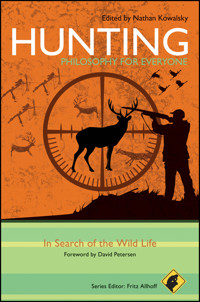
Hunting - Philosophy for Everyone E-Book
14,99 €
Mehr erfahren.
- Herausgeber: John Wiley & Sons
- Kategorie: Geisteswissenschaft
- Serie: Philosophy for Everyone
- Sprache: Englisch
Hunting - Philosophy for Everyone presents a collection of readings from academics and non-academics alike that move beyond the ethical justification of hunting to investigate less traditional topics and offer fresh perspectives on why we hunt.
- The only recent book to explicitly examine the philosophical issues surrounding hunting
- Shatters many of the stereotypes about hunting, forcing us to rethink the topic
- Features contributions from a wide range of academic and non-academic sources, including both hunters and non-hunters
Sie lesen das E-Book in den Legimi-Apps auf:
Seitenzahl: 506
Veröffentlichungsjahr: 2011
Ähnliche




















CONTENTS
Foreword: Hunting as Philosophy ProfessorDavid Petersen
AcknowledgmentsNathan Kowalsky
Picking Up the Trail: An Introduction to Hunting – Philosophy for EveryoneNathan Kowalsky
PART I THE GOOD, THE BAD, AND THE HUNTER
1 Taking a Shot: Hunting in the Crosshairs Jesús Ilundáin-Agurruza
2 But They Can’t Shoot Back: What Makes Fair Chase Fair? Theodore R. Vitali
3 A Shot in the Dark: The Dubious Prospects of Environmental Hunting Lisa Kretz
4 Hunting Like a Vegetarian: Same Ethics, Different Flavors Tovar Cerulli
5 What You Can’t Learn from Cartoons: Or, How to Go Hunting After Watching Bambi Gregory A. Clark
PART II THE HUNTER'S VIEW OF THE WORLD
6 Hunting for Meaning: A Glimpse of the Game Brian Seitz
7 Getting By with a Little Help from My Hunter: Riding to Hounds in English Foxhound Packs Alison Acton
8 Tracking in Pursuit of Knowledge: Teachings of anAlgonquin Anishinabe Bush Hunter Jacob Wawatie and Stephanie Pyne
9 Living with Dead Animals? Trophies as Souvenirs of the Hunt Garry Marvin
PART III EATING NATURE NATURALLY
10 The Carnivorous Herbivore: Hunting and Culture in Human Evolution Valerius Geist
11 The Fear of the Lord: Hunting as if the Boss is Watching Janina Duerr
12 Hunting: A Return to Nature? Roger J. H. King
13 The Camera or the Gun: Hunting through Different Lenses Jonathan Parker
14 Flesh, Death, and Tofu: Hunters, Vegetarians, and Carnal Knowledge T. R. Kover
PART IV THE ANTLER CHANDELIER: Hunting in Culture, Politics, and Tradition
15 The Sacred Pursuit: Reflections on the Literature of Hunting Roger Scruton
16 Big Game and Little Sticks: Bowmaking and Bowhunting Kay Koppedrayer
17 Going to the Dogs: Savage Longings in Hunting Art Paula Young Lee
18 The New Artemis? Women Who Hunt Debra Merskin
19 Off the Grid: Rights, Religion, and the Rise of the Eco-Gentry James Carmine
Notes on Contributors
VOLUME EDITOR
NATHAN KOWALSKY is Assistant Professor of Philosophy,St. Joseph’s College, University of Alberta. He has published essays inthe journals Environmental Ethics and Ethical Perspectives and in thebook The Ranges of Evil: Multidisciplinary Studies in Human Wickedness.He has also served as a consultant to Environment Canada(a ministry of the Canadian government).
SERIES EDITOR
FRITZ ALLHOFF is an Assistant Professor in the PhilosophyDepartment at Western Michigan University, as well as a SeniorResearch Fellow at the Australian National University’s Centre for Applied Philosophy and Public Ethics. In addition to editing thePhilosophy for Everyone series, Allhoff is the volume editor or co-editorfor several titles, including Wine & Philosophy (Wiley-Blackwell, 2007),Whiskey & Philosophy (with Marcus P. Adams, Wiley, 2009), andFood & Philosophy (with Dave Monroe, Wiley-Blackwell, 2007).
PHILOSOPHY FOR EVERYONE
Series editor: Fritz Allhoff
Not so much a subject matter, philosophy is a way of thinking. Thinking not just about the Big Questions, but about little ones too. This series invites everyone to ponder things they care about, big or small, significant, serious … or just curious.
Running & Philosophy: A Marathon for the MindEdited by Michael W. Austin
Wine & Philosophy: A Symposium on Thinking and DrinkingEdited by Fritz Allhoff
Food & Philosophy: Eat, Think and Be MerryEdited by Fritz Allhoff and Dave Monroe
Beer & Philosophy: The Unexamined Beer Isn’t Worth DrinkingEdited by Steven D. Hales
Whiskey & Philosophy: A Small Batch of Spirited IdeasEdited by Fritz Allhoff and Marcus P. Adams
College Sex – Philosophy for Everyone: Philosophers With BenefitsEdited by Michael Bruceand Robert M. Stewart
Cycling – Philosophy for Everyone: A Philosophical Tour de ForceEdited by Jesúundá-Agurruza and Michael W. Austin
Climbing – Philosophy for Everyone: Because It’s ThereEdited by Stephen E. Schmid
Hunting – Philosophy for Everyone: In Search of the Wild LifeEdited by Nathan Kowalsky
Christmas – Philosophy for Everyone: Better Than a Lump of CoalEdited by Scott C. Lowe
Cannabis – Philosophy for Everyone: What Were We Just Talking About?Edited by Dale Jacquette
Porn – Philosophy for Everyone: How to Think With KinkEdited by Dave Monroe
Serial Killers – Philosophy for Everyone: Being and KillingEdited by S. Waller
Dating – Philosophy for Everyone: Flirting With Big IdeasEdited by Kristie Miller and Marlene Clark
Gardening – Philosophy for Everyone: Cultivating WisdomEdited by Dan O’Brien
Motherhood – Philosophy for Everyone: The Birth of WisdomEdited by Sheila Lintott
Fatherhood – Philosophy for Everyone: The Dao of DaddyEdited by Lon S. Nease and Michael W. Austin
Forthcoming books in the series:
Fashion – Philosophy for EveryoneEdited by Jessica Wolfendale and Jeanette Kennett
Coffee – Philosophy for EveryoneEdited by Scott Parker and Michael W. Austin
Blues – Philosophy for EveryoneEdited by Abrol Fairweather and Jesse Steinberg
This edition first published 2010© 2010 Blackwell Publishing Ltd except for editorial material and organization© 2010 Nathan Kowalsky
Blackwell Publishing was acquired by John Wiley & Sons in February 2007. Blackwell’s publishing program has been merged with Wiley’s global Scientific, Technical, and Medical business to form Wiley-Blackwell.
Registered OfficeJohn Wiley & Sons Ltd, The Atrium, Southern Gate, Chichester, West Sussex, PO19 8SQ, United Kingdom
Editorial Offices350 Main Street, Malden, MA 02148–5020, USA9600 Garsington Road, Oxford, OX4 2DQ, UKThe Atrium, Southern Gate, Chichester, West Sussex, PO19 8SQ, UK
For details of our global editorial offices, for customer services, and for information about how to apply for permission to reuse the copyright material in this book please see our website at www.wiley.com/wiley-blackwell.
The right of Nathan Kowalsky to be identified as the author of the editorial material in this work has been asserted in accordance with the UK Copyright, Designs and Patents Act 1988.
All rights reserved. No part of this publication may be reproduced, stored in a retrieval system, or transmitted, in any form or by any means, electronic, mechanical, photocopying, recording or otherwise, except as permitted by the UK Copyright, Designs and Patents Act 1988, without the prior permission of the publisher.
Wiley also publishes its books in a variety of electronic formats. Some content that appears in print may not be available in electronic books.
Designations used by companies to distinguish their products are often claimed as trademarks. All brand names and product names used in this book are trade names, service marks, trademarks or registered trademarks of their respective owners. The publisher is not associated with any product or vendor mentioned in this book. This publication is designed to provide accurate and authoritative information in regard to the subject matter covered. It is sold on the understanding that the publisher is not engaged in rendering professional services. If professional advice or other expert assistance is required, the services of a competent professional should be sought.
Library of Congress Cataloging-in-Publication Data
Hunting – philosophy for everyone: in search of the wild life / Nathan Kowalsky, editor.
p. cm. – (Philosophy for everyone)
Includes bibliographical references.
ISBN 978-1-4443-3569-9 (pbk.: alk. paper) 1. Hunting – Philosophy. I. Kowalsky, Nathan.
SK14.H86 2010
179´.3–dc22
2010017112
A catalogue record for this book is available from the British Library.
To my Grandfather, E. L. “Bud” Kowalsky (1925–2009), whose many loves included hunting with Dad and me out there in the wide-open lands of home.
“To illustrate all this by a similar instance, I shall observe, thatthere cannot be two passions more nearly resembling each otherthan those of hunting and philosophy, whatever disproportionmay at first sight appear betwixt them.”
David Hume, A Treatise of Human Nature, book II, part III, section X
DAVID PETERSEN
FOREWORD
Hunting as Philosophy Professor
The out-of-doors is our true ancestral estate. For a mere few thousand years we have grubbed in the soil and laid brick upon brick to build the cities; but for millions of years before that we lived the leisurely, free, and adventurous life of hunters and gatherers. How can we pluck that deep root of feeling from the racial consciousness? Impossible!
Edward Abbey
In my long and shaggy life, I’ve known no better philosophy teacher than hunting. While non-hunters may initially scoff at the concept of “hunting as philosophy professor,” the thought-provoking essay collection to follow should broaden and deepen personal insights about life and death, and the interplay between the two, for all with open minds.
In my case, as one who examines life and death through the eyes of a self-styled neo-animist, many of the most useful lessons I’ve learned about the nature of human nature, including especially my own, have come through the practice, in both the practical and Zen meanings of the word, of hunting.
As hunters, much is revealed about us by the tools we choose to carry afield, the strategies we employ to bring game to bag, the ethics we embrace or ignore in seeking success, how we define hunting “success,” and how we talk about it all.
Yet, personal ethics aside, it’s entirely logical to ask, as so many non-hunters do, why anyone hunts today, when it’s no longer necessary for human physical survival. Put this question to the average hunter and he or she predictably will trot out such pragmatic motivations as meat, challenge, adventure, trophies (physical memorabilia), and companionship afield.
Yet in fact such “reasons” as these are merely enjoyable products of the hunt. Let’s take it another step and ask why we find wild meat, big antlers, personal challenge, outdoor adventure, campfire companionship, crisp autumn sunrises, and stinky elk wallows so viscerally exciting as to compel us to seek them fall after fall, often at considerable cost in money, time, and energy.
As Edward Abbey suggests, the tenacious human urge to hunt, which feels so much like instinct to those of us who know it, is instinct, arising from the deepest primitive core of our species’ memory; a genetic predisposition, often sublimated yet very much still with and within our opportunistic omnivorous species.
And the flip-side of this same coin, a self-evident biological fact that hunting’s harshest philosophical critics fail to grasp or at least to acknowledge, is that a complementary instinctive need to be hunted is built into all evolved prey species. Without the perpetual continuation of the precise sort of physical and mental exercise provided by predation and evasion, our spectacular prey species, so beautifully sculpted by the artful knife of natural selection, would soon devolve into mere thin shadows of their artful wild selves.
Predation and evasion comprise a sacred game, without which no living thing would be the same – without which no living thing would even be. In a world with no predation – where no living organism sucks its sustenance from other living organisms – there would be no food, no adaptive evolution, no quality control via culling of the least fit, and no you or me.
Unfortunately, many criticisms of contemporary hunting are valid. Outdoor catalogs clog the mails, all hawking flashy lethal toys, skill-crutches, and cheater technologies targeted at contemporary Wannabee hunters who don’t wannabee real hunters badly enough to invest the time, energy, and heart required to do it right.
Finding such traditional hunting values as woodsmanship too slow and unreliable, too many of today’s dilettante sportsmen are eagerly co-opted by advertising to take such ethically bankrupt shortcuts as motorized decoys, electronic game calls, map-friendly GPS units, cell and satellite telephones, night-vision optics, space-age compound arrow-launching devices and cross-guns posing as “archery equipment,” automatic game “feeders” (bait stations) that spray out showers of corn at preset times each day so that our “trophies” are conditioned to appear promptly, say at 8 a.m. and 4 p.m., thus relieving Bubba from the exhausting inconvenience of actually having to hunt.
To true hunters and the concerned non-hunting public, this stinky garbage – as grotesquely acted out on TV’s “outdoor” channels – is embarrassingly pathetic, leaving us to ask: “What’s the point? Why even bother doing a thing when there’s so much cheating and self-delusion involved that both goal and gain become transparent lies?”
Happily and hopefully, standing in staunch opposition to this “new generation” of “hunters in a hurry,” true, traditional-values hunters remain abundant, if far less visible – quietly thoughtful natural predators playing a proper, exacting, and essential role in the scheme of things. It is, after all (circling back to this essential key to comprehending hunting), predators, human and otherwise, who sculpted the sublime defensive tactics of their prey. Predator and prey: a quintessential symbiotic relationship and the engine that throughout life’s long history powered an upward-spiraling intellectual evolution among our own species, in team with a quest for survival perfection among all creatures great and small.
Consequently, if hunting were to be banned or even unwisely restricted, rather than gains in the welfare of wildlife, as animal rights zealots envision, we would see rapid increases in wildlife overpopulation and its horrific upshots – increased run-ins with automobiles, contagious disease, genetic decline, overgrazing leading to mass starvation, and general misery all around.
The essence of wildlife is wildness. And the heartbeat of wildness is predation.
To true hunters, the game, in both meanings of the term, remains sacred, to be approached with an attitude of process over product; doing more with less, a willful body/spirit immersion in a determined effort to reconnect as honestly and humbly as possible to our innate human/animal wildness, which is the human soul. Above all, the true hunter’s thoughts and actions are tempered by respect for our prey as expressed through self-restraint even when, as Aldo Leopold famously noted, no one is out there watching us (that’s the “sporting” part). For true hunters, the trip is the destination and “success” is measured not by quantity of game “harvested” (a simpering agricultural euphemism) but by the quality of the overall experience, start to finish.
No one grows stronger by always taking the easy trail. No one grows wiser by ditching school.
Apropos to the task at hand, Hunting – Philosophy for Everyone takes no shortcuts. Whether you approach this book with the biases of a hunter, a non-hunter, or an animal rights advocate, don’t be surprised to feel yourself, as I did, being gently jolted into having to rethink what you thought you knew about hunting all along. The innovative, deep-time revelations of Valerius Geist (“The Carnivorous Herbivore: Hunting and Culture in Human Evolution”), to flag but one chapter among many, are themselves worth the price of admission.
Not all hunting is the same.
Not all hunters are the same.
To blanket-brand hunting and hunters as either “bad” or “good” – black or white with no room for gray – is a trophy-class philosophical oversimplification.
We are both.
We are Homo sapiens.
ACKNOWLEDGMENTS
Wow, editing a book is not a one-man job! I must thank, first and foremost, Richard Kover, who started off as my editorial assistant, but who I now recognize, by rights, as my assistant editor. Richard has worked with me on this project from the beginning, kicking me in the pants to get moving with a proposal, helping to draft it and propose the subtitle that eventually stuck, going through hundreds of abstracts, providing extremely helpful first impressions of contributions, and generally hauling the load whenever necessary – in addition to his own research and writing responsibilities (including a piece for this volume). I am deeply indebted to him for his assistance.
Second, I cannot but thank the contributors themselves, who have dealt with unusually tight deadlines, to say nothing of their tolerance of my editorial pestering. I’m amazed that we all got along smashingly in spite of the incredibly volatile topic, but given everyone’s caliber, it’s no surprise to find myself thrilled by the quality of their finished essays. We’ve only communicated via the disembodied electronic media, yet it’s been an honor nonetheless. You feel like friends, and I can only hope that we can actually meet someday in person – and take each other up on the apple pies, muzzleloaders, cooking over a fire under the sky, bowmaking. . .
Third, I want to thank all the people who submitted abstracts in the hope of inclusion in this volume. It was truly overwhelming to have hundreds of abstracts arrive within the short space of a month in the middle of summer holidays, and I can only hope there will be other opportunities in the future for these insightful thinkers to showcase their ideas. We could have easily put together two volumes on this topic! Timothy, Jorge, Chuck, Leon, Baird, Jordan, Nathan, Keith, Samantha, Alexandria, John, Marc, Mary, Thomas, Richard, Don, Carla, Niall, Alastair . . . the list of awesome possibilities just keeps on going. I do hope we’ll get a chance to work together somehow, someday.
Fourth, I wish to thank the various persons and organizations who were so cooperative in helping me advertise the call for abstracts, including Larry Cahoone, Lee Foote and the Canadian Circumpolar Institute, Roger Brunt, Peter Flack and Gerhard Damm of African Indaba, T. J. Schwanky, Christine Roedlach of the Federation of Associations for Hunting and Conservation of the European Union (FACE), and more. Your support has been invaluable!
Fifth, my superiors at Wiley-Blackwell have been longsuffering and generous in their dealings with me, a newbie. Fritz Allhoff, Tiffany Mok, and Jeff Dean have provided me with advice, instruction, and other invaluable assistance at almost a moment’s notice. In this vein I also want to thank Margolee Horn, Tona Cota, Tracy Yurchak, and Ashley Blum at St. Joseph’s College, University of Alberta, for the administrative support they provided me throughout this process. Additionally, I am deeply indebted to Rique Edgar Brotherston, who proofread the entire manuscript, pro bono.
Finally (and sheepishly), I thank my loving wife Stephanie, who lived as a virtually single parent while I slaved away on this project, and our two dear daughters, Anya and Nina, who thought Daddy was sick because of all the time he spent holed up in the office. I love each of you more than I know how to say, and more than I know how to show.
Nathan KowalskyEdmonton, Alberta
NATHAN KOWALSKY
PICKING UP THE TRAIL
An Introduction to Hunting – Philosophy for Everyone
If I think about it, my earliest memories of hunting are with my Dad, and seeing . . . nothing. Well, not nothing, but no deer, anyway. I do remember lots of walking, lots of grass (or snow), lots of wind, and lots of Halloween candy in my pockets. But hunting as a child never involved seeing deer, let alone shooting them. However, for some odd reason, the day after I went hunting, I do recall Dad showing up at school with deer in the back of the van. That was a cool way to spend a lunch hour, checking out deer with your friends in the parking lot, but they were never my deer.
My luck changed for the better when I reached 14, which was the first time we went out hunting with a rifle and a license in my hands. Dad let me use his .30–30 lever action Marlin with open sights, and somehow or other we had managed to sneak into sight of a small whitetail buck browsing in some brush on the side of a hill, easily under 100 yards away. We were laying in prone position, and had all the time in the world to get a bead on that buck. It was my shot. I sat there with him in my sights, but I couldn’t pull the trigger! Nope, couldn’t do it. Not because I didn’t want to kill him, but because I wasn’t confident I’d kill him well. From my perspective, my gun sights were bigger than his body, so I had no idea if that bullet would hit him in the heart or in the legs. I was okay with killing the buck (so I thought), but I wasn’t okay with maiming him instead. This was nothing like shooting at a target.
So Dad took the shot instead. BANG! (Actually, all I heard was a loud, high-pitched “whee” sound that wouldn’t go away, my ears being in too much shock to register anything else.) The buck fell to his knees, and thrashed around in the brush for what seemed too long, and then lay still. I remember running like hell towards him, but probably only after Dad woke me up from my . . . well, you can’t call it a “reverie,” but it was a kind of mindlessness – as if there was only one thing that existed in the world, that buck, and my entire consciousness was nothing but a giant tube through which something else beyond me was able to look through the fabric of the universe and see that buck, right there, die. Whoosh.
After that, running. “Dad, is he dead? Dad, is he okay? Dad, did it hurt? Dad . . . ?” There was only one thing that mattered to me: that the buck was okay. And by okay, I meant that he was well dead. Death was always in the cards, but it had to be good. Weird, huh? I loved that buck, that one, right there. He deserved the right kind of death. And then I cried. Good God, I cried! I guess 14-year-old boys are allowed to. It’s always odd to consider why one cries. We cry when we’re happy, when we’re sad, when we’re relieved, and when we’re frustrated. We cry when we see beauty, and when we see horror. And yet neither of these things truly captured what I felt. I don’t know of any words that really could. But it was good to cry, and it was good that the buck died as he did (Dad was a good shot).
And then, it was good that I could touch him.
Hunting and philosophy? C’mon, don’t be ridiculous. The combination is almost an oxymoron! Everybody knows that philosophers don’t hunt, and that hunters don’t think, right? Elmer Fudd’s an idiot, and Socrates hung around downtown where all the interesting people are.
Well . . . yeah, not so much. But you know what I’m talking about, don’t you? It doesn’t matter if you’re a hunter, a non-hunter, or an anti-hunter, because we’re all familiar with the stereotype, and not without reason. We hear news stories about how many hunters accidentally shot their hunting companions this season, or we’ve heard of how hunters pull into a gas station (or a school, *cough-cough*) with a bunch of dead deer hanging out of the half-ton, and we all know that most hunters kill animals that are wild and free – even though they don’t have to. What kind of people do this? Surely not . . . philosophers.
Well let me just say this: I am a philosopher and a hunter, and I’m not the only one. In fact, I am an environmental philosopher because I’m a hunter. How’s that for a paradox? Here’s the thing about philosophy: if there isn’t a paradox to work with, there’s not much philosophy to be done. Hunting provides that paradox, and how! Life and death, together, right there in front of your face – and on your hands. How often do humans and wildness touch? Must that kind of contact with raw nature involve death? Why is hunting so enjoyable? (Where else can you get organic, free-range, grass-fed, arguably cruelty-free, roughly 100-mile diet, U-Pick meat?) It’s enough to make someone think, and think hard.
You might be interested in thinking hard about hunting because you’re a hunter, or a foodie, or a locavore, or a vegetarian, or a conservation biologist, or a city slicker – this book has got chapters written by all those sorts, and more! There are deep thoughts here for everyone. One can be a philosopher by profession, inclination, or otherwise – the very term means “lover of wisdom,” and that isn’t limited to stodgy academics smoking pipes whilst wearing waistcoats. Even so (and you may already know this), a philosopher is only good for maybe one thing: thinking hard. Don’t go to them for answers, because all you’ll get is more questions. But what philosophers will do is some hard thinking for you (if you believe in the division of labor), and get you philosophizing too (that is, if you don’t mind).
That’s what this book is for: contemplating hunting – an activity that gets the mind going, if not the blood boiling – and doing the thinking well. It’s easy to dismiss hunters as barbaric or ignorant, but there’s no denying the profound nature of the issue. Hunting is itself a field for pursuit, and a worthy one. It isn’t often given the attention it deserves. So let’s get our wits about us and follow it down.
It’s fitting that we get our sights set on hunting with the guidance of the venerable hunter, nature writer, and cabin dweller, David Petersen. Dave’s been hunting the land where he lives almost as long as I’ve been alive. He knows the secret location of Edward Abbey’s grave. And he’s been doing some thinking. You might be a hunter or you might not be; Mr. Petersen’s got some words for the lot of us. That’s why he’s taking the point!
Now there are better and worse ways to hunt down your quarry, depending on what it is and where you are. What we’ve done is set up four practice targets, with almost five chapters aiming at each. “The Good, the Bad, and the Hunter” points us in the most obvious direction: the morality of hunting. Everybody wants to know, after all, if hunting is good or bad, and why. And that’s just the beginning! What better way to start thinking about right and wrong than with a guy named Jesús? Professor Ilundáin-Agurruza (if we’re speaking formally) dares us to go on a hunt with him – a philosophical hunt. Philosophers are, after all (so he says), “truth hunters,” even if he isn’t an animal hunter himself. With a bevy of bullet-laden puns, Jesús argues that the only way to answer the question of the value of hunting is to follow the philosophical ethic of “fair chase.” The same courtesy hunters are supposed to extend to their prey has to be shown to their opponents: this makes the debate fair, and anti-hunters fair philosophical game.
But what about “fair chase” for non-human animals? The feelings of animals count for something, and animals don’t like being hunted. That’s where Theodore Vitali comes in, a professional member of the Boone and Crockett Club, which pretty much wrote the book on the fair chase ethic. Father Ted throws us for a loop, arguing that hunters can’t be fair to animals. What they can do, however, is cultivate a particularly human excellence, one which provides a non-trivial justification for hunting – the kind which gives the prey (individually and as a species) a fighting chance. Our next contributor, Lisa Kretz, won’t have any of this. She systematically criticizes the idea that hunting is somehow “environmental.” It doesn’t matter if hunting is natural for humans; our hunting is not good for the prey (individually or as a species), and it doesn’t get us closer to the truth of nature either. This is precisely the kind of critical thinking that lies at the heart of philosophy, and her case cannot be ignored.
Tovar Cerulli proceeds to march right up the middle of this debate, as only an ex-vegan can. With drama and panache, he argues that the same sort of fundamental ethical concerns lie beneath both vegetarian and hunting practice. Say that again? Well, I’ll let you read it for yourself, but you may not look at either side in the same way again. Recognizing that ethics can lead us into deeper philosophical ground, Greg Clark asks the question on everybody’s mind: isn’t hunting the equivalent of murdering Bambi? Rather than dancing around in the wilderness equivalent of a princess palace, he leads us deep into a mystery – one that Disney doesn’t quite do justice to, and yet one that isn’t served by knee-jerk criticisms of Bambi either. Clark doesn’t offer us a “solution” to the “problem” of hunting so much as show us a portal into another way of experiencing the cosmos.
This is where the next part of the book points us, “The Hunter’s View of the World.” Part of the trouble with sorting out the morality of hunting is that not everybody knows what it’s like. As usual, Hollywood hasn’t done us many favors in this regard. Hunting is killing for fun, right? What a perverse way to look at the world! Well, hang on, we might not even have the right target – and shooting at a straw duck is no way to connect with the real thing. So our second goal is finding out what hunting actually is – how it is experienced (phenomenology), and how it can shape our view of the world (metaphysics).
Brian Seitz starts us off with an existential reflection on hunting: what it is, whether hunting for sport changes what it is to hunt, even whether or not killing is the essence of hunting, let alone the point of it! He makes the challenging case that hunting connects us to a timeless reality, which is why it is out of place with civilization and the other hyperactive degradations of our day and age. Yet, at the very same time, hunting can be a rip-roaring good time, as Alison Acton makes clear in her chapter. She takes us for a ride into that pell-mell rush which is English foxhunting. She points out that you can’t take yourself too seriously when hunting, least of all when you’re not the hunter, but your horse is! There’s a level of trust and respect that has to exist between the human and the animal if the ancient arrangement is going to come to any fruition at all.
But there’s nothing quite so timeless – and yet so current – as the once universal form of human flourishing known as hunting and gathering. Through the lens of traditional Anishinabe teachings, Jacob Wawatie (Mowegan) and Stephanie Pyne show us what the world can be like in the eyes of a people for whom hunting was a way of life. Rather than divisions between humanity and “nature,” interconnections are so prominent in their stories that even hunting isn’t something to investigate in isolation; it is as unremarkable as breathing, and yet one of the profound gifts given to humanity by the animals of our shared home. One might think that modern sport hunting lacks much of this character, but as Garry Marvin argues, even the trophy of a hunted animal only makes sense in terms of individual, personal connections between the prey and the hunter. Trophies are meaningless except as part of the experience of a particular hunt; they breathe life into an experience that goes beyond death. As the embodiment of memory, Garry argues that trophies perpetuate both relationship and spirit.
The third segment of this book, “Eating Nature Naturally,” focuses our attention even more intensely on the issue of nature. Hunting and naturalness is a particularly appropriate topic, given current concerns about the environmental crisis, and humanity’s relationship with (the rest of ) nature and (other) animals. We have already seen this issue come up, in relation to both the ethics of hunting and the quality of experience facilitated by hunting. To take us further into the depths of this issue, the eminent conservation biologist Valerius Geist examines the evidence for and implications of the evolution of human beings as hunters. While there’s no question that our species and its ancestors made their way in the world by hunting, he points out that it’s a whole lot more complicated than that. Val argues that our apelike ancestors started out as vulnerable vegetarians, but learned to fight off predators, which is how we learned to hunt. This evolutionary step, in turn, led to a great deal of the cultural capacities that we now hold dear. Professor Geist wants us to be clear as to exactly what is at stake when we consider the relationship between human nature, hunting, and the rest of nature.
These close connections between our basic constitution and hunting other animals don’t mean, however, that hunting can be pursued without any qualms at all. The archaeologist Janina Duerr argues that it’s universal across human cultures – hunting cultures, farming cultures, herding cultures – to believe that hunting is morally problematic and must be properly performed, lest one suffer the consequences. She suggests, in effect, that it’s natural to believe in a Master or Mistress of Animals, who will hunt you down if you don’t hunt with the proper respect. Yet even if hunting ethics are “natural,” that doesn’t mean hunting is the best way to reconnect with “nature.” In his chapter, Roger King makes the point that most hunters understand their relationship with nature to be a mind-game at best. There isn’t a growing movement of hunters who want to reform society so that more people do, in fact, access nature in a more authentic way. This is an important call to action: if hunting really does bring us closer to genuine nature, then hunters should be coming up with ways in which we can overcome societies that prevent such access!
Genuine access to nature? What’s that supposed to mean? The last two chapters in this section flesh that out for us, even if controversially. Jonathan Parker asks whether or not “hunting” with cameras can connect us to nature in the same way that hunting with weapons can. While he doesn’t have a problem with nature photography, he does argue that hunters are different from photographers in the way that participants are different from spectators: hunting places a person directly in the middle of the logic of ecosystems, whereas at best, photography can only view these realities from a distance. T. R. Kover takes this point and runs with it: the logic of ecosystems which hunters know firsthand is that biological life is intertwined with death! Hunting brings us face to face with the fact that all living things die and get eaten, including ourselves. Richard goes on to argue that most anti-hunters are motivated not by a “love” of animals, but rather by the fear of mortality characteristic of Western culture’s alienation from nature. You can’t love life, after all, if you won’t let it be what it is.
Implicit in the question of nature is the question of culture, as we’ve just seen: hunting is opposed to the dominant cultures of life-denial many of us languish in, and yet it is at the root of our species’ cultural hard-wiring. Our final section, “The Antler Chandelier: Hunting in Culture, Politics, and Tradition,” helps us to consider the interrelationship of hunting and various social factors. Leading this pack is the eminent philosopher and foxhunter Roger Scruton. Giving us a tour of both famous and obscure novels, operas, and other forms of literature, Roger explores the ways in which even contemporary hunting expresses profoundly human attitudes towards the land, other animals, and even the divine. There is something of the holy and the sacred in the ritual pursuit of “game,” and while we may not be able to fully explain it, we can by no means ignore its centrality to the human condition.
The “oldness” of hunting has already come up as a theme, and Kay Koppedrayer, an editor for Primitive Archer magazine, examines the phenomenon of hunting with bow and arrow. Moreover, it’s not “modern” bowhunting she’s interested in; rather, bowhunting and bowmaking with old-fashioned, even self-made bows and arrows draws her attention. What is it about the hands-on, do-it-yourself attitude at the heart of traditional archery? Kay suggests that the appeal here is not to go back in time, but rather to use the past as the foundation for a present which is more robust than the usual cultural trappings of carbon-fiber, surgical steel, and electronics. Similarly, this conflicted relationship between the past-informed present and a culture of the ravenous future figures prominently in Paula Lee’s chapter on hunting in visual art. Drawing on both contemporary and nineteenth-century examples, she shows how hunting presents a challenge to the dominant forces of civilization. Gustave Courbet’s paintings are but one instance where transformed ideals of masculinity and naturalness are mocked by the rural, lower-class values they make obsolete.
Ah, but it’s not only about masculinity. Debra Merskin proceeds to draw on feminist theory, investigating how it is that female hunters participate in an activity presently dominated by men. The analysis of hunting as a veiled metaphor for sexual predation is highly controversial, and yet Merskin suggests that there isn’t anything necessarily bizarre about women participating in the hunt. Not only do women hunt for reasons similar to those of men, but the image of the female hunter has a longer history of denying male dominance than one might imagine given contemporary stereotypes. While there’s plenty more to be said about sexual politics and hunting, I think Deb’s right in arguing that there’s no sense in denying the propriety of women hunters in light of problematic gender roles. Our final author, James Carmine, takes the political aspects of hunting and heats them up over a blazing fire! Arguing from the perspective of classical American liberalism, he claims that hunting is a right of the commoner to the commonwealth that is wild nature. The aristocracy is no more entitled to the common grace of God’s Green Earth than we are. In fact, he views the modern environmental movement as the equivalent of the uppity English gentry, in that it wishes to restrict access to hunting by asserting the equality of humans with all other forms of biological life. One needn’t agree with Jim’s politics or analysis of ecological philosophy to see the politically significant and subversive nature of hunting – and it’s a sure way to go out with a bang!
In closing, I hope that you, the reader, will not only enjoy the chapters in this book – thinking along with and/or against each author – but will also be better placed to tread the path of thinking critically about hunting. Seeking an answer to a riddle is the paradigm of the hunt, and this book’s highest aspiration is to put you on the scent. Good hunting!
PART I
THE GOOD, THE BAD, AND THE HUNTER
Lesen Sie weiter in der vollständigen Ausgabe!
Lesen Sie weiter in der vollständigen Ausgabe!
Lesen Sie weiter in der vollständigen Ausgabe!
Lesen Sie weiter in der vollständigen Ausgabe!
Lesen Sie weiter in der vollständigen Ausgabe!
Lesen Sie weiter in der vollständigen Ausgabe!
Lesen Sie weiter in der vollständigen Ausgabe!
Lesen Sie weiter in der vollständigen Ausgabe!
Lesen Sie weiter in der vollständigen Ausgabe!
Lesen Sie weiter in der vollständigen Ausgabe!
Lesen Sie weiter in der vollständigen Ausgabe!
Lesen Sie weiter in der vollständigen Ausgabe!
Lesen Sie weiter in der vollständigen Ausgabe!
Lesen Sie weiter in der vollständigen Ausgabe!
Lesen Sie weiter in der vollständigen Ausgabe!
Lesen Sie weiter in der vollständigen Ausgabe!
Lesen Sie weiter in der vollständigen Ausgabe!
Lesen Sie weiter in der vollständigen Ausgabe!
Lesen Sie weiter in der vollständigen Ausgabe!
Lesen Sie weiter in der vollständigen Ausgabe!
Lesen Sie weiter in der vollständigen Ausgabe!
Lesen Sie weiter in der vollständigen Ausgabe!




