


80,99 €
Mehr erfahren.
- Herausgeber: John Wiley & Sons
- Kategorie: Wissenschaft und neue Technologien
- Sprache: Englisch
HYDROGEOLOGY
Hydrogeology: Principles and Practice provides a comprehensive introduction to the study of hydrogeology to enable the reader to appreciate the significance of groundwater in meeting current and future environmental and sustainable water resource challenges. This new edition has been thoroughly updated to reflect advances in the field since 2014 and includes over 350 new references.
The book presents a systematic approach to understanding groundwater starting with new insights into the distribution of groundwater in the Earth’s upper continental crust and the role of groundwater as an agent of global material and elemental fluxes. Following chapters explain the fundamental physical and chemical principles of hydrogeology, and later chapters feature groundwater field investigation techniques in the context of catchment processes, as well as chapters on groundwater quality and contaminant hydrogeology, including a section on emerging contamination from microplastic pollution.
Unique features of the book are chapters on the application of environmental isotopes and noble gases in the interpretation of aquifer evolution, and a discussion of regional characteristics such as topography, compaction and variable fluid density on geological processes affecting past, present and future groundwater flow regimes. The last chapter discusses future challenges for groundwater governance and management for the long-term sustainability of groundwater resources, including the role of managed aquifer recharge, and examines the linkages between groundwater and climate change, including impacts on cold-region hydrogeology. Given the drive to net-zero carbon emissions by 2050, the interaction of groundwater in the exploitation of energy resources, including renewable resources and shale gas, is reviewed.
Throughout the text, boxes and a set of colour plates drawn from the authors’ teaching and research experience are used to explain special topics and to illustrate international case studies ranging from transboundary aquifers and submarine groundwater discharge to the hydrogeochemical factors that have influenced the history of malting and brewing in Europe. The appendices provide conversion tables and useful reference material, and include review questions and exercises, with answers, to help develop the reader’s knowledge and problem-solving skills in hydrogeology.
This highly informative and accessible textbook is essential reading for undergraduate and graduate students primarily in earth sciences, environmental sciences and physical geography with an interest in hydrogeology or groundwater topics. The book will also find use among practitioners in hydrogeology, soil science, civil engineering and landscape planning who are involved in environmental and resource protection issues requiring an understanding of groundwater.
Sie lesen das E-Book in den Legimi-Apps auf:
Seitenzahl: 1617
Veröffentlichungsjahr: 2021
Ähnliche



















Fresh Water to Drink
Laura Ingalls Wilder
1867–1957
In a little while the well was almost full of water. A circle of blue sky lay not far down in the ground, and when Laura looked at it, a little girl’s head looked up at her. When she waved her hand, a hand on the water’s surface waved, too.
The water was clear and cold and good. Laura thought she had never tasted anything so good as those long, cold drinks of water. Pa hauled no more stale, warm water from the creek. He built a solid platform over the well, and a heavy cover for the hole that let the water‐bucket through. Laura must never touch that cover. But whenever she or Mary was thirsty, Ma lifted the cover and drew a dripping bucket of cold, fresh water from that well.
Little House on the Prairie, 1935
© HarperCollins Publishers Inc., New York.
Hydrogeology
Principles and Practice
Third Edition
Kevin M. Hiscock and Victor F. Bense
This third edition first published 2021© 2021 John Wiley & Sons Ltd
Edition HistoryBlackwell Science Ltd (1e, 2005); John Wiley & Sons Ltd (2e, 2014)
All rights reserved. No part of this publication may be reproduced, stored in a retrieval system, or transmitted, in any form or by any means, electronic, mechanical, photocopying, recording or otherwise, except as permitted by law. Advice on how to obtain permission to reuse material from this title is available at http://www.wiley.com/go/permissions.
The right of Kevin M. Hiscock and Victor F. Bense to be identified as the authors of this work has been asserted in accordance with law.
Registered OfficesJohn Wiley & Sons, Inc., 111 River Street, Hoboken, NJ 07030, USAJohn Wiley & Sons Ltd, The Atrium, Southern Gate, Chichester, West Sussex, PO19 8SQ, UK
Editorial Office9600 Garsington Road, Oxford, OX4 2DQ, UK
For details of our global editorial offices, customer services, and more information about Wiley products visit us at www.wiley.com.
Wiley also publishes its books in a variety of electronic formats and by print‐on‐demand. Some content that appears in standard print versions of this book may not be available in other formats.
Limit of Liability/Disclaimer of WarrantyThe contents of this work are intended to further general scientific research, understanding, and discussion only and are not intended and should not be relied upon as recommending or promoting scientific method, diagnosis, or treatment by physicians for any particular patient. In view of ongoing research, equipment modifications, changes in governmental regulations, and the constant flow of information relating to the use of medicines, equipment, and devices, the reader is urged to review and evaluate the information provided in the package insert or instructions for each medicine, equipment, or device for, among other things, any changes in the instructions or indication of usage and for added warnings and precautions. While the publisher and authors have used their best efforts in preparing this work, they make no representations or warranties with respect to the accuracy or completeness of the contents of this work and specifically disclaim all warranties, including without limitation any implied warranties of merchantability or fitness for a particular purpose. No warranty may be created or extended by sales representatives, written sales materials or promotional statements for this work. The fact that an organization, website, or product is referred to in this work as a citation and/or potential source of further information does not mean that the publisher and authors endorse the information or services the organization, website, or product may provide or recommendations it may make. This work is sold with the understanding that the publisher is not engaged in rendering professional services. The advice and strategies contained herein may not be suitable for your situation. You should consult with a specialist where appropriate. Further, readers should be aware that websites listed in this work may have changed or disappeared between when this work was written and when it is read. Neither the publisher nor authors shall be liable for any loss of profit or any other commercial damages, including but not limited to special, incidental, consequential, or other damages.
Library of Congress Cataloging‐in‐Publication Data
Names: Hiscock, K. M. (Kevin M.), author. | Bense, V. F. (Victor Franciscus), author. | John Wiley & Sons, publisher.Title: Hydrogeology : principles and practice / Kevin M. Hiscock and Victor F. Bense.Description: Third edition. | Hoboken, NJ : Wiley, 2021. | Includes bibliographical references and index. Identifiers: LCCN 2021003266 (print) | LCCN 2021003267 (ebook) | ISBN 9781119569534 (paperback) | ISBN 9781119569527 (adobe pdf) | ISBN 9781119569510 (epub) Subjects: LCSH: Hydrogeology. Classification: LCC GB1003.2 .H57 2021 (print) | LCC GB1003.2 (ebook) | DDC 551.49–dc23 LC record available at https://lccn.loc.gov/2021003266LC ebook record available at https://lccn.loc.gov/2021003267
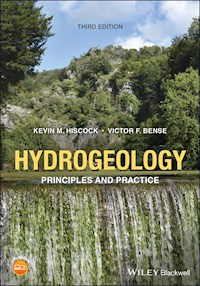
Cover Design: WileyCover Image: © Kevin Hiscock
Cover caption: Sluice overflow at Cheddar Rising, Somerset, England. With a catchment area of 40 km2, the Cheddar resurgence is the largest of the Mendip Hills springs, with flow varying from 0.6–10 m3s−1. The main conduit is blocked by scree through which water emerges from many outlets in the bed of the artificial lake.
List of colour plates
Plate 1.1 Examples of now redundant village pumps once widespread in their use in Britain: (a) the wooden pump on Queen’s Square, Attleborough, Norfolk, enclosed 1897; and (b) the large Shalders pump used in the days before tarmac for dust‐laying on the old turnpike (Newmarket Road) at Cringleford, near Norwich, Norfolk.
Plate 1.2 Arcade of the aqueduct Aqua Claudia situated in the Parco degli Acquedotti, 8 km east of Rome. The aqueduct, which is built of cut stone masonry, also carries the brick‐faced concrete Anio Novus, added later on top of the Aqua Claudia.
Plate 1.3 The baroque mostra




