


Hydrometeorological Hazards E-Book
73,99 €
Mehr erfahren.
- Herausgeber: John Wiley & Sons
- Kategorie: Wissenschaft und neue Technologien
- Serie: Hydrometeorological Extreme Events
- Sprache: Englisch
HYDROMETEOROLOGICAL EXTREME EVENTS
Hydrometeorological Hazards:
Interfacing Science and Policy
Recent hydrometeorological extreme events have highlighted the increased exposure and vulnerability of societies and the need to strengthen the knowledge-base of related policies. Current research is focused on improving forecasting, prediction and early warning capabilities in order to improve the assessment of vulnerability and risks linked to extreme climatic events.
Hydrometeorological Hazards: Interfacing Science and Policy is the first volume of a series which will gather scientific and policy-related knowledge on climate-related extreme events. Invited authors are internationally recognized experts in their respective fields. This volume reflects the most recent advances in science and policy within this field and takes a multidisciplinary approach. The book provides the reader with a state-of-the art account of flash floods, droughts, storms, and a comprehensive discussion focused on the cost of natural hazards, resilience and adaptation.
This book will be an invaluable reference for advanced undergraduates taking courses with a focus on natural hazards, including climate-related extreme events. The book will also be of interest to postgraduates, researchers and policymakers in this field looking for an overview of the subject.
Sie lesen das E-Book in den Legimi-Apps auf:
Seitenzahl: 666
Veröffentlichungsjahr: 2014
Ähnliche




















Table of Contents
Forthcoming titles in the Series
Title Page
Copyright
Series Foreword
Preface
The Series Editor – Philippe Quevauviller
List of Contributors
Part One: Setting the Scene
Chapter 1.1: Strengthened Resilience from Historic Experience. European Societies Confronted with Hydrometeors in the Sixteenth to Twentieth Centuries
1.1.1 Introduction
1.1.2 Five centuries of droughts
1.1.3 The European coast confronted with surges: A first ever?
1.1.4 A memory of risk or a culture of survival?
1.1.5 Conclusion
References
Chapter 1.2: Current Understanding of Climate Change Impacts on Extreme Events
1.2.1 Introduction
1.2.2 Global water balance, past and future
1.2.3 Global extremes – Rainfall, floods and droughts
1.2.4 Future global predictions
1.2.5 Regional drought and water resources
1.2.6 Case study: Science to support policy for flood management under climate change
1.2.7 Adaptation planning
1.2.8 Concluding remarks
References
Chapter 1.3: Features Common to Different Hydrometeorological Events and Knowledge Integration
1.3.1 Introduction
1.3.2 Extreme hydrometeorological events and disasters: An increasing trend
1.3.3 Integrating disaster risk management and climate change adaptation
1.3.4 Predicting disasters: Dealing with uncertainties and scales
1.3.5 Better understanding system exposure at the hazard
1.3.6 Resilience: From concept to operation
1.3.7 Learning from experience
1.3.8 Risk governance: Responsibility and participation
1.3.9 Risk communication
1.3.10 A roadmap towards a sustainable future
References
Chapter 1.4: Science and Policy Interfacing
1.4.1 Introduction
1.4.2 Taking account of the knowledge base
1.4.3 Concept of science and policy interfacing
1.4.4 Matching research with policy needs
1.4.5 Research–policy interactions
1.4.6 Conclusions
References
Part Two: Policy Settings
Chapter 2.1: When Science Meets Policy: Enhancing Governance and Management of Disaster Risks
2.1.1 Science and disaster risk management
2.1.2 Knowledge-based policy
2.1.3 The science–policy interface in practice
2.1.4 Evidence-based disaster risk policies
2.1.5 Climate research and disaster economics: Two scientific pillars of governance of disaster risks
2.1.6 Conclusions
References
Chapter 2.2: Hydrometeorological Extremes and the Science–policy Interface: IPCC
2.2.1 Introduction
2.2.2 IPCC at the interface of science and policy
2.2.3 Evolution of IPCC over 25 years
2.2.4 IPCC SREX messages in a nutshell
2.2.5 Final remarks—AR5 is there
Acknowledgements
References
Chapter 2.3: A Snapshot of EU and International Policies Relevant to Hydrometeorological Events
2.3.1 Introduction—A complex policy framework
2.3.2 Climate change impacts on water
2.3.3 Policy background
2.3.4 International policies
2.3.5 EU water policies
2.3.6 Climate adaptation strategy
2.3.7 Conclusions
References
Part Three: Outline of Scientific Features
Chapter 3.1: Hydroinformatics and Its Role in Flood Management
3.1.1 Background
3.1.2 Flood management in water-related activities
3.1.3 Why hydroinformatics?
3.1.4 Towards integrated flood management
3.1.5 Hydroinformatics and floods
3.1.6 Flood maps production
3.1.7 Real-time systems for decisions support
3.1.8 Emerging trends for higher efficiency
3.1.9 High resolution data and high resolution hydraulic modelling
3.1.10 From centralised to distributed and ubiquitous architecture
3.1.11 Perspectives in conclusion
Acknowledgement
References
Chapter 3.2: Drought: How to be Prepared for the Hazard?
3.2.1 Introduction
3.2.2 Drought: Generating processes and identification
3.2.3 Trends in drought
3.2.4 Monitoring, management and early warning
3.2.5 Drought impacts and policy
Acknowledgements
References
Chapter 3.3: Drought in the Light of Climate Change in the Mediterranean Area
3.3.1 Introduction
3.3.2 The limits of rainfall
3.3.3 Estimating drought vulnerability
3.3.4 From drought vulnerability to drought management
3.3.5 Looking into the future
3.3.6 Conclusions
Acknowledgements
References
Chapter 3.4: Prediction of Storm Impacts on Beach and Dune Systems
3.4.1 Introduction
3.4.2 Coastal storm definitions
3.4.3 The storm impact scale
3.4.4 Analytical methods of hazard definition
3.4.5 Modelling of storm impacts
3.4.6 Storm impact indicators, early warning systems and disaster risk reduction
3.4.7 Conclusions
Acknowledgements
References
Part Four: Social and Economic Considerations
Chapter 4.1: Assessing the Costs of Natural Hazards – State of the Art and the Way Forward
4.1.1 Introduction
4.1.2 State of the art of cost assessment for natural hazards – An overview
4.1.3 Conclusions and the way forward
References
Chapter 4.2: Resilience and Adaptation to Hydrometeorological Hazards
4.2.1 Introduction
4.2.2 Resilience
4.2.3 Discussion
4.2.4 Conclusions
Acknowledgements
References
Part Five: Social and Economic Considerations
Chapter 5: Conclusions, Outlook
5.1 Contextual developments
5.2 Scientific developments
5.3 Outlook
Index
End User License Agreement
Pages
xi
xii
xiii
xv
xvi
xvii
xviii
xix
xx
319
320
321
322
323
324
325
326
327
328
Guide
Cover
Table of Contents
Preface
Part One: Setting the Scene
Begin Reading
List of Illustrations
Figure 1.1.1
Figure 1.1.2
Figure 1.1.3
Figure 1.1.4
Figure 1.1.5
Figure 1.1.6
Figure 1.1.7
Figure 1.1.8
Figure 1.1.9
Figure 1.1.10
Figure 1.1.11
Figure 1.1.12
Figure 1.1.13
Figure 1.1.14
Figure 1.1.15
Figure 1.2.1
Figure 1.2.2
Figure 1.2.3
Figure 1.2.4
Figure 1.2.5
Figure 1.2.6
Figure 1.3.1
Figure 1.3.2
Figure 1.3.3
Figure 1.3.4
Figure 1.3.5
Figure 1.3.6
Figure 1.4.1
Figure 1.4.2
Figure 2.1.1
Figure 2.1.2
Figure 2.2.1
Figure 2.3.1
Figure 2.3.2
Figure 2.3.3
Figure 3.1.1
Figure 3.1.2
Figure 3.1.3
Figure 3.1.4
Figure 3.1.5
Figure 3.1.6
Figure 3.1.7
Figure 3.2.1
Figure 3.2.2
Figure 3.2.3
Figure 3.2.4
Figure 3.2.5
Figure 3.2.6
Figure 3.2.7
Figure 3.2.8
Figure 3.2.9
Figure 3.2.10
Figure 3.2.11
Figure 3.2.12
Figure 3.2.13
Figure 3.2.14
Figure 3.2.15
Figure 3.3.1
Figure 3.3.2
Figure 3.3.3
Figure 3.3.4
Figure 3.4.1
Figure 3.4.2
Figure 3.4.3
Figure 3.4.4
Figure 3.4.5
Figure 4.1.1
Figure 4.1.2
Figure 4.1.3
Figure 4.1.4
Figure 4.1.5
Figure 4.1.6
Figure 4.1.7
Figure 4.1.8
Figure 4.1.9
Figure 4.1.10
List of Tables
Table 1.1.1
Table 1.1.2
Table 1.1.3
Table 1.2.1
Table 1.3.1
Table 2.3.1
Table 3.3.1
Table 3.3.2
Table 3.3.3
Table 3.3.4
Table 4.1.1
Table 4.1.2
Table 4.1.3
Table 4.1.4
Table 4.1.5
Table 4.1.6
Table 4.2.1
Table 4.2.2
Table 4.2.3
Forthcoming titles in the Series
Flash Floods Early Warning Systems: Policy and Practice by Daniel Sempere-Torres
Coastal Storms: From Forecasting to Prediction by Paolo Ciavola and Giovanni Coco
Hydrometeorological Hazards
Interfacing Science and Policy
Edited by
Philippe Quevauviller
Vrije Universiteit Brussel (VUB)
Department of Hydrology and Hydrological Engineering
Brussels, Belgium
This edition first published 2015 © 2015 by John Wiley & Sons, Ltd
Registered office:
John Wiley & Sons, Ltd, The Atrium, Southern Gate, Chichester, West Sussex, PO19 8SQ, UK
Editorial offices:
9600 Garsington Road, Oxford, OX4 2DQ, UK
The Atrium, Southern Gate, Chichester, West Sussex, PO19 8SQ, UK
1606 Golden Aspen Drive, Suites 103 and 104, Ames, Iowa 50010, USA
For details of our global editorial offices, for customer services and for information about how to apply for permission to reuse the copyright material in this book please see our website at www.wiley.com/wiley-blackwell.
The right of the author to be identified as the author of this work has been asserted in accordance with the UK Copyright, Designs and Patents Act 1988.
All rights reserved. No part of this publication may be reproduced, stored in a retrieval system, or transmitted, in any form or by any means, electronic, mechanical, photocopying, recording or otherwise, except as permitted by the UK Copyright, Designs and Patents Act 1988, without the prior permission of the publisher.
Designations used by companies to distinguish their products are often claimed as trademarks. All brand names and product names used in this book are trade names, service marks, trademarks or registered trademarks of their respective owners. The publisher is not associated with any product or vendor mentioned in this book.
Limit of Liability/Disclaimer of Warranty: While the publisher and author(s) have used their best efforts in preparing this book, they make no representations or warranties with respect to the accuracy or completeness of the contents of this book and specifically disclaim any implied warranties of merchantability or fitness for a particular purpose. It is sold on the understanding that the publisher is not engaged in rendering professional services and neither the publisher nor the author shall be liable for damages arising herefrom. If professional advice or other expert assistance is required, the services of a competent professional should be sought.
Library of Congress Cataloging-in-Publication Data applied for.
Wiley also publishes its books in a variety of electronic formats. Some content that appears in print may not be available in electronic books.
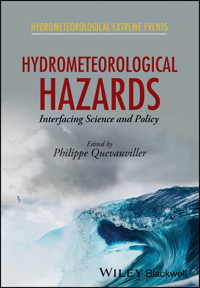
Cover image: Big waves © johnnorth / iStockphoto
1 2015
Series Foreword
The increasing frequency and severity of hydrometeorological extreme events are reported in many studies and surveys, including the 5th IPCC Assessment Report. This report and other sources highlight the increasing probability that these events are partly driven by climate change, while other causes are linked to the increased exposure and vulnerability of societies in exposed areas (which are not only due to climate change but also to mismanagement of risks and “lost memories” about them). Efforts are on-going to enhance today's forecasting, prediction and early warning capabilities in order to improve the assessment of vulnerability and risks and develop adequate prevention, mitigation and preparedness measures.
The Book Series on “Hydrometeorological Extreme Events” has the ambition to gather available knowledge in this area, taking stock of research and policy developments at an international level. While individual publications exist on specific hazards, the proposed series is the first of its kind to propose an enlarged coverage of various extreme events that are generally studied by different (not necessarily interconnected) research teams.
The Series encompasses several volumes dealing with various aspects of hydrometeorological extreme events, primarily discussing science–policy interfacing issues, and developing specific discussions about floods, coastal storms (including storm surges), droughts, resilience and adaptation. While the books are looking at the crisis management cycle as a whole, the focus of the discussions is generally oriented towards the knowledge base of the different events, prevention and preparedness, early warning and improved prediction systems.
The involvement of internationally renowned scientists (from different horizons and disciplines) behind the knowledge base of hydrometeorological events makes this series unique in this respect. The overall series will provide a multidisciplinary description of various scientific and policy features concerning hydrometeorological extreme events, as written by authors from different countries, making it a truly international book series.
The book on ‘Prevention of hydrometeorological extreme events—Interfacing sciences and policies’ is the first book of this Series; it has been written by policy-makers and scientific experts in the field. It offers the reader an overview of EU and international policies, discussions on science–policy interfacing, and a snapshot of the knowledge base of various types of events which are developed in separate volumes of the Series.
Philippe QuevauvillerSeries Editor
Preface
Recent hydrometeorological extreme events (e.g. the Xynthia storm in France, the Liguria flash floods) have highlighted the increased exposure and vulnerability of societies and the need to strengthen the knowledge base of related policies. In particular, research undertakings are constantly enhancing forecasting, prediction and early warning capabilities in order to improve the assessment of vulnerability and risks linked to extreme climatic events, as well as to develop adequate prevention, mitigation and preparedness measures. These concern events such as extreme winds, storm surges, coastal and estuarine floods, taking into consideration the effects of climate change, which are threats faced by many countries in the world. In this respect, international policies and research cooperation are in full development, leading to new knowledge, innovative, cost-effective, technological or non-technological solutions and ecosystem-based approaches, as well as new forms of organisational and institutional/governance.
The book Prevention of Hydrometeorological Extreme Events – Interfacing Sciences and Policies is the first volume of a series which will gather scientific and policy-related knowledge related to climate-related extreme events. Invited authors are internationally recognised experts in their respective fields, who have built up worldwide networks in the framework of EU-funded research programmes. The present volume and the following ones in the series will hence reflect the most recent science and policy advances in the field.
Philippe Quevauviller
The Series Editor – Philippe Quevauviller
Philippe Quevauviller began his research activities in 1983 at the University of Bordeaux I, France, studying lake geochemistry. Between 1984 and 1987 he was Associate Researcher at the Portuguese Environment State Secretary where he performed a multidisciplinary study (sedimentology, geomorphology and geochemistry) of the coastal environment of the Galé coastline and of the Sado Estuary, which was the topic of his PhD degree in Oceanography gained in 1987 (at the University of Bordeaux I). In 1988, he became Associate Researcher in the framework of a contract between the University of Bordeaux I and the Dutch Ministry for Public Works (Rijskwaterstaat), in which he investigated organotin contamination levels of Dutch coastal environments and waterways. From this research work, he gained another PhD in chemistry at the University of Bordeaux I in 1990. From 1989 to 2002, he worked at the European Commission (DG Research) in Brussels where he managed various Research and Technological Development (RTD) projects in the field of quality assurance, analytical method development and pre-normative research for environmental analyses in the framework of the Standards, Measurements and Testing Programme. In 1999, he obtained an HDR (Diplôme d'Habilitation à Diriger des Recherches) in chemistry at the University of Pau, France, from a study of the quality assurance of chemical species' determination in the environment.
In 2002, he left the research world to move to the policy sector at the EC Environment Directorate-General where he developed a new EU Directive on groundwater protection against pollution and chaired European science-policy expert groups on groundwater and chemical monitoring in support of the implementation of the EU Water Framework Directive. He moved back to the EC DG Research in 2008, where he acted as research Programme Officer and managed research projects on climate change impacts on the aquatic environment and on hydrometeorological hazards, while ensuring strong links with policy networks. In April 2013 he moved to another area of work, namely Security Research, at the EC DG Enterprise and Industry where he is research Programming and Policy Officer in the fields of Crisis Management and CBRN.
Besides his EC career, Philippe Quevauviller has remained active in academic and scientific developments. He is Associate Professor at the Free University of Brussels and promoter of Master theses in an international Master on Water Engineering (IUPWARE programme), which is under this function that he is acting as Series Editor of the Hydrometeorological Extreme Events Series for Wiley. He also teaches integrated water management issues and their links to EU water science and policies to Master students of the EurAquae programme at the Polytech'Nice (France).
Philippe Quevauviller has published (as author and coauthor) more than 220 scientific and policy publications in the international literature, 54 book chapters, 80 reports and 6 books and has acted as an editor and co-editor for 26 special issues of scientific journals and 15 books. He also coordinated a book series for Wiley on Water Quality Measurements which resulted in 10 books published between 2000 and 2011.
List of Contributors
Clara Armaroli
Dipartimento di Fisica e Scienze della Terra, Università di Ferrara, Ferrara, Italy
Nina Becker
Department of Economics, Helmholtz Centre for Environmental Research-UFZ, Leipzig, Germany, and Overseas Development Institute, London, UK
Laurens M. Bouwer
Deltares, Delft, The Netherlands
Philip Bubeck
adelphi, Berlin, Germany
Paolo Ciavola
Dipartimento di Fisica e Scienze della Terra, Università di Ferrara, Ferrara, Italy
Hugh Deeming
Engineering & Environment, Northumbria University, Newcastle upon Tyne, UK
Oscar Ferreira
FCT, CIMA, Universidade do Algarve, Faro, Portugal
Maureen Fordham
Engineering & Environment, Northumbria University, Newcastle upon Tyne, UK
Emmanuel Garnier
Institut Universitaire de France, CNRS and University of La Rochelle, France
Luis Garrote
Department of Agricultural Economics and Social Sciences, Technical University of Madrid, Madrid, Spain
Elisabetta Genovese
Centre International de Recherche sur l'Environnement et le Développement (CIRED), Nogent-sur-Marne, France
Philippe Gourbesville
Université Nice Sophia Antipolis, Polytech Nice Sophia, I-CiTy Lab, Nice, France
Colin Green
Flood Hazard Research Centre, Middlesex University, Hendon, UK
Stephane Hallegatte
Centre International de Recherche sur l'Environnement et le Développement (CIRED), Nogent-sur-Marne, France; Ecole Nationale de Météorologie, Toulouse, France, and The World Bank, Sustainable Development Network, Washington, DC, USA
Richard Harding
Centre for Ecology and Hydrology, Wallingford, Oxon, UK
Mitchell Harley
Dipartimento di Fisica e Scienze della Terra, Università di Ferrara, Ferrara, Italy
Ana Iglesias
Department of Agricultural Economics and Social Sciences, Technical University of Madrid, Madrid, Spain
Demetrio Innocenti
University of Antwerp, Institute of Development Policy and Management (IOB), Antwerp, Belgium, and The United Nations Office for Disaster Risk Reduction (UNISDR), Brussels, Belgium
Alison Kay
Centre for Ecology and Hydrology, Wallingford, Oxon, UK
Heidi Kreibich
Helmholtz Centre Potsdam – GFZ, German Research Centre for Geosciences, Potsdam, Germany
Zbigniew W. Kundzewicz
Institute for Agricultural and Forest Environment, Polish Academy of Sciences, Poznan, Poland, and Potsdam Institute for Climate Impact Research, Potsdam, Germany
Quentin Lequeux
Dipartimento di Fisica e Scienze della Terra, Università di Ferrara, Ferrara, Italy
Ivana Logar
Swiss Federal Institute of Aquatic Science and Technology (EAWAG), Dübendorf, Switzerland
Vasileios Markantonis
Faculty of Economics and Business Administration, Chemnitz University of Technology, Chemnitz, Germany
Volker Meyer
Department of Economics, Helmholtz Centre for Environmental Research, Leipzig, Germany
Elissaios Papyrakis
Institute for Environmental Studies, VU University Amsterdam, Amsterdam,
The Netherlands; School of International Development, University of East Anglia, Norwich, UK, and International Institute of Social Studies, Erasmus University Rotterdam, The Netherlands
Clemens Pfurtscheller
Institute of Interdisciplinary Mountain Research, Austrian Academy of Sciences, Innsbruck, Austria
Jennifer Poussin
Institute for Environmental Studies, VU University Amsterdam, Amsterdam, The Netherlands
Valentin Przyluski
Centre International de Recherche sur l'Environnement et le Développement (CIRED), Nogent-sur-Marne, France
Philippe Quevauviller
Department of Hydrology and Hydrological Engineering, Vrije Universiteit Brussels, Brussels, Belgium
Nick Reynard
Centre for Ecology and Hydrology, Wallingford, Oxon, UK
Reimund Schwarze
Department of Economics, Helmholtz Centre for Environmental Research, Leipzig, Germany
Åsa Gerger Swartling
Stockholm Environment Institute, Stockholm, Sweden, and Stockholm Resilience Centre, Stockholm University, Stockholm, Sweden.
Jeroen C.J.M. van den Bergh
ICREA, Barcelona, Spain; Institute of Environmental Science and Technology, Universitat Autònoma de Barcelona, Barcelona, Spain; Faculty of Economics and Business Administration, VU University Amsterdam, The Netherlands, and Institute for Environmental Studies, VU University Amsterdam, Amsterdam, The Netherlands
Annegret H. Thieken
Institute of Earth and Environmental Science, University of Potsdam, Potsdam, Germany
Ap Van Dongeren
Deltares, Delft, The Netherlands
Henny A.J. Van Lanen
Hydrology and Quantitative Water Management Group, Wageningen University, Wageningen, The Netherlands
Jaap Van Thiel de Vries
Faculty of Civil Engineering and Geosciences, University of Delft, Delft,
The Netherlands
Christophe Viavattene
Flood Hazard Research Centre, Middlesex University, Hendon, London, UK
Barbara Zanuttigh
Department of Civil, Chemical, Environmental and Materials Engineering,
University of Bologna, Bologna, Italy
Part OneSetting the Scene
Chapter 1.1
Strengthened Resilience from Historic Experience. European Societies Confronted with Hydrometeors in the Sixteenth to Twentieth Centuries
Emmanuel Garnier
Institut Universitaire de France, CNRS and University of La Rochelle, France
1.1.1 Introduction
In his seminal book published in 1992 on the evolution of society from a society of disasters to a society of risk, the sociologist Ulrich Beck clearly distinguishes between a “pre-modern” society qualified as “traditional”, devoid of industries, and a “modern” society (Beck, 1992). In the first case, risk is non-existent, supplanted as it is by a social conviction: threats of all kinds which result from disasters are both natural and totally unpredictable. Against this traditional collective fatalism, he contrasts industrialized society which would redefine the relations which it maintains with its natural environment according to a relationship of domination (Man) and dominated (Nature). For Beck, by inventing the concept of risk, industrialization finally allowed its definition and quantification thanks to an improvement in instrumentation and to scientific progress. However, the historical reality observed in archives about hydrometeors is particularly enlightening. It indicates that the germs of a “risk”-based mentality can be observed very early on, in a time when societies and states remained nevertheless fundamentally agrarian and traditional. This historical work consequently aims to study the “trajectories of vulnerability” of territories and European societies confronted with two types of hydrometeors: droughts and storm surges.
1.1.2 Five centuries of droughts
The results presented in this section fall within the framework of the EU project FP 7 ‘Fostering European Drought Research and Science-Policy Interfacing’ (project number 282769). This project aims to reduce Europe's future vulnerability to and risk of drought by innovative in-depth studies that combine drought investigations in case study areas in water-stressed regions with drought analysis at the pan-European scale. In this perspective, it grants in particular an important role to the historical approach in helping us to understand better the frequency and severity of the droughts during the last 500 years as well as the reactions of the old societies.
Droughts are a factor of historic durability and, because of their impacts on societies, they left multiple indicators in the archives of the last 500 years. For the record, it is necessary to remind ourselves that the general term of ‘drought’ covers different notions. The most frequent meaning of the word is a rainfall deficit and an extreme climate event.
1.1.2.1 Historic material and methods of evaluation
Because of the unpredictable character and the absence of civil services specially dedicated to the study of these extreme events before the middle of the nineteenth century, historians have to make maximum use of the entire corpus of sources. The information we need is often hidden at random in the margins of some documentation and we cannot afford to neglect any type of archive if we want to hope to reconstruct long and relatively reliable chronologies (Garnier, 2010a).
Lesen Sie weiter in der vollständigen Ausgabe!
Lesen Sie weiter in der vollständigen Ausgabe!
Lesen Sie weiter in der vollständigen Ausgabe!
Lesen Sie weiter in der vollständigen Ausgabe!
Lesen Sie weiter in der vollständigen Ausgabe!
Lesen Sie weiter in der vollständigen Ausgabe!
Lesen Sie weiter in der vollständigen Ausgabe!
Lesen Sie weiter in der vollständigen Ausgabe!
Lesen Sie weiter in der vollständigen Ausgabe!
Lesen Sie weiter in der vollständigen Ausgabe!
Lesen Sie weiter in der vollständigen Ausgabe!
Lesen Sie weiter in der vollständigen Ausgabe!
Lesen Sie weiter in der vollständigen Ausgabe!
Lesen Sie weiter in der vollständigen Ausgabe!
Lesen Sie weiter in der vollständigen Ausgabe!
Lesen Sie weiter in der vollständigen Ausgabe!
Lesen Sie weiter in der vollständigen Ausgabe!
Lesen Sie weiter in der vollständigen Ausgabe!
Lesen Sie weiter in der vollständigen Ausgabe!




