


15,99 €
Mehr erfahren.
- Herausgeber: Riverside Architectural Press
- Kategorie: Wissenschaft und neue Technologien
- Sprache: Englisch
The Hylozoic Soil experimental architecture series developed by architect Philip Beesley and engineer Rob Gorbet has been expanded and refined by researchers, engineers and designe rs from around the world. An interactive geotextile mesh that senses human occupants, Hylozoic Soil transforms a static building into a responsive environment, filling it with a kind of mechanical empathy. The space functions like a giant lung that breathes in and out around its occupants in peristaltic waves of lightweight pores. With contributions by:Will Elsworthy, Rob Gorbet, Jonah Humphrey, Hayley Isaacs, and Christian Joakim. Project selected as Canada's Venice Biennale entry for 2010.
Das E-Book können Sie in Legimi-Apps oder einer beliebigen App lesen, die das folgende Format unterstützen:
Seitenzahl: 181
Veröffentlichungsjahr: 2020
Ähnliche


















Published by Riverside Architectural Presswww.riversidearchitecturalpress.com
Copyright © 2010 Riverside Architectural Press. All rights reserved.Printed and bound in China.First edition
No part of this book may be used or reproduced in any manner without written permission from the publisher, except in the context of reviews.
Every reasonable attempt has been made to identify owners of copyright. Errors or omissions would be corrected in subsequent editions.
Library and Archives Canada Cataloguing in Publication
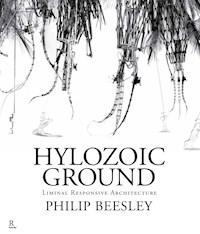
Hylozoic Ground : liminal responsive architecture : Philip Beesley / contributions by Rob Gorbet ... [et al.] ; edited by Pernilla Ohrstedt & Hayley Isaacs.
Includes bibliographical references.
ISBN 978-1-926724-02-7
1 Beesley, Philip, 1956- --Exhibitions. 2 Kinetic sculpture--Canada--Exhibitions. 3 Interactive art--Canada--Exhibitions. 4 Geotextiles--Canada--Exhibitions. 5 Art and architecture--Canada--Exhibitions. 6 Sculpture, Canadian--21st century--Exhibitions.
I. Gorbet, Rob II. Ohrstedt, Pernilla, 1980- III. Isaacs, Hayley, 1980- IV. Beesley, Philip, 1956-
NB1272.H85 2010 735’.230473 C2010-903638-7
Publication Design and Production PBAIArt Director Hayley Isaacs Graphic Designers Eric Bury, Carlos Carrillo Duran, Elie Nehme, Adam Schwartzentruber, Jonathan Tyrrell Copy Editor Robin Paxton
Printing by Regal Printing LimitedThis book is set in Zurich Lt BT and Garamond
Hylozoic Ground, Canada’s entry to the Biennale di Venezia 12th International Architecture Exhibition, is part of a series of collaborative installations that have developed during the past four years. This work extends landscape and gallery installations that began in Rome during 1995. The first of the Hylozoic series was commissioned for the Langlois Foundation’s e-art exhibition at the Montreal Museum of Fine Art in 2007–8. Early versions were installed in 2008–9, at the VIDA 11.0 festival in Madrid, and at Ars Electronica’s Museum of the Future in Linz. An expanded version employing modular meshwork elements and suspended lower filter strata was developed for SIGGRAPH 2009 in New Orleans, and was subsequently mounted at Medialab Enschede in the fall of 2009. Preliminary portions of the 2010 Venice Biennale installation were installed earlier this year at Recto-Verso’s Meduse facility in Quebec City, and at the Laboratorio Arte Alameda for the Festival de Mexico, Mexico City.
The project documented within this book was developed with research colleagues from Toronto, Waterloo, London, and Odense, supported by volunteer teams mounting work in Mexico City, Quebec City, Enschede, New Orleans, Madrid, Linz, and Montreal. The work is developed by a collective of designers, engineers, and contributors associated with the School of Architecture and the Faculty of Engineering at the University of Waterloo, and is manufactured by digital fabrication within the PBAI studio.
Key individuals include associates Hayley Isaacs, Eric Bury, and Jonathan Tyrrell, principal collaborator Rob Gorbet and the Waterloo-based Gorbet lab, and experimental designer Rachel Armstrong. The team for the Venice Hylozoic Ground project includes production director Pernilla Ohrstedt, promotion team Poet Farrell and Sascha Hastings, designers Carlos Carillo Duran, Federica Pianta, Carlo-Luigi Pasini, and Adam Schwartzentruber, and engineers Brandon DeHart and Andre Hladio. Over 1500 students and professionals have taken part in the conception and assembly of the Hylozoic series.
Profound thanks are due to Hayley Isaacs, Pernilla Ohrstedt, and the members of the PBAI studio for their primary roles in creating and shaping this book. This book has been enriched by the texts of collaborators Rob Gorbet and Rachel Armstrong, writings by Michelle Addington, Geoff Manaugh, Detlef Mertins, Neil Spiller, and Cary Wolfe and photography by Pierre Charron. Will Elsworthy, Jonah Humphrey, and Christian Joakim’s detailed texts reflect their direct roles within early generations of the design work. Meticulous copy editing was contributed by Robin Paxton-Beesley.
The support of the Canada Council for the Arts, Royal Architecture Institute of Canada and RAIC Foundation, National Gallery of Canada, and University of Waterloo, as well as that of numerous agencies and funding partners, is gratefully acknowledged. Deepest appreciation is extended to the generous individual, institutional, corporate, and public supporters who have made this work possible.
The lives and personal histories of my beloved partner Anne Ogilvie Paxton, my children Robin, Alex, Tommy, Olivia, and Michael, my parents Birgitt Traute Popper Beesley and Pierre Michel Beesley, are intertwined in this work.
This book is dedicated to Dr. Thomas Seebohm.
Philip Beesley
Cambridge, Toronto, and Venice, 2010
In presenting Hylozoic Ground at la Biennale di Venezia 12th International Architecture Exhibition Canadian architecture shows itself to be at the limits of the field—exploring the boundaries between environment, building, technology, and human experience. The roots of the work lie in Professor Beesley’s research during his Prix de Rome fellowship. The University of Waterloo’s Rome Program has provided fundamental support for the evolution of this work. The Hylozoic Ground project is deeply rooted in the Italian soil, and presents rich evidence that the architecture of Rome and Italy continue to offer inspiration and renewal to contemporary architecture. By questioning what the nature of architecture could be, Hylozoic Ground proposes vivid possibilities for a renewed responsive relationship between humanity and the built environment.
Eric Haldenby
O’Donovan Director, School of Architecture, University of Waterloo
Philip Beesley’s interactive installations—part creatures, part environments; part mechanical, part biological—remind us that the cosmological point of reference for architecture has shifted from the human to the non-human: from the Vitruvian man, inscribed in a circle and a square as the guarantor of universal validity, to the tangled web of creatures and environments within which humanity lives a promiscuous life. Following Leon Battista Alberti’s counsel that architects emulate nature’s methods of construction and production of unity, the ‘organic’ became an unattainable ideal that drove restless invention.
While beauty was typically the hallmark of this classically conceived nature, its myriad others—the picturesque, sublime, grotesque, and ugly—attended the various Gothic revivals. Art Nouveau, and even more so its German counterpart Jugendstil, often ventured into terrifying territories beyond rationality, sending the observer into the fluid spaces of the unconscious, ominous emotions and deep yearnings—above all the yearning for re-integration into the primal soup of creation. Yet it is precisely this yearning, Beesley’s constructions remind us, that is the most problematic.
In an age when genetic engineering works invisibly to the human eye, Beesley’s Hylozoic Ground is emphatically constructed and, in fact, anachronistic in its reliance on mechanical technologies of assembly that the early twentieth century had already sought to supersede with the then-new science of bionics. The appearance of the mechanical here, in structures that move (sometimes fitfully) and nervous systems that breathe (sometimes convulsively) should remind us, not of the supposed authority of biomorphic forms, but rather of nature’s inclusiveness. For humanity never was divorced from nature, nor were any of its creations. We must, finally, learn to think without this opposition, recognizing that, warts and all, we have always been part of nature. The technologies of life being developed today offer no more guarantee of value than those of old. Beesley’s architecture leads us to recognize the organic/non-organic opposition as a version of ‘good versus bad,’ and invites us to explore other, more dexterous and effective terms of judgment.
Detlef Mertins
Professor of Architecture, University of Pennsylvania
PHILIP BEESLEY
IntroductionLiminal Responsive Architecture
GEOFF MANAUGH
Synthetic GeologyLandscape Remediation in an Age of Benign Geotextiles
NEIL SPILLER
Liberating the Infinite Architectural Substance
CARY WOLFE
Queasy PosthumanismHylozoic Ground
MICHELLE ADDINGTON
Architecture of Contingency
JONAH HUMPHREY
Integrated SystemsThe Breathing Cycle
CHRISTIAN JOAKIM
Topology and GeometryThe Hylozoic Mesh
WILLIAM ELSWORTHY
Component Design and Actuated DevicesAn Evolutionary Process
ROB GORBET
Revealing the Hylozoic Ground Interaction Layer
RACHEL ARMSTRONG
Hylozoic Soil Chemistries & Unanswered Questions In the Origin of Life
Hylozoic SeriesComponent Detail Plates
AfterwordImmanence and Empathy
Hylozoic Series Chronology2007-2010
Image Credits
Biographies
Funding and Sponsors
IntroductionLiminal Responsive Architecture
PHILIP BEESLEY
Words and tones, since they can hurt, are no doubt made of material stuff”
Titus Lucretius Carus, De Rerum Natura
When Lucretius watched motes of dust quivering and darting within the sunbeams of his Roman window, he saw atoms play. Rivers of motion took the particles in laminar flows, bringing degrees of certainty into the sight of barely tangible things. Darting and wavering, the dust spoke of decay and loss; possibility; specious circumstance in flux: corrupted, damaged, and dying swerves. And a vague, shaded shift of life arising too—the rising semiquaver of living seeds. This quickening leads into the earth.
The Hylozoic project seeks abject fertility. In the footsteps of Lucretius, it imagines new layers of hylozoic soil. Hylozoism is the ancient perception of life arising out of material. Lucretius followed earlier, Grecian thinkers in seeing life arising from the chaos-borne quickening of air, water, and stone.
Hylozoic Ground is an immersive, interactive sculpture environment organized as a textile matrix supporting responsive actions, dynamic material exchanges, and ‘living’ technologies—conceived as the first stages of self-renewing functions that might take root within this architecture. The Hylozoic Ground environment can be described as a suspended geotextile,2 gradually accumulating hybrid soil from ingredients drawn from its surroundings.
Akin to the functions of a living system, embedded machine intelligence allows human interaction to trigger breathing, caressing, and swallowing motions and hybrid metabolic exchanges.3 These empathic motions ripple out from hives of kinetic valves and pores in peristaltic waves, creating a diffuse pumping that pulls air, moisture, and stray organic matter through the filtering Hylozoic membranes.
A distributed array of proximity sensors activates these primitive responsive devices, stirring the air in thickened areas of the matrix. Dense groves of frond-like ‘breathing’ pores, tongues, and thickets of twitching whiskers are organized in spiralling rows that curl in and around its mesh surfaces. A trickling water source connects the matrix to the Venice lagoon.
The structural core of the Hylozoic environment is a flexible meshwork skeleton of transparent, lily-shaped ribbed vaults and basket-like columns. The meshwork stretches and billows, creating a hyperbolic grid-shell topology that surrounds occupants in the space. It is assembled from small acrylic chevron-shaped tiles that clip together to form a pleated diagrid textile structure. Columnar elements extend out from this membrane, reaching upward and downward to create tapered suspension and mounting points. Tension rods support the scaffold with toothed clamps that bite into the ceiling and floor surfaces.
Pure, distilled spheres and pyramids from Plato’s cosmology might hover as ghosts that inform this environment, but that family of reductive crystal forms does not govern. Far from transcendent perfection, the formwork that organizes the space boils out of local circumstance. As with the fabric that emerges from the steady cadence of knitting or crocheting, the chevron links are combined in repeating rows, and their numbers tend to drift and bifurcate. Adding links within linked rows crowds the surface, producing warped and reticulated surfaces that expand outwards in three dimensions.
Similarly, the linking systems that form scaffolds for the filtering systems use a tessellated geometry of self-healing hexagonal and rhombic arrays that readily accommodate tears and breaks within their fabrics. In opposition to design principles of the past century that favoured optimal equations where maximum volume might be enclosed by the minimum possible surface, the structures in Hylozoic Ground prefer diffuse, deeply reticulated skins.5 These forms turn away from the minimum surface exposures of pure spheres and cubes as they seek to increase their exposure and interchange with the atmosphere.6
Although the surface topologies of these forms are generous, their material consumption is reduced to a minimum by employing form-finding design methods, textile systems, and tensile forces. Strategies include the use of thin tensile component arrays with floating compression elements within interlinked fields of tension fibres. Three-dimensional forms are derived from thin, two-dimensional sheets of material, organized in nested tessellations to nearly eliminate waste during digital fabrication. In pursuit of resonant, vulnerable physical presence, components use materials stretched near to the point of individual collapse. The space formed from these materials expands a thousand-fold, filling the volume of the containing building.7
The responsive devices fitted into the expanded Hylozoic topology function similarly to pores and hair follicles within the epithelial skin layers of an organism. Breathing pores are composed of thin sheets shaped into outward-branching serrated membranes, each containing flexible acrylic tongue stiffeners fitted with monofilament tendons. The tendons pull along the surface of each tongue, producing upward curling motions that sweep through the surrounding air. Sensor lashes, carried by the lower tips of meshwork columns, are cousins of the breathing pore. These are fitted with a fleshy latex membrane and offer cupping, pulling motions.
A further kind of swallowing actuator is fitted inside the meshwork columns. Its chained air muscles are organized in a segmented radial system to produce expanding and contracting movements, causing convulsive waves in their surrounding halo of hooked whiskers, while at the same time delivering an incremental siphoning transport of lagoon water within their cores. Wound-wire pendant whiskers are supported by acrylic outriggers with rotating bearings. Tensile mounts for these tendrils encourage cascades of rippling and spinning movements that amplify swelling waves of motion within the mesh structure.
Dozens of sensors that detect the presence of visitors through changes in space, light, and touch are spread throughout the Hylozoic environment. They function like the space-reading sonar employed by dolphins and bats and feed impulses into an embedded network of microcontrollers, working in concert with and guiding device movements.
Interactive processing is based on the open-source Arduino microcontroller system. This palm-sized board can read sensors, make simple decisions, and control devices. The boards used in Hylozoic Ground carry extensions that provide communication, power outputs, and mode switches, together supporting the emergence of different behaviours. Levels of behaviour organized by local clusters, neighbourhood groups, and global systems are programmed into the sculpture in order to encourage coordinated spatial behaviour. Each processor produces its own response to local sensor activity and listens for messages from neighbours. Background behaviours akin to pre-conscious muscular reflexes are produced in the environment using these encoded responses. Controllers hold information about sensor activity from individual boards and catalyze ‘global’ behaviour with this information.
Alongside mechanized component systems, a wet system has been introduced into the environment, with bladder clusters surrounded by thickened vapours. The system supports simple chemical exchanges that share some of the properties of life-giving blood in living organisms. Thousands of primitive glands containing synthetic digestive liquids and salts are clustered throughout the system, located at the base of each breathing pore and within suspended colonies of whiskers and trapping burrs. The salt derivatives serve a hygroscopic function, pulling fluids out of the surrounding environment.
The adaptive chemistries within the wet system capture traces of carbon from the vaporous surroundings and build delicate structural scaffolds. Engineered protocells and chells—liquid-supported artificial cells that share some of the characteristics of natural living cells—are arranged in a series of embedded incubator flasks. Bursts of light and vibration, created by the responses of visitors standing within the work, influence the growth of the protocells, catalyzing the formation of vesicles and inducing secondary deposits of benign materials. Sensors monitor the health of the growing flasks and give feedback that governs the behaviour of the interactive system surrounding the viewer. The flux of viscous, humid atmospheres creates a hybrid expanded protoplasm with constantly changing boundaries.
soil and protoplasm
Can soil be constructed? Work in previous decades began in this pursuit of the chthonian, the deep underground. The recent geotextile forms that prevail in Hylozoic Ground extend this pursuit, making synthetic earth.
Design paradigms for shelter built upon the solid, eternal ground of a Canadian wilderness render the task for architecture relatively simple.10 Springing from foundations secured by the cardinal powers of the earth, one of the primary tasks of a building envelope might be rendering the outer world as vividly as possible, consuming the environment and serving my outward-seeking gaze in acute encounter. A functional definition of this architecture could describe building envelopes as filters that enclose human bodies and draw the environment inward and outward, sheltering the interior and amplifying the experience of the surrounding world.
The great extinction that occupies current human culture has swept away celebration of such transcendent, eternal qualities.11 If I stand on the floating piers of the Venice lagoon, amidst a withering biosphere, my posture shifts. The ground is yawning, viscous, inducing queasy vertigo. My legs unconsciously tense themselves, reptile brain–inflected posture tensed by the elastic meniscus underfoot. The shift of my own posture inverts a confident gaze, sending it outward. The enclosing function of architecture shifts from consuming the surroundings. A renewed task appears: constructing synthetic ground.
Geotextile systems seen in installations such as Haystack Veil at Deer Isle, 1997, and Erratics Net, Peggy’s Cove, 1998, pursued methodical expansion of landscape surfaces, building hybrid layers of artificial soil.12 Earlier built projects, such as contributions to A. J. Diamond and Donald Schmitt’s York University Student Centre,13 also speak of nascent versions of this synthesis, folding and layering relatively thin planes of material, constructing hybrid depth. Recent buildings such as the Niagara Credit Union in Virgil, Ontario, and interior layers at the French River Visitor Centre14 show a movement towards increasingly porous open space. In those buildings, hovering latticeworks of interlinking timber vaulting and dense constellations of material components offer expanded boundaries. Most recently, contributions to the North House project15 include design of filtering active shades which work in distributed arrays. These design systems provide an expanded physiology akin to the layered envelopes created by nightdresses and bedclothes surrounding a sleeping body.
What ground, what soil, might support involved dwelling? Within Hylozoic Ground in Venice there lies a diffuse matrix, riddled with the ground. If, quickened by the humid Venetian microclimate and organic atmospheres blooming around human occupation, the vesicles and primitive glands crowding the Hylozoic Ground surface spoke, they might call and lure, voicing abject hunger. This matrix offers a map of a dissociated body moving to and fro across junctures of conception, disarticulating. This soil is pulling. Its environment seeks human presence as elemental food.
journal
The journal entries that follow correspond to various stages of development of the Hylozoic series. They loop in a series of wide aerial paths, tangent to Venice. The notes seek an orienting lexicon for the practical craft of working with protoplasmic space. These visualizations navigate weather-like formations of the atmosphere, layers of earth before condensation. The entries offer common threads that form a language rooted in generative formation and dissipation—a flux of dissemblance and figuration.16
The constructed fertility of the Hylozoic series claims material lying within the dark layers of soil that cloak the world, coming before the light-filled events of measured geography, and again before boundaries coalesced into smooth-skinned spheres of bounded territory. Interlinking pools of vortices play within Pacific and Atlantic currents, forming surging necklaces that encircle the granite-bound landscape of the Canadian shield. The spiral pools are scored by glacial ice that cleared febrile soils, and even the salt-encrusted limestones that traced earlier lives in the Cambrian explosion. Barred, wrinkled hazes of cumulus and nimbus clouds hover in diffuse octaves that echo this liquid skin. Starved of metered focus, tinges of delirium blur these sightings. Pathways stretch through ripples, coalescing into bundled, gaseous rivers. I grasp faintly quivering traces, flame-licking tendrils projecting within the diffuse, slipping currents. What patterns am I printing within this field?
melt
Homogenous silence, marked by blurs and flecks. The dimension so vast as to measure time: an aeon of girth. Elephant-skin wrinkles, emerging from the smoothly ruffled surface of the massive depth of ice. At the edge, soaking in a million pits, the mass opening, revealing pitted subcutane, and then felted, porous liquid tendrils. At the edge, catastrophes: frozen tumbling fragments, continuous collapse. A minor sea collects in a shallow; accordioned shards of the sheet above, intermixing anew. Then failing: the phase yields into river. Cascade: infinitesimally slow torrent, rime of shards above the fresh water discharging to the ocean.
This is a landmass in reverse: not the fundament eroded by the shore, but a proto-ocean above as an upper land, turning like a sun into the open water outside. The land here seems like residue, effluent incident of the melt. Ocean salt receives the freshwater: bright fissures of current, overlapping arcs of wrinkled pressures from the tide slowly pulsing toward the land in counter-current to the melting. Then the sea begins, homogenous: a miasma of swells, fissured by the transverse wind and second transverse of rebounding coastal current. Cumulus drifts hover above, clustering into a stratum that stands offshore, making a counter-coast, long dissolved fingers casting shadow on the rippled water.
A new shore: a vast floating edge ends, revealing the preceding world as a tableau. Trailing carcasses of thinning haze stream downward and stretch off into entrails. A plunging gorge, edged by lapping swells that converge, and marrow to heal the foot, bleeding into lower depths. This catastrophe is quickly cloaked by upper haze, engulfing me. Except for a string of plumes that orient me wide to my left, the field shifts to a single, hovering sphere reaching the pure horizon, sky against stratosphere, pronouncing the lensing flux of light at its furthest spherical tangent. Almost nothing, a suspension that plays me by deflection. That parsimony is stretched toward primal vagueness. Not lost, but delayed past recognition. Corrosion cloaked as leavened temperance: the quietest death.
Like finger-print wrinkles, clumping in repeated rolls, barrel-vault wrinkle oriented in a single meandering spread that shifts every few diameters, then reasserts itself. Cutting across, a twill chevron of cross-wrinkles searing across the whole, a ridge that grows in height, reverse fissures, becoming more turbulent as it merges, then collapsing upward into cumulus bursts with entrail-quilted spicules and hydra-vortices shedding beside and behind. This thermal plumage is tiny, not the thunderhead I already know but instead tufts, follicles. Where is the next? Just ahead, one valley’s length and then another. And another—skipping-stones’ lengths, decelerating.
landfall
Similar wrinkles, but sharper and with tighter folds—like tulle or gauze, compared to the canvas lower down. Tufts here only singular, but marked by great outward swaths of rebound and counter-current that furrow the surface. Nipple and navel arrays, but then the reverse—ahead, a pitted skin with sinks and gentle whirlpool creases converging around, upholstered. Pigskin and orange peel alternating.




