


67,99 €
Mehr erfahren.
- Herausgeber: John Wiley & Sons
- Kategorie: Wissenschaft und neue Technologien
- Sprache: Englisch
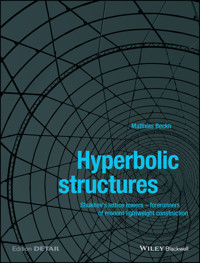
Hyperbolic structures analyses the interactions of form with the structural behaviour of hyperbolic lattice towers, and the effects of the various influencing factors were determined with the help of parametric studies and load capacity analyses. This evaluation of Shukhov’s historical calculations and the reconstruction of the design and development process of his water towers shows why the Russian engineer is considered not only a pathfinder for lightweight structures but also a pioneer of parametrised design processes.
Sie lesen das E-Book in den Legimi-Apps auf:
Seitenzahl: 265
Veröffentlichungsjahr: 2014
Ähnliche




















CONTENTS
Cover
Title page
Copyright page
Foreword
Introduction
Current state of research
Overview
Building with hyperbolic lattice structures
The development of building with iron in the 19th century
The work of Vladimir G. Shukhov, pioneer of lightweight construction
The hyperbolic lattice towers of Vladimir G. Shukhov
Hyperbolic structures after Shukhov
Geometry and form of hyperbolic lattice structures
Principles and classification
Geometry of hyperbolic lattice structures
Structural analysis and calculation methods
The problem of inextensional bending
Principal structural behaviour
Theoretical principles for determining ultimate load capacity
Parametric studies on differently meshed hyperboloids
Principles of the parametric studies
Relationships between form and structural behaviour
Comparison of circular cylindrical shells and hyperboloids of rotation
Mesh variant 1: Intermediate rings at intersection points
Mesh variant 2: Construction used by Vladimir G. Shukhov
Mesh variant 3: Discretisation as reticulated shells
Summary and comparison of the results
Structural analysis of selected towers built by Vladimir G. Shukhov
Design and analysis of Shukhov’s towers
The development of steel water tanks and water towers
The water towers of Vladimir G. Shukhov
Development of structural analysis and engineering design methods in the 19th century
Calculations for Vladimir G. Shukhov’s lattice towers
Evaluation of the historical calculations
The design process adopted by Vladimir G. Shukhov
NiGRES tower on the Oka
Telescopic construction method
Geometry of the sections
Structural arrangement
Results of new calculations
Summary
Résumé
Towers in comparison
Nizhny Novgorod (RUS) 1896
Lysychansk (UA) 1896
Moscow Simonov (RUS) 1899
Tsaritsyn (RUS) 1899
Kolomna (RUS) 1902
Yefremov (RUS) 1902
Yaroslavl (RUS) 1904
Mykolaiv (UA) 1907
Tyumen (RUS) 1908
Andijan (UZ) 1909
Sagiri (AZ) 1912
Kharkiv (UA) 1912
Samarkand (UZ) 1913
Pryluky (UA) 1914
Voronezh (RUS) 1915
Kazalinsk (RUS) 1915
Tambov (RUS) 1915
Dnipropetrovsk (UA) 1930
Notes
Literature
Picture credits
About the author
Notation
Index
Acknowledgement
End User License Agreement
List of Illustrations
Foreword
1 Shabolovka radio tower, blueprint of the first (unbuilt) design with a height of 350 m, 1919
Introduction
2 Looking up inside the NiGRES tower on the Oka, Dzerzhinsk (RUS) 1929
Building with hyperbolic lattice structures
1 Crystal Palace, London (GB) 1851, Joseph Paxton, interior view from “The Crystal Palace Exhibition Illustrated Catalogue”, London 1851
2 Galerie de Machines, Paris (F) 1889, Charles Louis Ferdinand Dutert, Victor Contamin
3 Schematic section (a) and interior photograph (b) of the arcade roofs of the GUM department store, Moscow (RUS) design from 1890
4 Gridshell mesh roof over a pump station, Grozny (RUS) ca. 1890
5 3D visualisation of the doubly curved gridshell, Vyksa (RUS) 1897
6 Doubly curved glass roof of the British Museum, an example of a modern reticulated shell, London (GB) 2000, Foster and Partners
Lesen Sie weiter in der vollständigen Ausgabe!
Lesen Sie weiter in der vollständigen Ausgabe!
Lesen Sie weiter in der vollständigen Ausgabe!
Lesen Sie weiter in der vollständigen Ausgabe!
Lesen Sie weiter in der vollständigen Ausgabe!
Lesen Sie weiter in der vollständigen Ausgabe!
Lesen Sie weiter in der vollständigen Ausgabe!
Lesen Sie weiter in der vollständigen Ausgabe!
Lesen Sie weiter in der vollständigen Ausgabe!
Lesen Sie weiter in der vollständigen Ausgabe!
Lesen Sie weiter in der vollständigen Ausgabe!
Lesen Sie weiter in der vollständigen Ausgabe!
Lesen Sie weiter in der vollständigen Ausgabe!
Lesen Sie weiter in der vollständigen Ausgabe!
Lesen Sie weiter in der vollständigen Ausgabe!
Lesen Sie weiter in der vollständigen Ausgabe!
Lesen Sie weiter in der vollständigen Ausgabe!
Lesen Sie weiter in der vollständigen Ausgabe!
Lesen Sie weiter in der vollständigen Ausgabe!
Lesen Sie weiter in der vollständigen Ausgabe!
Lesen Sie weiter in der vollständigen Ausgabe!
Lesen Sie weiter in der vollständigen Ausgabe!
Lesen Sie weiter in der vollständigen Ausgabe!
Lesen Sie weiter in der vollständigen Ausgabe!




