


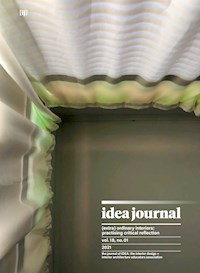
idea journal: (extra) ordinary interiors: practising critical reflection E-Book
Erhalten Sie Zugang zu diesem und mehr als 300000 Büchern ab EUR 5,99 monatlich.
- Herausgeber: Spurbuchverlag
- Kategorie: Geisteswissenschaft
- Serie: idea journal
- Sprache: Englisch
(Extra) Ordinary Interiors features research articles and visual essays by academics, research students and practitioners that demonstrate contemporary modes of criticality and reflection on specific interior environments in ways that expand upon that which is ordinary (of the everyday, common, banal, or taken for granted).
Sie lesen das E-Book in den Legimi-Apps auf:
Seitenzahl: 311
Veröffentlichungsjahr: 2021
Das E-Book (TTS) können Sie hören im Abo „Legimi Premium” in Legimi-Apps auf:
Ähnliche




















vol. 18, no. 012021
(extra)ordinary interiors
01
(extra) ordinary interiors:practising critical reflection
vol. 18, no. 01
2021
the journal of IDEA: the interior design + interior architecture educators association
idea journal
vol. 18, no. 012021
(extra)ordinary interiors
02
idea journal
(extra) ordinary interiors:practising critical reflection
vol. 18, no. 01
2021
the journal of IDEA: the interior design + interior architecture educators association
vol. 18, no. 012021
(extra)ordinary interiors
03
about
IDEA (Interior Design/Interior Architecture Educators Association) was formed in 1996 for the advancement and advocacy of education by encouraging and supporting excellence in interior design/interior architecture education and research within Australasia.
www.idea-edu.com
The objectives of IDEA are:
1. Objects
3.1 The general object of IDEA is the advancement of education by:
(a) encouraging and supporting excellence in interior design/interior architecture/spatial design education and research globally and with specific focus on Oceania; and
(b) being an authority on, and advocate for, interior design/interior architecture/spatial design education and research.
3.2 The specific objects of IDEA are:
(a) to be an advocate for undergraduate and postgraduate programs at a minimum of AQF7 or equivalent education in interior design/interior architecture/spatial design;
(b) to support the rich diversity of individual programs within the higher education sector;
(c) to create collaboration between programs in the higher education sector;
(d) to foster an attitude of lifelong learning;
(e) to encourage staff and student exchange between programs;
(f) to provide recognition for excellence in the advancement of interior design/interior architecture/spatial design education; and
(g to foster, publish and disseminate peer reviewed interior design/interior architecture/spatial design research.
membership
Institutional Members:
Membership is open to programs at higher education institutions in Australasia that can demonstrate an on-going commitment to the objectives of IDEA.
Current members:
AUT University, AucklandCurtin University, PerthMassey University, WellingtonMonash University, MelbourneQueensland University of Technology, BrisbaneRMIT University, MelbourneUniversity of New South Wales, SydneyUniversity of South Australia, AdelaideUniversity of Tasmania, Launceston and Hobart University of Technology Sydney, SydneyVictoria University, Wellington
Affiliate Members:
Affiliate membership is open to programs at higher education institutions in Australasia that do not currently qualify for institutional membership but support the objectives of IDEA. Affiliate members are non-voting members of IDEA.
Associate Members:
Associate membership is open to any person who supports the objectives of IDEA. Associate members are non-voting members of IDEA.
Honorary Associate Members:
In recognition of their significant contribution as an initiator of IDEA, a former chair and/or executive editor: Suzie Attiwill, Rachel Carley, Lynn Chalmers, Lynn Churchill, Jill Franz, Roger Kemp, Tim Laurence, Gini Lee, Marina Lommerse, Gill Matthewson, Dianne Smith, Harry Stephens, George Verghese, Andrew Wallace and Bruce Watson.
vol. 18, no. 012021
(extra)ordinary interiors
04
publishing
© Copyright 2021 IDEA (Interior Design/Interior Architecture Educators Association) and AADR (Spurbuchverlag) and authors.
All rights reserved.
No part of the work must in any mode (print, photocopy, microfilm, CD or any other process) be reproduced nor – by application of electronic systems – processed, manifolded nor broadcast without approval of the copyright holders.ISSN 2208-9217eISBN 978-3-88778-918-3
Published by Art Architecture Design Research (AADR): aadr.info. AADR publishes research with an emphasis on the relationship between critical theory and creative practice. AADR Curatorial Editor: Dr Rochus Urban Hinkel, Melbourne.
IDEA (Interior Design/Interior Architecture Educators Association)ACN 135 337 236; ABN 56 135 337 236
Registered at the National Library of Australia
idea journal is published by AADR and is distributed through common ebook platforms. Selected articles are available online as open source at time of publication, and the whole issue is made open access on the idea journalwebsite one year after its date of publication.
idea journal editorial board
Dr Julieanna Preston, Executive Editor, Professor of Spatial Practice, Massey University, Wellington, New Zealand
Dr Anthony Fryatt, Program Manager, Bachelor of Interior Design (Hons), RMIT University, Melbourne, Australia
Dr Susan Hedges, Senior Lecturer, Spatial Design, School of Art and Design, Auckland University of Technology, Auckland, New Zealand
Dr Antony Pelosi, Senior Lecturer, Interior Architecture, Victoria University of Wellington, New Zealand
Luke Tipene, Lecturer, School of Architecture, University of Technology Sydney, Sydney, Australia
external advisory panel
Dr Lilian Chee, SDE, National University of Singapore, Singapore
Dr Helene Furjan, Westphal College of Design, Drexel University, Philadelphia, Pennsylvania, USA
Professor Laurent Gutierrez, School of Design, The Hong Kong Polytechnic University, Hong Kong
cover image
Lying motionless, listless. Consuming time; being present, each moment folds into another. Surfaces becoming expanses of inflections of hue. Normality expands into a stream of observing luminosity. Still image from video by Chora Carleton, 2021.
online publication editor
Dr Antony Pelosi, Senior Lecturer, Interior Architecture, Victoria University of Wellington, New Zealand
copy editor
Dr Christina Houen, Perfect Words Editing
design + production
Jo Bailey, School of Design, Massey University, Wellington, New Zealand
correspondence
Correspondence regarding this publication should be addressed to:
Dr Lynn Churchillc/oidea journalInterior ArchitectureCurtin UniversityGPO Box U1987Perth 6845Western Australia
vol. 18, no. 012021
(extra)ordinary interiors
05
this issue’s provocation
(Extra) Ordinary Interiors calls for contributions from academics, research students and practitioners that demonstrate contemporary modes of criticality and reflection on specific interior environments in ways that expand upon that which is ordinary (of the everyday, common, banal, or taken for granted).
This theme has two agendas: First, the desire to amplify critical reflection as a key practice of the disciplines associated with this journal’s readership. In short, to prompt interior designers, interior architects, and spatial designers to be more proactive and experimental in asserting their specialist knowledge and expertise as critical commentary. This asks authors to reconsider the role of critique and criticism in their scholarly and creative works, or, to demonstrate how to reflect critically upon a design and to locate the design’s relation to material, political, social, cultural, historical and geographical concerns. Such an enterprise may reveal whether models of criticality centred on judgement, authority and historicism are relevant, constructive, insightful or generative, or, as Bruno Latour poses, have they ‘run out of steam’? 01This exercise may prompt some to revisit key thinkers who pose new discursive, visual and temporal models for critical practice in this recent age of criticality. We draw your attention to Critical Spatial Practice by Nikolaus Hirsch and Markus Miessen, which asks for thinking “about ‘space’ without necessarily intervening in it physically, but trying to sensitise, promote, develop and foster an attitude towards contemporary spatial production, its triggers, driving forces, effects and affects… [to] speculate on the modalities of production and potential benefits of the role of ‘the outsider.’”02
We also look to Jane Rendell’s introduction to Critical Architecture, which asserts that criticism and design are linked together by virtue of their shared interests in invoking social change.03Whether it takes written, built or speculative form, criticism is an action, which according to Roland Barthes, is a calling into crisis, a moment where existing definitions, disciplinary boundaries and assumptions about normativity are put into question.04
The second agenda of this journal issue takes heed of the ordinary, and how, in its intense observation, what is normal or often taken for granted exceeds itself, becomes extra or more ordinary. Everyday spaces such supermarkets, service stations, laundry mats, hardware stores, parks and four-way street intersections, and banal gestures such as washing the dishes, walking the dog or street sweeping become subject to critical scrutiny and introspection. Xavier de Maistre’s Voyage Around My Room, Julio Cortázar’s Around the Day in Eighty Worlds, and Virginia Woolf’s The Wavesare but a few historic examples that draw out critical depth and aesthetic meaning about ordinary interiors, interiors understood in the most liberal sense.05What new actions to the crisis of critical commentary lurk restlessly in ordinary interiors?
While a nostalgic or romantic response to this journal’s theme may dwell on interior situations with no special or distinctive features, or explore the persistence and abundance of ordinary interiors, even commonplace spaces, noticed or not, it can not be denied that recent pandemic events world-wide have flung the many facets of everyday life into crisis, including long-standing notions of proximity, intimacy, hapticity, privacy, freedom and rights to access ‘essential’ services. For many, the world has become home and home has become an internal world, an interior contaminated or augmented by virtual technologies serving as lifelines to a previous highly social and diversified lifestyle. As the interior of one’s domestic space finds coincidence with one’s isolation bubble, many are finding that interiority and interiors are conflating to take on new meaning, new function, and new configuration. Ordinary scenes of dead flies on windowsills, sun rays pointing to poor house-keeping habits, mounting bags of uncollected rubbish and recycling, shuffling of mattresses, improvised work surfaces, revised chores rubrics, commandeering of the bathroom, and the commodity of headphones and adapters highlight an intensified condition.
Authors are prompted to practice a form of critical reflection on one (extra) ordinary interior.
reviewers for this issue
Charles Anderson, RMITJen Archer-Martin, Massey UniversityMary Ann Beecher, Ohio State UniversityVincent Caranchini, Northern Arizona UniversityRachel Carley, AUTTania Chumaira, Aalto UniversityElly Clarke, Goldsmiths, University of LondonMaria Costantino, University Arts LondonMig Dann, RMITEmma Filippides, Veldwerk ArchitectenJill Franz, QUTAnthony Fryatt, RMITSue Gallagher, AUTKate Geck, RMITSusan Hedges, AUTEd Hollis, University of EdinburghAymen Kassem, Lebanese UniversityCathryn Klasto, University of GothenburgLiz Lambrou, RMITBelinda Mitchell, University of PortsmouthEmily O’Hara, AUTRemco Roes, Hasselt UniversityIgor Siddiqui, University of TexasLindsay Tan, Auburn UniversityNooroa Tapuni, AUTTaneshia West, Auburn UniversityJiangmei Wu, Indiana University
01 Bruno Latour. ‘Why Has Critique Run Out of Steam? From Matters of Fact to Matters of Concern,’ In Critical Inquiry - Special issue on the Future of Critique30, no. 2 (2004): 25-248.
02 Nikolaus Hirsch and Markus Miessen, ‘Architecture and Critical Spatial Practice,’ 1 May 2020, criticalspatialpractice.org.
03 Jane Rendell, Jonathan Hill, Murray Fraser and Mark Dorrian (Eds), Critical Architecture(Oxon UK, USA and Canada: Routledge, 2007), 4.
04 Roland Barthes, Criticism and Truth, translated and edited by Katrine Pilcher Keuneman (London and New York: The Althone Press, 1966).
05 Xavier de Maistre, Voyage Around My Room, translated by Stephen Sartarelli (New York: New Directions Publishing Corporation, 1994); Julio Cortázar, Around the Day in Eighty Worlds, translated by Thomas Christensen (San Francisco: North Point Press 1986); Virginia Woolf, The Waves [1931] (California: Harvest Books, 1978).
vol. 18, no. 012021
(extra)ordinary interiors
06
in this issue
07 introduction: extra’s ordinary interiors
Luke Tipene
Julieanna Preston
13 closed down clubs
Fiona Connor
26 occupying merzbau: the critic, her words and the work
Tordis Berstrand
49 lovers in an upstairs room: a layered portrait of a soft interior(ity)
Maria Gil Ulldemolins
65 re-collecting space: pre- and post-lockdown encounters with the grand gallery of the national museum of scotland
Edward Hollis
Rachel Simmonds
87 CO2interiors
Eduardo Kairuz
Sam Spurr
113 opening expanding spaces: interiors in lacaton and vassal
Andrew Benjamin
126 transcoding structural ornamentation: a track-report of migrating characteristics around villa empain
Remco Roes
Usoa Fullaondo
Koenraad Claes
151 extra-interior: makeshift practices and localised creative broadcasts
Sarah Burrell
173 apartment 203
Louise Martin
Dominic Robson
205 as an interior: reimagining gerhard richter’s atlas
Christina Deluchi
223 open letter as reparative interior: expanding, making, participating
Cathryn Klasto
Jonathan Orlek
237 outside in: (extra)ordinary screenteriors in the era of virtual public interiority
Rana Abudayyeh
vol. 18, no. 012021
(extra)ordinary interiors
07
introduction
julieanna prestonluke tipene
Julieanna Preston
Executive Editoridea journal
Luke Tipene
Guest Editoridea journal
The histories of interior design, interior architecture and spatial design practice are richly punctuated by beautiful, monumental, radical experiments and spectacular examples. These form what many might call a canon of good practice; exemplars if you will. Interiors also have a unique relationship with the ordinary — they are affective without being noticed. These interiors are typically taken for granted, enmeshed in the everyday, forming under the influence of unseen spatial and material dynamics, unheroic, unpretentious, and often not found in design discourse. This idea journalissue, (Extra) Ordinary Interiors: Practising Critical Reflection,explores this ordinariness to reveal that these spaces bear out something more, something special, something extra-ordinary in their own modest,subtle, familiar, habitual, and understated qualities of inhabitation. For, in these quiet merits, the extra-ordinary capacity for our complex interrelationships with interior spaces resides.
When conceiving the agendas for this issue, we discussed memories of first reading Robin Evans’s essay on the emergence of the corridor in 17th century English manor homes.01So familiar was this compositional element to interior space that we wondered why anyone would write about something so ordinary? Of course, we’d overlooked the consideration that the corridor emerged from social reasoning and beliefs, and was designed to influence behaviour. The criticality of Evans’s examination revealed a problem-space for the study of interiors, full of endless questions on the extraordinarily capacity of the unfixed and informal interrelations between interior material
introduction: extra’s ordinary interiors
cite as:Tipene, Luke, and Julieanna Preston, ‘Introduction: extra’s ordinary interiors,’ idea journal18, no. 01 (2021): 13–25,https://doi.org/10.37113/ij.v18i01.450.
vol. 18, no. 012021
(extra)ordinary interiors
08
introduction
julieanna prestonluke tipene
practices and our perceptions. It is in this spirit of finding the extra-ordinary through critical reflection on the ordinary that the twelve research articles and visual essays of this issue are presented. Each contributes complex ideas and subtle reflections on moments of interstitiality between our inhabiting bodies, interior materialities, virtual/social/urban spheres, dead artists and artworks, and memories of friends long-gone.
The first agenda for this journal issue was to amplify methods of critical reflection on interior spaces in order to address the extra-ordinary. Our aim was to prompt proactive and experimental approaches to exploring the specialist knowledge and expertise of interior spaces as critical commentary. This takes many forms, including radical approaches to defining interior spaces, such as Andrew Benjamin’s examination of the interiors of the contemporary French architects Lacaton and Vassal and the ideas of interior spaces as sites for relational indeterminacy. Other approaches include radical forms of historiographic exploration, such as Tordis Berstrand’s employment of performative writing strategies to actualise a history of three photographs of German artist Kurt Schwitters’s Merzbau(ca. 1933) interior installation. Another form is visual essays, which use radical approaches to text and image composition, such as Maria Gil Ulldemolins’s interlaced examination of the layered, erotic woodblock print of Kitagawa Utamaro’s 1788 Lovers in an Upstairs Roomand her own domestic interior. All contributions evidence our assertion that criticism is an action — what Roland Barthes refers to as a calling into crisis — a moment where existing definitions, disciplinary boundaries and assumptions about normativity are put into question.02
vol. 18, no. 012021
(extra)ordinary interiors
09
introduction
julieanna prestonluke tipene
The second agenda of this journal issue takes heed of the ordinary and how, in intense observation of it, what is normal or often taken for granted exceeds itself, becomes extra or more ordinary. On this agenda, Xavier de Maistre’s 1790 novella Voyage Around My Room was discussed at length.03De Maistre’s forty-two-day incarceration in his own apartment — for duelling illegally — speaks to a capacity for transcendent flights of imagination and insights that may arise from introspective curiosity about the objects and scenes of our everyday lives.04De Maistre’s imaginative voyages while under house arrest reflect our ability to call the ordinary into crisis through the creative examination of critical depths and aesthetic meanings of ordinary interiors. Reading the contributions, it is clear how well-equipped artistic practices are with vocabularies to interrogate the everyday in such creative ways. From references to the works of George Perec, Marcel Duchamp, Gerhard Richter, and contributors’ own artistic projects, the capacity of art to examine everyday ideas, objects and images through the creative displacement of ordinary things provides a common methodology across this issue. In this spirit, the invited contribution by the New Zealand-born visual artist Fiona Connor on her 2018 exhibition, Closed Down Clubs,is a valuable addition of a spatial art practice that interrogates the ordinary. Its collection of full-scale door sculptures from abandoned clubs within the United States of America speak as ordinary memorials of the interstitial moments of entry to these unique hyper-social interiors and their changing natures, discarded by external technological, economic, and political forces.
vol. 18, no. 012021
(extra)ordinary interiors
10
introduction
julieanna prestonluke tipene
―――
Condensation drapes the window glass and obscures the view of a hoar frost blanket.A spider hangs in the corner, proud of its night’s construction.Three house flies cling to the ceiling in flight formation.As the day emerges, thermal vents stir the insects’ innards and nudge them to play chase in a tight circle, around and around and around, hours on end.The heat from my laptop, which has been zooming since dawn, attracts the attention of a large blowfly drunk from cold; still dumb, loud, and annoying.A blood-thirsty mosquito floats through the open window and hovers as a high-pitched irritant in the cloud of my breath before it lands to take a sip.As the day wears on, these escapades escalate amongst swatting, flapping, brushing, and shooing.My puppy manages to corner the blowfly between her paws, looking to me with eyes that ask: ‘what to do now?’The expiring sunlight creeps across the sill and the carcasses of what was the buzz in my ears all day. Every day.The spider hangs in the corner licking its chops.05
―――
Why now? Why are these critical reflections on extra-ordinary interiors timely? It would be remiss not to address the current displacement responsible for shifting our everyday experiences into crisis. The COVID-19 pandemic is the backdrop from which many extra-ordinary findings of this issue surface. Like de Maistre’s house-arrest, globally imposed lockdowns have in many ways enabled recent critical explorations and reflections on the qualities and opportunities of our everyday interior spaces. Emphasis on interiority, communication methods, relationality, acting locally, on making, and interior permeability, are themes presented in this issue in response to the global collapse of
vol. 18, no. 012021
(extra)ordinary interiors
11
introduction
julieanna prestonluke tipene
our civic spaces. Reflecting on how many of us have been or are currently sitting in our interiors in lock-down, one cannot help but imagine this issue as a kind of message in a bottle. A time capsule full of stories of intimate and extra-ordinary lives rolled up in interiors and thrown overboard into history, waiting for a future to find them and turn them into facts about this generational phenomenon.
Beyond the pandemic, each article offers critical reflections on the (extra) ordinary in its own way, as you will see. Yet, we recognise three interrelated qualities that emerged as extra-ordinary to us as we worked with these contributions to see them published. The first is the un-resolvable edge condition of interiors. Several contributions directly address the permeable, porous, and interactive edges of interior spaces by considering various economies of social, material, and emotive exchange between the inside and the other. What is extra-ordinary was the preparedness of authors to recognise interiors as unbounded and undefined — more as actions than as forms — constructed from constellations of relations and interactivities. This interdependent, temporal and softly edged understanding of interiors speaks to the extra-ordinary capacity of this field of study, wilfully remaining as unresolvable as our interactions, perceptions, and opinions.
The second (extra) ordinary quality we recognise is the preparedness of many authors to experiment with language. Several contributions confidently explore the creative capacity of words with highly distinctive effects. Radical historiographies, ficto-critical narratives, interlaced text and first-hand accounts are explored in various ways to extend new knowledge on interrelationships between subjectivities and interior spaces. It is exciting to read new voices taking risks with words and challenging accepted forms of knowledge production about interiors and interiority. And thirdly, the emphasis on practices of making-as-inquiry emerged across many articles in written and visual essay formats. Makeshift practices and assemblages of images, objects, and texts, interrogate and reflect on our everyday assumptions about habitual, local, and institutionalised contexts. Beyond documenting making practices, the creative
vol. 18, no. 012021
(extra)ordinary interiors
12
introduction
julieanna prestonluke tipene
enactment of visual essays on the pages of this issue provokes ourextra-ordinary capacities as readers and viewers to construct our own new knowledge of interior spaces through prompted interpretation.
We want to extend our great appreciation to our authors who contributed to this issue. It has been a privilege working with you and sharing in the development of your wonderful insights, ideas, and experiments. We would also like to extend our enormous appreciation to the generosity of our peer reviewers and our newly formed external advisory panel, Helene Furjan, Lilian Chee, and Laurent Gutierrez, who helped guide and shape this issue. Additionally, we acknowledge the expertise of the journal’s copy editor Christina Houen and Graphic Designer, Jo Bailey, and AADR, for their continued efforts to expand the journal’s horizons.
We hope you enjoy this idea journalissue, (Extra) Ordinary Interiors: Practising Critical Reflection,and in your quiet hours at home, find (extra) ordinary insights as you turn and re-turn toits pages.
notes
01 Robin Evans, ‘Figures, Doors and Passages,’ Architectural Design48, no. 4, 1978: 267–78.
02 Roland Barthes, Criticism and Truth, translated and edited by Katrine Pilcher Keuneman (London and New York, NY: The Althone Press, 1966).
03 Xavier de Maistre, Voyage Around My Room, translated by Stephen Sartarelli (New York, NY: New Directions Publishing Corporation, 1994).
04 De Maistre, Voyage Around My Room, vii.
05 An excerpt of an unpublished poem written during the 2020 COVID-19 level 4 lockdown in NZ by Julieanna Preston.
vol. 18, no. 012021
(extra)ordinary interiors
13
closed down clubs
fiona connor
visual essay
closed down clubs
Fiona Connor
Independent Artist
0000-0003-0878-9408
cite as:Connor, Fiona, ‘Closed Down Clubs,’ idea journal18, no. 01 (2021): 13–25,https://doi.org/10.37113/ij.v18i01.449.
keywords:archive, closed down clubs, micro history, threshold, installation, placeholder, mapping, mimesis, decentralised, documentation
abstract
Closed Down Clubsis a body of work that replicates doors to clubs located in various places the artist encounters, where personal, technological, economic, and political forces have led to their failure as part of the urban fabric. As full-scale objects that one can walk around, these doors are place holders for the entities they mimic or represent; they point to places that had once supported communities, autonomous places that have now been erased.
The archive is the source material for a number of exhibitions internationally. When not on exhibition, this archive is based in Connor’s studio. The visual essay charts the artist’s making process in her own words, accompanied by photographs taken by Marten Elder in her studio. This piece expands on and will become part of the archive, and along the way, ruminates on an extraordinary moment of NOW.
vol. 18, no. 012021
(extra)ordinary interiors
14
closed down clubs
fiona connor
visual essay
vol. 18, no. 012021
(extra)ordinary interiors
15
closed down clubs
fiona connor
visual essay
introduction
Closed Down Clubsacts as a memorial for spaces. Their doors are documented as 1:1 objects and installed as sculpture that you can walk around. They are place holders for the entities they once held.
Closed Down Clubsis an archive that anticipates its own collection. It is based in my studio in Glendale and supported by many hosts that care, house, document and help it circulate. It is a single archive that is supported and housed by many.
Pointing to spaces that had supported communities, and that have now been erased, the project builds an autonomous archive which includes an ongoing series of sculptures. Parts of the archive can enter into other collections, be photographed and circulate, but each door remains tethered to the logic of the larger archive, casting galleries and institutions as contributors to and collaborators in the project.
micro history
Closed Down Clubsmultitasks between a document and an art work. The works contain many lives: before I find them on the street, when I work on them in the studio, and then, after I am finished and they become part of the series.
A catalogue of all the doors in the archive is accessible online (fconnor.studio). Members of the public can request access; they may type in and search something like: “Hop Louie Chinatown Los Angeles.” While only some club doors are chosen to be part of the project, once selected, everything that is on the door is reproduced to the same level of verisimilitude. As documents, they are open to decentralised interruption in the future.
vol. 18, no. 012021
(extra)ordinary interiors
16
closed down clubs
fiona connor
visual essay
vol. 18, no. 012021
(extra)ordinary interiors
17
closed down clubs
fiona connor
visual essay
dead and alive
Being dead and alive is a productive contradiction, like two sides of a magnet in opposition creating a spin. Finishing a work and calling it DONE is a conclusion but also a beginning; cropping an image is a loss, and yet, new games begin. The threshold of a door between two spaces is like the edge of the magnet. Closed, it is a hard NO, but I don’t leave. I hang around and return, learning its entangled logics of construction, use and maintenance. When to hold on?
mapping
Sometimes I find Closed Down Clubsunexpectedly, sometimes I seek them out, sometimes I find them when I am looking for something else. Images accumulate on my phone; documentation of each door is automatically mapped in the phone’s ‘People & Places Album’ using the GPS function. I refer to this map often, crocodile fingers, zooming in and out. As the series of Closed Down Clubsgrows, it gathers together a network of singular touch points that take people elsewhere and punctuates something horizontal and boundless. Something embedded in the everyday, the normal, and yet entangled with ample portions of the more than ordinary.
The ‘getting to know you process’ takes place over multiple visits. I start wide and zoom in — walking distance from home, old haunt, Virgil Village, Smog Cutter, single door, wood, black paint, diamond-shaped window with quarter-curved, uncoated wooden bead around it, Victorian bronze pull handle, drawer pull, dead bolt, kick plate, faux tongue and groove panel attached, inside dead bolt, wood veneer, piece of sheet material covering window attached with red tape, small holes covered with too big circular taps.
vol. 18, no. 012021
(extra)ordinary interiors
18
closed down clubs
fiona connor
visual essay
vol. 18, no. 012021
(extra)ordinary interiors
19
closed down clubs
fiona connor
visual essay
vol. 18, no. 012021
(extra)ordinary interiors
20
closed down clubs
fiona connor
visual essay
clubs
‘Clubs’ is a loose category, like counterculture, currently in crisis. Binaries like public and private, visible and invisible, inside and outside, now not only rely on each other but have become undecipherable. Closed Down Clubs,Full O’ Life, Closed Down Clubs, Smog Cutter, Closed Down Clubs, Kings Arms, Closed Down Clubs, Brooklyn, Closed Down Clubs, NoHo Photo, Closed Down Clubs, Hop Louie, Closed Down Clubs, Catch One, Closed Down Clubs, Once Upon a Page. When they close, the leaving tenants often post a direct address to their patrons expressing gratitude and informing them of their change in circumstance.
mimesis
For me they are real; I cannot recognise the difference between these sculptures and my memory of the actual doors. They have become one thing in my mind through the process of making — memorising, touch intelligence and reverse engineering. They are formed from the inside out — their construction and finish, their ephemera, additive marks of use and entropic wear. The logic of their fabrication is a combination of standardised and custom-made parts with stand-in materials for archival purposes. The paper of the notices is actually kitchen foil coated with clicker-can white primer which then receives a silk screen print. The stickers are silk screen and digital print on vinyl. The screens are made from images reconstructed in an old version of Adobe Photoshop. Sometimes I take molds of the actual doors and get parts made at an aluminum foundry. Once, when I contacted the door owner to see inside, they offered me an actual handle. When they are structurally complete and standing up, I work round the room, arranging the ephemera and completing them with a palette of washes, pigment, spray and wax.
vol. 18, no. 012021
(extra)ordinary interiors
21
closed down clubs
fiona connor
visual essay
vol. 18, no. 012021
(extra)ordinary interiors
22
closed down clubs
fiona connor
visual essay
installation
The doors find their way into a grid. When they are installed, they are upright; we can move around them. A reversal has taken place: a former gateway that controlled access to a protected space has been removed from its surrounding architecture and is now fixed to the floor. They appear to balance on their bottom edge, unplugged from their doorway, standing up and singular.
Doors meet people by design. Their proportions and fittings take human scale into account, setting the terms of exit and entry. In Closed Down Clubs, anatomical prompts are still at play — PUSH/PULL handles reach out at hand height, kick plates are at ground level, and peep holes at eye height. Instead of touching the doors, we activate them by looking; we choose our relationship with them, deciding to walk around them, or not. As a ‘thing’ they let us see exterior, interior and the threshold (the edgy in-between space) as one.
vol. 18, no. 012021
(extra)ordinary interiors
23
closed down clubs
fiona connor
visual essay
vol. 18, no. 012021
(extra)ordinary interiors
24
closed down clubs
fiona connor
visual essay
libraries
I have tried other spatial arrangements, but they always snap back into a grid. Is it that I can’t get away from a minimalist strategy of arranging a show with a singular gesture in mind? Or maybe the grid is a way to address the existing architecture of a rectangular room? I worked at Geisel Library at University of California San Diego shelving books, walking down corridors between stacks, looking down rows, dense with material, then the next, and the next, and the next. The stacks became a rhythm that helped me mark time.
Ken Bernstein at the Office of Historic Resources in the Los Angeles Department of City Planning has shifted his attention from preserving ‘good’ examples of architecture to sites with ‘cultural importance’.
The doors pack up like pages in a book.
the club
I can remember landing at LAX in 2009 on my way to California Institute of the Arts from Aotearoa. I could feel its inconceivable expanse. I remember thinking — what if I treated Los Angeles as a real place? That sentiment or fantasy has always stuck with me, a compulsion to find ground through a forensic quoting of surfaces.
When I get to make things, I often think — this is when I am happiest — between worlds — on a mission. What happens afterwards I don’t mind so much, but I like that Closed Down Clubshave the potential of staying together, somehow.
Figures 01-06:Fiona Connor, Closed Down Clubs (detail). Photos by Marten Elder taken at Fiona’s studio in Glendale, California in 2020.
vol. 18, no. 012021
(extra)ordinary interiors
25
closed down clubs
fiona connor
visual essay
acknowledgements
Thank you to Leslie Dick for comments on the first draft.
Commissioned by Julieanna Preston for idea journal.
author biography
Fiona Connorwas born in Tāmaki Makaurau; she now lives and works in Los Angeles. Connor received a BFA through Elam School of Fine Arts and her Masters in Fine Arts through California Institute of the Arts. In 2007 she was a founding member of Gambia Castle. Recent solo exhibitions include #8, Closed for installation, Sequence of events, Secession, Vienna (2019); Object Classrooms, Govett-Brewster, New Plymouth (2018); Closed Down Clubs, MAK Centre for Art and Architecture, Los Angeles (2018); Community Noticeboard and Monochromes, Stuart Shave Modern Art, London (2018); Colour Census, 1301PE, Los Angeles (2017); Brick, Cane and Paint, Hopkinson Mossman (2016); and On What Remains Part 2, Lisa Cooley, New York (2016). In 2015 she founded Laurel Doody Library Supply, an ongoing initiative to support artists publishing on a small scale.
vol. 18, no. 012021
(extra)ordinary interiors
26
vol. 18, no. 012021
26
occupying merzbau: the critic, her words and the work
tordis berstrand
visual essay
Tordis Berstrand
Independent architect, scholar and writer
0000-0001-9971-7121
abstract
In the early twentieth century, German artist Kurt Schwitters (1887-1948) constructed the work Merzbau[Merzbuilding] inside his studio in the family residence in Hanover, Germany. The interior developed from a series of Merzsäulen[Merzcolumns] which eventually grew into a continuous spatial structure along with three of the studio’s four walls. The central floor space was left empty while some elements stretched across the ceiling above. Only three photographs, taken in 1933 by a local photographer, have survived as evidence of the work which was destroyed by allied bombing during World War II. Schwitters had, by then, fled Germany and travelled to Norway where he would start the construction of a new Merzbuilding. The following examines the Hanover Merzbauas a work of art embedded in the fabric of a conventional residential house. It explores how, employing the intermediary space of the artist’s studio, the work unfolded an inhabitable wall space built from scrap material collected from the streets of Hanover. If Schwitters seems to have grounded himself between the interior and exterior of his house through the intricate weaving of a liminal living space, the following addresses this space between the ordinary/familiar and the extraordinary/strange that Merzbaunegotiated. It does so for the purpose of framing the work’s attempt at transcending its everyday domestic setting. Radical writing strategies developed by French novelist George Perec (1936-1982) are employed for experimentation with the way that insight into Merzbauis produced. This approach involves detailed descriptions of places and scenes that complicate the extra/ordinary nature of these in pursuit of a space beyond named the ‘infra-ordinary’. Three positions between the artwork Merzbau, the conventional dwelling house inside which it was built, and the critic evaluating the work, are developed for the purpose of foregrounding the act of writing as a critical and creative spatial practice.
occupying merzbau: the critic, her words and the work
keywords:Merzbau, infra-ordinary, spatial writing, architectural criticism
cite as:Berstrand, Tordis, ‘Occupying Merzbau: The critic, her words and the work,’ idea journal18, no. 01 (2021): 26–48, https://doi.org/10.37113/ij.v18i01.427.
vol. 18, no. 012021
(extra)ordinary interiors
27
vol. 18, no. 012021
27
occupying merzbau: the critic, her words and the work
tordis berstrand
visual essay
extra/ordinary
Kurt Schwitters’ Merzbauis, by all means, an extraordinary work. This is not only so because of the construction’s highly unusual appearance in contrast to the seemingly ordinary house inside which it was built. The circumstance that neither house nor work exists today means that three photographs captured in 1933 by the photographer Wilhelm Redemann are the only surviving evidence of the structure (Figures 01-03). Numerous accounts of Merzbauin its various stages of development have been given by Kurt Schwitters himself, by his wife and son and visitors to the house, as well as by historians, critics, and others who have pieced the evidence and anecdotes together to produce an understanding of what the photographs display.01On this basis, what is attempted here is to explore the relationship between house and work — the ordinary and the extraordinary — as a relation of co-dependence. Furthermore, to explore and articulate, in forms of writing that exceed conventional practices of academic critique, how the convolution of site and work comes to constructively involve and engage the critic when discussing the work.
A relation between the ordinary and the extraordinary is developed through the introduction of a third term from Georges Perec — the ‘infra-ordinary’ — which is the title of a collection of texts written in the 1970s.02Here, Perec suggests that something lies beyond the extra/ordinary which is neither one nor the other nor something in-between. The concept of the infra-ordinary must, in spatial terms, be understood as something
beyondthat barely exists. The infra-ordinary is ‘the opposite of events,’ as Perec explains.03It is
what we do when we do nothing, what we hear when we hear nothing, what happens when nothing happens … those things which are the opposite of the extraordinary, yet which are not the ordinary either — things which are ‘infra’ …
as the architect Paul Virilio elaborates when thinking back on his work with Perec on the French journal




