


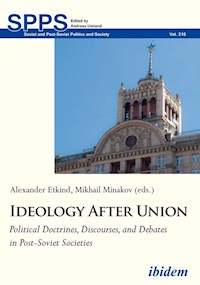
Ideology After Union E-Book
30,99 €
Mehr erfahren.
- Herausgeber: ibidem
- Kategorie: Geisteswissenschaft
- Serie: Soviet and Post-Soviet Politics and Society
- Sprache: Englisch
The recent history of post-Soviet societies is often described in terms of the transition metaphor. Images of movement as well as changing places and situations were foundational for the social conceptualization of the new nations. The idea of looking for novelty and new beginnings legitimized the dissolution of the USSR as well as many state- and economy-related experiments. This volume describes how the new societies survived this period of regime change, economic crises, internal wars, political drawbacks, and social innovations, and how they are making sense of it. The volume’s contributors include Russian, Ukrainian, and German scholars who analyze political, social, and cultural ideologies: Natalia Koulinka, Kostiantyn Fedorenko, Pavel Skigin, Jesko Schmoller, Valentyna Kyselova, Anton Avksentiev, Chris Monday, Egor Isaev, Oleksandr Zabirko, Sergiy Kurbatov, Alla Marchenko, Jennifer J. Carroll, Daria Goriacheva, and Darya Malyutina.
Das E-Book können Sie in Legimi-Apps oder einer beliebigen App lesen, die das folgende Format unterstützen:
Seitenzahl: 675
Veröffentlichungsjahr: 2020
Ähnliche




















ibidem-Press, Stuttgart
The authors and editors express their gratitude to Ms. Natalia Sheiko for her generous support to this publication.
Contents
Post-Soviet Ideological Creativity
I. Discourses on State and Society
Belarus and its Flight from Democracy Revised Political Discourse and the Peoples’ Choice in the 1994 Presidential Election
The Two Movements Liberals and Nationalists During Euromaidan
Neopatrimonialism The Russian Regime through a Weberian Lens
Clientelism and the State in Uzbekistan
Calculated versus Ideological Motives The Logic of National and Regional Coalition Formation in Ukraine
Family Rule and the Post-Marxist State
II. Memory, Imagination and Propaganda
The Militarization of the Past in Russian Popular Historical Films
The Magic Spell of Revanchism Geopolitical Visions in Post-Soviet Speculative Fiction
Diversification of the “Late Soviet“ Attitudes to Mikhail Gorbachev in the Mirrors of History Textbooks
Image and Imitation The Visual Rhetoric of Pro-Russian Propaganda
Understanding the “Ukrainian Crisis” Metaphors Used by Ukrainian, German, and British Leaders in 2014–16
The Impact of the Armed Conflict in the East of Ukraine on Relationships Among Scholars of Ukraine Across Europe
Information About the Authors
Post-Soviet Ideological Creativity
Aleksander Etkind & Mikhail Minakov
1.
Since the collapse of the Soviet Union in 1991, the people of its former republics have witnessed the return of history into their new—and old—homelands. The former Soviet populations lived in a world with a predictable future, and thus, as Aleksei Yurchak has well phrased it, “everything was forever until it was no more” (Yurchak 2013). Political thinking and the social imagination of individuals, small and large groups in USSR were directed and limited by the ideological monopoly of the state with its specific worldview, language, and regime. And the dissolution of the fundamental ideas and grammar of this monopoly during the time of Perestroika (1985-1991) caused the walls, which had long been guarding the Union, to collapse irreparably.
The Soviet vision of a preordained and predestined future has been replaced by a feeling of limitlessness of individual and collective endeavors. Unpredictability of the future was coupled with a sense of vulnerability vis-à-vis history. The challenges of an open future have led to a multitude of ideological responses in the enormous space lying between Tallinn and Vladivostok, Murmansk and Osh, Magadan and Chisinau. Human creativity has been boosted in all spheres, including politics and ideology. Formerly engaged in the dogmas of Soviet Marxism, political and ideological creativity provided these new societies, emerging from the ruins of the USSR, with an opportunity to build freer and more just polities. History has repatriated the post-Soviet lands as a plurality of political ideas and a clash of ideologies.
However, the disappearance of the “great” Soviet society was not as rapid as the changes in the political realm. The new societies of Eastern Europe and Northern Eurasia faced tectonic transformations, which led to a flourishing of different phenomena related to ideology. But the social structure adapted slowly. The new social reality had to normalize political competition, multiparty systems, private property, the significance of money, the coexistence of consumerist lifestyle and totalitarian traditions, and the contradictions between democratic politics and oligarchic economies, between atheism and religious renaissance, and so on. Events throughout the late 20th and early 21st centuries inspired new ideological frameworks, which allowed individuals, institutions and social groups to accept and interpret the new political and socioeconomic reality in a way that was eclectic, relativistic or—the most popular ideological term of the epoch—post-modern. Though philosophical genealogies of the post-modern and post-Soviet conditions were vastly different— if not opposite—these concepts often merged or conflated in their popular usage.
The new states and societies were immersed into a period of state- and nation-building, as well as the birth of new capitalist economies. The vast and drastic changes in lifestyles coincided with the spread of individualism, neoliberalism, democratic liberalism, libertarian anarchism, ethno-nationalism, religious conservatism, anti-progressivism, which frivolously combined or even merged in a public sphere that had been long deprived of critical discourse. Attempts to establish new ideocratic regimes based on ideological monopoly and then attempts to return to the political and ideological pluralism constituted chaos. All these contradictions needed revision and rational order. However, the resulting hierarchies could hardly sustain the new critical atmosphere.
Stemming from this chaos, the post-Soviet social imagination was striving for certainty and normalization. The massive discontent and revolutionary quest for new forms of social, political and economic life paradoxically coincided with the collective desire to “return to normality” and to “join the civilized world” (these expressions were the buzzwords in the late Soviet/early post-Soviet media). The idea of return also had a transitory intention: breaking away from the Soviet dead end, the Russian, Ukrainian and Lithuanian societies were striving to go back to their “natural” or “correct” past. Leaders of the Baltic countries, Ukraine and Russia saw the February Revolution in 1917 as the model for their republican experiments. Along with new legal experiments on the restitution of property and historical myths that made heroes of the nationalist leaders of the pre-Soviet era, the ideological creativity of 1991 tended to use forms and models of the late 19th/early 20th century for the post-Soviet societies entering the 21st century.
Another limitation for our societies’ political imagination was posed by the idea of copying. The limitlessness of politics after the dissolution of the USSR was also seen as a period when transfer of Western experience could have guaranteed democratic and economic success for the new Eastern Europe and Western Eurasia, according to some experts (Stefes 2006: 10-11; Gaidar 2010: 17-18). However, neither transition through transfer, nor transit via return delivered the promised success and return to normality. New forms of collective life took over the post-Soviet societies where neopatrimonialism, patronal networks, mafia-state, neo-imperialist politics, neo-Sovietism, neo-nazism, and demodernization became as strong as the democratic tendencies. The Baltic countries, in spite of the strong EU influence, still have considerable obstacles to being functioning democracies (Maciukaite-Zviniene 2009: 29-30; Krastev 2018). In the last twenty years the other 12 post-Soviet republics were slowly losing Perestroika’s emancipatory impulse (Hale 2016). Even the most “democratic” countries out of these 12 remain in a state of semi-freedom with only a weak association with the EU (Nodia, Cenusa and Minakov 2017). The situation with democracy and the rule of law in six de facto post-Soviet states is even worse (Fischer 2016: 5-7; Minakov 2019). This unexpected current post-Soviet social reality was created by an interplay of revolutionary and restorationist strategies (Umland 2017). Overcoming Marxist, Stalinist and Brezhnevist pasts, post-Soviet authors have demonstrated an outstanding creativity in various genres of ideological storytelling, from non-fiction to fiction, from philosophy to utopia, and from history to fantasy.
2.
These and many other processes connected to ideological creativity and political imagination in the post-Soviet societies have been studied by many individual scholars and research groups. One of the networks that unites the political scholars, sociologists, political philosophers and historians studying post-Soviet societies, cultures and ideologies was organized around The Ideology and Politics Journal.
The Ideology and Politics Journal (IPJ) was established by a group of scholars from Ukraine, Russia, Belarus and the USA in 2011 to analyze ideology in its political, social, and conceptual forms, at the core of post-Soviet societies.1 Very soon the Journal became a communication platform for researchers who study ideological processes in Belarus, Moldova, Russia, Ukraine and other post-Soviet countries. Researchers from this network published their studies in IPJ, transforming it into a unique chronicle of the development of new societies influenced by the multiplicity of ideological forms.
From the outset, IPJ has been devoted to the study of how post-Soviet societies acknowledged the new socio-economic reality, as well as the changing values and guiding ideas for new political systems and cultures. Its authors have also considered how these societies represent themselves and their pasts, and how they project their futures.
Since philosophy, social science, history, and political science operate with many different, often conflicting, definitions of ideology, the IPJ community of scholars agreed to define ideology in the widest sense possible. The definition of ideology includes (in no order of preference):
A system of political ideas and beliefs;
Unanimous instance of power dispositions legitimation;
A false consciousness created by the dominating class;
A symbolic system utilized to make sense of the social reality.
In this manner, it is possible to reconcile the neo- and post-Marxist, liberal and neo-liberal, morphological, poststructuralist and postmodern interpretations of ideology.2
We also look at ideology as intrinsically linked to political imagination. Political imagination is an intersubjective faculty that simultaneously creates affectionate and cognitive adherence of individuals to a political collective. Among the phenomena associated with political imagination are political ideologies, utopias and visions of common future, nostalgies and memories/oblivions of common past, as well as euphoric or critical assessments of the social now. Thus, the creative force of imagination hegemonically prescribes what is collectively possible and impossible, normal and deviant, justified and unfair, legitimate and forbidden. And authors of the IPJ studied how this human faculty manifested itself in the post-Soviet societies.
3.
After 13 IPJ issues were published, authors of a body of research articles appealed for publishing in a separate book that could provide an insight into contemporary ideological situations in the post-Soviet societies. After a thorough selection of the articles published in IPJ from 2011-2019, we chose 12 articles. Their authors updated and modified them into the chapters of this book. Together, these texts—and cases they illuminate—constitute a coherent study of the contemporary post-Soviet political thinking and social imagination.
The 12 chapters of this book are divided into two parts. The first part analyses the diversity of discourses on state and society and related ideologies emerging from the tension between post-Soviet state and society.
In the first chapter, Natalia Koulinka studies the case of the Lukashenko regime in Belarus. At the time of writing (2019) Aleksandr Lukashenko celebrates twenty-five years in power. The author tries to understand how did it happen that the Belarusian voters were able to navigate and choose between the nearly identical promises of social justice and well-being made by all six candidates for the presidency back in 1994? Koulinka draws on the pre-election materials written on behalf of the two most controversial candidates—Zianon Paz’niak, the leader of Belarusian Popular Front “Adradzhen’ne,” and Aleksandr Lukashenko, who positioned himself as an independent candidate. Her comparative analysis of the candidates’ rhetoric provides an analysis of early post-Soviet Belarus ideological thinking, as well as of the stability of Lukashenko’s authority after his victory a quarter-century ago.
KostiantynFedorenko analyzes a more recent event, the Euromaidan in Ukraine. Fedorenko studies how Ukrainian liberals and nationalists cooperated in the protests of late 2013/early 2014, and the way they explained the cooperation with their ideological rivals. The author skillfully shows the political complexity and ideological flexibility of post-Soviet protest movements.
Pavel Skigin applies the Weberian analytical model of neopatrimonialism to an analysis of Putin’s regime. In this case study, the author examines the hierarchy of patron-client bonds, rent extraction, and the conditional status of private property in contemporary Russia. This chapter offers a promising explanation of the persistent features of Russian political thinking and practice through a neopatrimonial lens, thus rendering the democratic/authoritarian dichotomy somewhat superficial.
Authored by Jesko Schmoller, the fourth chapter examines clientelism and the state in Uzbekistan. The author argues that patron-client relationships constitute a challenge for the emergence of a modern state in post-Soviet Uzbekistan. His analysis of the practice and prevalent thinking patterns in the Uzbekistani public service shows that state and society are not properly differentiated; thus the public and private spheres overlap. Schmoller also shows that the 21st century Uzbekistani state functions as combination of clientelistic practices, with elements of pre-modern social order interacting with the remnants of Soviet formal institutions and informal relations.
Anton Avksentiev and Valentyna Kyselova also use the concept of neopatrimonialism to study how the contemporary Ukrainian state and power elites function. Their research focuses on the formation and function of parliamentary and regional council alliances in Ukraine. The work is based on the analysis of materials from the 3rd-8th convocations of the Verkhovna Rada (1998-2019) and all acting regional councils of the southeastern regions. Based on the results of their study, Avksentiev and Kyselova argue that the formation of coalitions are based on party antagonisms across the ideological scale, and are common at both the national and regional level. However, regional councils demonstrate that their obedience to Presidential Administrations is stronger than the tie to Parliament.Also, they show that, despite the election results, the “party of power” regularly captures the biggest share of real power nationally and regionally, and, ultimately, it becomes the key coalition player in Ukraine.
Chris Monday studies the post-communist societies (or “the post-utopian nations” as he calls them) and the role of families in their development. Monday argues that these societies are not so much caught in a development trap, as they are shifting structurally towards family rule. For these nations, “the return to dynasty” has provided their economies with the necessary organization. It also provides their polities with some opportunities for development through personalized channels of contact.
The second part of our book is dedicated to the post-Soviet collective memory, imagination and propaganda.
This part starts with a chapter dedicated to the issue of militarization of cultures in Eastern Europe. Egor Isaev studies this problem on the case of contemporary Russia. The author specifically addresses militarization of the Russian movies dealing with recent history and collective memory. Isaev determines the role of history and historical films in the contemporary politics of memory and describes the relations between the state and Russian cinema as systemic. The author argues that historical movies describe Russia’s past mainly in terms of wars and conflicts, and the criticism of war is becoming less and less prevalent in popular cinema.
The next chapter addresses the problem of how and to what extent the anti-democratic, imperial and ultimately antimodernist narratives of the post-Soviet era are influenced by the aesthetics and generic conventions of literary works that in post-Soviet cultures are commonly known as fantastika. Oleksandr Zabirko analyses a vast body of recent Russian and Ukrainian fictional texts, which leads him to the conclusion that the current conflict in Donbass and Crimea was well prepared in both societies’ imagination and discourse. The political thinking and social imagination of two neighboring nations were already primed for war and mutual enmity before 2014.
Sergiy Kurbatov and Alla Marchenko deal with the issue how post-Soviet nations remember the USSR. Particularly, the authors analyze representations of Mikhail Gorbachev, the last leader of the USSR, in textbooks on the history of Russia, Belarus and Ukraine, published in 1991-2012. Their study shows the ambiguity and diversification of the attitudes towards the late Soviet Union, reflected in different assessments of Gorbachev and his policies. In these assessments one can see the manifest or latent nostalgia for the Soviet past (in the cases of Russia and Belarus), as well as optimism regarding national independence (the case of Ukraine).
In the fourth chapter of this second section, Jennifer J. Carroll pays attention to the rough edges of the geopolitical and military campaigns in Eastern Europe. The author focuses particularly on a specific technique of deception and information warfare currently emerging from within the Russian sphere of influence. Carrol shows that imitation—the deliberate attempt to make one thing appear as though it is really another by mimicking its observable features—typically generates highly influential disinformation campaigns. She also compares imitation with other forms of public deception, and thus tells the story of new ways of social imagination and political thinking management by authorities.
Further, Daria Goriacheva challenges a widespread belief that the Euromaidan uprisings and the subsequent Russian-instigated crisis in Ukraine have brought about a leap forward in Ukraine’s long-held aspirations of European integration. She argues that the failure of numerous Ukrainian attempts to join European structures, as well as regular setbacks in the country’s democratic transformation, are largely the result of a lack of shared long-term goals between Ukrainian and Western political elites. Based on metaphor-oriented critical discourse analysis, the author examines Ukrainian and key European leaders’ official discourses in the post-Euromaidan era in order to reveal and compare their perspectives on EU-Ukraine relations as well as their view on Russia in this context. In her study, Goriacheva concludes that leaders possess substantially different visions on prospective relations in the EU-Ukraine-Russia triangle, which reveals even deeper differences in political thinking and practice of the three parties.
Our book ends with an interesting chapter looking at how the Euromaidan, Russia’s annexation of Crimea, and the armed conflict in the Donbas region have affected relationships among scholars based in Western Europe and Ukraine. Darya Malyutina looks at the community of scholars focusing on Ukraine in their work, who should have stayed immune to ideological influences. However, the political conflict divided scholars as well. As Malyutina rightly states, knowledge production is never an individual endeavor; hence the effect of political crises on scholarly communities may be particularly traumatizing, leading to a polarization within the intellectual field. Drawing upon a series of interviews with social scientists and humanities scholars specializing in Ukraine, the author shows that, on the one hand, the conflict has had a strong impact on relationships within the field of Ukrainian Studies and beyond, in terms of disrupting both local and transnational connections in the real and virtual spaces of universities, conferences, and social media discussions. On the other hand, the destructive effect has been far from universal. An increasing number of scholars have discussed the reconciliation and easing of problematic relationships amongst researchers. These discussions focus on the new transnational ways of conducting research, maintaining the connections and establishing new contacts; they draw upon political solidarity rather than differences, and focus on the need to (re)establish a dialogue on a larger scale in the future.
We hope that this collective study of the post-Soviet political thinking and social imagination will foster further studies of ideological creativity of people across the world. Neither for the first nor for the last time, history demands bravery and solidarity in dealing with human-caused catastrophes and crises.
References
Fischer, S. (ed). 2016. Not Frozen! The Unresolved Conflicts over Transnistria, Abkhazia, South Ossetia and Nagorno-Karabakh in Light of the Crisis over Ukraine. Berlin: SWP.
Freeden, M., Sargent, L.T., and Stears, M. (eds). 2013. The Oxford Handbook of Political Ideologies. Oxford: Oxford University Press.
Gaidar, Y. 2010. Collapse of an Empire. Washington, DC: Brookings Institution Press.
Gel’man, V. 2015. “The vicious circle of post-Soviet neopatrimonialism in Russia.” Post-Soviet Affairs, 32(5): 455–473.
Hale, H. 2010. “Eurasian Polities as Hybrid Regimes: The Case of Putin's Russia.” Journal of Eurasian Studies, 1(1): 33–41.
Hale, H. E. 2016. 25 “Years After The USSR: What's Gone Wrong?” Journal of Democracy, 27(3): 24-35.
Krastev, I. 2018. “Eastern Europe’s Illiberal Revolution.” Foreign Affairs. Access at: https://www.foreignaffairs.com/articles/hungary/2018-04-16/eastern-europes-illiberal-revolution.
Maciukaite-Zviniene, S. 2009. “Defining Criteria and Assessing Democracy in the Baltic States.” Social Research, 15(1): 28-38.
Minakov, M. 2019. “On the Extreme Periphery. The Status of post-Soviet Non-Recognized States in the World-System”. Ideology and Politics Journal, 12(1): 39-72.
Nodia, G., Cenusa, D. and Minakov, M. 2017. “Democracy and its Deficits: The Way of Georgia, Moldova and Ukraine Towards Becoming European-Style Democracies.” Centre for European Policy Studies policy papers. Accessed at: http://www.3dcftas.eu/publications/other/democracy-and-its-deficitsway-georgia-moldova-and-ukraine-towards-becoming.
Stefes, C.H. 2006. Understanding Post-Soviet Transitions. London: Palgrave Macmillan.
Umland, A. 2017. “Restavratsionnyi i revolutsionnyi imperializm v politicheskom diskurse segodniashnei Rossii (from Rus. Restorationist and revolutionary imperialism in the political discourse of contemporary Russia).” Ideology and Politics Journal 2(8): 11-58.
Yurchak, A. 2013. Everything was forever, until it was no more: The last Soviet generation. Princeton: Princeton University Press.
1 Since the Ideology and Politics Journal is an open access peer-reviewed journal, all its issues, as well as information on its editors, Board, code of conducts etc. are accessible on its website at www.ideopol.org. All IPJ articles go through a process of anonymous double peer review. The IPJ publishes its materials in English, Russian and Ukrainian.
2 For differences of these approaches please seeFreeden et al. 2013
I.Discourses on State and Society
Belarus and its Flight from Democracy Revised Political Discourse and the Peoples’ Choice in the 1994 Presidential Election
Natalia Koulinka
The turn toward authoritarianism, which formally occurred in Belarus in 1996, is generally attributed to the obvious culprit—current Belarusian president, Aleksandr Lukashenko. In 1996, he initiated a Constitutional Referendum that ended a sharp confrontation between the president and the Supreme Soviet, the highest legislative authority in the country.1 Lukashenko won. All propositions initiated by him received overwhelming support, which allowed him to change the Constitution and turn Belarus from a parliamentary-presidential republic into a solely presidential one. As of 2019, Lukashenko is still in power2 and his actions over the last 23 years have been violent and destructive to the very idea of the rule of law.
Lukashenko’s swift rise to power was preceded by a few years of independence—between December 1991, when the USSR was dissolved by the trilateral agreement between Russia, Belarus, and Ukraine, and June 1994, when the first presidential election took place. The brevity of this period is disproportional to the important role it played in the history of modern Belarus. If nothing else, the visible increase in economic inequality and the rapid deterioration of standard of living during this period testify to its historical importance in the country’s history. For example, according to Chairman of the Belarusian Supreme Soviet Stanislav Shushkevich, in 1993, inflation in Belarus was 30 percent a month (Shushkevich 1993: 2). Zianon Paz’niak, leader of the Belarusian Popular Front and one of the candidates in the 1994 presidential election, in his pre-election program presented an even grimmer picture. According to him, between 1991 and 1994, production in Belarus decreased by 50 percent, inflation reached more than 50 percent a month, prices for staple foods increased 3,000 times, and 7 out of 10 Belarusians were below the poverty line (Zviazda 1994: 2). On the eve of the 1994 election, summing up the results of 1993 and 1994 surveys, Evgenii Babosov, a Belarusian social scientist, predicted: “Two factors—skyrocketing prices and the rapid impoverishment of the working population would pre-define the electoral behavior of the majority of the working-class” (Babosov 1994: 2).
Reflecting on that time, Vitalii Silitskii, a Belarusian political analyst, wrote that Lukashenko’s success “was made possible by the fair degree of political openness that had followed the demise of communism” (Silitskii 2010: 281). This observation was counter-balanced by Lucan Way, a political scientist from the University of Toronto. Way argued that that was a “pluralism by default,” which on the one hand prevented the enforcement of authoritarian rule by incumbents, while on the other was characterized by a lack of “a robust civil society, strong democratic institutions or democratic leadership” (Way 2003: 4). A new discourse arose about the best way out of the economic and political confusion caused by the collapse of the USSR. It was a combination of the still fresh memories of the Soviet past, expectations of a Western-style liberal-democratic future, and the rise of Belarusian nationalism. A pool of its chief instigators consisted of four types of political players: brand-new political activists (e.g. Zianon Paz’niak) who have never been members of the Communist Party or, in some cases, even opposed it; reformed politicians who quit their membership in the Party and wholeheartedly adopted the new liberal-democratic values; those who remained faithful to their communist values; and finally, a number of politically active citizens (e.g. Alexandr Lukashenko) who quit their membership in the Party, but did not entirely commit themselves to the new liberal-democratic values. The political decisions of this last group were situational rather than dependent on a certain ideology. In the late 1980s and the early 1990s, this diverse population of politicians, struggling over the right to define the meaning of democracy and of public happiness, formed and re-formed political parties, socio-political and cultural organizations, and movements. The antagonism between them reached a climax during the presidential campaign of 1994.
By analyzing the rhetoric of pre-election materials created on behalf of Zianon Paz’niak and Aleksandr Lukashenko, this chapter seeks to understand the choice that the Belarusian citizens made in 1994. It begins by examining the existing scholarly and popular explanations for the peoples’ choice. It then proceeds with a brief overview of the new and old political elites within the changing political landscape of the early years of Belarusian independence. It concludes with a comparative analysis of the rhetoric that the two candidates employed in their programs and leaflets in order to present the future they envisioned.
The Gaps in Explanations for the 1994 Election Results
Aleksandr Lukashenko won the 1994 presidential election in the second round with the support of over 80 percent of voters, which was 57 percent of the Belarusian electorate overall. His rival, then-Prime Minister Viacheslav Kebich, received 14.17 percent. The phenomenon of his victory drew wide attention both within Belarus and abroad. Researchers, public intellectuals, and journalists subjected President Lukashenko and those who voted for him to scrutiny. The explanations that emerged out of the analysis at that time ranged from those that were seemingly obvious, to those deeply entwined in the country’s history.
Pavel Sheremet3 and Svetlana Kalinkina, Belarusian journalists and co-authors of the book Sluchainyi President [A Random President], for example, after an exploration of factors that facilitated Lukashenko’s election, claimed that his success was simple: Lukashenko spoke with people in a language they understood. By this, the authors mean Lukashenko’s vocabulary, communication style, but importantly also his accent. Like many Belarusians, Lukashenko speaks so-called “trasianka,” which is a form of speech that combines Belarusian and Russian words, pronounced with a Belarusian accent. However, in the social environment of contemporary Belarus, trasianka is not only a form of speech, but also a perceived marker of lower social status. Despite tremendous changes in Lukashenko’s appearance and vocabulary since that time, he continues to speak in trasianka, which remains an audible reminder of his origin.
Aleksandr Feduta, a famous Belarusian public intellectual, journalist, and literary scholar, who was one of the critical members of Lukashenko’s 1994 campaign team, introduced a new explanation of Lukashenko’s success in his book Aleksandr Lukashenko: Politicheskaia Biografiia [Aleksandr Lukashenko: Political Biography].One of the focal points of Feduta’s analysis is Lukashenko’s “anti-corruption speech” that the latter delivered as Head of the Parliamentary Anti-corruption Committee at the end of 1993. According to a commonly accepted view, this speech turned the once rank-and-file MP into a real political figure. Reflecting on Lukashenko’s speech in a December issue of Sovietskaia Belorussiia, the biggest, state-run, Russian language newspaper, its political commentator Liudmila Masliukova wrote, “Aleksandr Lukashenko heatedly pointed to a large-scale robbery of people that has been carried out in the country. His words touched peoples’ hearts as correct and honest” (Masliukova 1993b: 3).4
Feduta approached the speech from a different perspective. “Lukashenko,” he stated, “caught the essence of the Soviet mentality ... that if somebody lives in better conditions than we can afford, then this person is our enemy” (Feduta 2005: 103). Complementing this conclusion with his recollection about the focus of Lukashenko’s campaign on the underclass, Feduta wrote, “The only feature that could distinguish our electorate was its extreme lumpenization”5 (ibid.: 124). A quote from Petr Kravchenko, a former high-level Communist Party official who at the time of this interview was a prominent member of the opposition, added to the picture its final touch:
As a politician … [Lukashenko] was born not on the podium of the parliament. As a politician he was born in a bathhouse in the town of Shklov,6 where naked, with a bath basin in hands, he listened to half-drunk villagers. They were speaking straight from the shoulder and this became his source of information about peoples’ lives and concerns (ibid., 363).
Although it is popular to point to the low social status of Lukashenko’s electorate as a way of rationalizing his triumph in the 1994 election, another approach has been emerging on the margins of political analysis. Its most consistent proponent—social scientist Elena Gapova—has insisted on the necessity to examine critically the Belarusian liberal intelligentsia who represented the core of the Belarusian opposition to Lukashenko. She argued that by supporting the individualistic values of liberal democracy, intellectuals and opposition politicians have been promoting the interests of their “class,” which were (and are) not always congruent with what many people in Belarus regard as a common good. One of the examples of such a divide is an elitist position once expressed by prominent Belarusian philosopher Valiantin Akudovich. He stated that there was no practical reason to be concerned with freedom of speech and association for those in Belarus who made their living by working the land, because they had a different lifestyle, different values, and “very different scopes of responsibility.” What he meant was that their preoccupation with the banal materiality of everyday life, such as growing potatoes, made them indifferent to “ephemeral” values such as, for example, freedom of speech. Consequently, according to Akudovich, it was intellectuals who were pre-destined to take care of civil liberties—their sphere of social responsibility (Gapova 2010: 212). Commenting on this position, Gapova noted that the higher consciousness that Akudovich attributed to the intellectuals, however, did not help them realize that unless they act in a way that would make sense for those who live off their hands, their “project” would achieve neither moral right nor legitimate perspective. Instead, she continued, Akudovich pointed to the need to have “more of ‘us’ [intellectuals] to [be able to] remove ‘the social province’ to where it belongs… [In this case] … the province would [be left to] worry about the issues that were appropriate for it, and we would take care of those belong to us”(ibid.: 212).7
In Belarus, which had just emerged as an independent state, many factors made this division possible. One of them was the access to Western funds that provided a financial support to study abroad or to implement various projects within Belarus. By no means were these resources available to everyone engaged in intellectual production. However, what is important in the context of this chapter is that the intellectuals had a privileged access to them by virtue of the structural position that they occupy in society.8 In the following observation, Grigorii Ioffe, whose area of expertise includes geopolitics and national identity, emphasizes the disparity that has emerged from this difference in structural positions and separated social groups in Belarus since the collapse of the USSR:
…most of his [Stanislau Shushkevich, the head of the first independent Belarusian Supreme Soviet] fellow countrymen were ill prepared for independence. While a few Minsk-based intellectuals were able to convert the newly emerging freedom into some sort of social capital, materialized through contacts with the West and with its financial support, most Belarusians saw their lifelong savings evaporate and their quality of life plummet (Ioffe 2008: 110).
An interview published by Sovetskaia Belorussiia in 1993 adapts this seemingly speculative conclusion into a plot from real life. During the course of the conversation, the interviewee, a prominent member of the National Academy of Sciences, remarks that his most resourceful colleagues had left for the West to wait out the times of hardship (Efanov 1993: 2).
On the other hand, in explaining Lukashenko’s victory, Western scholars turned to factors related to the country’s most recent past. American political scientists Coit Blacker and Condoleezza Riсe in their article, “Belarus and the Flight from Sovereignty,” discussed his tripartite pre-election pledge: “to provide strong, no-nonsense leadership, to restore social discipline, and to seek the closest possible ties with Russia” (Blacker and Rice 2006: 242). They paid particular attention to the third point and remarked that by promising to resume a close relationship with the Russian Federation, Aleksandr Lukashenko met the expectations of the majority of Belarusians “to return to familiar ways,” hinting at the Soviet past (ibid.: 242).
The results of European 1992 and 1993 Barometer Surveys pointed to the plausibility of such an explanation. The questions that tested Belarusians’ attitude toward the USSR revealed positive associations. In 1992, for example, on a scale ranging from –100 to +100, Belarusian respondents rated the socialist economic system a +76 and this number rose to +78 the following year (Rose 2006: 32). The former Communist regime was rated as a +60 and +64 in these respective years (ibid.: 22). This apparently positive attitude, however, did not result in the support of a communist candidate at the first round of the 1994 presidential election. He received five percent of the vote—the lowest result among the six candidates. Another example adds even more questions to this already confusing situation. It is widely known that in the March 1991 Soviet referendum, 82.7 percent or five million voters in the Belarusian Soviet Socialist Republic supported the idea of living in a renewed federation of equal and sovereign republics (Grishan 1994: 3). However, less than a year later, after the Soviet Union’s disbandment in December of 1991 69 percent of respondents in independent Belarus welcomed the decision (ibid.: 3). This volatility of peoples’ opinions appears intractable and yields only one explanation—a familiar theme of the crowd acting under the influence of irrational passions. Yet, this explanation may not satisfy those with a different view towards “the crowd.” They may point to the fact—attested by readers’ letters to newspapers and the strikes—that people wanted and welcomed change. The question is, what kind of change were they hoping for? The analysis presented in this chapter attempts to answer this question, too.
Another popular claim—that Lukashenko’s pledge to restore close relations with Russia was a decisive factor in his victory—can be only a partial explanation because other candidates, too, actively promised the same in their pre-election campaigns, which proves its resonance with the electorate. Thus, the following handwritten sentence that summarized a presentation of then-Prime Minister Kebich appeared in Sovetskaia Belorussiia on the eve of the first round of election. “‘In my life,’ he stated, ‘I have two interdependent goals: the well-being of Belarusian people and unity with Russia’” (Sovetskaia Belorussiia 1994a: 1). Before the second round, the same newspaper published a number of articles that praised Kebich’s efforts to restore ties with Russia. In one of them, Kebich declared that the first round of the election had proved that people unambiguously support the efforts to unite with Russia, Ukraine, and other countries that form the Commonwealth of Independent States. He continued that he has always advocated this idea and in the future, he will do everything possible to make it true (Kebich 1994: 1).9 Enjoying one of the largest circulations10 and having the potential to reach out a significant number of people, especially outside the capital city, Sovetskaia Belorussiia widely delivered this message by Kebich to the voters. Even Zianon Paz’niak, fearful that a lack of emphasis on unity with Russia in his pre-election campaign might impair his chances to win the election, published a special leaflet (in Russian, no less) titled “Chto Zenon ne budet delat’” [What Zenon Will Not Do].One of his six promises was that he would not sever economic ties with Russia. In other words, the popularity of this promise among the candidates decreases its value as an explanation for Lukashenko’s victory.
Finally, in political analysis, the allusion to people’s nostalgic feelings was often linked with explanations that paired Lukashenko’s victory with the Belarusians’ dearth of a national consciousness and their willingness, according to David Marples, a historian at the University of Alberta, “to sacrifice independence if they could be assured of an improvement in their economic well-being” (Marples 1996: 125). Marples’ visits to Belarus in 1992 and 1993 resulted in a book in which he shared his observation that the number of citizens nostalgic for the Soviet past had increased, and he contemplated the question of why Belarusians sacrificed their language and “lost interest in their own history” (ibid.: xviii).
These observations and explanations, however accurately reflecting the Belarusian reality in the first years of independence, have one shared presumption—the outcome of the 1994 election was determined largely by the ineptitude of the people—that restricts their explanatory power. Moreover, even if accepted, they cannot answer the question of how the voters were able to distinguish between the very similar promises of social well-being promulgated by all six candidates. These similarities may mean that when making their decision, the voters were not responding to the promises per se. If that is the case, then to what did they respond? The following analysis, preceded by a brief overview of the Belarusian political landscape of the time, aims at finding out what helped the voters make their choice.
Old and New Political Elites in the New Political Landscape
The long-forgotten diversity in public opinion was, among other factors, the springboard for the rapid growth of competing political parties and cultural and socio-political movements. The first alternative to the Communist Party was the Belarusian Popular Front (BPF). Although the Belarusian Ministry of Justice registered the BPF only in February 1992, the movement emerged earlier, in June 1989, with its founding congress convening in neighboring Lithuania. In addition to the active (but not officially registered) BPF, between March and July 1991 the Ministry of Justice registered five other political parties11 (Spisok politicheskikh partii 1992). A few months after the 1994 presidential election, Sovetskaia Belorussiia reported that the leaders of 26 parties and seven socio-political organizations gathered in the Supreme Soviet to discuss an electoral system for the upcoming parliamentary elections (Ivanova 1994: 1–2).
Two main features characterized the transformation of the political landscape in independent Belarus: new parties had low membership and their multiple attempts to form a democratic bloc had failed. According to a brochure published by the Belarusian Academy of Sciences in 1992, at the end of 1991 the number of members and supporters of different parties varied widely. For example, the Belarusian Christian Democrats had 150 members and there were 1,000 people who in one way or another belonged to the Belarusian Social-Democratic Gramada. Predictably, the party with the highest membership was the Belarusian Popular Front. It claimed about 15,000 members, according to the same source. Despite the proliferation of the parties, a relatively slow growth in their membership weakened their influence on Belarusian society and reflected the majority’s cautiousness toward them, which was proved by the results of a 1992 survey. According to Evgenii Babosov, it showed that none of the political parties had significant support and that not more than 13 percent of the respondents trusted them (Babosov 1993: 1).
Analyzing the situation, Belarusian political scientist Nikolai Kuznets wrote in 1996 that an impressive number of parties neither spoke to the democratization of the country, nor satisfied the variety of views in the society. He concluded that the parties did not address the problems of people and did not represent all social strata in the society (Kuznets 1996: 16). Kuznets’ criticism is not without merit. Indeed, the discrepancy between views held by the new political elite and the average Belarusian regarding the most urgent tasks of the period could be an important factor that contributed to the population’s relative indifference to the political parties.
The demonstration in Minsk organized by the BPF in May 1991, on the fifth anniversary of the Chernobyl tragedy, may strengthen Kuznets’ point. The BPF did not usually enjoy wide support, which is a point that a Russian political scientist, Kirill Koktysh, makes while elaborating on the high participation in the demonstration. Even though the 25 seats12 that the BPF won in the Supreme Soviet in 1990 were a sign of success, they did not give the party much influence on the legislative process or the executive branch. Koktysh cites the BPF’s radical nationalism and its heavy emphasis on the “Belarusian language issue” as impeding the faction’s collaboration with other political forces in the Supreme Soviet. Nevertheless, the demonstration initiated by the BPF in May 1991 brought 100,000 Belarusians to the streets, which allowed Koktysh to conclude that when the party reflected peoples’ actual concerns, it received enormous social support (Koktysh 2000: 31).
Repeated and unsuccessful attempts of political parties to unite and create a “centrist” political force was another trend characteristic to the years preceding the 1994 presidential election. The primary impediment to this endeavor was a disagreement between the parties about the toll that society can and should pay now for its prosperity in the future. The Belarusian Social Democrats proposed one of such initiatives in February 1992. A bloc, “New Belarus,” suggested by the Social Democrats was supposed to unite the country’s democratic political forces around the goal of protecting people from impoverishment (Pankratovich 1992: 1). However, this goal caused disagreement between the parties and most likely alienated the main player—the Belarusian Popular Front. An independent newspaper, Svaboda,13 noted in this regard that without the BPF the political unity of democratic forces cannot be achieved. Yurii Khadyko, one of the BPF leaders, explained his party’s reluctance to join the bloc: “[T]his bloc … does not have any clear political agenda, which is unacceptable to the BPF” (ibid.: 1). On the other hand, the BPF likewise initiated similar propositions. In April 1992, Svaboda published a declaration issued by the Political Committee of BPF’s Sejm and the BPF’s leadership, which proposed to establish a pre-election bloc of the democratic forces. However, the invitation restricted the invitees to only those democratic forces that “strove for the sovereignty, creation of a [national] state, and national and cultural revival of Fatherland” (Svaboda 1992: 1).
Meanwhile, another journalist and political analyst Anatolii Maisenia warned in the newspaper Sovetskaia Belorussiia about the danger of the old regime’s restoration due to the absence of а new party or coalition to fill the gap between the left-wing and right-wing political extremes (Maisenia 1992: 1). On the eve of the 1994 election, Evgenii Babosov drew attention to the problem once again. He presented the results of a survey that measured the satisfaction of the working-class population with the economic and political reforms in Belarus. The numbers showed that few of the surveyed workers had knowledge about political parties in Belarus, and what they knew was vague in most cases. According to Babosov, an explanation to this lies in the fact that the new political parties and organizations did not suggest a clear answer to the core questions—what kind of society they were aspiring to and what reforms were needed to create it. Forecasting the likelihood of each of the six candidates winning the election, Babosov maintained that despite a dramatic change in the public discourse—which at that time tended to present the entrepreneur as a leading social force—it was the worker and his or her labor that could help society overcome the crisis. The survey registered that Lukashenko was far ahead of his rivals, with the support of 20.5 percent of working class respondents; Prime Minister Kebich garnered 8.4 percent; and the BPF leader Paz’niak—5.1 percent (Babosov 1994: 2).
Belarusians’ attitude toward the BPF and its leader, Zianon Paz’niak, a historian and archeologist, has never been simple.14 When on the eve of the election Sovetskaia Belorussiia announced Paz’niak among other candidates for the Presidency, it pointed out that his name alone evoked an emotional response: some ardently supported him while others strongly rejected him (Sovetskaia Belorussiia 1994b: 1). This clash of views may be more comprehensible if seen through an episode related to the visit of U.S. President Clinton to Belarus in 1994. Svaboda reported that Paz’niak was not enthusiastic about the U.S. Ambassador’s invitation to participate in a meeting between President Clinton and Belarusian democratic leaders. Paz’niak’s reluctance was caused by his belief that not all invited leaders were truly democratic. He eventually agreed to join the group, but did so with the aim of explaining to President Clinton the “real” situation with the democratic opposition in Belarus (Pankratovich 1994a: 1 and 1994c: 1).
An American historian and publicist of Belarusian descent, Jan Zaprudnik, in his 1993 book, Belarus: At a Crossroads of History, introduced Paz’nuak to an English-speaking audience as “a rigorous maximalist who is seen by many as an extremist. But,” Zaprudnik added to mitigate this perception, “he is not undemocratic” (1993: 169). A similar attempt to smooth the sharp edges of Paz’niak’s political personality was made in one of the leaflets prepared on his behalf on the eve of the 1994 election. Paz’niak, perceived as “a rigorous maximalist,” that is, someone who holds radical views and is not prepared to compromise, was presented in the leaflet as a candidate with “significant life experience … [and] correct in his projections.” To smooth edges even further, the leaflet added, “he listens attentively to the people and absorbs their wisdom.” The leaflet also emphasized some biographical facts which Paz’niak chose as essential for the development of his personality—he was born in a Belarusian village; his father died in World War II and his mother raised him alone; he had always opposed the Communist rule, and this critical attitude toward the Party had affected his career (Leaflet 1994a). Another leaflet, Daragiia Zhanchyny [Dear Women], specifically addressing the female electorate on behalf of Paz’niak stated, “The Belarusian Popular Front has always told and will continue to tell the truth to the Belarusian people. So far, all its predictions had come true, which means that they will be true this time, too: our children and grandchildren, most definitely, will be happier and wealthier than we are” (Leaflet 1994b).
Lukashenko, a former state farm chairman and a political outsider, was another candidate whose name provoked strong emotional response and ambivalence. On the one hand, as Feduta often stressed, fellow MPs and the media ridiculed Lukashenko. Journalists from Svaboda and the leading members of the BPF were especially keen on making fun of him in the newspaper, and Lukashenko’s victory has inspired further angry and offensive articles about him and his supporters.15 On the other hand, despite brazen and subtle pressure on the state-run newspapers—that is, nearly all newspapers—to support Prime Minister Kebich, many journalists, as well as some editors, sympathized with Lukashenko. Particularly they admired his zeal to protect the common people. In this context, the fact that Lukashenko’s program was the only one published twice in the oldest Soviet Belarusian-language newspaper, Zviazda, is telling. Zviazda claimed that in the process of production, technical problems caused the disappearance of some sentences when the program was first published, which justified its re-printing (Zviazda 1994: 3). It is also interesting that Lukashenko’s name appeared 14 times in one of the articles published by Sovetskaia Belorussiia on the eve of the first round of the election. To compare, Prime Minister Kebich’s name appeared only three times in an article three times longer published in the same issue.
Like Paz’niak, Lukashenko highlighted certain facts from his biography: he was born in a Belarusian village; he grew up without a father; and he had never been in power, namely, he had “never lied to people” (Sovetskaia Belorussiia 1994c: 1). It is hard to ignore the parallels between the two candidates’ self-presentations, which could mean that certain information was seen as important to the electorate, so both Paz’niak and Lukashenko emphasized it. Can any further conclusions be drawn from these similarities? While it is impossible to prove that the parallels had any influence on the voters’ perception of the two candidates as resembling each other, one similarity between the two was noticed by Paz’niak himself. At a party rally after his defeat in the first round of the election, he claimed that Lukashenko had appropriated the results of anti-communist and anti-government propaganda that the BPF had cultivated for years (Chuiko 1994: 2). This detail is of enormous importance because it frees those who voted for Lukashenko of the stigma of the “underclass” motivated only by envy of other peoples’ prosperity as Feduta stated in his book. On the contrary, it proves the peoples’ aspiration to change their lives.
Struggle over the Definition of Public Happiness
After more than two years of confusion that followed the USSR’s disbandment, the 1994 presidential election in Belarus turned into a decisive struggle over the right to define what kind of state Belarus should become. The discourse in Belarusian mass media left no doubt that people longed for change. This desire manifested itself in newspaper articles written by scholars and readers’ letters. For example, in a February 1994 issue of Narodnaia Gazeta,16 Mikhail Tiavlovskii, a professor at the leading university, Belarusian State University, argued for the need of such economic and political reforms that would endorse all types of ownership and create a socially-oriented economy responsive to the needs of every citizen. He supported his argument by warning that the “black market,” which had been steadily encroaching the weakened economy, would ultimately destroy the nation. In his view, the Belarusians would die out as a result of a sharp decrease in their standard of living if reforms were not implemented (Tiavlovskii 1994: 3). Newspaper readers supported that critical perspective and with their letters to newspapers contributed to the discussions on the need for transformation. Aleksei Petukhov, a retiree from a Belarusian town, wrote in 1991 to the same newspaper:
… people slowly and painfully are waking up from lethargy that has lasted for the decades. For too long, we have been deceived by the ‘leading and guiding’ [an ironic reference of the time to the Communist Party]. While tirelessly asserting that it cares about the peoples’ welfare, the Party, in fact, gave them a hard life and kept them on a short leash (Petukhov 1991: 2).
These and many other contributions to the discussions on the urgency for change were fraught with two questions—“what kind of state do we want to build?” and “how can we do this?”—which raised the stakes in the 1994 presidential election. A comparative analysis of Lukashenko’s and Paz’niak’s rhetoric reveals that in 1994, while arguing for peoples’ well-being, the two candidates offered the electorate two different futures along with distinct means to achieve it.
Immediately noticeable in their proposals is the fact that both candidates in their programs responded to the prevailing mood of the time and made sure that they highlighted the priority of peoples’ welfare. First and foremost, they both pointed to the need of state support for the disadvantaged and low-income individuals and families. They also drew attention to the problems inherent in an unreasonably large, inefficient, and wasteful government that they both proposed to reduce. Finally, both Lukashenko and Paz’niak admitted to the state’s responsibility for skyrocketing inflation and promised some relief for struggling citizens. In short, when approached from this perspective, it is hard to differentiate between Lukashenko and Paz’niak, or determine why people voted as they did. The future prosperity that both candidates promised to people did not differ in any significant way. However, the devil is usually in the details. It is Lukashenko’s and Paz’niak’s rhetoric that opened their promises to public interpretation and helped both feed and frame peoples’ imagination regarding their future in the state that each candidate envisioned.
A pivotal difference between the candidates can be distilled from the differences in their comments about the state they would inherit. This, in turn, defined their approaches to the task of transforming society. Lukashenko, instead of perceiving the state as in need of total remodeling, saw it as a functioning machine ready to be used in solving various social and economic problems that besieged the country and its people. All that was required was to eliminate corruption and to address the irresponsibility and incompetence of some bureaucrats. In his proposals, Lukashenko returned to these problems with the state apparatus multiple times. He promised to reduce the budget spent on the state and spoke with indignation that the continuous economic decline of the country had been accompanied by a simultaneous increase in the number of government officials and a drop in their quality of performance. In addition, an entire section of the program was devoted to the issue of corruption. Here, too, Lukashenko declared his intention to focus on the fight against various forms of corruption in the state machine (Sovetskaia Belorussiia 1994c: 3).
It was not the same for Paz’niak. He thought of the existing state as of something that needed to be rebuilt anew because only a state in which national identity, in this case Belarusian, is clearly defined, would be able to implement the necessary reforms. Moreover, even though in his proposals Paz’niak paid considerable attention to the issues of social justice and social welfare, the task of building a national state was of primary importance for him. Such prioritization evokes the 19th century Romantic nationalism and the writings of the Italian nationalist political thinker and revolutionary, Giuseppe Mazzini. Struggling for a national unity and pointing to the alleged helplessness of socialist internationalism for the worker’s cause, Mazzini tied the two together in his work, The Duties of Man, which was first printed in 1858. He wrote:
Your industrial associations and mutual help societies are useful as a means of educating and disciplining yourself; as an economic fact they will remain barren until you have an Italy. … Your emancipation can have no practical beginning until a National Government, understanding the sings of the times, shall, seated in Rome, formulate a Declaration of Principles to be the guide for Italian progress…” (Mazzini 1907: 54).
The power of similar ideas informed Paz’niak’s vision in 1994, and his recipe for the social and economic recovery of the Belarusian state. Yet there was an important exception—he advocated for a “national state,” rather than a “nation-state.” In other words, even though Paz’niak has not missed a chance to use the adjective “Belarusian” in his speeches and pre-election materials, his nationalism was not purely ethnic, as one of his leaflets, though written in Belarusian, proves. Addressing a general audience, Paz’niak stressed that “the Belarusian state should be a welcoming home for all its citizens—Belarusians, Russians, Poles, Ukrainians, Jews, and others” (Leaflet 1994a). At the same time, the way Paz’niak related socio-economic reforms to the issue of national independence bears comparison with Mazzini. For example, in his program, under the subtitle, “The Main Principles of the Reforms,” Paz’niak stated that the economic reform required the introduction of borders, customs, a national currency and a banking system with its own emission bank, and a national army (Zviazda 1994: 2).17
Both Paz’niak and Lukashenko assigned primary importance to the establishment of an independent national banking system in Belarus. However, their arguments for such a system reveal a difference in their visions. Even though the two agreed that an independent banking system with a central issuing bank was necessary, Paz’niak presented it as an indispensable attribute of national independence, whereas Lukashenko pointed to it as an instrument required to eliminate the “vicious practice of issuing money that is not backed by produced goods and services” (Zviazda 1994: 3).
A further comparison of the programs proposed by the two candidates in their pre-election materials illuminates what seems to have predetermined the election results. Not only did the candidates have distinct understandings of social well-being, but—and more importantly—their understandings overlapped differently with the expectations held by people. These expectations were at least in part based on peoples’ Soviet past, as well as on friction between their hopes and their most recent experience.18 This, in turn, guided their understanding of what social well-being can and should be.
Acting within the framework of Romantic nationalism, even perhaps without any awareness of this, Paz’niak assumed the possibility to resolve any social conflict, including a class conflict, within a national state. In a 1994 leaflet, answering a question he posed about the social actors who would be able to revive Belarus, Paz’niak said, “Those, who can and want to work—honest and hardworking peasants, teachers, workers, scientists, entrepreneurs” (Leaflet 1994b). By including entrepreneurs, Paz’niak, in a most obvious, perhaps even defiant way, cut himself off from the Soviet past. Simultaneously, however, he went against a widely shared negative attitude towards a new social group—“nouveau riche”—to which entrepreneurs popularly belonged. The term “nouveau riche” entered the vocabulary of Soviet citizens in the late 1980s towards the end of perestroika, along with its socio-economic and political ideals. It had an overwhelmingly negative connotation as the following examples taken from newspapers demonstrate.
Arguing in 1994 for the civilized market,19 Professor Tiavlovskii emphasized that reforms should be undertaken in the interests of “‘our long-suffering people, rather than for the profit-boosting of a small group of so-called ‘entrepreneurs’ and scoundrels’” (Tiavlovskii 1994: 3). Four years earlier, in 1990, the leaders of the Workers’ Committee in their Address to laboring people called the “working class and peasantry the main productive force of society” and asked why recently-emerged businessmen and co-operators had quickly amassed huge fortunes, while those who kept honestly working in the state-run factories suffered all sorts of hardship (Sovetskaia Belorussiia 1990: 1). These examples demonstrate that while people ardently supported the idea of socio-economic transformation, they were sensitive to the issue of who would bear the disproportionate hardship resulting from these reforms.
Lukashenko adopted the opposite stance. Importantly, the word “people” in the overall rhetorical makeup of his program continued to draw its meaning from its “Soviet” understanding—namely, workers and peasants. For example, the opening sentence of a section on the social welfare priorities stated, “A working person [chelovek truda] will become the main priority of the state social policy” (Zviazda 1994: 3). In addition, unlike Paz’niak’s rhetoric, Lukashenko’s echoed the widely shared and bitter feelings toward the rapidly growing socio-economic inequality in the country. The following phrase from the same section of his program could not have failed to resonate with the majority—the necessity to “prevent sharp economic inequality in the society” (ibid.: 3).
Lukashenko responded to this sentiment with a few propositions. Foremost, he emphasized that “a president will support non-speculative entrepreneurship,” that is, only businesses that produce more and better-quality consumer goods, rather than those that take advantage of difficult economic times by hiking prices and boosting their profits as a result. The idea of non-speculative entrepreneurship echoed the electorate’s expectations because it reflected the ethics still popular among many former Soviet citizens that placed value on “honest” work while simultaneously discouraging any actions that yielded “quick and easy” money by profiteering. Based on this perspective, it is possible to argue that the widespread antipathy to entrepreneurs was not a sign of peoples’ envy for someone else’s wealth but rather a sign of their betrayed sense of social justice.20
Another measure suggested by Lukashenko to prevent further decline of peoples’ faith in social justice and to decrease socio-economic cleavage between different social strata was first voiced in 1989 by the striking Soviet coal miners.21 One of the biggest All-Union dailies, Izvestiia, reporting on the strikes in July and August of 1989, made no secret of the miners’ chief demand—to reduce the number of mine managers and to make their salaries comparable to the miners’ wages.22 Responding to a similar social tension in Belarus in 1994, Lukashenko stated that a new practice of determining the salaries of high-ranking state employees would be introduced. “From now on,” he declared in the program, “the salary of a state-owned enterprise manager will depend on the performance of that enterprise rather than on its manager’s whimsical will (Zviazda 1994: 3).
On the other hand, trying to assuage the socio-economic inequalities that already existed and, perhaps, anticipating that the situation would worsen, Lukashenko presented a list of socio-economic groups that qualified for social welfare. His program pledged that it would be guaranteed to those “segments of the population who for objective reasons cannot be self-sufficient: disabled, sick, unemployed, retirees, single mothers and families with many children, refugees” (ibid.: 3). Even though to list something usually means to restrict a circle of recipients, the above list looked more like a means of inclusion rather than exclusion. Paz’niak, on the contrary, mentioned support for low-income citizens in one sentence and tied it, in the same sentence, to a promise—which could be equally read as threat—“to end the practice of state subsidies to manufacturers” (Zviazda 1994: 2).




