


60,99 €
Mehr erfahren.
- Herausgeber: John Wiley & Sons
- Kategorie: Wissenschaft und neue Technologien
- Sprache: Englisch
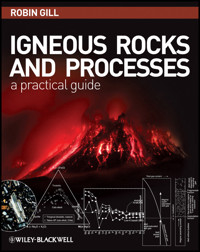
This book is for geoscience students taking introductory or intermediate-level courses in igneous petrology, to help develop key skills (and confidence) in identifying igneous minerals, interpreting and allocating appropriate names to unknown rocks presented to them. The book thus serves, uniquely, both as a conventional course text and as a practical laboratory manual. Following an introduction reviewing igneous nomenclature, each chapter addresses a specific compositional category of magmatic rocks, covering definition, mineralogy, eruption/ emplacement processes, textures and crystallization processes, geotectonic distribution, geochemistry, and aspects of magma genesis. One chapter is devoted to phase equilibrium experiments and magma evolution; another introduces pyroclastic volcanology. Each chapter concludes with exercises, with the answers being provided at the end of the book. Appendices provide a summary of techniques and optical data for microscope mineral identification, an introduction to petrographic calculations, a glossary of petrological terms, and a list of symbols and units. The book is richly illustrated with line drawings, monochrome pictures and colour plates. Additional resources for this book can be found at: http://www.wiley.com/go/gill/igneous.
Sie lesen das E-Book in den Legimi-Apps auf:
Seitenzahl: 1013
Veröffentlichungsjahr: 2011
Ähnliche



















Contents
Preface
Acknowledgements
Chapter 1 An introduction to magmas and magmatic rocks
WHY STUDY MAGMATIC ROCKS?
WHAT IS ‘MAGMA’?
THE DIVERSITY OF NATURAL MAGMA COMPOSITIONS
PARAMETERS USED TO CLASSIFY IGNEOUS ROCKS
DEVISING A BASIC PETROGRAPHIC NOMENCLATURE FOR IGNEOUS ROCKS
CHEMICAL SUBDIVISION OF IGNEOUS ROCKS AND MAGMAS
REVIEW
EXERCISES
Chapter 2 Basalts and related rocks
THE NOMENCLATURE AND MINERALOGY OF BASALTIC ROCKS
ERUPTIVE PROCESSES AND VOLCANIC FORMS
HOW BASALT MAGMAS CRYSTALLIZE EVIDENCE FROM TEXTURES
ALTERATION AND METAMORPHISM OF BASALTS
ANOTHER LOOK AT THE CHEMICAL SUBDIVISION OF BASALTS-NORMS
WHERE BASALTS OCCUR
WHERE AND HOW ARE BASALT MAGMAS FORMED IN THE EARTH?
REVIEW – WHAT INFORMATION CAN WE GLEAN FROM BASALTS?
Chapter 3 Magma differentiation
THE CAUSES OF MAGMA DIVERSITY
PHASE E QUILIBRIUM EXPERIMENTS
MAJOR ELEMENT VARIATION DIAGRAMS FOR NATURAL VOLCANIC ROCK SERIES
MAGMA INTERACTION WITH THE CRUST
REVIEW
EXERCISES
Chapter 4 Gabbroic rocks
THE NOMENCLATURE OF GABBROIC ROCKS
THE SCALE AND EMPLACEMENT OF DOLERITIC AND GABBROIC INTRUSIONS
INTERNAL FORMS, STRUCTURES AND LAYERING
HOW DOLERITES AND GABBROS CRYSTALLIZE – EVIDENCE FROM TEXTURES
WHERE DOLERITES AND GABBROS ARE FOUND
ANORTHOSITES, NORITES AND TROCTOLITES
REVIEW – WHAT CAN ONE LEARN FROM THE STUDY OF GABBROIC ROCKS?
EXERCISES
Chapter 5 Ultramafic and ultrabasic rocks
THE NOMENCLATURE OF ULTRAMAFIC ROCKS
‘STRATIFORM’ ULTRAMAFIC CUMULATES IN LAYERED INTRUSIONS
MANTLE-DERIVED PERIDOTITES
KOMATIITES, PICRITES AND RELATED HIGH-MGO VOLCANIC ROCKS
REVIEW – WHAT CAN ONE LEARN FROM THE STUDY OF ULTRAMAFIC ROCKS?
EXERCISES
Chapter 6 Andesite, dacite and rhyolite
THE NOMENCLATURE OF INTERMEDIATE AND ACID VOLCANIC ROCKS
ERUPTIVE PROCESSES AND VOLCANIC FORMS
HOW ANDESITES, DACITES AND RHYOLITES CRYSTALLIZE – TEXTURAL EVIDENCE
CHEMICAL SUBDIVISION OF ANDESITES, DACITES AND RHYOLITES
WHERE ANDESITES, DACITES AND RHYOLITES OCCUR
HOW ARE INTERMEDIATE AND ACID MAGMAS FORMED IN THE EARTH?
REVIEW – WHAT CAN WE LEARN FROM ANDESITES, DACITES AND RHYOLITES?
EXERCISES
Chapter 7 How magmas erupt – an introduction to pyroclastic processes and products
THE NOMENCLATURE OF VOLCANIC ERUPTIONS AND DEPOSITS
INTERNAL STRUCTURES OF PYROCLASTIC DEPOSITS
MICROSCOPIC TEXTURES
CALDERAS
REVIEW – THE SIGNIFICANCE OF PYROCLASTIC ERUPTIONS
EXERCISES
Chapter 8 Granitic rocks
THE NOMENCLATURE OF INTERMEDIATE AND ACID PLUTONIC ROCKS
FORM AND SCALE OF GRANITIC INTRUSIONS
EMPLACEMENT OF GRANITIC INTRUSIONS: THE ‘SPACE PROBLEM’
INTERNAL STRUCTURES IN GRANITIC INTRUSIONS
HOW GRANITIC MAGMAS CRYSTALLIZE – TEXTURAL EVIDENCE
LATE-STAGE PROCESSES, ALTERATION AND MINERALIZATION ASSOCIATED WITH GRANITOIDS
GEOCHEMISTRY AND THE CHEMICAL SUBDIVISION OF GRANITOIDS
WHERE GRANITIC MAGMAS OCCUR
HOW ARE GRANITOID MAGMAS FORMED?
REVIEW – WHAT CAN WE LEARN FROM GRANITIC COMPLEXES?
EXERCISES
Chapter 9 Alkali rocks
THE NOMENCLATURE OF FINE-GRAINED ALKALI ROCKS
ERUPTIVE PROCESSES AND VOLCANIC FORMS
NOMENCLATURE OF COARSE-GRAINED ALKALI ROCKS
INTRUSIVE FORMS AND PROCESSES IN ALKALI PLUTONS
TEXTURES – MINERAL IDENTIFICATION AND CRYSTALLIZATION PROCESSES
CHEMICAL ATTRIBUTES AND THE SUBDIVISION OF ALKALI ROCKS
WHERE ALKALI ROCKS OCCUR
HOW ARE ALKALI MAGMAS FORMED IN THE EARTH?
REVIEW – THE SIGNIFICANCE OF ALKALI IGNEOUS MAGMATISM
EXERCISES
Appendix A – Mineral identifi cation using a polarizing microscope
INTRODUCTION
OBSERVATIONS IN PLANE-POLARIZED LIGHT
OBSERVATIONS IN CROSSED POLARS
Appendix B – Petrographic calculations
SIMPLIFIED CIPW NORM CALCULATIONS
PLOTTING DATA IN TERNARY AND QUATERNARY DIAGRAMS
MIXING CALCULATIONS
EXERCISES
Appendix C – Symbols, units and constants used in this book
Glossary
Answers to exercises
Bibliography
Colour plate
Companion website for this book: wiley.com/go/gill/igneous
Index
This edition first published 2010, © 2010 by Robin Gill
Blackwell Publishing was acquired by John Wiley & Sons in February 2007. Blackwell's publishing program has been merged with Wiley's global Scientific, Technical and Medical business to form Wiley-Blackwell.
Registered office: John Wiley & Sons Ltd, The Atrium, Southern Gate, Chichester, West Sussex, PO19 8SQ, UK
Editorial offices: 9600 Garsington Road, Oxford, OX4 2DQ, UK
The Atrium, Southern Gate, Chichester, West Sussex, PO19 8SQ, UK
111 River Street, Hoboken, NJ 07030–5774, USA
For details of our global editorial offices, for customer services and for information about how to apply for permission to reuse the copyright material in this book please see our website at www.wiley.com/wiley-blackwell
The right of the author to be identified as the author of this work has been asserted in accordance with the Copyright, Designs and Patents Act 1988.
All rights reserved. No part of this publication may be reproduced, stored in a retrieval system, or transmitted, in any form or by any means, electronic, mechanical, photocopying, recording or otherwise, except as permitted by the UK Copyright, Designs and Patents Act 1988, without the prior permission of the publisher.
Wiley also publishes its books in a variety of electronic formats. Some content that appears in print may not be available in electronic books.
Designations used by companies to distinguish their products are often claimed as trademarks. All brand names and product names used in this book are trade names, service marks, trademarks or registered trademarks of their respective owners. The publisher is not associated with any product or vendor mentioned in this book. This publication is designed to provide accurate and authoritative information in regard to the subject matter covered. It is sold on the understanding that the publisher is not engaged in rendering professional services. If professional advice or other expert assistance is required, the services of a competent professional should be sought.
Library of Congress Cataloguing-in-Publication Data
Gill, Robin, 1944–
Igneous rocks and processes: a practical guide/Robin Gill.
p. cm.
Includes bibliographical references and index.
ISBN 978-1-4443-3065-6 (hardcover: alk. paper) – ISBN 978-0-632-06377-2
(pbk.: alk. paper)
1. Rocks, Igneous. 2. Magmatism. I. Title.
QE461.G495 2010
552'.1-dc22
2009031380
To Mary
Preface
This book has grown from my experiences teaching a second-year igneous petrology course at Royal Holloway, University of London. At this intermediate level, one ‘s primary goal is to help students to develop appropriate descriptive and interpretive techniques. An emphasis on skills dictates a different order of priorities to those that one would embrace in writing a book on petrogenesis. Faced with an intermediate rock of unknown provenance, a student should be encouraged to describe objectively the rock that they see, and to infer what they can from this information, rather than bend their analysis to fit a pre-conceived name, origin or tectonic association. The term ‘andesite’ should emerge from the student’s examination, on the basis of the mineralogy they observe or the chemical data they are presented with, not because they happen to know that the rock comes from Japan (useful hint though that might be). Therefore, as I see it, the book that students need at this stage is one that can help them translate a set of observations (e.g. ‘a rock consisting of abundant plagioclase and hornblende phenocrysts set in a finegrained groundmass, mainly consisting of intermediate plagioclase + augite + opaques’) into an informative, appropriate name (‘plagioclase-hornblende-phyric andesite’ – see Chapter 6). Intermediate students also need guidance in interpreting textures and geochemical data intelligently for themselves, in order to draw informed conclusions about magmatic processes. To support this practical student-led emphasis, most chapters in the book are devoted to major rock families (basalts, gabbroic rocks, granitic rocks, etc.); geotectonic environments are of course discussed, but they do not determine the structure of the book as they might in a text emphasizing magma genesis.
Once the nuts and bolts of igneous nomenclature have been introduced in Chapter 1, the order of chapters reflects a logical journey from the simplest, most abundant, least fractionated products of mantle melting (basalts, Chapter 2) and their plutonic equivalents (Chapters 4 and 5), through to more evolved magma types in Chapters 6 and 8. The final chapter examines the alkali rocks, whose diversity and mineralogical complexity challenge even the most dedicated student! Chapters 3 and 7 digress, at the points in the book where this is most pertinent, to examine experimental petrology (an invaluable laboratory window on magma evolution) and concepts of physical volcanology.
As to igneous nomenclature, I have aimed at what I hope is a judicious blend of traditional petrographic practice and current International Union of Geological Sciences (IUGS) convention (Le Maitre, 2002). The minerals observed in a rock are discussed here under four conceptual headings: essential minerals, type minerals, accessory minerals and post-magmatic minerals. ‘Essential’ and ‘accessory’ are familiar terms from traditional usage but assume slightly different meanings in this book, as the table shows:
1 AGI Glossary of Geology, 2nd edition 1960.
2 Holmes (1928).
The term ‘type mineral’ merely makes explicit a concept that we understand implicitly whenever we speak of ‘olivine basalt’ . It goes without saying that the same mineral may assume essential status in one rock type (nepheline in nephelinite), act as a type mineral in another (nepheline in alkali gabbro) or be present as an accessory in a third, according to abundance and context. The notion of ‘post-magmatic mineral’ is introduced to emphasize that a real igneous rock may in its current state contain minerals that never coexisted with the melt from which it originally formed.
In writing rock definitions, I have stuck to one cardinal principle: the definition of a rock type should be founded on purely descriptive criteria, free of genetic connotations. Accordingly the adjective ‘volcanic’ has been omitted from the definition of basalt and ‘plutonic’ from that of gabbro. Though this diverges from IUGS canon (Le Maitre, 2002, p 60 1) I believe the logic is unassailable: a fine-grained sample from the chilled margin of a gabbroic intrusion, if found unlabelled in a drawer, would objectively be called a basalt, whereas the coarse-grained basic part of a thick komatiite lava would logically be called a gabbro (following, for example, Arndt et al., 1977). In other words, it should not be necessary to know where a rock comes from, or where it formed, in order to assign the appropriate name. To speak of a ‘fine-grained gabbro’ (MacKenzie et al., 1982, p12) is a logical contortion that ought to be queried by any intelligent student. The principles adopted here happen to be similar to the nomenclature adopted by the British Geological Survey (Gillespie and Styles, 1999).2
The ‘practical’ in the book’s title highlights my aim to support students’ own work in the petrology teaching lab or in research projects. Being a pragmatist, I have included outline optical data to allow simple mineral identification without recourse to a separate mineralogy text,3 which (experience suggests) many students are reluctant to buy today; this summary optical information is given in Appendix A and in boxes at appropriate points in the body of the book. Appendix B covers various petrographic calculations, including a simplified CIPW norm scheme as an aid to understanding concepts like silica undersaturation. Appendix C summarizes the symbols and units used throughout the book. Figures and tables appearing in explanatory boxes are identified by numbers having three parts; so ‘Fig. 1.3.1’ identifies the first (or only) figure of Box 1.3 (which is of course the third box in Chapter 1 ). ‘Fig. B3’ refers the reader to Figure 3 in Appendix B . A general glossary is also provided to enhance the book’s usefulness; terms defined in it are highlighted in bold where first mentioned in a chapter or section, or where cross-referenced in the glossary itself.
1 Elsewhere, however (p3), the IUGS defines volcanic rock as ‘an igneous rock with an aphanitic texture, i.e. a relatively fine-grained (<1 mm) rock …’. Rather than adopt this ambiguous usage, the term ‘volcanic’ is reserved in this book for its traditional genetic meaning, describing an igneous rock crystallized from magma that erupted at (or very close to) the surface.
2 See www.bgs.ac.uk/bgsrcs/.
3 The optical principles summarized in Appendix A are intended merely as a reminder, not as an introductory course.
Acknowledgements
The following organizations are thanked for permission to reproduce figures (the numbers in parentheses) or other material specified: American Geophysical Union (Figs. 5.3.1a,b,c; 6.4; 6.24; 9.13), American Journal of Science (Fig. 9.7b), Blackwell Science (Figs. 6.16;8.23; 9.7c), British Geological Survey (Fig. 4.3e), Caribbean Helicopters (Fig. 6.3b), Elsevier (Figs. 2.13; 4.9; 4.14a; 5.4; 5.12; 5.13; 5.6.1; 6.17; 6.26a; 6.4.1; 8.7; 8.16; 8.18; 9.3; 9.14; 9.15; 9.18; Plate 2.10), Geological Society of America (Figs. 4.14b; 5.8a; 5.3.2; 6.7; 6.21b,c; 6.26b), Geological Society of Australia (Fig. 4.6.2), Geological Society of London (Figs. 4.4; 9.6; 9.8; 9.11; 9.16; 9.6.1 and a text extract from Guest et al., 2003), Geological Survey of Denmark and Greenland (GEUS) (Figs. 2.2d; 4.3; 4.6; 4.6.1; 8.3a; 8.8; 8.10a-c; 8.13b), Geologists' Association (Figs. 7.6; 8.5b), Getty Images (Fig. 7.9a), Integrated Ocean Drilling Program (Fig. 2.9a), Leicester Literary and Philosophical Society (Fig. 2.14), Mineralogical Association of Canada (Fig. 9.23), Mineralogical Society of America (Fig. 6.6), Montserrat Volcano Observatory (Fig. 7.4a and the front cover image), The Open University (Figs. 6.13; 6.21), Oxford University Press (Figs. 3.12; 4.4.1; 5.3; 5.8b; 5.11; 5.5.2; 6.18; 8.15; 8.19; 8.4.1; 9.7a; 9.20; 9.22), Penguin Books (text passage from Radice, 1963), Springer Business Media (Figs. 4.13; 5.9; 6.5; 7.17b; 9.4.1), Wiley Interscience (Fig. 2.5) and U.S. National Academy of Sciences (Fig. 5.4.1). The U.S. Geological Survey is warmly acknowledged as the source of many public-domain images used in this book (see captions); if only some other geological surveys were as generous.
The following people are warmly thanked for providing illustrations or giving permission to reproduce figures: J. Bedard (Fig. 4.3d); Smithsonian Institution of Washington DC (Figs. 6.3a & d); J. Blundy (Fig. 7.17b); A. Bussell (Fig. 8.10d); J.P. Davison (Fig. 2.5); C.H. Donaldson (Fig. 5.9); C.H. Emeleus (Fig. 4.3e); R. Greeley (Fig. 6.3e); D. Millward (Fig. 7.4b); I. Modinou (Fig. 2.2a); J.S. Myers (Fig. 4.6.3).
I thank the following colleagues for kindly providing samples or images for the following colour plates: D. Alderton (Plate 8.5)' F. Belton (9.18; 9.19), J.B. Dawson (9.10), C.M.H. Edwards (6.1; 6.2), J.G. Fitton (2.1), C.A. Goodrich (2.10), I.S. McCallum (4.9; 5.1; 5.2), E. McPherson (5.8; 5.9), M.A. Menzies (5.5), R.H. Mitchell (9.1; 9.2), I. Modinou (2.6), G. Stripp (4.11), R.N. Taylor (6.4; 6.5), C. Tiltman (7.2), B.G.J. Upton (9.9), P. Wallace (6.11), J. Walton (9.5), A. Zaitsev (9.4). Figure 2.9(c) was kindly provided by Integrated Ocean Drilling Program. I am most grateful to Eric Tomme and Jonathan Stone for providing Montserrat photographs. Other images are from my own collection or that of the Department of Earth Sciences, Royal Holloway, University of London. I am particularly grateful to Aubrey Lambert of Carl Zeiss (Germany) for giving me permission to reproduce the Michel-Levy chart.
Grazie mille to Giulia Kistruck for kindly translating a passage in Chapter 7 from Italian. Kevin D ' Souza, Neil Holloway, Frank Lehane and Mark Longbottom are thanked for their skilled technical support over many years. I am grateful to Ian Francis and Kelvin Matthews of Wiley-Blackwell for their unstinting support.
Above all, I am very grateful to Dave Alderton, Grant Cawthorn, Godfrey Fitton,1 John Gamble, Ray Macdonald, Colin Macpherson, Nick Petford and Anatoly Zaitsev for critically reviewing sections of the book, and to Richard Arculus and Jon Blundy for their many constructive comments on the complete manuscript. These perceptive contributions have added materially to the book's substance and accuracy. Its shortcomings of course remain my responsibility alone.
1 who also improved algebraic rigour in Box 3.2.
Chapter 1
An introduction to magmas and magmatic rocks
WHY STUDY MAGMATIC ROCKS?
The purpose of this book is to stimulate the reader’s interest in magmatic rocks and processes, to develop key skills of describing, classifying and naming such rocks, and to show how much we can learn about igneous processes from careful, informed interpretation of rock textures, mineralogy and geochemistry. The book is aimed primarily at the intermediate-level student of geology who already has a basic knowledge of igneous rocks, but anyone starting from scratch should find that the opening chapter and relevant boxes – together with the Glossary – provide the minimum introduction they require. The emphasis throughout the book will be on practical investigation, mainly by means of the polarizing microscope; basic mineral-identification data have therefore been included to provide – between one set of covers – all that the student needs during a typical igneous practical class.
The logical place to begin any ‘ig. pet.’ course is to ask what purpose the petrologist, geologist or volcanologist hopes to accomplish in studying igneous rocks. Why do we do it? What kinds of things do we hope to learn? What answers are we trying to find? Such questions should always engage the mind of a petrologist who embarks on a petrographic or geochemical study; petrological science has moved on a long way from the early days when merely describing an igneous rock was an end in itself. In real life, a petrologist may study a suite of igneous rocks with one or more objectives in mind, including:
understanding eruptive processes;assessing from previously erupted products the hazard presented by a volcano to surrounding communities;investigating magma evolution in a sub-volcanic magma chamber;documenting the structure and formation of oceanic or continental crust;inferring past tectonic environments (e.g. mid-ocean ridge, island arc) from the compositions of ancient igneous rocks;understanding the formation of economic mineral deposits associated with igneous rocks.establishing the absolute age of a succession of sedimentary and volcanic rocks (igneous rocks being easier to date isotopically than sedimentary rocks);identifying the source from which a magma has originated, and under what conditions melting occurred (i.e. investigating ‘magma genesis’);identifying from erupted magmatic rocks the character and distribution of geochemical domains in the underlying mantle, and their evolution in time.In every such investigation, there is likely to be a role for carefully describing the igneous rocks involved, but the ultimate goal is usually to learn about magmatic processes, or the conditions under which those processes operate. That goal – of studying igneous rocks to learn about process – will come up again and again in this book, because understanding what goes on in magmatic systems is the modern petrologist’s principal aim in life. Igneous rocks can tell us not only about processes taking place on the Earth’s surface at the present time, but also:
about processes that have taken place earlier in Earth history, andabout processes that operate in parts of the Earth that are not directly accessible to us, for example in a magma chamber that originally lay 5 km below an active volcano (but whose contents – or erupted products – are now exposed at the surface).Today, anyone working with igneous rocks has to apply a range of skills, including the analysis of field relationships, hand-specimen identification in the field, the description and interpretation of thin sections, the allocation of informative rock names, the quantitative interpretation of rock and mineral analyses (often including trace elements and isotope ratios), and the interpretation of experimental equilibria and phase diagrams. This book provides a basic introduction to all but the first of these practical and interpretive skills. The book is not intended to take the place of advanced texts dealing with theories of igneous petrogenesis.
The remainder of this chapter is devoted to introducing the basic vocabulary that will be needed for a clear explanation of igneous rocks.
WHAT IS ‘MAGMA’?
Igneous rocks are those that form from molten products of the Earth’s interior. Petrologists use two words for molten rock. Magma1 is the more general term that embraces mixtures of melt and any crystals that may be suspended in it. A good example would be flowing lava which contains crystals suspended in the melt (Fig. 1.1): the term magma refers to the entire assemblage, embracing both solid and liquid states of matter present in the lava. Melt, on the other hand, refers to the molten state on its own, excluding any solid material which might be suspended in or associated with it. The difference becomes clearer if one considers how one would chemically analyse the distinct chemical compositions of the magma and melt, once the lava flow had solidified (Fig. 1.1). The magma composition could be estimated by crushing up a sample of the solidified lava, including both phenocrysts and groundmass (ensuring they are present in representative proportions). Analysing the melt composition, however, would require the groundmass or glassy matrix – the solidified equivalent of the melt between the phenocrysts – to be physically separated out and analysed on its own.
Fig. 1.1 Terminology used to designate the different constituents of (a) a molten lava and (b) the same lava in the solid state.
In fact, ‘magma’ may be used in a still broader sense. An ascending magma body, as it approaches the surface, commonly contains gas bubbles as well as phenocrysts, bubbles formed by gas that has escaped from the melt due to the fall in pressure that accompanies ascent (see Box 1.4). The term ‘magma’ is generally understood to embrace melt, crystals any gas bubbles present (). Once erupted on the surface, on the other hand, and having lost some of its gas content to the atmosphere, the molten material is more appropriately called ‘lava’. Determining a representative chemical analysis of the original magma composition, including the gaseous component, would however be difficult: as the melt solidified and contracted on cooling, the gaseous contents of the vesicles would escape to the atmosphere (and they would in any case be lost during crushing of the rock prior to analysis). Determining the concentrations of these magma constituents – from the solid rock that the magma eventually becomes – therefore requires a different analytical approach that will be discussed later.
Lesen Sie weiter in der vollständigen Ausgabe!
Lesen Sie weiter in der vollständigen Ausgabe!
Lesen Sie weiter in der vollständigen Ausgabe!
Lesen Sie weiter in der vollständigen Ausgabe!
Lesen Sie weiter in der vollständigen Ausgabe!
Lesen Sie weiter in der vollständigen Ausgabe!
Lesen Sie weiter in der vollständigen Ausgabe!
Lesen Sie weiter in der vollständigen Ausgabe!
Lesen Sie weiter in der vollständigen Ausgabe!
Lesen Sie weiter in der vollständigen Ausgabe!
Lesen Sie weiter in der vollständigen Ausgabe!
Lesen Sie weiter in der vollständigen Ausgabe!
Lesen Sie weiter in der vollständigen Ausgabe!
Lesen Sie weiter in der vollständigen Ausgabe!
Lesen Sie weiter in der vollständigen Ausgabe!
Lesen Sie weiter in der vollständigen Ausgabe!
Lesen Sie weiter in der vollständigen Ausgabe!




