


13,99 €
Mehr erfahren.
- Herausgeber: Parkstone International
- Kategorie: Geisteswissenschaft
- Sprache: Englisch
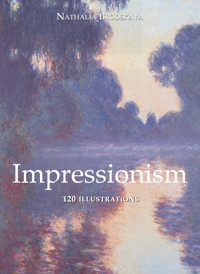
Impressionism has always been one of the public’s favourite styles of art and Impressionist works continue to enchant beholders with their amazing play of colours and forms. This book offers a well-chosen selection of the most impressive works of artists such as Degas, Monet, Pissarro, Renoir and Sisley. Mega Square Impressionism pays tribute to the subject’s popularity.
Das E-Book können Sie in Legimi-Apps oder einer beliebigen App lesen, die das folgende Format unterstützen:
Seitenzahl: 52
Veröffentlichungsjahr: 2022






Nathalia Brodskaya
© 2014, Confidential Concepts, Worldwide, USA
© 2014, Parkstone Press USA, New York
© Image-Barwww.image-bar.com
All rights reserved. No part of this may be reproduced or adapted without the permission of the copyright holder, throughout the world.
Unless otherwise specified, copyright on the works reproduced lies with the respective photographers. Despite intensive research, it has not always been possible to establish copyright ownership. Where this is the case, we would appreciate notification.
ISBN: 978-1-78160-964-4
Contents
The Impressionists and the classical school of Art
The predecessors
The Impressionists’ Exhibition
Important dates
List of Illustrations
Ladies in the Garden
Claude Monet, 1866. Oil on canvas. Musée d’Orsay, Paris
Foreword
“Never before have paintings appeared to me to possess such an overwhelming dignity. One can almost hear the inner voices of the earth and sense the trees burgeoning.”
In the Garden, under the Trees Le Moulin de la Galette
Auguste Renoir. Oil on canvas, 81 x 65 cm. Pushkin Museum of Fine Arts, Moscow
Impression, Sunrise. (Soleil levant, Musée Marmottan, Paris) was the name of one of the paintings that Claude Monet displayed in 1874 at the first exhibition of the “Society of anonymous painters, sculptors, engravers, etc.” It is a landscape painted early in the morning.
The grey mist turns the shapes of the ships’ sails into ghosts; the black silhouettes of the boats slide over water, and the sun is coming up as a flat orange disc, which traces its orange path on the surface of the water. It was not exactly a painting, but rather a quick sketch, a free draft in oil.
The painting’s name, The View of Le Havre, did not really correspond to the painting – one cannot see Le Havre in it at all. “Call it Impression”, Monet told Renoir, who was compiling the catalogue, and this was the beginning of the history of Impressionism.
On 25 April, 1874 the critic Louis Leroy published a satirical piece in the Charivari newspaper, which narrated his visit to the exhibition. The surface of the work by Camille Pissarro depicting a ploughed field appeared to him to be scraped dried paint from the palette thrown onto a dirty canvas.
He was terrified by Claude Monet’s Paris scene entitled Boulevard des Capucines. He stopped in front of the landscape from Le Havre painted by Monet and asked what the painting meant. Impression, Sunrise. “Impression!” the journalist snorted.
“Wallpaper in its embryonic state is more finished!” (Charivari, 25 April, 1874). Leroy named his article, ‘The Exhibition of the Impressionists’. With a truly French linguistic agility, he coined a new word from the title of the painting. Within a year, the name “Impressionism” was an accepted term – the art itself was not.
The term turned out to be so accurate that it was destined to stay forever in the history of art. The group of the future Impressionists had been formed in the early 1860s; and the term “Impressionism” came to mean a trend not only in French art, but in fact, it also was a new stage of the development of European art. It marked the end of the classical period that began in the Renaissance.
The Impressionist movement, thought, did not impose itself as an evidence. It initiated very serious discussions and criticism. It is true that the Impressionists marked an important distance with the classical school of art and this could only cause debate. The difficulty, for the Impressionists, to display their works illustrate the tension that accompanied the birth of this artistic movement.
For instance, Albert Wolff, a critic, wrote after the second Impressionist exhibition: “Try to make Monsieur Pissarro understand that these trees are not violet, that the sky is not the colour of fresh butter (…) and that no sensible human being could countenance such aberrations (…) try to explain to Mr. Renoir that a woman’s torso is not a mass of decomposing flesh with those purplish-green stains”.
The Bellelli Family
Edgar Degas, 1858-67. Oil on canvas, 200 x 250 cm. Musée d’Orsay, Paris
Young Spartan Girls Challenging the Boys
Edgar Degas, ca. 1860. Pencil on paper, 22.9 x 36 cm. Musée d’Orsay, Paris
Self-Portrait
Edgar Degas, ca. 1863. Oil on canvas, 92.1 x 66.5 cm. Calouste Gulbenkian Foundation, Lisbon
Bunch of Peonies
Edouard Manet, 1864. Oil on canvas, 93 x 70 cm. Musée d’Orsay, Paris
The Impressionists and the classical school of Art
As said before, the group of young artists – the future Impressionists –, was formed in the early 1860s. Claude Monet, the son of a store owner from Le Havre, Frédéric Bazille, the son of wealthy parents from Montpellier, Alfred Sisley, a young Englishman born in France, and Auguste Renoir, the son of a Parisian tailor, all came to study painting in the free studio of professor Charles Gleyre in 1862.
For them, Gleyre was the embodiment of the classical school of art. At the time he met the future Impressionists, Charles Gleyre was sixty years old. Born in Switzerland, on the shore of Lake Lean, he had lived in France since his childhood. Having graduated from the School of Fine Arts, Gleyre spent six years in Italy.
His success in the Paris Salon made him famous. Gleyre taught in the studio organized by the famous salon artist Hippolyte Delaroche. The professor painted huge pieces based on themes from the Holy Scriptures and ancient mythology built with classical clarity. The modeling of his feminine nudes could only be compared to works of the great Jean-Auguste-Dominique Ingres.
Auguste Renoir, in his conversations with his son, the great movie director Jean Renoir, said that the best part of his education took place in the studio. He described his professor as “a powerful Swiss, bearded and short-sighted” (Jean Renoir, Pierre-Auguste Renoir, my father, Paris, Gallimard, 1981, p.114).




