


Erhalten Sie Zugang zu diesem und mehr als 300000 Büchern ab EUR 5,99 monatlich.
- Herausgeber: Allen & Unwin
- Kategorie: Gesellschafts- und Liebesromane
- Sprache: Englisch
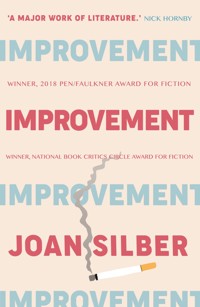
'Improvement is a major work of literature.' - Nick Hornby, The Believer Reyna knows her relationship with Boyd isn't perfect, yet as she visits him throughout his three-month stint in prison, their bond grows tighter. Kiki, now settled in New York after a journey that took her to Turkey and around the world, admires her niece's spirit but worries that she always picks the wrong man. Little does she know that the otherwise honourable Boyd is pulling Reyna into a scheme which violates his probation. When Reyna ultimately decides to remove herself for the sake of her four-year-old child, her small act of resistance sets into motion a tapestry of events that affect the lives of loved ones and strangers around them. A novel that examines conviction, connection and the possibility of generosity in the face of loss, Improvement is as intricately woven together as Kiki's beloved Turkish rugs and as colourful as the tattoos decorating Reyna's body, with narrative twists and turns as surprising and unexpected as the lives all around us. The Boston Globe says of Joan Silber 'No other writer can make a few small decisions ripple across the globe, and across time, with more subtlety and power.' Improvement is Silber's most shining achievement yet.
Sie lesen das E-Book in den Legimi-Apps auf:
Seitenzahl: 277
Veröffentlichungsjahr: 2019
Das E-Book (TTS) können Sie hören im Abo „Legimi Premium” in Legimi-Apps auf:
Ähnliche




















Praise for Improvement
‘[A] love-and-loss story seasoned with single motherhood and smuggling schemes, National Book Award finalist Joan Silber’s Improvement hits the sexy sweet spot from page one.’Elle
‘I love all of Joan Silber’s work for her mastery of character, her ferocious and searching compassion, and her elegant lines that make the mind hum for hours.’Lauren Groff
‘Without fuss or flourishes, Joan Silber weaves a remarkably patterned tapestry connecting strangers from around the world to a central car accident. The writing here is funny and down-to-earth, the characters are recognizably fallible, and the message is quietly profound: We are not ever really alone, however lonely we feel.’Wall Street Journal, top fiction titles of 2017
‘An everyday masterpiece.’Newsday
‘An accomplished, wise, humane book, generously graced with those fleeting but vivid moments – of puzzlement, vexation and love – in which the humanity of her characters shines through.’Colin Barrett
Also by Joan Silber
FICTIONFoolsThe Size of the WorldIdeas of HeavenLucky UsIn My Other LifeIn the CityHousehold Words
NONFICTIONThe Art of Time in Fiction
This is a work of fiction. Names, characters, places and incidents are products of the author’s imagination and are used fictitiously. Any resemblance to actual events, locales, or persons, living or dead, is entirely coincidental.
First published in Great Britain in 2019 by Allen & Unwin
First published in the United States in 2017 by Counterpoint
Copyright © 2017 by Joan Silber
The moral right of Joan Silber to be identified as the author of this work has been asserted by her in accordance with the Copyright, Designs and Patents Act of 1988.
All rights reserved. No part of this book may be reproduced or transmitted in any form or by any means, electronic or mechanical, including photocopying, recording or by any information storage and retrieval system, without prior permission in writing from the publisher.
Every effort has been made to trace or contact all copyright holders. The publishers will be pleased to make good any omissions or rectify any mistakes brought to their attention at the earliest opportunity.
Allen & Unwinc/o Atlantic BooksOrmond House26–27 Boswell StreetLondon WC1N 3JZPhone: 020 7269 1610Fax: 020 7430 0916Email: [email protected]: www.allenandunwin.com/uk
A CIP catalogue record for this book is available from the British Library.
Internal design by Wah-Ming ChangCover design by Marina Drukman
Hardback ISBN 978 1 91163 006 7E-Book ISBN 978 1 76063 726 2
Printed in
10 9 8 7 6 5 4 3 2 1
For Myra,with great thanks
Contents
PART I
Chapter 1
Chapter 2
PART II
Chapter 3
Chapter 4
Chapter 5
Chapter 6
Chapter 7
PART III
Chapter 8
ACKNOWLEDGMENTS
Part I
1
Everyone knows this can happen. People travel and they find places they like so much they think they’ve risen to their best selves just by being there. They feel distant from everyone at home who can’t begin to understand. They take up with beautiful locals, they settle in, they get used to how everything works, they make homes. But maybe not forever.
I had an aunt who was such a person. She went to Istanbul when she was in her twenties. She met a good-looking carpet seller from Cappadocia. She’d been a classics major in college and had many questions to ask him, many observations to offer. He was a gentle and intelligent man who spent his days talking to travelers. He’d come to think he no longer knew what to say to Turkish girls, and he loved my aunt’s airy conversation. When her girlfriends went back to Greece, she stayed behind and moved in with him. This was in 1970.
His shop was in Sultanahmet, where tourists went, and he lived in Fener, an old and jumbled neighborhood. Kiki, my aunt, liked having people over, and their apartment was always filled with men from her boyfriend’s region and expats of various ages. She was happy to cook big semi-Turkish meals and make up the couch for anyone passing through. She helped out in the store, explained carpet motifs to anyone who walked in—those were stars for happiness, scorpion designs to keep real scorpions away. In her letters home, she sounded enormously pleased with herself—she dropped Turkish phrases into her sentences, reported days spent sipping çay and kahve. All this became lore in my family.
She wrote to her father, who suffered from considerable awkwardness in dealing with his children (her mother had died some six years before), and to her kid brother, who was busy hating high school. The family was Jewish, from a forward-thinking leftist strain; Kiki had gone to camps where they sang songs about children of all nations, so no one had any bigoted objections to her Turkish boyfriend. Kiki sent home to Brooklyn a carpet she said was from the Taurus Mountains. Her father said, “Very handsome colors. I see you are a connoisseur. No one is walking on it, I promise.”
Then Kiki’s boyfriend’s business took a turn for the worse. There was a flood in the basement of his store and a bill someone never paid and a new shop nearby that was getting all the business. Or something. The store had to close. Her family thought this meant that Kiki was coming home at last. But, no. Osman, her guy, had decided to move back to the village he was from, to help his father, who raised pumpkins for their seed-oil. Also tomatoes, green squash, and eggplant. Kiki was up for the move; she wanted to see the real Turkey. Istanbul was really so Western now. Cappadocia was very ancient and she couldn’t wait to see the volcanic rock. She was getting married! Her family in Brooklyn was surprised about that part. Were they invited to the wedding? Apparently not. In fact, it had already happened by the time they got the letter. “I get to wear a beaded hat and a glitzy headscarf, the whole shebang,” Kiki wrote. “I still can’t believe it.”
Neither could any of her relatives. But they sent presents, once they had an address. A microwave oven, a Mister Coffee, an electric blanket for the cold mountains. They were a practical and liberal family, they wanted to be helpful. They didn’t hear from Kiki for a while and her father worried that the gifts had been stolen in the mail. “I know it’s hard for you to imagine,” Kiki wrote, “but we do very well without electricity here. Every morning I make a wood fire in the stove. Very good-smelling smoke. I make a little fire at the bottom of the water heater too.”
Kiki built fires? No one could imagine her as the pioneer wife. Her brother, Alan (who later became my father), asked what kind of music she listened to there and if she had a radio. She sent him cassette tapes of favorite Turkish singers—first a crappy male crooner and then a coolly plaintive woman singer who was really very good. Alan was always hoping to visit, but first he was in college and working as a house painter in the summers and then he had a real job in advertising that he couldn’t leave. Kiki said not a word about making any visits home. Her father offered to pay for two tickets to New York so they could all meet her husband, but Kiki wrote, “Oh, Dad. Spend your money on better things.” No one nagged her; she’d been a touchy teenager, given to sullen outbursts, and everyone was afraid of that Kiki appearing again.
She stayed for eight years. Her letters said, “My husband thinks I sew as well as his sisters,” and “I’m rereading my copy of Ovid in Latin. It’s not bad!” and “Winter is sooo long this year, I hate it. Osman has already taught me all he knows about the stars.” No one could make sense of who she was now or put the parts together. There were no children and no pregnancies that anyone heard about, and the family avoided asking.
Her brother was finally about to get himself over for a visit, when Kiki wrote to say, “Guess what? I’m coming back at last. For good. Cannot wait to see you all.”
“Cannot wait, my ass,” her brother said. “She waited fine. What’s so irresistible now?”
No, the husband was not coming with her. “My life here has reached its natural conclusion,” Kiki wrote. “Osman will be my dear friend forever but we’ve come to the end of our road.”
“So who ran around on who?” the relatives kept asking. “She’ll never say, will she?”
•
Everybody wondered what she would look like when she arrived. Would she be sun-dried and weather-beaten, would she wear billowing silk trousers like a belly dancer, would the newer buildings of New York amaze her, would she gape at the Twin Towers? None of the above. She looked like the same old Kiki, thirty-one with very good skin, and she was wearing jeans and a turtleneck, possibly the same ones she’d left home with. She said, “God! Look at YOU!” when she saw her brother, grown from a scrawny teenager to a man in a sport jacket. She said, “Been a while, hasn’t it?” to her dad.
Her luggage was a mess, very third-world, woven plastic valises baled up with string, and there were a lot of them. She had brought back nine carpets! What was she thinking? She wanted to sell them. To someone or other.
Her brother always remembered that when they ate their first meal together, Kiki held her knife and fork like a European. She laughed at things lightly, as if the absurdity of it all wasn’t worth shrieking over. She teased Alan about his eyeglasses (“you look like a genius in them”) and his large appetite (“has not changed since you were eight”). She certainly sounded like herself. Wasn’t she tired from her flight? “No big deal,” she said.
She’d had a crappy job in a bookstore before going off on her travels, so what was she going to do now? Did she have any friends left from before? It seemed that she did. Before very long, she moved in with someone named Marcy she’d known at Brooklyn College. Marcy’s mother bought the biggest of the rugs, and Kiki used the proceeds to start renting a storefront in the East Village, where she displayed her carpets and other items she had brought back—a brass tea set and turquoise beads and cotton pants with gathered hems that she herself had once worn.
The store stayed afloat for a while. Her brother sort of wondered if she was dealing drugs—hashish was all over Istanbul in the movie Midnight Express, which came out just before her return. Kiki refused to see such a film, with its lurid scenes of mean Turkish prisons. “Who has nice prisons?” she said. “Name me one single country in the world. Just one.”
When her store began to fail and she had to give it up, Kiki supported herself by cleaning houses. She evidently did this with a good spirit; the family was much more embarrassed about it than she was. “People here don’t know how to clean their houses,” she would say. “It’s sort of remarkable, isn’t it?”
By the time I was a little kid, Kiki had become the assistant director of a small agency that booked housekeepers and nannies. She was the one you got on the phone, the one who didn’t take any nonsense from either clients or workers. She was friendly but strict and kept people on point.
I was only a teeny bit afraid of her as a child. She could be very withering if I was acting up and getting crazy and knocking over chairs. But when my parents took me to visit, Kiki had special cookies for me (I loved Mallomars), and for a while she had a boyfriend named Hernando who would play airplane with me and go buzzing around the room. I loved visiting her.
My father told me later that Hernando had wanted to marry Kiki. “But she wasn’t made for marriage,” he said. “It’s not all roses, you know.” He and my mother had a history of having, as they say, their differences.
“Kiki was always like a bird,” my father said. “Flying here and there.”
What a corny thing to say.
I grew up on the outskirts of Boston, in a neighborhood whose leafy familiarity I spurned once I was old enough for hip disdain. I moved to New York as soon as I finished high school, which I barely did. My parents and I were not on good terms in my early years in the city. They hated the guy I first took off with, and my defense of him often turned into insulting them. And I really had no use for more school, and they could never take this in. But Kiki made a point of keeping in touch. She’d call on the phone and say, “I’m thirsty, let’s go have a drink. Okay?” At first I was up in Inwood, as far north in Manhattan as you can get, so it was a long subway ride to see her in the East Village, but once I moved to Harlem it wasn’t quite so bad. When my son was born, four years ago, Kiki brought me the most useful layette of baby stuff, things a person couldn’t even know she needed. Oliver would calm down and sleep when she walked him around. He grew up calling her Aunt Great Kiki.
The two of us lived in a housing project, one of the nicer ones, in an apartment illegally passed on to me by a boyfriend. It was a decent size, with good light, and I liked my neighbors. They were a great mix, and nobody wanted to rat on me about the lease. They’d stopped thinking I was another white gentrifier, sneaking in.
In late October of the year that the TV kept telling us to get prepared for Hurricane Sandy, Oliver had a great time flicking the flashlight on and off (a really annoying game) and watching me tape giant x’s on the window glass. All the kids on our hallway were hyped up and excited, running around and yelling. We kept looking out the windows as the sky turned a sepia tint. When the rains broke and began to come down hard, we could hear the moaning of the winds and everything clattering and banging in the night, awnings and trees getting the hell beaten out of them. I kept switching to different channels on TV so we wouldn’t miss any of it. The television had better coverage than my view out the window. Through the screen a newscaster in a suit told us the Con Ed substation on Fourteenth Street had exploded! The lights in the bottom of Manhattan had gone out! I made efforts to explain to Oliver about electricity, as if I knew. Never, never put your finger in a socket. Oliver wanted to watch a better program.
At nine thirty the phone rang and it was my father, who had more patience with me these days but didn’t call that often. He was calling to say, “Your aunt Kiki doesn’t have power, you know. She’s probably sitting in the dark.” I had forgotten about her entirely. She was on East Fifth Street, in the no-electricity zone. I promised I’d check on Kiki in the morning.
“I might have to walk there,” I said. “It’s like a hundred twenty blocks. You’re not going to ask about my neighborhood? It’s fine.”
“How’s Oliver?”
“Great.”
“Don’t forget about Kiki, okay? Tell me that.”
“I just told you,” I said.
The weather outside was shockingly pleasant the next day, mild with a white sky. We walked for half an hour, which Oliver really did not like, past some downed trees and tossed branches, and then a cab miraculously stopped and we shared it with an old guy all the way downtown. No traffic lights, no stores open—how strange the streets were. In Kiki’s building, I led Oliver up four flights of dark tenement stairs while he drove me nuts flicking the flashlight on and off.
When Kiki opened the door onto her pitch-black hallway, she said, “Reyna! What are you doing here?”
Kiki, of course, was fine. She had plenty of vegetables and canned food and rice—who needed a fridge?—and she could light the stove with a match. She had daylight now and candles for later. She had pots of water she could boil to wash with. The tub had been filled the night before. How was I? “Oliver, isn’t this fun?” she said.
Oh, New Yorkers were making such a big fuss, she thought. She had a transistor radio so the fussing came through. “I myself am enjoying the day off from work,” she said. She was rereading The Greek Way by Edith Hamilton—had I ever read it? I didn’t read much, did I?—and she planned to finish it tonight by candlelight.
“Come stay with us,” I said. “Wouldn’t you like that, Oliver?”
Oliver crowed on cue.
Kiki said she always preferred being in her own home. “Oliver, I bet you would like some of the chocolate ice cream that’s turning into a lovely milkshake.”
We followed her into the kitchen, with its painted cabinets and old linoleum. When I took off my jacket to settle in, Kiki said, “Oh, no. Did you get a new tattoo?”
“No. You always say that. You’re phobic about my arms.”
“I’ll never get used to them.”
I had a dove and a sparrow and a tiger lily and a branch with leaves. They all stood for things. The dove was to settle a fight with Oliver’s father, who was much less nice than Boyd, my current boyfriend; the sparrow was the true New York bird; the tiger lily meant boldness, which I was big on when I was younger; and the branch was an olive tree in honor of Oliver. I used to try to tell Kiki they were no different from the patterns on rugs. “Are you a floor?” she said. She accused my tattoos of being forms of mutilation and also forms of deception against my natural skin. According to what? “Well, Islamic teaching, for one thing,” she said.
Kiki had never been a practicing Muslim but she liked a lot of it. I may have been the only one in the family who knew how into it she’d once been. She used to try to get me to read this unreadable guy Averroes and also another one, Avicenna. Only my aunt would think someone like me could just dip into twelfth-century philosophy if I felt like it. She saw no reason why not.
“Oliver, my boy,” she was saying now, “you don’t have to finish if you’re full.”
“Dad’s worried about you,” I told Kiki.
“I already called him,” she said. It turned out her phone still worked because she had an old landline, nothing digital or bundled.
She’d been outside earlier in the day. Some people on her block had water but she didn’t. Oliver was entranced when Kiki showed him how she flushed the toilet by throwing down a potful of water.
“It’s magic,” I said.
When we left, Kiki called after us, “I’m always glad to see you, you know that.” She could have given us more credit for getting all the way there, I thought.
“You might change your mind about staying with us,” I called back, before we went out into the dark hallway.
I had an extra reason for wanting her to stay. Not to be one of those mothers who was always desperate for babysitting, but I needed a babysitter.
My boyfriend was spending three months at Rikers Island. For all of October I’d gone to see him once a week. He was there for selling five ounces of weed (who thinks that should even be a crime?) and it made a big difference to him to have someone visit. I planned to go there again this week, once the subways were back on and buses were going over the bridge again. But it was hard bringing Oliver, who wasn’t his kid and who needed a lot of attention during those toyless visits.
I loved Boyd but I wouldn’t have said I loved him more than the others I’d been with. Fortunately no one asked. Not even Boyd. There was no need for people to keep mouthing off about how much they felt, in his view. Some degree of real interest, some persistence in showing up, was enough. Every week I watched him waiting in that visitors’ room, another young African American in a stupid jumpsuit. The sight of him—heavy-faced, wary, waiting to smile slightly—always got to me, and when I hugged him (light hugs were permitted), I’d think, It’s still Boyd, it’s Boyd here.
Oliver could be a nuisance. Sometimes he was very, very whiney from standing in too many different lines, or he was incensed that he couldn’t bring in his giant plastic dinosaur. Or he got overstimulated and had to nestle up to Boyd and complain at length about some kid who threw sand in the park. “You having adventures, right?” Boyd said. Meanwhile, I was trying to ask Boyd if he’d had an okay week and why not. I had an hour to give him the joys of my conversation. Dealing with those two at once was not the easiest.
•
I got a phone call from Aunt Kiki on the second day after the hurricane. “How would you feel about my coming over after work to take a hot shower?” she said. “I can bring a towel, I’ve got piles of towels.”
“Our shower is dying to see you,” I said. “And Oliver will lend you his ducky.”
“Kiki Kiki Kiki Kiki Kiki!” Oliver yelled, when she came through the door. Maybe I’d worked him up too much in advance. We’d gotten the place very clean.
When my aunt came out of the bathroom, dressed again in her slacks and sweater and with a steamed-pink face under the turban of her towel, I handed her a glass of red wine. “A person without heat or water needs alcohol,” I said. And we sat down to meat loaf, which I was good at, and mashed potatoes, which Oliver had learned to eat with garlic.
“This is a feast,” she said. “Did you know the sultans had feasts that went on for two weeks?”
Oliver was impressed. “This one could go on longer,” I said. “You should stay over. Or come back tomorrow. I mean it.”
Tomorrow was what I needed—it was the visiting night for inmates with last names from M to Z.
“Maybe the power will be back by then,” Kiki said. “Maybe maybe.”
At Rikers, Boyd and the others had spent the hurricane under lockdown, no wandering off into the torrent. Rikers had its own generator, and the buildings were in the center of the island, too high to wash away. It was never meant to be a place you might swim from.
“You know I have this boyfriend, Boyd,” I said.
Kiki was looking at her plate while I gave her the situation, about the weekly visits, as much as I could tell in front of Oliver. “Oh, shit,” she said. She had to finish chewing to say, “Okay, sure, okay, I’ll come right from work.”
When I leaned over to embrace her, she seemed embarrassed. “Oh, please,” she said. “No big deal.”
What an interesting person Kiki was. What could I ever say to her that would throw her for a loop? Best not to push it, of course. No need to warn her not to tell my parents either. Not Kiki. And maybe she had a boyfriend of her own that I didn’t even know about. She wasn’t someone who told you everything. She wasn’t showering with him, wherever he was. Maybe he was married. A man that age. Oh, where was I going with this?
When Kiki turned up the next night, she was forty-five minutes later than she’d said, and I had given up on her several times over. She bustled through the door saying, “Don’t ask me how the subways are running. Go, go. Get out of here, go.”
She looked younger, all flushed like that. What a babe she must’ve once been. Or at least a hippie sweetheart. Oliver clambered all over her. “Will you hurry up and get out of here?” she said to me.
•
The subway (which had only started running that day) was indeed slow to arrive and very crowded, but the bus near Queens Plaza that went to Rikers was the same as ever. After the first few stops, all the white people emptied out except for me. I read People magazine while we inched our way toward the bridge to the island; love was making a mess of the lives of any number of celebrities. And look at that teenage girl across the aisle in the bus, combing her hair, checking it in a mirror, pulling the strands across her face to make it hang right. Girl, I wanted to say, he fucked up bad enough to get himself where he is, and you’re still worried he won’t like your hair?
Of course, I was all moussed and lipsticked myself. I had standards. But you couldn’t wear anything too revealing—no rips or see-through—they had rules. Visitors must wear undergarments.
Poor Boyd. After I stood in a line and put my coat and purse in a locker and showed my ID to the guards and got searched and stood in a line for one of Rikers’s own buses and got searched again, I sat in the room to wait for him. It was odd being there without Oliver. The wait went on too long. It wasn’t like you could bring a book to occupy you. And then I heard Boyd’s familiar name, read from the list.
Those jumpsuits didn’t flatter anyone. But when we hugged, he smelled of soap and Boyd, and I was sorry for myself to have him away so long. “Hey, there,” he said.
“Didn’t mean to get here so late,” I said.
Boyd wanted to hear about the hurricane and who got hit the worst. Aunt Kiki became my material. “Oh, she had her candles and her pots of water and her cans of soup and her bags of rice, she couldn’t see why everybody was so upset.”
“Can’t keep ’em down, old people like that,” he said. “Good for her. That’s the best thing I’ve heard all week.”
I went on about the gameness of Kiki. The way she’d taught me the right way to climb trees when I was young, when my mother was only worried I’d fall on my head.
“I didn’t know you were a climber. Have to tell Claude.”
His friend Claude, much more of an athlete than Boyd was, had recently discovered the climbing wall at some gym. Boyd himself was a couch potato, but a lean and lanky one. Was he getting puffy now? A little.
“Claude’s a monster on that wall. Got Lynnette doing it too.” Lynnette was Claude’s sister. And Boyd’s last girlfriend before me. “Girls can do that stuff fine, he says.”
“When did he say that?”
“They came by last week. The whole gang.”
What gang? Only three visitors allowed. “Lynnette was here?”
“And Maxwell. They came to show support. I appreciated it, you know?”
I’ll bet you did, I thought. I was trying not to leap to any conclusions. It wasn’t as if she could’ve crept into the corner with him for a quickie, though you heard rumors of such things. Urban myths.
“Does Claude still have that stringy haircut?”
“He does. Looks like a root vegetable. Man should go to my barber.” The Rikers barber had given Boyd an onion look, if you were citing vegetables.
“They’re coming again Saturday. You’re not coming Saturday, right?”
I never came on Saturdays. I cut him a look.
“Because if you are,” he said, “I’ll tell them not to come.”
You couldn’t blame a man who had nothing for wanting everything he could get his hands on. This was pretty much what I thought on the bus ride back to the subway. Oh, I could blame him. I was spending an hour and a half to get there every week and an hour and a half to get home, so he could entertain his ex? I was torn between being pissed off and my preference for not making trouble. But why had Boyd told me? The guy could keep his mouth shut when he needed to.
He didn’t think he needed to. Because I was a good sport. What surprised me even more was how painful this was starting to be. I could imagine Boyd greeting Lynnette, in his offhand, Mr. Cool way. “Can’t believe you dropped in.” Lynnette silky and tough, telling him it had been too long. But what was so great about Boyd that I should twist in torment from what I was seeing too clearly in my head?
I was sitting on the bus during this anguish. I wanted Boyd to comfort me. He had a talent for that. If you were insulted because some asshole at daycare said your kid’s shoes were unsuitable, if you splurged on a nice TV and then realized you’d overpaid, if you got fired from your job because you used up sick days and it wasn’t your fault, Boyd could make it seem hilarious. He could imitate people he’d never met. He could remind you it was part of the ever-expanding joke of human trouble. Not just you.
When I got back to the apartment, Oliver was actually asleep in his bed—had Kiki drugged him?—and Kiki was in the living room watching the Cooking Channel on TV. “You watch this crap?” I said.
“How was the visit?”
“Medium. Who’s winning on Chopped?”
“The wrong guy. But I have a thing for Marcus Samuelsson.” He was the judge who had a restaurant right here in Harlem, a chef born in Ethiopia, tall and good-looking. Good for Kiki.
“Oliver spilled a lot of yogurt on the floor but we got it cleaned up,” she said.
I wanted a drink, I wanted a joint. What was in the house? I found a very used bottle of Beaujolais in the kitchen and poured glasses for us both.
“When does he get out?” Kiki asked.
“They say January. He’s holding up okay.”
“He has you.”
So he did. I’d gotten more attached to Boyd, from all my visiting in that place, from our weekly private talking in that big public room. We made our own little kingdom of conversation, however awkward it was, the two of us saying whatever came to us, with the chairs and the tables around us the sites of other families’ dramas. We had our snacks from the machine and our stories; the two of us and Oliver. Sometimes Oliver got us silly; it was all very precious. And every week I admired the way Boyd hosted us, the way he settled into the plastic chair as if we were just hanging out, waiting, on our way to some place better. Which we were.
“You don’t have to tell me if you don’t want to, but when you got divorced,” I said to Kiki, “was it because one of you had been messing around with someone else?”
“Hey,” Kiki said, “where did that come from?”
“Someone named Lynnette has been visiting Boyd.”
Kiki considered this. “Could be nothing.”
“So when you left Turkey, why did you leave?”
“It was time.”
I admired Kiki’s way of deciding what was none of your business, but it made you think there was business there.
And it was my bad luck that Con Ed got its act together the very next evening, so electricity flowed in the walls of Kiki’s home to give her light and refrigeration and to pump her water and the gurgling steam in her radiators. I called her to say Happy Normal.
“Normal is overrated,” she said. “I’ll be so busy next week.”
“Me, too,” I said.
Oliver hardly ever had sitters. He was in daycare while I went off to my unglamorous employment as a part-time receptionist at a veterinarian’s office (it paid lousy but the dogs were usually nice), and at night I took him with me if I went to friends’ or to Boyd’s, when I used to stay with Boyd. Sometimes Boyd had a cousin who took him.
“Oliver wants to say hi,” I told my aunt.
“I love you, Great Kiki!” Oliver said.
This didn’t move her to volunteer to sit for him again, and I thought it was better not to ask again so soon.
Oliver wasn’t bad at all on the next visit to Rikers. And one of the guards at the first gate was nicely jokey with him. Because he was a kid? Because he was a white kid with a white mother? I didn’t know but I was glad.
The weather was colder outside and he got to wear his favorite Spiderman sweater, which Boyd said was very sharp.
“Your mom’s looking good too,” Boyd said.
“Better than Lynnette?”
I hadn’t meant to say any such whiny-bitch thing, it leaped out of me. I was horrified. I wasn’t as good as I thought I was, was I?
“Not in your league,” Boyd said. “Girl’s nowhere near.” He said this slowly and soberly. He shook his onion head for emphasis.
And the rest of the visit went very well. Boyd suggested that Oliver now had superpowers to spin webs from the ceiling—“You going to float above us all, land right on all the bad guys”—and Oliver was so tickled he had to be stopped from shrieking with glee at top volume.
“Know what I miss?” Boyd said. “Well, that, of course. Don’t look at me that way. But also I miss when we used to go ice-skating.”
We had gone exactly twice, renting skates in Central Park, falling on our asses. I almost crushed Oliver one time I went down. “You telling everyone you’re the next big hockey star?” I said.
“I hope there’s still ice when I get out,” he said.
“There will be,” I said. “It’s soon. Before you know it.”




